anaheim-gazette 1914-06-25
Scanned page
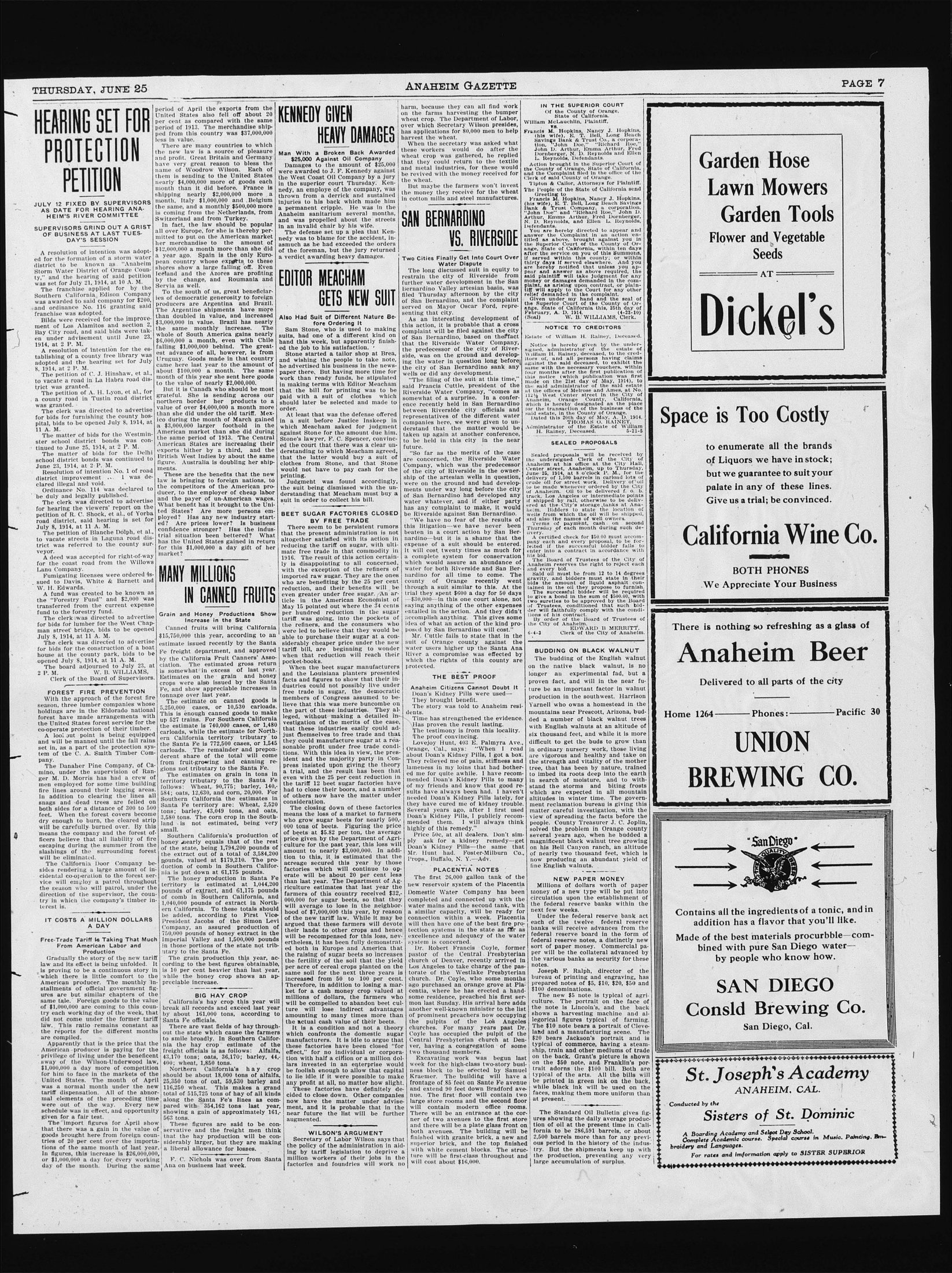
Searchable text
HEARING SET FOR PROTECTION PETITION
JULY 12 FIXED BY SUPERVISORS AS DATE FOR HEARING ANA-HEIM'S RIVER COMMITTEE
SUPERVISORS GRIND OUT A GRIST OF BUSINESS AT LAST TUESDAY'S SESSION
A resolution of intention was adopted for the formation of a storm water district to be known as "Anaheim Storm Water District of Orange County," and the hearing of said petition was set for July 21, 1914, at 10 A.M.
The franchise applied for by the Southern California Edison Company was awarded to said company for $200, and ordinance No. 116 granting said franchise was adopted.
Bilds were received for the improvement of Los Alamitos and section 2, Bay City road, and said bids were taken under advisement until June 23, 1914, at 2 P.M.
A resolution of intention for the establishment of a county free library was adopted and the hearing set for July 8, 1914, at 2 P.M.
The petition of C. J. Hinshaw, et al., to vacate a road in La Habra road district was granted.
The petition of A. H. Lyon, et al., for a county road in Tustin road district was granted.
The clerk was directed to advertise for bids for furnishing the county hospital, bids to be opened July 8, 1914, at 11 A.M.
The matter of bids for the Westminster school district bonds was continued to June 25, 1914, at 2 P.M.
The matter of bids for the Delhi school district bonds was continued to June 23, 1914, at 2 P.M.
Resolution of intention No. 1 of road period of April the exports from the United States also fell off about 20 per cent as compared with the same period of 1913. The merchandise shipped from this country was $37,000,000 less in value.
There are many countries to which the new law is a source of pleasure and profit. Great Britain and Germany have very great reason to bless the name of Woodrow Wilson. Each of them is sending to the United States nearly $4,000,000 more of goods each month than it did before. France is shipping nearly $2,000,000 more a month, Italy $1,000,000 and Belgium the same, and a monthly $500,000 more is coming from the Netherlands, from Switzerland and from Turkey.
In fact, the law should be popular all over Europe, for she is thereby permitted to put on the American market her merchandise to the amount of $12,000,000 a month more than she did a year ago. Spain is the only European country whose exports to these shores show a large falling off. Even Iceland and the Azores are profiting by the change, and Roumania and Servia as well.
To the south of us, great beneficiaries of democratic generosity to foreign producers are Argentina and Brazil. The Argentine shipments have more than doubled in value, and increased $3,000,000 in value. Brazil has nearly the same monthly increase. The whole of South America gains nearly $6,000,000 a month, even with Chile falling $1,000,000 behind. The greatest advance of all, however, is from Uruguay. Goods made in that country came last year to the amount of about $100,000 a month. The same month of this year she sent here goods to the value of nearly $2,000,000.
But it is Canada who should be most grateful. She is sending across our northern border her products to a value of over $4,000,000 a month more than she did under the old tariff. Mexico during the month of March gained a $3,000,000 larger foothold in the American market than she did during the same period of 1913. The Central American States are increasing their exports hither by a third, and the British West Indies by about the same figure. Australia is doubling her shipments.
These are the benefits that the new
The petition of C. J. Hinshaw, et al., to vacate a road in La Habra road district was granted.
The petition of A. H. Lyon, et al., for a county road in Tustin road district was granted.
The clerk was directed to advertise for bids for furnishing the county hospital, bids to be opened July 8, 1914, at 11 A. M.
The matter of bids for the Westminster school district bonds was continued to June 25, 1914, at 2 P. M.
The matter of bids for the Delhi school district bonds was continued to June 23, 1914, at 2 P. M.
Resolution of intention No. 1 of road district improvement... 1 was declared illegal and void.
Ordinance No. 114 was declared to be duly and legally published.
The clerk was directed to advertise for hearing the viewers' report on the petition of R. C. Shock, et al., of Yorba road district, said hearing is set for July 8, 1914, at 11 A. M.
The petition of Blanche Dolph, et al., to vacate streets in Laguna road district was referred to the county surveyor.
A deed was accepted for right-of-way for the coast road from the Willows Lana Company.
Fumigating licenses were ordered issued to Davis, White & Barnett and W. H. Edwards.
A fund was created to be known as the "Forestry Fund" and $2,000 was transferred from the current expense fund to the forestry fund.
The clerk was directed to advertise for bids for lumber for the West Chapman street bridge, bids to be opened July 8, 1914, at 11 A. M.
The clerk was directed to advertise for bids for the construction of a boat house at the county park, bids to be opened July 8, 1914, at 11 A. M.
The board adjourned to July 23, at 2 P. M.
W. B. WILLIAMS,
Clerk of the Board of Supervisors.
FOREST FIRE PREVENTION
With the approach of the forest fire season, three lumber companies whose holdings are in the Eldorado national forest have made arrangements with the United States forest service for the co-operate protection of their timber.
A loot-out point is being equipped and will be manned until the fall rains set in, as a part of the protection system of the C. A. Smith Timber Company.
The Danaher Pine Company, of Camino, under the supervision of Ranger M. D. Morris has had a crew of men employed for some time building fire lines around their logging areas.
In addition to clearing the lines all snags and dead trees are felled on both sides for a distance of 300 to 500 feet.
When the forest covers become dry enough to burn, the cleared strip will be carefully burned over. By this means the company and the forest officers believe that all liability of fire escaping during the summer from the slashings of the surrounding forest will be eliminated.
The California Door Company besides rendering a large amount of incidental co-operation to the forest service will employ a patrol throughout the season who will patrol, under the direction of the supervisor, the countryside in which the company's timber is located.
But it is Canada who should be most grateful. She is sending across our northern border her products to a value of over $4,000,000 a month more than she did under the old tariff. Mexico during the month of March gained a $3,000,000 larger foothold in the American market than she did during the same period of 1913. The Central American States are increasing their exports hither by a third, and the British West Indies by about the same figure. Australia is doubling her shipments.
These are the benefits that the new law is bringing to foreign nations, to the competitors of the American producer, to the employer of cheap labor and the payer of un-American wages. What benefit has it brought to the United States? Are any new industry started? Are prices lower? Is business confidence stronger? Has the industrial situation been bettered? What has the United States gained in return for this $1,000,000 a day gift of her market?
MANY MILLIONS IN CANNED FRUITS
Grain and Honey Productions Show Increase in the State
Canned fruits will bring California $15,750,000 this year, according to an estimate issued recently by the Santa Fe freight department, and approved by the California Fruit Canners' Association. The estimated gross return is somewhat in excess of last year. Estimates on the grain and honey crops were also issued by the Santa Fe, and show appreciable increases in tonnage over last year.
The estimate on canned goods is 5,250,000 cases, or 10,530 carloads. This is enough canned goods to make up 527 trains. For Southern California the estimate is 740,000 cases, or 1,480 carloads, while the estimate for Northern California territory tributary to the Santa Fe is 772,500 cases, or 1,545 carloads. The remainder and preponderant share of the total will come from fruit-growing and canning regions not tributary to the Santa Fe.
The estimates on grain in tons in territory tributary to the Santa Fe follows: Wheat, 90,775; barley, 140,584; oats, 12,630; and corn, 20,000. For Southern California the estimates in Santa Fe territory are: Wheat, 2,520 tons; barley, 43,049 tons; and oats, 3,580 tons. The corn crop in the Southland is not estimated, being very small.
Southern California's production of honey nearly equals that of the rest of the state, being 1,794,200 pounds of the extract out of a total of 3,584,200 pounds, valued at $179,210. The production of comb in Southern California is put down at 61,175 pounds.
The honey production in Santa Fe territory is estimated at 1,044,200 pounds of extract, and 61,175 pounds of comb in Southern California, and work than ready funds in making terms with Edwards that the bill for printing paid with a suit of cloth should later be selected by order.
At least that was due in a suit before Justice which Meacham asked against Stone for the amalgamation court that there was derstanding to which Meacham that the latter would be clothes from Stone, and would not have to pay printing.
Judgment was found that the suit being dismissed derstanding that Meacham suit in order to collect his BEET SUGAR FACTORY BY FREE TRAIN
There seem to be perceptions that the present administration altogether satisfied with reducing the tariff on sugar free trade in that year. The result of this is disappointing to a with the exception of imported raw sugar. The who are benefiting by their reduction, and their benefit even greater under free tribute in the American May 15 pointed out when per hundred reduction tariff was going into that refiners, and the co-ereal led to believe that able to purchase their siderably cheaper price tariff bill, are beginning when that reduction wipe-pocket-books.
When the beet sugar and the Louisiana plant facts and figures to show dustries could not possibly free trade in sugar,the members of Congress argue that this was mere part of these industries legged without making vestigation of the merits that these industries earn just themselves to free they could manufacture sonable profit under free tributes.With this idea in mind and the majority press insisted upon giving a trial,and the result even with the 25 per cent tariff 12 beet sugar had to close their booze of others now have their consideration.
The closing down of means the loss of a man who grow sugar beets in 2000 tons of beets.Figure of beets at $5.82 per ton price given by the Depar culture for the past year amount to nearly $3,000 tion to this.it is estiacre secured this factories which will cernate will be about 20 than last year.The Depar culture estimates tha farmers of this country
IT COSTS A MILLION DOLLARS A DAY
Free-Trade Tariff Is Taking That Much From American Labor and Production
Gradually the story of the new tariff law and its effect is being unfolded. It is proving to be a continuous story in which there is little comfort to the American producer. The monthly installments of official government figures are but similar chapters of the same tale. Foreign goods to the value of $1,000,000 are coming to this country each working day of the week, that did not come under the former tariff law. This ratio remains constant as the reports for the different months are compiled.
Apparently that is the price that the American producer is paying for the privilege of living under the beneficent sway of the Wilson-Underwood law, $1,000,000 a day more of competition for him to face in the markets of the United States. The month of April was a normal month under the new tariff dispensation. All of the abnormal elements of the preceding time were out of the way. Every new schedule was in effect, and opportunity given for a fair test.
The import figures for April show that there was a gain in the value of goods brought here from foreign countries of 20 per cent over the importations of the same month of last year. In figures, this increase is $26,000,000 or $1,000,000 a day for every working day of the month. During the same Southern California the estimates in Santa Fe territory are: Wheat, 2,520 tons; barley, 43,049 tons, and oats, 3,580 tons. The corn crop in the Southland is not estimated, being very small.
Southern California's production of honey nearly equals that of the rest of the state, being 1,794,200 pounds of the extract out of a total of 3,584,200 pounds, valued at $179,210. The production of comb in Southern California is put down at 61,175 pounds.
The honey production in Santa Fe territory is estimated at 1,044,200 pounds of extract, and 61,175 pounds of comb in Southern California, and 1,040,000 pounds of extract in Northern California. To these totals should be added, according to First Vice-President Jacobs of the Simon Levi Company, an assured production of 750,000 pounds of honey extract in the Imperial Valley and 1,500,000 pounds in those portions of the state not tributary to the Santa Fe.
The grain production this year, according to the best figures obtainable, is 10 per cent heavier than last year, while the honey crop shows an appreciable increase.
BIG HAY CROP
California's hay crop this year will break all records and exceed last year by about 161,000 tons, according to Santa Fe officials.
There are vast fields of hay throughout the state which cause the farmers to smile broadly. In Southern California the hay crop estimate of the freight officials is as follows: Alfalfa, 43,170 tons; oats, 36,170; barley, 44,400; wheat, 1,850 tons.
Northern California's hay crop should be about 18,000 tons of alfalfa, 25,350 tons of oat, 59,530 barley and 116,250 wheat. This makes a grand total of 515,725 tons of hay of all kinds along the Santa Fe's lines as compared with 354,162 tons last year, showing a gain of approximately 161.563 tons.
These figures are said to be conservative and the freight men think that the hay production will be considerably larger, but they are making a liberal allowance for losses.
F. C. Nichols was over from Santa Ana on business last week.
The closing down of means the loss of a man who grow sugar beets in 2000 tons of beets. Figure of beets at $5.82 per ton price given by the Department culture for the past year amount to nearly $3,000 tion to this, it is estimating acreage secured this factories which will continue to be about 20% than last year. The Department estimates that farmers of this country 600,000 for sugar beets will average to lose in hood of $7,000,000 this year of the new tariff law. We argued that these farms their lands to other crops will be recompensed forertheless, it has been furthered both in Europe and the raising of sugar beet fertility of the soil per acre of cereal crops same soil for the next increased from 50 to 75 Therefore, in addition to ket for a cash money millions of dollars, this will be compelled to ablure will lose indirect amounting to many times the actual cash value of These factories have cided to close down. Now have the matter ment, and it is probable near future the list would augmented.
WILSON'S ARGON
Secretary of Labor wrote the policy of the administration by tariff legislation million workers of the factories and foundries.
KENNEDY GIVEN HEAVY DAMAGES
Man With a Broken Back Awarded $25,000 Against Oil Company
Damages to the amount of $25,000 were awarded to J. F. Kennedy against the West Coast Oil Company by a jury in the superior court Thursday. Kennedy, an employee of the company, was thrown from a derrick and sustained injuries to his back which made him a permanent cripple. He was in the Anaheim sanitarium several months, and was propelled about the streets in an invalid chair by his wife.
The defense set up a plea that Kennedy was to blame for the accident, inasmuch as he had exceeded the orders of the foreman, but the jury returned a verdict awarding heavy damages.
EDITOR MEACHAM GETS NEW SUIT
Also Had Suit of Different Nature Before Ordering It
Sam Stone, who is used to making suits, had one of a different kind on hand this week, but apparently finished the job to his satisfaction.
Stone started a tailor shop at Brea, and wishing the people to take note, he advertised his business in the newspaper there. But having more time for work than ready funds, he stipulated in making terms with Editor Meacham that the bill for printing was to be paid with a suit of clothes which should later be selected and made to order.
At least that was the defense offered in a suit before Justice Inskeep in which Meacham asked for judgment against Stone for the amount due him. Stone's lawyer, F. C. Spencer, convinced the court that there was a clear understanding to which Meacham agreed, that the latter would buy a suit of clothes from Stone, and that Stone would not have to pay cash for the harm, because they can all find work on the farms harvesting the bumper wheat crop. The Department of Labor, over which Secretary Wilson presides, has applications for 80,000 men to help harvest the wheat.
When the secretary was asked what these workers would do after the wheat crop was gathered, he replied that they could return to the textile and metal industries, for these would be revived with the money received for the wheat.
But maybe the farmers won't invest the money they receive for the wheat in cotton mills and steel manufactures.
SAN BERNARDINO VS. RIVERSIDE
Two Cities Finally Get Into Court Over Water Dispute
The long discussed suit in equity to restrain the city of Riverside from further water development in the San Bernardino Valley artesian basin, was filed Thursday afternoon by the city of San Bernardino, and the complaint served on Mayor Oscar Ford, representing that city.
As an interesting development of this action, it is probable that a cross complaint will be filed against the city of San Bernardino, based on the fact that the Riverside Water Company, the predecessor of the city of Riverside, was on the ground and developing the water in question long before the city of San Bernardino sank any wells or did any development.
"The filing of the suit at this time," said Francis Cuttle, president of the Riverside Water Company, "comes as somewhat of a surprise. In a conference recently held in San Bernardino between Riverside city officials and representatives of the different water companies here, we were given to understand that the matter would be taken up again at another conference, to be held in this city in the near future.
"So far as the merits of the case are concerned, the Riverside Water Company, which was the predecessor of the city of Riverside in the owner-in-law," said Francis Cuttle, president of the Riverside Water Company, which was the predecessor of the city of Riverside in the owner-in-law.
IN THE SUPERIOR COURT
Of the County of Orange,
State of California.
William McLauchlin, Plaintiff,
vs.
Francis M. Hopkins, Nancy J. Hopkins,
(his wife), E. T. Bell, Long Beach Savings Bank & Trust Co., a corporation,
"John Doe," "Richard Roe," John D. Arthur, Emma Arthur, Fred Dornberger, N. D. Reynolds and Ellen L. Reynolds, Defendants.
Action brought in the Superior Court of the County of Orange, State of California, and the Complaint filed in the office of the Clerk of said County of Orange.
Tipton & Cailor, Attorneys for Plaintiff.
The People of the State of California send Greeting to
Francis M. Hopkins, Nancy J. Hopkins,
(his wife), E. T. Bell, Long Beach Savings Bank & Trust Company, a corporation,
"John Doe" and "Richard Roe," John D. Arthur, Emma Arthur, Fred Dornberger, N. D. Reynolds, and Ellen L. Reynolds, Defendants.
You are hereby directed to appear and answer the Complaint in an action entitled as above, brought against you in the Superior Court of the County of Orange, State of California, within ten days after the service on you of this Summons if served within this county; or within thirty days if served elsewhere. And you are hereby notified that unless you appear and answer as above required, the said plaintiff will take judgment for any money or damages demanded in the complaint, as arising upon contract, or plaintiff will apply to the Court for any other relief demanded in the complaint.
Given under my hand and the seal of the Superior Court of the County of Orange, State of California this, 25th day of February, A. D. 1914.
(4-23-10)
(Secal)
W. B. WILLIAMS, Clerk.
NOTICE TO CREDITORS
Estate of William H. Rainey, Deceased.
Notice is hereby given by the undersigned, administrator of the estate of William H. Rainey, deceased, to the creditors of, and all persons having claims against the said deceased, to exhibit the same with the necessary vouchers, within four months after the first publication of this notice (which publication was first made on the 21st day of May, 1914), to the said administrator of the said estate at the offices of Melrose and Ames, at No. 112½ West Center street in the City of Anaheim, Orange County, California, which is hereby designated as the place for the transaction of the business of the said estate, in the County of Orange.
Dated this 20th day of May, A. D. 1914.
THOMAS O. RAINEY.
Administrator of the Estate of William H. Rainey, Deceased.
5-21-5
SEALED PROPOSALS
Sealed proposals will be received by the undersigned Clerk of the City of Anaheim at his office at the City Hall, Center street, Anaheim, up to Thursday, June 25, 1914, at 8 o'clock P.M., for
BEET SUGAR FACTORIES CLOSED BY FREE TRADE
There seem to be persistent rumors that the present administration is not altogether satisfied with its action in reducing the tariff on sugar, with ultimate free trade in that commodity in 1916. The result of this action certainly is disappointing to all concerned, with the exception of the refiners of imported raw sugar. They are the ones who are benefiting by the 25 per cent reduction, and their benefits will be even greater under free sugar. An article in the American Economist of May 15 pointed out where the 34 cents per hundred reduction in the sugar tariff was going, into the pockets of the refiners, and the consumers who were led to believe that they would be able to purchase their sugar at a considerably cheaper price under the new tariff bill, are beginning to wonder when that reduction will reach their pocket-books.
When the beet sugar manufacturers and the Louisiana planters presented facts and figures to show that their industries could not possibly live under free trade in sugar, the democratic members of Congress assumed to believe that this was mere buncombe on the part of these industries. They alleged, without making a detailed investigation of the merits of the case, that these industries easily could adjust themselves to free trade and that they could manufacture sugar at a reasonable profit under free trade conditions. With this idea in view, the president and the majority party in Congress insisted upon giving the theory a trial, and the result has been that even with the 25 per cent reduction in the tariff 12 beet sugar factories have had to close their boors, and a number of others now have the matter under consideration.
The closing down of these factories means the loss of a market to farmers who grow sugar beets for nearly 500,000 tons of beets. Figuring the price of beets at $5.82 per ton, the average price given by the Department of Agriculture for the past year, this loss will amount to nearly $3,000,000. In addition to this, it is estimated that the acreage secured this year by those factories which will continue to operate will be about 20 per cent less than last year. The Department of Agriculture estimates that last year the farmers of this country received $32,000,000 for sugar beets so that they
"The filing of the suit at this time," said Francis Cuttle, president of the Riverside Water Company, "comes as somewhat of a surprise. In a conference recently held in San Bernardino between Riverside city officials and representatives of the different water companies here, we were given to understand that the matter would be taken up again at another conference, to be held in this city in the near future.
"So far as the merits of the case are concerned, the Riverside Water Company, which was the predecessor of the city of Riverside in the ownership of the artesian wells in question, were on the ground and had developments under way long before the city of San Bernardino had developed any water whatever, and if either party has any complaint to make, it would be Riverside against San Bernardino.
"We have no fear of the results of this litigation—we have never been beaten in a court action by San Bernardino—but it is a shame that the expense of a suit should be entered. It will cost twenty times as much for a complete system for conservation which would assure an abundance of water for both Riverside and San Bernardino for all time to come. The county of Orange recently went through a suit similar to this. At the trial they spent $600 a day for 50 days—$30,000—In this one court alone, not saying anything of the other expenses entailed in the action. And they didn't accomplish anything. This gives some idea of what an action of the kind proposed by San Bernardino will cost."
Mr. Cuttle fails to state that in suit of Orange county against the water users higher up the Santa Ana River a compromise was effected by which the rights of this county are protected.
THE BEST PROOF
Anaheim Citizens Cannot Doubt It
Doan's Kidney Pills were used—they brought benefit.
The story was told to Anaheim residents.
Time has strengthened the evidence. Has proven the result lasting.
The testimony is from this locality.
The proof convincing.
Lovejoy Hunt, 403 E. Palmyra Ave., Orange, Cal., says: "When I read about Doan's Kidney Pills, I got a box. They relieved me of pain, stiffness and laxiness in my loins that had bothered me for quite awhile. I have recommended Doan's Kidney Pills to many of my friends and know that good results have always been had. I haven't needed Doan's Kidney Pills lately, for they have cured me of kidney trouble. Several years ago, after I first used Doan's Kidney Pills, I publicly recommended them. I will always think highly of this remedy."
Price 50c, at all dealers. Don't simply ask for a kidney remedy—get Doan's Kidney Pills—the same that Mr. Hunt had. Foster-Milburn Co., Props., Buffalo, N.Y.-Adv.
PLACENTIA NOTES
The first 26,000 gallon tank of the new reservoir system of the Placentia Domestic Water Company has been completed and connected up with the this notice (which publication was first made on the 21st day of May, 1914), to the said administrator of the said estate at the offices of Melrose and Ames, at No. 1124 West Center street in City of Anaheim, Orange County, California, which is hereby designated as the place for the transaction of the business of the said estate, in the County of Orange.
Dated this 20th day of May, A.D. 1914.
THOMAS O. RAINEY,
Administrator of the Estate of William H. Rainey, Deceased.
SEALED PROPOSALS
Sealed proposals will be received by the undersigned Clerk of the City of Anaheim at his office at the City Hall, Center street, Anaheim, up to Thursday, June 25, 1914, at 8 o'clock P.M., for the delivery of 1,500 barrels in carload lots of crude oil for street work. Delivery of oil to be made whenever ordered by the City of Anaheim. Oil to be delivered f.o.b. track. Los Angeles or intermediate points if shipped by rail, otherwise to be delivered at the City's storage tanks at Anaheim. Bidders to state the location of wells from which the oil will be shipped, and also the names of well owners.
Terms of payment, cash on second Thursday of each month during such delivery.
A certified check for $50.00 must accompany each and every proposal, to be forfeited if the successful bidder fails to enter into a contract in accordance with his bid.
The Board of Trustees of the City of Anaheim reserves the right to reject each and every bid.
Sald oil must be from 12 to 14 degrees gravity, and bidders must state in their bids the amount of liquid asphalt contained in the oil they propose to furnish.
The successful bidder will be required to give a bond in the sum of $500.00, with two sureties to be approved by the Board of Trustees, conditioned that such bidder will faithfully comply with the conditions of his contract.
By order of the Board of Trustees of the City of Anaheim.
EDWARD B MERRITT,
Clerk of the City of Anaheim.
BUDDING ON BLACK WALNUT
The budding of the English walnut on the native black walnut is no longer an experimental fad, but a proven fact, and will in the near future be an important factor in walnut production in the southwest. Harrison Yarnell who owns a homestead in the mountains near Prescott, Arizona, budded a number of black walnut trees with English walnuts at an altitude of six thousand feet, and while it is more difficult to get the buds to grow than in ordinary nursery work, those living are vigorous and healthy and take on the strength and vitality of the mother tree, that has been by nature, trained to imbed its roots deep into the earth in search of moisture, and to withstand the storms and biting frosts which are expected in all mountain altitudes in winter time. The government reclamation bureau is giving this matter careful investigation, with the view of spreading the facts before the people. County Treasurer J. C. Joplin solved the problem in Orange county several years ago, when he budded a magnificent black walnut tree growing on his Bell Canyon ranch, an altitude of nearly two thousand feet, which is now producing an abundant yield of fine English walnuts.
NEW PAPER MONEY
Millions of dollars worth of paper money of a new type will be put into circulation upon the establishment of
The closing down of these factories means the loss of a market to farmers who grow sugar beets for nearly 500,000 tons of beets. Figuring the price of beets at $5.82 per ton, the average price given by the Department of Agriculture for the past year, this loss will amount to nearly $3,000,000. In addition to this, it is estimated that the acreage secured this year by those factories which will continue to operate will be about 20 per cent less than last year. The Department of Agriculture estimates that last year the farmers of this country received $32,000,000 for sugar beets, so that they will average to lose in the neighborhood of $7,000,000 this year, by reason of the new tariff law. While it may be argued that these farmers will devote their lands to other crops and hence will be recompensed for this loss, nevertheless, it has been fully demonstrated both in Europe and America that the raising of sugar beets so increases the fertility of the soil that the yield per acre of cereal crops planted on the same soil for the next three years is increased from 50 to 100 per cent. Therefore, in addition to losing a market for a cash money crop valued at millions of dollars, the farmers who will be compelled to abandon beet culture will lose indirect advantages amounting to many times more than the actual cash value of their beets.
It is a condition and not a theory which confronts the domestic sugar manufacturers. It is idle to argue that these factories have been closed "for effect," for no individual or corporation with half a cillion or a million dollars invested in an enterprise would be foolish enough to allow that capital to lie idle if it were possible to make any profit at all, no matter how slight.
These factories have definitely decided to close down. Other companies now have the matter under advisement, and it is probable that in the near future the list will be further augmented.
WILSON'S ARGUMENT
Secretary of Labor Wilson says that the policy of the administration in aid by tariff legislation to deprive a million workers of their jobs in the factories and foundries will work no needed Doan's Kidney Pills laterly, for they have cured me of kidney trouble. Several years ago, after I first used Doan's Kidney Pills, I publicly recommended them. I will always think highly of this remedy."
Price 50c, at all dealers. Don't simply ask for a kidney remedy—get Doan's Kidney Pills—the same that Mr. Hunt had. Foster-Milburn Co., Props., Buffalo, N. Y.—Adv.
PLACENTIA NOTES
The first 26,000 gallon tank of the new reservoir system of the Placentia Domestic Water Company has been completed and connected up with the water mains and the second tank, with a similar capacity, will be ready for connection within a week. Placentia will then have one of the best fire protection systems in the state as far as excellence and adequacy of the water system is concerned.
Dr. Robert Francis Coyle, former pastor of the Central Presbyterian church of Denver, recently arrived in Los Angeles to take charge of the pastorate of the Westlake Presbyterian church. Dr. Coyle, who some months ago purchased an orange grove at Placentia, where he has erected a handsome residence, preached his first sermon last Sunday. His arrival here adds another well-known minister to the list of prominent preachers now occupying the pulpits of the Los Angeles churches. For many years past Dr. Coyle has occupied the pulpit of the Central Presbyterian church at Denver, having a congregation of some two thousand members.
Excavating work was begun last week for the high-class two-story business block to be erected by Samuel Kraemer. The building will have a frontage of 85 feet on Sante Fe avenue and extend 90 feet down Bradford avenue. The first floor will contain two large store rooms and the second floor will contain modern office rooms. There will be an entrance at the corner of two avenues to the first store and there will be a plate glass front on both avenues. The building will be finished with granite brick, a new and superior brick, and the top finished with white cement blocks. The structure will be first-class throughout and will cost about $16,000.
NEW PAPER MONEY
Millions of dollars worth of paper money of a new type will be put into circulation upon the establishment of the federal reserve banks within the next few weeks.
Under the federal reserve bank act each of the twelve federal reserve banks will receive advances from the federal reserve board in the form of federal reserve notes, a distinctly new sort of paper money. Commercial paper will be the collateral advanced by the various banks as security for these notes.
Joseph F. Ralph, director of the bureau of printing and engraving, has prepared notes of $5, $10, $20, $50 and $100 denominations.
The new $5 note is typical of agriculture. The portrait on the face of the note is Lincoln's, and the back shows a harvesting machine and allegorical figures typical of farming. The $10 note bears a portrait of Cleveland and a manufacturing scene. The $20 bears Jackson's portrait and is typical of commerce, having a steamship, train and other mediums of trade on the back. Grant's picture is shown on the $50 note, and Franklin's portrait adorns the $100 bill. Both are typical of the arts. All the bills will be printed in green ink on the back, while black ink will be used on the faces, making them more uniform than at present.
The Standard Oil Bulletin gives figures showing the daily average production of oil at the present time in California to be 286,591 barrels, or about 2,500 barrels more than for any previous period in the history of the industry. But the shipments keep up with the production, preventing any very large accumulation of surplus.
Garden Hose
Lawn Mowers
Garden Tools
Flower and Vegetable
Seeds
AT
Dickel's
Space is Too Costly
to enumerate all the brands
of Liquors we have in stock;
but we guarantee to suit your
Space is Too Costly
to enumerate all the brands
of Liquors we have in stock;
but we guarantee to suit your
palate in any of these lines.
Give us a trial; be convinced.
California Wine Co.
BOTH PHONES
We Appreciate Your Business
There is nothing so refreshing as a glass of
Anaheim Beer
Delivered to all parts of the city
Home 1264 Phones: Pacific 30
UNION
BREWING CO.
"San Diego"
QUALITY GRADE
"San Diego"
Contains all the ingredients of a tonic, and in addition has a flavor that you'll like.
Made of the best materials procurbble—combined with pure San Diego water—by people who know how.
SAN DIEGO
Consld Brewing Co.
San Diego, Cal.
St. Joseph's Academy
ANAHEIM, CAL.
Conducted by the
Sisters of St. Dominic
A Boarding Academy and Select Day School.
Complete Academic course. Special course in Music, Painting, Embroidery and Languages.
For rates and information apply to SISTER SUPERIOR