anaheim-gazette 1914-04-30
Scanned page
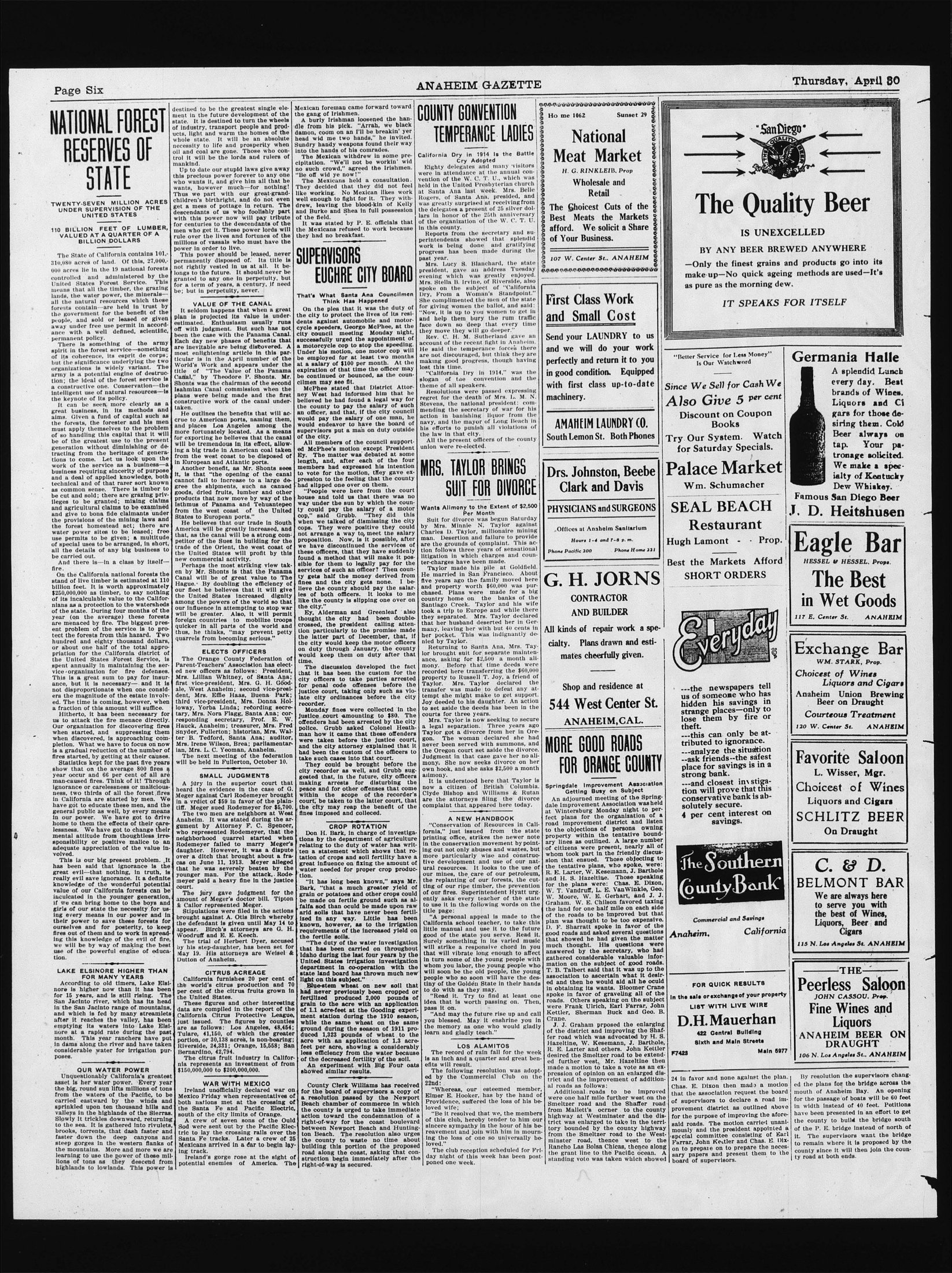
Searchable text
NATIONAL FOREST RESERVES OF STATE
TWENTY-SEVEN MILLION ACRES UNDER SUPERVISION OF THE UNITED STATES
110 BILLION FEET OF LUMBER, VALUED AT A QUARTER OF A BILLION DOLLARS
The State of California contains 101,310,080 acres of land. Of this, 27,000,000 acres lie in the 19 national forests controlled and administered by the United States Forest Service. This means that all the timber, the grazing lands, the water power, the minerals—all the natural resources which these forests contain—are held in trust by the government for the benefit of the people, and sold or leased or given away under free use permit in accordance with a well defined, scientific, permanent policy.
There is something of the army spirit in the forest service—something of its coherence, its esprit de corps; but the significance underlying the two organizations is widely variant. The army is a potential engine of destruction; the ideal of the forest service is a constructive one. Conservation—the intelligent use of natural resources—is the keynote of its policy.
It can be seen more clearly as a great business, in its methods and aims. Given a fund of capital such as the forests, the forester and his men must apply themselves to the problem of so handling this capital that it will be of the greatest use to the present generation without diminishing or detracting from the heritage of generations to come. Let us look upon the work of the service as a business requiring sincerity of purpose destined to be the greatest single element in the future development of the state. It is destined to turn the wheels of industry, transport people and products, light and warm the homes of the whole state. It will be an absolute necessity to life and prosperity when oil and coal are gone. Those who control it will be the lords and rulers of mankind.
Up to date our stupid laws give away this precious power forever to any one who wants it, and give him all that he wants, however much—for nothing! Thus we part with our great-grandchildren's birthright, and do not even get a mess of pottage in return. The descendants of us who foolishly part with this power now will pay tribute for centuries to the descendants of the men who get it. These power lords will rule over the lives and fortunes of the millions of vassals who must have the power in order to live.
This power should be leased, never permanently disposed of. Its title is not rightly vested in us at all. It belongs to the future. It should never be granted to any one in perpetuity, but for a term of years, a century, if need be; but in perpetuity, never.
VALUE OF THE CANAL
It seldom happens that when a great plan is projected its value is underestimated. Enthusiasm usually runs off with judgment. But such has not been the case with the Panama Canal. Each day new phases of benefits that are inevitable are being discovered. A most enlightening article in this particular is in the April number of the World's Work and appears under the title of "The Value of the Panama Canal," by Theodore P. Shonts. Mr. Shonts was the chairman of the second Isahmian Canal commission when the plans were being made and the first constructive work of the canal undertaken.
He outlines the benefits that will accrue to American ports, naming them, and places Los Angeles among the more fortunately located. As a means for exporting he believes that the canal will be tremendous in its effect, allowing a big trade in American coal taken from the west coast to be disposed of in European and Atlantic ports.
Another benefit, as Mr. Shonts sees it, is that "the opening of the canal Mexican foreman can take the gang of Irishmen. A burly Irishman dale from his pick. damon, coom on an head wid me two Sundry handy weapons into the hands of his.
The Mexican with cipitation. "We'll no such crowd," agen "Be off wid ye now."
The Mexicans here They decided that like working. No M well enough to fight drew, leaving the and Burke and Shea of the field.
It was stated by the Mexicans refused they had no breakfa
SUPERVISORS EUCHRE
That's What Santa Think Has
On the plea that the city to protect its students against auto-cycle speeders, Georgetown council meeting successfully urged a motorcycle cop to Under his motion, he be employed for act at a salary of $100 expiration of that time be continued or board members may see fit.
McPhee stated thatney West had informed believed he had found the county to pay an officer, and that would pay the salaries would endeavor to supervisors put a mof of the city.
All members of tred McPhee's motion Ey. The matter ww length, and, after members had expressed vote for the mo
It can be seen more clearly as a great business, in its methods and aims. Given a fund of capital such as the forests, the forester and his men must apply themselves to the problem of so handling this capital that it will be of the greatest use to the present generation without diminishing or detracting from the heritage of generations to come. Let us look upon the work of the service as a business requiring sincerity of purpose and a deal of applied knowledge, both technical and of that rarer sort known as common sense. There is timber to be cut and sold; there are grazing privileges to be granted; mining claims and agricultural claims to be examined and give to bona fide claimants under the provisions of the mining laws and the forest homestead act; there are water power sites to be leased; free use permits to be given; a multitude of special uses to be arranged, in short, all the details of any big business to be carried out.
And there is—in a class by itself—fire.
On the California national forests the stand of live timber is estimated at 110 billion feet. It is worth approximately $250,000,000 as timber, to say nothing of its incalculable value to the Californians as a protection to the watersheds of the state. During four months of the year (on the average) these forests are menaced by fire. The biggest present problem of the service is to protect the forests from this hazard. Two hundred and eighty thousand dollars, or about one half of the total appropriation for the California district of the United States Forest Service, is spent annually in maintaining the service organization for fire defenses. This is a great sum to pay for insurance, but it is necessary—and it is not disproportionate when one considers the magnitude of the estate involved. The time is coming, however, when a fraction of this amount will suffice.
Hitherto, it has been necessary for us to attack the fire menace directly. Our organization for discovering fires when started, and suppressing them when discovered, is approaching completion. What we have to focus on now is a gradual reduction of the number of fires started, by getting at their causes.
Statistics kept for the past five years show that on the average 800 fires a year occur and 66 per cent of all are man-caused fires. Think of it! Through ignorance or carelessness or maliciousness, two thirds of all the forest fires in California are started by men. We have got to educate these men, and the general public as well, by every means in our power. We have got to drive home to them the effects of their carelessness. We have got to change their mental attitude from thoughtless irresponsibility or positive malice to an adequate appreciation of the value involved.
This is our big present problem. It has been said that ignorance is the great evil—that nothing, in truth, is really evil save ignorance. It a definite knowledge of the wonderful potential value of our California forests can be inculcated in the younger generation,
Canal,” by Theodore P. Shonts. Mr. Shonts was the chairman of the second Isaiahman Canal commission when the plans were being made and the first constructive work of the canal undertaken.
He outlines the benefits that will accrue to American ports, naming them, and places Los Angeles among the more fortunately located. As a means for exporting he believes that the canal will be tremendous in its effect, allowing a big trade in American coal taken from the west coast to be disposed of in European and Atlantic ports.
Another benefit, as Mr. Shonts sees it, is that “the opening of the canal cannot fall to increase to a large degree the shipments, such as canned goods, dried fruits, lumber and other products that now move by way of the Isthmus of Panama and Tehuantepec from the west coast of the United States to European ports.”
He believes that our trade in South America will be greatly increased, and that, as the canal will be a strong competitor of the Suez in building for the trade of the Orient, the west coast of the United States will profit by this new commercial activity.
Perhaps the most striking view taken by Mr. Shonts is that the Panama Canal will be of great value to The Hague. By doubling the efficiency of our fleet he believes that it will give the United States increased dignity among the powers of the world so that our influence in attempting to stop war will be greater. Also, it will permit foreign countries to mobilize troops quicker in all parts of the world and thus, he thinks, “may prevent petty quarrels from becoming serious.”
ELECTS OFFICERS
The Orange County Federation of Parent-Teachers’ Association has elected new officers as follows: President, Mrs. Lillian Whitney, of Santa Ana; first vice-president, Mrs. G. H. Goodale, West Anaheim; second vice-president, Mrs. Effle Haas, Buena Park; third vice-president, Mrs. Donna Holloway, Yorba Linda; recording secretary, Prof. E. W. Hauck, Anaheim; treasurer, Mrs. Fred Snyder, Fullerton; historian, Mrs. Walter B. Tedford, Santa Ana; auditor, Mrs. Irene Wilson, Brea; parliamentarian, Mrs. L. C. Yeoman, Anaheim.
The next meeting of the federation will be held in Fullerton, October 10.
SMALL JUDGMENTS
A jury in the superior court that heard the evidence in the case of G. Meger against Carl Rodemeyer brought in a vdict of $59 in favor of the plaintiff. Meger sued Rodemeyer for $5,700.
The two men are neighbors at West Anaheim. It was stated during the argument by Attorney F. C. Spencer, who represented Rodemeyer, that the neighborhood quarrel started when Rodemeyer failed to marry Meger's daughter. However, it was a dispute over a ditch that brought about a fracas on June 11, 1913. Meyer alleged that he was severely beaten by the younger man. For the attack, Rodemeyer paid a heavy fine in the justice court.
The jury gave judgment for the amount of Meger’s doctor bill. Tinton
McPhee stated that they West had informed believed he had found the county to pay an officer, and that would pay the salaries would endeavor to superviseors put a mage of the city.
All members of the Ed McPhee’s motion Ey. The matter was length, and after members had expressed vote for the motion to feel had slipped one over.
“People were here house and told us way under the sun could pay the cop,” said Grubb when we talked of cops. They were not arrange a way proposition. Now, we have discontinuing these officers, that found a method thible for them to services of such an ty gets half the fines and the city lieve the county shields like both officers like the county is siding the city.”
Ey, Alderman and thought the city crossed, the presiion particularly to latter part o f the city would keep on duty through J would keep them time.
The discussion that it has been city officers to take for penal code o justice court, taking late city ordinance recorder.
Monday fines were justice court among offenders had been police. Grubb asked man how it came were taken before and the city attorney had been the custom take such cases into.
They could be city recorder as w gested that, in thie making arrests peace and for other within the scope court, be taken to o city may reap fines imposed and
in California are started by men. We have got to educate these men, and the general public as well, by every means in our power. We have got to drive home to them the effects of their carelessness. We have got to change their mental attitude from thoughtless irresponsibility or positive malice to an adequate appreciation of the value involved.
This is our big present problem. It has been said that ignorance is the great evil—that nothing, in truth, is really evil save ignorance. It a definite knowledge of the wonderful potential value of our California forests can be inculcated in the younger generation, if we can bring home to the boys and girls of our state the necessity for using every means in our power and in their power to save these forests for ourselves and for posterity, to keep fires out of them and to work in spreading this knowledge of the evil of fire, we will be by way of making the best use of the powerful engine of education.
LAKE ELSINORE HIGHER THAN FOR MANY YEARS
According to old timers, Lake Elsinore is higher now than it has been for 15 years, and is still rising. The San Jacinto river, which has its head in the San Jacinto range of mountains, and which is fed by many streamlets after it reaches the valley, has been emptying its waters into Lake Elsinore at a rapid rate during the past month. This year ranchers have put in dams along the river and have taken considerable water for irrigation purposes.
OUR WATER POWER
Unquestionably California's greatest asset is her water power. Every year the big, round sun lifts millions of tons from the waters of the Pacific, to be carried eastward by the winds and sprinkled upon ten thousand hills and valleys in the highlands of the Slerras. Slowly it trickles downward, returning to the sea. It is gathered into rivulets, brooks, torrents, that dash faster and faster down the deep canyons and steep gorges in the western flanks of the mountains. More and more we are learning to use the power of these millions of tons as they descend from highlands to lowlands. This power is in a vrdict of $59 in favor of the plaintiff. Meger sued Rodemeyer for $5,700.
The two men are neighbors at West Anaheim. It was stated during the argument by Attorney F. C. Spencer, who represented Rodemeyer, that the neighborhood quarrel started when Rodemeyer failed to marry Meger's daughter. However, it was a dispute over a ditch that brought about a fracas on June 11, 1913. Meyer alleged that he was severely beaten by the younger man. For the attack, Rodemeyer paid a heavy fine in the justice court.
The jury gave judgment for the amount of Meger's doctor bill. Tipton & Callor represented Meger.
Stipulations were filed in the actions brought against A. Otis Birch whereby the defendant is given until May 14 to appear. Birch's attorneys are G. H. Woodruff and E. E. Keech.
The trial of Herbert Dyer, accused by his step-daughter, has been set for May 19. His attorneys are Weisel & Dutton of Anaheim.
CITRUS ACREAGE
California furnishes 20 per cent of the world's citrus production and 70 per cent of the citrus fruits grown in the United States.
These figures and other interesting data are compiled in the report of the California Citrus Protective League, just issued. The figures by counties are as follows: Los Angeles, 48,454; Tulare, 41,150, of which the greater portion, or 30,138 acres, is non-bearing; Riverside, 24,331; Orange, 15,558; San Bernardino, 42,794.
The citrus fruit industry in California represents an investment of from $150,000,000 to $200,000,000.
WAR WITH MEXICO
Ireland unofficially declared war on Mexico Friday when representatives of both nations met at the crossing of the Santa Fe and Pacific Electric, south of the city limits of Orange.
A crew of seven sons of the Ould Sod were sent out by the Pacific Electric to lay the crossing rails over the Santa Fe tracks. Later a crew of 25 Mexicans arrived in a car to begin laying track.
Ireland's gorge rose at the sight of potential enemies of America. The county Clerk W for the board of selections by the department relating to the duty ten a statement w tation of crops and great influence on water needed for tation.
"It has long been Bark, "that a mu grain or potatoes are made on fertile falfa sod than oculid soils that have lized in any way known, however, requirements of tha fertile soils.
"The duty of tha that has been called Idaho during la United States irrig department in co state land board light on this subject Blue-stem wheat had never previous fertilized produce grain to the acre of 1.1 acre-feet att ment station duri while the same ground during tha duced 1,323 pound acre with an app feet per acre, show less efficiency fro tha decreased f
An experiment showed similar rea County Clerk W for the board of selections by the department relating to the duty ten a statement w tation of crops and great influence on water needed for tation.
"It has long been Bark, "that a mu grain or potatoes are made on fertile falfa sod than oculid soils that have lized in any way known, however, requirements of tha fertile soils."
"The duty of tha that has been called Idaho during la United States irrig department in co state land board light on this subject Blue-stem wheat had never previous fertilized produce grain to the acre of 1.1 acre-feet att ment station duri while the same ground during tha duced 1,323 pound acre with an app feet per acre, show less efficiency fro tha decreased f"
An experiment showed similar rea County Clerk W for the board of selections by the department relating to the duty ten a statement w tation of crops and great influence on water needed for tation."
ANAHEIM GAZETTE
Mexican foreman came forward toward the gang of Irishmen.
A burly Irishman loosened the handle from his pick. "Arrah, we black damon, coom on an I'll be breakin' yer head wid me two hands," he invited. Sundry handy weapons found their way into the hands of his comrades.
The Mexican withdrew in some precipitation. "We'll not be workin' wid no such crowd," agreed the Irishmen. "Be off wid ye now!"
The Mexicans held a consultation. They decided that they did not feel like working. No Mexican likes work well enough to fight for it. They withdrew, leaving the blood-kin of Kelly and Burke and Shea in full possession of the field.
It was stated by P. E. officials that the Mexicans refused to work because they had no breakfast.
SUPERVISORS
EUCHRE CITY BOARD
That’s What Santa Ana Councilmen Think Has Happened
On the plea that it was the duty of the city to protect the lives of its residents against automobile and motorcycle speeders, George McPhee, at the city council meeting Monday night, successfully urged the appointment of a motorcycle cop to stop the speeding. Under his motion, one motor cop will be employed for at least two months at a salary of $100 per month. At the expiration of that time the officer may be continued or bounced, as the councilmen may see fit.
McPhee stated that District Attorney West had informed him that he believed he had found a legal way for the county to pay the salary of such an officer, and that, if the city council would pay the salary of one man, he would endeavor to have the board of supervisors put a man on duty outside of the city.
All members of the council supported McPhee's motion except President Ey. The matter was debated at some length, and, after each of the four members had expressed his intention to vote for the motion, they gave ex-
McPhee stated that District Attorney West had informed him that he believed he had found a legal way for the county to pay the salary of such an officer, and that, if the city council would pay the salary of one man, he would endeavor to have the board of supervisors put a man on duty outside of the city.
All members of the council supported McPhee's motion except President Ey. The matter was debated at some length, and, after each of the four members had expressed his intention to vote for the motion, they gave expression to the feeling that the county had slipped one over on them.
"People were here from the court house and told us that there was no way under the sun by which the county could pay the salary of a motor cop," said Grubb. "They did this when we talked of dismissing the city cops. They were positive they could not arrange a way to, meet the salary proposition. Now, is it possible, after we have discontinued the services of these officers, that they have suddenly found a method that will make it possible for them to legally pay for the services of such an officer? Then county gets half the money derived from fines and the city gets none. I believe the county should pay the salaries of both officers. It looks to me like the county is slipping one over on the city."
Ey, Alderman and Greenleaf also thought the city had been double-crossed, the president calling attention particularly to the promise made the latter part of December, that, if the city would keep the motor officers on duty through January, the county would keep them on duty after that time.
The discussion developed the fact that it has been the custom for the city officers to take parties arrested for penal code offenses before the justice court, taking only such as violate city ordinances before the city recorder.
Monday fines were collected in the justice court amounting to $80. The offenders had been arrested by the city police. Grubb asked Colonel Heathman how it came that these offenders were taken before the justice court, and the city attorney explained that it had been the custom of the officers to take such cases into that court.
They could be brought before the city recorder as well, and Grubb suggested that, in the future, city officers making arrests for disturbing the peace and for other offenses that come within the scope of the recorder's court, be taken to the latter court, that the city may reap the benefit of the fines imposed and collected.
CROP ROTATION
Don H. Bark, in charge of investigations by the department of agriculture relating to the duty of water has written a statement which shows that rotation of crops and soil fertility have a great influence on fixing the amount of water needed for proper crop production.
"It has long been known," says Mr. Bark, "that a much greater yield of grain or potatoes and other crops could be made on fertile ground such as al-
MRS. TAYLOR BRINGS SUIT FOR DIVORCE
Wants Alimony to the Extent of $2,500 Per Month
Suit for divorce was begun Saturday by Mrs. Minnie N. Taylor against Charles D. Taylor, millionaire mining man. Desertion and failure to provide are the grounds of complaint. This action follows three years of sensational litigation in which charges and counter-charges have been made.
Taylor made his pile at Goldfield. He married in San Francisco. About five years ago the family moved here and property worth $60,000 was purchased. Plans were made for a big country home on the banks of the Santiago Creek. Taylor and his wife took a trip to Europe and while there they separated. Mrs. Taylor declared that her husband deserted her in Germany, leaving her with but 40 cents in her pocket. This was indignantly denied by Taylor.
Returning to Santa Ana, Mrs. Taylor brought suit for separate maintenance, asking for $2,500 a month alimony. Before that time deeds were recorded here transferring the $60,000 property to Russell T. Joy, a friend of Taylor. Mrs. Taylor declared the transfer was made to defeat any attempt she might make to get support. Joy deeded to his daughter. An action to set aside the deeds has been in the courts for three years.
Mrs. Taylor is now seeking to secure a legal separation. Three years ago Taylor got a divorce from her in Oregon. The woman declared she had never been served with summons, and the Oregon court set aside the divorce. Judgment in that case gave her no alimony. She now seeks divorce on her own hook, and she asks $2,500 a month alimony.
It is understood here that Taylor is now a citizen of British Columbia. Clyde Bishop and Williams & Rutan are the attorneys filing the divorce complaint that appeared here today.
A NEW HANDBOOK
"Conservation of Resources in California," just issued from the state printing office, strikes the newer note in the conservation movement by pointing out not only abuses and wastes, but more particularly wise and constructive development and use of our natural resources. It looks to the use of our mines, the care of our petroleum, the replanting of our forests, the cutting of our ripe timber, the prevention of our fires. Superintendent Hyatt urgently asks every teacher of the state
CROP ROTATION
Don H. Bark, in charge of investigations by the department of agriculture relating to the duty of water has written a statement which shows that rotation of crops and soil fertility have a great influence on fixing the amount of water needed for proper crop production.
"It has long been known," says Mr. Bark, "that a much greater yield of grain or potatoes and other crops could be made on fertile ground such as alfalfa sod than oculd be made upon raw arid soils that have never been fertilized in any way. Little has been known, however, as to the irrigation requirements of the increased yield on the fertile soils.
"The duty of the water investigation that has been carried on throughout Idaho during the last four years by the United States irrigation investigation department in co-operation with the state land board has thrown much new light on this subject."
Blue-stem wheat on new soil that had never previously been cropped or fertilized produced 2,000 pounds of grain to the acre with an application of 1.1 acre-feet at the Gooding experiment station during the 1910 season, while the same wheat on the same ground during the season of 1911 produced 1,323 pounds of wheat to the acre with an application of 1.3 acre-feet per acre, showing a considerably less efficiency from the water because of the decreased fertility of the soil.
An experiment with Big Four oats showed similar results.
County Clerk Williams has received for the board of supervisors a copy of a resolution passed by the Newport Beach chamber of commerce in which the county is urged to take immediate action toward the condemnation of a right-of-way for the coast boulevard between Newport Beach and Huntington Beach. The resolution also urges the county to waste no time about building this portion of the proposed road along the coast, asking that construction begin immediately after the right-of-way is secured.
A NEW HANDBOOK
"Conservation of Resources in California," just issued from the state printing office, strikes the newer note in the conservation movement by pointing out not only abuses and wastes, but more particularly wise and constructive development and use of our natural resources. It looks to the use of our mines, the care of our petroleum, the replanting of our forests, the cutting of our ripe timber, the prevention of our fires. Superintendent Hyatt urgently asks every teacher of the state to use it in the following words on the title page:
"A personal appeal is made to the California school teacher, to take this little manual and use it to the future good of the state you serve. Read it. Surely something in its varied music will strike a responsive chord in you that will vibrate long enough to affect in turn some of the young people with whom you labor, the young people who will soon be the old people, the young people who so soon will have the destiny of the Golden State in their hands to do with as they may.
"Read it. Try to find at least one idea that is worth passing on. Then, pass it on.
"And may the future rise up and call you blessed. May it enshrine you in the memory as one who would gladly learn and gladly teach."
LOS ALAMITOS
The record of rain fall for the week is an inch and a quarter and great benefits will result.
The following resolution was adopted by the Commercial Club on the 22nd:
"Whereas, our esteemed member, Elmer E. Hooker, has by the hand of Providence, suffered the loss of his beloved wife;
"Be it resolved that we, the members of this club, hereby tender to him our sincere sympathy in the hour of his bereavement and join with him in mourning the loss of one so universally beloved."
The club reception scheduled for Friday night of this week has been postponed one week.
An adjourned meeting of the Spring dale Improvement Association was held at Wintersburg Monday night to perfect plans for the organization of a road improvement district and listen to the objections of persons owning property within the tentative boundary lines as outlined. A large number of citizens were present, nearly all of whom took part in the friendly discussion that ensued. Those objecting to the tentative plans, who spoke, were: R. E. Larter, W. Kesemann, J. Barthole and H. S. Hazeltine. Those speaking for the plans were: Chas. E. Dixon, W. T. Vandruff, L. E. VanWinkle, Geo. W. Moore, W. E. Gerhart, and J. J. Graham. W. E. Chilson favored taxing the land for one half mile on each side of the roads to be improved but that plan was thought to be too expensive. D. F. Sharratt spoke in favor of the good roads and asked several questions that showed he had given the matter much thought. His questions were answered by the secretary, who had gathered considerable valuable information on the subject of good roads. T. B. Talbert said that it was up to the association to ascertain what it desired and then he would aid all he oculd in obtaining its wants. Bloomer Crane spoke in favor of graveling all of the roads. Others speaking on the subject were Frank Ulrich, Earl Farrar, John Kettler, Sherman Buck and Geo. B. Crane.
J. J. Graham proposed the enlarging of the district and improving the Shaffer road which was advocated by H. S. Hazeltine, W. Kesemann, J. Barthole, R. E. Larter and others. John Kettler desired the Smeltzer road to be extended further west. Mr. Hazeltine then made a motion to take a vote as an expression of opinion on an enlarged district and the improvement of additional roads as follows:
Additional roads to be improved were one half mile further west on the Smeltzer road and the Shaffer road from Mallett's ocner to the county highway at Westminster and the district was enlarged to take in the territory bounded by the county highway from the Smeltzer road to the Westminster road, thence west to the Rancho Las Bolsa Chicas, thence along the grant line to the Pacific ocean. A standing vote was taken which showed
Thursday, April 80
"San Diego"
The Quality Beer
IS UNEXCELLED
BY ANY BEER BREWED ANYWHERE
—Only the finest grains and products go into its make-up—No quick ageing methods are used—It's as pure as the morning dew.
IT SPEAKS FOR ITSELF
"Better Service for Less Money"
Is Our Watchword
Since We Sell for Cash We
Also Give 5 per cent
Discount on Coupon Books
Try Our System. Watch for Saturday Specials.
Palace Market
Germania Halle
A splendid Lunch every day. Best brands of Wines, Liquors and Cigars for those desiring them. Cold Beer always on tap. Your patronage solicited. We make a speciality of Kentucky
Since We Sell for Cash We
Also Give 5 per cent
Discount on Coupon
Books
Try Our System. Watch
for Saturday Specials.
Palace Market
Wm. Schumacher
SEAL BEACH
Restaurant
Hugh Lamont - Prop.
Best the Markets Afford
SHORT ORDERS
Everyday
---the newspapers tell us of someone who has hidden his savings in strange places—only to lose them by fire or theft.
---this can only be attributed to ignorance.
---analyze the situation
---ask friends—the safest place for savings is in a strong bank.
---and closest investigation will prove that this conservative bank is absolutely secure.
4 per cent interest on savings.
The Southern County Bank
Eagle Bar
HESSEL & HESSEL. Props.
The Best
in Wet Goods
117 E. Center St. ANAHEIM
Exchange Bar
WM. STARK, Prop.
Choicest of Wines
Liquors and Cigars
Anaheim Union Brewing
Beer on Draught
Courteous Treatment
120 W. Center St. ANAHEIM
Favorite Saloon
L. Wisser, Mgr.
Choicest of Wines
Liquors and Cigars
SCHLITZ BEER
On Draught
C. & D.
BELMONT BAR
We are always here
24 in favor and none against the plan. Chas. E. Dixon then made a motion that the association request the board of supervisors to declare a road improvement district as outlined above for the purpose of improving the aforesaid roads. The motion carried unanimously and the president appointed a special committee consisting of Earl Farrar, John Kettler and Chas. E. Dixon to prepare on to prepare the necessary papers and present them to the board of supervisors.
By resolution the supervisors changed the plans for the bridge across the mouth of Anaheim Bay. An opening for the passage of boats will be 60 feet in width instead of 40 feet. Petitions have been presented in an effort to get the county to build the bridge south of the P. E. bridge instead of north of it. The supervisors want the bridge to remain where it is proposed by the county since it will then join the county road at both ends.