anaheim-gazette 1914-04-30
Scanned page
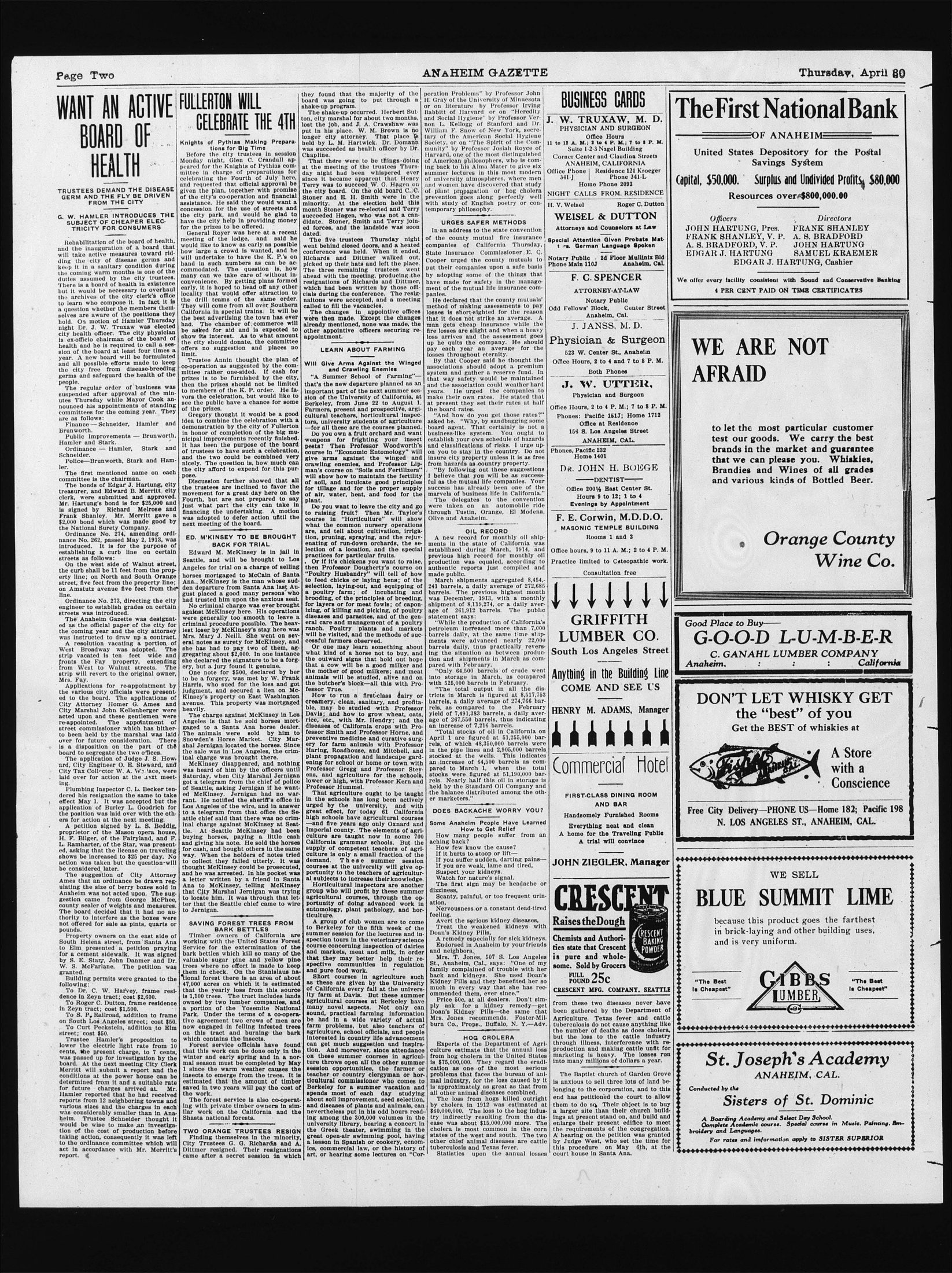
Searchable text
WANT AN ACTIVE BOARD OF HEALTH
TRUSTEES DEMAND THE DISEASE GERM AND THE FLY BE DRIVEN FROM THE CITY
G. W. HAMLER INTRODUCES THE SUBJECT OF CHEAPER ELECTRICITY FOR CONSUMERS
Rehabilitation of the board of health, and the inauguration of a board that will take active measures toward ridging the city of disease germs and keep it in a sanitary condition during the coming warm months is one of the duties assumed by the city trustees. There is a board of health in existence but it would be necessary to overhaul the archives of the city clerk's office to learn who compose it. In fact it is a question whether the members themselves are aware of the positions they hold. On motion of Hamler Thursday night Dr. J. W. Truxaw was elected city health officer. The city physician is ex-officio chairman of the board of health and he is required to call a session of the board at least four times a year. A new board will be formulated and all possible efforts made to keep the city free from disease-breeding germs and safeguard the health of the people.
The regular order of business was suspended after approval of the minutes Thursday while Mayor Cook announced his appointments of standing committees for the coming year. They are as follows:
Finance — Schneider, Hamler and Brunworth.
Public Improvements — Brunworth, Hamler and Stark.
Ordinance — Hamler, Stark and Schneider.
Police — Brunworth, Stark and Hamler.
The first mentioned name on each page
FULLERTON WILL CELEBRATE THE 4TH
Knights of Pythias Making Preparations for Big Time
Before the city trustees in session Monday night, Glen C. Crandall appeared for the Knights of Pythias committee in charge of preparations for celebrating the Fourth of July here, and requested that official approval be given the plan, together with promise of the city's co-operation and financial assistance. He said they would want a concession for the use of streets and the city park, and would be glad to have the city help in providing money for the prizes to be offered.
General Royer was here at a recent meeting of the lodge, and said he would like to know as early as possible how large a crowd is wanted, and he will undertake to have the K. P.'s on hand in such numbers as can be accommodated. The question is, how many can we take care of without inconvenience. By getting plans formed early, it is hoped to head off any other locality that would offer attraction to the drill teams of the same order. They will come from all over Southern California in special trains. It will be the best advertising the town has ever had. The chamber of commerce will be asked for aid and is expected to show its interest. As to what amount the city should donate, the committee offers no suggestion and places no limit.
Trustee Annin thought the plan of co-operation as suggested by the committee rather one-sided. If cash for prizes is to be furnished by the city, then the prizes should not be limited to members of the K. P. order. He favors the celebration, but would like to see the public have a chance for some of the prizes.
Gregory thought it would be a good idea to combine the celebration with a demonstration by the city of Fullerton in honor of completion of the big municipal improvements recently finished. It has been the purpose of the board of trustees to have such a celebration, and the two could be combined very nicely. The question is, how much can the city afford to expend for this purpose?
They found that they found that they found that they found that they found that they found that they found that they found that they found that they found that they found that they found that they found that they found that they found that they found that they found that they found that they found that they found that they found that they found that they found that they found that they found that they found that they found that they found that they found that they found that they found that they found that they found that they found that they found that they found that they found that they found that they found that they found that they found that they found that they found that they found that they found that they found that they found that they found that they found that they found that they found that they found that they found that they found that they found that they found that they found that they found that they found that they found that they found that they found that they found that they found that they found that they found that they found that they found that they found that they found that they found that they found that they found that they found that they found that they found that they find that they find that they find that they find that they find that they find that they find that they find that they find that they find that they find that they find that they find that they find that they find that they find thatthey findthattheyfindthattheyfindthattheyfindthattheyfindthattheyfindthattheyfindthattheyfindthattheyfindthattheyfindthattheyfindthattheyfindthattheyfindthattheyfindthattheyfindthattheyfindthattheyfindthattheyfindthattheyfindthattheyfindthattheyfindthattheyfindthattheyfindthattheyfindthattheyfindthattheyfindthattheyfindthattheyfindthattheyfindthattheyfindthattheyfindthattheyfindthattheyfindthattheyfindthattheyfindthattheyfindthattheyfindthattheyfindthattheyfindthattheyfindthattheyfindthattheyfindthattheyfindthattheyfindthattheyfindthattheyfindthattheyfindthattheyfindthattheyfoundthattheyfoundthattheyfoundthat他们found That there were at the meeting of day night had been since it became Terry was to succeed the city board. O'Stoner and E.H. minority. At this month Stoner was succeeded Hagenidate. Stoner, S.ed forces, and th dated.
The five trustees went behind close conference was H Richards and I picked up their ha The three remain ahead with the most resignations of R which had beencials during the caitions were accalled to fill the w The changes were then made already mentioned other appointive appointment.
LEARN AB
WILL Give Arms and Crawl
"A Summer S that's the new de important part o sion of the Univer Berkeley, from Farmers, present cultural teachers tors, university s—for all these ar Do you own a f weapons for fr pests? Then Pr course in "Econ give arms agai crawling enemies man's course on
The regular order of business was suspended after approval of the minutes Thursday while Mayor Cook announced his appointments of standing committees for the coming year. They are as follows:
Finance — Schneider, Hamler and Brunworth.
Public Improvements — Brunworth, Hamler and Stark.
Ordinance — Hamler, Stark and Schnelder.
Police—Brunworth, Stark and Hamler.
The first mentioned name on each committee is the chairman.
The bonds of Edgar J. Hartung, city treasurer, and Edward B. Merritt, city clerk, were submitted and approved. Mr. Hartung's bond is for $25,000 and is signed by Richard Melrose and Frank Shanley. Mr. Merritt gave a $2,000 bond which was made good by the National Surety Company.
Ordinance No. 274, amending ordinance No. 262, passed May 2, 1913, was introduced. It is for the purpose of establishing a curb line on certain streets as follows:
On the west side of Walnut street, the curb shall be 11 feet from the property line; on North and South Orange street, five feet from the property line; on Amstutz avenue five feet from the line.
Ordinance No. 273, directing the city engineer to establish grades on certain streets was introduced.
The Anaheim Gazette was designated as the official paper of the city for the coming year and the city attorney was instructed to draw up a contract.
A resolution vacating a portion of West Broadway was adopted. The strip vacated is ten feet wide and fronts the Fay property, extending from West to Walnut streets. The strip will revert to the original owner, Mrs. Fay.
Applications for re-appointment by the various city officials were presented to the board. The applications of City Attorney Homer G. Ames and City Marshal John Kellenberger were acted upon and these gentlemen were re-appointed.
The appointment of street commissioner which has hitherto been held by the marshal was laid over for future consideration. There is a disposition on the part of the board to segregate the two offices.
The application of Judge J. S. Howard, City Engineer O. E. Steward, and City Tax Collector W. A. Wallace, were laid over for action at the next meeting.
Plumbing Inspector C. L. Becker tendered his resignation the same to take effect May 1. It was accepted but the application of Burley L. Goodrich for the position was laid over with the others for action at the next meeting.
A petition signed by L. S. Beddig, proprietor of the Mason opera house, H. F. Bilger, of the Fairyland, and F. L. Ramharter, of the Star, was presented, asking that the license on traveling shows be increased to $25 per day. No action was taken but the question-will be considered later.
The suggestion of City Attorney Ames that an ordinance be drawn regulating the size of berry boxes sold in Anaheim was not acted upon. The suggestion came from George McPherson.
ED. M'KINSEY TO BE BROUGHT BACK FOR TRIAL
Edward M. McKinsey is in jail in Seattle, and will be brought to Los Angeles for trial on a charge of selling horses mortgaged to McCain of Santa Ana. McKinsey is the man whose sudden departure from Santa Ana last August placed a good many persons who had trusted him upon the anxious seat.
No criminal charge was ever brought against McKinsey here. His operations were generally too smooth to leave a criminal procedure possible. The heaviest loser by McKinsey's stay here was Mrs. Mary J. Neill. She went on several notes as surety for McKinsey, and she has had to pay two of them, aggregating about $2,000. In one instance she declared the signature to be a forgery, but a jury found it genuine.
One note for $500, declared by her to be a forgery, was met by W. Frank Harris, who sued for the loss and got judgment, and secured a lien on McKinsey's property on East Washington avenue. This property was mortgaged heavily.
The charge against McKinsey in Los Angeles is that he sold horses mortgaged to a Santa Ana horse dealer. The animals were sold by him to Snowden's Horse Market. City Marshal Jernigan located the horses. Since the sale was in Los Angeles, the criminal charge was brought there.
McKinsey disappeared, and nothing was heard of him by the officers until Saturday, when City Marshal Jernigan got a telegram from the chief of police of Seattle, asking Jernigan if he wanted McKinsey. Jernigan had no warrant. He notified the sheriff's office in Los Angeles of the wire, and in answer to a telegram from that office the Seattle chief said that there was no criminal charge against McKinsey at Seattle. At Seattle McKinsey had been buying horses, paying a little cash and giving his note. He sold the horses for cash, and bought others in the same way. When the holders of notes tried to collect they failed utterly. It was thought McKinsey could be prosecuted, and he was arrested. In his pocket was a letter written by a friend in Santa Ana to McKinsey, telling McKinsey that City Marshal Jernigan was trying to locate him. It was through that let-prize is to be furnished by the city, then the prizes should not be limited to members of the K.P. order. He favors the celebration, but would like to see the public have a chance for some of the prizes.
Gregory thought it would be a good idea to combine the celebration with a demonstration by the city of Fullerton in honor of completion of the big municipal improvements recently finished. It has been the purpose of the board of trustees to have such a celebration, and the two could be combined very nicely. The question is, how much can the city afford to expend for this purpose.
Discussion further showed that all the trustees are inclined to favor the movement for a great day here on the Fourth, but are not prepared to say just what part the city can take in financing the undertaking. A motion was adopted to defer action until the next meeting of the board.
"A Summer School that's new demeanor important part of its sion of University Berkeley from Farmers, present cultural teachers tors, university sion-for all these are Do you own a fire weapons for fire pests? Then Prune course in "Economics give arms again crawling enemies man's course on will show how tough of soil, and incur for tillage and tion of air, water, he plant.
Do you want to raise fruit back for trial
Edward M. McKinsey is in jail in Seattle, and will be brought to Los Angeles for trial on a charge of selling horses mortgaged to McCain of Santa Ana. McKinsey is the man whose sudden departure from Santa Ana last August placed a good many persons who had trusted him upon the anxious seat.
No criminal charge was ever brought against McKinsey here. His operations were generally too smooth to leave a criminal procedure possible. The heaviest loser by McKinsey's stay here was Mrs. Mary J. Neill. She went on several notes as surety for McKinsey, and she has had to pay two of them, aggregating about $2,000. In one instance she declared the signature to be a forgery, but a jury found it genuine.
One note for $500, declared by her to be a forgery, was met by W. Frank Harris, who sued for the loss and got judgment, and secured a lien on McKinsey's property on East Washington avenue. This property was mortgaged heavily.
The charge against McKinsey in Los Angeles is that he sold horses mortgaged to a Santa Ana horse dealer. The animals were sold by him to Snowden's Horse Market. City Marshal Jernigan located the horses. Since the sale was in Los Angeles, the criminal charge was brought there.
McKinsey disappeared, and nothing was heard of him by the officers until Saturday, when City Marshal Jernigan got a telegram from the chief of police of Seattle, asking Jernigan if he wanted McKinsey. Jernigan had no warrant. He notified the sheriff's office in Los Angeles of the wire, and in answer to a telegram from that office the Seattle chief said that there was no criminal charge against McKinsey at Seattle. At Seattle McKinsey had been buying horses, paying a little cash and giving his note. He sold the horses for cash, and bought others in the same way. When the holders of notes tried to collect they failed utterly. It was thought McKinsey could be prosecuted, and he was arrested. In his pocket was a letter written by a friend in Santa Ana to McKinsey, telling McKinsey that City Marshal Jernigan was trying to locate him. It was through that let-prize is to be furnished by the city, then the prizes should not be limited to members of the K.P.order. He favors the celebration, but would like to see the public have a chance for some of the prizes.
Gregory thought it would be a good idea to combine the celebration with a demonstration by the city of Fullerton in honor of completion of the big municipal improvements recently finished. It has been the purpose of the board of trustees to have such a celebration, and the two could be combined very nicely. The question is, how much can the city afford to expend for this purpose.
Discussion further showed that all the trustees are inclined to favor the movement for a great day here on the Fourth, but are not prepared to say just what part the city can take in financing the undertaking. A motion was adopted to defer action until the next meeting of the board.
ED.M'KINSEY TO BE BROUGHT BACK FOR TRIAL
Edward M. McKinsey is in jail in Seattle, and will be brought to Los Angeles for trial on a charge of selling horses mortgaged to McCain of Santa Ana. McKinsey is the man whose sudden departure from Santa Ana last August placed a good many persons who had trusted him upon the anxious seat.
No criminal charge was ever brought against McKinsey here. His operations were generally too smooth to leave a criminal procedure possible. The heaviest loser by McKinsey's stay here was Mrs. Mary J. Neill. She went on several notes as surety for McKinsey, and she has had to pay two of them, aggregating about $2,000. In one instance she declared the signature to be a forgery, but a jury found it genuine.
One note for $500, declared by her to be a forgery, was met by W. Frank Harris, who sued for the loss and got judgment, and secured a lien on McKinsey's property on East Washington avenue. This property was mortgaged heavily.
The charge against McKinsey in Los Angeles is that he sold horses mortgaged to a Santa Ana horse dealer. The animals were sold by him to Snowden's Horse Market. City Marshal Jernigan located the horses. Since the sale was in Los Angeles, the criminal charge was brought there.
McKinsey disappeared, and nothing was heard of him by the officers until Saturday, when City Marshal Jernigan got a telegram from the chief of police of Seattle, asking Jernigan if he wanted McKinsey. Jernigan had no warrant. He notified the sheriff's office in Los Angeles of the wire, and in answer to a telegram from that office the Seattle chief said that there was no criminal charge against McKinsey at Seattle. At Seattle McKinsey had been buying horses, paying a little cash and giving his note. He soldthe horses for cash,and bought others inthe same way .WhentheholdersofnotestriedtocolllecttheyfailedutterlyItwerethoughtMcKinseycouldbeprosecuted,andhewasarrested.InhispocketwassaletterwrittenbyafriendintSantaAnatoMcKinsey,tellingMcKinseythatCityMarshlJerniganwastryingtocolllecthim.itwasthroughthatlet-prizeistobefurnishedbythecitythenprizesshouldnotbelimitedtomembersofthek.porder.Hefavorsthecelebration,specialenjoymentofdrug-deliveryofrun-delectionofacollegepracticesforpart OrifititschicklenProfessorIliPoultryHusbandtofeedchicksonc selectionlayingapoultryfarm;broodingoftheforlayersorforgingsorincursingforschoolsProfessorGreensens,andagriculturelowerorhigh.wellProfessorHummersThatagricultureIntheschoolshouldurgentbythenewdevelopmentoftheUniversitysionandfiveyearImperialcounty.CulturearetauntCaliforniagramsupplyofcompoundcultureisonlyademand.Thecoursesattatheupportunitytotheallsubjectstoinhumanagriculturalgroupwhoprovideagriculturalcoum
It was accepted but the application of Burley L. Goodrich for the position was laid over with the others for action at the next meeting.
A petition signed by L. S. Beddig, proprietor of the Mason opera house, H. F. Bilger, of the Fairyland, and F. L. Ramharter, of the Star, was presented, asking that the license on traveling shows be increased to $25 per day. No action was taken but the question will be considered later.
The suggestion of City Attorney Ames that an ordinance be drawn regulating the size of berry boxes sold in Anaheim was not acted upon. The suggestion came from George McPhee, county sealer of weights and measures. The board decided that it had no authority to interfere as the boxes were not offered for sale as pints, quarts or pounds.
Property owners on the east side of South Helena street, from Santa Ana to Elm presented a petition praying for a cement sidewalk. It was signed by S. E. Starr, John Danmer and Dr. W. S. McFarlane. The petition was granted.
Building permits were granted to the following:
To Dr. C. W. Harvey, frame residence in Zeyn tract; cost $2,600.
To Roger C. Dutton, frame residence in Zeyn tract; cost $1,500.
To S. P. Railroad, addition to frame on South Los Angeles street; cost $50.
To Curt Peckstein, addition to Elm street; cost $50.
Trustee Hamler's proposition to lower the electric light rate from 10 cents, the present charge, to 7 cents, was passed up for investigation by the board. At the next meeting City Clerk Merritt will submit a report and the conditions at the power house can be determined from it and a suitable rate for future charges arrived at. Mr. Hamler reported that he had received reports from 12 neighboring towns and various sizes and the charges in each was considerably smaller than in Anaheim. Trustee Schneider thought it would be wise to make an investigation of the cost of production before taking action, consequently it was left to the ordinance committee which will act in accordance with Mr. Merritt's report.
SAVING FOREST TREES FROM BARK BETTLES
Timber owners of California are working with the United States Forest Service for the extermination of the bark bettles which kill so many of the valuable sugar pine and yellow pine trees where no effort is made to keep them in check. On the Stanislaus national forest there is an area of about 47,000 acres on which it is estimated that the yearly loss from this source is 1,100 trees. The tract includes lands owned by two lumber companies, and a portion of the Yosemite National Park. Under the terms of a co-operative agreement two crews of men are now engaged in felling infested trees on this tract and burning the bark which contains the insects.
Forest service officials have found that this work can be done only in the winter and early spring and in a normal season must be completed by May 1 since the warm weather causes the insects to emerge from the trees. It is estimated that the amount of timber saved in two years will pay the cost of the work.
The forest service is also co-operating with private timber owners in similar work on the California and the Shasta national forests.
TWO ORANGE TRUSTEES RESIGN
Finding themselves in the minority, City Trustees G. G. Richards and A. Dittmer resigned. Their resignations came after a secret session in which
ANAHEIM GAZETTE
they found that the majority of the board was going to put through a shake-up program.
The shake-up occurred. Herbert Sutton, city marshal for about two months, lost the job, and J. A. Crawshaw was put in his place. W. M. Brown is no longer city attorney. That place is held by L. M. Hartwick. Dr. Domann was succeeded as health officer by Dr. Chapline.
That there were to be things doing at the meeting of the trustees Thursday night had been whispered ever since it became apparent that Henry Terry was to succeed W. G. Hagen on the city board. On the old board C.C. Stoner and E. H. Smith were in the minority. At the election held this month Stoner was re-elected and Terry succeeded Hagen, who was not a candidate. Stoner, Smith and Terry joined forces, and the landside was soon dated.
The five trustees Thursday night went behind closed doors, and a heated conference was held. When it ended, Richards and Dittmer walked out, picked up their hats and left the place. The three remaining trustees went ahead with the meeting, producing the resignations of Richards and Dittmer, which had been written by those officials during the conference. The resignations were accepted, and a meeting called to fill the vacancies.
The changes in appointive offices were then made. Except the changes already mentioned, none was made, the other appointive officers securing re-appointment.
LEARN ABOUT FARMING
Will Give Arms Against the Winged and Crawling Enemies
"A Summer School of Farming"—that's the new departure planned as an important part of the next summer session of the University of California, at Berkeley, from June 22 to August 1. Farmers, present and prospective, agricultural teachers, horticultural inspectors, university students of agriculture—for all these are the courses planned.
Do you own a fruit orchard and want weapons for frighting your insect pests? Then Professor Woodworth's course in "Economic Entomology" will give arms against the winged and crawling enemies, and Professor Lipman's course on "Soils and Fertilizers"
poration Problems" by Professor John H. Gray of the University of Minnesota or on literature by Professor Irving Babbitt of Harvard or on "Heredity and Social Hygiene" by Professor Vernon L. Kellogg of Stanford and Dr. William F. Snow of New York, secretary of the American Social Hygiene Society, or on "The Spirit of the Community" by Professor Josiah Royce of Harvard, one of the most distinguished of American philosophers, who is coming back to his Alma Mater to give six summer lectures in this most modern of university atmospheres, where men and women have discovered that study of plant propagation or hog cholera prevention goes along perfectly well with study of English poetry or contemporary philosophy.
URGES SAFER METHODS
In an address to the state convention of the county mutual fire insurance companies of California Thursday, State Insurance Commissioner E. C. Cooper urged the county mutuals to put their companies upon a safe basis by adopting some of the things that have made for safety in the management of the mutual life insurance companies.
He declared that the county mutuals' method of making assessments to pay losses is short-sighted for the reason that it does not strike an average. A man gets cheap insurance while the fire losses are slight and when a heavy loss arrives and the assessment goes up he quits the company. He should pay each year an average for the losses throughout eternity.
By that Cooper said he thought the associations should adopt a premium system and gather a reserve fund. In that way safety would be maintained and the association could weather hard years. He urged the companies to make their own rates. He stated that at present they set their rates at half the board rates.
"And how do you get those rates?" asked he. "Why, by sandbagging some board agent. That certainly is not a business-like system. You ought to establish your own schedule of hazards and classifications of risks. I urge upon you to stay in the country. Do not insure city property unless it is as free from hazards as country property.
"By following out these suggestions I believe that you will be successful."
"A Summer School of Farming"—that's the new departure planned as an important part of the next summer session of the University of California, at Berkeley, from June 22 to August 1. Farmers, present and prospective, agricultural teachers, horticultural inspectors, university students of agriculture—for all these are the courses planned.
Do you own a fruit orchard and want weapons for frighting your insect pests? Then Professor Woodworth's course in "Economic Entomology" will give arms against the winged and crawling enemies, and Professor Lipman's course on "Soils and Fertilizers" will show how to maintain the fertility of soil, and inculcate good principles for tillage and for the proper supply of air, water, heat, and food for the plant.
Do you want to leave the city and go to raising fruit? Then Mr. Taylor's course in "Horticulture" will show what the common nursery operations are, and tell about cultivation, irrigation, pruning, spraying, and the rejuvenating of run-down orchards, the selection of a location, and the special practices for particular fruits.
Or if it's chickens you want to raise, then Professor Dougherty's course on "Poultry Husbandry" will tell of how to feed chicks or laying hens; of the selection, laying-out, and equipping of a poultry farm; of incubating and brooding, of the principles of breeding, for layers or for meat fowls; of caponizing, of killing and picking, of poultry diseases and parasites, and of the general care and management of a poultry ranch. Poultry plants and markets will be visited, and the methods of successful farmers observed.
Or one may learn something about what kind of a horse not to buy, and the outward signs that hold out hope that a cow will be a good milker and the mother of good milkers; and meat animals will be studied, alive and on the butcher's block—all this with Professor True.
How to run a first-class dairy or creamery, clean, sanitary, and profitable, may be studied with Professor Davis; and how to grow wheat, oats, rice, etc., with Mr. Hendry; and the diseases of California crops with Professor Smith and Professor Horne, and preventive medicine and curative surgery for farm animals with Professor Haring, Roadhouse, and Mitchell, and plant propagation and landscape gardening for school or home or town with Professor Gregg and Professor Stevens, and agriculture for the schools, lower or high, with Professor Kern and Professor Hummel.
That agriculture ought to be taught in the schools has long been actively urged by the university, and with great effect, for today 61 California high schools have agricultural courses—and five years ago only Oxnard and Imperial county. The elements of agriculture are taught now in some 700 California grammar schools. But the supply of competent teachers of agriculture is only a small fraction of the demand. These summer session courses at the university will give opportunity to the teachers of agricultural subjects to increase their knowledge.
Horticultural inspectors are another group who will profit by these summer agricultural courses, through the op-
OIL RECORD
A new record for monthly oil shipments in the state of California was established during March, 1914, and previous high record for monthly oil production was equaled, according to authentic reports just compiled and made public.
March shipments aggregated 8,454,-241 barrels, a daily average of 272,685 barrels. The previous highest month was December, 1913, with a monthly shipment of 8,119,274, or a daily average of 261,912 barrels. The public statement says:
"While the production of California's petroleum increased more than 7,000 barrels daily, at the same time shipments were advanced nearly 22,000 barrels daily, thus practically reversing the situation as between production and shipments in March as compared with February.
"Only 64,500 barrels of crude went into storage in March, as compared with 525,000 barrels in February.
"The total output in all the districts in March is figured at 8,517,753 barrels, a daily average of 274,766 barrels, as compared to the February yield of 7,491,383 barrels, a daily average of 267,550 barrels, thus indicating an increase of 7,216 barrels."
Total stocks of oil in California on April 1 are figured at 51,255,000 barrels, of which 48,350,000 barrels were in the pipe lines and 2,905,000 barrels stocked at the wells. This indicates an increase of 64,500 barrels as compared to March 1, when the total stocks were figured at 51,190,000 barrels. Nearly half this oil in storage is held by the Standard Oil Company and the balance distributed among other marketers."
DOES BACKACHE WORRY YOU?
Some Anaheim People Have Learned How to Get Relief
How many people suffer from an aching back?
How few know the cause?
If it hurts to stoop or lift—
If you suffer sudden,darting pains—
If you are weak,Lame and tired,
Suspect your kidneys.
Watch for nature's signal.
The first sign may be headache or dizziness,
Scanty,painful,或too frequent urin-
in the schools has long been actively urged by the university, and with great effect, for today 61 California high schools have agricultural courses—and five years ago only Oxnard and Imperial county. The elements of agriculture are taught now in some 700 California grammar schools. But the supply of competent teachers of agriculture is only a small fraction of the demand. These summer session courses at the university will give opportunity to the teachers of agricultural subjects to increase their knowledge.
Horticultural inspectors are another group who will profit by these summer agricultural courses, through the opportunity of doing advanced work in entomology, plant pathology, and horticulture.
A group of club women are to come to Berkeley for the fifth week of the summer session for the lectures and inspection tours in the veterinary science course concerning inspection of dairies and markets, meat and milk, in order that they may better help their respective communities in regulation and pure food work.
Short courses in agriculture such as these are given by the University of California every fall at the university farm at Davis. But these summer agricultural courses at Berkeley have many novel aspects. Not only can sound, practical farming information be had in a wide variety of actual farm problems, but also teachers of agriculture, school officials, and people interested in country life advancement can get much suggestion and inspiration. And moreover, since attendance on these summer courses in agriculture throws open all the other summer session opportunities, the farmer or teacher or country clergyman or horticultural commissioner who comes to Berkeley for a summer vacation and spends most of each day studying about soil improvement, seed selection, and diseases of plants and animals, can nevertheless put in his odd hours reading among the 300,000 volumes in the university library, hearing a concert in the Greek theater, swimming in the great open-air swimming pool, having a lesson in Spanish or cookery, economics, commercial law, or the history of art, or hearing some lectures on "Cor-
DOES BACKACHE WORRY YOU?
Some Anaheim People Have Learned How to Get Relief
How many people suffer from an aching back?
How few know the cause?
If it hurts to stoop or lift—
If you suffer sudden, darting pains—
If you are weak, lame and tired,
Suspect your kidneys.
Watch for nature's signal.
The first sign may be headache or dizziness,
Scanty, painful, or too frequent urination,
Nervousness or a constant dead-tired feeling.
Avert the serious kidney diseases,
Treat the weakened kidneys with Doan's Kidney Pills,
A remedy especially for sick kidneys.
Endorsed in Anaheim by your friends and neighbors.
Mrs. T. Jones, 507 S. Los Angeles St., Anaheim, Cal., says: "One of my family complained of trouble with her back and kidneys. She used Doan's Kidney Pills and they benefited her so much in every way that she has recommended them, ever since."
Price 50c, at all dealers. Don't simply ask for a kidney remedy—get Doan's Kidney Pills—the same that Mrs. Jones recommends. Foster-Milburn Co., Props., Buffalo, N. Y.—Adv.
HOG CROLERA
Experts of the Department of Agriculture estimate that the annual loss from hog cholera in the United States is $75,000,000. They regard the eradication as one of the most serious problems that faces the bureau of animal industry, for the loss caused by it is approximately as great as that from all other animal diseases combined.
The loss from hogs killed outright by cholera in 1912 was estimated at $60,000,000. The loss to the hog industry indirectly resulting from the disease was about $15,000,000 more. The cholera is most common in the corn states of the west and south. The two other chief animal diseases are cattle tuberculosis and Texas fever.
Statistics upon the annual losses
AND BAR
Handsomely Furnished Rooms
Everything neat and clean
A home for the Traveling Public
A trial will convince
JOHN ZIEGLER, Manager
CRESCENT Raises the Dough
Chemists and Authorities state that Crescent is pure and wholesome. Sold by Grocers
FULL POUND 25c
CRESCENT MFG. COMPANY. SEATTLE
from these two diseases never have been gathered by the Department of Agriculture. Texas fever and cattle tuberculosis do not cause anything like the number of deaths as does cholera, but the loss to the cattle industry through illness, interference with reproduction and making cattle unfit for marketing is heavy. The losses run into many millions of dollars a year.
The Baptist church of Garden Grove is anxious to sell three lots of land belonging to the corporation, and to this end has petitioned the court to allow them to do so. Their object is to buy a larger site than their church buildings at present stand on, and build and enlarge their present edifice to meet the requirements of the congregation. A hearing on the petition was granted by Judge West, who set the time for this procedure on May 6th, at the court house in Santa Ana.
THURSDAY, April 80
ESS CARDS
UXAW, M. D.
AND SURGEON
CE Hours
to 4 P. M.; 7 to 8 P. M.
Nagel Building
and Claudina Streets
CALIFORNIA
Residence 121 Kroeger
Phone 341-L
Phone 2093
FROM RESIDENCE
Roger C. Dutton
& DUTTON
Counselors at Law
Given Probate MatLanguage Spoken
2d Floor Mullinix Bld
Anaheim, Cal.
SPENCER
NEY-AT-LAW
Public
Stock, Center Street
Anaheim, Cal.
NSS, M. D.
& Surgeon
Center St., Anaheim
to 4 and 7 to 8 P. M.
Phones
UTTER,
and Surgeon
to 4 P. M.; 7 to 8 P. M.
Traffic 151J; Home 1712
at Residence
Los Angeles Street
HEIM, CAL.
232
401
N H. BOEGE
The First National Bank
OF ANAHEIM
United States Depository for the Postal Savings System
Capital, $50,000. Surplus and Undivided Profits, $80,000
Resources over $800,000.00
Officers
JOHN HARTUNG, Pres.
FRANK SHANLEY
A. S. BRADFORD
A. S. BRADFORD, V. P.
JOHN HARTUNG
EDGAR J. HARTUNG
SAMUEL KRAEMER
EDGAR J. HARTUNG, Cashier
We offer every facility consistent with Sound and Conservative Banking
4 PER CENT PAID ON TIME CERTIFICATES
WE ARE NOT AFRAID
to let the most particular customer test our goods. We carry the best brands in the market and guarantee that we can please you. Whiskies, Brandies and Wines of all grades
UTTER,
and Surgeon
to 4 P. M.; 7 to 8 P. M.
at Residence
Los Angeles Street
HEIM, CAL.
232
401
N H. BOEGE
DENTIST
½ East Center St.
9 to 12; 1 to 4
by Appointment
win, M.D.D.O.
TEMPLE BUILDING
rooms 1 and 2
to 11 A. M.; 2 to 4 P. M.
d to Cateopathic work.
ultation free
IFFITH
BER CO.
Angeles Street
the Building Line
AND SEE US
ADAMS, Manager
mercial Hotel
ASS DINING ROOM
AND BAR
y Furnished Rooms
ing neat and clean
the Travelling Public
will convince
GLER, Manager
AFRAID
to let the most particular customer test our goods. We carry the best brands in the market and guarantee that we can please you. Whiskies, Brandies and Wines of all grades and various kinds of Bottled Beer.
Orange County
Wine Co.
Good Place to Buy—
G-O-O-D L-U-M-B-E-R
C. GANAHL LUMBER COMPANY
Anaheim, California
DON'T LET WHISKY GET
the "best" of you
Get the BEST of whiskies at
A Store with a Conscience
Free City Delivery—PHONE US—Home 182; Pacific 198
N. LOS ANGELES ST., ANAHEIM, CAL.
WE SELL
BLUE SUMMIT LIME
WE SELL
BLUE SUMMIT LIME
because this product goes the farthest in brick-laying and other building uses,
and is very uniform.
"The Best Is Cheapest"
"The Best Is Cheapest"
St. Joseph’s Academy
ANAHEIM, CAL.
Conducted by the
Sisters of St. Dominic
A Boarding Academy and Select Day School.
Complete Academic course. Special course in Music, Painting, Embroidery and Languages.
For rates and information apply to SISTER SUPERIOR