anaheim-gazette 1914-04-30
Scanned page
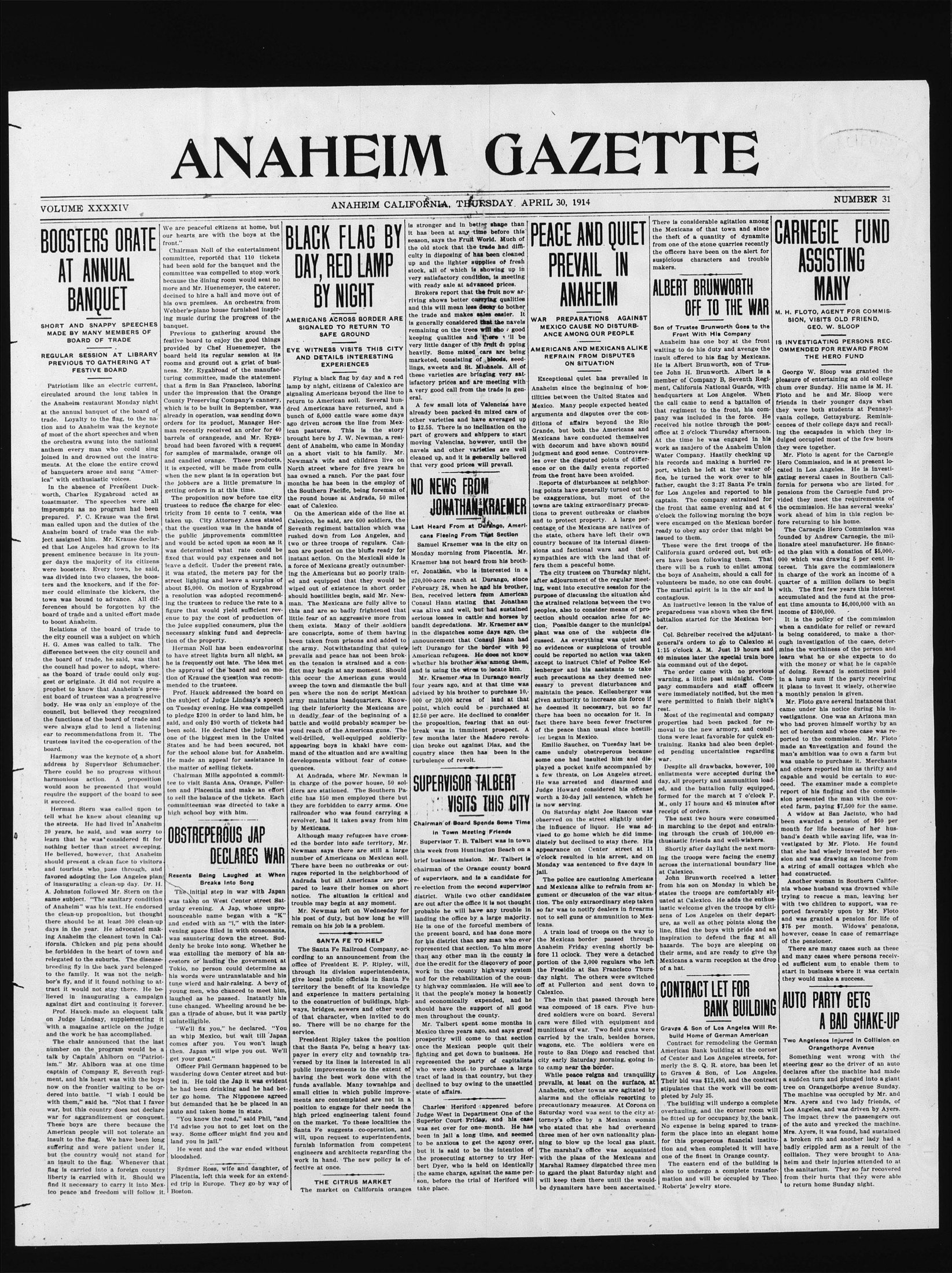
Searchable text
BOOSTERS ORATE AT ANNUAL BANQUET
SHORT AND SNAPPY SPEECHES MADE BY MANY MEMBERS OF BOARD OF TRADE
REGULAR SESSION AT LIBRARY PREVIOUS TO GATHERING AT FESTIVE BOARD
Patriotism like an electric current, circulated around the long tables in the Anaheim restaurant Monday night at the annual banquet of the board of trade. Loyalty to the flag, to the nation and to Anaheim was the keynote of most of the short speeches and when the orchestra swung into the national anthem every man who could sing joined in and drowned out the instruments. At the close the entire crowd of banqueters arose and sang "Amer-
We are peaceful citizens at home, but our hearts are with the boys at the front."
Chairman Noll of the entertainment committee, reported that 110 tickets had been sold for the banquet and the committee was compelled to stop work because the dining room would seat no more and Mr. Huenemeyer, the caterer, declined to hire a hall and move out of his own premises. An orchestra from Webber's piano house furnished inspiring music during the progress of the banquet.
Previous to gathering around the festive board to enjoy the good things provided by Chef Huenemeyer, the board held its regular session at its rooms and ground out a grist of business. Mr. Eygabroad of the manufacturing committee, made the statement that a firm in San Francisco, laboring under the impression that the Orange County Preserving Company's cannery, which is to be built in September, was already in operation, was sending down orders for its product, Manager Herrman recently received an order for 40 barrels of orangeade, and Mr. Eygabroad had been favored with a request for samples of marmalade, orange oil and candied orange. These products, it is expected, will be made from culls when the new plant is in operation but...
Patriotism like an electric current, circulated around the long tables in the Anaheim restaurant Monday night at the annual banquet of the board of trade. Loyalty to the flag, to the nation and to Anaheim was the keynote of most of the short speeches and when the orchestra swung into the national anthem every man who could sing joined in and drowned out the instruments. At the close the entire crowd of banqueters arose and sang "America" with enthusiastic voices.
In the absence of President Duckworth, Charles Eygabroad acted as toastmaster. The speeches were all impromptu as no program had been prepared. F. C. Krause was the first man called upon and the duties of the Anaheim board of trade was the subject assigned him. Mr. Krause declared that Los Angeles had grown to its present eminence because in its younger days the majority of its citizens were boosters. Every town, he said, was divided into two classes, the boosters and the knockers, and if the former could eliminate the kickers, the town was bound to advance. All differences should be forgotten by the board of trade and a united effort made to boost Anaheim.
Relations of the board of trade to the city council was a subject on which H. G. Ames was called to talk. The difference between the city council and the board of trade, he said, was that the council had power to adopt, whereas the board of trade could only suggest or originate. It did not require a prophet to know that Anaheim's present board of trustees was a progressive body. He was only an employee of the council, but believed they recognized the functions of the board of trade and were always glad to lend a listening ear to recommendations from it. The trustees invited the co-operation of the board.
Harmony was the keynote of a short address by Supervisor Schumacher. There could be no progress without harmonious action. A proposition would soon be presented that would require the support of the board to see it succeed.
Herman Stern was called upon to tell what he knew about cleaning up the streets. He had lived in Anaheim 20 years, he said, and was sorry to learn that he was considered fit for nothing better than street sweeping. He believed, however, that Anaheim should present a clean face to visitors and tourists who pass through, and favored adopting the Los Angeles plan of inaugurating a clean-up day. Dr. H. A. Johnston followed Mr. Stern on the same subject.
OBSTREPEROUS JAP DECLARES WAR
Resents Being Laughed at When Breaks Into Song
The initial step in war with Japan turing committee, made the statement that a firm in San Francisco, laboring under the impression that the Orange County Preserving Company's cannery, which is to be built in September, was already in operation, was sending down orders for its product, Manager Herrman recently received an order for 40 barrels of orangeade, and Mr. Eygabroad had been favored with a request for samples of marmalade, orange oil and candied orange. These products, it is expected, will be made from culls when the new plant is in operation but the jobbers are a little premature in getting orders in at this time.
The proposition now before the city trustees to reduce the charge for electricity from 10 cents to 7 cents, was taken up. City Attorney Ames stated that the question was in the hands of the public improvements committee and would be acted upon as soon as it was determined what rate could be fixed that would pay expenses and not leave a deficit. Under the present rate, it was stated, the meters pay for the street lighting and leave a surplus of about $5,000. On motion of Eygabroad a resolution was adopted recommending the trustees to reduce the rate to a figure that would yield sufficient revenue to pay the cost of production of the juice supplied consumers, plus the necessary sinking fund and depreciation of the property.
Herman Noll has been endeavoring to have street lights burn all night, as he is frequently out late. The idea met the approval of the board and on motion of Krause the question was recommended to the trustees.
Prof. Hauck addressed the board on the subject of Judge Lindsay's speech on Tuesday evening. He was compelled to pledge $200 in order to land him, he said, and only $90 worth of tickets had been sold. He declared the judge was one of the biggest men in the United States and he had been secured, not for the school alone but for Anaheim. He made an appeal for assistance in the matter of selling tickets.
Chairman Mills appointed a committee to visit Santa Ana, Orange, Fullerton and Placentia and make an effort to sell the balance of the tickets. Each committeeman was directed to take a high school boy with him.
Flying a black flag by night, citizens signaling Americans be return to American soil dredred Americans have bunch of 5,000 cattle wago driven across their pastures. This brought here by J. W. Dent of Anaheim, who on a short visit to his Newman's wife and on North street where foxes has owned a ranch. For months he has been in the Southern Pacific, by the round house at An East of Calexico.
On the American side Calexico, he said, are Seventh regiment battles rushed down from La two or three troops o non are posted on their instant action. On there a force of Mexicans greeting the Americans but ed and equipped that wiped out of existence should hostilities begin man. The Mexicans this and are so badly little fear of an aggre them exists. Many are conscripts, some been taken from prison army. Notwithstanding prevails and peace ha en the tension is strafict may begin at any this occur the Ameri sweep the town and open where the non d army maintains head ing their inferiority t in deadly fear of th battle and would prob yond reach of the Am well-drilled, well-equ appearing boys in k mand of the situation developments without quences.
At Andrada, where in charge of the pow diers are stationed. T cicific has 150 men em they are forbidden to railroader who was revolver, had it taken by Mexicans.
Although many refed the border into sa Newman says there no number of Americans There have been no rages reported in th Andrada but all Am paared to leave their notice. The situatio
Herman Stern was called upon to tell what he knew about cleaning up the streets. He had lived in Anaheim 20 years, he said, and was sorry to learn that he was considered fit for nothing better than street sweeping. He believed, however, that Anaheim should present a clean face to visitors and tourists who pass through, and favored adopting the Los Angeles plan of inaugurating a clean-up day. Dr. H. A. Johnston followed Mr. Stern on the same subject. "The sanitary condition of Anaheim" was his text. He endorsed the clean-up proposition, but thought there should be at least 300 clean-up days in the year. He advocated making Anaheim the cleanest town in California. Chicken and pig pens should be forbidden in the heart of town and relegated to the suburbs. The disease-breeding fly in the back yard belonged to the family. It was not the neighbor's fly, and if it found nothing to attract it would not stay there. He believed in inaugurating a campaign against dirt and continuing it forever.
Prof. Hauck made an eloquent talk on Judge Lindsay, supplementing it with a magazine article on the judge and the work he has accomplished.
The chair announced that the last number on the program would be a talk by Captain Ahlborn on "Patriotism." Mr. Ahlborn was at one time captain of Company E, Seventh regiment, and his heart was with the boys now on the frontier waiting to be ordered into battle. "I wish I could be with them," said he. "Not that I favor war, but this country does not declare war for aggrandizement or conquest. These boys are there because the American people will not tolerate an insult to the flag. We have been long suffering and were patient under it, but the country would not stand for an insult to the flag. Whenever that flag is carried into a foreign country liberty is carried with it. Should we find it necessary to carry it into Mexico peace and freedom will follow it.
OBSTREPEROUS JAP DECLARES WAR
Resents Being Laughed at When Breaks Into Song
The initial step in war with Japan was taken on West Center street Saturday evening. A Jap, whose unpronounceable name began with a "K" and ended with an "i," with the intervening space filled in with consonants, was sauntering down the street. Suddenly he broke into song. Whether he was extolling the memory of his ancestors or lauding the government at Tokio, no person could determine as his words were untranslatable and his tune wierd and hair-raising. A bevy of young men, who chanced to meet him, laughed as he passed. Instantly his tune changed. Wheeling around he began a tirade of abuse, but it was partly unintelligible.
"We'll fix you," he declared. "You an whip Mexico, but wait till Japan comes after you. You won't laugh then. Japan will wipe you out. We'll get your goat."
Officer Phil Germann happened to be wandering down Center street and butted in. He told the Jap it was evident he had been drinking and he had better go home. The Nipponese agreed but demanded that he be placed in an auto and taken home in state.
"You know the road," said Phil, "and I'd advise you not to get lost on the way. Some officer might find you and land you in jail."
He went and the war ended without bloodshed.
Sydmer Ross, wife and daughter, of Placentia, left this week for an extended trip in Europe. They go by way of Boston.
AHEIM GAZETE
ANAHEIM CALIFORNIA, THURSDAY. APRIL 30, 1914
BLACK FLAG BY DAY, RED LAMP BY NIGHT
AMERICANS ACROSS BORDER ARE SIGNALED TO RETURN TO SAFE GROUND
EYE WITNESS VISITS THIS CITY AND DETAILS INTERESTING EXPERIENCES
Flying a black flag by day and a red lamp by night, citizens of Calexico are signaling Americans beyond the line to return to American soil. Several hundred Americans have returned, and a bunch of 5,000 cattle were some days ago driven across the line from Mexican pastures. This is the story brought here by J. W. Newman, a resident of Anaheim, who came in Monday on a short visit to his family. Mr. Newman's wife and children live on North street where for five years he has owned a ranch. For the past four is stronger and in better shape than it has been at any time before this season, says the Fruit World. Much of the old stock that the trade had difficulty in disposing of has been cleaned up and the lighter supplies of fresh stock, all of which is showing up in very satisfactory condition, is meeting with ready sale at advanced prices.
Brokers report that the fruit now arriving shows better carrying qualities and this will mean less decay to bother the trade and makes sales easier. It is generally considered that the navels remaining on the trees will show good keeping qualities and there will be very little danger of the fruit dropping heavily. Some mixed cars are being marketed, consisting of bloods, seedlings, sweets and St. Michael's. All of these varieties are bringing very satisfactory prices and are meeting with a very good call from the trade in general.
A few small lots of Valencias have already been packed in mixed cars of other varieties and have averaged up to $2.55. There is no inclination on the part of growers and shippers to start moving Valencias, however, until the navels and other varieties are well cleaned up, and it is generally believed that very good prices will prevail.
PEACE AND QUIET PREVAIL IN ANAHEIM
WAR PREPARATIONS AGAINST MEXICO CAUSE NO DISTURBANCE AMONG OUR PEOPLE
AMERICANS AND MEXICANS ALike REFRAIN FROM DISPUTES ON SITUATION
Exceptional quiet has prevailed in Anaheim since the beginning of hostilities between the United States and Mexico. Many people expected heated arguments and disputes over the conditions of affairs beyond the Rio Grande, but both the Americans and Mexicans have conducted themselves with decorum and have shown sound judgment and good sense. Controversies over the disputed points of difference or on the daily events reported from the front have been avoided.
Flying a black flag by day and a red lamp by night, citizens of Calexico are signaling Americans beyond the line to return to American soil. Several hundred Americans have returned, and a bunch of 5,000 cattle were some days ago driven across the line from Mexican pastures. This is the story brought here by J. W. Newman, a resident of Anaheim, who came in Monday on a short visit to his family. Mr. Newman's wife and children live on North street where for five years he has owned a ranch. For the past four months he has been in the employ of the Southern Pacific, being foreman of the round house at Andrada, 50 miles east of Calexico.
On the American side of the line at Calexico, he said, are 600 soldiers, the Seventh regiment battalion which was rushed down from Los Angeles, and two or three troops of regulars. Cannon are posted on the bluffs ready for instant action. On the Mexicali side is a force of Mexicans greatly outnumbering the Americans but so poorly trained and equipped that they would be wiped out of existence in short order should hostilities begin, said Mr. Newman. The Mexicans are fully alive to this and are so badly frightened that little fear of an aggressive more from them exists. Many of their soldiers are conscripts, some of them having been taken from prisons and added to the army. Notwithstanding that quiet prevails and peace has not been broken the tension is strained and a conflict may begin at any moment. Should this occur the American guns would sweep the town and dismantle the bull pen where the non de script Mexican army maintains headquarters. Knowing their inferiority the Mexicans are in deadly fear of the beginning of a battle and would probably scamper beyond reach of the American guns. The well-drilled, well-equipped soldierly-appearing boys in khaki have command of the situation and are awaiting developments without fear of consequences.
At Andrada, where Mr. Newman is in charge of the power house, 50 soldiers are stationed. The Southern Pacific has 150 men employed there but they are forbidden to carry arms. One railroader who was found carrying a revolver, had it taken away from him by Mexicans.
Although many refugees have crossed the border into safe territory, Mr. Newman says there are still a large number of Americans on Mexican soil. There have been no outbreaks or outrages reported in the neighborhood of Andrada but all Americans are prepared to leave their homes on short notice. The situation is critical andExceptional quiet has prevailed in Anaheim since the beginning of hostilities between the United States and Mexico. Many people expected heated arguments and disputes over the conditions of affairs beyond the Rio Grande, but both the Americans and Mexicans have conducted themselves with decorum and have shown sound judgment and good sense. Controversies over the disputed points of difference or on the daily events reported from the front have avoided.
Reports of disturbances at neighboring points have generally turned out to be exaggerations, but most of the towns are taking extraordinary precautions to prevent outbreaks or clashes and to protect property. A large percentage of the Mexicans are natives of the state, others have left their own country because of its internal dissensions and factional wars and their sympathies are with the land that offers them a peaceful home.
The city trustees on Thursday night, after adjournment of the regular meeting, went into executive session for the purpose of discussing the situation and the strained relations between the two peoples, also to consider means of protection should occasion arise for action: Possible danger to the municipal plant was one of the subjects discussed. As everything was quiet and no evidences or suspicions of trouble could be reported no action was taken except to instruct Chief of Police Kellenberger and his assistants to take such precautions as they deemed necessary to prevent disturbances and maintain the peace. Kellenberger was given authority to increase his force if he deemed it necessary, but so far there has been no occasion for it. In fact there have been fewer fractures of the peace than usual since hostilities began in Mexico.
Emilio Sauchez, on Tuesday last became unduly obstreperous because some one had insulted him and displayed a pocket knife accompanied by a few threats, on Los Angeles street. He was arrested and disarmed and Judge Howard considered his offense worth a 30-day jail sentence, which he is now serving.
On Saturday night Joe Rascon was observed on the street slightly under the influence of liquor. He was advised to go home which he did immediately but declined to stay there. His appearance on Center street at 11 o'clock resulted in his arrest, and on Monday was sentenced to five days in jail.
The police are cautioning Americans and Mexicans alike to refrain from argument or discussion of the war situa-
SANTA FE TO HELP
The Santa Fe Railroad Company, according to an announcement from the office of President E. P. Ripley, will, through its division superintendents, give local public officials in Santa Fe territory the benefit of its knowledge and experience in matters pertaining to the construction of buildings, highways, bridges, sewers and other work of that character, when invited to do so. There will be no charge for the service.
President Ripley takes the position that the Santa Fe, being a heavy taxpayer in every city and township traversed by its lines is interested in all public improvements to the extent of having the best work done with the funds available. Many townships and small cities in which public improvements are contemplated are not in a position to engage for their needs the high priced engineering talent found on the market. To these localities the Santa Fe suggests co-operation, and will, upon request to superintendents, furnish information from competent engineers and architects regarding the work in hand. The new policy is effective at once.
THE CITRUS MARKET
The market on California oranges
Chairman of Board Spends Some Time in Town Meeting Friends
Supervisor T. B. Talbert was in town this week from Huntington Beach on a brief business mission. Mr. Talbert is chairman of the Orange county board of supervisors, and is a candidate for re-election from the second supervisor district. While two other candidates are out after the office it is not thought probable he will have any trouble in landing the office by a large majority. He is one of the forceful members of the present board, and has done more for his district than any man who ever represented that section. To him more than any other man in the county is due the credit for the discovery of poor work in the county highway system and for the rehabilitation of the county highway commission. He will see to it that the people's money is honestly and economically expended, and he should have the support of all good men throughout the county.
Mr. Talbert spent some months in Mexico three years ago, and says great prosperity will come to that section once the Mexican people quit their fighting and get down to business. He represented the party of capitalists who were about to purchase a large tract of land in that country, but they declined to buy owing to the unsettled state of affairs.
Charles Heriford appeared before Judge West in Department One of the Superior Court Friday, and his case was set over for one month. He has been in jail a long time, and seemed to be anxious to get the agony over, but it is said to be the intention of the prosecuting attorney to try Herbert Dyer, who is held on identically the same charge, against the same person, before the trial of Heriford will take place.
On Saturday night Joe Rascon was observed on the street slightly under the influence of liquor. He was advised to go home which he did immediately but declined to stay there. His appearance on Center street at 11 o'clock resulted in his arrest, and on Monday was sentenced to five days in jail.
The police are cautioning Americans and Mexicans alike to refrain from argument or discussion of the war situation. The only extraordinary step taken so far was to notify dealers in firearms not to sell guns or ammunition to Mexicans.
A train load of troops on the way to the Mexican border passed through Anaheim Friday evening shortly before 11 o'clock. They were a detached portion of the 3,000 regulars who left the Presidio at San Francisco Thursday night. The others were switched off at Fullerton and sent down to Calexico.
The train that passed through here was composed of 18 cars. Five hundred soldiers were on board. Several cars were filled with equipment and munitions of war. Two field guns were carried by the train, besides horses, wagons, etc. The soldiers were en route to San Diego and reached that city early Saturday morning, going into camp near the border.
While peace reigns and tranquility prevails, at least on the surface, at Anaheim, other towns are agitated by alarms and the officials resorting to precautionary measures. At Corona on Saturday word was sent to the city attorney's office by a Mexican woman who stated that she had overheard three men of her own nationality planning to blow up the local gas plant. The marshal's office was acquainted with the plans of the Mexicans and Marshal Ramsey dispatched three men to guard the plant Saturday night and will keep them there until the would-be dynamitors have been ascertained.
CETTE
NUMBER 31
D QUIET IN EIM
ONS AGAINST NO DISTURB-OUR PEOPLE
MEXICANS ALIKE DISPUTES ACTION
has prevailed in beginning of hos-United States and expected heated states over the con-beyond the Rio Americans and instructed themselves have shown sound sense. Controversial points of differ-events reported been avoided.
There is considerable agitation among the Mexicans of that town and since the theft of a quantity of dynamite from one of the stone quarries recently the officers have been on the alert for suspicious characters and trouble makers.
ALBERT BRUNWORTH OFF TO THE WAR
Son of Trustee Brunworth Goes to the Front With His Company
Anaheim has one boy at the front waiting to do his duty and avenge the insult offered to his flag by Mexicans. He is Albert Brunworth, son of Trustee John H. Brunworth. Albert is a member of Company B, Seventh Regiment, California National Guards, with headquarters at Los Angeles. When the call came to send a battalion of that regiment to the front, his company was included in the force. He received his notice through the post-office at 2 o'clock Thursday afternoon. At the time he was engaged in his work as zanjero of the Anaheim Union Water Company. Hastily checking up his records and making a hurried report, which he left at the water of-
CARNEGIE FUND ASSISTING MANY
M. H. FLOTO, AGENT FOR COMMISSION, VISITS OLD FRIEND,
GEO. W. SLOOP
IS INVESTIGATING PERSONS RECOMMENDED FOR REWARD FROM THE HERO FUND
George W. Sloop was granted the pleasure of entertaining an old college chum over Sunday. His name is M. H. Floto and he and Mr. Sloop were friends in their younger days when they were both students at Pennsylvania college, Gettsysburg. Reminiscences of their college days and recalling the escapades in which they indulged occupied most of the few hours they were together.
Mr. Floto is agent for the Carnegie Hero Commission, and is at present located in Los Angeles. He is investi-
has prevailed in the beginning of hostilities United States and expected heated states over the confluence beyond the Rio Grande Americans and instructed themselves have shown sound sense. Controversial points of differing events reported been avoided.
On Thursday night, at the regular meet-session for the situation and between the two sides means of provision arise for action to the municipal subjects discharging was quiet and explications of trouble in action was taken chief of Police Kellassistants to take they deemed necessary disturbances and Kellenberger was increase his force if necessary, but so far occasion for it. In fewer fractures unusual since hostilities Tuesday last be reperous because suited him and dis-友e accompanied by Los Angeles street, and disarmed and disordered his offense sentence, which he at Joe Rascon was slightly under guar. He was ad-hoc which he did immensely stay there. His enter street at 11 this arrest, and on proceed to five days in outlining Americans to refrain from arraignment of the war situ-
member of Company B, Seventh Regiment, California National Guards, with headquarters at Los Angeles. When the call came to send a battalion of that regiment to the front, his company was included in the force. He received his notice through the post-office at 2 o'clock Thursday afternoon. At the time he was engaged in his work as zanjero of the Anaheim Union Water Company. Hastily checking up his records and making a hurried report, which he left at the water office, he turned the work over to his father, caught the 3:27 Santa Fe train for Los Angeles and reported to his captain. The company entrained for the front that same evening and at 6 o'clock the following morning the boys were encamped on the Mexican border ready to obey any order that might be issued to them.
These were the first troops of the California guard ordered out, but others have been following them. That there will be a rush to enlist among the boys of Anaheim, should a call for volunteers be made, no one can doubt. The martial spirit is in the air and is contagious.
An instructive lesson in the value of preparedness was shown when the first battalion started for the Mexican border.
Col. Schreiber received the adjutant-general's orders to go to Calexico at 1:15 o'clock A.M. Just 19 hours and 40 minutes later the special train bore his command out of the depot.
The order came with no previous warning, a little past midnight. Company commanders and staff officers were immediately notified, but the men were permitted to finish their night's rest.
Most of the regimental and company properties had been packed for removal to the new armory, and conditions were least favorable for quick training. Ranks had also been depleted pending uncertainties regarding war.
Despite all drawbacks, however, 100 enlistments were accepted during the day, all property and ammunition loaded, and the battalion fully equipped, formed for the march at 7 o'clock P.M., only 17 hours and 45 minutes after receipt of orders.
The next two hours were consumed in marching to the depot and entrailing through the crush of 100,000 enthusiastic friends and well-wishers.
Shortly after daylight the next morning the troops were facing the enemy across the international boundary line at Calexico.
John Brunworth received a letter from his son on Monday in which he states the troops are comfortably situated at Calexico. He adds the enthuse pleasure of entertaining an old college chum over Sunday. His name is M. H. Floto and he and Mr. Sloop were friends in their younger days when they were both students at Pennsylvania college, Gettsysburg. Reminiscences of their college days and recalling the escapades in which they indulged occupied most of the few hours they were together.
Mr. Floto is agent for the Carnegie Hero Commission, and is at present located in Los Angeles. He is investigating several cases in Southern California for persons who are listed for pensions from the Carnegie fund provided they meet the requirements of the occommission. He has several weeks' work ahead of him in this region before returning to his home.
The Carnegie Hero Commission was founded by Andrew Carnegie, the millionaire steel manufacturer. He financed the plan with a donation of $5,000,-000 which was drawing 5 per cent interest. This gave the commissioners in charge of the work an income of a quarter of a million dollars to begin with. The first few years this interest accumulated and the fund at the present time amounts to $6,000,000 with an income of $300,000.
It is the policy of the commission when a candidate for relief or reward is being considered, to make a thorough investigation of the case, determine the worthiness of the person and learn what he or she expects to do with the money or what he is capable of doing. Reward is sometimes paid in a lump sum if the party receiving it plans to invest it wisely, otherwise a monthly pension is given.
Mr. Floto gave several instances that came under his notice during his investigations. One was an Arizona man who had proven himself worthy by an act of heroism and whose case was reported to the commission. Mr. Floto made an investigation and found the man's ambition was to own a farm but was unable to purchase it. Merchants and others reported him as thrifty and capable and would be certain to succeed. The examiner made a complete report of his finding and the commission presented the man with the coveted farm, paying $7,500 for the same.
A widow at San Jacinto, who had been awarded a pension of $60 per month for life because of her husband's death while saving life, was investigated by Mr. Floto. He found that she had wisely invested her pension and was drawing an income from a string of small cottages which she had constructed.
Another woman in Southern California whose husband was drowned while trying to rescue a man, leaving her
CONTRACT LET FOR BANK BUILDING
Graves & Son of Los Angeles Will Rebuild Home of German American
Contract for remodeling the German American Bank building at the corner of Center and Los Angeles streets, formerly the S. Q. R. store, has been let to Graves & Son, of Los Angeles. Their bid was $12,490, and the contract stipulates that the work will be completed by July 25.
The building will undergo a complete overhauling, and the corner room will be fitted up for occupancy by the bank. No expense is being spared to transform the place into an elegant home for this prosperous financial institution and when completed it will have one of the finest in Orange county.
The eastern end of the building is also to undergo a complete transformation and will be occupied by Theo Roberts' jewelry store.
AUTO PARTY GETS A BAD SHAKE-UP
Two Angelenos Injured in Collision on Orangethorpe Avenue
Something went wrong with the steering gear so the driver of an auto declares after the machine had made a sudden turn and plunged into a giant tree on Orangethorpe avenue Sunday. The machine was occupied by Mr. and Mrs. Ayers and two lady friends, of Los Angeles, and was driven by Ayers. The impact threw the passengers out of the auto and wrecked the machine. Mrs. Ayers, it was found, had sustained a broken rib and another lady had a badly crippled arm as a result of the collision. They were brought to Anaheim and their injuries attended to at the sanitarium. They so far recovered from their hurts that they were able to return home Sunday night.