anaheim-gazette 1914-03-12
Scanned page
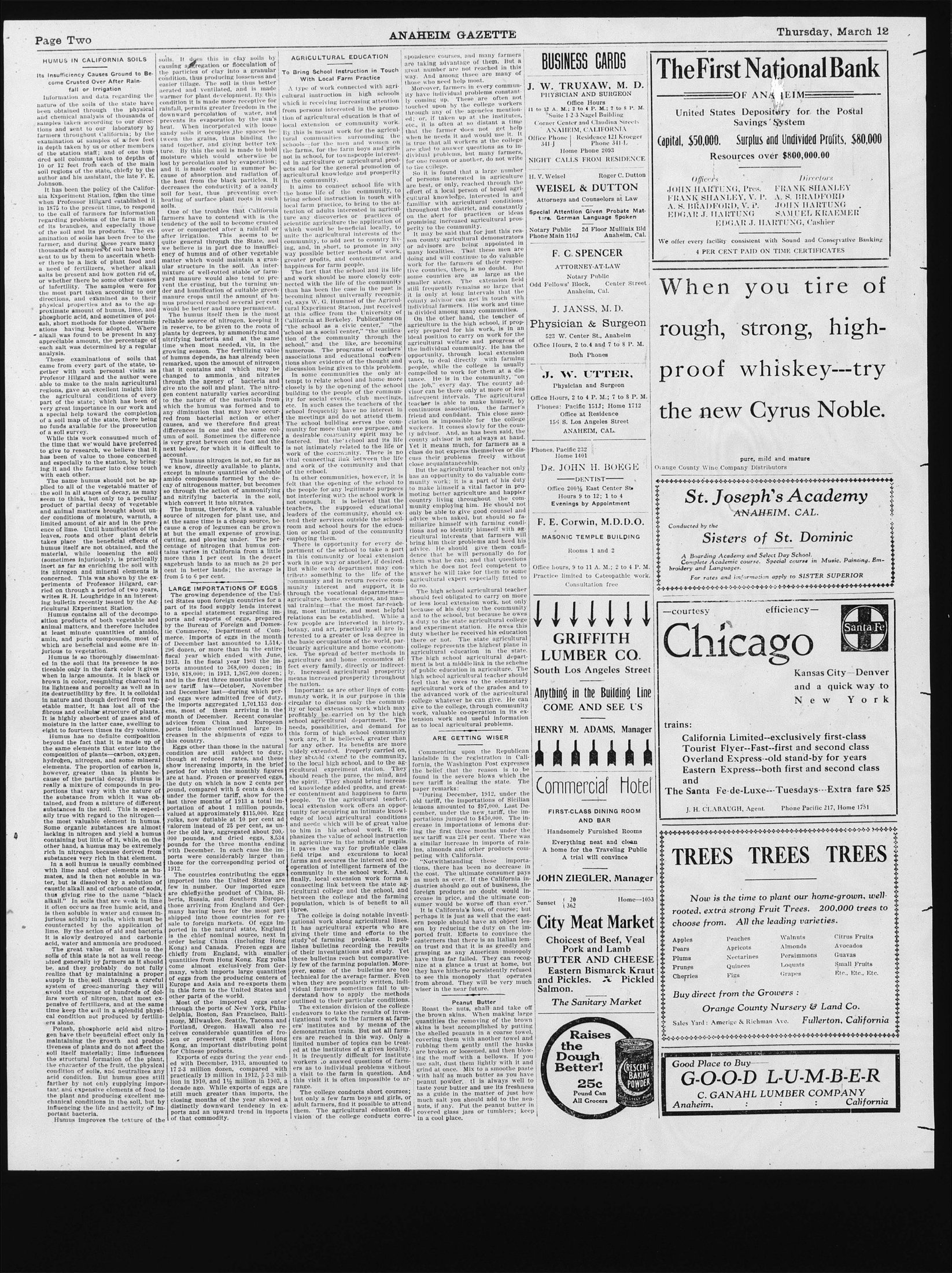
Searchable text
HUMUS IN CALIFORNIA SOILS
Its Insufficiency Causes Ground to Become Crusted Over After Rainfall or Irrigation
Information and data regarding the nature of the soils of the state have been obtained through the physical and chemical analysis of thousands of samples taken according to our directions and sent to our laboratory by farmers throughout California; by the examination of samples of a few feet in depth taken by us or other members of the station staff; and of one hundred soil columns taken to depths of 10 or 12 feet from each of the main soil regions of the state, chiefly by the author and his assistant, the late F. E. Johnson.
It has been the policy of the California Experiment Station, from the time when Professor Hilgard established it in 1875 to the present time, to respond to the call of farmers for information regarding problems of the farm in all of its branches, and especially those of the soil and its products. The examination of soils has been free to the farmer, and during these years many thousands of samples of soil have been sent to us by them to ascertain whether there be a lack of plant food and a need of fertilizers, whether alkali salts be present and how gotten rid of, or whether there be some other causes of infertility. The samples were for the most part taken according to our directions, and examined as to their physical properties and as to the approximate amount of humus, lime, and phosphoric acid, and sometimes potash, short methods for these determinations having been adopted. Where alkali was found to be present in any appreciable amount, the percentage of each salt was determined by a regular analysis.
These examinations of soils that came from every part of the state, together with such personal visits as Professor Hilgard and the author were able to make to the main agricultural regions, gave an excellent insight into the agricultural conditions of every part of the state; which has been of very great importance in our work and a special help toward the completion of a soil map of the state, there being no funds available for the prosecution of a soil survey.
While this work consumed much of the time that we would have preferred to give to research, we believe that it has been of value to those concerned and especially to the station, by bringing it and the farmer into close touch with each other.
soils. It does this in clay soils by causing aggregation or flocculation of the particles of clay into a granular condition, thus producing losseness and easier tillage. The soil is thus better aerated and ventilated, and is made warmer for plant development. By this condition it is made more receptive for rainfall, permits greater freedom in the downward percolation of water, and prevents its evaporation by the sun's heat. When incorporated with loose sandy soils it occupies the spaces between the grains, thus binding the sand together, and giving better texture. By this the soil is made to hold moisture which would otherwise be lost by percolation and by evaporation; and it is made cooler in summer because of absorption and radiation of the heat from the black particles. It decreases the conductivity of a sandy soil for heat, thus preventing overheating of surface plant roots in such soils.
One of the troubles that California farmers have to contend with is the tendency of the soil to become crusted over or compacted after a rainfall or after irrigation. This seems to be quite general through the State, and we believe is in part due to insufficiency of humus and of other vegetable matter which would maintain a granular structure in the soil. An intermixture of well-rotted stable or farmyard manure would also tend to prevent the crusting, but the turning under and humification of suitable greenmanure crops until the amount of humus produced reached several per cent would be better and more permanent.
The humus itself then is the most reliable source of nitrogen, keeping it in reserve, to be given to the roots of plants by degrees, by ammonifying and nitrifying bacteria and at the same time when most needed, viz., in the growing season. The fertilizing value of humus depends, as has already been remarked, upon the amount of nitrogen that it contains and which may be changed to ammonia, and nitrates through the agency of bacteria and give into the soil and plant. The nitrogen content naturally varies according to the nature of the materials from which the humus was formed and to any diminution that may have occurred from bacterial action or other causes, and we therefore find great differences in one and the same column of soil. Sometimes the difference is very great between one foot and the next below, for which it is difficult to account.
This humus nitrogen is not, so far as we know, directly available to plants, except in minute quantities of soluble
AGRICULTURAL EDGES
To Bring School Instruction With Local Farm
A type of work connected cultural instruction in which is receiving increased from persons interested in education local extension or compartment. By this is meant work for rural communities such schools—for the men at the farms, for the farmers not in school, for towns not in agriculture or agriculture and for the general agricultural knowledge in the community.
It aims to connect school life with bring school instruction locally farm practice, to mention adults interest in discoveries or scientific agriculture that which would be beneficial unite the agricultural community, to add zesting ing, and, in short, to provide way possible better means greater profits, and contribute happiness for farm people.
The fact that the school and work should be more connected with the life of than has been the case becoming almost universally says W. G. Hummel's experimental Station at this office from the California at Berkeley.
"The school as a civic school as a social center of the community school," and the like numerous. The program associations and educations show evidence of discussion being given.
In some communities tempt to relate school closely is by the opening building to the people city for social events, etc. In such cases they school frequently have meetings and do not form a desirable community fostered. But the school is not intimately related work of the community vital connecting link to and work of the commu
Professor Hilgard and the author were able to make to the main agricultural regions, gave an excellent insight into the agricultural conditions of every part of the state; which has been of very great importance in our work and a special help toward the completion of a soil map of the state, there being no funds available for the prosecution of a soil survey.
While this work consumed much of the time that we would have preferred to give to research, we believe that it has been of value to those concerned and especially to the station, by bringing it and the farmer into close touch with each other.
The name humus should not be applied to all of the vegetable matter of the soil in all stages of decay, as many seem to think, but only to a peculiar product of partial decay of vegetable and animal matters brought about under conditions of moisture, warmth, a limited amount of air and in the presence of lime. Until humification of the leaves, roots and other plant debris takes place the beneficial effects of humus itself are not obtained, and the material, while loosening the soil (sometimes injuriously), is practically inert as far as enriching the soil with its nitrogen and mineral elements is concerned. This was shown by the experiments of Professor Hilgard, carried on through a period of two years, writes R. H. Loughridge in an interesting bulletin recently issued by the Agricultural Experiment Station.
Humus contains all of the decomposition products of both vegetable and animal matters, and therefore includes at least minute quantities of amido, amin, and purin compounds, most of which are beneficial and some are injurious to vegetation.
Humus is so thoroughly disseminated in the soil that its presence is noticeable only in the dark color it gives when in large amounts. It is black or brown in color, resembling charcoal in its lightness and porosity as well as in its destructibility by fire. It is colloidal in nature and though derived from vegetable matter, it has lost all of the fibrous and cellular structure of plants. It is highly absorbent of gases and of moisture in the latter case, swelling to eight to fourteen times its dry volume.
Humus has no definite composition beyond the fact that it is made up of the same elements that enter into the composition of plants—carbon, oxygen, hydrogen, nitrogen, and some mineral elements. The proportion of carbon is, however, greater than in plants because of the partial decay. Humus is really a mixture of compounds in proportions that vary with the nature of the substance from which it was obtained, and from a mixture of different substances in the soil. This is especially true with regard to the nitrogen—the most valuable element in humus. Some organic substances are almost lacking in nitrogen and yield a humus containing but little of it, while, on the other hand, a humus may be extremely rich in nitrogen because derived from substances very rich in that element.
In a soil humus is usually combined with lime and other elements as humates, and is then not soluble in water, but is dissolved by a solution of caustic alkali and of carbonate of soda, thus giving rise to the name "black Professor Hilgard and the author were able to make to the main agricultural regions, gave an excellent insight into the agricultural conditions of every part of the state; which has been of very great importance in our work and a special help toward the completion of a soil map of the state, there being no funds available for the prosecution of a soil survey.
While this work consumed much of the time that we would have preferred to give to research, we believe that it has been of value to those concerned and especially to the station, by bringing it and the farmer into close touch with each other.
The name humus should not be applied to all of the vegetable matter of the soil in all stages of decay, as many seem to think, but only to a peculiar product of partial decay of vegetable and animal matters brought about under conditions of moisture, warmth, a limited amount of air and in the presence of lime. Until humification of the leaves, roots and other plant debris takes place the beneficial effects of humus itself are not obtained, and the material, while loosening the soil (sometimes injuriously), is practically inert as far as enriching the soil with its nitrogen and mineral elements is concerned. This was shown by the experiments of Professor Hilgard, carried on through a period of two years, writes R. H. Loughridge in an interesting bulletin recently issued by the Agricultural Experiment Station.
Humus contains all of the decomposition products of both vegetable and animal matters, and therefore includes at least minute quantities of amido, amin, and purin compounds, most of which are beneficial and some are injurious to vegetation.
Humus is so thoroughly disseminated in the soil that its presence is noticeable only in the dark color it gives when in large amounts. It is black or brown in color, resembling charcoal in its lightness and porosity as well as in its destructibility by fire. It is colloidal in nature and though derived from vegetable matter, it has lost all of the fibrous and cellular structure of plants. It is highly absorbent of gases and of moisture in the latter case, swelling to eight to fourteen times its dry volume.
Humus has no definite composition beyond the fact that it is made up of the same elements that enter into the composition of plants—carbon, oxygen, hydrogen, nitrogen, and some mineral elements. The proportion of carbon is, however, greater than in plants because of the partial decay. Humus is really a mixture of compounds in proportions that vary with the nature of the substance from which it was obtained, and from a mixture of different substances in the soil. This is especially true with regard to the nitrogen—the most valuable element in humus. Some organic substances are almost lacking in nitrogen and yield a humus containing but little of it, while, on the other hand, a humus may be extremely rich in nitrogen because derived from substances very rich in that element.
In a soil humus is usually combined with lime and other elements as humates, and is then not soluble in water, but is dissolved by a solution of caustic alkali and of carbonate of soda, thus giving rise to the name "black Professor Hilgard and the author were able to make to the main agricultural regions, gave an excellent insight into the agricultural conditions of every part of the state; which has been of value to those concerned and especially to the station, by bringing it and the farmer into close touch with each other.
The name humus should not be applied to all of the vegetable matter of the soil in all stages of decay, as many seem to think, but only to a peculiar product of partial decay of vegetable and animal matters brought about under conditions of moisture, warmth, a limited amount of air and in the presence of lime. Until humification of the leaves, roots and other plant debris takes place the beneficial effects of humus itself are not obtained, and the material, while loosening the soil (sometimes injuriously), is practically inert as far as enriching the soil with its nitrogen and mineral elements is concerned. This was shown by the experiments of Professor Hilgard, carried on through a period of two years, writes R. H. Loughridge in an interesting bulletin recently issued by the Agricultural Experiment Station.
Humus contains all of the decomposition products of both vegetable and animal matters, and therefore includes at least minute quantities of amido, amin, and purin compounds, most of which are beneficial and some are injurious to vegetation.
Humus is so thoroughly disseminated in the soil that its presence is noticeable only in the dark color it gives when in large amounts. It is black or brown in color, resembling charcoal in its lightness and porosity as well as in its destructibility by fire. It is colloidal in nature and though derived from vegetable matter, it has lost all of the fibrous and cellular structure of plants. It is highly absorbent of gases and of moisture in the latter case, swelling to eight to fourteen times its dry volume.
Humus has no definite composition beyond the fact that it is made up of the same elements that enter into the composition of plants—carbon, oxygen, hydrogen, nitrogen, and some mineral elements. The proportion of carbon is, however, greater than in plants because of the partial decay. Humus is really a mixture of compounds in proportions that vary with the nature of the substance from which it was obtained, and from a mixture of different substances in the soil. This is especially true with regard to the nitrogen—the most valuable element in humus. Some organic substances are almost lacking in nitrogen and yield a humus containing but little of it, while, on the other hand, a humus may be extremely rich in nitrogen because derived from substances very rich in that element.
In a soil humus is usually combined with lime and other elements as humates, and is then not soluble in water, but is dissolved by a solution of caustic alkali and of carbonate of soda, thus giving rise to the name "black Professor Hilgard and the author were able to make to the main agricultural regions,gave an excellent insight into the agricultural conditions of every part of the state; which has been of value to those concerned and especially to the station,buying them.
There is opportunity department of the school in this community or work in one way or another. It is best teachers,the suppo leadersofthe commun tend their services out roomand school hours tion or social good off employing them.
There is opportunity department of the school in this community or work in one way or another. It is best teachers,the suppo leadersofthe commun tend their services out roomand school hours tion or social good off employing them.
There is opportunity department of the school in this community or work in one way or another. It is best teachers,the suppo leadersofthe commun tend their services out roomand school hours tion or social good off employing them.
Important as are other munity work,它是our circularto discuss onity or local extension profitably be carried outschool agricultural deeds,possibilities,andthis formofhigh school workareitisbelieveforkindownforanyother.Itsbe widely extended.Pro they should extendto治the local high schricultural experimentshould reachthepursuitthe spirit They should ed knowledgeadded per contentmentandhie people.Tothe agriglocal extensionworktunityfor acquiringan edgeof local agricul needandswhichwillhelptomhimin his school phasizesthevalueofain agricultureintheIt pavesthewayfor field tripsandexercisesthe operationof intelligentcommunityintheso finally.localextensionconnectinglinkbetweenriculturalcollegeandbetweenthecollege
In a soil humus is usually combined with lime and other elements as humates, and is then not soluble in water, but is dissolved by a solution of caustic alkali and of carbonate of soda, thus giving rise to the name "black alkali." In soils that are weak in lime it often occurs as free humic acid, and is then soluble in water and causes injurious acidity in soils, which must be counteracted by the application of lime. By the action of aid and bacteria it is slowly destroyed and carbonic acid, water and ammonia are produced.
The great value of humus to the soils of this state is not as well recognized generally by farmers as it should be, and they probably do not fully realize that by maintaining a proper supply in the soil through a careful system of green-manuring they will avoid the expense of hundreds of dollars worth of nitrogen, that most expensive of fertilizers, and at the same time keep the soil in a splendid physical condition not produced by fertilizers alone.
Potash, phosphoric acid and nitrogen have their beneficial effect only in maintaining the growth and productivity of plants and do not affect the soil itself materially; lime influences the structural formation of the plant, the character of the fruit, the physical condition of soils, and neutralizes any acid condition. But humus goes still farther by not only supplying important and expensive elements of food to the plant and producing excellent mechanical conditions in the soil, but by influencing the life and activity of important bacteria.
Humus improves the texture of the last three months of 1913 a total importation of about 1 million pounds, valued at approximately $115,000. Egg yolks, now dutiful at 10 per cent ad valorem instead of 25 per cent, as under the old law, aggregated about 200,000 pounds, and dried eggs, 8,534 pounds for the three months ending with December. In each case the imports were considerably larger than those for the corresponding period of 1912.
The countries contributing the eggs imported into the United States are few in number. Our imported eggs are chiefly the product of China, Siberia, Russia, and Southern Europe, those arriving from England and Germany having been for the most part shipped into those countries for resale to foreign markets. Of eggs imported in the natural state, England is the chief nominal source, next in order being China (including Hong Kong) and Canada. Frozen eggs are chiefly from England, with smaller quantities from Hong Kong. Egg yolks come almost exclusively from Germany, which imports large quantities of eggs from the producing centers of Europe and Asia and re-exports them in this form to the United States and other parts of the world.
Most of the imported eggs enter through the ports of New York, Philadelphia, Boston, San Francisco, Baltimore, Milwaukee, Seattle, Tacoma and Portland, Oregon. Hawaii also receives considerable quantities of frozen or preserved eggs from Hong Kong, an important distributing point for Chinese products.
Exports of eggs during the year ended with December, 1913, amounted to 17 2-3 million dozen, compared with practically 19 million in 1912, 5 2-3 million in 1910, and 1½ million in 1903, a decade ago. While exports of eggs are still much greater than imports, the closing months of the year showed a distinctly downward tendency in exports and an upward trend in imports of that commodity.
To the agrarian local extension work finally, local extension connecting link between agricultural college and between the college population, which is three.
The college is doing gational work along with it has agricultural giving their time and study of farming practices bulletins record of their investigation these bulletins reach few of the farming over, some of the technical for the average when they are popular vidual farmers some derstand how to apply outlined to their part.
The extension division endeavors to take this tigational work to their institutes and demonstration trainers are reached in a limited number of towns at the institutes on it is frequently difficult workers to answer oers as to individual visit to the farm this visit it is often range.
The college conducts but only a few farms adult farmers find it them. The agricultur vision of the collec
AGRICULTURAL EDUCATION
To Bring School Instruction in Touch With Local Farm Practice
A type of work connected with agricultural instruction in high schools which is receiving increasing attention from persons interested in the promotion of agricultural education is that of local extension or community work. By this is meant work for the agricultural communities surrounding the schools—for the men and women on the farms, for the farm boys and girls not in school, for townspeople interested in agriculture or agricultural products and for the general promotion of agricultural knowledge and prosperity in the community.
It aims to connect school life with the home life of the community, to bring school instruction in touch with local farm practice, to bring to the attention of adults interested in agriculture any discoveries or practices of scientific agriculture the application of which would be beneficial locally, to unite the agricultural interests of the community, to add zest to country living, and, in short, to promote in any way possible better methods of work, greater profits, and contentment and happiness for farm people.
The fact that the school and its life and work should be more closely connected with the life of the community than has been the case in the past is becoming almost universally recognized, says W. G. Hummel of the Agricultural Experiment Station, just received at this office from the University of California at Berkeley. Publications on "the school as a civic center," "the school as a social center," "the unification of the community through the school," and the like, are becoming numerous. The programs of teachers' associations and educational conventions show evidence of the thought and discussion being given to this problem.
In some communities the only attempt to relate school and home more closely is by the opening of the school building to the people of the community for social events, club meetings, etc. In such cases the teachers of the school frequently have no interest in the meetings and do not attend them. The school building serves the community for more than one purpose, and a desirable community spirit may be fostered. But the school and its life is not intimately related to the life or work of the community. There is no vital connecting link between the life and work of the community and that of the school.
spondence courses, and many farmers are taking advantage of them. But a great number are not reached in this way. And among those are many of those who need help most.
Moreover, farmers in every community have individual problems constantly coming up. These are often not touched upon by the college workers through any of the agencies mentioned; or, if taken up at the institutes, etc., it is often at so distant a time that the farmer does not get help when he needs it and would use it. It is true that all workers at the college are glad to answer questions as to individual problems, but many farmers, for one reason or another, do not write to the college.
So it is found that a large number of persons interested in agriculture are best, or only, reached through the effort of a local person of broad agricultural knowledge, interested in and familiar with agricultural conditions throughout the district, and constantly on the alert for practices or ideas promising increased agricultural prosperity to the community.
It may be said that for just this reason county agricultural demonstrators or advisors are being appointed in many localities. That these men are doing and will continue to do valuable work for the farmers of their respective counties, there is no doubt. But some counties are as large as the smaller states. The extension field still frequently remains so large that it is only at long intervals that the county advisor can get in touch with individual farmers. His work and time is divided among many communities.
On the other hand, the teacher of agriculture in the high school, if properly prepared for his work, is in an ideal position to carry on work for the agricultural welfare and progress of the individual community. He has the opportunity, through local extension work, to deal directly with farming people, while the college is usually compelled to work for them at a distance. He is in the community, "on the job," every day. The county advisor can be there only at more or less infrequent intervals. The agricultural teacher is able to make himself, by continuous association, the farmer's friend and confidant. This close association is impossible for the college workers. It comes slowly for the county advisor. And, as has been said, the county advisor is not always at hand. Yet it means much, for farmers as a class do not express themselves or discuss their problems freely without close acquaintanceship.
But the agricultural teacher not only
In some communities the only attempt to relate school and home more closely is by the opening of the school building to the people of the community for social events, club meetings, etc. In such cases the teachers of the school frequently have no interest in the meetings and do not attend them. The school building serves the community for more than one purpose, and a desirable community spirit may be fostered. But the school and its life is not intimately related to the life or work of the community. There is no vital connecting link between the life and work of the community and that of the school.
In other communities, however, it is felt that the opening of the school to the people for any legitimate purposes not interfering with the school work is not enough. It is believed that the teachers, the supposed educational leaders of the community, should extend their services outside the school room and school hours for the education or social good of the community employing them.
There is opportunity for every department of the school to take a part in this community or local extension work in one way or another, if desired. But while each department may contribute something to the life of the community and in return receive community interest and support, it is through the vocational departments—agriculture, home economics, and manual training—that the most far-reaching, most intimate, and most helpful relations can be established. While a few people are interested in history, botany, and art, practically all are interested to a greater or less degree in the basic occupations of the world, particularly agriculture and home economics. The spread of better methods in agriculture and home economics affect every family, directly or indirectly. Increased agricultural prosperity means increased prosperity throughout the nation.
Important as are other lines of community work, it is our purpose in this circular to discuss only the community or local extension work which may profitably be carried on by the high school agricultural department. The needs, possibilities, and demand for this form of high school community work are, it is believed, greater than for any other. Its benefits are more widely extended. Properly carried on, they should extend to the community, to the local high school, and to the agricultural expirement station. They should reach the purse, the mind, and the spirit. They should bring increased knowledge added profits, and greater contentment and happiness to farm people. To the agricultural teacher, local extension work offers an opportunity for acquiring an intimate knowledge of local agricultural conditions and needs which will be of great value to him in his school work. It emphasizes the value of school instruction in agriculture in the minds of pupils. It paves the way for profitable class field trips and excursions to local farms and secures the interest and cooperation of intelligent farmers of the community in the school work. And finally, local extension work forms a connecting link between the state agricultural college and the school, and between the college and the farming tance. He is in the community, "on the job," every day. The county advisor can be there only at more or less infrequent intervals. The agricultural teacher is able to make himself, by continuous association, the farmer's friend and confidant. This close association is impossible for the college workers. It comes slowly for the county advisor. And, as has been said, the county advisor is not always at hand. Yet it means much, for farmers as a class do not express themselves or discuss their problems freely without close acquaintanceship.
But the agricultural teacher not only has an opportunity to do valuable community work; it is a part of his duty to make himself a vital factor in promoting better agriculture and happier country living throughout the community employing him. He should not only be able to give good counsel and advice when asked, but should so familiarize himself with farming conditions and so identify himself with agricultural interests that farmers will bring him their problems and heed his advice. He should give them confidence that he will personally do for them what he can; and that questions which he does not feel competent to answer he will take for them to some agricultural expert especially fitted to do so.
The high school agricultural teacher should feel obligated to carry on more or less local extension work, not only because of his duty to the community and to the school, but because he owes a duty to the state agricultural college and experiment station. He owes this duty whether he received his education there or not. The state agricultural college represents the highest plane in agricultural education in the state. The high school agricultural department is but a middle link in the scheme of public education in agriculture. The high school agricultural teacher should feel that he owes to the elementary agricultural work of the grades and to the advanced work of the agricultural college whatever he can give. He can give to the college, through community work, valuable co-operation in its extension work and useful information as to local agricultural problems.
ARE GETTING WISER
Commenting upon the Republican landslide in the registration in California, the Washington Post expresses the belief that the reason is to be found in the severe blows which the new tariff is dealing with the state. The paper remarks:
"During December, 1912, under the old tariff, the importations of Sicilian lemons amounted to $97,000. Last December, under the new tariff, the importations jumped to $430,000. The increase in importations of lemons during the first three months under the new tariff was 224 per cent. There was a similar increase in imports of raisins, almonds and other products competing with California.
Notwithstanding these importations, there has been no decrease in the cost. The ultimate consumer pays as much as ever. If the California industries should go out of business, the foreign products no doubt would increase in price, and the ultimate con-
To the agricultural teacher, local extension work offers an opportunity for acquiring an intimate knowledge of local agricultural conditions and needs which will be of great value to him in his school work. It emphasizes the value of school instruction in agriculture in the minds of pupils. It paves the way for profitable class field trips and excursions to local farms and secures the interest and cooperation of intelligent farmers of the community in the school work. And, finally, local extension work forms a connecting link between the state agricultural college and the school, and between the college and the farming population, which is of benefit to all three.
The college is doing notable investigational work along agricultural lines. It has agricultural experts who are giving their time and efforts to the study of farming problems. It publishes bulletins recording the results of their investigations and study. Yet these bulletins reach but comparatively few of the farming population. Moreover, some of the bulletins are too technical for the average farmer. Even when they are popularly written, individual farmers sometimes fail to understand how to apply the methods outlined to their particular conditions.
The extension division of the college endeavors to take the results of investigational work to the farmers at farmers' institutes and by means of the demonstration train. But not all farmers are reached in this way. Only a limited number of topics can be treated at the institutes of a given locality. It is frequently difficult for institute workers to answer questions of farmers as to individual problems without a visit to the farm in question. And this visit it is often impossible to arrange.
The college conducts short courses; but only a few farm boys and girls, or adult farmers, find it possible to attend them. The agricultural education division of the college conducts corre-
Peanut Butter
Roast the nuts, shall and take off the brown skins. When making large quantities the removing of the brown skins is best accomplished by putting the shelled peanuts in a coarse towel, covering them with another towel and rubbing them gently until the husks are broken or loosened, and then blowing the moff with a bellows. If you use salt, dust them lightly with it and grind at once. Mix to a smooth paste with half as much butter as you have peanut powder. It is always well to taste your butter and use its freshness as a guide in the matter of just how much salt you should add to the nea-nuts, if any. Put the peanut butter in covered glass jars or tumblers; keep in a cool place.
Thursday, March 12
The First National Bank
OF ANAHEIM
United States Depository for the Postal Savings System
Capital, $50,000. Surplus and Undivided Profits, $80,000
Resources over $800,000.00
Officers
JOHN HARTUNG, Pres.
FRANK SHANLEY
FRANK SHANLEY, V. P.
A. S. BRADFORD
A. S. BRADFORD, V. P.
EDGAR J. HARTUNG
SAMUEL KRAEMER
EDGAR J. HARTUNG, Cashier
We offer every facility consistent with Sound and Conservative Banking
4 PER CENT PAID ON TIME CERTIFICATES
When you tire of rough, strong, high-proof whiskey---try the new Cyrus Noble.
pure, mild and mature
Orange County Wine Company Distributors
the new Cyrus Noble.
pure, mild and mature
Orange County Wine Company Distributors
St. Joseph’s Academy
ANAHEIM, CAL.
Conducted by the
Sisters of St. Dominic
A Boarding Academy and Select Day School.
Complete Academic course. Special course in Music, Painting, Embroidery and Languages.
For rates and information apply to SISTER SUPERIOR
—courtesy efficiency—
Chicago
Kansas City—Denver
and a quick way to
New York
trains:
California Limited--exclusively first-class
Tourist Flyer--Fast--first and second class
Overland Express--old stand-by for years
Eastern Express--both first and second class
and
The Santa Fe-de-Luxe---Tuesdays---Extra fare $25
J. H. CLABAUGH, Agent. Phone Pacific 217, Home 1751
TREES TREES TREES
TREES TREES TREES
Now is the time to plant our home-grown, well-rooted, extra strong Fruit Trees. 200,000 trees to choose from. All the leading varieties.
Apples Peaches Walnuts Citrus Fruits
Pears Apricots Almonds Avocados
Plums Nectarines Persimmons Guavas
Prunes Quinces Loquats Small Fruits
Cherries Figs Grapes Etc., Etc., Etc.
Buy direct from the Growers:
Orange County Nursery & Land Co.
Sales Yard: Amerige & Richman Ave. Fullerton, California
Good Place to Buy
G-O-O-D L-U-M-B-E-R
C. GANAHL LUMBER COMPANY
Anaheim, California