anaheim-gazette 1914-03-12
Scanned page
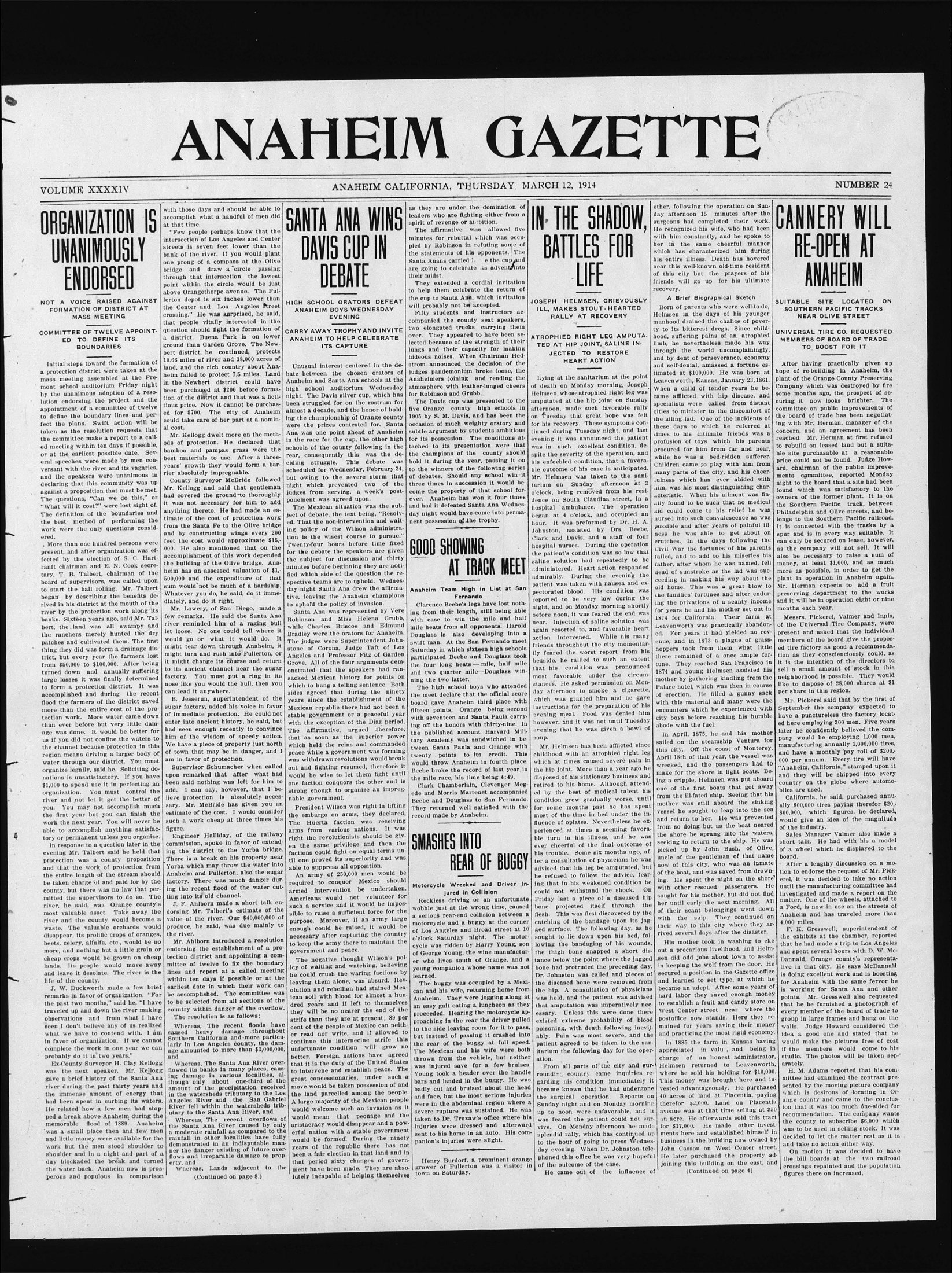
Searchable text
ORGANIZATION IS UNANIMOUSLY ENDORSED
NOT A VOICE RAISED AGAINST FORMATION OF DISTRICT AT MASS MEETING
COMMITTEE OF TWELVE APPOINTED TO DEFINE ITS BOUNDARIES
Initial steps toward the formation of a protection district were taken at the mass meeting assembled at the Fremont school auditorium Friday night by the unanimous adoption of a resolution endorsing the project and the appointment of a committee of twelve to define the boundary lines and perfect the plans. Swift action will be taken as the resolution requests that the committee make a report to a called meeting within ten days if possible, or at the earliest possible date. Several speeches were made by men conversant with the river and its vagaries, with those days and should be able to accomplish what a handful of men did at that time.
"Few people perhaps know that the intersection of Los Angeles and Center streets is seven feet lower than the bank of the river. If you would plant one prong of a compass at the Olive bridge and draw a circle passing through that intersection the lowest point within the circle would be just above Orangethorpe avenue. The Fullerton depot is six inches lower than the Center and Los Angeles Street crossing." He was surprised, he said, that people vitally interested in the question should fight the formation of a district. Buena Park is on lower ground than Garden Grove. The Newbert district, he continued, protects 10.66 miles of river and 18,000 acres of land, and the rich country about Anaheim failed to protect 7.5 miles. Land in the Newbert district could have been purchased at $200 before formation of the district and that was a fictitious price. Now it cannot be purchased for $700. The city of Anaheim could take care of her part at a nominal cost.
Mr. Kellogg dwelt more on the methods of protection. He declared that bamboo and pampas grass were the best materials to use. After a three-years' growth they would form a barrier absolutely impregnable.
mass meeting assembled at the Fremont school auditorium Friday night by the unanimous adoption of a resolution endorsing the project and the appointment of a committee of twelve to define the boundary lines and perfect the plans. Swift action will be taken as the resolution requests that the committee make a report to a called meeting within ten days if possible, or at the earliest possible date. Several speeches were made by men conversant with the river and its vagaries, and the speakers were unanimous in declaring that this community was up against a proposition that must be met. The questions, "Can we do this," or "What will it cost?" were lost sight of. The definition of the boundaries and the best method of performing the work were the only questions considered.
More than one hundred persons were present, and after organization was effected by the election of S. C. Hartranft chairman and E. N. Cook secretary, T. B. Talbert, chairman of the board of supervisors, was called upon to start the ball rolling. Mr. Talbert began by describing the benefits derived in his district at the mouth of the river by the protection work along its banks. Sixteen years ago, said Mr. Talbert, the land was all swampy and the ranchers merely hunted the dry patches and cultivated them. The first thing they did was form a drainage district, but every year the farmers lost from $50,000 to $100,000. After being turned down and annually suffering large losses it was finally determined to form a protection district. It was accomplished and during the recent flood the farmers of the district saved more than the entire cost of the protection work. More water came down than ever before but very little damage was done. It would be better for us if you did not confine the waters to the channel because protection in this region means driving a larger body of water through our district. You must organize legally, said he. Soliciting donations is unsatisfactory. If you have $1,000 to spend use it in perfecting an organization. You must control the river and not let it get the better of you. You may not accomplish much the first year but you can finish the work the next year. You will never be able to accomplish anything satisfactory or permanent unless you organize.
In response to a question later in the evening Mr. Talbert said he held that protection was a county proposition and that the work of protection from the entire length of the stream should be taken charge of and paid for by the county, but there was no law that permitted the supervisors to do so. Theheim failed to protect 7.5 miles. Land in the Newbert district could have been purchased at $200 before formation of the district and that was a fictitious price. Now it cannot be purchased for $700. The city of Anaheim could take care of her part at a nominal cost.
Mr. Kellogg dwelt more on the methods of protection. He declared that bamboo and pampas grass were the best materials to use. After a three-years' growth they would form a barrier absolutely impregnable.
County Surveyor McBride followed Mr. Kellogg and said that gentleman had covered the ground to thoroughly it was not necessary for him to add anything thereto. He had made an estimate of the cost of protection work from the Santa Fe to the Olive bridge and by constructing wings every 200 feet the cost would approximate $15,000. He also mentioned that on the accomplishment of this work depended the building of the Olive bridge. Anaheim has an assessed valuation of $1,500,000 and the expenditure of that sum would not be much of a hardship. Whatever you do, he said, do it immediately, and do it right.
Mr. Lowery, of San Diego, made a few remarks. He said the Santa Ana river reminded him of a raging bull let loose. No one could tell where it would go or what it would do. It might tear down through Anaheim, it might turn and rush into Fullerton, or it might change its course and return to its ancient channel near the sugar factory. You must put a ring in its nose like you would the bull, then you can lead it anywhere.
B. Jesserun, superintendent of the sugar factory, added his voice in favor of immediate protection. He could not enter into ancient history, he said, but had seen enough recently to convince him of the wisdom of speedy action. We have a piece of property just north of town that may be in danger, and I am in favor of protection.
Supervisor Schumacher when called upon remarked that after what had been said nothing was left for him to add. I can say, however, that I believe protection is absolutely necessary. Mr. McBride has given you an estimate of the cost. I would consider such a work cheap at three times his figure.
Engineer Halliday, of the railway commission, spoke in favor of extending the district to the Yorba bridge. There is a break on his property near Yorba which may throw the water into Anaheim and Fullerton, also the sugar factory. There was much danger during the recent flood of the water cutting into its old channel.
The Mexican situation object of debate, the texted, That the non-interviving policy of the Wilkinson is the wisest court Twenty-four hours before for the debate she spends minutes before beginning which side of the respective teams are to use day night Santa Ana active, leaving the Anaheim to uphold the policy of Santa Ana was reproached Robinson and Miss while Charles Briscoe Bradley were the orator The judges were Superstone of Corona, Judd Angeles and Professor Grove. All of the four mannons stated that she spacked Mexican history which to hang a telling sides agreed that during years since the establishment Mexican republic there stable government or with the exception of The affirmative, argue that as soon as she which held the reins peace while a government was withdrawn revolution out and fighting resumes would be wise to let one faction conquer strong enough to organize government.
President Wilson wasthe embargo on arms The Huerta faction arms from various migh right the revolutionist en the same privilege factions could fight on til one proved its supple able to suppress all opposes An army of 250,000 required to conquer armed intervention Americans would no
river and not let it get the better of you. You may not accomplish much the first year but you can finish the work the next year. You will never be able to accomplish anything satisfactory or permanent unless you organize.
In response to a question later in the evening Mr. Talbert said he held that protection was a county proposition and that the work of protection from the entire length of the stream should be taken charge of and paid for by the county, but there was no law that permitted the supervisors to do so. The river, he said, was Orange county's most valuable asset. Take away the river and the county would become a waste. The valuable orchards would disappear, its prolific crops of oranges, beets, celery, alfalfa, etc., would be no more, and nothing but a little grain or cheap crops would be grown on cheap lands. Its people would move away and leave it desolate. The river is the life of the county.
J. W. Duckworth made a few brief remarks in favor of organization. "For the past two months," said he, "I have traveled up and down the river making observations and from what I have seen I don't believe any of us realized what we have to contend with. I am in favor of organization. If we cannot complete the work in one year we can probably do it in two years."
Ex-County Surveyor H. Clay Kellogg was the next speaker. Mr. Kellogg gave a brief history of the Santa Ana river during the past thirty years and the immense amount of energy that had been spent in curbing its waters. He related how a few men had stopped a break above Anaheim during the memorable flood of 1889. Anaheim was a small place then and few men and little money were available for the work but the men stood shoulder to shoulder and in a night and part of a day blockaded the break and turned the water back. Anaheim now is prosperous and populous in comparison
Engineer Halliday, of the railway commission, spoke in favor of extending the district to the Yorba bridge. There is a break on his property near Yorba which may throw the water into Anaheim and Fullerton, also the sugar factory. There was much danger during the recent flood of the water cutting into its old channel.
J. F. Ahlborn made a short talk endorsing Mr. Talbert's estimate of the value of the river. Our $40,000,000 of produce, he said, was due mainly to the river.
Mr. Ahlborn introduced a resolution endorsing the establishment of a protection district and appointing a committee of twelve to fix the boundary lines and report at a called meeting within ten days if possible or at the earliest date in which their work can be accomplished. The committee was to be selected from all sections of the country within danger of the overflow.
The resolution is as follows:
Whereas, The recent floods have caused heavy damage throughout Southern California and more particularly in Los Angeles county, the damage amounted to more than $3,000,000, and
Whereas, The Santa Ana River overflowed its banks in many places, causing damage in various localities, although only about one-third of the amount of the precipitation received in the watersheds tributary to the Los Angeles River and the San Gabriel River fell within the watersheds tributary to the Santa Ana River,
Whereas, The recent overflows of the Santa Ana River caused by only a moderate rainfall as compared to the rainfall in other localities have fully demonstrated in an indisputable manner the danger existing of future overflows and irreparable damage to property, and
Whereas, Lands adjacent to the
(Continued on page 8.)
SANTA ANA WINS DAVIS CUP IN DEBATE
HIGH SCHOOL ORATORS DEFEAT ANAHEIM BOYS WEDNESDAY EVENING
CARRY AWAY TROPHY AND INVITE ANAHEIM TO HELP CELEBRATE ITS CAPTURE
Unusual interest centered in the debate between the chosen orators of Anaheim and Santa Ana schools at the high school auditorium Wednesday night. The Davis silver cup, which has been struggled for on the rostrum for almost a decade, and the honor of holding the championship of Orange county were the prizes contested for. Santa Ana was one point ahead of Anaheim in the race for the cup, the other high schools of the county following in the rear, consequently this was the deciding struggle. This debate was scheduled for Wednesday, February 24, as they are under the domination of leaders who are fighting either from a spirit of revenge or ambition.
The affirmative was allowed five minutes for rebuttal which was occupied by Robinson in refuting some of the statements of his opponents. The Santa Anans carried it like the cup and are going to celebrate its advent into their midst.
They extended a cordial invitation to help them celebrate the return of the cup to Santa Ana, which invitation will probably not be accepted.
Fifty students and instructors accompanied the county seat speakers, two elongated trucks carrying them over. They appeared to have been selected because of the strength of their lungs and their capacity for making hideous noises. When Chairman Hedstrom announced the decision of the judges pandemonium broke loose, the Anaheimers joining and rending the atmosphere with leather-lunged cheers for Robinson and Grubb.
The Davis cup was presented to the five Orange county high schools in 1905 by S. M. Davis, and has been the occasion of much weighty oratory and subtle argument by students ambitious for its possession. The conditions attached to its presentation were that the champions of the county should hold it during the year, passing it on to the winners of the following series
IN THE SHADOW, BATTLES FOR LIFE
JOSEPH HELMSEN, GRIEVOUSLY ILL, MAKES STOUT-HEARTED RALLY AT RECOVERY
ATROPHIED RIGHT LEG AMPUTATED AT HIP JOINT, SALINE INJECTED TO RESTORE HEART ACTION
Lying at the sanitarium at the point of death on Monday morning, Joseph Helmsen, whose atrophied right leg was amputated at the hip joint on Sunday afternoon, made such favorable rally on Tuesday that great hope was felt for his recovery. These symptoms continued during Tuesday night, and last evening it was announced the patient was in such excellent condition, despite the severity of the operation, and his enfeebled condition, that a favorable outcome of his case is anticipated.
date between the chosen orators of Anaheim and Santa Ana schools at the high school auditorium Wednesday night. The Davis silver cup, which has been struggled for on the rostrum for almost a decade, and the honor of holding the championship of Orange county were the prizes contested for. Santa Ana was one point ahead of Anaheim in the race for the cup, the other high schools of the county following in the rear, consequently this was the deciding struggle. This debate was scheduled for Wednesday, February 24, but owing to the severe storm that night which prevented two of the judges from serving, a week's postponement was agreed upon.
The Mexican situation was the subject of debate, the text being, "Resolved, That the non-intervention and waiting policy of the Wilson administration is the wisest course to pursue." Twenty-four hours before time fixed for the debate the speakers are given the subject for discussion and thirty minutes before beginning they are notified which side of the question the respective teams are to uphold. Wednesday night Santa Ana drew the affirmative, leaving the Anaheim champions to uphold the policy of invasion.
Santa Ana was represented by Vere Robinson and Miss Helena Grubb, while Charles Briscoe and Edmund Bradley were the orators for Anaheim. The judges were Superintendent Johnstone of Corona, Judge Taft of Los Angeles and Professor Fitz of Garden Grove. All of the four arguments demonstrated that the speakers had ransacked Mexican history for points on which to hang a telling sentence. Both sides agreed that during the ninety years since the establishment of the Mexican republic there had not been a stable government or a peaceful year with the exception of the Diaz period. The affirmative, argued therefore, that as soon as the superior power which held the reins and commanded peace while a government was forming was withdrawn revolutions would break out and fighting resumed, therefore it would be wise to let them fight until one faction conquors the other and is strong enough to organize an impregnable government.
President Wilson was right in lifting the embargo on arms, they declared, The Huerta faction was receiving arms from various nations. It was right the revolutionists should be given the same privilege and then the factions could fight on equal terms until one proved its superiority and was able to suppress all opposition.
An army of 250,000 men would be required to conquer Mexico should armed intervention be undertaken. Americans would not volunteer for
Anaheimers joining and rending the atmosphere with leather-lunged cheers for Robinson and Grubb.
The Davis cup was presented to the five Orange county high schools in 1905 by S. M. Davis, and has been the occasion of much weighty oratory and subtle argument by students ambitious for its possession. The conditions attached to its presentation were that the champions of the county should hold it during the year, passing it on to the winners of the following series of debates. Should any school win it three times in succession it would become the property of that school forever. Anaheim has won it four times and had it defeated Santa Ana Wednesday night would have come into permanent possession of the trophy.
GOOD SHOWING AT TRACK MEET
Anaheim Team High in List at San Fernando
Clarence Beebe's legs have lost nothing from their length, still being able with ease to win the mile and half mile heats from all opponents. Harold Douglass is also developing into a swift man. At the San Fernando meet Saturday in which sixteen high schools participated Beebe and Douglass took the four long heats—mile, half mile and two quarter mile—Douglass winning the two latter.
The high school boys who attended the meet declare that the official score board gave Anaheim third place with fifteen points, Orange being second with seventeen and Santa Paula carrying off the honors with thirty-nine. In the published account Harvard Military Academy was sandwiched in between Santa Paula and Orange with twenty points to its credit. This would throw Anaheim in fourth place. Beebe broke the record of last year in the mile race, his time being 4:49.
Clark Chamberlain, Clevenger Megede and Morris Martenet accompanied Beebe and Douglass to San Fernando. They returned well satisfied with the record made by Anaheim.
SMASHES INTO REAR OF BUGGY
Motorcycle Wrecked and Driver Injured In Collision
Lying at the sanitarium at the point of death on Monday morning, Joseph Helmsen, whose atrophied right leg was amputated at the hip joint on Sunday afternoon, made such favorable rally on Tuesday that great hope was felt for his recovery. These symptoms continued during Tuesday night, and last evening it was announced the patient was in such excellent condition, despite the severity of the operation, and his enfeebled condition, that a favorable outcome of his case is anticipated. Mr. Helmsen was taken to the sanitarium on Sunday afternoon at 3 o'clock, being removed from his residence on South Claudina street, in a hospital ambulance. The operation began at 4 o'clock, and occupied an hour. It was preformed by Dr. H. A. Johnston, assisted by Drs. Beebe, Clark and Davis, and a staff of four hospital nurses. During the operation the patient's condition was so low that saline solution had repeatedly to be administered. Heart action responded admirably. During the evening the patient was taken with nausea and expectorated blood. His condition was reported to be very low during the night, and on Monday morning shortly before noon, it was feared the end was near. Injection of saline solution was again resorted to, and favorable heart action intervened. While his many friends throughout the city momentarily feared the worst report from his bedside, he rallied to such an extent that his condition was pronounced most favorable under the circumstances. He asked permission on Monday afternoon to smoke a cigarette, which was granted him and he gave instructions for the preparation of his evening meal. Food was denied him however, and it was not until Tuesday evening that he was given a bowl of soup.
Mr. Helmsen has been afflicted since childhood with an atrophied right leg which at times caused severe pain in the hip joint. More than a year ago he disposed of his stationary business and retired to his home. Although attended by the best of medical talent his condition grew gradually worse, until for some months past he has spent most of the time in bed under the influence of opiates. Nevertheless he experienced at times a seeming favorable turn in his illness, and he was ever cheerful of the final outcome of his trouble. Some six months ago, after a consultation of physicians he was advised that his leg be amputated, but he refused to follow the advice, fearing that in his weakened condition he could not withstand the shock. On Friday last a piece of a diseased hip
President Wilson was right in lifting the embargo on arms, they declared, The Huerta faction was receiving arms from various nations. It was right the revolutionists should be given the same privilege and then the factions could fight on equal terms until one proved its superiority and was able to suppress all opposition.
An army of 250,000 men would be required to conquer Mexico should armed intervention be undertaken. Americans would not volunteer for such a service and it would be impossible to raise a sufficient force for the purpose. Moreover, if an army large enough could be raised, it would be necessary after capturing the country to keep the army there to maintain the government and peace.
The negative thought Wilson's policy of waiting and watching, believing he could crush the waring factions by leaving them alone, was absurd. Revolution and rebellion had stained Mexican soil with blood for almost a hundred years and if left to themselves they will be no nearer the end of the strife than they are at present; 89 percent of the people of Mexico can neither read nor write, and if allowed to continue this internecine strife this unfortunate condition will grow no better. Foreign nations have agreed that it is the duty of the United States to intervene and establish peace. The great concessionaries, under such a move would be taken possession of and the land parcelled among the people. A large majority of the Mexican people would welcome such an invasion as it would mean that peonage and the aristocracy would disappear and a powerful nation with a stable government would be formed. During the ninety years of the republic there has not been a fair election in that land and in that period sixty changes of government have been made. They are absolutely incapable of helping themselves
Beebe and Douglass to San Fernando. They returned well satisfied with the record made by Anaheim.
SMASHES INTO REAR OF BUGGY
Motorcycle Wrecked and Driver Injured In Collision
Reckless driving or an unfortunate wobble just at the wrong time, caused a serious rear-end collision between a motorcycle and a buggy at the corner of Los Angeles and Broad street at 10 o'clock Saturday night. The motorcycle was ridden by Harry Young, son of George Young, the wine manufacturer who lives south of Orange, and a young companion whose name was not learned.
The buggy was occupied by a Mexican and his wife, returning home from Anaheim. They were jogging along at an easy gait eating a luncheon as they proceeded. Hearing the motorcycle approaching in the rear the driver pulled to the side leaving room for it to pass, but instead of passing it crashed into the rear of the buggy at full speed. The Mexican and his wife were both thrown from the vehicle, but neither was injured save for a few bruises. Young took a header over the handle bars and landed in the buggy. He was badly cut and bruised about the head and face, but the most serious injuries were in the abdominal region where a severe rupture was sustained. He was taken to Dr. Truxaw's office where his injuries were dressed and afterward sent to his home in an auto. His companion's injuries were slight.
Henry Burdorf, a prominent orange grower of Fullerton was a visitor in town on Saturday.
condition grew gradually worse, until for some months past he has spent most of the time in bed under the influence of opiates. Nevertheless he experienced at times a seeming favorable turn in his illness, and he was ever cheerful of the final outcome of his trouble. Some six months ago, after a consultation of physicians he was advised that his leg be amputated, but he refused to follow the advice, fearing that in his weakened condition he could not withstand the shock. On Friday last a piece of a diseased hip bone projected itself through the flesh. This was first discovered by the catching of the bandage upon its jagged surface. The following day, as he sought to lie down upon his bed, following the bandaging of his wounds, the thigh bone snapped a short distance below the point where the jagged bone had protruded the preceding day. Dr. Johnston was called and pieces of the diseased bone were removed from the hip. A consultation of physicians was held, and the patient was advised that amputation was imperatively necessary. Unless this were done there existed extreme probability of blood poisoning, with death following inevitably. Pain was most severe, and the patient agreed to be taken to the sanitarium the following day for the operation.
From all parts of the city and surrounding country came inquiries regarding his condition immediately it became known that he had undergone the surgical operation. Reports on Sunday night and on Monday morning up to noon were unfavorable, and it was feared the patient could not survive. On Monday afternoon he made splendid rally, which has continued up to the hour of going to press Wednesday evening. When Dr. Johnston telephoned this office he was very hopeful of the outcome of the case.
He came out of the influence of
CANNERY WILL RE-OPEN AT ANAHEIM
SUITABLE SITE LOCATED ON SOUTHERN PACIFIC TRACKS NEAR OLIVE STREET
UNIVERSAL TIRE CO. REQUESTED MEMBERS OF BOARD OF TRADE TO BOOST FOR IT
After having practically given up hope of re-building in Anaheim, the plant of the Orange County Preserving Company which was destroyed by fire some months ago, the prospect of securing it now looks brighter. The committee on public improvements of the board of trade has been negotiating with Mr. Herman, manager of the concern, and an agreement has been reached. Mr. Herman at first refused to rebuild on leased land but a suitable site purchasable at a reasonable price could not be found. Judge Howard, chairman of the public improvement committee, reported Monday.
neen afflicted since trophied right leg had severe pain in than a year ago he January business and Although attend- medical talent his equally worse, until last he has spent under the in- evertheless he ex- seeming favora-ness, and he was the final outcome of six months ago, aff- physicians he was be amputated, but by the advice, fear-ened condition he held the shock. On of a diseased hip
When a child of tender years he became afflicted with hip disease, and specialists were called from distant cities to minister to the discomfort of the ailing lad. One of the incidents of these days to which he referred at times to his intimate friends was a profusion of toys which his parents procured for him from far and near, while he was a bed-ridden sufferer. Children came to play with him from many parts of the city, and his cheerfulness which has ever abided with aim, was his most distinguishing characteristic. When his ailment was finally found to be such that no medical aid could come to his relief he was nursed into such convalescence as was possible and after years of painful illness he was able to get about on crutches. In the days following the Civil War the fortunes of his parents failed, and to add to his miseries his father, after whom he was named, fell dead of sunstroke as the lad was succeeding in making his way about the old home. This was a great blow to the families' fortunes and after enduring the privations of a scanty income for years he and his mother set out in 1874 for California. Their farm at Leavenworth was practically abandoned. For years it had yielded no revenue, and in 1873 a plague of grasshoppers took from them what little there remained of a once ample fortune. They reached San Francisco in 1874 and young Helmsen assisted his mother by gathering kindling from the Palace hotel, which was then in course of erection. He filled a gunny sack with this material and many were the encounters which he experienced with city boys before reaching his humble abode with the fuel.
In April, 1875, he and his mother sailed on the steamship Ventura for this city. Off the coast of Monterey, April 18th of that year, the vessel was wrecked, and the passengers had to make for the shore in light boats. Being a cripple, Helmsen was put aboard one of the first boats that got away from the ill-fated ship. Seeing that his mother was still aboard the sinking vessel he sought to leap into the sea and return to her. He was prevented from so doing but as the boat neared the shore he sprang into the waters, seeking to return to the ship. He was picked up by John Bush, of Olive, uncle of the gentleman of that name now of this city, who was an inmate of the boat, and was saved from drowning. He spent the night on the shore with other rescued passengers. He sought for his mother, but did not find plant of the Orange County Preserving Company which was destroyed by fire some months ago, the prospect of securing it now looks brighter. The committee on public improvements of the board of trade has been negotiating with Mr. Herman, manager of the concern, and an agreement has been reached. Mr. Herman at first refused to rebuild on leased land but a suitable site purchasable at a reasonable price could not be found. Judge Howard, chairman of the public improvements committee, reported Monday night to the board that a site had been found which was satisfactory to the owners of the former plant. It is on the Southern Pacific track, between Philadelphia and Olive streets, and belongs to the Southern Pacific railroad. It is connected with the tracks by a spur and is in every way suitable. It can only be secured on lease, however, as the company will not sell. It will also be necessary to raise a sum of money, at least $1,000, and as much more as possible, in order to get the plant in operation in Anaheim again. Mr. Herman expects to add a fruit preserving department to the works and it will be in operation eight or nine months each year.
Messrs. Pickerel, Valmer and Innis, of the Universal Tire Company, were present and asked that the individual members of the board give the proposed tire factory as good a recommendation as they conscienciously could, as it is the intention of the directors to sell a small amount of stock in this neighborhood is possible. They would like to dispose of 28,000 shares at $1 per share in this region.
Mr. Pickerel said that by the first of September the company expected to have a punctureless tire factory located here employing 300 men. Five years later he confidently believed the company would be employing 1,000 men, manufacturing annually 1,000,000 tires, and have a monthly pay roll of $200,-000 per annum. Every tire will have "Anaheim, California," stamped upon it and they will be shipped into every country on the globe where automobiles are used.
California, he said, purchased annually 800,000 tires paying therefor $20,-800,000, which figures, he declared, would give an idea of the magnitude of the industry.
Sales Manager Valmer also made a short talk. He had with his a model of a wheel which he displayed to the board.
After a lengthy discussion on a motion to endorse the request of Mr. Pickerel, it was decided to take no action until the manufacturing committee had investigated and made a report on the matter. One of the wheels attached to
until last month he has spent six months under the interest of a seeming favorativeness, and he was the final outcome of
five months ago, affecited physicians he was be amputated, but
by the advice, fearened condition he had the shock. On
the of a diseased hip himself through the
discovered by the village upon its jagged
following day, as he upon his bed, folling of his wounds,
hipped a short distinct where the jagged
the preceding day.
called and pieces of
were removed from
portion of physicians
patient was advised
is imperatively necses were done there
probability of blood
with following inevitse severe, and the
be taken to the santing day for the operation of the city and surcome inquiries reson immediately it
he had undergone
action. Reports on
on Monday morning
unfavorable, and it
client could not surafternoon he made
which has continued upgoing to press Wednesday Dr. Johnston telephone was very hopeful
the case.
The influence of
mother was still aboard the sinking vessel he sought to leap into the sea and return to her. He was prevented from so doing but as the boat neared the shore he sprang into the waters, seeking to return to the ship. He was picked up by John Bush, of Olive, uncle of the gentleman of that name now of this city, who was an inmate of the boat, and was saved from drowning. He spent the night on the shore with other rescued passengers. He sought for his mother, but did not find her until early the next morning. All of their scant belongings went down with the saip. They continued on their way to this city where they arrived several days after the disaster.
His mother took in washing to eke out a precarious livelihood, and Helmsen did odd jobs about town to assist in keeping the wolf from the door. He secured a position in the Gazette office and learned to set type, at which he became an adept. After some years of hard labor they saved enough money to establish a fruit and candy store on West Center street near where the postoffice now stands. Here they remained for years saving their money and practicing the most rigid economy.
In 1885 the farm in Kansas having appreciated in valu, and being in charge of an honest administrator, Helmsen returned to Leavenworth, where he sold his holding for $10,000. This money was brought here and invested advantageously. He purchased 40 acres of land at Placentia, paying therefor $2,000. Land on Placentia avenue was at that time selling at $50 an acre. He afterwards sold this tract for $17,000. He made other investments here and established himself in business in the building now owned by John Cassou on West Center street. He later purchased the property adjoining this building on the east, and
(Continued on page 4)
California, he said, purchased annually 800,000 tires paying therefor $20,-800,000, which figures, he declared, would give an idea of the magnitude of the industry.
Sales Manager Valmer also made a short talk. He had with his a model of a wheel which he displayed to the board.
After a lengthy discussion on a motion to endorse the request of Mr. Pickerel, it was decided to take no action until the manufacturing committee had investigated and made a report on the matter. One of the wheels, attached to a Ford, is now in use on the streets of Anaheim and has traveled more than 4,000 miles.
F. K. Gresswell, superintendent of the exhibits at the chamber, reported that he had made a trip to Los Angeles and spent several hours with D. W. McDannald, Orange county's representative in that city. He says McDannald is doing excellent work and is boosting for Anaheim with the same fervor he is working for Santa Ana and other points. Mr. Gresswell also requested that he be furnished a photograph of every member of the board of trade to group in large frames and hang on the walls. Judge Howard considered the idea a good one and stated that he would make the pictures free of cost if the members would come to his studio. The photos will be taken separately.
H. M. Adams reported that his committee had examined the contract presented by the moving picture company which is desirous of locating in Orange county and came to the conclusion that it was too much one-sided for recommendation. The company wants the county to subscribe $6,000 which was to be used in selling stock. It was decided to let the matter rest as it is and take no action either way.
On motion it was decided to have the bill boards at the two railroad crossings repainted and the population figures there on increased.