anaheim-gazette 1914-02-12
Scanned page
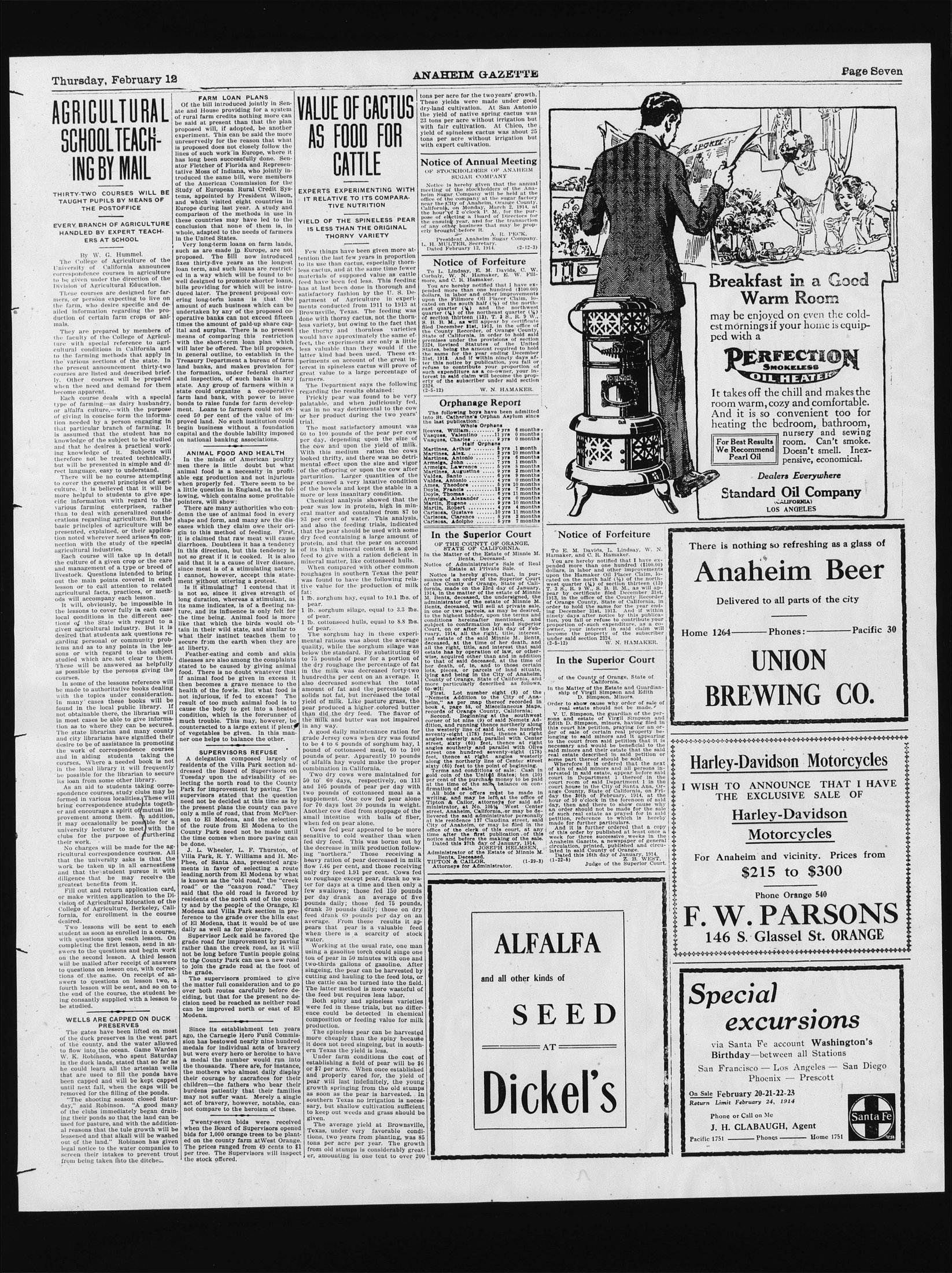
Searchable text
AGRICULTURAL SCHOOL TEACHING BY MAIL
THIRTY-TWO COURSES WILL BE TAUGHT PUPILS BY MEANS OF THE POSTOFFICE
EVERY BRANCH OF AGRICULTURE HANDLED BY EXPERT TEACHERS AT SCHOOL
By W. G. Hummel.
The College of Agriculture of the University of California announces correspondence courses in agriculture to be given under the direction of the Division of Agricultural Education.
These courses are designed for farmers, or persons expecting to live on the farm, who desire specific and detailed information regarding the production of certain farm crops or animals.
They are prepared by members of the faculty of the College of Agriculture with special reference to agricultural conditions in California and to the farming methods that apply in the various sections of the state. In the present announcement thirty-two courses are listed and described briefly. Other courses will be prepared when the need and demand for them become apparent.
Each course deals with a special type of farming—as dairy husbandry, or alfalfa culture,—with the purpose of giving in concise form the information needed by a person engaging in that particular branch of farming. It is assumed that the student has no knowledge of the subject to be studied and that he desires a practical working knowledge of it. Subjects will therefore not be treated technically, but will be presented in simple and direct language, easy to understand.
FARM LOAN PLANS
Of the bill introduced jointly in Senate and House providing for a system of rural farm credits nothing more can be said at present than that the plan proposed will, if adopted, be another experiment. This can be said the more unreservedly for the reason that what is proposed does not closely follow the lines of such work in Europe, where it has long been successfully done. Senator Fletcher of Florida and Representative Moss of Indiana, who jointly introduced the same bill, were members of the American Commission for the Study of European Rural Credit Systems, appointed by President Wilson, and which visited eight countries in Europe during last year. A study and comparison of the methods in use in these countries may have led to the conclusion that none of them is, in whole, adapted to the needs of farmers in the United States.
Very long-term loans on farm lands, such as are made in Europe, are not proposed. The bill now introduced fixes thirty-five years as the longest loan term, and such loans are restricted in a way which will be found to be well designed to promote shorter loans, bills providing for which will be introduced later. The present proposal covering long-term loans is that the amount of such business which can be undertaken by any of the proposed cooperative banks cannot exceed fifteen times the amount of paid-up share capital and surplus. There is no present means of comparing this restriction with the short-term loan plan which will later be offered. The bill proposes, in general outline, to establish in the Treasury Department a bureau of farm land banks, and makes provision for the formation, under federal charter and inspection, of such banks in any state. Any group of farmers within a state could organize a co-operative farm land bank, with power to issue bonds to raise funds for farm development. Loans to farmers could not exceed 50 per cent of the value of improved land. No such institution could begin business without a foundation capital and the double lability imposed on national banking associations.
ANIMAL FOOD AND HEALTH
In the minds of American poultry men there is little doubt but what animal food is a necessity in profit-
Each course deals with a special type of farming—as dairy husbandry, or alfalfa culture,—with the purpose of giving in concise form the information needed by a person engaging in that particular branch of farming. It is assumed that the student has no knowledge of the subject to be studied and that he desires a practical working knowledge of it. Subjects will therefore not be treated technically, but will be presented in simple and direct language, easy to understand.
There will be no course attempting to cover the general principles of agriculture. It is believed that it will be more helpful to students to give specific information with regard to the various farming enterprises, rather than to deal with generalized considerations regarding agriculture. But the basic principles of agriculture will be presented, explained, or their application noted wherever need arises in connection with the study of the special agricultural industries.
Each course will take up in detail the culture of a given crop or the care and management of a type or breed of livestock. Questions intended to bring out the main points covered in each lesson or to call attention to related agricultural facts, practices, or methods will accompany each lesson.
It will, obviously, be impossible in the lessons to cover fully in each case local conditions in the different sections of the State with regard to a given agricultural industry. But it is desired that students ask questions regarding personal or community problems and as to any points in the lessons or with regard to the subject studied which are not clear to them. These will be answered as helpfully as possible by the persons giving the courses.
In some of the lessons reference will be made to authoritative books dealing with the topics under consideration. In many cases these books will be found in the local public library. If not obtainable there, the librarian will in most cases be able to give information as to where they can be secured. The state librarian and many county and city librarians have signified their desire to be of assistance in promoting the work of correspondence courses and in aiding students taking the courses. Where a needed book is not in the local library it will frequently be possible for the librarian to secure its loan from some other library.
As an aid to students taking correspondence courses, study clubs may be formed in various localities. These will bring correspondence students together and encourage a spirit of mutual improvement among them. In addition, it may occasionally be possible for a university lecturer to meet with the clubs for the purpose of furthering their work.
No charges will be made for the agricultural correspondence courses. All that the university asks is that the work be taken up in all earnestness and that the student pursue it with diligence that he may receive the greatest benefits from it.
Fill out and return application card, or make written application to the Di-
ANIMAL FOOD AND HEALTH
In the minds of American poultry men there is little doubt but what animal food is a necessity in profitable egg production and not injurious when properly fed. There seem to be a little question in England, as the following, which contains some profitable pointers, will show:
There are many authorities who condemn the use of animal food in every shape and form, and many are the diseases which they claim owe their origin to this method of feeding. First, it is claimed that raw meat will cause diarrhoea. Doubtless it has a tendency in this direction, but this tendency is not so great if it is cooked. It is also said that it is a cause of liver disease, since meat is of a stimulating nature. I cannot, however, accept this statement without uttering a protest.
Is it stimulating? I contend that it is not so, since it gives strength of long duration, whereas a stimulant, as its name indicates, is of a fleeting nature, and its influence is only felt for the time being. Animal food is more like that which the birds would obtain in their wild state, and similar to what their instinct teaches them to secure from the earth when they are at liberty.
Feather-eating and comb and skin diseases are also among the complaints stated to be caused by giving animal food. There is no doubt whatever that if animal food be given in excess it then becomes a grave menace to the health of the fowls. But what food is not injurious, if fed to excess? The result of too much animal food is to cause the body to get into a heated condition, which is the forerunner of much trouble. This may, however, be counteracted to a large extent if plenty of vegetables be given. In this manner one helps to balance the other.
SUPERVISORS REFUSE
A delegation composed largely of residents of the Villa Park section addressed the Board of Supervisors on Tuesday upon the advisability of selecting the north road to the County Park for improvement by paving. The supervisors stated that the question need not be decided at this time as by the present plans the county can pave only a mile of road, that from McPherson to El Modena, and the selection of the route from El Modena to the County Park need not be made until the time comes when more paving can be done.
J. L. Wheeler, L. F. Thurston, of Villa Park, R. Y. Williams and H. McPhee, of Santa Ana, presented arguments in favor of selecting a route leading north from El Modena by what is known as the "old road," the "creek road" or the "canyon road." They said that the old road is favored by residents of the north end of the country.
The decrease in mourning "northers." heavy ration of flour 7.46 per cent only dry feed 1.99 no roughage except for days at a few swallows; no day drank
WELLS ARE CAPPED ON DUCK PRESERVES
The gates have been lifted on most of the duck preserves in the west part of the county, and the water allowed to flow into the ocean. Game Warden W. K. Robinson, who spent Saturday in the duck lands, stated that so far as he could learn all the artesian wells that are used to fill the ponds have been capped and will be kept capped until next fall, when the caps will be removed for the filling of the ponds.
"The shooting season closed Saturday," said Robinson. "A good many of the clubs immediately began draining their ponds so that the land can be used for pasture, and with the additional reasons that the tule growth will be lessened and that alkali will be washed out of the land." Robinson has given legal notice to the water companies to screen their intakes to prevent trout from being taken into the ditchez.
Since its establishment ten years ago, the Carnegie Hero Fund Commission has bestowed nearly nine hundred medals for individual acts of bravery but were every hero or heroine to have a medal the number would run into the thousands. There are, for instance, the mothers who almost daily display their courage by sacrafices for their children—the fathers who bear their burdens patiently that their families may not suffer want. Merely a single act of bravery, however, notable, cannot compare to the heroism of these.
Twenty-seven bids were received when the Board of Supervisors opened bids for 1,000 orange trees to be planted on the county farm at West Orange. The prices ranged from 49 cents to $1 per tree. The Supervisors will inspect the stock offered.
J. L. Wheeler, L. F. Thurston, of Villa Park, R. Y. Williams and H. McPhee, of Santa Ana, presented arguments in favor of selecting a route leading north from El Modena by what is known as the "old road," the "creek road" or the "canyon road." They said that the old road is favored by residents of the north end of the county and by the people of the Orange, El Modena and Villa Park section in preference to the grade over the hills east of El Modena, that it would be of use daily as well as for pleasure.
Supervisor Leck said he favored the grade road for improvement by paving rather than the creek road, as it will not be long before Tustin people going to the County Park can use a new road to join the grade road at the foot of the grade.
The supervisors promised to give the matter full consideration and to go over both routes carefully before deciding, but that for the present no decision need be reached as neither road can be improved north or east of El Modena.
Cows fed pear sensitive to cold fed dry feed. The decrease in meat ingering "northers," heavy ration of pea flow 7.46 per cent only dry feed 1.99 no roughage exceeder for days at a few swallows; per day drank 30 pounds daily; the drank 30 pounds feed drank 69 per average. From pears that pear when there is a water.
Working at this using a gasoline ton of pear in 50 two-thirds gallons singeing, the pear cutting and hauling the cattle can be The latter method the feed but require Both spiny are were fed in these ence could be composition or production.
The spineless more cheaply than it does not need eastern Texas the y under farm or establishing a fir or $7 per acre. and properly care pear will last if growth springing as soon as the southern Texas sary, but shallow to keep out weed given.
The average Texas, under vents, two years tons per acre from old stump er, amounting i
VALUE OF CACTUS AS FOOD FOR CATTLE
EXPERTS EXPERIMENTING WITH IT RELATIVE TO ITS COMPARATIVE NUTRITION
YIELD OF THE SPINELESS PEAR IS LESS THAN THE ORIGINAL THORNY VARIETY
Few things have been given more attention the last few years in proportion to its use than cactus, especially thornless cactus, and at the same time fewer materials of supposed value as cattle feed have been fed less. This feeding has at last been done in thorough and satisfactory fashion by the U. S. Department of Agriculture in experiments conducted from 1911 to 1913 at Brownsville, Texas. The feeding was done with thorny cactus, not the thornless variety, but owing to the fact that the thorny and thornless varieties would have approximately the same effect, the experiments are only a little less valuable than they would if the latter kind had been used. These experiments on account of the great interest in spineless cactus will prove of great value to a large percentage of farmers.
The Department says the following regarding the results obtained:
Prickly pear was found to be very palatable, and when judiciously fed, was in no way detrimental to the cow or her product during the two years' trial.
The most satisfactory amount was 60 to 100 pounds of the pear per cow per day, depending upon the size of the cow and upon the yield of milk. With this medium ration the cows looked thrifty, and there was no detrimental effect upon the size and vigor of the offspring or upon the cow after tons per acre for the two years' growth. These yields were made under good dry-land cultivation. At San Antonio the yield of native spring cactus was 23 tons per acre without irrigation but with fair cultivation. At Chico, the yield of spineless cactus was about 25 tons per acre without irrigation but with expert cultivation.
Notice of Annual Meeting
OF STOCKHOLDERS OF ANAHEIM SUGAR COMPANY
Notice is hereby given that the annual meeting of the stockholders of the Anaheim Sugar Company will be held at the office of the company at the sugar factory near the City of Anaheim, Orange County, California, on Monday, March 2, 1914, at the hour of 2 o'clock P.M., for the purpose of electing a Board of Directors for the ensuing year, and for the transaction of any other business that may be properly brought before it.
A. R. PECK,
President Anaheim Sugar Company.
L. H. MULTER, Secretary.
Dated February 12, 1914.
Notice of Forfeiture
To L. Lindsay, E. M. Davids, C. W. Corbaly, W. N. Hamaker, E. W. Fillmore, and C. R. Hamaker.
You are hereby notified that I have expended more than one hundred ($100.00) dollars, in labor and other improvements upon the Fillmore Oil Placer Claim, located on the south half (½) of the northeast quarter (¼) and the northwest quarter (¼) of the northeast quarter (¼) of section thirteen (13), T. 3 S., R. 9 W., S. B. B. M., as will appear by certificate filed December 31st, 1913, in the office of the County Recorder, of Orange County, State of California, in order to hold said premises under the provisions of section 2324, Revised Statutes of the United States, being the amount required to hold the same for the year ending December 31st, 1912. And if within ninety days after this notice by publication, you fail or refuse to contribute your proportion of such expenditure as a co-owner, your interest in said claim will become the property of the subscriber under said section 2324.
(2-5-12)
W. N. HAMAKER.
Orphanage Report
The following boys have been admitted into St. Catherine's Orphan Asylum since the last publication:
Whole Orphans
Reeves, William... 9 yrs 6 months
Vasques, Valentino... 11 yrs 0 months
Vasques, Charles... 9 yrs 0 months
Half Orphans
Martines, Arthur... 5 yrs 1 month
Martines, Alex... 2 yrs 10 months
Martines, Antonio... 7 yrs 6 months
Armeiga, John... 7 yrs 1 month
Armeiga, Lawrence... 5 yrs 8 months
Martines, Augustine... 9 yrs 2 months
The Department says the following regarding the results obtained:
Prickly pear was found to be very palatable, and when judiciously fed, was in no way detrimental to the cow or her product during the two years' trial.
The most satisfactory amount was 60 to 100 pounds of the pear per cow per day, depending upon the size of the cow and upon the yield of milk. With this medium ration the cows looked thrifty, and there was no detrimental effect upon the size and vigor of the offspring or upon the cow after parturition. Larger quantities of the pear caused a very laxative condition of the bowels and kept the stable in a more or less insanitary condition.
Chemical analysis showed that the pear was low in protein, high in mineral matter and contained from 87 to 93 per cent of water. This analysis, and also the feeding trials, indicated that the pear should be used with some dry feed containing a large amount of protein, and that the pear on account of its high mineral content is a good feed to give with a ration deficient in mineral matter, like cottonseed hulls.
When compared with other common roughages in southern Texas the pear was found to have the following relative value for the production of milk fat:
1 lb. sorghum hay, equal to 10.1 lbs. of pear.
1 lb. sorghum silage, equal to 3.3 lbs. of pear.
1 lb. cottonseed hulls, equal to 8.8 lbs. of pear.
The sorghum hay in these experimental rations was about the average quality, while the sorghum silage was below the standard. By substituting 60 to 75 pounds of pear for a portion of the dry roughage the percentage of fat in the milk was decreased forty-two hundredths per cent on an average. It also decreased somewhat the total amount of fat and the percentage of solids not fat, but increased the total yield of milk. Like pasture grass, the pear produced a higher-colored butter than did the dry feed. The flavor of the milk and butter was not impaired in any way.
A good daily maintenance ration for grade Jersey cows when dry was found to be 4 to 6 pounds of sorghum hay, 1 pound of cottonseed meal, 60 to 100 pounds of pear. Apparently 10 pounds of alfalfa hay would make the proper combination in California.
Two dry cows were maintained for 50 to 60 days, respectively, on 113 and 105 pounds of pear per day with two pounds of cottonseed meal as a supplement. One cow fed pear alone for 70 days lost 30 pounds in weight. Another cow died from stoppage of the small intestine with balls of fiber, when fed on pear alone.
Cows fed pear appeared to be more sensitive to cold weather than when fed dry feed. This was borne out by the decrease in milk production following "northers." Those receiving a heavy ration of pear decreased in milk flow 7.46 per cent, and those receiving only dry feed 1.91 per cent. Cows fed no roughage except pear, drank no water for days at a time and then only a few swallows; those fed 150 pounds per day drank an average of five
In the Superior Court
OF THE COUNTY OF ORANGE,
STATE OF CALIFORNIA.
In the Matter of the Estate of Minnie M. Bentz, Deceased.
Notice of Administrator's Sale of Real Estate at Private Sale.
Notice is hereby given, that in pursuance of an order of the Superior Court of the County of Orange, State of California, made on the 23rd day of January, 1914, in the matter of the estate of Minnie M. Bentz, deceased, will sell at private sale, in one or two parcels, as may be desired, to the highest bidder, upon the terms and conditions hereinafter mentioned, and subject to confirmation by said Superior Court, on or after the 14th day of February, 1914, all the right, title, interest, and estate of the said Minnie M. Bentz, deceased, at the time of her death, and all the right, title, and interest that said estate has by operation of law, or otherwise, acquired other than and in addition to that of said deceased, at the time of her death, of, in, and to those certain lots, pieces, or parcels of land situate, lying and being in the City of Anaheim, County of Orange, State of California, and more particularly described as follows: to-wit:
First. Lot number eight (8) of the "Nemetz Addition to the City of Anaheim," as per map thereof recorded in book 4, page 58, of Miscellaneous Maps, records of Orange County, California;
Second. Beginning at the southwest corner of lot nine (9) of said Nemetz Addition, and running thence northerly along the westerly line of lot lot, one hundred seventy-eight (178) feet, thence at right angles easterly and parallel with Center street, sixty (60) feet, thence at center angles southerly and parallel with Olive street one hundred seventy-eight (178) feet, thence at right angles westherly along the northerly line of Center street sixty (60) feet to the point of beginning.
Terms and conditions of sale: Cash in gold coin of the United States; ten (10) per cent of the purchase money to be paid at the time of the sale balance on confirmation of sale.
All bids or offers must be made in writing, and may be left at the office of Tipton & Cailor, attorneys for said administrator, at No. 105% West Center street, Anaheim, California; or may be delivered by the said administrator personally at his residence 137 Claudina street, said City of Anaheim, or may be filed in the office of the clerk of this court, at any time after the first publication of this notice and before the making of the sale.
Dated this 27th day of January, 1914.
JOSEPH HELMSEN.
Administrator of the Estate of Minnie M. Bentz, Deceased.
TIPTON & CAILOR,
Attorneys for Administrator.
Notice of Forfeiture
To E. M. Davids, L. Lindsay, W. N. Hamaker, and C. R. Hamaker.
You are hereby notified that I have expended more than one hundred ($100.00) dollars in labor and other improvements upon the Hamaker Oil Placer Claim, located on the north half (½) of the northwest quarter (¼) of section thirteen (13). T. S., R. 9 W., S. B. B.M., as will appear by certificate filed December 31st, 1913, in the office of the County Recorder of Orange County, State of California, in order to hold the same for the year ending December 31st, 1913. And if within ninety days after notice by this publication you fail or refuse to contribute your proportion-of-such expenditure, as a coowner, your interest in said claim will become the property of the subscriber under section 2324.
(2-5-12)
In the Superior Court
of the County of Orange, State of California.
In the Matter of the Estate and Guardianship of Virgil Simpson and Edith D. Simpson, Minors.
Order to show cause why order of sale of real estate should not be made.
V. U. Simpson, the guardian of the persons and estate of Virgil Simpson and Edith D. Simpson, minors having filed in this court his petition praying for an order of sale certain real property belonging to said minors and it appearing to the court from said petition that it is necessary and would be beneficial to the said minors and their estate that the said real estate described in said petition or some part thereof should be sold.
Wherefore it is ordered that the next kion of said minors and all persons interested in said estate appear before said court in Department 1 thereof in the court room of said Department 1 in the court house in the City Santa Ana, Orange County, State of California, on Friday the 20th of February, 1914, at the hour of 1 o'clock in the forenoon of said day, then and there to show cause why an order should not be made for the sale such real estate as prayed for in said petition; reference to which is hereby made for further particulars.
And it is further ordered that a copy of this order by published at least once a week for three successive weeks in the Anaheim Gazette, a newspaper of general circulation; printed; published and circulated in said County of Orange.
Dated this 16th day of January, 1914.
(1-22-5)
Judge of the Superior Court.
ALFALFA
and all other kinds of
SEED
AT
Dickel's
Breakfast in a Good Warm Room
may be enjoyed on even the coldest mornings if your home is equipped with a
PERFECTION
SMOKELESS
OIL HEATER
It takes off the chill and makes the room warm, cozy and comfortable. And it is so convenient too for heating the bedroom, bathroom, nursery and sewing room. Can't smoke. Doesn't smell. Inexpensive, economical.
For Best Results We Recommend Pearl Oil
It takes off the chill and makes the room warm, cozy and comfortable. And it is so convenient too for heating the bedroom, bathroom, nursery and sewing room. Can't smoke. Doesn't smell. Inexpensive, economical.
Dealers Everywhere
Standard Oil Company
(CALIFORNIA)
LOS ANGELES
There is nothing so refreshing as a glass of Anaheim Beer
Delivered to all parts of the city
Home 1264 Phones: Pacific 30
UNION BREWING CO.
Harley-Davidson Motorcycles
I WISH TO ANNOUNCE THAT I HAVE THE EXCLUSIVE SALE OF Harley-Davidson Motorcycles
For Anaheim and vicinity. Prices from $215 to $300
Phone Orange 540
Harley-Davidson
Motorcycles
For Anaheim and vicinity. Prices from
$215 to $300
Phone Orange 540
F. W. PARSONS
146 S. Glassel St. ORANGE
Special excursions
via Santa Fe account Washington's
Birthday—between all Stations
San Francisco — Los Angeles — San Diego
Phoenix — Prescott
On Sale February 20-21-22-23
Return Limit February 24, 1914
Phone or Call on Me
J. H. CLABAUGH, Agent
Pacific 1751 Phones Home 1751