anaheim-gazette 1914-02-12
Scanned page
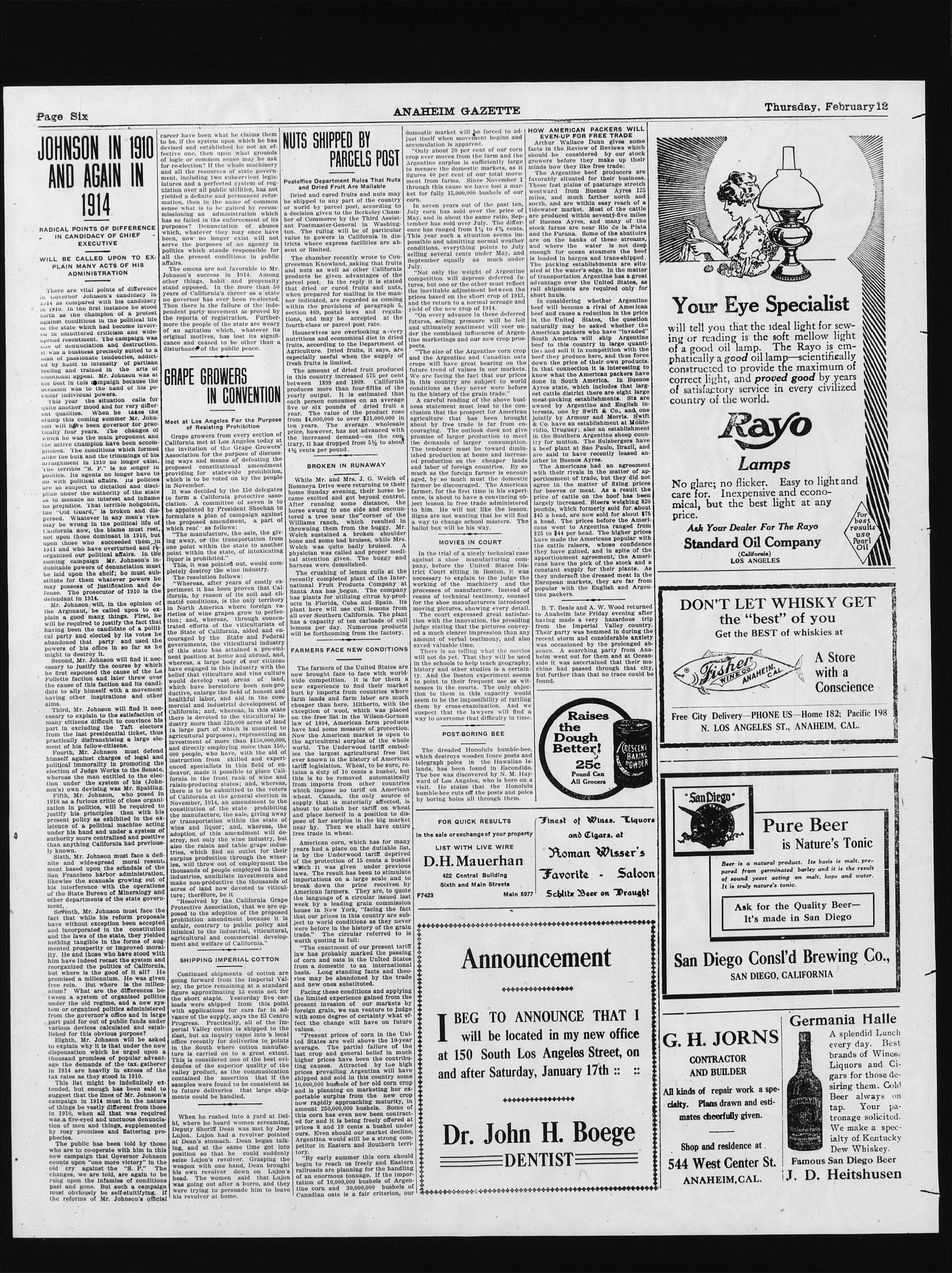
Searchable text
JOHNSON IN 1910 AND AGAIN IN 1914
RADICAL POINTS OF DIFFERENCE IN CANDIDACY OF CHIEF EXECUTIVE
WILL BE CALLED UPON TO EXPLAIN MANY ACTS OF HIS ADMINISTRATION
There are vital points of difference in Governor Johnson's candidacy in 1914 as compared with his candidacy in 1910. In the first instance he stood forth as the champion of a protest against conditions in the political life of the state which had become involved in embittered criticism and widespread resentment. The campaign was one of denunciation and destruction. It was a business precisely suited to a man of passionate tendencies, addicted by habit to intensity of partisan feeling and trained in the arts of emotional appeal. Mr. Johnson was at his best in this campaign because the occasion was to the hand of his peculiar individual powers.
This year the situation calls for quite another mood and for very different qualities. When he takes the stump this coming summer Mr. Johnson will have been governor for practically four years. The changes of which he was the main proponent and the active champion have been accomplished. The conditions which formed alike the bulk and the trimmings of his arraignment in 1910 no longer exist. The terrible "S. P." is no longer in politics its agents no longer have to career have been what he claims them to be, if the system upon which he has devised and established be not an effective one, then upon what grounds of logic or common sense may he ask for re-election? If the whole machinery and all the resources of state government, including two subservient legislatures and a perfected system of regulation over all public utilities, has not yielded a definite and permanent reformation, then in the name of common sense what is to be gained by recommissioning an administration which has so failed in the enforcement of its purposes? Denunciation of abuses which, whatever they may once have been, now no longer exist will not serve the purposes of an agency in politics which stands responsible for all the present conditions in public affairs.
The omens are not favorable to Mr. Johnson's success in 1914. Among other things, habit and propensity stand opposed. In the more than 50 years of California's career as a state no governor has ever been re-elected. Then there is the failure of the independent party movement as proved by the reports of registration. Furthermore the people of the state are weary of an agitation which, whatever its original motives, has lost its significance and ceased to be other than a disturbance of the public peace.
GRAPE GROWERS IN CONVENTION
Meet at Los Angeles For the Purpose of Resisting Prohibition
Grape growers from every section of California met at Los Angeles today at the invitation of the Grape Growers' Association for the purpose of discussing ways and means of defeating the proposed constitutional amendment providing for statewide prohibition,
NUTS SHIPPED PARCEL
Postoffice Department Rural and Dried Fruit Area
Dried and cured fruits be shipped to any part or world by parcel post a decision given to the number of Commerce by the ant Postmaster-General ton. The ruling will be value to gowers in Californias where express fare sent or limited.
The chamber recently gressman Knowland, asses and nuts as well as on products be given advancel post. In the ree that dried or cured fry when prepared for mailer indicated, are regarded within the provisions of section 469, postal lawtions, and may be added fourth-class or parcel post.
Housewives are overnutritious and economical fruits, according to the Agriculture. Dried fruit especially useful when fresh fruits is limited.
The amount of dried in this country increases between 1899 and 1919 produces more than forty yearly output. It is each person consumes five or six pounds of year. The value of t from $4,000,000 to over ten years. The average price, however, has not increased demand trary, ti has dropped from 4½ cents per pound.
Meet at Los Angeles For the Purpose of Resisting Prohibition
Grape growers from every section of California met at Los Angeles today at the invitation of the Grape Growers' Association for the purpose of discussing ways and means of defeating the proposed constitutional amendment providing for statewide prohibition, which is to be voted on by the people in November.
It was decided by the 150 delegates to form a California protective association. A committee of seven is to be appointed by President Sheehan to formulate a plan of campaign against the proposed amendment, a part of which reads as follows:
"The manufacture, the sale, the giving away, or the transportation from one point within the state to another point within the state, of intoxicating liquor is prohibited."
This, it was pointed out, would completely destroy the wine industry.
The resolution follows:
"Whereas, after years of costly experiment it has been proven that California, by reason of its soil and climatic conditions, is the only territory in North America where foreign varieties of wine grapes grow to perfection; and, whereas, through concentrated efforts of the viticulturists of the State of California, aided and encouraged by the State and Federal governments, the viticultural industry of this state has attained a pre-eminent position at home and abroad, and, whereas, a large body of our citizens have engaged in this industry with the belief that viticulture and vine culture would develop vast areas of land, which have heretofore been non-productive, enlarge the field of honest and healthful labor, and aid in the commercial and industrial development of California; and, whereas, in this state there is devoted to the viticultural industry more than 320,000 acres of land (a large part of which is unsuited to agricultural purposes), representing an investment of more than $150,000,000 and directly employing more than 150,000 people, who have, with the aid of instruction from skilled and experienced specialists in this field of endeavor, made it possible to place California in the front rank of wine and raisin-producing states; and, whereas, there is to be submitted to the voters of California at the general election in November, 1914, an amendment to the constitution of the state prohibiting the manufacture, the sale, giving away or transportation within the state of wine and liquor; and, whereas, the adoption of this amendment will destroy, not only the wine industry, but also the raisin and table grape industries, which find an outlet for their surplus production through the wineries, will throw out of employment the thousands of people employed in these industries, annihilate investments and make non-productive the thousands of acres of land now devoted to viticulture; therefore, be it
GRAPE GROWERS IN CONVENTION
While Mr. and Mrs. Romney Drive were re-home Sunday evening came excited and got After running some horse swung to one tered a tree near the Williams ranch, while throwing them from Welch sustained a broken bone and some bad bruce Welch was quite bad physician was called a cal attention given. The crushing of leaves recently completed plant national Fruit Producer Santa Ana has begun has plants for utilizing ucts in Florida, Cuba plant here will use all over Southern California has a capacity of ten lemons per day. Nu will be forthcoming from
FARMERS FACE NEWS
The farmers of the now brought face to wide competition. In new experience to fight hurt by imports from farm lands and farm cheaper than here. In exception of wool, we on the free list in the law of 1894, America have had some measures Now the American rice agricultural surplus world. The Underwriters the largest agri-ever known in the high tariff legislation. Which contains a duty of 10 cents this is to be removed from imports from which impose no tax wheat. Canada, supply that is made about to abolish her and place herself in pose of her surplus near by. Then we free trade in wheat.
American corn, when years had a place on is by the Underwood of the protection of which it was given laws. The result has importations on a break down the price American farmers.
1910 as a furious critic of close organization in politics, will be required to justify his principles then with his present policy as exhibited in the existence of a political machine acting under his hand and under a system of authority more centralized and positive than anything California had previously known.
Sixth, Mr. Johnson must face a definite and wide-spread moral resentment based upon the scandals of the San Francisco harbor administration, likewise the scandals growing out of his interference with the operations of the State Bureau of Mineralogy and other departments of the state government.
Seventh, Mr. Johnson must face the fact that while his reform proposals have without exception been accepted and incorporated in the constitution and the laws of the state, they yielded nothing tangible in the forms of augmented prosperity or improved morality. He and those who have stood with him have indeed recast the system and reorganized the politics of California, but where is the good of it all? He promised a millennium. He was given free rein. But where is the millennium? What are the differences between a system of organized politics under the old regime, and a new system or organized politics administered from the governor's office and in large part paid for out of public funds under various devices calculated and established for this obvious purpose?
Eighth, Mr. Johnson will be asked to explain why it is that under the new dispensation which he urged upon a thousand promises of popular advantage the demands of the tax gatherer in 1914 are heavily in excess of the tax rates as they stood in 1910.
This list might be indefinitely extended, but enough has been said to suggest that the lines of Mr. Johnson's campaign in 1914 must in the nature of things be vastly different from those in 1910, when all that was required was a fire-eyed and unctuous denunciation of men and things, supplemented by rosy promises and flattering propheclesies.
The public has been told by those who are to co-operate with him in this new campaign that Governor Johnson counts upon "one more victory" in the old cry against the "S. P." The changes, we are told, are again to be rung upon the infamies of conditions past and gone. But such a campaign must obviously be self-stultifying. If the reforms of Mr. Johnson's official November, 1914, an amendment to the constitution of the state prohibiting the manufacture, the sale, giving away or transportation within the state of wine and liquor; and, whereas, the adoption of this amendment will destroy, not only the wine industry, but also the raisin and table grape industries, which find an outlet for their surplus production through the wineries, will throw out of employment the thousands of people employed in these industries, annihilate investments and make non-productive the thousands of acres of land now devoted to viticulture; therefore, be it
"Resolved by the California Grape Protective Association, that we are opposed to the adoption of the proposed prohibition amendment because it is unfair, contrary to public policy and inimical to the industrial, viticultural, agricultural and commercial development and welfare of California."
SHIPPING IMPERIAL COTTON
Continued shipments of cotton are going forward from the Imperial Valley, the price remaining at a standard figure approximating 13 cents net for the short staple. Yesterday five carloads were shipped from this point with applications for cars far in advance of the supply, says the El Centro Progress. Practically, all of the Imperial Valley cotton is shipped to the East, but an inquiry came into a local office recently for deliveries to points in the South where cotton manufacture is carried on to a great extent. This is considered one of the best evidences of the superior quality of the valley product, as the communication contained the assertion that if the samples were found to be consistent as to future deliveries that large shipments could be handled.
When he rushed into a yard at Delhi, where he heard women screaming, Deputy Sheriff Dean was met by Jose Lujon. Lujon had a revolver pointed at Dean's stomach. Dean began talking, and at the same time got into position so that he could suddenly seize Lujon's revolver. Grasping the weapon with one hand, Dean brought his own revolver down on Lujon's head. The women said that Lujon was going out after a burro, and they were trying to persuade him to leave his revolver at home.
American corn, which years had a place on is by the Underwood of the protection of which it was given laws. The result has had importations on a break down the American farmers. The language of a week by a leading house in New York that our prices in this object to world condition were before in the high trade." The circular worth quoting in full.
"The enactment of law has probably made corn and oats in from a domestic to basis. Long standingries may be abandoned and new ones substitute.
Facing these conditions the limited experience present invasion of foreign grain, we can with some degree of effect the change with values.
"Present prices ordered States are well average. The parties last crop and generally higher prices have affecting causes. Attract prices prevailing Axis shipped and sold in 10,000,000 bushels on and is planning on portable surplus from now rapidly approaching amount 250,000,000 this corn has even edged for and it is being prices 8 and 10 centsours. Even should Argentina would still petitor in Eastern territory.
"By early summer begin to reach us railroads are planned of an enormous tonnage of 10,000,000 fine corn and 30,000 Canadian oats is a
NUTS SHIPPED BY PARCELS POST
Postoffice Department Rules That Nuts and Dried Fruit Are Mailable
Dried and cured fruits and nuts may be shipped to any part of the country or world by parcel post, according to a decision given to the Berkeley Chamber of Commerce by the Third Assistant Postmaster-General in Washington. The ruling will be of particular value to gowers in California in districts where express facilities are absent or limited.
The chamber recently wrote to Congressman Knowland, asking that fruits and nuts as well as other California products be given advantages of the parcel post. In the reply it is stated that dried or cured fruits and nuts, when prepared for mailing in the manner indicated, are regarded as coming within the provisions of paragraph 5, section 469, postal laws and regulations, and may be accepted at the fourth-class or parcel post rate.
Housewives are overlooking a very nutritious and economical diet in dried fruits, according to the Department of Agriculture. Dried fruits, it says, are especially useful when the supply of fresh fruits is limited.
The amount of dried fruit produced in this country increased 575 per cent between 1899 and 1909. California produces more than four-fifths of the yearly output. It is estimated that each person consumes on an average five or six pounds of dried fruit a year. The value of the product rose from $4,000,000 to over $21,000,000 in ten years. The average wholesale price, however, has not advanced with the increased demand—on the contrary, ti has dropped from 5½ to about 4½ cents per pound.
BROKEN IN RUNAWAY
domestic market will be forced to adjust itself when movement begins and accumulation is apparent.
"Only about 20 per cent of our corn crop ever moves from the farm and the Argentine surplus is sufficiently large to menace the domestic markets, as it figures 40 per cent of our total movement from farms. Since November 1 through this cause we have lost a market for fully 15,000,000 bushels of our corn.
In seven years out of the past ten, July corn has sold over the price of May, and in about the same ratio, September has sold over July. The difference has ranged from 1¼ to 4¾ cents. This year such a situation seems impossible and admitting normal weather conditions, everything points to July selling several cents under May, and September equally as much under July.
"Not only the weight of Argentine competition will depress deferred futures, but one or the other must reflect the inevitable adjustment between the prices based on the short crop of 1913, and the return to a normal acreage and yield of the new crop of 1914.
"On every advance in these deferred futures, selling pressure will be felt and ultimately sentiment will veer under the combined influences of Argentine marketings and our new crop prospects.
"The size of the Argentine corn crop and the Argentine and Canadian oats crops will have great bearing on the future trend of values in our markets. We are facing the fact that our prices in this country are subject to world conditions as they never were before in the history of the grain trade."
A careful reading of the above business statement must lead to the conclusion that the prospect for American agriculture that has been brought about by free trade is far from encouraging. The outlook does not give promise of larger production to meet the demands of larger consumption. The tendency must be toward diminished production at home and increased production on the cheaper lands and labor of foreign countries. By so much as the foreign farmer is encour-
HOW AMERICAN PACKERS WILL EVEN-UP FOR FREE TRADE
Arthur Wallace Dunn gives some facts in the Review of Reviews which should be considered by our stock growers before they make up their minds how they like free trade:
The Argentine beef producers are favorably situated for their business. These fast plains of pasturage stretch westward from Buenos Ayres 125 miles, and much farther north and south, and are within easy reach of a tidewater market. Most of the cattle are produced within seventy-five miles of Buenos Ayres, and many of the stock farms are near Rio de la Plata and the Parana. Some of the abattoirs are on the banks of these streams, and where the water is not deep enough for ocean steamers the beef is loaded in barges and trans-shipped. The packing establishments are situated at the water's edge. In the matter of transportation Argentine has a great advantage over the United States, as rail shipments are required only for short hauls.
In considering whether Argentine beef will become a rival of American beef and cause a reduction in the price in the United States, the question naturally may be asked whether the American packers who have "Invaded" South America will ship Argentine beef to this country in large quantities and sell it in competition with the beef they produce here, and thus force down the price of their own products. In that connection it is interesting to know what the American packers have done in South America. In Buenos Ayres state, which includes that largest cattle district there are eight large meat-packing establishments. Six are owned by Argentine and English interests, one by Swift & Co., and one jointly by Armour and Morris. Swift & Co. have an establishment at Montevidio, Uruguay; also an establishment in the Southern Argentine sheep country for mutton. The Sulzbergers have a beef plant at Sao Paulo, Brazil, and are said to have recently leased another in Buenos Ayres.
The Americans had an agreement with their rivals in the matter of ap-
in this country increased 575 per cent between 1899 and 1909. California produces more than four-fifths of the yearly output. It is estimated that each person consumes on an average five or six pounds of dried fruit a year. The value of the product rose from $4,000,000 to over $21,000,000 in ten years. The average wholesale price, however, has not advanced with the increased demand—on the contrary, ti has dropped from 5½ to about 4½ cents per pound.
BROKEN IN RUNAWAY
While Mr. and Mrs. J. G. Welch of Romneya Drive were returning to their home Sunday evening, their horse became excited and got beyond control. After running some distance, the horse swung to one side and encountered a tree near the corner of the Williams ranch, which resulted in throwing them from the buggy. Mr. Welch sustained a broken shoulder bone and some bad bruises, while Mrs. Welch was quite badly bruised. A physician was called and proper medical attention given. The buggy and harness were demolished.
The crushing of lemon culls at the recently completed plant of the International Fruit Products Company at Santa Ana has begun. The company has plants for utilizing citrus by-products in Florida, Cuba and Spain. Its plant here will use cull lemons from all over Southern California. The plant has a capacity of ten carloads of cull lemons per day. Numerous products will be forthcoming from the factory.
FARMERS FACE NEW CONDITIONS
The farmers of the United States are now brought face to face with worldwide competition. It is for them a new experience to find their market hurt by imports from countries where farm lands and farm labor are much cheaper than here. Hitherto, with the exception of wool, which was placed on the free list in the Wilson-Gorman law of 1894, American farm products have had some measure of protection. Now the American market is open to the agricultural surplus of the whole world. The Underwood tariff embodies the largest agricultural free list ever known in the history of American tariff legislation. Wheat, to be sure, retains a duty of 10 cents a bushel, but this is to be removed automatically from imports from other countries which impose no tariff on American wheat. Canada, the only source of supply that is materially affected, is about to abolish her tariff on wheat and place herself in a position to dispose of her surplus in the big market near by. Then we shall have entire free trade in wheat.
American corn, which has for many years had a place on the dutiful list, is by the Underwood tariff deprived of the protection of 15 cents a bushel which it was given under previous laws. The result has been to stimulate importations on a large scale and to break down the price received by American farmers. They are, to quote the language of a circular issued last
We are facing the fact that our prices in this country are subject to world conditions as they never were before in the history of the grain trade."
A careful reading of the above business statement must lead to the conclusion that the prospect for American agriculture that has been brought about by free trade is far from encouraging. The outlook does not give promise of larger production to meet the demands of larger consumption. The tendency must be toward diminished production at home and increased production on the cheaper lands and labor of foreign countries. By so much as the foreign farmer is encouraged, by so much must the domestic farmer be discouraged. The American farmer, for the first time in his experience, is about to have a convincing object lesson in free trade administered to him. He will not like the lesson. Signs are not wanting that he will find a way to change school masters. The ballot box will be his way.
MOVIES IN COURT
In the trial of a nicely technical case against a shoe manufacturing company, before the United States District Court sitting in Boston, it was necessary to explain to the judge the working of the machinery and the processes of manufacture. Instead of reams of technical testimony, counsel for the shoe manufacturers introduced moving pictures, showing every detail.
The court expressed great satisfaction with the innovation, the presiding judge stating that the pictures conveyed a much clearer impression than any amount of verbal testimony, and also saved valuable time.
There is no telling what the movies will not do yet. That they will be used in the schools to help teach geography, history and other studies is a certainty. And the Boston experiment seems to point to their frequent use as witnesses in the courts. The only objection to them in this capacity would seem to be the impossibility of rattling them by cross-examination. And we suspect that the lawyers will find a way to overcome that difficulty in time.
POST-BORING BEE
The dreaded Honolulu bumble-bee, which destroys wooden fence posts and telegraph poles in the Hawaiian Islands, has been found in Escondido. The bee was discovered by N. M. Hayward of Los Angeles, who is here on a visit. He states that the Honolulu bumble-bee cuts off the posts and poles by boring holes all through them.
FOR QUICK RESULTS
In the sale or exchange of your property
LIST WITH LIVE WIRE
D.H.Mauerhan
422 Central Building
Sixth and Main Streets
F7423
Main 5977
Finest of Wines, Liquors and Cigars, at Roman Wisser's Favorite - Saloon Schlitz Beer on Draught
American corn, which has for many years had a place on the dutiable list, is by the Underwood tariff deprived of the protection of 15 cents a bushel which it was given under previous laws. The result has been to stimulate importations on a large scale and to break down the price received by American farmers. They are, to quote the language of a circular issued last week by a leading grain commission house in New York, "facing the fact that our prices in this country are subject to world conditions as they never were before in the history of the grain trade." The circular referred to is worth quoting in full:
"The enactment of our present tariff law has probably marked the passing of corn and oats in the United States from a domestic to an international basis. Long standing facts and theories may be abandoned by the trade and new ones substituted.
Facing these conditions and applying the limited experience gained from the present invasion of our markets by foreign grain, we can venture to judge with some degree of certainty what effect the change will have on future values.
"Present prices of corn in the United States are well above the 10-year average. The partial failure of the last crop and general belief in much higher prices have been the contributing causes. Attracted by the high prices prevailing Argentina will have shipped and sold in this country some 10,000,000 bushels of her old corn crop and is planning on marketing her exportable surplus from the new crop now rapidly approaching maturity, in amount 250,000,000 bushels. Some of this corn has even now been contracted for and it is being freely offered at prices 8 and 10 cents a bushel under ours. Even should our market decline, Argentina would still be a strong competitor in Eastern and Southern territory.
"By early summer this corn should begin to reach us freely and Eastern railroads are planning for the handling of an enormous tonnage. If the importation of 10,000,000 bushels of Argentine corn and 30,000,000 bushels of Canadian oats is a fair criterion, our..."
Thursday, February 12
Your Eye Specialist
will tell you that the ideal light for sewing or reading is the soft mellow light of a good oil lamp. The Rayo is emphatically a good oil lamp—scientifically constructed to provide the maximum of correct light, and proved good by years of satisfactory service in every civilized country of the world.
Rayo
Lamps
Rayo
Lamps
No glare; no flicker. Easy to light and care for. Inexpensive and economical, but the best light at any price.
Ask Your Dealer For The Rayo
Standard Oil Company
(California)
LOS ANGELES
DON'T LET WHISKY GET
the "best" of you
Get the BEST of whiskies at
Fisher WINE CO.
ANAHEIM, CAL.
A Store with a Conscience
Free City Delivery—PHONE US—Home 182; Pacific 198
N. LOS ANGELES ST., ANAHEIM, CAL.
Pure Beer
is Nature's Tonic
Beer is a natural product. Its basis is malt, prepared from germinated barley and it is the result of sound yeast acting on malt, hops and water. It is truly nature's tonic.
Pure Beer is Nature's Tonic
Beer is a natural product. Its basis is malt, prepared from germinated barley and it is the result of sound yeast acting on malt, hops and water. It is truly nature's tonic.
Ask for the Quality Beer—It's made in San Diego
San Diego Consl'd Brewing Co., SAN DIEGO, CALIFORNIA
G. H. JORNS
CONTRACTOR AND BUILDER
All kinds of repair work a specialty. Plans drawn and estimates cheerfully given.
Shop and residence at 544 West Center St. ANAHEIM, CAL.
Germania Halle
A splendid Lunch every day. Best brands of Wines: Liquors and Cigars for those desiring them. Cold Beer always on tap. Your patronage solicited. We make a specialty of Kentucky Dew Whiskey.
Famous San Diego Beer J. D. Heitshusen