anaheim-gazette 1913-12-18
Scanned page
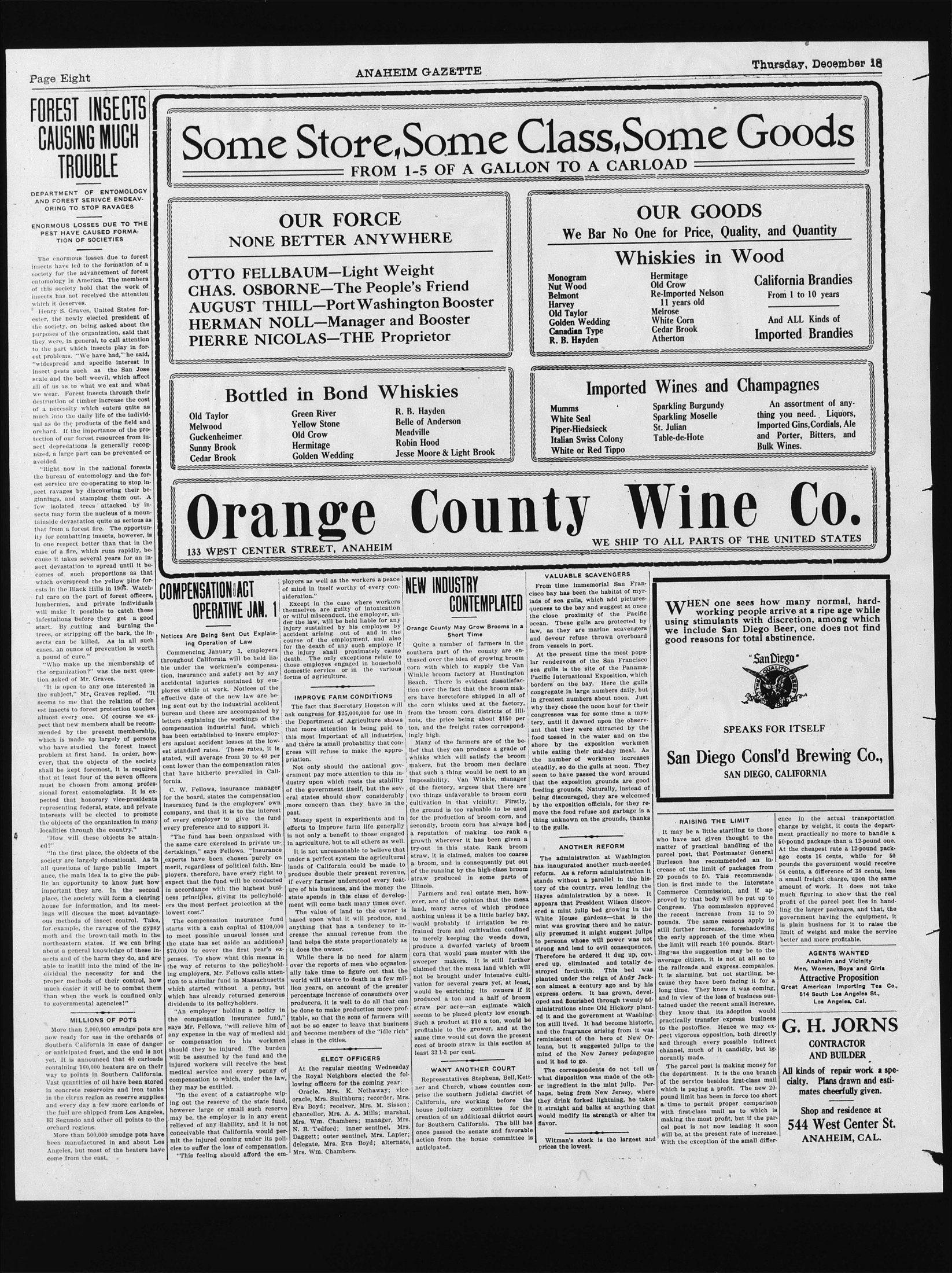
Searchable text
FOREST INSECTS CAUSING MUCH TROUBLE
DEPARTMENT OF ENTOMOLOGY AND FOREST SERIVCE ENDEAVORING TO STOP RAVAGES
ENORMOUS LOSSES DUE TO THE PEST HAVE CAUSED FORMA-TION OF SOCIETIES
The enormous losses due to forest insects have led to the formation of a society for the advancement of forest entomology in America. The members of this society hold that the work of insects has not received the attention which it deserves.
Henry S. Graves, United States forester, the newly elected president of the society, on being asked about the purposes of the organization, said that they were, in general, to call attention to the part which insects play in forest problems. "We have had," he said, "widespread and specific interest in insect pests such as the San Jose scale and the boll weevil, which affect all of us as to what we eat and what we wear. Forest insects through their destruction of timber increase the cost of a necessity which enters quite as much into the daily life of the individual as do the products of the field and orchard. If the importance of the protection of our forest resources from insect depredations is generally recognized, a large part can be prevented or avoided.
"Right now in the national forests
scale and the boll weevil, which affect all of us as to what we eat and what we wear. Forest insects through their destruction of timber increase the cost of a necessity which enters quite as much into the daily life of the individual as do the products of the field and orchard. If the importance of the protection of our forest resources from insect depredations is generally recognized, a large part can be prevented or avoided.
"Right now in the national forests the bureau of entomology and the forest service are co-operating to stop insect ravages by discovering their beginnings, and stamping them out. A few isolated trees attacked by insects may form the nucleus of a mountainside devastation quite as serious as that from a forest fire. The opportunity for combatting insects, however, is in one respect better than that in the case of a fire, which runs rapidly, because it takes several years for an insect devastation to spread until it becomes of such proportions as that which overspread the yellow pine forests in the Black Hills in 1906. Watchful care on the part of forest officers, lumbermen, and private individuals will make it possible to catch these infestations before they get a good start. By cutting and burning the trees, or stripping off the bark, the insects can be killed. As in all such cases, an ounce of prevention is worth a pound of cure."
"Who make up the membership of the organization?" was the next question asked of Mr. Graves.
"It is open to any one interested in the subject," Mr. Graves replied. "It seems to me that the relation of forest insects to forest protection touches almost every one. Of course we expect that new members shall be recommended by the present membership, which is made up largely of persons who have studied the forest insect problem at first hand. In order, however, that the objects of the society shall be kept foremost, it is required that at least four of the seven officers must be chosen from among professional forest entomologists. It is expected that honorary vice-presidents representing federal, state, and private interests will be elected to promote the objects of the organization in many localities through the country."
"How will these objects be attained?"
"In the first place, the objects of the society are largely educational. As in all questions of large public importance, the main idea is to give the public an opportunity to know just how important they are. In the second place, the society will form a clearing scale and the boll weevil, which affect all of us as to what we eat and what we wear. Forest insects through their destruction of timber increase the cost of a necessity which enters quite as much into the daily life of the individual as do the products of the field and orchard. If the importance of the protection of our forest resources from insect depredations is generally recognized, a large part can be prevented or avoided."
"Right now in the national forests the bureau of entomology and the forest service are co-operating to stop insect ravages by discovering their beginnings, and stamping them out. A few isolated trees attacked by insects may form the nucleus of a mountainside devastation quite as serious as that from a forest fire. The opportunity for combatting insects, however, is in one respect better than that in the case of a fire, which runs rapidly, because it takes several years for an insect devastation to spread until it becomes of such proportions as that which overspread the yellow pine forests in the Black Hills in 1906. Watchful care on the part of forest officers, lumbermen, and private individuals will make it possible to catch these infestations before they get a good start. By cutting and burning the trees, or stripping off the bark, the insects can be killed. As in all such cases, an ounce of prevention is worth a pound of cure."
"Who make up the membership of the organization?" was the next question asked of Mr. Graves.
"It is open to any one interested in the subject," Mr. Graves replied. "It seems to me that the relation of forest insects to forest protection touches almost every one. Of course we expect that new members shall be recommended by the present membership, which is made up largely of persons who have studied the forest insect problem at first hand. In order, however, that the objects of the society shall be kept foremost, it is required that at least four of the seven officers must be chosen from among professional forest entomologists. It is expected that honorary vice-presidents representing federal, state, and private interests will be elected to promote the objects of the organization in many localities through the country."
"How will these objects be attained?"
"In the first place, the objects of the society are largely educational. As in all questions of large public importance, the main idea is to give the public an opportunity to know just how important they are. In the second place, the society will form a clearing scale and the boll weevil, which affect all of us as to what we eat and what we wear. Forest insects through their destruction of timber increase the cost of a necessity which enters quite as much into the daily life of the individual as do the products of the field and orchard. If the importance of the protection of our forest resources from insect depredations is generally recognized, a large part can be prevented or avoided."
"Right now in the national forests the bureau of entomology and the forest service are co-operating to stop insect ravages by discovering their beginnings, and stamping them out. A few isolated trees attacked by insects may form the nucleus of a mountainside devastation quite as serious as that from a forest fire. The opportunity for combatting insects, however, is in one respect better than that in the case of a fire, which runs rapidly, because it takes several years for an insect devastation to spread until it becomes of such proportions as that which overspread the yellow pine forests in the Black Hills in 1906. Watchful care on the part of forest officers, lumbermen, and private individuals will make it possible to catch these infestations before they get a good start. By cutting and burning the trees, or stripping off the bark, the insects can be killed. As in all such cases, an ounce of prevention is worth a pound of cure."
"Who make up the membership of the organization?" was the next question asked of Mr. Graves.
"It is open to any one interested in the subject," Mr. Graves replied. "It seems to me that the relation of forest insects to forest protection touches almost every one. Of course we expect that new members shall be recommended by the present membership, which is made up largely of persons who have studied the forest insect problem at first hand. In order, however, that the objects of the society shall be kept foremost, it is required that at least four of the seven officers must be chosen from among professional forest entomologists. It is expected that honorary vice-presidents representing federal, state, and private interests will be elected to promote the objects of the organization in many localities through the country."
"How will these objects be attained?"
"In the first place, the objects of the society are largely educational. As in all questions of large public importance, the main idea is to give the public an opportunity to know just how important they are. In the second place, the society will form a clearing scale and the boll weevil, which affect all of us as to what we eat and what we wear. Forest insects through their destruction of timber increase the cost of a necessity which enters quite as much into the daily life of the individual as do the products of the field and orchard. If the importance of the protection of our forest resources from insect depredations is generally recognized, a large part can be prevented or avoided."
"Right now in the national forests the bureau of entomology and the forest service are co-operating to stop insect ravages by discovering their beginnings, and stamping them out. A few isolated trees attacked by insects may form the nucleus of a mountainside devastation quite as serious as that from a forest fire. The opportunity for combatting insects, however, is in one respect better than that in the case of a fire, which runs rapidly, because it takes several years for an insect devastation to spread until it becomes of such proportions as that which overspread the yellow pine forests in the Black Hills in 1906. Watchful care on the part of forest officers, lumbermen, and private individuals will make it possible to catch these infestations before they get a good start. By cutting and burning the trees, or stripping off the bark, the insects can be killed. As in all such cases, an ounce of prevention is worth a pound of cure."
pected that honorary vice-presidents representing federal, state, and private interests will be elected to promote the objects of the organization in many localities through the country."
"How will these objects be attained?"
"In the first place, the objects of the society are largely educational. As in all questions of large public importance, the main idea is to give the public an opportunity to know just how important they are. In the second place, the society will form a clearing house for information, and its meetings will discuss the most advantageous methods of insect control. Take, for example, the ravages of the gypsy moth and the brown-tail moth in the northeastern states. If we can bring about a general knowledge of these insects and of the harm they do, and are able to instill into the mind of the individual the necessity for and the proper methods of their control, how much easier it will be to combat them than when the work is confined only to governmental agencies!"
MILLIONS OF POTS
More than 2,000,000 smudge pots are now ready for use in the orchards of Southern California in case of danger or anticipated frost, and the end is not yet. It is announced that 40 carloads containing 160,000 heaters are on their way to points in Southern California. Vast quantities of oil have been stored in concrete reservoirs and iron tanks in the citrus region as reserve supplies and every day a few more carloads of the fuel are shipped from Los Angeles, El Segundo and other oil points to the orchard regions.
More than 500,000 smudge pots have been manufactured in and about Los Angeles, but most of the heaters have come from the east.
"The fund has been organized with the same care exercised in private undertakings," says Fellows. "Insurance experts have been chosen purely on merit, regardless of political faith. Employers, therefore, have every right to expect that the fund will be conducted in accordance with the highest business principles, giving its policyholders the most perfect protection at the lowest cost."
The compensation insurance fund starts with a cash capital of $100,000 to meet possible unusual losses and the state has set aside an additional $70,000 to cover the first year's expenses. To show what this means in the way of returns to the policyholding employers, Mr. Fellows calls attention to a similar fund in Massachusetts which started without a penny, but which has already returned generous dividends to its policyholders.
"An employer holding a policy in the compensation insurance fund," says Mr. Fellows, "will relieve him of any expense in the way of medical aid or compensation to his workmen should they be injured. The burden will be assumed by the fund and the injured workers will receive the best medical service and every penny of compensation to which, under the law, they may be entitled.
"In the event of a catastrophe wiping out the reserve of the state fund, however large or small such reserve may be, the employer is in any event relieved of any liability, and it is not conceivable that California would permit the injured coming under its policies to suffer the loss of compensation.
"This feeling should afford the em-
ANAHEIM GAZETTE
The Store, Some Class, Some
FROM 1-5 OF A GALLON TO A CARLOA
OUR FORCE
BETTER ANYWHERE
BLBAUM—Light Weight
ORNE—The People's Friend
HILL—Port Washington Booster
NOLL—Manager and Booster
COLAS—THE Proprietor
OUR
We Bar No One for
Whisky
Monogram Hermi
Nut Wood Old Cr
Belmont Re-Im
Harvey 11 y
Old Taylor Melros
Golden Wedding White
Canadian Type Cedar
R. B. Hayden Ather
d in Bond Whiskies
Green River R. B. Hayden
Yellow Stone Belle of Anderson
Old Crow Meadville
Hermitage Robin Hood
Golden Wedding Jesse Moore & Light Brook
Imported W
Mumms Sparkle
White Seal Sparkle
Piper-Hiedsieck St. Ju
Italian Swiss Colony Table
White or Red Tippo
New County W
R STREET, ANAHEIM
WE SHIP TO A
ployers as well as the workers a peace of mind in itself worthy of every consideration."
Except in the case where workers themselves are guilty of intoxication or wilful misconduct, the employer, under the law, will be held liable for any injury sustained by his employees by accident arising out of and in the course of the employment, and also for the death of any such employee if the injury shall proximately cause death. The only exceptions relate to those employees engaged in household domestic service or in the various forms of agriculture.
IMPROVE FARM CONDITIONS
The fact that Secretary Houston will ask congress for $25,000,000 for use in the Department of Agriculture shows that more attention is being paid to this most important of all industries, and there is small probability that congress will refuse to make the appropriation.
Not only should the national government pay more attention to this industry upon which rests the stability of the government itself, but the several states should show considerably more concern than they have in the past.
Money spent in experiments and efforts to improve farm life generally is not only a benefit to those engaged in agriculture, but to all others as well.
It is not unreasonable to believe that under a perfect system the agricultural lands of California could be made to produce double their present revenue, if every farmer understood every feature of his business, and the money the state spends in this class of development in Bond Whiskies
Green River R. B. Hayden
Yellow Stone Belle of Anderson
Old Crow Meadville
Hermitage Robin Hood
Golden Wedding Jesse Moore & Light Brook
NEW INDUSTRY CONTEMPLATED
Orange County May Grow Brooms in a Short Time
Quite a number of farmers in the southern part of the county are enthused over the idea of growing broom corn with which to supply the Van Winkle broom factory at Huntington Beach. There is evident dissatisfaction over the fact that the broom makers have heretofore shipped in all of the corn whisks used at the factory, from the broom corn districts of Illinois, the price being about $150 per ton, and the freight rates correspondingly high.
Many of the farmers are of the belief that they can produce a grade of whisks which will satisfy the broom makers, but the broom men declare that such a thing would be next to an impossibility. Van Winkle, manager of the factory, argues that there are two things unfavorable to broom corn cultivation in that vicinity: Firstly, the ground is too valuable to be used for the production of broom corn, and secondly, broom corn has always had a reputation of making too rank a growth wherever it has been given a try-out in this state. Rank broom straw, it is claimed, makes too coarse a broom, and is consequently put out of the running by the high-class broom straw produced in some parts of Illinois.
Farmers and real estate men, how-
VALUABLE SCAVENGERS
From time immemorial San Francisco bay has been the habitat of myriads of sea gulls, which add picturesqueness to the bay and suggest at once the close proximity of the Pacific ocean. These gulls are protected by law, as they are marine scavengers and devour refuse thrown overboard from vessels in port.
At the present time the most popular rendezvous of the San Francisco sea gulls is the site of the Panama-Pacific International Exposition, which borders on the bay. Here the gulls congregate in large numbers daily, but in greatest numbers about noon. Just why they chose the noon hour for their congresses was for some time a mystery, until it dawned upon the observant that they were attracted by the food tossed in the water and on the shore by the exposition workmen while eating their mid-day meal. As the number of workmen increases steadily, so do the gulls at noon. They seem to have passed the word around that the exposition grounds are good feeding grounds. Naturally, instead of being discouraged, they are welcomed by the exposition officials, for they remove the food refuse and garbage is a thing unknown on the grounds, thanks to the gulls.
ANOTHER REFORM
The administration at Washington has inaugurated another much-needed reform. As a reform administration it stands without a parallel in the history of the country, even leading the Hayes administration by a nose. It
Money spent in experiments and efforts to improve farm life generally is not only a benefit to those engaged in agriculture, but to all others as well.
It is not unreasonable to believe that under a perfect system the agricultural lands of California could be made to produce double their present revenue, if every farmer understood every feature of his business, and the money the state spends in this class of development will come back many times over.
The value of land to the owner is based upon what it will produce, and anything that has a tendency to increase the annual revenue from the land helps the state proportionately as it does the owner.
While there is no need for alarm over the reports of men who occasionally take time to figure out that the world will starve to death in a few million years, on account of the greater percentage increase of consumers over producers, it is well to do all that can be done to make production more profitable, so that the sons of farmers will not be so eager to leave that business and become members of the "idle rich" class in the cities.
ELECT OFFICERS
At the regular meeting Wednesday the Royal Neighbors elected the following officers for the coming year:
Oracle, Mrs. K. Nethaway; vice-oracle, Mrs. Smithburn; recorder, Mrs. Eva Boyd; receiver, Mrs. M. Sisson; chancellor, Mrs. A. A. Mills; marshal, Mrs. Wm. Chambers; manager, Mrs. N. B. Tedford; inner sentinel, Mrs. Daggett; outer sentinel, Mrs. Laplier; delegate, Mrs. Eva Boyd; alternate, Mrs. Wm. Chambers.
WANT ANOTHER COURT
Representatives Stephens, Bell, Ketterer and Church, whose counties comprise the southern judicial district of California, are working before the house judiciary committee for the creation of an additional district court for Southern California. The bill has once passed the senate and favorable action from the house committee is anticipated.
ANOTHER REFORM
The administration at Washington has inaugurated another much-needed reform. As a reform administration it stands without a parallel in the history of the country, even leading the Hayes administration by a nose. It appears that President Wilson discovered a mint julip bed growing in the White House gardens—that is the mint was growing there and he naturally presumed it might suggest julips to persons whose will power was not strong and lead to evil consequences. Therefore he ordered it dug up, covered up, eliminated and totally destroyed forthwith. This bed was planted under the reign of Andy Jackson almost a century ago and by his express orders. It has grown, developed and flourished through twenty administrations since Old Hickory planted it and the government at Washington still lived. It had become historic, and the fragrance arising from it was reminiscent of the hero of New Orleans, but it suggested julips to the mind of the New Jersey pedagogue and it had to go.
The correspondents do not tell us what disposition was made of the other ingredient in the mint julip. Perhaps, being from New Jersey, where they drink forked lightning, he takes it straight and balks at anything that would modify its strength or alter its flavor.
Witman's stock is the largest and prices the lowest.
s,Some Goods
A CARLOAD
OUR GOODS
No One for Price, Quality, and Quantity
Whiskies in Wood
Hermitage
Old Crow
Re-Imported Nelson
11 years old
Melrose
White Corn
Cedar Brook
Atherton
California Brandies
From 1 to 10 years
And ALL Kinds of Imported Brandies
Imported Wines and Champagnes
Sparkling Burgundy
Sparkling Moselle
St. Julian
Table-de-Hote
An assortment of anything you need. Liquors,
Imported Gins,Cordials,Ale and Porter,Bitters,and Bulk Wines.
Imported Wines and Champagnes
Sparkling Burgundy
Sparkling Moselle
St. Julian
Table-de-Hote
An assortment of anything you need. Liquors,
Imported Gins, Cordials, Ale and Porter, Bitters, and Bulk Wines.
Wine Co.
WE SHIP TO ALL PARTS OF THE UNITED STATES
WHEN one sees how many normal, hard-working people arrive at a ripe age while using stimulants with discretion, among which we include San Diego Beer, one does not find good reasons for total abstinence.
"San Diego"
QUALITY BEER
SPEAKS FOR ITSELF
San Diego Consl'd Brewing Co.,
SAN DIEGO, CALIFORNIA
RAISING THE LIMIT
It may be a little startling to those who have not given thought to the matter of practical handling of the parcel post, that Postmaster General Burleson has recommended an increase of the limit of packages from 20 pounds to 50. This recommendation is first made to the Interstate Commerce Commission, and if approved by that body will be put up to ence in the actual transportation charge by weight, it costs the department practically no more to handle a 50-pound package than a 12-pound one. At the cheapest rate a 12-pound package costs 16 cents, while for 50 pounds the government would receive 54 cents, a difference of 38 cents, less a small freight charge, upon the same amount of work. It does not take much figuring to show that the real
RAISING THE LIMIT
It may be a little startling to those who have not given thought to the matter of practical handling of the parcel post, that Postmaster General Burleson has recommended an increase of the limit of packages from 20 pounds to 50. This recommendation is first made to the Interstate Commerce Commission, and if approved by that body will be put up to Congress. The commission approved the recent increase from 12 to 20 pounds. The same reasons apply to still further increase, foreshadowing the early approach of the time when the limit will reach 100 pounds. Startling as the suggestion may be to the average citizen, it is not at all so to the railroads and express companies. It is alarming, but not startling, because they have been facing it for a long time. They knew it was coming, and in view of the loss of business sustained under the recent small increase, they know that its adoption would practically transfer express business to the postoffice. Hence we may expect vigorous opposition, both directly and through every possible indirect channel, much of it candidly, but ignorantly made.
The parcel post is making money for the department. It is the one branch of the service besides first-class mail which is paying a profit. The new 20-pound limit has been in force too short a time to permit proper comparison with first-class mail as to which is making the most profit, but if the parcel post is not now leading it soon will be, at the present rate of increase. With the exception of the small difference in the actual transportation charge by weight, it costs the department practically no more to handle a 50-pound package than a 12-pound one. At the cheapest rate a 12-pound package costs 16 cents, while for 50 pounds the government would receive 54 cents, a difference of 38 cents, less a small freight charge, upon the same amount of work. It does not take much figuring to show that the real profit of the parcel post lies in handling the larger packages, and that, the government having the equipment, it is plain business for it to raise the limit of weight and make the service better and more profitable.
AGENTS WANTED
Anaheim and Vicinity
Men, Women, Boys and Girls
Attractive Proposition
Great American Importing Tea Co., 514 South Los Angeles St., Los Angeles, Cal.
G. H. JORNS
CONTRACTOR AND BUILDER
All kinds of repair work a specialty. Plans drawn and estimates cheerfully given.
Shop and residence at
544 West Center St.
ANAHEIM, CAL.