anaheim-gazette 1913-12-18
Scanned page
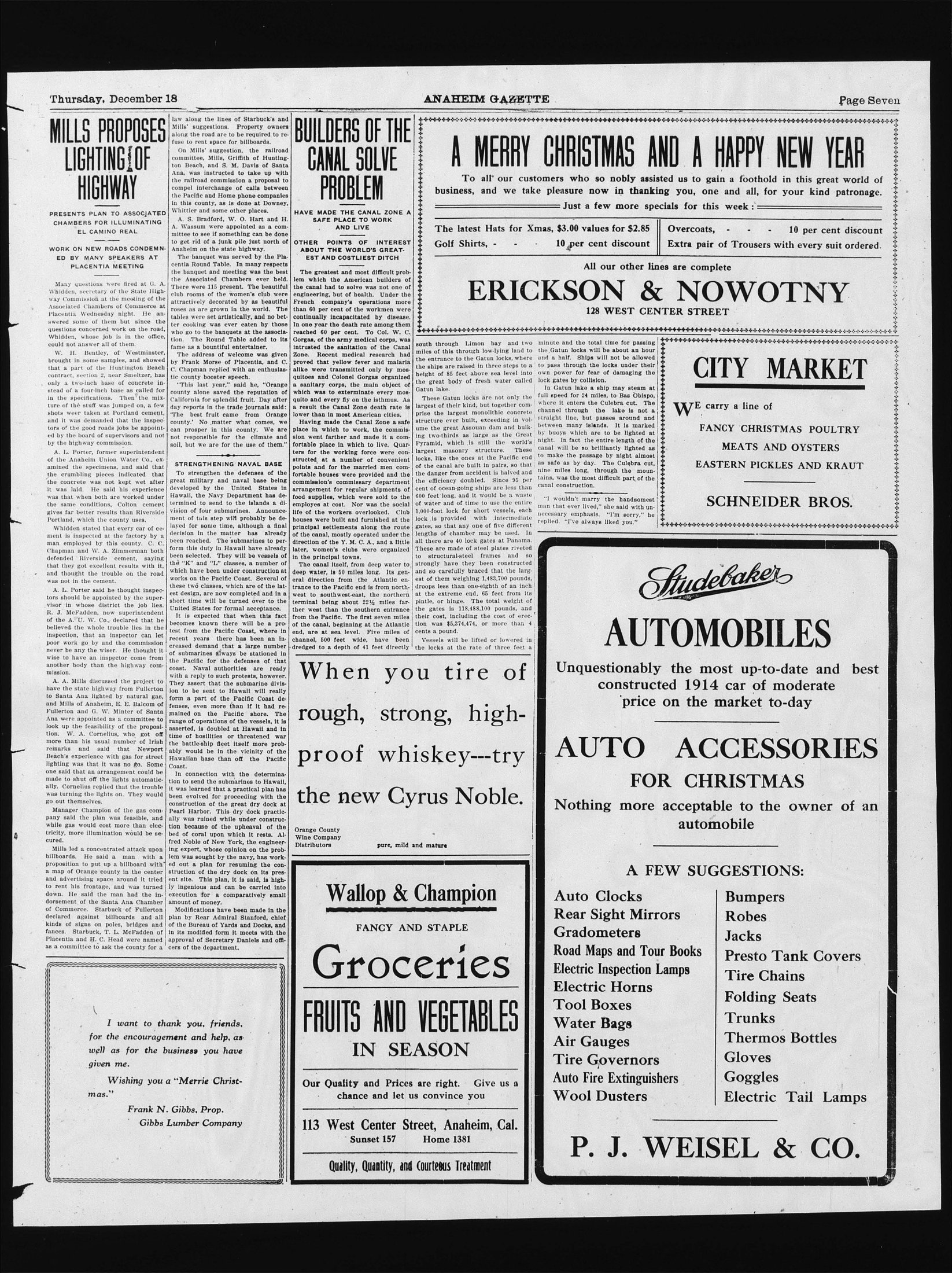
Searchable text
MILLS PROPOSES LIGHTING OF HIGHWAY
PRESENTS PLAN TO ASSOCIATED CHAMBERS FOR ILLUMINATING EL CAMINO REAL
WORK ON NEW ROADS CONDEMNED BY MANY SPEAKERS AT PLACENTIA MEETING
Many questions were fired at G. A. Whidden, secretary of the State Highway Commission at the meeting of the Associated Chambers of Commerce at Placentia Wednesday night. He answered some of them but since the questions concerned work on the road, Whidden, whose job is in the office, could not answer all of them.
W. H. Bentley, of Westminster, brought in some samples, and showed that a part of the Huntington Beach contract, section 2, near Smeltzer, has only a two-inch base of concrete instead of a four-inch base as called for in the specifications. Then the mixture of the stuff was jumped on, a few shots weer taken at Portland cement, and it was demanded that the inspectors of the good roads jobs be appointed by the board of supervisors and not by the highway commission.
A. L. Porter, former superintendent of the Anaheim Union Water Co., examined the specimens, and said that the crumbling pieces indicated that law along the lines of Starbuck's and Mills' suggestions. Property owners along the road are to be required to refuse to rent space for billboards.
On Mills' suggestion, the railroad committee, Mills, Griffith of Huntington Beach, and S. M. Davis of Santa Ana, was instructed to take up with the railroad commission a proposal to compel interchange of calls between the Pacific and Home phone companies in this county, as is done at Downey, Whittier and some other places.
A. S. Bradford, W. O. Hart and H. A. Wassum were appointed as a committee to see if something can be done to get rid of a junk pile just north of Anaheim on the state highway.
The banquet was served by the Placentia Round Table. In many respects the banquet and meeting was the best the Associated Chambers ever held. There were 115 present. The beautiful club rooms of the women's club were attractively decorated by as beautiful roses as are grown in the world. The tables were set artistically, and no better cooking was ever eaten by those who go to the banquets at the association. The Round Table added to its fame as a bountiful entertainer.
The address of welcome was given by Frank Morse of Placentia, and C. C. Chapman replied with an enthusiastic county booster speech.
"This last year," said he, "Orange county alone saved the reputation of California for splendid fruit. Day after day reports in the trade journals said: 'The best fruit came from Orange county.' No matter what comes, we can prosper in this county. We are not responsible for the climate and soil, but we are for the use of them."
STRENGTHENING NAVAL BASE
To strengthen the defenses of the
A. L. Porter, former superintendent of the Anaheim Union Water Co., examined the specimens, and said that the crumbling pieces indicated that the concrete was not kept wet after it was laid. He said his experience was that when both are worked under the same conditions, Colton cement gives far better results than Riverside Portland, which the county uses.
Whidden stated that every car of cement is inspected at the factory by a man employed by this county. C. C. Chapman and W. A. Zimmerman both defended Riverside cement, saying that they got excellent results with it, and thought the trouble on the road was not in the cement.
A. L. Porter said he thought inspectors should be appointed by the supervisor in whose district the job lies. R. J. McFadden, now superintendent of the A. U. W. Co., declared that he believed the whole trouble lies in the inspection, that an inspector can let poor work go by and the commission never be any wiser. He thought it wise to have an inspector come from another body than the highway commission.
A. A. Mills discussed the project to have the state highway from Fullerton to Santa Ana lighted by natural gas, and Mills of Anaheim, E. E. Balcom of Fullerton and G. W. Minter of Santa Ana were appointed as a committee to look up the feasibility of the proposition. W. A. Cornelius, who got off more than his usual number of Irish remarks and said that Newport Beach's experience with gas for street lighting was that it was no go. Some one said that an arrangement could be made to shut off the lights automatically. Cornelius replied that the trouble was turning the lights on. They would go out themselves.
Manager Champion of the gas company said the plan was feasible, and while gas would cost more than electricity, more illumination would be secured.
Mills led a concentrated attack upon billboards. He said a man with a proposition to put up a billboard with a map of Orange county in the center and advertising space around it tried to rent his frontage, and was turned down. He said the man had the incumbent county booster speech.
“This last year,” said he, “Orange county alone saved the reputation of California for splendid fruit. Day after day reports in the trade journals said: ‘The best fruit came from Orange county.’ No matter what comes, we can prosper in this county. We are not responsible for the climate and soil, but we are for the use of them.”
STRENGTHENING NAVAL BASE
To strengthen the defenses of the great military and naval base being developed by the United States in Hawaii, the Navy Department has determined to send to the islands a division of four submarines. Announcement of this step will probably be delayed for some time, although a final decision in the matter has already been reached. The submarines to perform this duty in Hawaii have already been selected. They will be vessels of the “K” and “L” classes, a number of which have been under construction at works on the Pacific Coast. Several of these two classes, which are of the latest design, are now completed and in a short time will be turned over to the United States for formal acceptance.
It is expected that when this fact becomes known there will be a protest from the Pacific Coast, where in recent years there has been an increased demand that a large number of submarines always be stationed in the Pacific for the defenses of that coast. Naval authorities are ready with a reply to such protests, however. They assert that the submarine division to be sent to Hawaii will really form a part of the Pacific Coast defenses, even more than if it had remained on the Pacific shore. The range of operations of the vessels, it is asserted, is doubled at Hawaii and in time of hostilities or threatened war the battle-ship fleet itself more probably would be in the vicinity of the Hawaiian base than off the Pacific Coast.
In connection with the determination to send the submarines to Hawaii, it was learned that a practical plan has been evolved for proceeding with the construction of the great dry dock at Pearl Harbor. This dry dock practically was ruined while under construction because of the upheaval of the bed of coral upon which it rests. Alfred Noble of New York, the engineering expert, whose opinion on the problem was sought by the navy, has worked out a plan for resuming the construction of the dry dock on its present site. This plan, it is said, is highly ingenious and can be carried into execution for a comparatively small
Manager Champion of the gas company said the plan was feasible, and while gas would cost more than electricity, more illumination would be secured.
Mills led a concentrated attack upon billboards. He said a man with a proposition to put up a billboard with a map of Orange county in the center and advertising space around it tried to rent his frontage, and was turned down. He said the man had the indorsement of the Santa Ana Chamber of Commerce. Starbuck of Fullerton declared against billboards and all kinds of signs on poles, bridges and fences. Starbuck, T. L. McFadden of Placentia and H. C. Head were named as a committee to ask the county for a
I want to thank you, friends, for the encouragement and help, as well as for the business you have given me.
Wishing you a "Merrie Christmas."
Frank N. Gibbs, Prop.
Gibbs Lumber Company
ANAHEIM GAZETTE
BUILDERS OF THE CANAL SOLVE PROBLEM
HAVE MADE THE CANAL ZONE A SAFE PLACE TO WORK AND LIVE
OTHER POINTS OF INTEREST ABOUT THE WORLD'S GREATEST AND COSTLIEST DITCH
The greatest and most difficult problem which the American builders of the canal had to solve was not one of engineering, but of health. Under the French company's operations more than 60 per cent of the workmen were continually incapacitated by disease. In one year the death rate among them reached 60 per cent. To Col. W. C. Gorgas, of the army medical corps, was intrusted the sanitation of the Canal Zone. Recent medical research had proved that yellow fever and malaria alike were transmitted only by mosquitoes and Colonel Gorgas organized a sanitary corps, the main object of which was to exterminate every mosquito and every fly on the isthmus. As a result the Canal Zone death rate is lower than in most American cities.
Having made the Canal Zone a safe place in which to work, the commission went farther and made it a comfortable place in which to live. Quarters for the working force were constructed at a number of convenient points and for the married men comfortable houses were provided and the south through Limon bay and two miles of this through low-lying land to the entrance to the Gatun locks, where the ships are raised in three steps to a height of 85 feet above sea level into the great body of fresh water called Gatun lake.
These Gatun locks are not only the largest of their kind, but together comprise the largest monolithic concrete structure ever built, exceeding in volume the great Assouan dam and bulking two-thirds as large as the Great Pyramid, which is still the world's largest masonry structure. These locks, like the ones at the Pacific end of the canal are built in pairs, so that the danger from accident is halved and minute and the total time for passing the Gatun locks will be about an hour and a half. Ships will not be allowed to pass through the locks under their own power for fear of damaging the lock gates by collision.
In Gatun lake a ship may steam at full speed for 24 miles, to Bas Obispo, where it enters the Culebra cut. The channel through the lake is not a straight line, but passes around and between many islands. It is marked by buoys which are to be lighted at night. In fact the entire length of the canal will be so brilliantly lighted as to make the passage by night almost as safe as by day. The Culebra cut, nine miles long, through the moun-
quitoes and Colonel Gorgas organized a sanitary corps, the main object of which was to exterminate every mosquito and every fly on the isthmus. As a result the Canal Zone death rate is lower than in most American cities.
Having made the Canal Zone a safe place in which to work, the commission went farther and made it a comfortable place in which to live. Quarters for the working force were constructed at a number of convenient points and for the married men comfortable houses were provided and the commission's commissary department arrangement for regular shipments of food supplies, which were sold to the employes at cost. Nor was the social life of the workers overlooked. Club houses were built and furnished at the principal settlements along the route of the canal, mostly operated under the direction of the Y. M. C. A., and a little later, women's clubs were organized in the principal towns.
The canal itself, from deep water to deep water, is 50 miles long. Its general direction from the Atlantic entrance to the Pacific end is from northwest to southwest-east, the northern terminal being about 22½ miles farther west than the southern entrance from the Pacific. The first seven miles of the canal, beginning at the Atlantic end, are at sea level. Five miles of channel, 500 feet wide, have been dredged to a depth of 41 feet directly
These Gatun locks are not only the largest of their kind, but together comprise the largest monolithic concrete structure ever built, exceeding in volume the great Assouan dam and bulking two-thirds as large as the Great Pyramid, which is still the world's largest masonry structure. These locks, like the ones at the Pacific end of the canal are built in pairs, so that the danger from accident is halved and the efficiency doubled. Since 95 per cent of ocean-going ships are less than 600 feet long, and it would be a waste of water and of time to use the entire 1,000-foot lock for short vessels, each lock is provided with intermediate gates, so that any one of five different lengths of chamber may be used. In all there are 40 lock gates at Panama. These are made of steel plates riveted to structural steel frames and so strongly have they been constructed and so carefully braced that the largest of them weighing 1,483,700 pounds, droops less than one-eighth of an inch at the extreme end, 65 feet from its pintle, or hinge. The total weight of the gates is 118,488,100 pounds, and their cost, including the cost of erection was $5,374,474, or more than 4 cents a pound.
Vessels will be lifted or lowered in the locks at the rate of three feet a
When you tire of rough, strong, high-proof whiskey---try the new Cyrus Noble.
Orange County
Wine Company
Distributors
pure, mild and mature
Wallon & Champion
In Gatun lake a ship may steam at full speed for 24 miles, to Bas Obispo, where it enters the Culebra cut. The channel through the lake is not a straight line, but passes around and between many islands. It is marked by buoys which are to be lighted at night. In fact the entire length of the canal will be so brilliantly lighted as to make the passage by night almost as safe as by day. The Culebra cut, nine miles long, through the mountains, was the most difficult part of the canal construction.
"I wouldn't marry the handsomest man that ever lived," she said with unnecessary emphasis. "I'm sorry," he replied. "I've always liked you."
Wallop & Champion
FANCY AND STAPLE
Groceries
FRUITS AND VEGETABLES
IN SEASON
Our Quality and Prices are right. Give us a chance and let us convince you
113 West Center Street, Anaheim, Cal.
Sunset 157 Home 1381
Quality, Quantity, and Courteous Treatment
A FEW
Auto Clocks
Rear Sight Mirror
Gradometers
Road Maps and Tour L
Electric Inspection Lan
Electric Horns
Tool Boxes
Water Bags
Air Gauges
Tire Governors
Auto Fire Extinguisher
Wool Dusters
P. J. W
CHRISTMAS AND A HAPPY NEW YEAR
so nobly assisted us to gain a foothold in this great world of
now in thanking you, one and all, for your kind patronage.
few more specials for this week:
Rates for $2.85
ent discount
Overcoats, - - - 10 per cent discount
Extra pair of Trousers with every suit ordered.
Our other lines are complete
ON & NOWOTNY
8 WEST CENTER STREET
CITY MARKET
WE carry a line of
FANCY CHRISTMAS POULTRY
MEATS AND OYSTERS
EASTERN PICKLES AND KRAUT
WE carry a line of
FANCY CHRISTMAS POULTRY
MEATS AND OYSTERS
EASTERN PICKLES AND KRAUT
SCHNEIDER BROS.
Studebaker
AUTOMOBILES
estionably the most up-to-date and best
constructed 1914 car of moderate
price on the market to-day
TO ACCESSORIES
FOR CHRISTMAS
being more acceptable to the owner of an
automobile
A FEW SUGGESTIONS:
Clocks | Bumpers
A FEW SUGGESTIONS:
Clocks
Sight Mirrors
Dimeters
Bags and Tour Books
Inspection Lamps
C horns
Boxes
Bags
Luges
Governors
Fire Extinguishers
Dusters
Bumpers
Robes
Jacks
Presto Tank Covers
Tire Chains
Folding Seats
Trunks
Thermos Bottles
Gloves
Goggles
Electric Tail Lamps
J. WEISEL & CO.