anaheim-gazette 1913-11-20
Scanned page
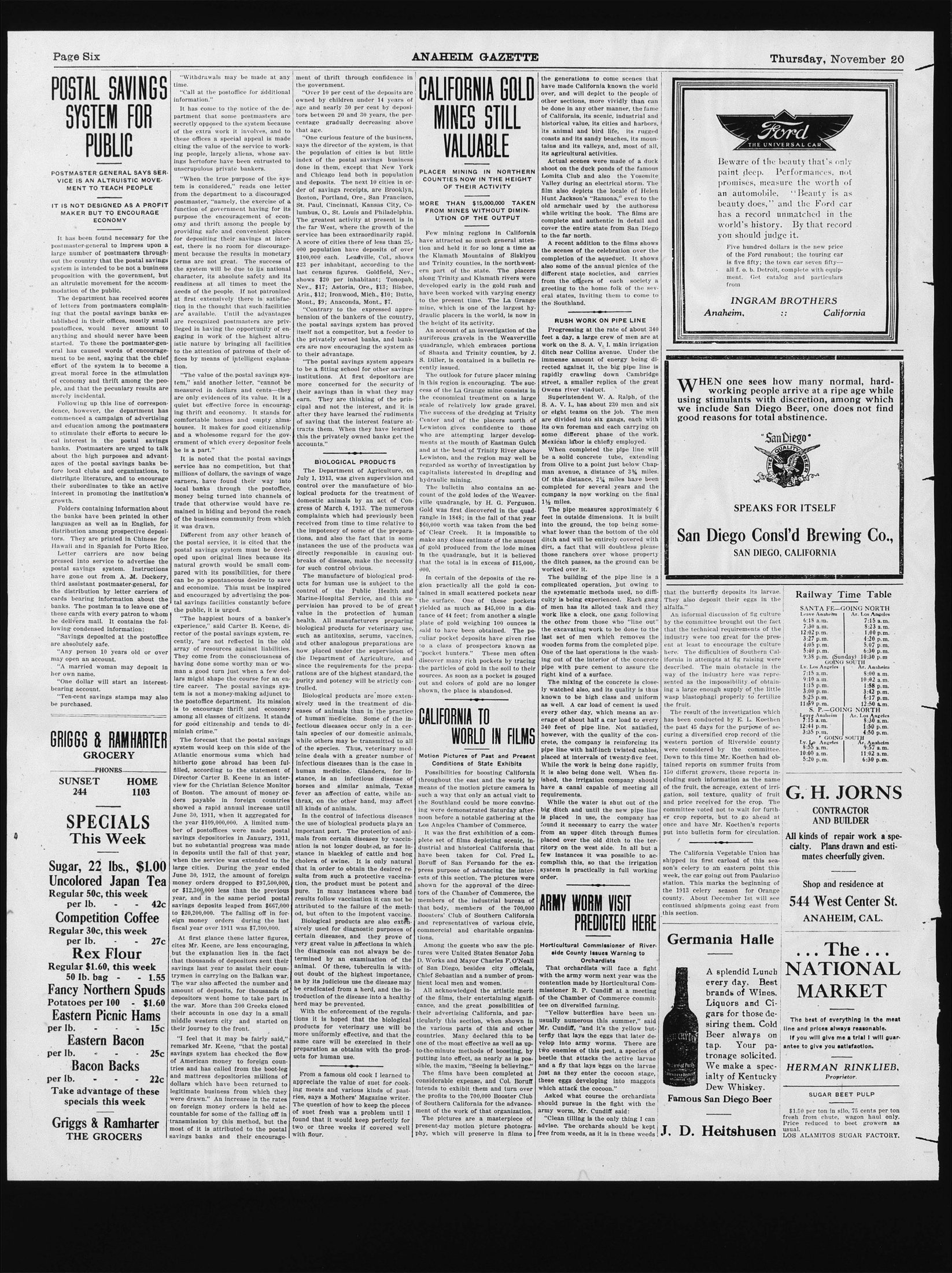
Searchable text
POSTAL SAVINGS SYSTEM FOR PUBLIC
POSTMASTER GENERAL SAYS SERVICE IS AN ALTRUISTIC MOVEMENT TO TEACH PEOPLE
IT IS NOT DESIGNED AS A PROFIT MAKER BUT TO ENCOURAGE ECONOMY
It has been found necessary for the postmaster-general to impress upon a large number of postmasters throughout the country that the postal savings system is intended to be not a business proposition with the government, but an altruistic movement for the accommodation of the public.
The department has received scores of letters from postmasters complaining that the postal savings banks established in their offices, mostly small postoffices, would never amount to anything and should never have been started. To these the postmaster-general has caused words of encouragement to be sent, saying that the chief effort of the system is to become a great moral force in the stimulation of economy and thrift among the people, and that the pecuniary results are merely incidental.
Following up this line of correspondence, however, the department has commenced a campaign of advertising and education among the postmasters to stimulate their efforts to secure local interest in the postal savings banks. Postmasters are urged to talk about the high purposes and advantages of the postal savings banks before local clubs and organizations, to
"Withdrawals may be made at any time.
"Call at the postoffice for additional information."
It has come to the notice of the department that some postmasters are secretly opposed to the system because of the extra work it involves, and to these offices a special appeal is made citing the value of the service to working people, largely aliens, whose savings heretofore have been entrusted to unscrupulous private bankers.
"When the true purpose of the system is considered," reads one letter from the department to a discouraged postmaster, "namely, the exercise of a function of government having for its purpose the encouragement of economy and thrift among the people by providing safe and convenient places for depositing their savings at interest, there is no room for discouragement because the results in monetary terms are not great. The success of the system will be due to its national character, its absolute safety and its readiness at all times to meet the needs of the people. If not patronized at first extensively there is satisfaction in the thought that such facilities are available. Until the advantages are recognized postmasters are privileged in having the opportunity of engaging in work of the highest altruistic nature by bringing all facilities to the attention of patrons of their offices by means of intelligent explanation.
"The value of the postal savings system," said another letter, "cannot be measured in dollars and cents—they are only evidences of its value. It is a quiet but effective force in encouraging thrift and economy. It stands for comfortable homes and empty alms-houses. It makes for good citizenship and a wholesome regard for the government of which every depositor feels he is a part."
It is noted that the postal savings service has no competition, but that millions of dollars, the savings of wage
Following up this line of correspondence, however, the department has commenced a campaign of advertising and education among the postmasters to stimulate their efforts to secure local interest in the postal savings banks. Postmasters are urged to talk about the high purposes and advantages of the postal savings banks before local clubs and organizations, to distribute literature, and to encourage their subordinates to take an active interest in promoting the institution's growth.
Folders containing information about the banks have been printed in other languages as well as in English, for distribution among prospective depositors. They are printed in Chinese for Hawaii and in Spanish for Porto Rico.
Letter carriers are now being pressed into service to advertise the postal savings system. Instructions have gone out from A. M. Dockery, third assistant postmaster-general, for the distribution by letter carriers of cards bearing information about the banks. The postman is to leave one of these cards with every patron to whom he delivers mail. It contains the following condensed information:
"Savings deposited at the postoffice are absolutely safe.
Any person 10 years old or over may open an account.
A married woman may deposit in her own name.
One dollar will start an interest-bearing account.
Ten-cent savings stamps may also be purchased."
GRIGGS & RAMHARTER GROCERY
PHONES
SUNSET HOME
244 1103
SPECIALS
This Week
Sugar, 22 lbs., $1.00 Uncolored Japan Tea Regular 50c, this week
"The value of the postal savings system," said another letter, "cannot be measured in dollars and cents—they are only evidences of its value. It is a quiet but effective force in encouraging thrift and economy. It stands for comfortable homes and empty alms-houses. It makes for good citizenship and a wholesome regard for the government of which every depositor feels he is a part."
It is noted that the postal savings service has no competition, but that millions of dollars, the savings of wage earners, have found their way into local banks through the postoffice, money being turned into channels of trade that otherwise would have remained in hiding and beyond the reach of the business community from which it was drawn.
Different from any other branch of the postal service, it is cited that the postal savings system must be developed upon original lines because its natural growth would be small compared with its possibilities, for there can be no spontaneous desire to save and economize. This must be inspired and encouraged by advertising the postal savings facilities constantly before the public, it is urged.
"The happiest hours of a banker's experience," said Carter B. Keene, director of the postal savings system, recently, "are not reflected in the old array of resources against liabilities. They come from the consciousness of having done some worthy man or woman a good turn just when a few dollars might shape the course for an entire career. The postal savings system is not a money-making adjunct to the postoffice department. Its mission is to encourage thrift and economy among all classes of citizens. It stands for good citizenship and tends to diminish crime."
The forecast that the postal savings system would keep on this side of the Atlantic enormous sums which had hitherto gone abroad has been fulfilled, according to the statement of Director Carter B. Keene in an interview for the Christian Science Monitor of Boston. The amount of money orders payable in foreign countries showed a rapid annual increase until June 30, 1911, when it aggregated for the year $109,000,000. A limited number of postoffices were made postal savings depositories in January, 1911, but no substantial progress was made in deposits until the fall of that year, when the service was extended to large cities. During the year ended June 30, 1912, the amount of foreign money orders dropped to $97,500,000, or $12,300,000 less than the previous year, and in the same period postal institutions.
BIOLOGICAL
The Department July 1, 1913, was given control over the biological products for domestic animals by decree of March 4, 1913 complaints which had received from time to time the impotency of selections, and also the instances use of directly responsible breaks of disease, for such control objects.
The manufacture of human use control of the P.Marine-Hospital Service has proved valuable in the protection health. All manufactured biological products such as antitoxins, and other analogous now placed under the Department since the requirements are of the highest purity and potency controlled.
Biological products sively used in the releases of animals therof human medicine infectious diseases oustain species of our while others may be of the species. Therapeutic deals with a infectious diseases human medicine, is an infrequent horses and similar fever an affection thrax, on the other all kinds of animals.
In the control of the use of biological important part. Themals from certain organization is not longerSTANCE in blackleg cholera of swine. That in order to obtain results from such a product, the product must pure. In many insults follow vaccine-
SPECIALS
This Week
Sugar, 22 lbs., $1.00
Uncolored Japan Tea
Regular 50c, this week
per lb. - - 42c
Competition Coffee
Regular 30c, this week
per lb. - - 27c
Rex Flour
Regular $1.60, this week
50 lb. bag - - 1.55
Fancy Northern Spuds
Potatoes per 100 - $1.60
Eastern Picnic Hams
per lb. - - 15c
Eastern Bacon
per lb. - - 25c
Bacon Backs
per lb. - - 22c
Take advantage of these specials this week
Griggs & Ramharter
THE GROCERS
At first glance these latter figures,
cites Mr. Keene, are less encouraging,
but the explanation lies in the fact
that thousands of depositors sent their
savings last year to assist their countrymen in carrying on the Balkan war.
The war also affected the number and amount of deposits, for thousands of depositors went home to take part in the war. More than 300 Greeks closed their accounts in one day in a small middle western city and started on their journey to the front.
"I feel that it may be fairly said," remarked Mr. Keene, "that the postal savings system has checked the flow of American money to foreign countries and has called from the boot-leg and mattress depositories millions of dollars which have been returned to legitimate business from which they were drawn." An increase in the rates on foreign money orders is held accountable for some of the falling off in transmission by this method, but the most of it is attributed to the postal savings banks and their encourage-
ANAHEIM GAZETTE
MENT of thrift through confidence in the government.
"Over 10 per cent of the deposits are owned by children under 14 years of age and nearly 30 per cent by depositors between 20 and 30 years, the percentage gradually decreasing above that age.
"One curious feature of the business, says the director of the system, is that the population of cities is but little index of the postal savings business done in them, except that New York and Chicago lead both in population and deposits. The next 10 cities in order of savings receipts, are Brooklyn, Boston, Portland, Ore., San Francisco, St. Paul, Cincinnati, Kansas City, Columbus, O., St. Louis and Philadelphia. The greatest activity at present is in the far West, where the growth of the service has been extraordinarily rapid. A score of cities there of less than 25,000 population have deposits of over $100,000 each. Leadville, Col., shows $23 per inhabitant, according to the last census figures. Goldfield, Nev., shows $20 per inhabitant; Tonopah, Nev., $17; Astoria, Ore., $13; Bisbee, Ariz., $12; Ironwood, Mich., $10; Butte, Mont., $9; Anaconda, Mont., $7.
"Contrary to the expressed apprehension of the bankers of the country, the postal savings system has proved itself not a competitor, but a feeder to the privately owned banks, and bankers are now encouraging the system as to their advantage.
"The postal savings system appears to be a fitting school for other savings institutions. At first depositors are more concerned for the security of their savings than in what they may earn. They are thinking of the principal and not the interest, and it is after they have learned the rudiments of saving that the interest feature attracts them. When they have learned this the privately owned banks get the accounts."
BIOLOGICAL PRODUCTS
The Department of Agriculture, on
CALIFORNIA GOLD MINES STILL VALUABLE
PLACER MINING IN NORTHERN COUNTIES NOW IN THE HEIGHT OF THEIR ACTIVITY
MORE THAN $15,000,000 TAKEN FROM MINES WITHOUT DIMINUTION OF THE OUTPUT
Few mining regions in California have attracted so much general attention and held it for so long a time as the Klamath Mountains of Siskiyou and Trinity counties, in the northwestern part of the state. The placers along Trinity and Klamath rivers were developed early in the gold rush and have been worked with varying energy to the present time. The La Grange mine, which is one of the largest hydraulic placeries in the world, is now in the height of its activity.
An account of an investigation of the auriferous gravels in the Weaverville quadrangle, which embraces portions of Shasta and Trinity counties, by J. S. Diller, is contained in a bulletin recently issued.
The outlook for future placer mining in this region is encouraging. The success of the La Grange mine consists in the economical treatment on a large scale of relatively low grade gravel. The success of the dredging at Trinity Center and of the placers north of Lewiston gives confidence to those who are attempting larger developments at the mouth of Eastman Gulch and at the bend of Trinity River above Lewiston, and the region may well be regarded as worthy of investigation by capitalists interested in dredging and the generations to come scenes that have made California known the world over, and will depict to the people of other sections, more vividly than can be done in any other manner, the fame of California, its scenic, industrial and historical value, its cities and harbors, its animal and bird life, its rugged coasts and its sandy beaches, its mountains and its valleys, and most of all, its agricultural activities.
Actual scenes were made of a duck shoot on the duck ponds of the famous Lomita Club and also the Yosemite Valley during an electrical storm. The film also depicts the locale of Helen Hunt Jackson's "Ramona," even to the old armchair used by the authoress while writing the book. The films are complete and authentic in detail and cover the entire state from San Diego to the far north.
A recent addition to the films shows the scenes of the celebration over the completion of the aqueduct. It shows also some of the annual picnics of the different state societies, and carries from the officers of each society a greeting to the home folk of the several states, inviting them to come to the Southland.
RUSH WORK ON PIPE LINE
Progressing at the rate of about 340 feet a day, a large crew of men are at work on the S. A. V. I. main irrigation ditch near Collins avenue. Under the immense amount of energy being directed against it, the big pipe line is rapidly crawling down Cambridge street, a smaller replica of the great Owens river viaduct.
Superintendent W. A. Ralph, of the S. A. V. I., has about 230 men and six or eight teams on the job. The men are divided into six gangs, each with its own foreman and each carrying on some different phase of the work. Mexican labor is chiefly employed.
When completed the pipe line will be a solid concrete tube, extending from Olive to a point just below Chapman avenue, a distance of 3¼ miles.
BIOLOGICAL PRODUCTS
The Department of Agriculture, on July 1, 1913, was given supervision and control over the manufacture of biological products for the treatment of domestic animals by an act of Congress of March 4, 1913. The numerous complaints which had previously been received from time to time relative to the impotency of some of the preparations, and also the fact that in some instances the use of the products was directly responsible in causing outbreaks of disease, make the necessity for such control obvious.
The manufacture of biological products for human use is subject to the control of the Public Health and Marine-Hospital Service, and this supervision has proved to be of great value in the protection of human health. All manufacturers preparing biological products for veterinary use, such as antitoxins, serums, vaccines, and other analogous preparations are now placed under the supervision of the Department of Agriculture, and since the requirements for the preparations are of the highest standard, the purity and potency will be strictly controlled.
Biological products are more extensively used in the treatment of diseases of animals than in the practice of human medicine. Some of the infectious diseases occur only in a certain species of our domestic animals, while others may be transmitted to all of the species. Thus, veterinary medicine deals with a greater number of infectious diseases than is the case in human medicine. Glanders, for instance, is an infectious disease of horses and similar animals, Texas fever an affection of cattle, while anthrax, on the other hand, may affect all kinds of animals.
In the control of infectious diseases the use of biological products plays an important part. The protection of animals from certain diseases by vaccination is not longer doubted, as for instance in blackleg of cattle and hog cholera of swine. It is only natural that in order to obtain the desired results from such a protective vaccination, the product must be potent and pure. In many instances where bad results follow vaccination it can not be rapidly crawling down Cambridge street, a smaller replica of the great Owens river viaduct.
Superintendent W. A. Ralph, of the S. A. V. I., has about 230 men and six or eight teams on the job. The men are divided into six gangs, each with its own foreman and each carrying on some different phase of the work. Mexican labor is chiefly employed.
When completed the pipe line will be a solid concrete tube, extending from Olive to a point just below Chapman avenue, a distance of 3¼ miles. Of this distance, 2¼ miles have been completed for several years and the company is now working on the final 1½ miles.
The pipe measures approximately 6 feet in outside dimensions. It is built into the ground, the top being somewhat lower than the bottom of the old ditch and will be entirely covered with dirt, a fact that will doubtless please those ranchers over whose property the ditch passes, as the ground can be worked over it.
The building of the pipe line is a complicated operation, but owing to the systematic methods used, no difficulty is being experienced. Each gang of men has its allotted task and they work like a clock, one gang following the other from those who "line out" the excavating work to be done to the last set of men which removes the wooden forms from the completed pipe. One of the last operations is the washing out of the interior of the concrete pipe with pure cement to assure the right kind of a surface.
The mixing of the concrete is closely watched also, and its quality is thus known to be high class and uniform as well. A car load of cement is used every other day, which means an average of about half a car load to every 340 feet of pipe line. Not satisfied, however, with the quality of the concrete, the company is reinforcing its pipe line with half-inch twisted cables, placed at intervals of twenty-five feet. While the work is being done rapidly, it is also being done well. When finished, the irrigation company should have a canal capable of meeting all requirements.
While the water is shut out of the big ditch and until the new pipe line is placed in use, the company has found it necessary to carry the water from an upper ditch through flumes placed over the old ditch to the territory on the west side. In all but a few instances it was possible to accomplish this, so that the irrigation system is practically in full working order.
In the control of infectious diseases the use of biological products plays an important part. The protection of animals from certain diseases by vaccination is not longer doubted, as for instance in blackleg of cattle and hog cholera of swine. It is only natural that in order to obtain the desired results from such a protective vaccination, the product must be potent and pure. In many instances where bad results follow vaccination it can not be attributed to the failure of the method, but often to the impotent vaccine.
Biological products are also extensively used for diagnostic purposes of certain diseases, and they prove of very great value in affections in which the diagnosis can not always be determined by an examination of the animal. Of these, tuberculin is without doubt of the highest importance, as by its judicious use the disease may be eradicated from a herd, and the introduction of the disease into a healthy herd may be prevented.
With the enforcement of the regulations it is hoped that the biological products for veterinary use will be more uniformly effective, and that the same care will be exercised in their preparation as obtains with the products for human use.
From a famous old cook I learned to appreciate the value of suet for cooking meats and various kinds of pastries, says a Mothers' Magazine writer. The question of how to keep the pieces of suet fresh was a problem until I found that it would keep perfectly for two or three weeks if covered well with flour.
While the water is shut out of the big ditch and until the new pipe line is placed in use, the company has found it necessary to carry the water from an upper ditch through flumes placed over the old ditch to the territory on the west side. In all but a few instances it was possible to accomplish this, so that the irrigation system is practically in full working order.
Horticultural Commissioner of River-side County Issues Warning to Orchardists
That orchardists will face a fight with the army worm next year was the contention made by Horticultural Commissioner R. P. Cundiff at a meeting of the Chamber of Commerce committee on diversified farming.
"Yellow butterflies have been unusually numerous this summer," said Mr. Cundiff, "and it's the yellow butterfly that lays the eggs that later develop into army worms. There are two enemies of this pest, a species of beetle that attacks the active larvae and a fly that lays eggs on the larvae just as they enter the cocoon stage, these eggs developing into maggots which attack the cocoon."
Asked what course the orchardists should pursue in the fight with the army worm, Mr. Cundiff said:
"Clean tilling is the only thing I can advise. The orchards should be kept free from weeds, as it is in these weeds."
Thursday, November 20
Ford
THE UNIVERSAL CAR
Beware of the beauty that's only paint deep. Performances, not promises, measure the worth of an automobile. "Beauty is as beauty does," and the Ford car has a record unmatched in the world's history. By that record you should judge it.
Five hundred dollars is the new price of the Ford runabout; the touring car is five fifty; the town car seven fifty—all f. o. b. Detroit, complete with equipment. Get catalog and particulars from
INGRAM BROTHERS
Anaheim, California
WHEN one sees how many normal, hard-working people arrive at a ripe age while using stimulants with discretion, among which we include San Diego Beer, one does not find good reasons for total abstinence.
"San Diego"
THE QUALITY BEER
WHEN one sees how many normal, hard-working people arrive at a ripe age while using stimulants with discretion, among which we include San Diego Beer, one does not find good reasons for total abstinence.
SPEAKS FOR ITSELF
San Diego Consl’d Brewing Co., SAN DIEGO, CALIFORNIA
An informal discussion of fig culture by the committee brought out the fact that the technical requirements of the industry were too great for the present at least to encourage the culture here. The difficulties of Southern California in attempts at fig raising were described. The main obstacle in the way of the industry here was represented as the impossibility of obtaining a large enough supply of the little wasp blastophagi properly to fertilize the fruit.
The result of the investigation which has been conducted by E. L. Koethen the past 45 days for the purpose of securing a diversified crop record of the western portion of Riverside county were considered by the committee. Down to this time Mr. Koethen had obtained reports on summer fruits from 150 different growers, these reports including such information as the name of the fruit, the acreage, extent of irrigation, soil texture, quality of fruit and price received for the crop. The committee voted not to wait for further crop reports, but to go ahead at once and have Mr. Koethen’s reports put into bulletin form for circulation.
The California Vegetable Union has shipped its first carload of this season’s celery to an eastern point this week, the car going out from Paularino station. This marks the beginning of the 1913 celery season for Orange county. About December 1st will see that the butterfly deposits its larvae. They also deposit their eggs in the alfalfa.”
Railway Time Table
SANTA FE—GOING NORTH
Leave Anaheim Ar. Los Angeles
6:18 a.m. 7:15 a.m.
7:30 a.m. 8:23 a.m.
12:02 p.m. 1:00 p.m.
3:27 p.m. 4:20 p.m.
4:05 p.m. 5:07 p.m.
5:40 p.m. 6:30 p.m.
9:38 p.m. (Sunday) 10:30 p.m.
GOING SOUTH
Lv. Los Angeles Ar. Anaheim
7:15 a.m. 8:00 a.m.
9:10 a.m. 10:02 a.m.
1:15 p.m. 1:58 p.m.
3:00 p.m. 3:42 p.m.
5:25 p.m. 6:17 p.m.
11:59 p.m. 12:50 a.m.
S. P.—GOING NORTH
Leave Anaheim Ar. Los Angeles
7:15 a.m. 8:30 a.m.
12:44 p.m. 1:50 p.m.
3:35 p.m. 4:50 p.m.
GOING SOUTH
Lv. Los Angeles Ar. Anaheim
8:55 a.m. 9:57 a.m.
10:00 a.m. 11:02 a.m.
5:20 p.m. 6:30 p.m.
G. H. JORNS
CONTRACTOR AND BUILDER
All kinds of repair work a specialty. Plans drawn and estimates cheerfully given.
Shop and residence at
is shut out of the
the new pipe line
the company has
to carry the water
through flumes
ditch to the terside. In all but a
was possible to acthat the irrigation
fully in full working
The California Vegetable Union has shipped its first carload of this season's celery to an eastern point this week, the car going out from Paularino station. This marks the beginning of the 1913 celery season for Orange county. About December 1st will see continued shipments going east from this section.
Germania Halle
A splendid Lunch every day. Best brands of Wines, Liquors and Cigars for those desiring them. Cold Beer always on tap. Your patronage solicited. We make a specialty of Kentucky Dew Whiskey.
Famous San Diego Beer
J. D. Heitshusen
CONTRACTOR AND BUILDER
All kinds of repair work a specialty. Plans drawn and estimates cheerfully given.
Shop and residence at
544 West Center St.
ANAHEIM, CAL.
The National Market
The best of everything in the meat line and prices always reasonable.
If you will give me a trial I will guarantee to give you satisfaction.
HERMAN RINKLIEB,
Proprietor.
SUGAR BEET PULP
$1.50 per ton in silo, 75 cents per ton fresh from chute, wagon haul only. Price reduced to beet growers as usual.
LOS ALAMITOS SUGAR FACTORY.