anaheim-gazette 1913-10-09
Scanned page
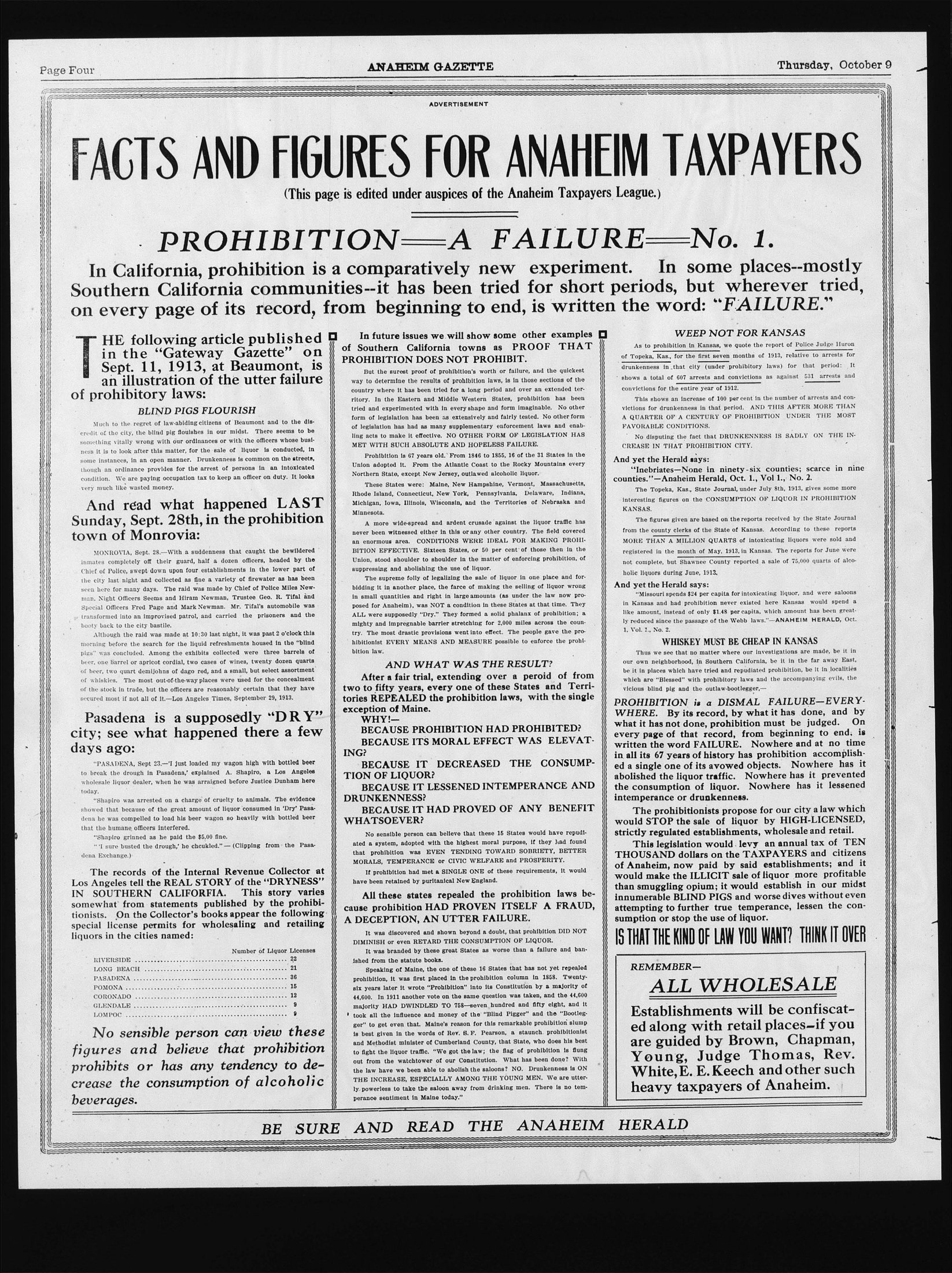
Searchable text
FACTS AND FIGURES
(This page is
PROHIBITION
In California, prohibition is a c
Southern California communitie
on every page of its record, fror
THE following article published
in the "Gateway Gazette" on
Sept. 11, 1913, at Beaumont, is
an illustration of the utter failure
of prohibitory laws:
BLIND PIGS FLOURISH
Much to the regret of law-abiding citizens of Beaumont and to the discredit of the city, the blind pig flouishes in our midst. There seems to be
something vitally wrong with our ordinances or with the officers whose business it is to look after this matter, for the sale of liquor is conducted, in
some instances, in an open manner. Drunkenness is common on the streets,
though an ordinance provides for the arrest of persons in an intoxicated
an illustration of the utter failure of prohibitory laws:
BLIND PIGS FLOURISH
Much to the regret of law-abiding citizens of Beaumont and to the discredit of the city, the blind pig flouishes in our midst. There seems to be something vitally wrong with our ordinances or with the officers whose business it is to look after this matter, for the sale of liquor is conducted, in some instances, in an open manner. Drunkenness is common on the streets, though an ordinance provides for the arrest of persons in an intoxicated condition. We are paying occupation tax to keep an officer on duty. It looks very much like wasted money.
And read what happened LAST Sunday, Sept. 28th, in the prohibition town of Monrovia:
MONROVIA, Sept. 28.—With a suddenness that caught the bewildered inmates completely off their guard, half a dozen officers, headed by the Chief of Police, swept down upon four establishments in the lower part of the city last night and collected as fine a variety of firewater as has been seen here for many days. The raid was made by Chief of Police Miles Newman, Night Officers Seems and Hiram Newman, Trustee Geo. R. Tifal and Special Officers Fred Page and Mark Newman. Mr. Tifal's automobile was transformed into an improvised patrol, and carried the prisoners and the booty back to the city bastile.
Although the raid was made at 10:30 last night, it was past 2 o'clock this morning before the search for the liquid refreshments housed in the "blind pigs" was concluded. Among the exhibits collected were three barrels of beer, one barrel or apricot cordial, two cases of wines, twenty dozen quarts of beer, two quart demijohns of dago red, and a small, but select assortment of whiskies. The most out-of-the-way places were used for the concealment of the stock in trade, but the officers are reasonably certain that they have secured most if not all of it.—Los Angeles Times, September 29, 1913.
Pasadena is a supposedly “DRY” city; see what happened there a few days ago:
“PASADENA, Sept 23.—‘I just loaded my wagon high with bottled beer to break the drought in Pasadena,’ explained A. Shapiro, a Los Angeles wholesale liquor dealer, when he was arraigned before Justice Dunham here today.
“Shapiro was arrested on a charge of cruelty to animals. The evidence showed that because of the great amount of liquor consumed in ‘Dry’ Pasadena he was compelled to load his beer wagon so heavily with bottled beer that the humane officers interfered.
“Shapiro grinned as he paid the $5,00 fine.
‘I sure busted the drought,’ he chuckled.’ — (Clipping from the Pasadena Exchange.)
The records of the Internal Revenue Collector at Los Angeles tell the REAL STORY of the “DRYNESS” IN SOUTHERN CALIFORNIA. This story varies
"Shapiro was arrested on a charge of cruelty to animals. The evidence showed that because of the great amount of liquor consumed in 'Dry' Pasadena he was compelled to load his beer wagon so heavily with bottled beer that the humane officers interfered.
'Shapiro grinned as he paid the $5.00 fine.
'I sure busted the drough,' he cheukled.' — (Clipping from the Pasadena Exchange.)
The records of the Internal Revenue Collector at Los Angeles tell the REAL STORY of the "DRYNESS" IN SOUTHERN CALIFORFIA. This story varies somewhat from statements published by the prohibitionists. On the Collector's books appear the following special license permits for wholesaling and retailing liquors in the cities named:
Number of Liquor Licenses
RIVERSIDE ..... 22
LONG BEACH ..... 21
PASADENA ..... 36
POMONA ..... 15
CORONADO ..... 12
GLENDALE ..... 9
LOMPOC ..... 9
No sensible person can view these figures and believe that prohibition prohibits or has any tendency to decrease the consumption of alcoholic beverages."
ANAHEIM GAZETTE
ADVERTISEMENT
FIGURES FOR ANAHEIM TOWN
(This page is edited under auspices of the Anaheim Taxpayers League.)
PROHIBITION—A FAILURE
Prohibition is a comparatively new experiment. In communities--it has been tried for short periods, record, from beginning to end, is written the w
In future issues we will show some other examples of Southern California towns as PROOF THAT PROHIBITION DOES NOT PROHIBIT.
But the surest proof of prohibition's worth or failure, and the quickest way to determine the results of prohibition laws, is in those sections of the country where it has been tried for a long period and over an extended territory. In the Eastern and Middle Western States, prohibition has been tried and experimented with in every shape and form imaginable. No other form of legislation has been as extensively and fairly tested. No other form of legislation has had as many supplementary enforcement laws and enabling acts to make it effective. NO OTHER FORM OF LEGISLATION HAS MET WITH SUCH ABSOLUTE AND HOPELESS FAILURE.
Prohibition is 67 years old. From 1846 to 1855, 16 of the 31 States in the Union adopted it. From the Atlantic Coast to the Rocky Mountains every Northern State, except New Jersey, outlawed alcoholic liquor.
As to prohibition of Topeka, Kas., drunkenness in shows a total of convictions for this
This shows a vicious for drummer
A QUARTER OF FAVORABLE CO
No disputing CREASE IN THE
And yet the He
“Inebriates”
way to determine the results of prohibition laws, is in those sections of the country where it has been tried for a long period and over an extended territory. In the Eastern and Middle Western States, prohibition has been tried and experimented with in every shape and form imaginable. No other form of legislation has been as extensively and fairly tested. No other form of legislation has had as many supplementary enforcement laws and enabling acts to make it effective. NO OTHER FORM OF LEGISLATION HAS MET WITH SUCH ABSOLUTE AND HOPELESS FAILURE.
Prohibition is 67 years old. From 1846 to 1855, 16 of the 31 States in the Union adopted it. From the Atlantic Coast to the Rocky Mountains every Northern State, except New Jersey, outlawed alcoholic liquor.
These States were: Maine, New Hampshire, Vermont, Massachusetts, Rhode Island, Connecticut, New York, Pennsylvania, Delaware, Indiana, Michigan, Iowa, Illinois, Wisconsin, and the Territories of Nebraska and Minnesota.
A more wide-spread and ardent crusade against the liquor traffic has never been witnessed either in this or any other country. The field covered an enormous area. CONDITIONS WERE IDEAL FOR MAKING PROHIBITION EFFECTIVE. Sixteen States, or 50 per cent of those then in the Union, stood shoulder to shoulder in the matter of enforcing prohibition, of suppressing and abolishing the use of liquor.
The supreme folly of legalizing the sale of liquor in one place and forbidding it in another place, the farce of making the selling of liquor wrong in small quantities and right in large amounts (as under the law now proposed for Anaheim), was NOT a condition in these States at that time. They ALL were supposedly "Dry." They formed a solid phalanx of prohibition; a mighty and impregnable barrier stretching for 2,000 miles across the country. The most drastic provisions went into effect. The people gave the prohibitionist EVERY MEANS AND MEASURE possible to enforce the prohibition law.
AND WHAT WAS THE RESULT?
After a fair trial, extending over a peroid of from two to fifty years, every one of these States and Territories REPEALED the prohibition laws, with the single exception of Maine.
WHY!—
BECAUSE PROHIBITION HAD PROHIBITED?
BECAUSE ITS MORAL EFFECT WAS ELEVATING?
BECAUSE IT DECREASED THE CONSUMPTION OF LIQUOR?
BECAUSE IT LESSENED INTEMPERANCE AND DRUNKENNESS?
BECAUSE IT HAD PROVED OF ANY BENEFIT WHATSOEVER?
No sensible person can believe that these 15 States would have repudiated a system, adopted with the highest moral purpose, if they had found that prohibition was EVEN TENDING TOWARD SOBRIETY, BETTER MORALS, TEMPERANCE or CIVIC WELFARE and PROSPERITY.
If prohibition had met a SINGLE ONE of these requirements, it would have been retained by puritanical New England.
All these states repealed the prohibition laws be-
BECAUSE IT HAD PROVED OF ANY BENEFIT WHATSOEVER?
No sensible person can believe that these 15 States would have repudiated a system, adopted with the highest moral purpose, if they had found that prohibition was EVEN TENDING TOWARD SOBRIETY, BETTER MORALS, TEMPERANCE or CIVIC WELFARE and PROSPERITY.
If prohibition had met a SINGLE ONE of these requirements, it would have been retained by puritanical New England.
All these states repealed the prohibition laws because prohibition HAD PROVEN ITSELF A FRAUD, A DECEPTION, AN UTTER FAILURE.
It was discovered and shown beyond a doubt, that prohibition DID NOT DIMINISH or even RETARD THE CONSUMPTION OF LIQUOR.
It was branded by these great States as worse than a failure and banished from the statute books.
Speaking of Maine, the one of these 16 States that has not yet repealed prohibition, it was first placed in the prohibition column in 1858. Twenty-six years later it wrote "Prohibition" into its Constitution by a majority of 44,600. In 1911 another vote on the same question was taken, and the 44,600 majority HAD DWINDLED TO 758—seven hundred and fifty eight, and it took all the influence and money of the "Blind Pigger" and the "Bootlegger" to get even that. Maine's reason for this remarkable prohibition slump is best given in the words of Rev. S. F. Pearson, a staunch prohibitionist and Methodist minister of Cumberland County, that State, who does his best to fight the liquor traffic. "We got the law; the flag of prohibition is flung out from the watchtower of our Constitution. What has been done? With the law have we been able to abolish the saloons? NO. Drunkenness is ON THE INCREASE, ESPECIALLY AMONG THE YOUNG MEN. We are utterly powerless to take the saloon away from drinking men. There is no temperance sentiment in Maine today."
THURSDAY, October 9
WEIM TAXPAYERS
(Members League.)
RE=No. 1.
ment. In some places--mostly
t periods, but wherever tried,
en the word: "FAILURE."
WEEP NOT FOR KANSAS
As to prohibition in Kansas, we quote the report of Police Judge Huron
of Topeka, Kas., for the first seven months of 1913, relative to arrests for
drunkenness in that city (under prohibitory laws) for that period: It
shows a total of 607 arrests and convictions as against 531 arrests and
convictions for the entire year of 1912.
This shows an increase of 100 per cent in the number of arrests and convictions for drunkenness in that period. AND THIS AFTER MORE THAN
A QUARTER OF A CENTURY OF PROHIBITION UNDER THE MOST
FAVORABLE CONDITIONS.
No disputing the fact that DRUNKENNESS IS SADLY ON THE INCREASE IN THAT PROHIBITION CITY.
And yet the Herald says:
"Inebriates—None in ninety-six counties; scarce in nine
shows a total of 607 arrests and convictions as against 531 arrests and convictions for the entire year of 1912.
This shows an increase of 100 per cent in the number of arrests and convictions for drunkenness in that period. AND THIS AFTER MORE THAN A QUARTER OF A CENTURY OF PROHIBITION UNDER THE MOST FAVORABLE CONDITIONS.
No disputing the fact that DRUNKENNESS IS SADLY ON THE INCREASE IN THAT PROHIBITION CITY.
And yet the Herald says:
"Inebriates—None in ninety-six counties; scarce in nine counties."—Anaheim Herald, Oct. 1., Vol 1., No. 2.
The Topeka, Kas., State Journal, under July 8th, 1913, gives some more interesting figures on the CONSUMPTION OF LIQUOR IN PROHIBITION KANSAS.
The figures given are based on the reports received by the State Journal from the county clerks of the State of Kansas. According to these reports MORE THAN A MILLION QUARTS of intoxicating liquors were sold and registered in the month of May, 1913, in Kansas. The reports for June were not complete, but Shawnee County reported a sale of 75,000 quarts of alcoholic liquors during June, 1913.
And yet the Herald says:
"Missouri spends $24 per capita for intoxicating liquor, and were saloons in Kansas and had prohibition never existed here Kansas would spend a like amount, instead of only $1.48 per capita, which amount has been greatly reduced since the passage of the Webb laws."—ANAHEIM HERALD, Oct. 1, Vol. 1., No. 2.
WHISKEY MUST BE CHEAP IN KANSAS
Thus we see that no matter where our investigations are made, be it in our own neighborhood, In Southern California, be it in the far away East, be it in places which have tried and repudiated prohibition, be it in localities which are "Blessed" with prohibitory laws and the accompanying evils, the violent blind pig and the outlaw-bootlegger,
PROHIBITION is a DISMAL FAILURE—EVERY-WHERE. By its record, by what it has done, and by what it has not done, prohibition must be judged. On every page of that record, from beginning to end, is written the word FAILURE. Nowhere and at no time in all its 67 years of history has prohibition accomplished a single one of its avowed objects. Nowhere has it abolished the liquor traffic. Nowhere has it prevented the consumption of liquor. Nowhere has it lessened intemperance or drunkenness.
The prohibitionists propose for our city a law which would STOP the sale of liquor by HIGH-LICENSED, strictly regulated establishments, wholesale and retail.
This legislation would levy an annual tax of TEN THOUSAND dollars on the TAXPAYERS and citizens of Anaheim, now paid by said establishments; and it would make the ILLICIT sale of liquor more profitable than smuggling opium; it would establish in our midst innumerable BLIND PIGS and worse dives without even
The prohibitionists propose for our city a law which would STOP the sale of liquor by HIGH-LICENSED, strictly regulated establishments, wholesale and retail.
This legislation would levy an annual tax of TEN THOUSAND dollars on the TAXPAYERS and citizens of Anaheim, now paid by said establishments; and it would make the ILLICIT sale of liquor more profitable than smuggling opium; it would establish in our midst innumerable BLIND PIGS and worse dives without even attempting to further true temperance, lessen the consumption or stop the use of liquor.
IS THAT THE KIND OF LAW YOU WANT? THINK IT OVER
REMEMBER—
ALL WHOLESALE
Establishments will be confiscated along with retail places—if you are guided by Brown, Chapman, Young, Judge Thomas, Rev. White, E. E. Keech and other such heavy taxpayers of Anaheim.