anaheim-gazette 1913-05-01
Scanned page
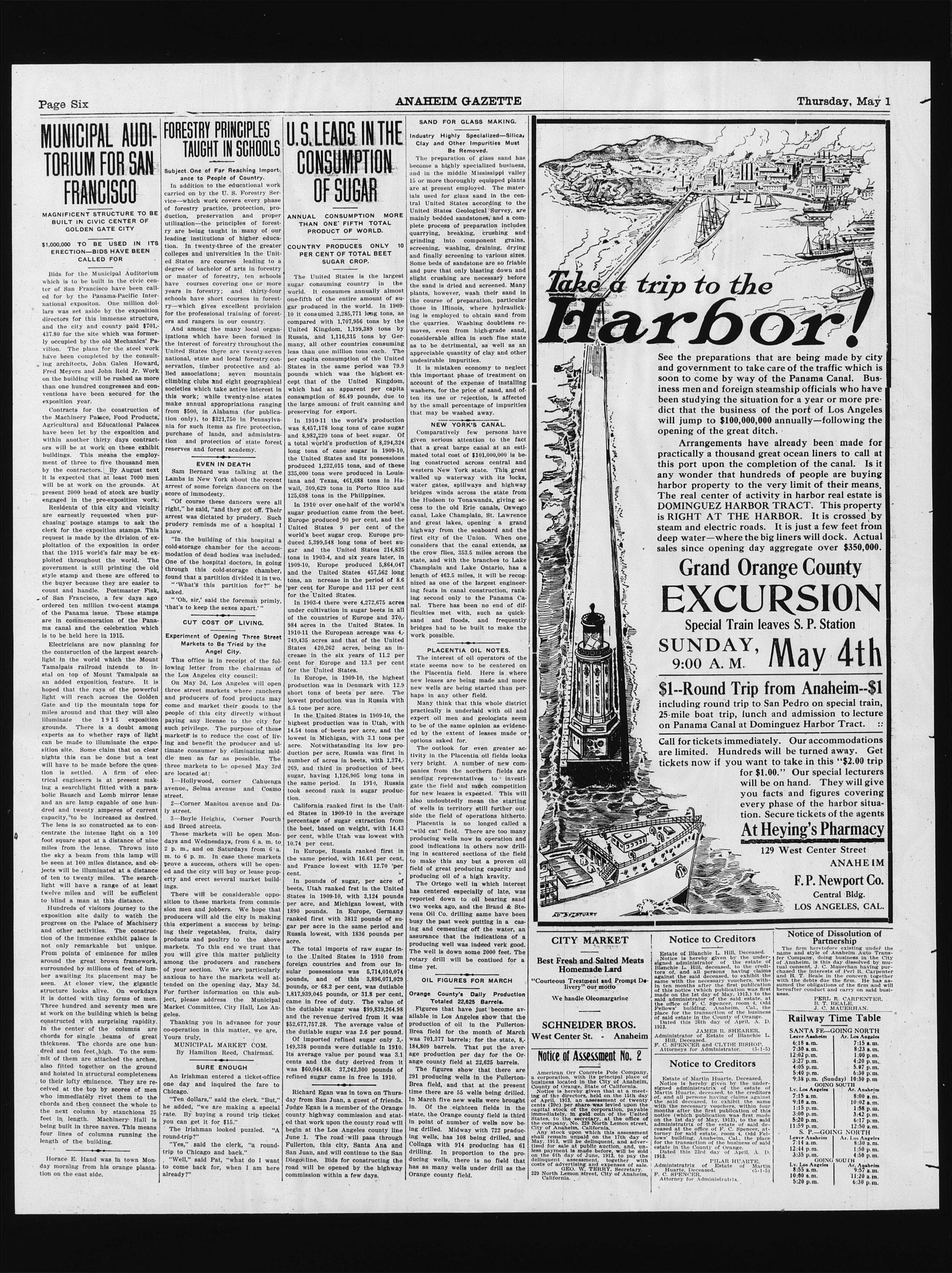
Searchable text
MUNICIPAL AUDIORIUM FOR SAN FRANCISCO
MAGNIFICENT STRUCTURE TO BE BUILT IN CIVIC CENTER OF GOLDEN GATE CITY
$1,000,000 TO BE USED IN ITS ERECTION—BIDS HAVE BEEN CALLED FOR
Bids for the Municipal Auditorium which is to be built in the civic center of San Francisco have been called for by the Panama-Pacific International exposition. One million dollars was set aside by the exposition directors for this immense structure, and the city and county paid $701,437.80 for the site which was formerly occupied by the old Mechanics' Pavilion. The plans for the steel work have been completed by the consulting architects, John Galen Howard, Fred Meyers and John Reid Jr. Work on the building will be rushed as more than one hundred congresses and conventions have been secured for the exposition year.
Contracts for the construction of the Machinery Palace, Food Products, Agricultural and Educational Palaces have been let by the exposition and within another thirty days contractors will be at work on these exhibit buildings. This means the employment of three to five thousand men by the contractors. By August next
FORESTRY PRINCIPLES TAUGHT IN SCHOOLS
Subject One of Far Reaching Importance to People of Country.
In addition to the educational work carried on by the U.S. Forestry Service—which work covers every phase of forestry practice, protection, production, preservation and proper utilization—the principles of forestry are being taught in many of our leading institutions of higher education. In twenty-three of the greater colleges and universities in the United States are courses leading to a degree of bachelor of arts in forestry or master of forestry, ten schools have courses covering one or more years in forestry; and thirty-four schools have short courses in forestry—which gives excellent provision for the professional training of foresters and rangers in our country.
And among the many local organizations which have been formed in the interest of forestry throughout the United States there are twenty-seven national, state and local forestry conservation, timber protective and allied associations; seven mountain climbing clubs and eight geographical societies which take active interest in this work; while twenty-nine states make annual appropriations ranging from $500, in Alabama (for publication only), to $321,750 in Pennsylvania for such items as fire protection, purchase of lands, and administration and protection of state forest reserves and forest academy.
EVEN IN DEATH
Sam Bernard was talking at the
Contracts for the construction of the Machinery Palace, Food Products, Agricultural and Educational Palaces have been let by the exposition and within another thirty days contractors will be at work on these exhibit buildings. This means the employment of three to five thousand men by the contractors. By August next it is expected that at least 7000 men will be at work on the grounds. At present 2000 head of stock are busily engaged in the pre-exposition work.
Residents of this city and vicinity are earnestly requested when purchasing postage stamps to ask the clerk for the exposition stamps. This request is made by the division of exploitation of the exposition in order that the 1915 world’s fair may be exploited throughout the world. The government is still printing the old style stamp and these are offered to the buyer because they are easier to count and handle. Postmaster Fisk, of San Francisco, a few days ago ordered ten million two-cent stamps of the Panama issue. These stamps are in commemoration of the Panama canal and the celebration which is to be held here in 1915.
Electricians are now planning for the construction of the largest searchlight in the world which the Mount Tamalpais railroad intends to instal on top of Mount Tamalpais as an added exposition feature. It is hoped that the rays of the powerful light will reach across the Golden Gate and tip the mountain tops for miles around and that they will also illuminate the 1915 exposition grounds. There is a doubt among experts as to whether rays of light can be made to illuminate the exposition site. Some claim that on clear nights this can be done but a test will have to be made before the question is settled. A firm of electrical engineers is at present making a searchlight fitted with a parabolic Bausch and Lomb mirror lense and an arc lamp capable of one hundred and twenty amperes of current capacity, to be increased as desired. The lens is so constructed as to concentrate the intense light on a 100 foot square spot at a distance of nine miles from the lense. Thrown into the sky a beam from this lamp will be seen at 100 miles distance, and objects will be illuminated at a distance of ten to twenty miles. The searchlight will have a range of at least twelve miles and will be sufficient on the building will be rushed as more than one hundred congresses and conventions have been secured for the exposition year.
EVEN IN DEATH
Sam Bernard was talking at the Lambs in New York about the recent arrest of some foreign dancers on the score of immodesty.
“Of course these dancers were all right,” he said, “and they got off. Their arrest was dictated by prudery. Such prudery reminds me of a hospital I know.
“In the building of this hospital a cold-storage chamber for the accommodation of dead bodies was included. One of the hospital doctors, in going through this cold-storage chamber, found that a partition divided it in two.
“What’s this partition for?” he asked.
“‘Oh, sir,’ said the foreman primly, ‘that’s to keep the sexes apart.’”
CUT COST OF LIVING.
Experiment of Opening Three Street Markets to Be Tried by the Angel City.
This office is in receipt of the following letter from the chairman of the Los Angeles city council:
On May 3d, Los Angeles will open three street markets where ranchers and producers of food products may come and market their goods to the people of this city directly without paying any license to the city for such privilege. The purpose of these markets is to reduce the cost of living and benefit the producer and ultimate consumer by eliminating middle men as far as possible. The three markets to be opened May 3rd are located at:
1—Hollywood, corner Cahuenga avenue., Selma avenue and Cosmo street.
2—Corner Manitou avenue and Daly street.
3—Boyle Heights, Corner Fourth and Breed streets.
These markets will be open Mondays and Wednesdays, from 6 a.m. to 2 p.m., and on Saturdays from 6 a.m. to 6 p.m. In case these markets prove a success, others will be opened and the city will buy or lease property and erect several market buildings.
There will be considerable oppo-
and an arc lamp capable of one hundred and twenty amperes of current capacity, to be increased as desired. The lens is so constructed as to concentrate the intense light on a 100 foot square spot at a distance of nine miles from the lense. Thrown into the sky a beam from this lamp will be seen at 100 miles distance, and objects will be illuminated at a distance of ten to twenty miles. The searchlight will have a range of at least twelve miles and will be sufficient to blind a man at this distance.
Hundreds of visitors journey to the exposition site daily to watch the progress on the Palace of Machinery and other activities. The construction of the immense exhibit palace is not only remarkable but unique. From points of eminence for miles around the great brown framework, surrounded by millions of feet of lumber awaiting its placement may be seen. At closer view, the gigantic structure looks alive. On workdays it is dotted with tiny forms of men. Three hundred and seventy men are at work on the building which is being constructed with surprising rapidity. In the center of the columns are chords for single beams of great thickness. The chords are one hundred and ten feet high. To the summit of them are attached the arches, also fitted together on the ground and hoisted in structural completeness to their lofty eminence. They are received at the top by scores of men who immediately rivet them to the chords and then connect the whole to the next column by stanchions 25 feet in length. Machinery Hall is being built in three naves. This means four lines of columns running the length of the building.
Horace E. Hand was in town Monday morning from his orange plantation on the east side.
2—Corner Manitou avenue and Daily street.
3—Boyle Heights, Corner Fourth and Breed streets.
These markets will be open Mondays and Wednesdays, from 6 a.m. to 2 p.m., and on Saturdays from 6 a.m. to 6 p.m. In case these markets prove a success, others will be opened and the city will buy or lease property and erect several market buildings.
There will be considerable opposition to these markets from commission men and jobbers. We hope that producers will aid the city in making this experiment a success by bringing their vegetables, fruits, dairy products and poultry to the above markets. To this end we trust that you will give this matter publicity among the producers and ranchers of your section. We are particularly anxious to have the markets well attended on the opening day, May 3d. For further information on this subject, please address the Municipal Market Committee, City Hall, Los Angeles.
Thanking you in advance for your co-operation in this matter, we are, Yours truly,
MUNICIPAL MARKET COM.
By Hamilton Reed, Chairman.
SURE ENOUGH
An Irishman entered a ticket-office one day and inquired the fare to Chicago.
"Ten dollars," said the clerk. "But," he added, "we are making a special rate. By buying a round trip ticket you can get it for $15."
The Irishman looked puzzled. "A round-trip?"
"Yes," said the clerk, "a round-trip to Chicago and back."
"Well," said Pat, "what do I want to come back for, when I am here already?"
U.S. LEADS IN THE CONSUMPTION OF SUGAR
ANNUAL CONSUMPTION MORE THAN ONE FIFTH TOTAL PRODUCT OF WORLD.
COUNTRY PRODUCES ONLY 10 PER CENT OF TOTAL BEET SUGAR CROP.
The United States is the largest sugar consuming country in the world. It consumes annually almost one-fifth of the entire amount of sugar produced in the world. In 1909-10 it consumed 3,285,771 long tons, as compared with 1,707,956 tons by the United Kingdom, 1,199,389 tons by Russia, and 1,116,315 tons by Germany, all other countries consuming less than one million tons each. The per capita consumption of the United States in the same period was 79.9 pounds which was the highest except that of the United Kingdom, which had an apparent per capita consumption of 86.49 pounds, due to the large amount of fruit canning and preserving for export.
In 1910-11 the world's production was 8,457,178 long tons of cane sugar and 8,982,220 tons of beet sugar. Of a total world's production of 8,294,324 long tons of cane sugar in 1909-10, the United States and its possessions produced 1,232,015 tons, and of these 335,000 tons were produced in Louis-
SAND FOR GLASS MAKING.
Industry Highly Specialized—Silica Clay and Other Impurities Must Be Removed.
The preparation of glass sand has become a highly specialized business, and in the middle Mississippi valley 15 or more thoroughly equipped plants are at present employed. The materials used for glass sand in the central United States according to the United States Geological Survey, are mainly bedded sandstones, and a complete process of preparation includes quarrying, breaking, crushing and grinding into component grains, screening, washing, draining, drying and finally screening to various sizes. Some beds of sandstone are so friable and pure that only blasting down and slight crushing are necessary before the sand is dried and screened. Many plants, however, wash their sand in the course of preparation, particular those in Illinois, where hydraulicking is employed to obtain sand from the quarries. Washing doubtless removes, even from high-grade sand, considerable silica in such fine state as to be detrimental, as well as an appreciable quantity of clay and other undesirable impurities.
It is mistaken economy to neglect this important phase of treatment on account of the expense of installing washers, for the price of sand, and often its use or rejection, is affected by the small percentage of impurities that may be washed away.
NEW YORK'S CANAL.
Comparatively few persons have given serious attention to the fact that a great barge canal at an estimated total cost of $101,000,000 is being constructed across central and western New York state. This great
In 1910-11 the world's production was 8,457,178 long tons of cane sugar and 8,982,220 tons of beet sugar. Of a total world's production of 8,294,324 long tons of cane sugar in 1909-10, the United States and its possessions produced 1,232,015 tons, and of these 335,000 tons were produced in Louisiana and Texas, 461,688 tons in Hawaii, 309,629 tons in Porto Rico and 125,698 tons in the Philippines.
In 1910 over one-half of the world's sugar production came from the beet. Europe produced 90 per cent, and the United States 9 per cent of the world's beet sugar crop. Europe produced 5,399,548 long tons of beet sugar and the United States 214,825 tons in 1903-4, and six years later, in 1909-10, Europe produced 5,864,047 and the United States 457,562 long tons, an increase in the period of 8.6 per cent for Europe and 113 per cent for the United States.
In 1903-4 there were 4,272,675 acres under cultivation in sugar beets in all of the countries of Europe and 370,-984 acres in the United States. In 1910-11 the European acreage was 4,-749,435 acres and that of the United States 420,262 acres, being an increase in the six years of 11.2 per cent for Europe and 13.3 per cent for the United States.
In Europe, in 1909-10, the highest production was in Denmark with 12.9 short tons of beets per acre. The lowest production was in Russia with 5.5 tone per acre.
In the United States in 1909-10, the highest production was in Utah, with 14.54 tons of beets per acre; and the lowest in Michigan, with 3.1 tons per acre. Notwithstanding its low production per acre, Russia was first in number of acres in beets, with 1,374,-269, and third in production of beet sugar, having 1,126,905 long tons in the same period. In 1919, Russia took second rank in sugar production.
California ranked first in the United States in 1909-10 in the average percentage of sugar extraction from the beet, based on weight, with 14.43 per cent, while Utah was lowest with 10.74 per cent.
In Europe, Russia ranked first in the same period, with 16.61 per cent, and France lowest with 12.70 'per cent.
In pounds of sugar, per acre of beets, Utah ranked first in the United States in 1909-10, with 3,124 pounds this important phase of treatment on account of the expense of installing washers, for the price of sand, and often its use or rejection, is affected by the small percentage of impurities that may be washed away.
NEW YORK'S CANAL.
Comparatively few persons have given serious attention to the fact that a great barge canal at an estimated total cost of $101,000,000 is being constructed across central and western New York state. This great walled up waterway with its locks, water gates, spillways and highway bridges winds across the state from the Hudson to Tonawanda, giving access to the old Erie canals, Oswego canal, Lake Champlain, St. Lawrence and great lakes, opening a grand highway from the seaboard and the first city of the Union. When one considers that the canal extends, as the crow flies, 353.5 miles across the state, and with the branches to Lake Champlain and Lake Ontario, has a length of 463.5 miles, it will be recognized as one of the largest engineering feats in canal construction, ranking second only to the Panama Canal. There has been no end of difficulties met with, such as quick-sand and floods, and frequently bridges had to be built to make the work possible.
PLACENTIA OIL NOTES.
The interest of oil operators of the state seems now to be centered on the Placentia field. Here is where new leases are being made and more new wells are being started than perhaps in any other field.
Many think that this whole district practically is underlaid with oil and expert oil men and geologists seem to be of the same opinion as evidenced by the extent of leases made or options asked for.
The outlook for even greater activity in the Placentia oil fields looks very bright. A number of new companies from the northern fields are sending representatives to investigate the field and much competition for new leases is expected. This will also undoubtedly mean the starting of wells in territory still further outside the field of operations hitherto.
Placentia is no longer called a "wild cat" field. There are too many producing wells now in operation and good indications in others now drilling in scattered sections of the field to make this any but a proven oil field of great producing capacity and producing oil of a high kravity.
The Ortego well in which interest has centered especially of late, was reported down to oil bearing sand
California ranked first in the United States in 1909-10 in the average percentage of sugar extraction from the beet, based on weight, with 14.43 per cent, while Utah was lowest with 10.74 per cent.
In Europe, Russia ranked first in the same period, with 16.61 per cent, and France lowest with 12.70 'per cent.
In pounds of sugar, per acre of beets, Utah ranked first in the United States in 1909-10, with 3,124 pounds per acre, and Michigan lowest, with 1890 pounds. In Europe, Germany ranked first with 3812 pounds of sugar per acre in the same period and Russia lowest, with 1836 pounds per acre.
The total imports of raw sugar into the United States in 1910 from foreign countries and from our insular possessions was 5,714,010,074 pounds, and of this 3,896,071,029 pounds, or 68.2 per cent, was dutiable 1,817,939,045 pounds, or 31.8 per cent, came in free of duty. The value of the dutiable sugar was $99,839,264.98 and the revenue derived from it was $52,677,757.28. The average value of the dutiable sugar was 2.6 per pound.
Of imported refined sugar only 3,-149,338 pounds were dutiable in 1910. Its average value per pound was 3.1 cents and the duty derived from it was $60,044.68. 37,242,300 pounds of refined sugar came in free in 1910.
Richard Egan was in town on Thursday from San Juan, a guest of friends. Judge Egan is a member of the Orange county highway commission and stated that work upon the county road will begin at the Los Angeles county line June 1. The road will pass through Fullerton, this city, Santa Ana and San Juan, and will continue to the San Diego line. Bids for constructing the road will be opened by the highway commission within a few days.
OIL FIGURES FOR MARCH
Orange County's Daily Production Totaled 22,625 Barrels.
Figures that have just become available in Los Angeles show that the production of oil in the Fullerton-Brea field for the month of March was 701,377 barrels; for the state, 8,-184,809 barrels. That put the average production per day for the Orange county field at 22,625 barrels.
The figures show that there are 291 producing wells in the Fullerton-Brea field, and that at the present time there are 55 wells being drilled. In March five new wells were brought in. Of the eighteen fields in the state, the Orange county field is third in point of number of wells now being drilled. Midway with 722 producing wells, has 108 being drilled, and Colinga with 914 producing has 61 drilling. In proportion to the producing wells, there is no field that has as many wells under drill as the Orange county field.
CITY MARKET
Best Fresh and Salted Meats Homemade Lard
"Courteous Treatment and Prompt Delivery" our motto
We handle Oleomargarine
SCHNEIDER BROS.
West Center St. - Anaheim
Notice of Assessment No. 2
American Orr Concrete Pole Company, a corporation, with its principal place of business located in the City of Anaheim, County of Orange, State of California.
Notice is hereby given that at a meeting of the directors, held on the 15th day of April, 1913, an assessment of twenty cents (20c) per share was levied upon the capital stock of the corporation, payable immediately, in gold coin of the United States, to the secretary, at the office of the company, No. 229 North Lemon street, City of Anaheim, California.
Any stock upon which this assessment shall remain unpaid on the 17th day of May, 1913, will be delinquent, and advertised for sale at public auction, and unless payment is made before, will be sold on the 6th day of June, 1913, to pay the delinquent assessment, together with costs of advertising and expenses of sale.
GEO. W. TERRY, Secretary.
229 North Lemon street, City of Anaheim, California.
Thursday, May 1
a trip to the
arbor!
See the preparations that are being made by city and government to take care of the traffic which is soon to come by way of the Panama Canal. Business men and foreign steamship officials who have been studying the situation for a year or more predict that the business of the port of Los Angeles will jump to $100,000,000 annually—following the opening of the great ditch.
Arrangements have already been made for practically a thousand great ocean liners to call at this port upon the completion of the canal. Is it any wonder that hundreds of people are buying
soon to come by way of the Panama Canal. Business men and foreign steamship officials who have been studying the situation for a year or more predict that the business of the port of Los Angeles will jump to $100,000,000 annually—following the opening of the great ditch.
Arrangements have already been made for practically a thousand great ocean liners to call at this port upon the completion of the canal. Is it any wonder that hundreds of people are buying harbor property to the very limit of their means. The real center of activity in harbor real estate is DOMINGUEZ HARBOR TRACT. This property is RIGHT AT THE HARBOR. It is crossed by steam and electric roads. It is just a few feet from deep water—where the big liners will dock. Actual sales since opening day aggregate over $350,000.
Grand Orange County
EXCURSION
Special Train leaves S. P. Station
SUNDAY, May 4th
9:00 A.M.
$1--Round Trip from Anaheim--$1 including round trip to San Pedro on special train, 25-mile boat trip, lunch and admission to lecture on Panama Canal at Dominguez Harbor Tract. ::
Call for tickets immediately. Our accommodations are limited. Hundreds will be turned away. Get tickets now if you want to take in this "$2.00 trip for $1.00." Our special lecturers will be on hand. They will give you facts and figures covering every phase of the harbor situation. Secure tickets of the agents At Heying's Pharmacy
129 West Center Street
ANAHEIM
F.P. Newport Co.
Central Bldg.
MARKET
Salted Meats
Lard
t and Prompt Demargarine
R BROS.
- Anaheim
Amendment No. 2
Estate Pole Company,
principal place of
City of Anaheim,
State of California.
In that at a meetd on the 15th day
assessment of twenty
was levied upon the
corporation, payable
in coin of the United
States, at the office of
North Lemon street,
Corona.
With this assessment
on the 17th day of
sequent, and adversurement, and unbefore, will be sold
the 1913, to pay the
together with
expenses of sale.
BERRY, Secretary,
City of Anaheim,
Notice to Creditors
Estate of Blanchie L. Hill, Deceased.
Notice is hereby given by the undersigned administrator of the estate of
Blanchie L. Hill, deceased, to the creditors of, and all persons having claims against the said deceased, to exhibit the same with the necessary vouchers, within ten months after the first publication of this notice (which publication was first made on the 1st day of May, 1913.) to the said administrator of the said estate, at the office of F. C. Spencer, room 4, Odd Fellows' building, Anaheim, Cal., the place for the transaction of the business of said estate in the County of Orange.
Dated this 26th day of April, A. D. 1913.
JAMES R. SHEARER,
Administrator of Estate of Blanchie L. Hill, Deceased.
F. C. SPENCER and CLYDE BISHOP,
Attorneys for Administrator.
Notice to Creditors
Estate of Martin Huarte, Deceased.
Notice is hereby given by the undersigned administratrix of the estate of Martin Huarte, deceased, to the creditors of, and all persons having claims against the said deceased, to exhibit the same with the necessary vouchers, within four months after the first publication of this notice (which publication was first made on the 1st day of May, 1913.), to the said administratrix of the estate of said deceased at the office of F. C. Spencer, attorney for said estate, room 4, Odd Fellows' building, Anaheim, Cal., the place for the transaction of the business of said estate in the County of Orange.
Dated this 23rd day of April, A. D. 1913.
PILAR HUARTE,
Administratrix of Estate of Martin Huarte, Deceased.
F. C. SPENCER,
Attorney for Administratrix.
Notice of Dissolution of Partnership
The firm heretofore existing under the name and style of Anaheim Auto Transfer Company, doing business in the City of Anaheim, is this day dissolved by mutual consent, J. C. Mauerhan having purchased the interests of Perl R. Carpenter and B. T. Beale in the concern together with the debts due the firm. He has assumed the obligations of the firm and will hereafter conduct and carry on said business.
PERL R. CARPENTER,
B. T. BEALE,
J. C. MAUERHAN.
Railway Time Table
SANTA FE—GOING NORTH
Leave Anaheim Ar. Los Angeles
6:18 a.m. 7:15 a.m.
7:30 a.m. 8:23 a.m.
12:02 p.m. 1:00 p.m.
3:27 p.m. 4:20 p.m.
4:05 p.m. 5:07 p.m.
5:40 p.m. 6:30 p.m.
9:38 p.m. (Sunday) 10:30 p.m.
GOING SOUTH
Lv. Los Angeles Ar. Anaheim
7:15 a.m. 8:00 a.m.
9:10 a.m. 10:02 a.m.
1:15 p.m. 1:58 p.m.
3:00 p.m. 3:42 p.m.
5:20 p.m. 6:17 p.m.
11:59 p.m. 12:50 a.m.
S.P.-GOING NORTH
Leave Anaheim Ar. Los Angeles
7:14 a.m. 8:30 a.m.
12:44 p.m. 1:50 p.m.
3:35 p.m. 4:50 p.m.
Lv. Los Angeles Ar. Anaheim
8:55 a.m. 9:57 a.m.
10:00 a.m. 11:20 a.m.
5:20 p.m. 6:30 p.m.