anaheim-gazette 1913-04-10
Scanned page
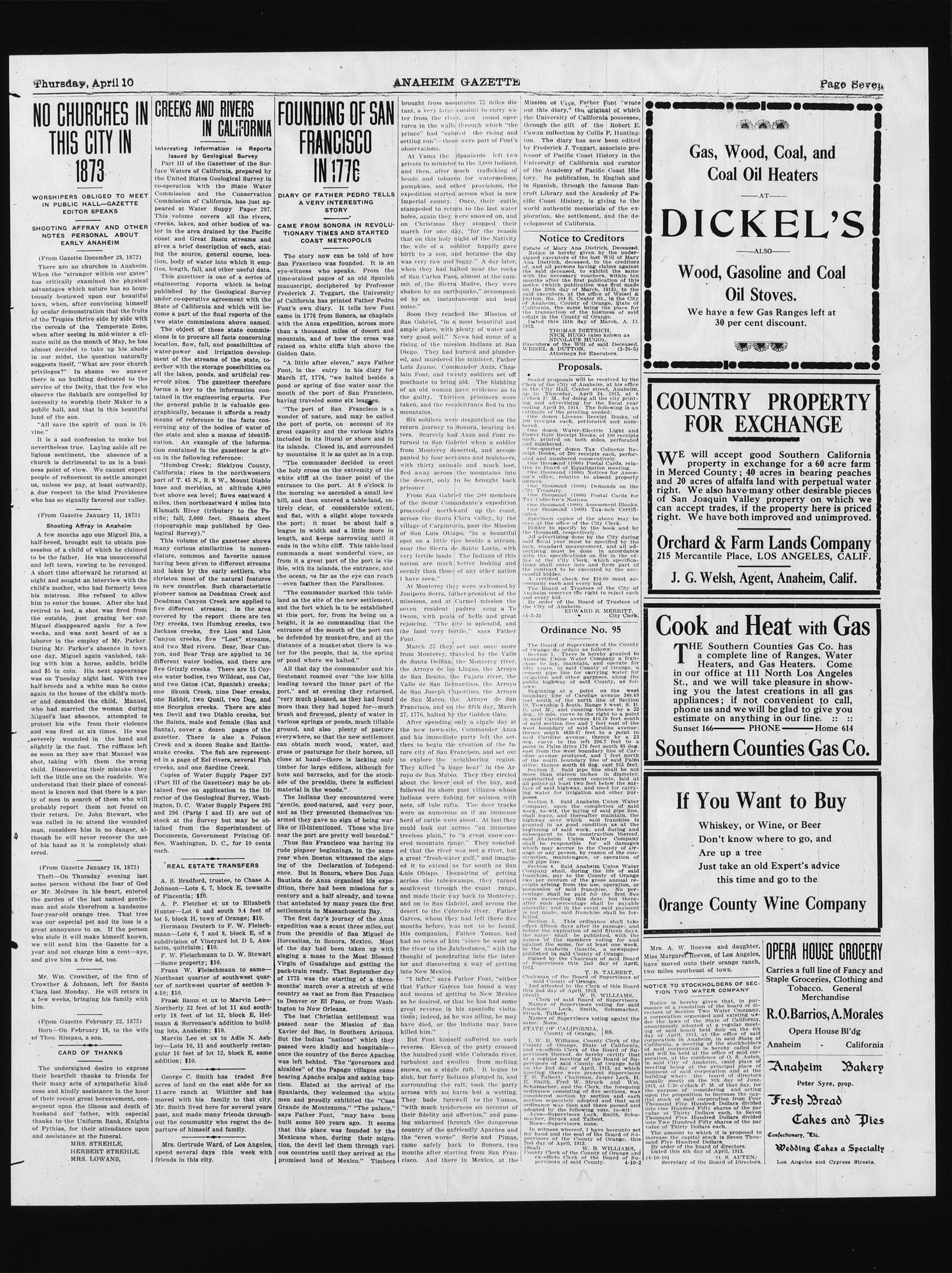
Searchable text
NO CHURCHES IN THIS CITY IN 1873
WORSHIPERS OBLIGED TO MEET IN PUBLIC HALL—GAZETTE EDITOR SPEAKS
SHOOTING AFFRAY AND OTHER NOTES PERSONAL ABOUT EARLY ANAHEIM
(From Gazette December 28, 1872)
There are no churches in Anaheim. When the "stranger within our gates" has critically examined the physical advantages which nature has so bountifully bestowed upon our beautiful town, when, after convincing himself by ocular demonstration that the fruits of the Tropics thrive side by side with the cereals of the Temperate Zone, when after seeing in mid-winter a climate mild as the month of May, he has almost decided to take up his abode in our midst, the question naturally suggests itself, "What are your church privileges?" In shame we answer there is no building dedicated to the service of the Deity, that the few who observe the Sabbath are compelled by necessity to worship their Maker in a public hall, and that in this beautiful land of the sun.
"All save the spirit of man is Divine."
It is a sad confession to make but nevertheless true. Laying aside all religious sentiment, the absence of a church is detrimental to us in a business point of view. We cannot expect
CREEKS AND RIVERS IN CALIFORNIA
Interesting Information in Reports Issued by Geological Survey
Part III of the Gazetteer of the Surface Waters of California, prepared by the United States Geological Survey in co-operation with the State Water Commission and the Conservation Commission of California, has just appeared at Water Supply Paper 297. This volume covers all the rivers, creeks, lakes, and other bodies of water in the area drained by the Pacific coast and Great Basin streams and gives a brief description of each, stating the source, general course, location, body of water into which it empties, length, fall, and other useful data.
This gazetteer is one of a series of engineering reports which is being published by the Geological Survey under co-operative agreement with the State of California and which will become a part of the final reports of the two state commissions above named.
The object of these state commissions is to procure all facts concerning location, flow, fall, and possibilities of water-power and irrigation development of the streams of the state, together with the storage possibilities on all the lakes, ponds, and artificial reservoir sites. The gazetteer therefore forms a key to the information contained in the engineering erports. For the general public it is valuable geographically, because it affords a ready means of reference to the facts concerning any of the bodies of water of the state and also a means of identification. An example of the information contained in the gazetteer is given in the following reference:
"Humbug Creek; Siskiyou County, California; rises in the northwestern"
FOUNDING OF FRANCISKIN IN 1776
DIARY OF FATHER PEACE A VERY INTERESTING STORY
CAME FROM SONORA TIONARY TIMES AND COAST METROPOLITAN
The story now can be San Francisco was founded eye-witness who speaks, time-stained pages of an manuscript, deciphered Frederick J. Teggart, that of California has printed Benton Font's own diary. It tells came in 1776 from Sonoran with the Anza expedition, than a thousand miles o' mountain, and of how they raised on white cliffs high Golden Gate.
"A little after eleven," Font, in the entry in March 27, 1776, "we halt pond or spring of fine water mouth of the port of San having traveled some six miles."
"The port of San Francisco wonder of nature, and meet the port of ports, on great capacity and the vast included in its littoral or its islands. Closed in, and by mountains it is as quiet."
"The commander decide the holy cross on the extraterritorial."
There is no building dedicated to the service of the Deity, that the few who observe the Sabbath are compelled by necessity to worship their Maker in a public hall, and that in this beautiful land of the sun.
"All save the spirit of man is Divine."
It is a sad confession to make but nevertheless true. Laying aside all religious sentiment, the absence of a church is detrimental to us in a business point of view. We cannot expect people of refinement to settle amongst us, unless we pay, at least outwardly, a due respect to the kind Providence who has so signally favored our valley.
(From Gazette January 11, 1873)
Shooting Affray in Anaheim
A few months ago one Miguel Bia, a half-breed, brought suit to obtain possession of a child of which he claimed to be the father. He was unsuccessful and left town, vowing to be revenged. A short time afterward he returned at night and sought an interview with the child's mother, who had formerly been his mistress. She refused to allow him to enter the house. After she had retired to bed, a shot was fired from the outside, just grazing her ear. Miguel disappeared again for a few weeks, and was next heard of as a laborer in the employ of Mr. Parker. During Mr. Parker's absence in town one day, Miguel again vanished, taking with him a horse, saddle, bridle and $5 in coin. His next appearance was on Tuesday night last. With two half-breeds and a white man he came again to the house of the child's mother and demanded the child. Manuel, who had married the woman during Miguel's last absence, attempted to protect his wife from their violence and was fired at six times. He was severely wounded in the hand and slightly in the foot. The ruffians left as soon as they saw that Manuel was shot, taking with them the wrong child. Discovering their mistake they left the little one on the roadside. We understand that their place of concealment is known and that there is a party of men in search of them who will probably report them not found on their return. Dr. John Stewart, who was called in to attend the wounded man, considers him in no danger, although he will never recover the use of his hand as it is completely shattered.
(From Gazette January 18, 1873)
Theft—On Thursday evening last some person without the fear of God or Mr. Melrose in his heart, entered the garden of the last named gentle all lakes, ponds, and artificial reservoir sites. The gazetteer therefore forms a key to the information contained in the engineering erports. For the general public it is valuable geographically, because it affords a ready means of reference to the facts concerning any of the bodies of water of the state and also a means of identification. An example of the information contained in the gazetteer is given in the following reference:
"Humbug Creek; Siskiyou County, California; rises in the northwestern part of T. 45 N., R. 8 W., Mount Diablo base and meridian, at altitude 4,000 feet above sea level; flows eastward 4 miles, then northeastward 4 miles into Klamath River (tributary to the Pacific; fall, 2,000 feet). Shasta sheet (topographic map published by Geological Survey)."
This volume of the gazetteer shows many curious similarities in nomenclature, common and favorite names having been given to different streams and lakes by the early settlers, who christen most of the natural features in new countries. Such characteristic pioneer names as Deadman Creek and Deadman Canyon Creek are applied to five different streams; in the area covered by the report there are ten Dry creeks, two Humbug creeks, two Jackass creeks, five Lion and Lion Canyon creeks, five "Lost" streams, and two Mad rivers. Bear, Bear Canyon, and Bear Trap are applied to 36 different water bodies, and there are five Grizzly creeks. There are 15 Coyote water bodies, two Wildcat, one Cat, and two Gatos (Cat, Spanish) creeks; one Skunk Creek, nine Deer creeks, one Rabbit, two Quail, two Dog, and one Scorpion creeks. There are also ten Devil and two Diabla creeks, but the Saints, male and female (San and Santa), cover a dozen pages of the gazetteer. There is also a Poison Creek and a dozen Snake and Rattlesnake creeks. The fish are represented in a page of Eel rivers, several Fish creeks, and one Sardine Creek.
Copies of Water Supply Paper 297 (Part III of the Gazetteer) may be obtained free on application to the Director of the Geological Survey, Washington, D.C. Water Supply Papers 295 and 296 (Parts I and II) are out of stock at the Survey but may be obtained from the Superintendent of Documents, Government Printing Office, Washington, D.C., for 10 cents each.
REAL ESTATE TRANSFERS
A. S. Bradford, trustee, to Chase A. Johnson—Lots 6, 7, block E, townsite of Placentia; $10.
March 27, 1776, "we halt pond or spring of fine water mouth of the port of San having traveled some six miles."
"The port of San Francisco wonder of nature, and me the port of ports, on acid great capacity and the vile included in its litoral or its islands. Closed in, and by mountains it is as quiet."
"The commander decides the holy cross on the extra white cliff at the inner entrance to the port. At the morning we ascended hill, and then entered a trail clearly clear, of considerand flat, with a slight slantthe port; it must be a league in width and a life length, and keeps narrowends in the white cliff. The commands a most wonderfulfrom it a great part of thible, with its islands,the eavethe ocean," as far as the eve—even farther than the F.
"The commander marketland as the site of the newand the fort which is tobeat at this port, for from itsheight, it is so commandentrance of the mouthof itbe defended by musket-firedistance of a musket-shotter for the people that isor pond where we halted.
All that day the commander roamed over "leading toward theinnerport," and at evening thervery much pleased, asthemore than they had hopebrush and firewood, plentyvarious springs or ponds,ground,and alsoplentyeverywhere,so thatthe necanobtainmuch wood grass or pasturage fortheclose at hand—there is timberfor large edifices,hutsand barracks,andfoadeofthepresidio,thematerialinthewoods."
The Indians they encourage"gentle, good-natured,andandas they presented themarmed they gave no signof like or ill-intentioned.Theneartheportareprettywet.
Thus San Francisco wasrude pipeer beginnings,year when Boston witnessingof the Declarationence.But in Sonora,becauseBautista de Anza organization,dhe had been m centuryanda half alread
(From Gazette January 18, 1873)
Theft—On Thursday evening last some person without the fear of God or Mr. Melrose in his heart, entered the garden of the last named gentleman and stole therefrom a handsome four-year-old orange tree. That tree was our especial pet and its loss is a great annoyance to us. If the person who stole it will make himself known, we will send him the Gazette for a year and not charge him a cent—aye, and give him a free ad, too.
Mr. Wm. Crowther, of the firm of Crowther & Johnson, left for Santa Clara last Monday. He will return in a few weeks, bringing his family with him.
(From Gazette February 22, 1873)
Born—On February 18, to the wife of Theo. Rimpau, a son.
CARD OF THANKS
The undersigned desire to express their heartfelt thanks to friends for their many acts of sympathetic kindness and kindly assistance in the hour of their recent great bereavement, consequent upon the illness and death of husband and father, with especial thanks to the Uniform Rank, Knights of Pythias, for their attendance upon and assistance at the funeral.
MRS. STREHLE,
HERBERT STREHLE.
MRS. LOWANS,
REAL ESTATE TRANSFERS
A. S. Bradford, trustee, to Chase A. Johnson—Lots 6, 7, block E, townsite of Placentia; $10.
A. P. Fletcher et ux to Elizabeth Hunter—Lot 6 and south 9.4 feet of lot 5, block H, town of Orange; $10.
Hermann Deutsch to F. W. Fleischmann—Lots 6, 7 and 8, block E, of a subdivision of Vineyard lot D 5, Anaheim, quitclaim; $10.
F. W. Fleischmann to D. W. Stewart—Same property; $10.
Franz W. Fleischmann to same—Northeast quarter of southwest quarter of northwest quarter of section 9-4-10; $10.
Frank Baum et ux to Marvin Lee—Northerly 32 feet of lot 11 and southerly 18 feet of lot 12, block E, Helmann & Sorensen's addition to building lots, Anaheim; $10.
Marvin Lee et ux to Adie N. Ashley—Lots 10, 11 and southerly rectangular 16 feet of lot 12, block E, same addition; $10.
George C. Smith has traded five acres of land on the east side for an 11-acre ranch at Whittier and has moved with his family to that city. Mr. Smith lived here for several years past, and made many friends throughout the community who regret the departure of himself and family.
Mrs. Gertrude Ward, of Los Angeles, spend several days this week with friends in this city.
Thus San Francisco was rude pipeer beginnings, a year when Boston witnessing of the Declaration of Independence. But in Sonora, where Bautista de Anza organized there had been more century and a half already that antedated by many years settlements in Massachusetts.
The first day's expedition was a scant thrill from the presidio of San Horcasitas, in Sonora, Mexico of the day had been taking singing a mass to the Virgin of Guadalupe and pack-train ready. That Sept. of 1775 was the starting month's march over a strife country as vast as from San Diego to Denver or El Paso, orington to New Orleans.
The last Christian set passed near the Mississippi Xavier del Bac, in South But the Indian "nations" passed were kindly and once the country of the fief was left behind. The "goalcaldes" of the Papago bearing Apache scalps and tism. Elated at the arrival Spaniards, they welcomed men and proudly exhibited Grande de Montezuma." says Father Font, "may built some 500 years ago that this place was found Mexicans when, during tion, the devil led them ous countries until they promised land of Mexico."
FOUNDING OF SAN FRANCISCO IN 1776
DIARY OF FATHER PEDRO TELLS A VERY INTERESTING STORY
CAME FROM SONORA IN REVOLUTIONARY TIMES AND STARTED COAST METROPOLIS
The story now can be told of how San Francisco was founded. It is an eye-witness who speaks. From the time-stained pages of an old Spanish manuscript, deciphered by Professor Frederick J. Teggart, the University of California has printed Father Pedro Font's own diary. It tells how Font came in 1776 from Sonora, as chaplain with the Anza expedition, across more than a thousand miles of desert and mountain, and of how the cross was raised on white cliffs high above the Golden Gate.
"A little after eleven," says Father Font, in the entry in his diary for March 27, 1776, "we halted beside a pond or spring of fine water near the mouth of the port of San Francisco, having traveled some six leagues."
"The port of San Francisco is a wonder of nature, and may be called the port of ports, on account of its great capacity and the various bights included in its litoral or shore and in its islands. Closed in, and surrounded by mountains it is as quiet as in a cup.
"The commander decided to erect the holy cross on the extremity of the brought from mountains 75 miles distant, a very large conduit to carry water from the river, and round opertures in the walls through which "the prince" had "saluted the rising and setting sun"—these were part of Font's observations.
At Yuma the Spaniards left two priests to minister to the 3,000 Indians, and then, after much trafficking of beads and tobacco for watermelons, pumpkins, and other provisions, the expedition started across what is now Imperial county. Once, their cattle, stampeded to return to the last water holes, again they were snowed on, and on Christmas they stopped their march for one day, "for the reason that on this holy night of the Nativity the wife of a soldier happily gave birth to a son, and because the day was very raw and foggy." A day later, when they had halted near the rocks of San Carlos Pass, almost at the summit of the Sierra Madre, they were shaken by an earthquake," accompanied by an instantaneous and loud noise."
Soon they reached the Mission of San Gabriel, "in a most beautiful and ample place, with plenty of water and very good soil." News had come of a rising of the mission Indians at San Diego. They had burned and plundered, and murdered the minister, Father Luis Jaume. Commander Anza, Chaplain Font, and twenty soldiers set off posthaste to bring aid. The blabbing of an old woman gave evidence as to the guilty. Thirteen prisoners were taken, and the recalcitrants fled to the mountains.
Six soldiers were despatched on the return journey to Sonora, bearing letters. Scarcely had Anza and Font returned to San Gabriel when a soldier from Monterey deserted, and accompanied by four servants and muleteers, with thirty animals and much loot, fled away across the mountains into Mission of Uyes, Father Font "wrote out this diary," the original of which the University of California possesses, through the gift of the Robert E. Cowan collection by Collis P. Huntington. The diary has now been edited by Frederick J. Teggart, associate professor of Pacific Coast History in the University of California and curator of the Academy of Pacific Coast History. Its publication, in English and in Spanish, through the famous Bancroft Library and the Academy of Pacific Coast History, is giving to the world authentic memorials of the exploration, the settlement, and the development of California.
Notice to Creditors
Estate of Mary Ana Dietrich, Deceased.
Notice is hereby given by the undersigned executors of the last Will of Mary Ana Dietrich, deceased, to the creditors of, and all persons having claims against the said deceased, to exhibit the same with the necessary vouchers, within ten months after the first publication of this notice (which publication was first made on the 20th day of March, 1913), to the said executors, at the office of Weisel & Dutton, No. 104 E. Center St., in the City of Anaheim, County of Orange, State of California, the same being the place for the transaction of the business of said estate in the County of Orange.
Dated this 15th day of March, A. D. 1913.
THOMAS DIETRICH,
NICK HUGO (also known as NICOLAUS HUGO).
Executors of the Will of said Deceased.
WEISEL & DUTTON,
(3-20-5)
Attorneys for Executors.
Proposals.
Sealed proposals will be received by the Clerk of the City of Anaheim, at his office in the City Hall, Center street, Anaheim, up to Thursday, April 24, 1913, at 8 o'clock P.M., for doing all the city printing and advertising for the fiscal year ending April 30, 1914. The following is an estimate of the printing needed:
One dozen License Receipt Books, of 100 receipts each, perforated and numbered.
One dozen Water-Electric Light and Power Rate Receipt Books, of 100 receipts each, printed on both sides, perforated and numbered.
One-quarter dozen Tax Collector Receipt Books, of 200 receipts each, perforated and numbered.
One thousand (1000) Postal Cards, relative to Board of Equalization meeting.
One thousand (1000) Notices for Asses-
"The port of San Francisco is a wonder of nature, and may be called the port of ports, on account of its great capacity and the various bights included in its litoral or shore and in its islands. Closed in, and surrounded by mountains it is as quiet as in a cup.
"The commander decided to erect the holy cross on the extremity of the white cliff at the inner point of the entrance to the port. At 8 o'clock in the morning we ascended a small low hill, and then entered a table-land, entirely clear, of considerable extent, and flat, with a slight slope towards the port; it must be about half a league in width and a little more in length, and keeps narrowing until it ends in the white cliff. This table-land commands a most wonderful view, as from it a great part of the port is visible, with its islands, the entrance, and the ocean, as far as the eye can reach—even farther than the Farallones.
"The commander marked this table-land as the site of the new settlement, and the fort which is to be established at this port, for, from its being on a height, it is so commanding that the entrance of the mouth of the port can be defended by musket-fire, and at the distance of a musket-shot there is water for the people, that is, the spring or pond where we halted."
All that day the commander and his deutenant roamed over "the low hills leading toward the inner part of the port," and at evening they returned, every much pleased, as they had found more than they had hoped for—much brush and firewood, plenty of water in various springs or ponds, much tillable ground, and also plenty of pasture everywhere, so that the new settlement can obtain much wood, water, and grass or pasturage for their horses, all close at hand—there is lacking only timber for large edifices, although for nuts and barracks, and for the stockade of the presidio, there is sufficient material in the woods."
The Indians they encountered were gentle, good-natured, and very poor, and as they presented themselves unarmed they gave no sign of being warlike or ill-intentioned. Those who live near the port are pretty well bearded."
Thus San Francisco was having itsude pipeer beginnings, in the same year when Boston witnessed the signing of the Declaration of Independence. But in Sonora, where Don Juan Bautista de Anza organized his expedition, there had been missions for a century and a half already, and towns
Six soldiers were despatched on the return journey to Sonora, bearing letters. Scarcely had Anza and Font returned to San Gabriel when a soldier from Monterey deserted, and accompanied by four servants and muleteers, with thirty animals and much loot, fled away across the mountains into the desert, only to be brought back prisoner.
From San Gabriel the 200 members of the Senior Comandante's expedition proceeded northward up the coast, across the Santa Clara valley, by the village of Carpinteria, past the Mission of San Luis Obispo; "in a beautiful spot on a little rise beside a stream, near the Sierra de Sante Lucia, with very fertile lands. The Indians of this nation are much better looking and seemly than those of any other nation I have seen."
At Monterey they were welcomed by Junipero Serra, father-president of the missions, and at Carmel mission the seven resident padres sang a Te Deum, with peals of bells and great rejoicing. "The site is splendid, and the land very fertile," says Father Font.
March 23 they set out once more from Monterey, traveled by the Valle de Santa Delfina, the Monterey river, the Arroyo de las Llagas, the Arroyo de San Benito, the Pajaro river, the Valle de San Bernardino, the Arroyo de San Joseph Cupertino, the Arroyo de San Mateo, the Arroyo de San Francisco, and on the fifth day, March 27, 1776, halted by the Golden Gate.
After spending only a single day at the new town-site, Commander Anza and his immediate party left the settlers to begin the creation of the future city of San Francisco, and set out to explore the neighboring region. They killed "a huge bear" in the Arroyo de San Mateo. They they circled about the lower end of the bay, and followed its shore past villages whose Indians were fishing for salmon with nets, off tule rafts. The deer tracks were as numerous as if an immense herd of cattle were about. At last they could look out across "an immense treeless plain," to "a great snow-covered mountain range." They concluded that the river was not a river, but a great "fresh-water gulf," and imagined it to extend as far south as San Luis Obispo. Despairing of getting across the tule-swamps, they turned southwest through the coast range, and made their way back to Monterey,
Sealed proposals will be received by the Clerk of the City of Anaheim, at his office in the City Hall, Center street, Anaheim, up to Thursday, April 24, 1913, at 8 o'clock P.M., for doing all the city printing and advertising for the fiscal year ending April 30, 1914. The following is an estimate of the printing needed:
One dozen License Receipt Books, of 100 receipts each, perforated and numbered.
One dozen Water-Electric Light and Power Rate Receipt Books, of 100 receipts each, printed on both sides, perforated and numbered.
One-quarter dozen Tax Collector Receipt Books, of 200 receipts each, perforated and numbered consecutively.
One thousand (1000) Postal Cards relative to Board of Equalization meeting.
One thousand (1000) Notices for Assessor's office, relative to absent property owners.
One thousand (1000) Demands on the City Treasury.
One thousand (1000) Postal Cards for Tax Collector's Notices.
One thousand (1000) Assessment Blanks.
One thousand (1000) Tax-sale Certificates.
Specimen copies of the above may be seen at the office of the City Clerk.
Bldder to specify by the book and by the thousand, respectively.
All advertising done by the City during said fiscal year must be specified by the inch, standard measurement, and all advertising must be done in accordance with the specifications on file in the office of the City Clerk, which specifications shall enter into and form part of the contract to be executed by the successful bidder.
A certified check for $10.00 must accompany each and every bid.
The Board of Trustees of the City of Anaheim reserves the right to reject each and every bid.
By order of the Board of Trustees of the City of Anaheim.
EDWARD B. MERRITT,
(4-3-3)
City Clerk.
The Indians they encountered were gentle, good-natured, and very poor, and as they presented themselves unarmed they gave no sign of being warlike or ill-intentioned. Those who live near the port are pretty well bearded."
Thus San Francisco was having itsude pipere beginnings, in the same year when Boston witnessed the signing of the Declaration of Independence. But in Sonora, where Don Juan Bautista de Anza organized his expedition, there had been missions for a century and a half already, and towns that antedated by many years the first settlements in Massachusetts Bay.
The first day's journey of the Anza expedition was a scant three miles, out from the presidio of San Miguel de Horcasitas, in Sonora, Mexico. Most of the day had been taken up with singing a mass to the Most Blessed Virgin of Guadalupe and getting the back-train ready. That September day of 1775 was the starting of a three-months' march over a stretch of wild country as vast as from San Francisco to Denver or El Paso, or from Washington to New Orleans.
The last Christian settlement was passed near the Mission of San Xavier del Bac, in Southern Arizona. But the Indian "nations" which they passed were kindly and hospitable—once the country of the fierce Apaches was left behind. The "governors and calcaldes" of the Papago villages came bearing Apache scalps and asking bapism. Elated at the arrival of the Spaniards, they welcomed the white men and proudly exhibited the "Casa Grande de Montezuma." "The palace," says Father Font, "may have been built some 500 years ago. It seems that this place was founded by the Mexicans when, during their migration, the devil led them through various countries until they arrived at the promised land of Mexico." Timbers Indians were fishing for salmon with nets, off tule rafts. The deer tracks were as numerous as if an immense herd of cattle were about. At last they could look out across "an immense treeless plain," to "a great snow-covered mountain range." They concluded that the river was not a river, but a great "fresh-water gulf," and imagined it to extend as far south as San Luis Obispo. Despairing of getting across the tule-swamps, they turned southwest through the coast range, and made their way back to Monterey, and on to San Gabriel, and across the desert to the Colorado river. Father Garces, whom they had left there five months before, was not to be found. His companion, Father Tomas, had no news of him "since he went up the river to the Jalchedunes," with the thought of penetrating into the interior and discovering a way of getting into New Mexico.
"I infer," says Father Font, "either that Father Garces has found a way and means of getting to New Mexico as he desired, or that he has had some great reverse in his apostolic visitations; indeed, as he was ailing, he may have died, or the Indians may have killed him."
But Font himself suffered no such reverse. Eleven of the party crossed the hundred-yard wide Colorado river, turbulent and swollen from melting snows, on a single raft. It began to sink, but forty Indians plunged in, and surrounding the raft, took the party across with no harm but a wetting. They bade farewell to the Yumas, "with much tenderness on account of their fidelity and affection," and passing unharmed through the dangerous country of the unfriendly Apaches and the "even worse" Seris and Pimas, came safely back to Sonora, two months after starting from San Francisco. And there in Mexico, at the
Section 3. Said Anaheim Union Water Company, upon the completion of said work, to-wit, the laying of said pipe line, shall leave, and thereafter maintain, the highway over which said franchise is granted in as good condition as at the beginning of said work; and during and subsequent to the construction thereof, said Anaheim Union Water Company shall be responsible for all damages which may accrue to the County of Orange or any person, by reason of the construction, maintenance, or operation of said pipe line.
Section 4. Said Anaheim Union Water Company shall, during the life of said franchise, pay to the County of Orange two per centum of the gross annual receipts arising from the use, operation, or possession of said franchise. No percentage shall be paid for the first five years succeeding this date, but thereafter such percentage shall be payable annually; and in the event said payment is not made, said franchise shall be forfeited.
Section 5. This ordinance shall take effect fifteen days after its passage; and before the expiration of said fifteen days, the same shall be published, with the names of the members voting for and against the same, for at least one week, in the Anaheim Gazette, a newspaper published in said County of Orange.
Signed by the Chairman of said Board of Supervisors this 2nd day of April, 1913.
T. B. TALBERT,
Chairman of the Board of Supervisors of said County of Orange.
And attested by the Clerk of this Board this 2nd day of April, 1913.
Seal)
W. B. WILLIAMS,
Clerk of said Board of Supervisors.
Names of Supervisors voting for said franchise: Leck, Smith, Schumacher, Struck, Talbert.
Names of Supervisors voting against the same: None.
STATE OF CALIFORNIA,
County of Orange,
I. W. B. Williams, County Clerk of the County of Orange, State of California,
and ex-officio Clerk of the Board of Supervisors thereof do hereby certify that at a regular meeting of the Board of Supervisors of said County of Orange held on the 2nd day of April, 1913, at which meeting there were present Supervisors T. B. Talbert, Chairman, Jasper Leck, H. E. Smith, Fred W. Struck and Wm. Schumacher, and the Clerk, the foregoing ordinance consisting of five sections, was considered section by section and each section separately adopted and that said ordinance was then and there passed and adopted by the following vote, to-wit:
Ayes—Supervisors Leck, Smith, Schumacher, Struck and Talbert.
Noes—Supervisors, none.
In witness whereof I have hereunto set my hand and the seal of the Board of Supervisors of the County of Orange, this 2nd day of April, 1913.
W. B. WILLIAMS,
County Clerk of the County of Orange and ex-officio Clerk of the Board of Supervisors of said County.
Gas, Wood, Coal, and
Coal Oil Heaters
AT
DICKEL'S
ALSO
Wood, Gasoline and Coal
Oil Stoves.
We have a few Gas Ranges left at
30 per cent discount.
COUNTRY PROPERTY
FOR EXCHANGE
WE will accept good Southern California
property in exchange for a 60 acre farm
in Merced County; 40 acres in bearing peaches
COUNTRY PROPERTY FOR EXCHANGE
WE will accept good Southern California property in exchange for a 60 acre farm in Merced County; 40 acres in bearing peaches and 20 acres of alfalfa land with perpetual water right. We also have many other desirable pieces of San Joaquin Valley property on which we can accept trades, if the property here is priced right. We have both improved and unimproved.
Orchard & Farm Lands Company
215 Mercantile Place, LOS ANGELES, CALIF.
J. G. Welsh, Agent, Anaheim, Calif.
Cook and Heat with Gas
THE Southern Counties Gas Co. has a complete line of Ranges, Water Heaters, and Gas Heaters. Come in our office at 111 North Los Angeles St., and we will take pleasure in showing you the latest creations in all gas appliances; if not convenient to call, phone us and we will be glad to give you estimate on anything in our line. :: ::
Sunset 166——PHONE——Home 614
Southern Counties Gas Co.
If You Want to Buy
Whiskey, or Wine, or Beer
Don’t know where to go, and
Are up a tree
Just take an old Expert’s advice
this time and go to the
If You Want to Buy
Whiskey, or Wine, or Beer
Don’t know where to go, and
Are up a tree
Just take an old Expert’s advice
this time and go to the
Orange County Wine Company
Mrs. A. W. Reeves and daughter,
Miss Margaret Reeves, of Los Angeles,
have moved onto their orange ranch,
two miles southeast of town.
NOTICE TO STOCKHOLDERS OF SECTION TWO WATER COMPANY
Notice is hereby given that, in pursuance of a resolution of the board of directors of Section Two Water Company, a corporation organized and existing under the laws of the State of California, unanimously adopted at a regular meeting of said board held duly on the 4th day of April, 1913, at the office of said corporation in Anaheim, in said State of California, a meeting of the stockholders of said corporation is hereby called for and will be held at the office of said corporation, at the residence of O. S. Auten, in said City of Anaheim, (said place of meeting being at the principal place of business of said corporation and at the building where the board of directors usually meet) on the 9th day of June, 1913, at 7:30 o’clock P.M. of that day, for the purpose of considering and acting upon the proposition to increase the capital stock of said corporation from Four Thousand Five Hundred Dollars divided into One Hundred Fifty shares of the par value of Thirty Dollars each, to Seven Thousand Five Hundred Dollars divided into Two Hundred Fifty shares of the par value of Thirty Dollars each.
The amount to which it is proposed to increase the capital stock is Seven Thousand Five Hundred Dollars.
By order of the board of directors.
Dated this 4th day of April, 1913.
(4-10-10)
O. S. AUTEN,
Secretary of the Board of Directors.
OPERA HOUSE CROCERY
Carries a full line of Fancy and Staple Groceries, Clothing and Tobacco. General Merchandise
R.O.Barrios, A.Morales
Opera House Bl’dg
Anaheim - California
Anaheim Bakery
Peter Syre, prop.
Fresh Bread
Cakes and Pies
Confectionery, Eic.
Wedding Cakes a Specialty
Los Angeles and Cypress Streets.