anaheim-gazette 1913-02-13
Scanned page
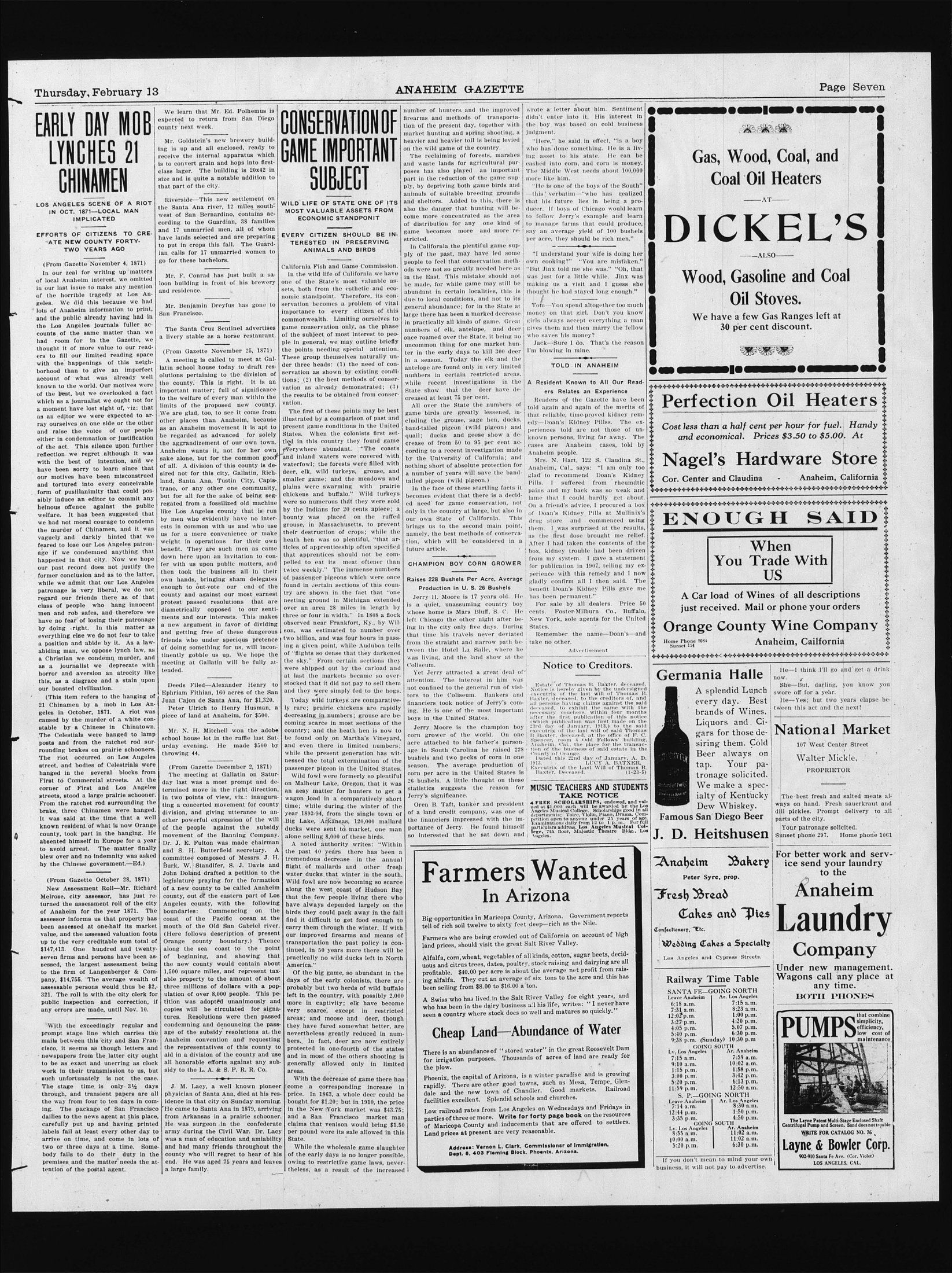
Searchable text
EARLY DAY MOB LYNCHES 21 CHINAMEN
LOS ANGELES SCENE OF A RIOT IN OCT. 1871—LOCAL MAN IMPLICATED
EFFORTS OF CITIZENS TO CREATE NEW COUNTY FORTY-TWO YEARS AGO
(From Gazette November 4, 1871)
In our zeal for writing up matters of local Anaheim interest, we omitted in our last issue to make any mention of the horrible tragedy at Los Angeles. We did this because we had lots of Anaheim information to print, and the public already having had in the Los Angeles journals fuller accounts of the same matter than we had room for in the Gazette, we thought it of more value to our readers to fill our limited reading space with the happenings of this neighborhood than to give an imperfect account of what was already well known to the world. Our motives were of the best, but we overlooked a fact which as a journalist we ought not for a moment have lost sight of, viz: that as an editor we were expected to array ourselves on one side or the other and raise the voice of our people either in condemnation or justification of the act. This silence upon further reflection we regret although it was with the best of intention, and we have been sorry to learn since that
We learn that Mr. Ed. Polhemus is expected to return from San Diego county next week.
Mr. Goldstein’s new brewery building is up and all enclosed, ready to receive the internal apparatus which is to convert grain and hops into first-class lager. The building is 20x42 in size and is quite a notable addition to that part of the city.
Riverside—This new settlement on the Santa Ana river, 12 miles southwest of San Bernardino, contains according to the Guardian, 38 families and 17 unmarried men, all of whom have lands selected and are preparing to put in crops this fall. The Guardian calls for 17 unmarried women to go for these bachelors.
Mr. F. Conrad has just built a saloon building in front of his brewery and residence.
Mr. Benjamin Dreyfus has gone to San Francisco.
The Santa Cruz Sentinel advertises a livery stable as a horse restaurant.
(From Gazette November 25, 1871)
A meeting is called to meet at Gallatin school house today to draft resolutions pertaining to the division of the county. This is right. It is an important matter; full of significance to the welfare of every man within the limits of the proposed new county. We are glad, too, to see it come from other places than Anaheim, because as an Anaheim movement it is apt to be regarded as advanced for solely the aggrandizement of our own town. Anaheim wants it, not for her own sake alone, but for the common good of all. A division of this county is desired not for this city, Gallatin, Rich-
CONSERVATION GAME IMPORT SUBJECT
WILD LIFE OF STATES MOST VALUABLE AS ECONOMIC STAND
EVERY CITIZEN SHOT TERESTED IN PROVINCIAL ANIMALS AND
California Fish and Game
In the wild life of California one of the State’s most sets, both from the esthetic nomic standpoint. Conservation becomes a pre-importance to every commonwealth. Limiting game conservation only, of the subject of most in-ple in general, we may not the points needing special These group themselves der three heads: (1) the servation as shown by observations; (2) the best mettlevation as already demonstrated the results to be obtained vation.
The first of these points illustrated by a comparison present game conditions States. When the colonized in this country there everywhere abundant, and inland waters were waterfowl; the forests w deer, elk, wild turkeys.
account of what was already well known to the world. Our motives were of the best, but we overlooked a fact which as a journalist we ought not for a moment have lost sight of, viz: that as an editor we were expected to array ourselves on one side or the other and raise the voice of our people either in condemnation or justification of the act. This silence upon further reflection we regret although it was with the best of intention, and we have been sorry to learn since that our motives have been misconstrued and tortured into every conceivable form of pusillanimity that could possibly induce an editor to commit any heinous offence against the public welfare. It has been suggested that we had not moral courage to condemn the murder of Chinamen, and it was vaguely and darkly hinted that we feared to lose our Los Angeles patronage if we condemned anything that happened in that city. Now we hope our past record does not justify the former conclusion and as to the latter, while we admit that our Los Angeles patronage is very liberal, we do not regard our friends there as of that class of people who hang innocent men and rob safes, and therefore we have no fear of losing their patronage by doing right. In this matter as everything else we do not fear to take a position and abide by it. As a law-abiding man, we oppose lynch law, as a Christian we condemn murder, and as a journalist we deprecate with horror and aversion an atrocity like this, as a disgrace and a stain upon our boasted civilization.
(This item refers to the hanging of 21 Chinamen by a mob in Los Angeles in October, 1871. A riot was caused by the murder of a white constable by a Chinese in Chinatown. The Celestials were hanged to lamp posts and from the ratchet rod surrounding the brake, three Chinamen were hanged. It was said at the time that a well known resident of what is now Orange county, took part in the hanging. He absented himself in Europe for a year to avoid arrest. The matter finally blew over and no indemnity was asked by the Chinese government.—Ed.)
(From Gazette October 28, 1871)
New Assessment Roll—Mr. Richard Melrose, city assessor, has just re-solutions pertaining to the division of the county. This is right. It is an important matter; full of significance to the welfare of every man within the limits of the proposed new county. We are glad, too, to see it come from other places than Anaheim, because as an Anaheim movement it is apt to be regarded as advanced for solely the aggrandizement of our own town. Anaheim wants it, not for her own sake alone, but for the common good of all. A division of this county is desired not for this city, Gallatin, Richland, Santa Ana, Tustin City, Capistrano, or any other one community, but for all for the sake of being segregated from a fossilized old machine like Los Angeles county that is run by men who evidently have no interests in common with us and who use us for a mere convenience or make weight in operations for their own benefit. They are such men as came down here upon an invitation to confer with us upon public matters, and then took the business all in their own hands, bringing sham delegates enough to out-vote our end of the county and against our most earnest protest passed resolutions that are diametrically opposed to our sentiments and our interests. This makes a new argument in favor of dividing and getting free of these dangerous friends who under specious pretence of doing something for us, will incontinently gobble us up. We hope the meeting at Gallatin will be fully attended.
Deeds Filed—Alexander Henry to Ephriam Fithian, 160 acres of the San Juan Cajon de Santa Ana, for $1,320.
Peter Ulrich to Henry Husman, a piece of land at Anaheim, for $500.
Mr. N. H. Mitchell won the adobe school house lot in the raffle last Saturday evening. He made $500 by throwing 44.
(From Gazette December 2, 1871)
The meeting at Gallatin on Saturday last was a most prompt and determined move in the right direction, in two points of view, viz.: inaugurating a concerted movement for county division, and giving utterance to another powerful expression of the will of the people against the subsidy movement of the Banning Company. Dr. J. E. Fulton was made chairman and S. H. Butterfield secretary. A committee composed of Messrs. J. H. Burk, W. Standifer, S. J. Davis and John Doland drafted a petition to the legislature praying for the formation of a new county to be called Anaheim county, out of the eastern part of Los
The first of these points illustrated by a comparison present game conditions States. When the colored in this country they everywhere abundant and inland waters were waterfowl; the forests wedge elk, wild turkeys; smaller game; and the plains were swarming chickens and buffalo.” were so numerous that by the Indians for 20 coyotes was placed on grouse, in Massachusetts their destruction of cree heath hen was so plentiful titles of apprenticeship that apprentices should pelled to eat its meat twice weekly.” The import of passenger pigeons who found in certain sections try are shown in the nesting ground in Michigan over an area 28 miles three or four in width.” observed near Frankford son, was estimated to two billion, and was found a given point, while of “flights so dense that the sky.” From certain were shipped out by them at last the markets be stocked that it did not put them and they were simply fledged that it did not put them.
Today wild turkeys are rarely rare; prairie chickens decreasing in numbers; coming scarce in most countries; and the health be found only on Marshland and even there in limestone nessesed the total external passenger pigeon in the Wild fowl were formed on Malheur Lake, Oregon an easy matter for hunter load in a complex time; while during these years 1893-94, from the Big Lake, Arkansas, ducks were sent to marsh alone selling 8,000 of them.
A noted authority was the past 40 years there tremendous decrease in flight of mallards and water ducks that winter. Wild fowl are now become along the west coast that the few people live
From the ratchet rod surrounding the brake, three Chinamen were hanged. It was said at the time that a well known resident of what is now Orange county, took part in the hanging. He absented himself in Europe for a year to avoid arrest. The matter finally blew over and no indemnity was asked by the Chinese government.—Ed.)
(From Gazette October 28, 1871)
New Assessment Roll—Mr. Richard Melrose, city assessor, has just returned the assessment roll of the city of Anaheim for the year 1871. The assessor informs us that property has been assessed at one-half its market value, and the assessed valuation foots up to the very creditable sum total of $147,413. One hundred and twenty-seven firms and persons have been assessed, the largest assessment being to the firm of Langenberger & Company, $14,755. The average wealth of assessable persons would thus be $2,321. The roll is with the city clerk for public inspection and correction, if any errors are made, until Nov. 10.
With the exceedingly regular and prompt stage line which carries the mails between this city and San Francisco, it seems as though letters and newspapers from the latter city ought to be as exact and unerring as clock work in their transmission to us, but such unfortunately is not the case. The stage time is only 3½ days through, and transient papers are all the way from four to ten days in coming. The package of San Francisco dailies to the news agent at this place, carefully put up and having printed labels fail at least every other day to arrive on time, and come in lots of two or three days at a time. Somebody fails to do their duty in the premises and the matter needs the attention of the postal agent.
J. M. Lacy, a well known pioneer physician of Santa Ana, died at his residence in that city on Sunday morning. He came to Santa Ana in 1879, arriving from Arkansas in a prairie schooner. He was surgeon in the confederate army during the Civil War. Dr. Lacy was a man of education and amiability and had many friends throughout the county who will regret to hear of his end. He was aged 75 years and leaves a large family.
A noted authority wrote the past 40 years that tremendous decrease in flight of mallards and water ducks that winter. Wild fowl are now becoming along the west coast that the few people live have always depended on birds they could pack and find it difficult to get carry them through the our improved firearms transportation the pass-tinued, in 50 years more practically no wild duck America."
Of the big game, so many days of the early color probably but two herds left in the country, with more in captivity; eleven very scarce, except areas; and moose and they have fared somewhat nevertheless greatly re- bers. In fact, deer are protected in one-fourth and in most of the other generally allowed on areas.
With the decrease of come a corresponding price. In 1863, a wholly bought for $1.20; but in the New York marriag- and a San Francisco claims that venison we per pound were its sal- State.
While the wholesale of the early days is now owing to restrictive gai-theless, as a result o
CONSERVATION OF GAME IMPORTANT SUBJECT
WILD LIFE OF STATE ONE OF ITS MOST VALUABLE ASSETS FROM ECONOMIC STANDPONIT
EVERY CITIZEN SHOULD BE INTERESTED IN PRESERVING ANIMALS AND BIRDS
California Fish and Game Commission.
In the wild life of California we have one of the State's most valuable assets, both from the esthetic and economic standpoint. Therefore, its conservation becomes a problem of vital importance to every citizen of this commonwealth. Limiting ourselves to game conservation only, as the phase of the subject of most interest to people in general, we may outline briefly the points needing special attention. These group themselves naturally under three heads: (1) the need of conservation as shown by existing conditions; (2) the best methods of conservation as already demonstrated; (3) the results to be obtained from conservation.
The first of these points may be best illustrated by a comparison of past and present game conditions in the United States. When the colonists first settled in this country they found game everywhere abundant. "The coasts and inland waters were covered with waterfowl; the forests were filled with deer, elk, wild turkeys, grouse, and number of hunters and the improved firearms and methods of transportation of the present day, together with market hunting and spring shooting, a heavier and heavier toll is being levied on the wild game of the country.
The reclaiming of forests, marshes and waste lands for agricultural purposes has also played an important part in the reduction of the game supply, by depriving both game birds and animals of suitable breeding grounds and shelters. Added to this, there is also the danger that hunting will become more concentrated as the area of distribution for any one kind of game becomes more and more restricted.
In California the plentiful game supply of the past, may have led some people to feel that conservation methods were not so greatly needed here as in the East. This mistake should not be made, for while game may still be abundant in certain localities, this is due to local conditions, and not to its general abundance; for in the State at large there has been a marked decrease in practically all kinds of game. Great numbers of elk, antelope, and deer once roamed over the State, it being no uncommon thing for one market hunter in the early days to kill 300 deer in a season. Today the elk and the antelope are found only in very limited numbers in certain restricted areas, while recent investigations in the State show that the deer have decreased at least 75 per cent.
All over the State the numbers of game birds are greatly lessened, including the grouse, sage hen, ducks, band-tailed pigeon (wild pigeon) and quail; ducks and geese show a decrease of from 50 to 95 per cent according to a recent investigation made by the University of California; and nothing short of absolute protection for a number of years will save the band-wrote a letter about him. Sentiment didn't enter into it. His interest in the boy was based on cold business judgment.
"Here," he said in effect, "is a boy who has done something. He is a living asset to his state. He can be cashed into corn, and corn is money. The Middle West needs about 100,000 more like him.
"He is one of the boys of the South"—this verbatim—"who has realized that his future lies in being a producer. If boys of Chicago would learn to follow Jerry's example and learn to manage farms that could produce, say an average yield of 100 bushels per acre, they should be rich men."
"I understand your wife is doing her own cooking?" "You are mistaken." "But Jinx told me she was." "Oh, that was just for a little while. Jinx was making us a visit and I guess she thought he had stayed long enough."
Tom—You spend altogether too much money on that girl. Don't you know girls always accept everything a man gives them and then marry the fellow who saves his money?
Jack—Sure I do. That's the reason I'm blowing in mine.
TOLD IN ANAHEIM
A Resident Known to All Our Readers Relates an Experience
Readers of the Gazette have been told again and again of the merits of that reliable, time-proved kidney remedy—Doan's Kidney Pillss. The experiences told are not those of unknown persons, living far away. The cases are Anaheim cases, told by Anaheim people.
Mrs. N. Hart, 122 S. Claudina St., Anaheim, Cal., says: "I am only too glad to recommend Doan's Kidney."
The first of these points may be best illustrated by a comparison of past and present game conditions in the United States. When the colonists first settled in this country they found game everywhere abundant. "The coasts and inland waters were covered with waterfowl; the forests were filled with deer, elk, wild turkeys, grouse, and smaller game; and the meadows and plains were swarming with prairie chickens and buffalo." Wild turkeys were so numerous that they were sold by the Indians for 20 cents apiece; a bounty was placed on the ruffed grouse, in Massachusetts, to prevent their destruction of crops; while the heath hen was so plentiful, "that articles of apprenticeship often specified that apprentices should not be compelled to eat its meat oftener than twice weekly." The immense numbers of passenger pigeons which were once found in certain sections of this country are shown in the fact that "one nesting ground in Michigan extended over an area 28 miles in length by three or four in width." In 1808 a flock observed near Frankfort, Ky., by Wilson, was estimated to number over two billion, and was four hours in passing a given point, while Audubon tells of "flights so dense that they darkened the sky." From certain sections they were shipped out by the carload and at last the markets became so overstocked that it did not pay to sell them and they were simply fed to the hogs.
Today wild turkeys are comparatively rare; prairie chickens are rapidly decreasing in numbers; grouse are becoming scarce in most sections of the country; and the heath hen is now to be found only on Martha's Vineyard, and even there in limited numbers; while the present generation has witnessed the total extermination of the passenger pigeon in the United States.
Wild fowl were formerly so plentiful on Malheur Lake, Oregon, that it was an aesy matter for hunters to get a wagon load in a comparatively short time; while during the winter of the year 1893-94, from the single town of Big Lake, Arkansas, 120,000 mallard ducks were sent to market, one man alone selling 8,000 of these birds.
A noted authority writes: "Within the past 40 years there has been a tremendous decrease in the annual flight of mallards and other fresh water ducks that winter in the south. Wild fowl are now becoming so scarce along the west coast of Hudson Bay that the few people living there who numbers in certain restricted areas, while recent investigations in the State show that the deer have decreased at least 75 per cent.
All over the State the numbers of game birds are greatly lessened, including the grouse, sage hen, ducks, band-tailed pigeon (wild pigeon) and quail; ducks and geese show a decrease of from 50 to 95 per cent according to a recent investigation made by the University of California; and nothing short of absolute protection for a number of years will save the band-tailed pigeon (wild pigeon.)
In the face of these startling facts it becomes evident that there is a decided need for game conservation, not only in the country at large, but also in our own State of California. This brings us to the second main point, namely, the best methods of conservation, which will be considered in a future article.
CHAMPION BOY CORN GROWER
Raises 228 Bushels Per Acre, Average Production in U. S. 26 Bushels
Jerry H. Moore is 17 years old. He is a quiet, unassuming country boy whose home is Mars Bluff, S. C. He left Chicago the other night after being in the city only five days. During that time his travels never deviated from the straight and narrow path between the Hotel La Salle, where he was living, and the land show at the Coliseum.
Yet Jerry attracted a great deal of attention. The interest in him was not confined to the general run of visitors to the Coliseum. Bankers and financiers took notice of Jerry's coming. He is one of the most important boys in the United States.
Jerry Moore is the champion boy corn grower of the world. On one acre attached to his father's parsonage in South Carolina he raised 228 bushels and two pecks of corn in one season. The average production of corn per acre in the United States is 26 bushels. A little thought on these statistics suggests the reason for Jerry's significance.
Oren B. Taft, banker and president of a land credit company, was one of the financiers impressed with the importance of Jerry. He found himself so interested that he sat down and
A Resident Known to All Our Readers Relates an Experience
Readers of the Gazette have been told again and again of the merits of that reliable, time-proved kidney remedy—Doan's Kidney Pillsss. The experiences told are not those of unknown persons, living far away. The cases are Anaheim cases, told by Anaheim people.
Mrs. N. Hart, 122 S. Claudina St., Anaheim, Cal., says: "I am only too glad to recommend Doan's Kidney Pills. I suffered from rheumatic pains and my back was so weak and lame that I could hardly get about. On a friend's advice, I procured a box of Doan's Kidney Pills at Mullinix's drug store and commenced using them. I was surprised at the results, as the first dose brought me relief. After I had taken the contents of the box, kidney trouble had been driven from my system. I gave a statement for publication in 1907, telling my experience with this remedy and I now gladly confirm all I then said. The benefit Doan's Kidney Pills gave me has been permanent."
For sale by all dealers. Price 50 cents. Foster-Milburn Co., Buffalo, New York, sole agents for the United States.
Remember the name—Doan's—and take no other.
Advertisement
Notice to Creditors.
Estate of Thomas B. Baxter, deceased.
Notice is hereby given by the undersigned executrix of the last will of Thomas B. Baxter, deceased, to the creditors of, and all persons having claims against the said deceased, to exhibit the same with the necessary vouchers, within four months after the first publication of this notice (which publication was first made on the 23rd day of January, 1913.) to the said executrix of the last will of said Thomas B. Baxter, deceased, at the office of F. C. Spencer, room 4 Odd Fellows' building, Anaheim, Cal., the place for the transaction of the business of said estate in the County of Orange.
Dated this 22nd day of January, A. D. 1913.
LUCY A. BATXER.
Executrix of the Last Will of Thomas B. Baxter, Deceased.
MUSIC TEACHERS AND STUDENTS TAKE NOTICE
4 FREE SCHOLARSHIPS, endowed, and valued at $1,000 each will be awarded by the Los Angeles Musical College. Scholarships good in all departments; Voice, Violin, Plano, Drama. Competition open to anyone under 25 years of age. Examinations daily from 12 to 1 p.m. For full particulars address, Los Angeles Musical College, 7th floor, Majestic Theatre Blvd., Los Angeles.
Farmers Wanted
In Arizona
Farmers Wanted In Arizona
Big opportunities in Maricopa County, Arizona. Government reports tell of rich soil twelve to sixty feet deep—rich as the Nile.
Farmers who are being crowded out of California on account of high land prices, should visit the great Salt River Valley.
Alfalfa, corn, wheat, vegetables of all kinds, cotton, sugar beets, deciduous and citrus trees, dates, poultry, stock raising and dairying are all profitable. $40.00 per acre is about the average net profit from raising alfalfa. They cut an average of six tons to the acre and this has been selling from $8.00 to $16.00 a ton.
A Swiss who has lived in the Salt River Valley for eight years, and who has been in the dairy business all his life, writes: "I never have seen a country where stock does so well and matures so quickly."
Cheap Land—Abundance of Water
There is an abundance of “stored water” in the great Roosevelt Dam for irrigation purposes. Thousands of acres of land are ready for the plow.
Phoenix, the capital of Arizona, is a winter paradise and is growing rapidly. There are other good towns, such as Mesa, Tempe, Glendale and the new town of Chandler. Good markets. Railroad facilities excellent. Splendid schools and churches.
Low railroad rates from Los Angeles on Wednesdays and Fridays in parties of three or more. Write for forty page book on the resources of Maricopa County and inducements that are offered to settlers. Land prices at present are very reasonable.
Address: Vernon L. Clark, Commissioner of Immigration,
Dept. 8, 403 Fleming Block, Phoenix, Arizona.
Gas, Wood, Coal, and
Coal Oil Heaters
AT
DICKEL'S
ALSO
Wood, Gasoline and Coal
Oil Stoves.
We have a few Gas Ranges left at
30 per cent discount.
Perfection Oil Heaters
Cost less than a half cent per hour for fuel. Handy
and economical. Prices $3.50 to $5.00. At
Nagel's Hardware Store
Perfection Oil Heaters
Cost less than a half cent per hour for fuel. Handy and economical. Prices $3.50 to $5.00. At
Nagel’s Hardware Store
Cor. Center and Claudina - Anaheim, California
ENOUGH SAID
When You Trade With US
A Car load of Wines of all descriptions just received. Mail or phone your orders
Orange County Wine Company
Anaheim, Cailfornia
Germania Halle
A splendid Lunch every day. Best brands of Wines, Liquors and Cigars for those desiring them. Cold Beer always on tap. Your patronage solicited. We make a specialty of Kentucky Dew Whiskey.
Famous San Diego Beer
J. D. Heitshusen
Anaheim Bakery
Peter Syre, prop.
Fresh Bread
He—I think I'll go and get a drink now.
She—But, darling, you know you swore off for a year.
He—Yes; but two years elapse between this act and the next!
National Market
107 West Center Street
Walter Mickle,
PROPRIETOR
The best fresh and salted meats always on hand. Fresh sauerkraut and dill pickles. Prompt delivery to all parts of the city.
Your patronage solicited.
Sunset phone 297. Home phone 1061
For better work and service send your laundry to the Anaheim
Dew Whiskey.
Famous San Diego Beer
J. D. Heitshusen
Anaheim Bakery
Peter Syre, prop.
Fresh Bread
Cakes and Pies
Confectionery, Etc.
Wedding Cakes a Specialty
Los Angeles and Cypress Streets.
Railway Time Table
SANTA FE—GOING NORTH
Leave Anaheim Ar. Los Angeles
6:18 a.m. 7:15 a.m.
7:31 a.m. 8:23 a.m.
12:02 p.m. 1:00 p.m.
3:27 p.m. 4:20 p.m.
4:05 p.m. 5:07 p.m.
5:40 p.m. 6:30 p.m.
9:38 p.m. (Sunday) 10:30 p.m
GOING SOUTH
Lv. Los Angeles Ar. Anaheim
7:15 a.m. 7:59 a.m.
9:10 a.m. 10:02 a.m.
1:15 p.m. 1:58 p.m.
3:00 p.m. 3:42 p.m.
5:20 p.m. 6:13 p.m.
11:59 p.m. 12:50 a.m.
S. P.—GOING NORTH
Leave Anaheim Ar. Los Angeles
7:14 a.m. 8:30 a.m.
12:44 p.m. 1:50 p.m.
3:35 p.m. 4:50 p.m.
GOING SOUTH
Lv. Los Angeles Ar. Anaheim
8:55 a.m. 11:02 a.m.
10:00 a.m. 11:02 a.m.
5:20 p.m. 6:30 p.m.
If you don't mean to mind your own business, it will not pay to advertise.
For better work and service send your laundry to the Anaheim Laundry Company
Under new management. Wagons call any place at any time.
BOTH PHONES
PUMPS that combine simplicity, efficiency, low cost of maintenance
The Layne Patent Multi-Stage Enclosed Shaft Centrifugal Pump and Screen. Sand does not trouble
WRITE FOR CATALOG NO. 76
Layne & Bowler Corp.
902-910 Santa Fe Ave. (Cor. Violet)
LOS ANGELES, CAL.