anaheim-gazette 1913-01-23
Scanned page
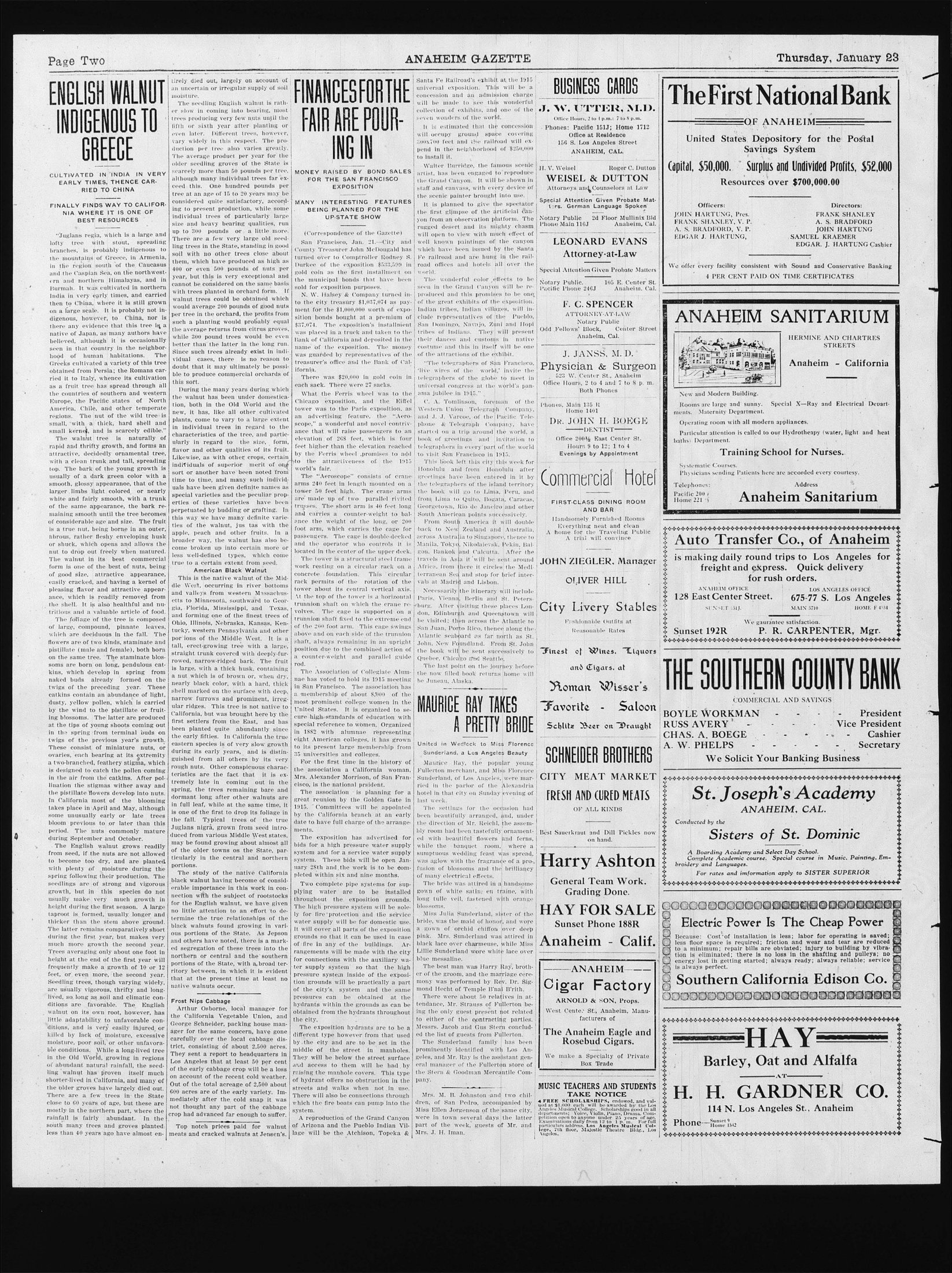
Searchable text
ENGLISH WALNUT INDIGENOUS TO GREECE
CULTIVATED IN INDIA IN VERY EARLY TIMES, THENCE CARRIED TO CHINA
FINALLY FINDS WAY TO CALIFORNIA WHERE IT IS ONE OF BEST RESOURCES
"Juglans regia, which is a large and lofty tree with stout, spreading branches, is probably indigenous to the mountains of Greece, in Armenia, in the region south of the Caucasus and the Caspian Sea, on the northwestern and northern Himalayas, and in Burmah. It was cultivated in northern India in very early times, and carried then to China, where it is still grown on a large scale. It is probably not indigenous, however, to China, nor is there any evidence that this tree is a native of Japan, as many authors have believed, although it is occasionally seen in that country in the neighborhood of human habitations. The Greeks cultivated a variety of this tree obtained from Persia; the Romans carried it to Italy, whence its cultivation as a fruit tree has spread through all the countries of southern and western Europe, the Pacific states of North America, Chile, and other temperate regions. The nut of the wild tree is small, with a thick, hard shell and small kernel, and is scarcely edible."
The walnut tree is naturally of rapid and thrifty growth, and forms an attractive, decidedly ornamental tree, with a clean trunk and tall, spreading top. The bark of the young growth is entirely died out, largely on account of an uncertain or irregular supply of soil moisture.
The seedling English walnut is rather slow in coming into bearing, most trees producing very few nuts until the fifth or sixth year after planting or even later. Different trees, however, vary widely in this respect. The production per tree also varies greatly. The average product per year for the older seedling groves of the State is scarcely more than 50 pounds per tree, although many individual trees far exceed this. One hundred pounds per tree at an age of 15 to 20 years may be considered quite satisfactory, according to present production, while some individual trees of particularly large size and heavy bearing qualities, run up to 300 pounds or a little more. There are a few very large old seedling trees in the State, standing in good soil with no other trees close about them, which have produced as high as 400 or even 500 pounds of nuts per year, but this is very exceptional and cannot be considered on the same basis with trees planted in orchard form. If walnut trees could be obtained which would average 200 pounds of good nuts per tree in the orchard, the profits from such a planting would probably equal the average returns from citrus groves, while 300 pound trees would be even better than the latter in the long run. Since such trees already exist in individual cases, there is no reason to doubt that it may ultimately be possible to produce commercial orchards of this sort.
During the many years during which the walnut has been under domestication, both in the Old World and the new, it has, like all other cultivated plants, come to vary to a large extent in individual trees in regard to the characteristics of the tree, and particularly in regard to the size, form, flavor and other qualities of its fruit. Likewise, as with other crops, certain individuals of superior merit of one sort or another have been noted from
ried it to Italy, whence its cultivation as a fruit tree has spread through all the countries of southern and western Europe, the Pacific states of North America, Chile, and other temperate regions. The nut of the wild tree is small, with a thick, hard shell and small kernel, and is scarcely edible."
The walnut tree is naturally of rapid and thrifty growth, and forms an attractive, decidedly ornamental tree, with a clean trunk and tall, spreading top. The bark of the young growth is usually of a dark green color with a smooth, glossy appearance, that of the larger limbs light colored or nearly white and fairly smooth, with a trunk of the same appearance, the bark remaining smooth until the tree becomes of considerable age and size. The fruit is a true nut, being borne in an outer, fibrous, rather fleshy enveloping husk or shuck, which opens and allows the nut to drop out freely when matured. The walnut in its best commercial form is one of the best of nuts, being of good size, attractive appearance, easily cracked, and having a kernel of pleasing flavor and attractive appearance, which is readily removed from the shell. It is also healthful and nutritious and a valuable article of food.
The foliage of the tree is composed of large, compound, pinnate leaves, which are deciduous in the fall. The flowers are of two kinds, staminate and pistillate (male and female), both born on the same tree. The staminate blossoms are born on long, pendulous catkins, which develop in spring from naked buds already formed on the twigs of the preceding year. These catkins contain an abundance of light, dusty, yellow pollen, which is carried by the wind to the pistillate or fruiting blossoms. The latter are produced at the tips of young shoots coming out in the spring from terminal buds on twigs of the previous year's growth. These consist of miniature nuts, or ovaries, each bearing at its extremity a two-branched, feathery stigma, which is designed to catch the pollen coming in the air from the catkins. After pollination the stigmas wither away and the pistillate flowers develop into nuts. In California most of the blooming takes place in April and May, although some unusually early or late trees bloom previous to or later than this period. The nuts commonly mature during September and October.
The English walnut grows readily from seed, if the nuts are not allowed to become too dry, and are planted with plenty of moisture during the spring following their production. The seedlings are of strong and vigorous growth, but in this species do not usually make very much growth in
During the many years during which the walnut has been under domestication, both in the Old World and the new, it has, like all other cultivated plants, come to vary to a large extent in individual trees in regard to the characteristics of the tree, and particularly in regard to the size, form, flavor and other qualities of its fruit. Likewise, as with other crops, certain individuals of superior merit of one sort or another have been noted from time to time, and many such individuals have been given definite names as special varieties and the peculiar properties of these varieties have been perpetuated by budding or grafting. In this way we have many definite varieties of the walnut, jus tas with the apple, peach and other fruits. In a broader way, the walnut has also become broken up into certain more or less well-defined types, which come true to a certain extent from seed.
American Black Walnut
This is the native walnut of the Middle West, occurring in river bottoms and valleys from western Massachusetts to Minnesota, southward to Georgia, Florida, Mississippi, and Texas, and forming one of the finest trees of Ohio, Illinois, Nebraska, Kansas, Kentucky, western Pennsylvania and other porions of the Middle West. It is a tall, erect-growing tree with a large straight trunk covered with deeply-furrowed, narrow-ridged bark. The fruit is large, with a thick husk, containing a nut which is of brown or, when dry, nearly black color, with a hard, thick shell marked on the surface with deep, narrow furrows and prominent irregular ridges. This tree is not native to California, but was brought here by the first settlers from the East, and has been planted quite abundantly since the early fifties. In California the true eastern species is of very slow growth during its early years, and is distinguished from all others by its very rough nuts. Other conspicuous characteristics are the fact that it is extremely late in coming out in the spring; the trees remaining bare and dormant long after other walnuts are in full leaf, while at the same time, it is one of the first to drop its foliage in the fall. Typical trees of the true Juglans nigra, grown from seed introduced from various Middle West states, may be found growing about almost all of the older towns os the State, particularly in the central and northern portions.
The study of the native California black walnut having become of considerable importance in this work in connection with the subject of rootstocks able to produce commercial orchards of this sort.
During the many years during which the walnut has been under domestication, both in the Old World and the new, it has, like all other cultivated plants, come to vary to a large extent in individual trees in regard to the characteristics of the tree, and particularly in regard to the size, form, flavor and other qualities of its fruit. Likewise, as with other crops, certain individuals of superior merit of one sort or another have been noted from time to time, and many such individuals have been given definite names as special varieties and the peculiar properties of these varieties have been perpetuated by budding or grafting. In this way we have many definite varieties of the walnut, jus tas with the apple, peach and other fruits. In a broader way, the walnut has also become broken up into certain more or less well-defined types, which come true to a certain extent from seed.
American Black Walnut
This is the native walnut of the Middle West, occurring in river bottoms and valleys from western Massachusetts to Minnesota, southward to Georgia, Florida, Mississippi, and Texas, and forming one of the finest trees of Ohio, Illinois, Nebraska, Kansas, Kentucky, western Pennsylvania and other porions of the Middle West. It is a tall, erect-growing tree with a large straight trunk covered with deeply-furrowed, narrow-ridged bark. The fruit is large, with a thick husk containing a nut which is of brown or when dry, nearly black color with a hard,thick shell marked on the surface with deep,narrow furrows and prominent,irregular ridges. This tree is not native to California,但 was brought here by the first settlers from the East,and has been planted quite abundantly since the early fifties. In California the true eastern species is of very slow growth during its early years,and is distinguished from all others by its very rough nuts. Other conspicuous characteristics are the fact that it is extremely late in coming out in the spring;the trees remaining bare and dormant long after other walnuts are in full leaf,while at the same time,it is one of the first to drop its foliage in the fall. Typical trees of the true Juglans nigra,grown from seed introduced from various Middle West states,may be found growing about almost all of the older towns os the State,particularly in the central and northern portions.
The study of the native California black walnut having become of considerable importance in this work in connection with the subject of rootstocks able to produce commercial orchards of this sort.
During the many years during which the walnut has been under domestication,both in the Old World and the new,it has,like all other cultivated plants,come to vary to a large extent in individual trees in regard to the characteristics of the tree,and particularly in regard to the size,form, flavor和 other qualities of its fruit. Likewise,as with other crops,certain individuals of superior merit of one sort or another have been noted from time to time,and many such individuals have been given definite names as special varieties and the peculiar properties of these varieties have been perpetuated by budding or grafting. In this way we have many definite varieties of the walnut,just tas with the apple,peach and other fruits. In a broader way,the walnut has also become broken up into certain more or less well-defined types,which come true to a certain extent from seed.
American Black Walnut
This is the native walnut of the Middle West,occurring in river bottoms and valleys from western Massachusetts to Minnesota,southward to Georgia,Florida,Mississippi,and Texas,and forming one ofthe finest treesofOhioIllinois,NebraskaKansasKentuckywesternPennsylvaniaandotherporionsoftheMiddleWest.itisa tall,erect-growingtreewithalargestraighttrunkcoveredwithdeeply-furrowed,narrow-ridgedbark.Thefruitislarge.witha thickhuskcontaininga nutwhichisofbrownorwhendrynearlyblackcolorwithahard.thickshellmarkedonthesurfacewithdeep,narrowfurrowsandprominent irregularridges.ThistreeisnotnativetoCaliforniabutwasbroughtherebythefirstsettlersfromtheEast,andhasbeenplantedquiteabundantlysincetheearlyfifties.InCaliforniathetrueeasternspeciesisofveryslowgrowthduringitsearlyyears,andisdistinguishedfromallothersbyitsveryroughnuts.Otherconspicuouscharacteristicsarethefactthatitisextremelylateincomingoutinthespring,thetreesremainingbareanddormantlongafterotherwalnutsareinfullleaf,而atthesametime,它是一ofthefirsttodropitsfoliageinthefall.TypicaltreesofthetrueJuglansnigra,grownfromseedintroducedfromvariousMiddleWeststates,maybefoundgrowingaboutalmostalloftheoldertownsostheState,particularlyinthecentralandnorthernportions.
The study oftheNativeCaliforniablackwalnuthavingbecomeofconsiderableimportanceinthisworkinconnectionwiththesubjectofrootstocksabletoproducecommercialorchardsofthissort.
WhattheFerrisSocietyChicagoexpositionontowerto50feethigharemadeupoftwctrusses.Theshortacadandcarriesaconferenceoftheweightofffootarmwhichcarespassengers.Thecaseandtheoperatorwilocatedinthecenter.
The towerisastrongworkrestingonacondestructurefoundertermpermitsoftowersaboutitscentreAtthetopofthetrustnshipontowervolves.Thecageinhortunionshippliedofthe200footarm.Ataboveandoncashshaftalwaysremainpositionduetothecounter-weightarrod.
TheAssociationohnaehasvotedtoholdinSanFrancisco.Thera membershipofalmostprominentcollegeUnitedStates.Itsincurehighstandardspecialreferenceto1882withalumneyricancollegetoitspresentlarge35universitiesandcourses.
ForthefirsttimeotheassociationaO Mrs.AlexanderMorriscois,thenational associationgreatreunionbythe1915.CommitteesbytheCaliforniabureaudatetohavefullchargements.
The expositionhbidsforafighpresseystemandfordaseystemThesebidsJanuary28thandthewpletedwithin sixandtwocompletepiplyingwaterarethroughouttheexxpressiedit
In California most of the blooming takes place in April and May, although some unusually early or late trees bloom previous to or later than this period. The nuts commonly mature during September and October.
The English walnut grows readily from seed, if the nuts are not allowed to become too dry, and are planted with plenty of moisture during the spring following their production. The seedlings are of strong and vigorous growth, but in this species do not usually make very much growth in height during the first season. A large taproot is formed, usually longer and thicker than the stem above ground. The latter remains comparatively short during the first year, but makes very much more growth the second year. Trees averaging only about one foot in height at the end of the first year will frequently make a growth of 10 or 12 feet, or even more, the second year. Seedling trees, though varying widely, are usually vigorous, thrifty and long-lived, so long as soil and climatic conditions are favorable. The English walnut on its own root, however, has little adaptability to unfavorable conditions, and is very easily injured or killed by lack of moisture, excessive moisture, poor soil, or other unfavorable conditions. While a long-lived tree in the Old World, growing in regions of abundant natural rainfall, the seedling walnut has proven itself much shorter-lived in California, and many of the older groves have largely died out. There are a few trees in the State close to 60 years of age, but these are mostly in the northern part, where the rainfall is fairly abundant. In the south many trees and groves planted less than 40 years ago have almost endormant long after other walnuts are in full leaf, while at the same time, it is one of the first to drop its foliage in the fall. Typical trees of the true Juglans nigra, grown from seed introduced from various Middle West states, may be found growing about almost all of the older towns os the State, particularly in the central and northern portions.
The study of the native California black walnut having become of considerable importance in this work in connection with the subject of rootstocks for the English walnut, we have given no little attention to an effort to determine the true relationships of the black walnuts found growing in various portions of the State. As Jepson and others have noted, there is a marked segregation of these trees into the northern or central and the southern portions of the State, with a broad territory between, in which it is evident that at the present time at least no native walnuts occur.
Frost Nips Cabbage
Arthur Osborne, local manager for the California Vegetable Union, and George Schneider, packing house manager for the same concern, have gone carefully over the local cabbage district, consisting of about 2,500 acres. They sent a report to headquarters in Los Angeles that at least 50 per cent of the early cabbage crop will be a loss on account of the recent cold weather. Out of the total acreage of 2,500 about 600 acres are of the early variety. Immediately after the cold snap it was not thought any part of the cabbage crop had advanced far enough to suffer.
Top notch prices paid for walnut meats and cracked walnuts at Jensen's.
FINANCES FOR THE FAIR ARE POURING IN
MONEY RAISED BY BOND SALES FOR THE SAN FRANCISCO EXPOSITION
MANY INTERESTING FEATURES BEING PLANNED FOR THE UP-STATE SHOW
(Correspondence of the Gazette)
San Francisco, Jan. 21.—City and County Treasurer John McDougald has turned over to Comptroller Rodney S. Durkee of the exposition $533,599 in gold coin as the first installment on the municipal bonds that have been sold for exposition purposes.
N. W. Halsey & Company turned into the city treasury $1,037,074 as payment for the $1,000,000 worth of exposition bonds bought at a premium of $37,074. The exposition's installment was placed in a truck and taken to the Bank of California and deposited in the name of the exposition. The money was guarded by representatives of the treasurer's office and the Bank of California.
There was $20,000 in gold coin in each sack. There were 27 sacks.
What the Ferris wheel was to the Chicago exposition, and the Eiffel tower was to the Paris exposition, as an advertising feature, the "Aeroscope," a wonderful and novel contrivance that will raise passengers to an elevation of 268 feet, which is four feet higher than the elevation reached by the Ferris wheel promises to add to the attractiveness of the 1915 world's fair.
Santa Fe Railroad's exhibit at the 1915 universal exposition. This will be a concession and an admission charge will be made to see this wonderful collection of exhibits, and one of the seven wonders of the world.
It is estimated that the concession will occupy ground space covering 300x700 feet and the railroad will expend in the neighborhood of $250,000 to install it.
Walter Burridge, the famous scenic artist, has been engaged to reproduce the Grand Canyon. It will be shown in staff and canvass, with every device of the scenic painter brought into use.
It is planned to give the spectator the first glimpse of the artificial canyon from an observation platform. The rugged desert and its mighty chasm will open to view with much effect of well known paintings of the canyon which have been issued by the Santa Fe railroad and are hung in the railroad offices and hotels all over the world.
The wonderful color effects to be seen in the Grand Canyon will be reproduced and this promises to be one of the great exhibits of the exposition. Indian tribes, Indian villages, will include representatives of the Pueblo, San Domingo, Navajo, Zuni and Hopi tribes of Indians. They will present their dances and customs in native costume and this in itself will be one of the attractions of the exhibit.
"The telegraphers of San Francisco, 'live wires of the world,' invite the telegraphers of the globe to meet in universal congress at the world's panama jubilee in 1915."
C. A. Tomlinson, foreman of the Western Union Telegraph Company, and J. J. Varcoe, of the Pacific Telephone & Telegraph Company, have started on a trip around the world, a book of greetings and invitation to telegraphers in every part of the world to visit San Francisco in 1915.
This book left this city this week for Honolulu and from Honolulu after...
There was $20,000 in gold coin in each sack. There were 27 sacks.
What the Ferris wheel was to the Chicago exposition, and the Eiffel tower was to the Paris exposition, as an advertising feature, the "Aeroscope," a wonderful and novel contrivance that will raise passengers to an elevation of 268 feet, which is four feet higher than the elevation reached by the Ferris wheel, promises to add to the attractiveness of the 1915 world's fair.
The "Aeroscope" consists of crane arms 240 feet in length mounted on a tower 50 feet high. The crane arms are made up of two parallel rivited trusses. The short arm is 40 feet long and carries a counter-weight to balance the weight of the long, or 200 foot arm, which carries the cage for passengers. The cage is double-decked and the operator who controls it is located in the center of the upper deck.
The tower is a structural steel frame work resting on a circular rack on a concrete foundation. This circular rack permits of the rotation of the tower about its central vertical axis. At the top of the tower is a horizontal trunnion shaft on which the crane revolves. The cage is supported on a trunnion shaft fixed to the extreme end of the 200 foot arm. This cage swings above and on each side of the trunnion shaft, always remaining in an upright position due to the combined action of a counter-weight and parallel guide rod.
The Association of Collegiate Alumnae has voted to hold its 1915 meeting in San Francisco. The association has a membership of about 8,000 of the most prominent college women in the United States. It is organized to secure high standards of education with special reference to women. Organized in 1882 with alumnae representing eight American colleges, it has grown to its present large membership from 35 universities and colleges.
For the first time in the history of the association a California woman, Mrs. Alexander Morrison, of San Francisco, is the national president.
The association is planning for a great reunion by the Golden Gate in 1915. Committees will be appointed by the California branch at an early date to have full charge of the arrangements.
The exposition has advertised for bids for a high pressure water supply system and for a service water supply system. These bids will be open January 28th and the work is to be completed within six and nine months.
Two complete pipe systems for supplying water are to be installed throughout the exposition grounds.
C. A. Tomlinson, foreman of the Western Union Telegraph Company, and J. J. Varcoe, of the Pacific Telephone & Telegraph Company, have started on a trip around the world, a book of greetings and invitation to telegraphers in every part of the world to visit San Francisco in 1915.
This book left this city this week for Honolulu and from Honolulu after greetings have been entered in it by the telegraphers of the island territory the book will go to Lima, Peru, and from Lima to Quito, Bogata, Caracas, Georgetown, Rio de Janeiro and other South American points successively.
From South America it will double back to New Zealand and Australia, across Australia to Singapore, thence to Manila, Tokyo, Nikolaievsk, Pekin, Balgon, Bankok and Calcutta. After the travels in Asia it will be sent around Africa, from there it circles the Mediterranean Sea and stop for brief intervals at Madrid and Lisbon.
Necessarily the itinerary will include Paris, Vienna, Berlin and St. Petersburg. After visiting these places London, Edinburgh and Queenstown will be visited; then across the Atlantic to San Juan, Porto Rico, thence along the Atlantic seaboard as far north as St. John, New Foundland. From St. John the book will be sent successively to Quebec, Chicago and Seattle.
The last point on the journey before the now filled book returns home will be Juneau, Alaska.
MAURICE RAY TAKES A PRETTY BRIDE
United in Wedlock to Miss Florence Sunderland, a Los Angeles Beauty
Maurice Ray, the popular young Fullerton merchant, and Miss Florence Sunderland, of Los Angeles, were married in the parlor of the Alexandria hotel in that city on Sunday evening of last week.
The settings for the occasion had been beautifully arranged, and under the direction of Mr. Reichl, the assembly room had been tastefully ornamented with beautiful flowers and ferns, while the banquet room, where a sumptuous wedding feast was spread, was aglow with the fragrance of a profusion of blossoms and the brilliancy of many electrical effects.
The bride was attired in a handsome gown of white satin; en traine, with long tulle veil fastened with orange telegraphers of the globe to meet in universal congress at the world's panama jubilee in 1915."
Commercial Hotel
FIRST-CLASS DINING ROOM AND BAR
Handsomely Furnished Rooms Everything neat and clean A home for the Traveling Public A trial will convince
JOHN ZIEGLER, Manager
OLIVER HILL
City Livery Stables
Fashionable Outfits at Reasonable Rates
Finest of Wines, Liquors and Cigars at
Roman Wisser's Favorite - Saloon Schlitz Beer on Draught
SCHNEIDER BROTHERS
CITY MEAT MARKET
FRESH AND CURED MEATS OF ALL KINDS
Best Sauerkraut and Dill Pickles now on hand.
Harry Ashton
General Team Work. Grading Done.
great reunion by the Golden Gate in 1915. Committees will be appointed by the California branch at an early date to have full charge of the arrangements.
The exposition has advertised for bids for a high pressure water supply system and for a service water supply system. These bids will be open January 28th and the work is to be completed within six and nine months.
Two complete pipe systems for supplying water are to be installed throughout the exposition grounds. The high pressure system will be solely for fire protection and the service water supply will be for domestic use. It will cover all parts of the exposition grounds so that it can be used in case of fire in any of the buildings. Arrangements will be made with the city for connections with the auxiliary water supply system so that the high pressure system inside of the exposition grounds will be practically a part of the city's system and the same pressures can be obtained at the hydrants within the grounds as can be obtained from the hydrants throughout the city.
The exposition hydrants are to be a different type however from that used by the city and are to be set in the middle of the street in manholes. They will be below the street surface and access to them will be had by raising the manhole covers. This type of hydrant offers no obstruction in the streets and walks when not in use. There will also be connections through which the fire boats can pump into the system.
A reproduction of the Grand Canyon of Arizona and the Pueblo Indian Village will be the Atchison, Topeka & last week.
The settings for the occasion had been beautifully arranged, and, under the direction of Mr. Reichl, the assembly room had been tastefully ornamented with beautiful flowers and ferns, while the banquet room, where a sumptuous wedding feast was spread, was aglow with the fragrance of a profusion of blossoms and the brilliancy of many electrical effects.
The bride was attired in a handsome gown of white satin; en traine, with long tulle veil, fastened with orange blossoms.
Miss Julia Sunderland, sister of the bride, was the maid of honor, and wore a gown of orchid chiffon over deep pink. Mrs. Sunderland was attired in black lace over charmeuse, while Miss Lillie Sunderland wore white lace over blue messaline.
The best man was Harry Ray, brother of the groom, and the marriage ceremony was performed by Rev. Dr. Sigmond Hecht of Temple B'nai B'rith.
There were about 50 relatives in attendance, Mr. Strauss of Fullerton being the only guest present not related to either of the contracting parties. Messrs. Jacob and Gus Stern concluded the list of guests from Fullerton.
The Sunderland family has been prominently identified with Los Angeles, and Mr. Ray is the assistant general manager of the Fullerton store of the Stern & Goodman Mercantile Company.
Mrs. M. B. Johnston and two children, of San Pedro, accompanied by Miss Ellen Jorgenson of the same city, were in town several days the latter part of the week, guests of Mr. and Mrs. J. H. Iman.
Thursday, January 23
The First National Bank
OF ANAHEIM
United States Depository for the Postal Savings System
Capital, $50,000. Surplus and Undivided Profits, $52,000
Resources over $700,000.00
Officers:
JOHN HARTUNG, Pres.
FRANK SHANLEY
FRANK SHANLEY, V. P.
A. S. BRADFORD
A. S. BRADFORD, V. P.
EDGAR J. HARTUNG,
SAMUEL KRAEMER
EDGAR. J. HARTUNG Cashier
We offer every facility consistent with Sound and Conservative Banking
4 PER CENT PAID ON TIME CERTIFICATES
ANAHEIM SANITARIUM
HERMINE AND CHARTRES STREETS
Anaheim - California
New and Modern Building.
Rooms are large and sunny. Special X—Ray and Electrical Departments. Maternity Department.
Operating room with all modern appliances.
Particular attention is called to our Hydrotheapy (water, light and heat baths) Department.
Training School for Nurses.
Systematic Courses.
Physicians sending Patients here are accorded every courtesy.
New and Modern Building.
Rooms are large and sunny. Special X—Ray and Electrical Departments. Maternity Department.
Operating room with all modern appliances.
Particular attention is called to our Hydrotheapy (water, light and heat baths) Department.
Training School for Nurses.
Systematic Courses.
Physicians sending Patients here are accorded every courtesy.
Telephones:
Pacific 200
Home 221
Anaheim Sanitarium
Auto Transfer Co., of Anaheim
is making daily round trips to Los Angeles for freight and express. Quick delivery for rush orders.
ANAHEIM OFFICE
128 East Center Street.
SUNSET 351J.
LOS ANGELES OFFICE
675-77 S. Los Angeles
MAIN 5710
HOME F434
We guarantee satisfaction.
Sunset 192R
P. R. CARPENTER, Mgr.
THE SOUTHERN COUNTY BANK
COMMERCIAL AND SAVINGS
BOYLE WORKMAN - President
RUSS AVERY - Vice President
CHAS. A. BOEGE - Cashier
A. W. PHELPS - Secretary
We Solicit Your Banking Business
St. Joseph’s Academy
ANAHEIM, CAL.
Conducted by the
Sisters of St. Dominic
A Boarding Academy and Select Day School.
Complete Academic course. Special course in Music, Painting, Embroidery and Languages.
For rates and information apply to SISTER SUPERIOR
ANAHEIM, CAL.
Conducted by the
Sisters of St. Dominic
A Boarding Academy and Select Day School.
Complete Academic course. Special course in Music, Painting, Embroidery and Languages.
For rates and information apply to SISTER SUPERIOR
Electric Power Is The Cheap Power
Because: Cost of installation is less; labor for operating is saved;
less floor space is required; friction and wear and tear are reduced
to a minimum; repair bills are obviated; injury to building by vibration is eliminated; there is no loss in the shafting and pulleys; no
energy lost in getting started; always ready; always reliable; service
is always perfect.
Southern California Edison Co.
HAY
Barley, Oat and Alfalfa
AT
H. H. GARDNER CO.
114 N. Los Angeles St., Anaheim
Phone—Sunset 9
Home 1542