anaheim-gazette 1913-01-09
Scanned page
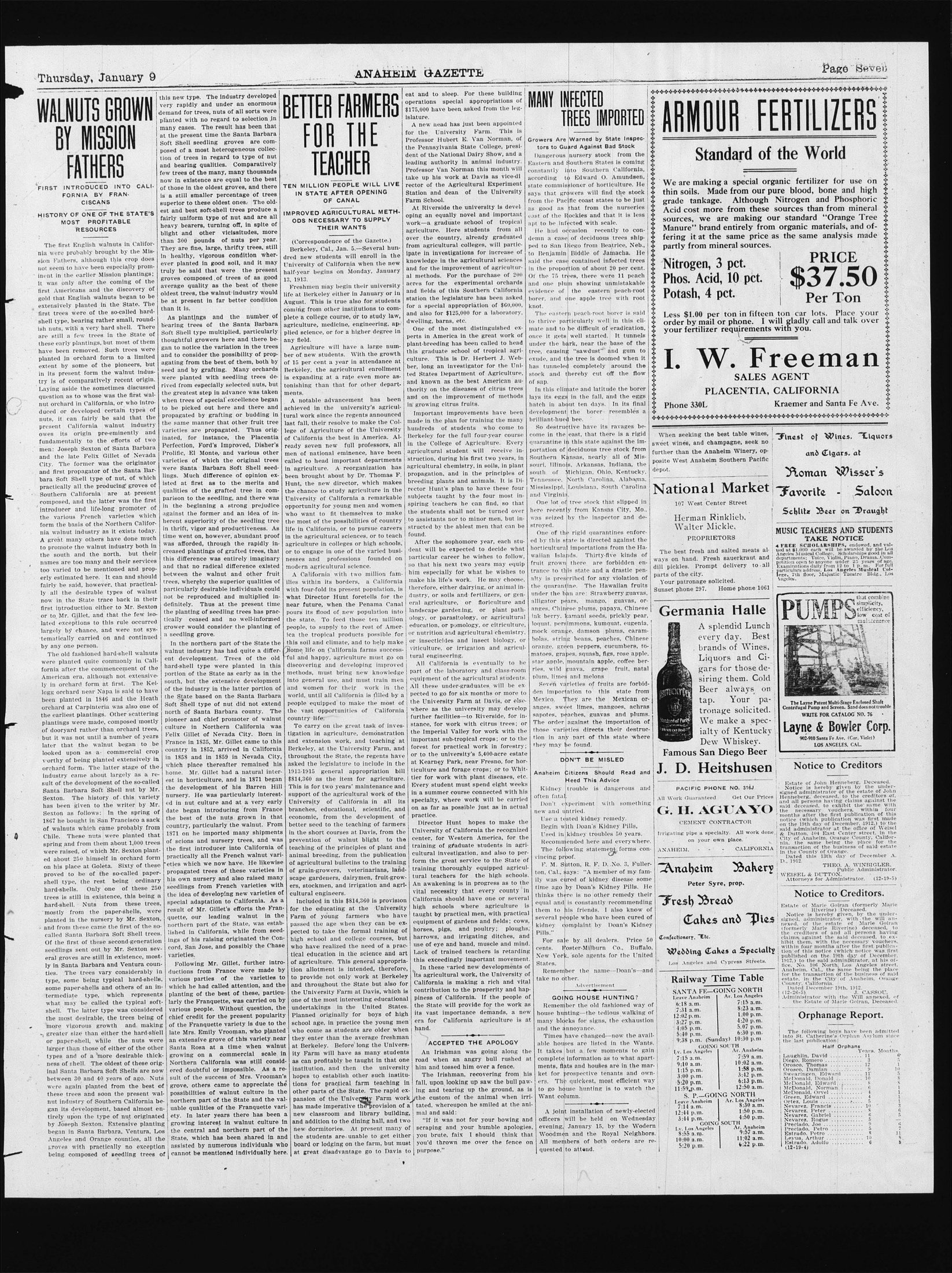
Searchable text
WALNUTS GROWN BY MISSION FATHERS
FIRST INTRODUCED INTO CALIFORNIA BY FRANCISCANS
HISTORY OF ONE OF THE STATE'S MOST PROFITABLE RESOURCES
The first English walnuts in California were probably brought by the Mission Fathers, although this crop does not seem to have been especially prominent in the earlier Mission plantings; it was only after the coming of the first Americans and the discovery of gold that English walnuts began to be extensively planted in the State. The first trees were of the so-called hard-shell type, bearing rather small, roundish nuts, with a very hard shell. There are still a few trees in the State of these early plantings, but most of them have been removed. Such trees were planted in orchard form to a limited extent by some of the pioneers, but in its present form the walnut industry is of comparatively recent origin. Laying aside the sometimes discussed question as to whose was the first walnut orchard in California, or who introduced or developed certain types of nuts, it can fairly be said that the present California walnut industry owes its origin pre-eminently and fundamentally to the efforts of two men: Joseph Sexton of Santa Barbara and the late Felix Gillet of Nevada City. The former was the originator and first propagator of the Santa Bar-
in its present form the walnut industry is of comparatively recent origin. Laying aside the sometimes discussed question as to whose was the first walnut orchard in California, or who introduced or developed certain types of nuts, it can fairly be said that the present California walnut industry owes its origin pre-eminently and fundamentally to the efforts of two men: Joseph Sexton of Santa Barbara and the late Felix Gillet of Nevada City. The former was the originator and first propagator of the Santa Barbara Soft Shell type of nut, of which practically all the producing groves of Southern California are at present composed, and the latter was the first introducer and life-long promoter of the various French varieties which form the basis of the Northern California walnut industry as it exists today. A great many others have done much to promote the walnut industry both in the south and the north, but their names are too many and their services too varied to be mentioned and properly estimated here. It can and should fairly be said, however, that practically all the desirable types of walnut now in the State trace back in their first introduction either to Mr. Sexton or to Mr. Gillet, and that the few isolated exceptions to this rule occurred largely by chance, and were not systematically carried on and continued by any one person.
The old fashioned hard-shell walnuts were planted quite commonly in California after the commencement of the American era, although not extensively in orchard form at first. The Kellegg orchard near Napa is said to have been planted in 1846 and the Heath orchard at Carpinteria was also one of the earliest plantings. Other scattering plantings were made, composed mostly of dooryard rather than orchard trees, but it was not until a number of years later that the walnut began to be looked upon as a commercial crop worthy of being planted extensively in orchard form. The latter stage of the industry came about largely as a result of the development of the so-called Santa Barbara Soft Shell nut by Mr. Sexton. The history of this variety has been given to the writer by Mr. Sexton as follows: In the spring of 1867 he bought in San Francisco a sack of walnuts which came probably from Chile. These nuts were planted that spring and from them about 1,000 trees were raised, of which Mr. Sexton planted about 250 himself in orchard form on his place at Goleta. Sixty of these proved to be of the so-called paper shell type, the rest being ordinary hard-shells. Only one of these 250 trees is still in existence, this being a were planted with seedling trees derived from especially selected nuts, but the greatest step in advance was taken when trees of special excellence began to be picked out here and there and propagated by grafting or budding in the same manner that other fruit tree varieties are propagated. Thus originated, for instance, the Placentia Perfection, Ford's Improved, Disher's Prolific, El Monte, and various other varieties of which the original trees were Santa Barbara Soft Shell seedlings. Much difference of opinion existed at first as to the merits and qualities of the grafted tree in comparison to the seedling, and there was in the beginning a strong prejudice against the former and an idea of inherent superiority of the seedling tree in thrift, vigor and productiveness. As time went on, however, abundant proof was afforded, through the rapidly increased plantings of grafted trees, that this difference was entirely imaginary and that no radical difference existed between the walnut and other fruit trees, whereby the superior qualities of particularly desirable individuals could not be reproduced and multiplied indefinitely. Thus at the present time the planting of seedling trees has practically ceased and no well-informed grower would consider the planting of a seedling grove.
In the northern part of the State the walnut industry has had quite a different development. Trees of the old hard-shell type were planted in this portion of the State as early as in the south, but the extensive development of the industry in the latter portion of the State based on the Santa Barbara Soft Shell type of nut did not extend north of Santa Barbara county. The pioneer and chief promoter of walnut culture in Northern California was Felix Gillet of Nevada City. Born in France in 1835, Mr. Gillet came to this country in 1852, arrived in California in 1858 and in 1859 in Nevada City, which place thereafter remained his home. Mr. Gillet had a natural interest in horticulture, and in 1871 began the development of his Barren Hill nursery. He was particularly interested in nut culture and at a very early date began introducing from France the best of the nuts grown in that country, particularly the walnut. From 1871 on he imported many shipments of scions and nursery trees, and was the first introducer into California of practically all the French walnut varieties which we now have. He likewise propagated trees of these varieties in his own nursery and also raised many seedlings from French varieties with the idea of developing new varieties of
is expanding at a rate far astonishing than that for movements.
A notable advancement achieved in the universal work since the regular last fall, their resolve to lege of Agriculture of California the best in ready seven new full men of national eminent called to head important agriculture. A record been brought about by Hunt, the new director, the chance to study agro-University of California opportunity for young ranchers who want to fit them; most of the possibility life in California, or to join in the agricultural science agriculture in colleges or to engage in one of these sciences and professions modern agricultural science.
A California with two illies within its borders with four-fold its present what Director Hunt for near future, when they pours its flood of new state. To feed these people, to supply to themica the tropical produce this soil and climate, and home life on California ful and happy, agricultur discovering and developing methods, must bring into general use, and aid women for their world, until all California people equipped to make the vast opportunities country life.
To carry on theigation in agriculture and extension work, Berkeley, at the University throughout the State, asked the legislature to 1913-1915 general apportion $814,360 as the item This is for two years' support of the agricultural University of California branches, educational economic, from better seed to the teachin in short courses at prevention of walnut teaching of the principle animal breeding, from off agricultural bulletiness of grain-growers, vex scope gardeners, dairiers, stockmen, and irrultural engineers.
Sexton. The history of this variety has been given to the writer by Mr. Sexton as follows: In the spring of 1867 he bought in San Francisco a sack of walnuts which came probably from Chile. These nuts were planted that spring and from them about 1,000 trees were raised, of which Mr. Sexton planted about 250 himself in orchard form on his place at Goleta. Sixty of these proved to be of the so-called paper-shell type, the rest being ordinary hard-shells. Only one of these 250 trees is still in existence, this being a hard-shell. Nuts from these trees, mostly from the paper-shells, were planted in the nursery by Mr. Sexton, and from these came the first of the so-called Santa Barbara Soft Shell trees. Of the first of these second-generation seedlings sent out by Mr. Sexton several groves are still in existence, mostly in Santa Barbara and Ventura counties. The trees vary considerably in type, some being typical hard-shells, some paper-shells and others of an intermediate type, which represents what may be called the typical soft-shell. The latter type was considered the most desirable, the trees being of more vigorous growth and making greater size than either the hard-shell or paper-shell, while the nuts were larger than those of either of the other types and of a more desirable thickness of shell. The oldest of these original Santa Barbara Soft Shells are now between 30 and 40 years of ago. Nuts were again planted from the best of these trees and soon the present walnut industry of Southern California began its development, based almost entirely upon the type of nut originated by Joseph Sexton. Extensive planting began in Santa Barbara, Ventura, Los Angeles and Orange counties, all the groves with practically no exception being composed of seedling trees of nut culture and at a very early date began introducing from France the best of the nuts grown in that country, particularly the walnut. From 1871 on he imported many shipments of scions and nursery trees, and was the first introducer into California of practically all the French walnut varieties which we now have. He likewise propagated trees of these varieties in his own nursery and also raised many seedlings from French varieties with the idea of developing new varieties of special adaptation to California. As a result of Mr. Gillet's efforts the Franquette, our leading walnut in the northern part of the State, was established in California, while from seedings of his raising originated the Concord, San Jose, and possibly the Chase varieties.
Following Mr. Gillet, further introductions from France were made by various parties of the varieties to which he had called attention, and the planting of the best of these, particularly the Franquette, was carried on by various people. Without question, the chief credit for the present popularity of the Franquette variety is due to the late Mrs. Emily Vrooman, who planted an extensive grove of this variety near Santa Rosa at a time when walnut growing on a commercial scale in Northern California was still considered doubtful or impossible. As a result of the success of Mrs. Vrooman's grove, others came to appreciate the possibilities of walnut culture in the northern part of the State and the valuable qualities of the Franquette variety. In later years there has been a growing interest in walnut culture in the central and northern part of the State, which has been shared in and assisted by numerous individuals who cannot be mentioned individually here.
University of California branches, educational, economic, from the better seed to the teacher in the short courses and prevention of walnut teaching of the principal animal breeding, from of agricultural bulletins of grain-growers, vex scape gardeners, dairiers, stockmen, and irrigation cultural engineers.
Included in this $815 for the educating at Farm of young farmers passed the age when expected to take the fourth high school and college who have realized their technical education in the field of agriculture. This graduation allotment is intended to provide not only students and throughout the State University Farm but one of the most interesting undertakings in the Planned originally for school age, in practice who come as students they enter than she at Berkeley. Before it will have been as can profitably be institution, and then hopes to establish operations for practical use other parts of the State pansion of the University has made imperative new classroom and addition to the new dormitories. All the students are unboard or lodging on at great disadvantage.
BETTER FARMERS FOR THE TEACHER
TEN MILLION PEOPLE WILL LIVE IN STATE AFTER OPENING OF CANAL
IMPROVED AGRICULTURAL METHODS NECESSARY TO SUPPLY THEIR WANTS
(Correspondence of the Gazette.)
Berkeley, Cal., Jan. 5.—Several hundred new students will enroll in the University of California when the new half-year begins on Monday, January 13, 1913.
Freshmen may begin their university life at Berkeley either in January or in August. This is true also for students coming from other institutions to complete a college course, or to study law, agriculture, medicine, engineering, applied science, or for a higher degree in any field.
Agriculture will have a large number of new students. With the growth of 15 per cent a year in attendance at Berkeley, the agricultural enrollment is expanding at a rate even more astonishing than that for other departments.
A notable advancement has been achieved in the university's agricultural work since the regents announced last fall, their resolve to make the College of Agriculture of the University of California the best in America. Already seven new full professors, all men of national eminence, have been called to head important departments in agriculture. A reorganization has been brought about by Dr. Thomas E.
eat and to sleep. For these building operations special appropriations of $175,000 have been asked from the legislature.
A new nead has just been appointed for the University Farm. This is Professor Hubert E. Van Norman, of the Pennsylvania State College, president of the National Dairy Show, and a leading authority in animal industry. Professor Van Norman this month will take up his work at Davis as vice-director of the Agricultural Experiment Station and dean of the University Farm School.
At Riverside the university is developing an equally novel and important work—a graduate school of tropical agriculture. Here students from all over the country, already graduated from agricultural colleges, will participate in investigations for increase of knowledge in the agricultural sciences and for the improvement of agricultural methods. For the purchase of 200 acres for the experimental orchards and fields of this Southern California station the legislature has been asked for a special appropriation of $60,000, and also for $125,000 for a laboratory, dwelling, barns, etc.
One of the most distinguished experts in America in the great work of plant-breeding has been called to head this graduate school of tropical agriculture. This is Dr. Herbert J. Webber, long an investigator for the United States Department of Agriculture, and known as the best American authority on the diseases of citrus trees and on the improvement of methods in growing citrus fruits.
Important improvements have been made in the plan for training the many hundreds of students who come to Berkeley for the full four-year course in the College of Agriculture. Every agricultural student will receive instruction, during his first two years, in agricultural chemistry, in soils, in plant propagation, and in the principles of
MANY INFECTED TREES IMPORTED
Growers Are Warned by State Inspectors to Guard Against Bad Stock
Dangerous nursery stock from the Eastern and Southern States is coming constantly into Southern California, according to Edward O. Amundsen, state commissioner of horticulture. He says that growers will find the stock from the Pacific coast states to be just as good as that from the nurseries east of the Rockies and that it is less apt to be infected with scale.
He had occasion recently to condemn a case of deciduous trees shipped to San Diego from Beatrice, Neb., to Benjamin Biddle of Jamacha. He said the case contained infected trees in the proportion of about 20 per cent. Of the 75 trees, there were 11 peach and one plum showing unmistakable evidence of the eastern peach-root borer, and one apple tree with root knot.
The eastern peach-root borer is said to thrive particularly well in this climate and to be difficult of eradication, once it gets well started. It tunnels under the bark, near the base of the tree, causing "sawdust" and gum to exude, and the tree is doomed when it has tunneled completely around the stock and thereby cut off the flow of sap.
In this climate and latitude the borer lays its eggs in the fall, and the eggs hatch in about ten days. In its final development the borer resembles a brilliant-hued bee.
So destructive have its ravages become in the east, that there is a rigid quarantine in this state against the importation of deciduous tree stock from Southern Kansas, nearly all of Missouri, Illinois, Arkansas, Indiana, the south of Michigan, Ohio, Kentucky.
A notable advancement has been achieved in the university's agricultural work since the regents announced last fall, their resolve to make the College of Agriculture of the University of California the best in America. Already seven new full professors, all men of national eminence, have been called to head important departments in agriculture. A reorganization has been brought about by Dr. Thomas F. Hunt, the new director, which makes the chance to study agriculture in the University of California a remarkable opportunity for young men and women who want to fit themselves to make the most of the possibilities of country life in California, or to pursue careers in the agricultural sciences, or to teach agriculture in colleges or high schools, or to engage in one of the varied businesses and professions founded on modern agricultural science.
A California with two million families within its borders, a California with four-fold its present population, is what Director Hunt foretells for the near future, when the Penama Canal pours its flood of new population into the state. To feed those ten million people, to supply to the rest of America the tropical products possible for this soil and climate, and to help make home life on California farms successful and happy, agriculture must go on discovering and developing improved methods, must bring new knowledge into general use, and must train men and women for their work in the world, until all California is filled by a people equipped to make the most of the vast opportunities of California country life.
To carry on the great task of investigation in agriculture, demonstration and extension work, and teaching at Berkeley, at the University Farm, and throughout the State, the regents have asked the legislature to include in the 1913-1915 general appropriation bill $814,360 as the item for agriculture. This is for two years' maintenance and support of the agricultural work of the University of California in all its branches, educational, scientific, and economic, from the development of better seed to the teaching of farmers in the short courses at Davis, from the prevention of walnut blight to the teaching of the principles of plant and animal breeding, from the publication of agricultural bulletins to the training of grain-growers, veterinarians, landscape gardeners, dairymen, fruit-growers, stockmen, and irrigation and agricultural engineers.
Important improvements have been made in the plan for training the many hundreds of students who come to Berkeley for the full four-year course in the College of Agriculture. Every agricultural student will receive instruction during his first two years, in agricultural chemistry, in soils, in plant propagation, and in the principles of breeding plants and animals. It is Director Hunt's plan to have these four subjects taught by the four most inspiring teachers he can find, so that the students shall not be turned over to assistants nor to minor men, but instructed by the ablest men that can be found.
After the sophomore year, each student will be expected to decide what particular career he wishes to follow, so that his next two years may equip him especially for what he wishes to make his life's work. He may choose therefore, either dairying, or animal industry, or soils and fertilizers, or general agriculture, or floriculture and landscape gardening, or plant pathology, or parasitology, or agricultural education, or pomology, or citriculture, or nutrition and agricultural chemistry, or insecticides and insect biology, or viticulture, or irrigation and agricultural engineering.
All California is eventually to be part of the laboratory and class-room equipment of the agricultural students. All these under-graduates will be expected to go for six months or more to the University Farm at Davis, or elsewhere as the university may develop further facilities—to Riverside, for instance, for work with citrus trees; or the Imperial Valley for work with the important sub-tropical crops; or to the forest for practical work in forestry; or to the university's 5,400-acre estate at Kearney Park, near Fresno, for horticulture and forage crops; or to Whittier for work with plant diseases, etc. Every student must spend eight weeks in a summer course connected with his specialty, where work will be carried on as far as possible just as in actual practice.
Director Hunt hopes to make the University of California the recognized center for Western America, for the training of graduate students in agricultural investigation, and also to perform the great service to the State of training thoroughly equipped agricultural teachers for the high schools. An awakening is in progress as to the vital necessity that every county in California should have one or several stock and thereby cut on the flow of sap.
In this climate and latitude the borer lays its eggs in the fall, and the eggs hatch in about ten days. In its final development the borer resembles a brilliant-hued bee.
So destructive have its ravages become in the east, that there is a rigid quarantine in this state against the importation of deciduous tree stock from Southern Kansas, nearly all of Missouri, Illinois, Arkansas, Indiana, the south of Michigan, Ohio, Kentucky, Tennessee, North Carolina, Alabama, Mississippi, Louisiana, South Carolina and Virginia.
One lot of tree stock that slipped in here recently from Kansas City, Mo., was seized by the inspector and destroyed.
One of the rigid quarantines enforced by this state is directed against the horticultural importations from the Hawaiian Islands. Thirty-five kinds of fruit grown there are forbidden entrance to this state and a drastic penalty is prescribed for any violation of the quarantine. The Hawaiian fruits under the ban are: Strawberry guavas, alligator pears, mango, guavas, oranges, Chinese plums, papaya, Chinese ink berry, kamani seeds, prickly pear, loquat, persimmons, kumquat, eugenia, mock orange, damson plums, carambolas, string beans, peaches, Chinese orange, green peppers, cucumbers, tomatoes, grapes, squash, figs, rose apple, star apple, mountain apple, coffee berries, wild guava, grape fruit, natal plum, limes and melons.
Seven varieties of fruits are forbidden importation to this state from Mexico. They are the Mexican oranges, sweet limes, mangoes, achras sapotes, peaches, guavas and plums. The order against the importation of those varieties directs their destruction in any part of this state where they may be found.
DON'T BE MISLED
Anaheim Citizens Should Read and Heed This Advice
Kidney trouble is dangerous and often fatal.
Don't experiment with something new and untried.
Use a tested kidney remedy.
Begin with Doan's Kidney Pills,
Used in kidney troubles 50 years.
Recommended here and everywhere.
The following statement forms convincing proof.
F. M. Sutton, R. F. D. No. 3. Fullerton, Cal., says: "A member of my family was cured of kidney disease some time ago by Doan's Kidney Pills. He thinks there is no other remedy their
University of California in all its branches, educational, scientific, and economic, from the development of better seed to the teaching of farmers in the short courses at Davis, from the prevention of walnut blight to the teaching of the principles of plant and animal breeding, from the publication of agricultural bulletins to the training of grain-growers, veterinarians, landscape gardeners, dairymen, fruit-growers, stockmen, and irrigation and agricultural engineers.
Included in this $814,360 is provision for the educating at the University Farm of young farmers who have passed the age when they can be expected to take the formal training of high school and college courses, but who have realized the need of a practical education in the science and art of agriculture. This general appropriation allotment is intended, therefore, to provide not only work at Berkeley and throughout the State but also for the University Farm at Davis, which is one of the most interesting educational undertakings in the United States. Planned originally for boys of high school age, in practice the young men who come as students are older when they enter than the average freshman at Berkeley. Before long the University Farm will have as many students as can profitably be taught in that one institution, and then the university hopes to establish other such institutions for practical farm teaching in other parts of the State. The rapid expansion of the University Farm work has made imperative the provision of a new classroom and library building, and addition to the dining hall, and two new dormitories. At present many of the students are unable to get either board or lodging on the farm, but must at great disadvantage go to Davis to specialty, where work will be carried on as far as possible just as in actual practice.
Director Hunt hopes to make the University of California the recognized center, for Western America, for the training of graduate students in agricultural investigation, and also to perform the great service to the State of training thoroughly equipped agricultural teachers for the high schools. An awakening is in progress as to the vital necessity that every county in California should have one or several high schools where agriculture is taught by practical men, with practical equipment of gardens and fields; cows, horses, pigs, and poultry; ploughs, harrows, and irrigating ditches, and use of eye and hand, muscle and mind. Lack of trained teachers is retarding this exceedingly important movement.
In these varied new developments of its agricultural work, the University of California is making a rich and vital contribution to the prosperity and happiness of California. If the people of the State will provide for the work as its vast importance demands, a new era for California agriculture is at hand.
ACCEPTED THE APOLOGY
An Irishman was going along the road when an angry bull rushed at him and tossed him over a fence.
The Irishman, recovering from his fall, upon looking up saw the bull pawing and tearing up the ground, as is the custom of the animal when irritated, whereupon he smiled at the animal and said:
“If it was not for your bowing and scraping and your humble apologies, you brute, faix I should think that you'd thrown me over the fence on purpose.”
Don't experiment with something new and untried.
Use a tested kidney remedy.
Begin with Doan's Kidney Pills,
Used in kidney troubles 50 years.
Recommended here and everywhere.
The following statement forms convincing proof.
F. M. Sutton, R. F. D. No. 3, Fullerton, Cal., says: “A member of my family was cured of kidney disease some time ago by Doan's Kidney Pills. He thinks there is no other remedy their equal and is constantly recommending them to his friends. I also know of several people who have been cured of kidney complaint by Doan's Kidney Pills.”
For sale by all dealers. Price 50 cents. Foster-Milburn Co., Buffalo, New York, sole agents for the United States.
Remember the name—Doan's—and take no other.
Advertisement
GOING HOUSE HUNTING?
Remember the old fashioned way of house hunting—the tedious walking of many blocks for signs, the exhaustion and the annoyance.
Times have changed—now the available houses are listed in the Wants. It takes but a few moments to gain complete information as to what apartments, flats and houses are in the market for prospective tenants and owners. The quickest, most efficient way to go house hunting is to watch the Want column.
A joint installation of newly-elected officers will be held on Wednesday evening, January 15, by the Modern Woodmen and the Royal Neighbors. All members of both orders are requested to attend.
ARMOUR FERTILIZERS
Standard of the World
We are making a special organic fertilizer for use on thin soils. Made from our pure blood, bone and high grade tankage. Although Nitrogen and Phosphoric Acid cost more from these sources than from mineral sources, we are making our standard "Orange Tree Manure" brand entirely from organic materials, and offering it at the same price as the same analysis made partly from mineral sources.
Nitrogen, 3 pct.
Phos. Acid, 10 pct.
Potash, 4 pct.
PRICE
$37.50
Per Ton
Less $1.00 per ton in fifteen ton car lots. Place your order by mail or phone. I will gladly call and talk over your fertilizer requirements with you.
I. W. Freeman
SALES AGENT
PLACENTIA, CALIFORNIA
Phone 330L Kraemer and Santa Fe Ave.
When seeking the best table wines, sweet wines, and champagne, seek no further than the Anaheim Winery, opposite West Anaheim Southern Pacific depot.
Finest of Wines. Liquors
and Tigars, at
Roman Wisser's
SALES AGENT
PLACENTIA, CALIFORNIA
Phone 330L Kraemer and Santa Fe Ave.
When seeking the best table wines, sweet wines, and champagne, seek no further than the Anaheim Winery, opposite West Anaheim Southern Pacific depot.
National Market
107 West Center Street
Herman Rinklieb,
Walter Mickle,
PROPRIETORS
The best fresh and salted meats always on hand. Fresh sauerkraut and dill pickles. Prompt delivery to all parts of the city.
Your patronage solicited.
Sunset phone 297. Home phone 1061
Germania Halle
A splendid Lunch every day. Best brands of Wines, Liquors and Cigars for those desiring them. Cold Beer always on tap. Your patronage solicited. We make a specialty of Kentucky Dew Whiskey.
Famous San Diego Beer
J. D. Heitshusen
PACIFIC PHONE NO. 316J
All Work Guaranteed Get Our Prices
G. H. AGUAYO
CEMENT CONTRACTOR
Irrigating pipe a specialty. All work done on your own place.
ANAHEIM. CALIFORNIA
Anaheim Bakery
Peter Syre, prop.
Finest of Wines, Liquors and Cigars, at Roman Wisser's Favorite - Saloon Schlitz Beer on Draught
MUSIC TEACHERS AND STUDENTS TAKE NOTICE
4 FREE SCHOLARSHIPS, endowed, and valued at $1,000 each will be awarded by the Los Angeles Musical College. Scholarships good in all departments. Voice, Vocal, Piano, Drama. Competition open to anyone under 25 years of age. Examinations daily from 12 to 1 p.m. For full particulars address: Los Angeles Musical College, 7th floor, Majestic Theatre Bldg., Los Angeles.
PUMPS that combine simplicity, efficiency, low cost of maintenance
The Layne Patent Multi-Stage Enclosed Shaft Centrifugal Pump and Screen. Sand does not trouble WRITE FOR CATALOG NO. 76
Layne & Bowler Corp.
902-910 Santa Fe Ave. (Cor. Violet)
LOS ANGELES, CAL.
Notice to Creditors
Estate of John Henneberg, Deceased.
Notice is hereby given by the undersigned administrator of the estate of John Henneberg, deceased, to the creditors of, and all persons having claims against the said deceased, to exhibit the same with the necessary vouchers, within four months after the first publication of this notice (which publication was first made on the 19th day of December, 1912.) to the said administrator at the office of Weisel & Dutton, 104 East Center street, in the City of Anaheim, Orange County, California, the same being the place for the transaction of the business of said estate in the County of Orange.
Dated this 13th day of December A.D., 1912.
THEO. A. WINBIGLER.
Public Administrator.
WEISEL & DUTTON.
Attorneys for Administrator. (12-19-5)
Notice to Creditors.
G. H. AGUAYO
CEMENT CONTRACTOR
Irrigating pipe a specialty. All work done on your own place.
ANAHEIM. CALIFORNIA
Anaheim Bakery
Peter Syre, prop.
Fresh Bread
Cakes and Pies
Confectionery, Etc.
Wedding Cakes a Specialty
Los Angeles and Cypress Streets.
Railway Time Table
SANTA FE—GOING NORTH
Leave Anaheim Ar. Los Angeles
6:18 a.m. 7:15 a.m.
7:31 a.m. 8:23 a.m.
12:02 p.m. 1:00 p.m.
3:27 p.m. 4:20 p.m.
4:05 p.m. 5:07 p.m.
5:40 p.m. 6:30 p.m.
9:38 p.m. (Sunday) 10:30 p.m
GOING SOUTH
Lv. Los Angeles Ar. Anaheim
7:15 a.m. 7:59 a.m.
9:10 a.m. 10:02 a.m.
1:15 p.m. 1:58 p.m.
3:00 p.m. 3:42 p.m.
5:20 p.m. 6:13 p.m.
11:59 p.m. 12:50 a.m.
S. P.—GOING NORTH
Leave Anaheim Ar. Los Angeles
7:14 a.m. 8:30 a.m.
12:44 p.m. 1:50 p.m.
3:44 p.m. 4:50 p.m.
GOING SOUTH
Lv. Los Angeles Ar. Anaheim
8:55 a.m. 9:57 a.m.
10:00 a.m. 11:02 a.m.
5:20 p.m. 6:22 p.m.
Notice to Creditors.
Estate of Marie Goiran (formerly Marie Riverine) deceased.
Notice is hereby given by the undersigned, administrator, with the will annexed, of the estate of Marie Goiran (formerly Marie Riverine) deceased, to the creditors of and all persons having claims against the said deceased, to exhibit them, with the necessary vouchers, within four months after the first publication of this notice (which notice was first published on the 19th day of December, 1912.) to the said administrator, at his office, No. 106 North Los Angeles street, Anaheim, Cal., the same being the place for the transaction of the business of said estate, in the City of Anaheim, Orange County, California.
Dated December 19th, 1912.
(12-26-5)
J. CASSOU,
Administrator with the Will annexed, of the Estate of Marie Goiran, Deceased.
Orphanage Report.
The following boys have been admitted into St. Catherine's Orphan Asylum since the last publication:
Half Orphans
Laughlin, David ... 11 ... 6*
Diego, Romero ... 3 ... 5*
Orosco, Thomas ... 12 ... 1*
Orosco, Damian ... 9 ... 10*
Swearingen, Edward ... 11 ... 5*
McDonald, Donald ... 10 ... 8*
McDonald, Edward ... 8 ... 8*
McDonald, Norman ... 6 ... 1*
McDonald, Orvel ... 4 ... 1*
Green, Edward ... 4 ... 1*
Ortez, Louis ... 5 ... 1*
Nevarez, Francis ... 10 ... 3*
Nevarez, Peter ... 8 ... 6*
Nevarez, Gabriel ... 6 ... 5*
Nevarez, Rogue ... 5 ...
Preciado, Joe ... 9 ... 6*
Preciado, Petro ... 5 ... 7*
Estrado, Petro ... 8 ... 11*
Leyua, Arthur ... 10 ... 8*
Estrado, Adolfo ... 6 ... 8
(12-19-4)