anaheim-gazette 1913-01-09
Scanned page
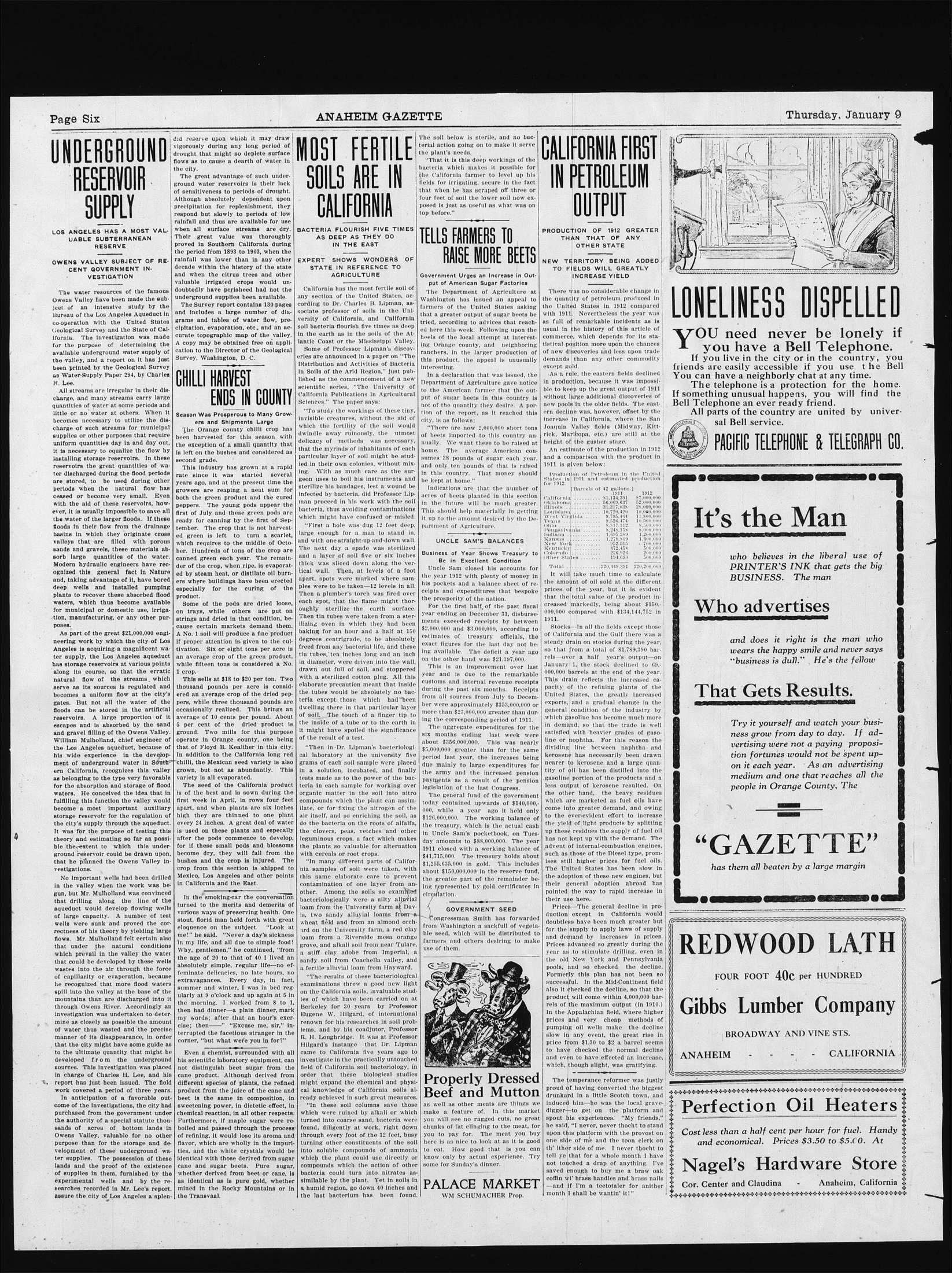
Searchable text
UNDERGROUND RESERVOIR SUPPLY
LOS ANGELES HAS A MOST VALUABLE SUBTERRANEAN RESERVE
OWENS VALLEY SUBJECT OF RECENT GOVERNMENT INVESTIGATION
The water resources of the famous Owens Valley have been made the subject of an intensive study by the Bureau of the Los Angeles Aqueduct in cooperation with the United States Geological Survey and the State of California. The investigation was made for the purpose of determining the available underground water supply of the valley, and a report on it has just been printed by the Geological Survey as Water-Supply Paper 294, by Charles H. Lee.
All streams are irregular in their discharge, and many streams carry large quantities of water at some periods and little or no water at others. When it becomes necessary to utilize the discharge of such streams for municipal supplies or other purposes that require uniform quantities day in and day out, it is necessary to equalize the flow by installing storage reservoirs. In these reservoirs the great quantities of water discharged during the flood periods did reserve upon which it may draw vigorously during any long period of drought that might so deplete surface flows as to cause a dearth of water in the city.
The great advantage of such underground water reservoirs is their lack of sensitiveness to periods of drought. Although absolutely dependent upon precipitation for replenishment, they respond but slowly to periods of low rainfall and thus are available for use when all surface streams are dry. Their great value was thoroughly proved in Southern California during the period from 1893 to 1903, when the rainfall was lower than in any other decade within the history of the state and when the citrus trees and other valuable irrigated crops would undoubtedly have perisheed had not the underground supplies been available.
The Survey report contains 130 pages and includes a large number of diagrams and tables of water flow, precipitation, evaporation, etc., and an accurate topographic map of the valley. A copy may be obtained free on application to the Director of the Geological Survey, Washington, D. C.
CHILLI HARVEST ENDS IN COUNTY
Season Was Prosperous to Many Growers and Shipments Large
The Orange county chilli crop has been harvested for this season with the exception of a small quantity that is left on the bushes and considered as second grade.
This industry has grown at a rapid rate since it was started several
All streams are irregular in their discharge, and many streams carry large quantities of water at some periods and little or no water at others. When it becomes necessary to utilize the discharge of such streams for municipal supplies or other purposes that require uniform quantities day in and day out, it is necessary to equalize the flow by installing storage reservoirs. In these reservoirs the great quantities of water discharged during the flood periods are stored, to be used during other periods when the natural flow has ceased or become very small. Even with the aid of these reservoirs, however, it is usually impossible to save all the water of the larger floods. If these floods in their flow from the drainage basins in which they originate cross valleys that are filled with porous sands and gravels, these materials absorb large quantities of the water. Modern hydraulic engineers have recognized this general fact in Nature and, taking advantage of it, have bored deep wells and installed pumping plants to recover these absorbed flood waters, which thus become available for municipal or domestic use, irrigation, manufacturing, or any other purposes.
As part of the great $21,000,000 engineering work by which the city of Los Angeles is acquiring a magnificent water supply, the Los Angeles aqueduct has storage reservoirs at various points along its course, so that the erratic natural flow of the streams which serve as its sources is regulated and becomes a uniform flow at the city's gates. But not all the water of the floods can be stored in the artificial reservoirs. A large proportion of it escapes and is absorbed by the sand and gravel filling of the Owens Valley. William Mulholland, chief engineer of the Los Angeles aqueduct, because of his wide experience in the development of underground water in Southern California, recognizes this valley as belonging to the type very favorable for the absorption and storage of flood waters. He conceived the idea that in fulfilling this function the valley would become a most important auxiliary storage reservoir for the regulation of the city's supply through the aqueduct. It was for the purpose of testing this theory and estimating so far as possible the extent to which this underground reservoir could be drawn upon, that he planned the Owens Valley investigations.
No important wells had been drilled in the valley when the work was begun, but Mr. Mulholland was convinced
CHILLI HARVEST ENDS IN COUNTY
Season Was Prosperous to Many Growers and Shipments Large
The Orange county chilli crop has been harvested for this season with the exception of a small quantity that is left on the bushes and considered as second grade.
This industry has grown at a rapid rate since it was started several years ago, and at the present time the growers are reaping a neat sum for both the green product and the cured peppers. The young pods appear the first of July and these green pods are ready for canning by the first of September. The crop that is not harvested green is left to turn a scarlet, which requires to the middle of October. Hundreds of tons of the crop are canned green each year. The remainder of the crop, when ripe, is evaporated by steam heat, or distilate oil burners where buildings have been erected especially for the curing of the product.
Some of the pods are dried loose, on trays, while others are put on strings and dried in that condition, because certain markets demand them. A No. 1 soil will produce a fine product if proper attention is given to the cultivation. Six or eight tons per acre is an average crop of the green product, while fifteen tons is considered a No. 1 crop.
This sells at $18 to $20 per ton. Two thousand pounds per acre is considered an average crop of the dried peppers, while three thousand pounds are occasionally realized. This brings an average of 10 cents per pound. About 5 per cent of the dried product is ground. Two mills for this purpose operate in Orange county, one being that of Floyd B. Kealiher in this city. In addition to the California long red chilli, the Mexican seed variety is also grown, but not as abundantly. This variety is all evaporated.
The seed of the California product is of the best and is sown during the first week in April, in rows four feet apart, and when plants are six inches high they are thinned to one plant every 24 inches. A great deal of water is used on these plants and especially after the pods commence to develop, for if these small pods and blossoms become dry, they will fall from the bushes and the crop is injured. The crop from this section is shipped to Mexico, Los Angeles and other points in California and the East.
In the smoking-car conversation
“To study the work invisible creatures, which the fertility dwindle away ruin delicacy of methods that the myriads of particular layer of particles lie in their own coiling. With as much geon uses to boil lily sterilize his bandage infected by bacteria man proceed in his bacteria, thus avoid which might have been “First a hole was large enough for water and with one straight The next day a sew and a layer of soils thick was sliced diagonal wall. Then, apart spots were placed were to be taken Then a plumber’s tape each spot, that touches sterilize them. Then tin tubes were illizing oven in which baking for an hour degrees centigrade freed from any back tin tubes, ten inch diameter, were drawn out full of with a sterilized cotton elaborate precaution the tubes would be teria except those dwelling there in to soil. The touch inside of a tube it might have spoiled of the result of a tear.”
“Then in Dr. Lical laboratory at grams of each soil in a solution, includes tests made as to teria in each sample organic matter in compounds which dilute, or for fixing air itself, and so do the bacteria on the clovers, peas, leguminous crops, plants so valuable with cereals or roots.”
“In many different samples of soil this same elaborate contamination of other. Among the bacteriologically
fulfilling this function the valley would become a most important auxiliary storage reservoir for the regulation of the city's supply through the aqueduct. It was for the purpose of testing this theory and estimating so far as possible the extent to which this underground reservoir could be drawn upon, that he planned the Owens Valley investigations.
No important wells had been drilled in the valley when the work was begun, but Mr. Mulholland was convinced that drilling along the line of the aqueduct would develop flowing wells of large capacity. A number of test wells were sunk and proved the correctness of his theory by yielding large flows. Mr. Mulholland felt certain also that under the natural conditions which prevail in the valley the water that could be developed by these wells wastes into the air through the force of capillarity or evaporation, because he recognized that more flood waters spill into the valley at the base of the mountains than are discharged into it through Owens River. Accordingly an investigation was undertaken to determine as closely as possible the amount of water thus wasted and the precise manner of its disappearance, in order that the city might have some guide as to the ultimate quantity that might be developed from the underground sources. This investigation was placed in charge of Charles H. Lee, and his report has just been issued. The field work covered a period of three years.
In anticipation of a favorable outcome of the investigations, the city had purchased from the government under the authority of a special statute thousands of acres of bottom lands in Owens Valley, valuable for no other purpose than for the storage and development of these underground water supplies. The possession of these lands and the proof of the existence of supplies in them, furnished by the experimental wells and by the researches recorded in Mr. Lee's report, assure the city of Los Angeles a splen-
first week in April, in rows four feet apart, and when plants are six inches high they are thinned to one plant every 24 inches. A great deal of water is used on these plants and especially after the pods commence to develop, for if these small pods and blossoms become dry, they will fall from the bushes and the crop is injured. The crop from this section is shipped to Mexico, Los Angeles and other points in California and the East.
In the smoking-car the conversation turned to the merits and demerits of various ways of preserving health. One stout, florid man held forth with great eloquence on the subject. "Look at me!" he said. "Never a day's sickness in my life, and all due to simple food! Why, gentlemen," he continued, "from the age of 20 to that of 40 I lived an absolutely simple, regular life—no effeminate delicacies, no late hours, no extravagances. Every day, in fact, summer and winter, I was in bed regularly at 9 o'clock and up again at 5 in the morning. I worked from 8 to 1, then had dinner—a plain dinner, mark my words; after that an hour's exercise; then——" "Excuse me, sir," interrupted the facetious stranger in the corner, "but what were you in for?"
Even a chemist, surrounded with all his scientific laboratory equipment, cannot distinguish beet sugar from the cane product. Although derived from different species of plants, the refined product from the juice of the cane and beet is the same in composition, in sweetening power, in dietetic effect, in chemical reaction, in all other respects. Furthermore, if maple sugar were reboiled and passed through the process of refining, it would lose its aroma and flavor, which are wholly in the impurities, and the white crystals would be identical with those derived from sugar cane and sugar beets. Pure sugar, whether derived from beet or cane, is as identical as is pure gold, whether mined in the Rocky Mountains or in the Transvaal.
In many different samples of soil this same elaborate contamination of other. Among the bacteriologically weak loam from the United States, two sandy alluvial wheat field and frond on the University loam from a Riversgrove, and alkali soil a stiff clay adobe sandy soil from Canyon a fertile alluvial loam.
"The results of our examinations three months ago on the California soils of which have Berkeley for 30 yrs Eugene W. Hilgard renown for his research lemmas, and by his R. H. Loughridge Hilgard's instance came to California investigate in the field of California order that these results might expand their real knowledge of soil ready achieved in so."
In these soil which were ruined turned into coarse found, diligently and through every foot turning other compounds which bacteria could turn similable by the plant compounds which
MOST FERTILE SOILS ARE IN CALIFORNIA
BACTERIA FLOURISH FIVE TIMES AS DEEP AS THEY DO IN THE EAST
EXPERT SHOWS WONDERS OF STATE IN REFERENCE TO AGRICULTURE
California has the most fertile soil of any section of the United States, according to Dr. Charles B. Lipman, associate professor of soils in the University of California, and California soil bacteria flourish five times as deep in the earth as in the soils of the Atlantic Coast or the Mississippi Valley.
Some of Professor Lipman's discoveries are announced in a paper on "The Distribution and Activities of Bacteria In Soils of the Arid Region," just published as the commencement of a new scientific series, "The University of California Publications in Agricultural Sciences." The paper says:
"To study the workings of these tiny, invisible creatures, without the aid of which the fertility of the soil would dwindle away ruinously, the utmost delicacy of methods was necessary, that the myriads of inhabitants of each particular layer of soil might be studied in their own colonies, without mixing. With as much care as the sur-"
The soil below is sterile, and no bacterial action going on to make it serve the plant's needs.
"That it is this deep workings of the bacteria which makes it possible for the California farmer to level up his fields for irrigating, secure in the fact that when he has scraped off three or four feet of soil the lower soil now exposed is just as useful as what was on top before."
TELLS FARMERS TO RAISE MORE BEETS
Government Urges an Increase in Output of American Sugar Factories
The Department of Agriculture at Washington has issued an appeal to farmers of the United States asking that a greater output of sugar beets be tried, according to advices that reached here this week. Following upon the heels of the local attempt at interesting Orange county, and neighboring ranchers, in the larger production of this product, the appeal is unusually interesting.
In a declaration that was issued, the Department of Agriculture gave notice to the American farmer that the output of sugar beets in this country is not of the quantity they desire. A portion of the report, as it reached this city, is as follows:
"There are now 2,000,000 short tons of beets imported to this country annually. We want these to be raised at home. The average American consumes 38 pounds of sugar each year, and only ten pounds of that is raised in this country. That money should"
CALIFORNIA FIRST IN PETROLEUM OUTPUT
PRODUCTION OF 1912 GREATER THAN THAT OF ANY OTHER STATE
NEW TERRITORY BEING ADDED TO FIELDS WILL GREATLY INCREASE YIELD
There was no considerable change in the quantity of petroleum produced in the United States in 1912 compared with 1911. Nevertheless the year was as full of remarkable incidents as is usual in the history of this article of commerce, which depends for its statistical position more upon the chances of new discoveries and less upon trade demands than any other commodity except gold.
As a rule, the eastern fields declined in production, because it was impossible to keep up the great output of 1911 without large additional discoveries of new pools in the older fields. The eastern decline was, however, offset by the increase in California, where the San Joaquin Valley fields (Midway, Kittrick, Maricopa, etc.) are still at the height of the gusher stage.
An estimate of the production in 1912 and a comparison with the product in 1911 is given below:
To study the workings of these tiny, invisible creatures, without the aid of which the fertility of the soil would dwindle away ruinously, the utmost delicacy of methods was necessary, that the myriads of inhabitants of each particular layer of soil might be studied in their own colonies, without mixing. With as much care as the surgeon uses to boil his instruments and sterilize his bandages, lest a wound be infected by bacteria, did Professor Lipman proceed in his work with the soil bacteria, thus avoiding contaminations which might have confused or misled.
"First a hole was dug 12 feet deep, large enough for a man to stand in, and with one straight-up-and-down wall. The next day a spade was sterilized and a layer of soil five or six inches thick was sliced down along the vertical wall. Then, at levels of a foot apart, spots were marked where samples were to be taken—12 levels in all. Then a plumber's torch was fired over each spot, that the flame might thoroughly sterilize the earth surface. Then tin tubes were taken from a sterilizing oven in which they had been baking for an hour and a half at 150 degrees centigrade, to be absolutely freed from any bacterial life, and these tin tubes, ten inches long and an inch in diameter, were driven into the wall, drawn out full of soil, and stoppered with a sterilized cotton plug. All this elaborate precaution meant that inside the tubes would be absolutely no bacteria except those which had been dwelling there in that particular layer of soil. The touch of a finger tip to the inside of a tube or to the earth in it might have spoiled the significance of the result of a test.
"Then in Dr. Lipman's bacteriological laboratory at the university five grams of each soil sample were placed in a solution, incubated, and finally tests made as to the power of the bacteria in each sample for working over organic matter in the soil into nitro compounds which the plant can assimilate, or for fixing the nitrogen of the air itself, and so enriching the soil, as do the bacteria on the roots of alfalfa, the clovers, peas, vetches and other leguminous crops, a fact which makes the plants so valuable for alternation with cereals or root crops.
"In many different parts of California samples of soil were taken, with this same elaborate care to prevent contamination of one layer from another. Among the soils so examined bacteriologically were a silty alluvial
In a declaration that was issued, the Department of Agriculture gave notice to the American farmer that the output of sugar beets in this country is not of the quantity they desire. A portion of the report, as it reached this city, is as follows:
"There are now 2,000,000 short tons of beets imported to this country annually. We want these to be raised at home. The average American consumes 38 pounds of sugar each year, and only ten pounds of that is raised in this country. That money should be kept at home."
Indications are that the number of acres of beets planted in this section in the future will be much greater. This should help materially in getting it up to the amount desired by the Department of Agriculture.
UNCLE SAM'S BALANCES
Business of Year Shows Treasury to Be in Excellent Condition
Uncle Sam closed his accounts for the year 1912 with plenty of money in his pockets and a balance sheet of receipts and expenditures that bespoke the prosperity of the nation.
For the first half of the past fiscal year ending on December 31, disbursements exceeded receipts by between $2,000,000 and $3,000,000, according to estimates of treasury officials, the exact figures for the last day not being available. The deficit a year ago on the other hand was $21,397,000.
This is an improvement over last year and is due to the remarkable customs and internal revenue receipts during the past six months. Receipts from all sources from July to December were approximately $353,000,000 or more than $23,000,000 greater than during the corresponding period of 1911.
The aggregate expenditures for the six months ending last week were about $356,000,000. This was nearly $5,000,000 greater than for the same period last year, the increases being due mainly to large expenditures for the army and the increased pension payments as a result of the pension legislation of the last Congress.
The general fund of the government today contained upwards of $140,000,000 while a year ago it held only $126,000,000. The working balance of the treasury, which is the actual cash in Uncle Sam's pocketbook, on Tuesday amounts to $88,000,000. The year 1911 closed with a working balance of $41,715,000. The treasury holds about $1,255,635,000 in gold. This includes about $150,000,000 in the reserve fund, the greater part of the remainder being represented by gold certificates in circulation.
As a rule, the eastern fields declined in production because it was impossible to keep up the great output of 1911 without large additional discoveries of new pools in the older fields. The eastern decline was, however, offset by the increase in California, where the San Joaquin Valley fields (Midway, Kittrick, Maricopa, etc.) are still at the height of the gusher stage.
An estimate of the production in 1912 and a comparison with the product in 1911 is given below:
Production of Petroleum in the United States in 1911 and estimated production for 1912.
[Barrels of 42 gallons.] 1911 1912
California 81,134,391 87,000,000
Oklahoma 56,609,637 52,000,000
Illinois 31,217,628 28,000,000
Louisiana 10,729,420 10,999,000
West Virginia 9,795,464 11,899,000
Texas 9,526,474 10,599,000
Ohio 8,817,112 8,599,000
Pennsylvania 8,248,158 8,000,000
Indiana 1,695,289 1,299,
Kansas 1,278,819 1,399,
New York 962,515 799,
Kentucky 472,458 509,
Colorado 226,926 209,
Other States 194,699 509,
Total 220,449,391 220,200,000
It will take much time to calculate the amount of oil sold at the different prices of the year but it is evident that the total value of the product increased markedly being about $150,-
ooo thousand compared with $134,144,752 in 1911.
Stocks—In all the fields except those of California and the Gulf there was a steady drain on stocks during the year so that from a total of $8,789,390 barrels—over a half year's output—on January 1,the stock declined to 69,-
ooo thousand barrels at the end of the year. This drain reflects the increased capacity of the refining plants of the United States,the greatly increased exports,and a gradual change in the general condition ofthe industryby which gasoline has become much more in demand,sо thatthe trade is well satisfied with heavier grades of gasoline or nophtha. For this reason dividing line between naphtha and kerosene has necessarily been drawn nearer to kerosene and a large quantityof oil has been distilled intothe gasoline portionoftheproductsanda lessoutputofkeroseneresulted.Ontheotherhand,theheavyresidueswhicharemarketedas fueloilhavesomeintergendemand,andowingtotheever-evidentefforttoincreaseythe yieldlightproductsbysplittinguptheresiduesthe supplyoffuelohassnotkeptupwiththedemand.Theadventofinternal-combustionengines.suchasthoseoftheDieseltype,promisesstillhigherpricesforfueloils.TheUnitedStateshasbeen slowinthe adoptionofthesenewengines,butthegeneraladoptionabroadhaspointedthewaytorapidincreasein theirusehere.
compounds which the plant can assimilate, or for fixing the nitrogen of the air itself, and so enriching the soil, as do the bacteria on the roots of alfalfa, the clovers, peas, vetches and other leguminous crops, a fact which makes the plants so valuable for alternation with cereals or root crops.
"In many different parts of California samples of soil were taken, with this same elaborate care to prevent contamination of one layer from another. Among the soils so examined bacteriologically were a silty alluvial loam from the University farm at Davis, two sandy alluvial loams from a wheat field and from an almond orchard on the University farm, a red clay loam from a Riverside mesa orange grove, and alkali soil from near Tulare, a stiff clay adobe from Imperial, a sandy soil from Coachella valley, and a fertile alluvial loam from Hayward.
"The results of these bacteriological examinations threw a good new light on the California soils, invaluable studies of which have been carried on at Berkeley for 30 years by Professor Eugene W. Hilgard, of international renown for his researches in soil problems, and by his coadjutor, Professor R. H. Loughridge. It was at Professor Hilgard's instance that Dr. Lipman came to California five years ago to investigate in the practically untouched field of California soil bacteriology, in order that these biological studies might expand the chemical and physical knowledge of California soils already achieved in such great measures.
"In these soil columns save those which were ruined by alkali or which turned into coarse sand, bacteria were found, diligently at work, right down through every foot of the 12 feet, busy turning other constituents of the soil into soluble compounds of ammonia which the plant could use directly or compounds which the action of other bacteria could turn into nitrates assimilable by the plant. Yet in soils in a humid region, go down 40 inches and the last bacterium has been found."
GOVERNMENT SEED
Congressman Smith has forwarded from Washington a sackfull of vegetable seed, which will be distributed to farmers and others desiring to make use of them.
Properly Dressed Beef and Mutton
as well as other meats are things we make a feature of. In this market you will see no ragged cuts, no great chunks of fat clinging to the meat, for you to pay for. The meat you buy here is as nice to look at as it is good to eat. How good that is you can know only by actual experience. Try some for Sunday's dinner.
PALACE MARKET
WM SCHUMACHER Prop.
Thursday, January 9
NIA FIRST
OLEUM
PUT
OF 1912 GREATER
AT OF ANY
R STATE
RY BEING ADDED
WILL GREATLY
USE YIELD
considerable change in
oilroleum produced in
is in 1912 compared
theless the year was
table incidents as is
ory of this article of
depends for its stamore upon the chances
and less upon trade
any other commodity
eastern fields declined
because it was impossigreat output of 1911
nitional discoveries of
older fields. The easthowever, offset by the
ornia, where the San
fields (Midway, Kitttc.) are still at the
other stage.
the production in 1912
with the product in
LONELINESS DISPELLED
YOU need never be lonely if you have a Bell Telephone.
If you live in the city or in the country, you friends are easily accessible if you use the Bell You can have a neighborly chat at any time.
The telephone is a protection for the home. If something unusual happens, you will find the Bell Telephone an ever ready friend.
All parts of the country are united by universal Bell service.
PACIFIC TELEPHONE & TELEGRAPH CO.
You can have a neighborly chat at any time.
The telephone is a protection for the home. If something unusual happens, you will find the Bell Telephone an ever ready friend.
All parts of the country are united by universal Bell service.
PACIFIC TELEPHONE & TELEGRAPH CO.
It’s the Man
who believes in the liberal use of PRINTER'S INK that gets the big BUSINESS. The man
Who advertises
and does it right is the man who wears the happy smile and never says “business is dull.” He’s the fellow
That Gets Results.
Try it yourself and watch your business grow from day to day. If advertising were not a paying proposition fortunes would not be spent upon it each year. As an advertising medium and one that reaches all the people in Orange County, The
“GAZETTE”
has them all beaten by a large margin
"GAZETTE"
has them all beaten by a large margin
REDWOOD LATH
FOUR FOOT 40c per HUNDRED
Gibbs Lumber Company
BROADWAY AND VINE STS.
ANAHEIM - CALIFORNIA
Perfection Oil Heaters
Cost less than a half cent per hour for fuel. Handy and economical. Prices $3.50 to $5.00. At
Nagel's Hardware Store
Cor. Center and Claudina - Anaheim, California