anaheim-gazette 1912-12-19
Scanned page
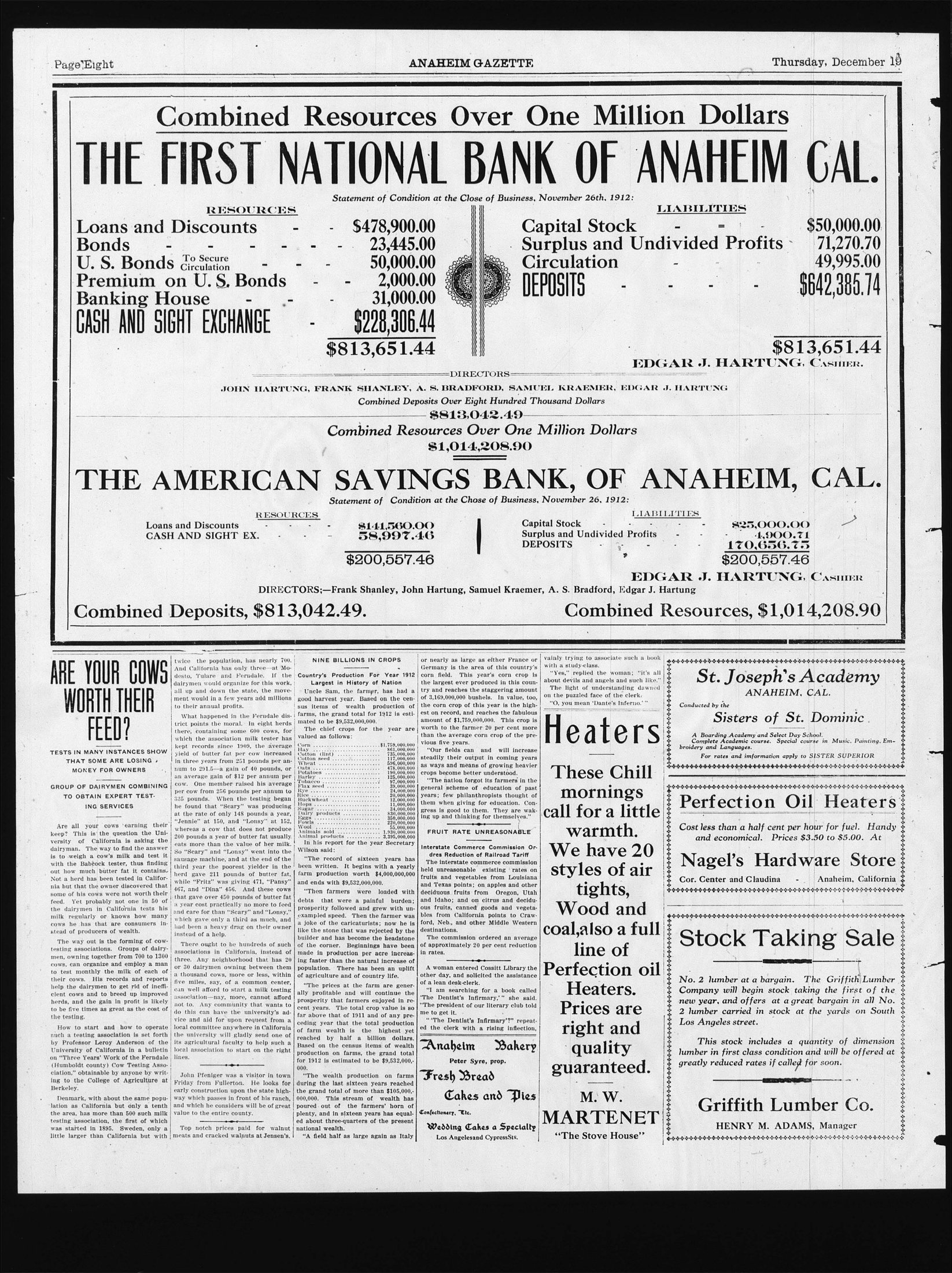
Searchable text
Combined Rese
THE FIRST NATI
RESOURCES
Loans and Discounts
Bonds
U. S. Bonds To Secure Circulation
Premium on U. S. Bonds
Banking House
CASH AND SIGHT EXCHANGE
$81
JOHN HARTUNG, FRANK
THE AMERICAN SALOON
RESOURCES
Loans and Discounts
CASH AND SIGHT EX.
DIRECTORS;—Frank
Combined Deposits, $813,042.49
ARE YOUR COWS WORTH THEIR FEED?
TESTS IN MANY INSTANCES SHOW THAT SOME ARE LOSING MONEY FOR OWNERS
GROUP OF DAIRYMEN COMBINING TO OBTAIN EXPERT TESTING SERVICES
Are all your cows earning their keep? This is the question the University of California is asking the dairyman. The way to find the answer is to weigh a cow's milk and test it with the Babcock tester, thus finding out how much butter fat it contains. Not a herd has been tested in California but that the owner discovered that some of his cows were not worth their twice the population, has nearly 700. And California has only three—at Modesto, Tulare and Ferndale. If the dairymen would organize for this work, all up and down the state, the movement would in a few years add millions to their annual profits.
What happened in the Ferndale district points the moral. In eight herds there, containing some 600 cows, for which the association milk tester has kept records since 1909, the average yield of butter fat per cow increased in three years from 251 pounds per annum to 291.5—a gain of 40 pounds, or an average gain of $12 per annum per cow. One member raised his average per cow from 256 pounds per annum to 325 pounds. When the testing began he found that "Scary" was producing at the rate of only 148 pounds a year, "Jennie" at 150, and "Lonsy" at 152, whereas a cow that does not produce 200 pounds a year of butter fat usually eats more than the value of her milk. So "Scary" and "Lonsy" went into the sausage machine, and at the end of the third year the poorest yielder in the herd gave 211 pounds of butter fat, while "Fritz" was giving 471, "Pansy" 467, and "Dina" 456. And these cows that gave over 450 pounds of butter fat twice the population, has nearly 700. And California has only three—at Modesto, Tulare and Ferndale. If the dairymen would organize for this work, all up and down the state, the movement would in a few years add millions to their annual profits.
What happened in the Ferndale district points the moral. In eight herds there, containing some 600 cows, for which the association milk tester has kept records since 1909, the average yield of butter fat per cow increased in three years from 251 pounds per annum to 291.5—a gain of 40 pounds, or an average gain of $12 per annum per cow. One member raised his average per cow from 256 pounds per annum to 325 pounds. When the testing began he found that "Scary" was producing at the rate of only 148 pounds a year, "Jennie" at 150, and "Lonsy" at 152, whereas a cow that does not produce 200 pounds a year of butter fat usually eats more than the value of her milk. So "Scary" and "Lonsy" went into the sausage machine, and at the end of the third year the poorest yielder in the herd gave 211 pounds of butter fat, while "Fritz" was giving 471, "Pansy" 467, and "Dina" 456. And these cows that gave over 450 pounds of butter fat twice the population, has nearly 700. And California has only three—at Modesto, Tulare and Ferndale. If the dairymen would organize for this work, all up and down the state, the movement would in a few years add millions to their annual profits.
What happened in the Ferndale district points the moral. In eight herds there, containing some 600 cows, for which the association milk tester has kept records since 1909, the average yield of butter fat per cow increased in three years from 251 pounds per annum to 291.5—a gain of 40 pounds, or an average gain of $12 per annum per cow. One member raised his average per cow from 256 pounds per annum to 325 pounds. When the testing began he found that "Scary" was producing at the rate of only 148 pounds a year, "Jennie" at 150, and "Lonsy" at 152, whereas a cow that does not produce 200 pounds a year of butter fat usually eats more than the value of her milk. So "Scary" and "Lonsy" went into the sausage machine, and at the end of the third year the poorest yielder in the herd gave 211 pounds of butter fat, while "Fritz" was giving 471, "Pansy" 467, and "Dina" 456. And these cows that gave over 450 pounds of butter fat twice the population, has nearly 700. And California has only three—at Modesto, Tulare and Ferndale. If the dairymen would organize for this work, all up and down the state, the movement would in a few years add millions to their annual profits.
What happened in the Ferndale district points the moral. In eight herds there, containing some 600 cows, for which the association milk tester has kept records since 1909, the average yield of butter fat per cow increased in three years from 251 pounds per annum to 291.5—a gain of 40 pounds, or an average gain of $12 per annum per cow. One member raised his average per cow from 256 pounds per annum to 325 pounds. When the testing began he found that "Scary" was producing at the rate of only 148 pounds a year, "Jennie" at 150, and "Lonsy" at 152, whereas a cow that does not produce 200 pounds a year of butter fat usually eats more than the value of her milk. So "Scary" and "Lonsy" went into the sausage machine, and at the end of the third year the poorest yielder in the herd gave 211 pounds of butter fat, while "Fritz" was giving 471, "Pansy" 467, and "Dina" 456. And these cows that gave over 450 pounds of butter fat twice the population, has nearly 700. And California has only three—at Modesto, Tulare and Ferndale. If the dairymen would organize for this work, all up and down the state, the movement would in a few years add millions to their annual profits.
What happened in the Ferndale district points the moral. In eight herds there, containing some 600 cows, for which the association milk tester has kept records since 1909, the average yield of butter fat per cow increased in three years from 251 pounds per annum to 291.5—a gain of 40 pounds, or an average gain of $12 per annum per cow. One member raised his average per cow from 256 pounds per annum to 325 pounds. When the testing began he found that "Scary" was producing at the rate of only 148 pounds a year, "Jennie" at 150, and "Lonsy" at 152, whereas a cow that does not produce 200 pounds a year of butter fat usually eats more than the value of her milk. So "Scary" and "Lonsy" went into the sausage machine, and at the end of the third year the poorest yielder in the herd gave 211 pounds of butter fat, while "Fritz" was giving 471, "Pansy" 467, and "Dina" 456. And these cows that gave over 450 pounds of butter fat twice the population, has nearly 700. And California has only three—at Modesto, Tulare and Ferndale. If the dairymen would organize for this work, all up and down the state, the movement would in a few years add millions to their annual profits.
What happened in the Ferndale district points the moral. In eight herds there, containing some 600 cows, for which the association milk tester has kept records since 1909, the average yield of butter fat per cow increased in three years from 251 pounds per annum to 291.5—a gain of 40 pounds, or an average gain of $12 per annum per cow. One member raised his average per cow from 256 pounds per annum to 325 pounds. When the testing began he found that "Scary" was producing at the rate of only 148 pounds a year, "Jennie" at 150, and "Lonsy" at 152, whereas a cow that does not produce 200 pounds a year of butter fat usually eats more than the value of her milk. So "Scary" and "Lonsy" went into the sausage machine, and at the end of the third year the poorest yielder in herd gave 211 pounds of butter fat, while "Fritz" was giving 471, "Pansy" 467, and "Dina" 456. And these cows that gave over 450 pounds of butter fat twice the population, has nearly
Are all your cows earning their keep? This is the question the University of California is asking the dairyman. The way to find the answer is to weigh a cow's milk and test it with the Babcock tester, thus finding out how much butter fat it contains. Not a herd has been tested in California but that the owner discovered that some of his cows were not worth their feed. Yet probably not one in 50 of the dairymen in California tests his milk regularly or knows how many cows he has that are consumers instead of producers of wealth.
The way out is the forming of cow-testing associations. Groups of dairymen, owning together from 700 to 1300 cows, can organize and employ a man to test monthly the milk of each of their cows. His records and reports help the dairymen to get rid of inefficient cows and to breed up improved herds, and the gain in profit is likely to be five times as great as the cost of the testing.
How to start and how to operate such a testing association is set forth by Professor Leroy Anderson of the University of California in a bulletin on "Three Years' Work of the Ferndale (Humboldt county) Cow Testing Association," obtainable by anyone by writing to the College of Agriculture at Berkeley.
Denmark, with about the same population as California but only a tenth the area, has more than 500 such milk testing association, the first of which was started in 1895. Sweden, only a little larger than California but with
When the testing began he found that "Scary" was producing at the rate of only 148 pounds a year, "Jennie" at 150, and "Lonsy" at 152, whereas a cow that does not produce 200 pounds a year of butter fat usually eats more than the value of her milk. So "Scary" and "Lonsy" went into the sausage machine, and at the end of the third year the poorest yielder in the herd gave 211 pounds of butter fat, while "Fritz" was giving 471, "Pansy" 467, and "Dina" 456. And these cows that gave over 450 pounds of butter fat a year cost practically no more to feed and care for than "Scary" and "Lonsy," which gave only a third as much, and had been a heavy drag on their owner instead of a help.
There ought to be hundreds of such associations in California, instead of three. Any neighborhood that has 20 or 30 dairymen owning between them a thousand cows, more or less, within five miles, say, of a common center, can well afford to start a milk testing association—nay, more, cannot afford not to. Any community that wants to do this can have the university's advice and aid for upon request from a local committee anywhere in California the university will gladly send one of its agricultural faculty to help such a local association to start on the right lines.
John Pfeniger was a visitor in town Friday from Fullerton. He looks for early construction upon the state highway which passes in front of his ranch, and which he considers will be of great value to the entire county.
Top notch prices paid for walnut meats and cracked walnuts at Jensen's.
ANAHEIM GAZETTE
Fund Resources Over One Million
NATIONAL BANK OF AN
Statement of Condition at the Close of Business, November 26th, 1912:
ES
$478,900.00
23,445.00
50,000.00
2,000.00
31,000.00
$228,306.44
$813,651.44
LI
Capital Stock
Surplus and Undi
Circulation
DEPOSITS
DIRECTORS
TUNG, FRANK SHANLEY, A. S. BRADFORD, SAMUEL KRAEMER, EDGAR J.
Combined Deposits Over Eight Hundred Thousand Dollars
$813,042.49
Combined Resources Over One Million Dollars
$1,014,208.90
TUNG, FRANK SHANLEY, A. S. BRADFORD, SAMUEL KRAEMER, EDGAR J.
Combined Deposits Over Eight Hundred Thousand Dollars
$813,042.49
Combined Resources Over One Million Dollars
$1,014,208.90
AN SAVINGS BANK, OF AN
Statement of Condition at the Chose of Business, November 26, 1912:
SOURCES
$141,560.00
58,997.46
$200,557.46
LIABILITIES
Capital Stock
Surplus and Undivided Profits
DEPOSITS
EDGAR
ECTORS;—Frank Shanley, John Hartung, Samuel Kraemer, A. S. Bradford, Edgar J. Han
13,042.49.
Combined R
NINE BILLIONS IN CROPS
Country's Production For Year 1912
Largest in History of Nation
Uncle Sam, the farmer, has had a good harvest year. Based on the census items of wealth production of farms, the grand total for 1912 is estimated to be $9,532,000,000.
The chief crops for the year are valued as follows:
Corn ... $1,759,000,000
Hay ... 861,000,000
Cotton (lint) ... 735,000,000
Cotton seed ... 117,000,000
Wheat ... 596,000,000
Oats ... 478,000,000
Potatoes ... 190,000,000
Barley ... 125,000,000
Tobacco ... 97,000,000
Flax seed ... 39,000,000
Rye ... 24,000,000
Rice ... 20,000,000
Buckwheat ... 12,000,000
Hops ... 11,000,000
Sugar ... 34,000,000
Dairy products ... 830,000,000
Eggs ... 350,000,000
Fowls ... 220,000,000
Wool ... 55,000,000
Animals sold ... 1,930,000,000
Animal products ... 3,395,555,555
In his report for the year Secretary Wilson said:
"The record of sixteen years has been written. It begins with a yearly farm production worth $4,4ooo,ooo and ends with $9,532,ooo,ooo."
"Then farmers were loaded with or nearly as large as either France or Germany is the area of this country's corn field. This year's corn crop is the largest ever produced in this country and reaches the staggering amount of 3,169,ooo,ooo bushels. In value, too,the corn crop of this year is the highest on record,and reaches the fabulous amount of $1,759,ooo,ooo. This crop is worth to the farmer 2o per cent more than the average corn crop of the previous five years.
'Our fields can and will increase steadily their output in coming years as ways and means of growing heavier crops become better understood.
'The nation forgot its farmers in the general scheme of education of past years; few philanthropists thought of them when giving for education. Congress is good to them. They are waking up and thinking for themselves.'"
FRUIT RATE UNREASONABLE
Interstate Commerce Commission Orders Reduction of Railroad Tariff
The interstate commerce commission held unreasonable existing rates on fruits and vegetables from Louisiana and Texas points; on apples and other deciduous fruits from Oregon, Utah and Idaho; and on citrus and deciduous fruit trees.
In his report for the year Secretary Wilson said:
"The record of sixteen years has been written. It begins with a yearly farm production worth $4,000,000,000 and ends with $9,532,000,000.
"Then farmers were loaded with debts that were a painful burden; prosperity followed and grew with unexampled speed. Then the farmer was a joke of the caricaturists; now he is like the stone that was rejected by the builder and has become the headstone of the corner. Beginnings have been made in production per acre increasing faster than the natural increase of population. There has been an uplift of agriculture and of country life.
"The prices at the farm are generally profitable and will continue the prosperity that farmers enjoyed in recent years. The total crop value is so far above that of 1911 and of any preceding year that the total production of farm wealth is the highest yet reached by half a billion dollars. Based on the census items of wealth production on farms, the grand total for 1912 is estimated to be $9,532,000,-000.
"The wealth production on farms during the last sixteen years reached the grand total of more than $105,000,-000,000. This stream of wealth has poured out of the farmers' horn of plenty, and in sixteen years has equaled about three-quarters of the present national wealth.
"A field half as large again as Italy"
FRUIT RATE UNREASONABLE
Interstate Commerce Commission Ordres Reduction of Railroad Tariff
The interstate commerce commission held unreasonable existing rates on fruits and vegetables from Louisiana and Texas points; on apples and other deciduous fruits from Oregon, Utah and Idaho; and on citrus and deciduous fruits, canned goods and vegetables from California points to Crawford, Neb., and other Middle Western destinations.
The commission ordered an average of approximately 20 per cent reduction in rates.
A woman entered Cossitt Library the other day, and solicited the assistance of a lean desk-clerk.
"I am searching for a book called 'The Dentist's Infirmary,'" she said.
"The president of our literary club told me to get it.
"'The Dentist's Infirmary?'" repeated the clerk with a rising inflection,
Anaheim Bakery
Peter Syre, prop.
Fresh Bread
Cakes and Pies
Confectionery, Etc.
Wedding Cakes a Specialty
Los Angelesand CypressSts.
call for a little warmth.
We have 20 styles of air tights,
Wood and coal, also a full line of Perfection oil Heaters.
Prices are right and quality guaranteed.
M. W.
MARTENET
"The Stove House"
Million Dollars
OF ANAHEIM CAL.
th, 1912:
LIABILITIES
Stock - = $50,000.00
and Undivided Profits 71,270.70
on - - - - 49,995.00
- - - - - $642,385.74
$813,651.44
EDGAR J. HARTUNG, CASHIER.
DER, EDGAR J. HARTUNG
Dollars
OF ANAHEIM, CAL.
5, 1912:
LIABILITIES
$25,000.00
4,900.71
170,656.75
$200,557.46
EDGAR J. HARTUNG, CASHIER
Ford, Edgar J. Hartung
combined Resources, $1,014,208.90
St. Joseph's Academy
ANAHEIM, CAL.
Conducted by the
Sisters of St. Dominic
A Boarding Academy and Select Day School.
Complete Academic course. Special course in Music, Painting, Embroidery and Languages.
For rates and information apply to SISTER SUPERIOR
Perfection Oil Heaters
Cost less than a half cent per hour for fuel. Handy and economical. Prices $3.50 to $5.00. At
Nagel's Hardware Store
Cor. Center and Claudina - Anaheim, California
Perfection Oil Heaters
Cost less than a half cent per hour for fuel. Handy and economical. Prices $3.50 to $5.00. At
Nagel’s Hardware Store
Cor. Center and Claudina - Anaheim, California
Stock Taking Sale
No. 2 lumber at a bargain. The Griffith Lumber Company will begin stock taking the first of the new year, and offers at a great bargain in all No. 2 lumber carried in stock at the yards on South Los Angeles street.
This stock includes a quantity of dimension lumber in first class condition and will be offered at greatly reduced rates if called for soon.
Griffith Lumber Co.
HENRY M. ADAMS, Manager