anaheim-gazette 1912-12-05
Scanned page
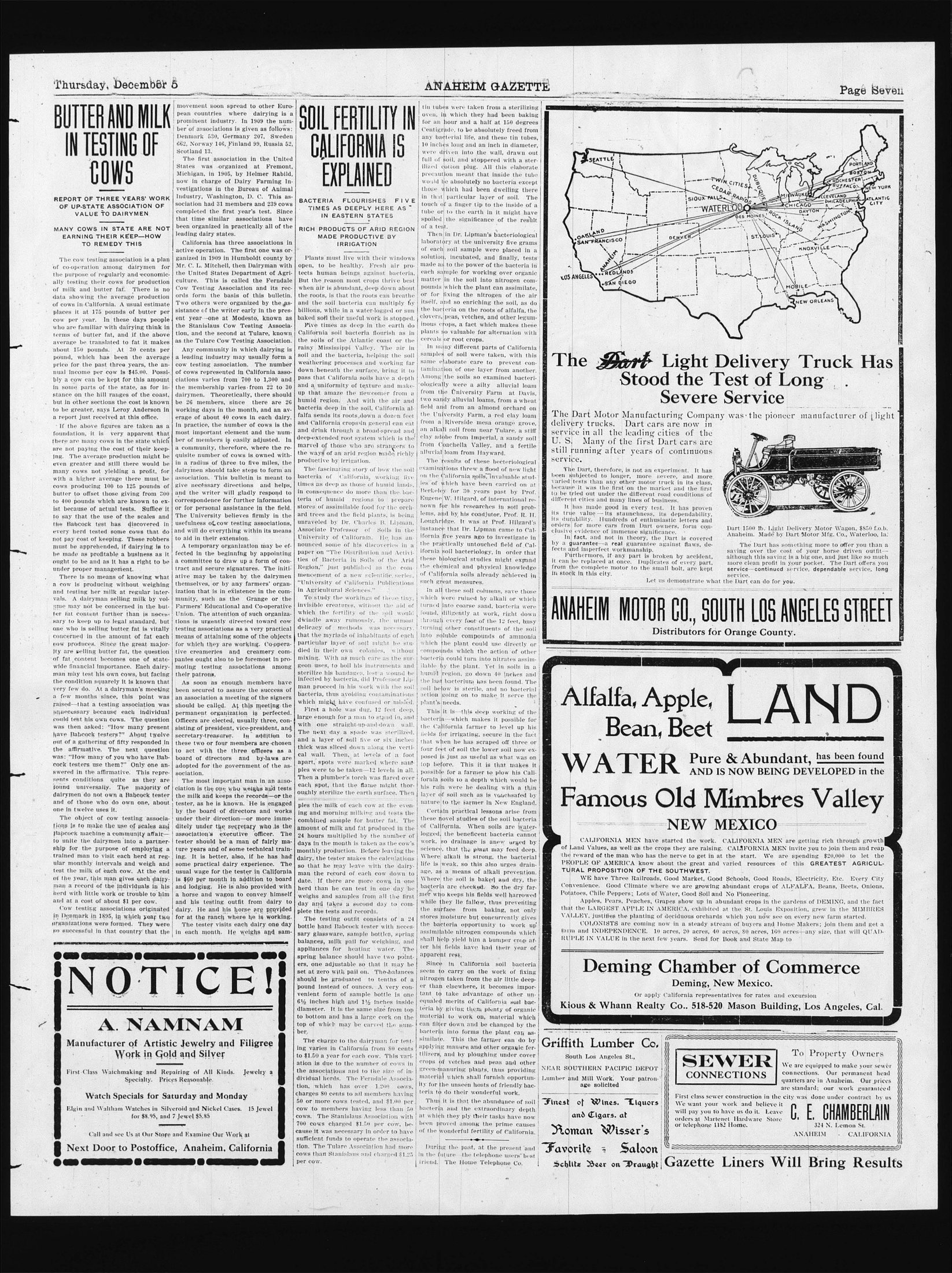
Searchable text
BUTTER AND MILK IN TESTING OF COWS
REPORT OF THREE YEARS' WORK OF UP-STATE ASSOCIATION OF VALUE TO DAIRYMEN
MANY COWS IN STATE ARE NOT EARNING THEIR KEEP—HOW TO REMEDY THIS
The cow testing association is a plan of co-operation among dairymen for the purpose of regularly and economically testing their cows for production of milk and butter fat. There is no data showing the average production of cows in California. A usual estimate places it at 175 pounds of butter per cow per year. In these days people who are familiar with dairying think in terms of butter fat, and if the above average be translated to fat it makes about 150 pounds. At 30 cents per pound, which has been the average price for the past three years, the annual income per cow is $45.00. Possibly a cow can be kept for this amount in some parts of the state, as for instance on the hill ranges of the coast, but in other sections the cost is known to be greater, says Leroy Anderson in a report just received at this office.
If the above figures are taken as a foundation, it is very apparent that there are many cows in the state which are not paying the cost of their keeping. The average production might be even greater and still there would be many cows not yielding a profit, for movement soon spread to other European countries where dairying is a prominent industry. In 1909 the number of associations is given as follows: Denmark 530, Germany 207, Sweden 662, Norway 146, Finland 99, Russia 52, Scotland 13.
The first association in the United States was organized at Fremont, Michigan, in 1905, by Helmer Rabild, now in charge of Dairy Farming Investigations in the Bureau of Animal Industry, Washington, D.C. This association had 31 members and 239 cows completed the first year's test. Since that time similar associations have been organized in practically all of the leading dairy states.
California has three associations in active operation. The first one was organized in 1909 in Humboldt county by Mr. C. L. Mitchell, then Dairyman with the United States Department of Agriculture. This is called the Ferndale Cow Testing Association and its records form the basis of this bulletin. Two others were organized by the assistance of the writer early in the present year—one at Modesto, known as the Stanislaus Cow Testing Association, and the second at Tulare, known as the Tulare Cow Testing Association.
Any community in which dairying is a leading industry may usually form a cow testing association. The number of cows represented in California associations varies from 700 to 1,300 and the membership varies from 22 to 30 dairymen. Theoretically, there should be 26 members, since there are 26 working days in the month, and an average of about 40 cows in each dairy. In practice, the number of cows is the most important element and the number of members is easily adjusted. In a community, therefore, where the requisite number of cows is owned within a radius of three to five miles, the dairymen should take steps to form an
a cow can be kept for this amount in some parts of the state, as for instance on the hill ranges of the coast, but in other sections the cost is known to be greater, says Leroy Anderson in a report just received at this office.
If the above figures are taken as a foundation, it is very apparent that there are many cows in the state which are not paying the cost of their keeping. The average production might be even greater and still there would be many cows not yielding a profit, for with a higher average there must be cows producing 100 to 125 pounds of butter to offset those giving from 300 to 400 pounds which are known to exist because of actual tests. Suffice it to say that the use of the scales and the Babcock test has discovered in every herd tested some cows that do not pay cost of keeping. These robbers must be apprehended, if dairying is to be made as profitable a business as it ought to be and as it has a right to be under proper management.
There is no means of knowing what a cow is producing without weighing and testing her milk at regular intervals. A dairyman selling milk by volume may not be concerned in the butter fat content further than is necessary to keep up to legal standard, but one who is selling butter fat is vitally concerned in the amount of fat each cow produces. Since the great majority are selling butter fat, the question of fat content becomes one of state-wide financial importance. Each dairyman may test his own cows, but facing the condition squarely it is known that very few do. At a dairyman's meeting a few months since, this point was raised—that a testing association was unnecessary because each individual could test his own cows. The question was then asked: "How many present have Babcock testers?" About twelve out of a gathering of fifty responded in the affirmative. The next question was: "How many of you who have Babcock testers use them?" Only one answered in the affirmative. This represents conditions quite as they are found universally. The majority of dairymen do not own a Babcock tester and of those who do own one, about one in twelve uses it.
The object of cow testing associations is to make the use of scales and Babcock machine a community affair—to unite the dairymen into a partnership for the purpose of employing a trained man to visit each herd at regular monthly intervals and weigh and test the milk of each cow. At the end of the year, this man gives each dairyman a record of the individuals in his herd with little work or trouble to him or co-workers in California associations varies from 700 to 1,300 and the membership varies from 22 to 30 dairymen. Theoretically, there should be 26 members, since there are 26 working days in the month, and an average of about 40 cows in each dairy. In practice, the number of cows is the most important element and the number of members is easily adjusted. In a community, therefore, where the requisite number of cows is owned within a radius of three to five miles, the dairymen should take steps to form an association. This bulletin is meant to give necessary directions and helps, and the writer will gladly respond to correspondence for further information or for personal assistance in the field. The University believes firmly in the usefulness of cow testing associations, and will do everything within its means to aid in their extension.
A temporary organization may be effected in the beginning by appointing a committee to draw up a form of contract and secure signatures. The initiative may be taken by the dairymen themselves, or by any farmers' organization that is in existence in the community, such as the Grange or the Farmers' Educational and Co-operative Union. The attention of such organizations is urgently directed toward cow testing associations as a very practical means of attaining some of the objects for which they are working. Co-operative creameries and creamery companies ought also to be foremost in promoting testing associations among their patrons.
As soon as enough members have been secured to assure the success of an association a meeting of the signers should be called. At this meeting the permanent organization is perfected. Officers are elected, usually three, consisting of president, vice-president, and secretary-treasurer. In addition to these two or four members are chosen to act with the three officers as a board of directors and by laws are adopted for the government of the association.
The most important man in an association is the one who weighs and tests the milk and keeps the records—or the tester, as he is known. He is engaged by the board of directors and works under their direction—or more immediately under the secretary who is the association's executive officer. The tester should be a man of fairly mature years and of some technical training. It is better, also, if he has had some practical dairy experience. The usual wage for the tester in California is $60 per month in addition to board and lodging. He is also provided with a horse and wagon to convey himself pass that California and a uniformity owe up that amaze them humid region. An bacteria deep in the falfa sends its roots and California crops and drink through deep-extended root marvel of those with the ways of an arid productive by irrigation.
The fascinating science of bacteria of California times as deep as that in consequence does teria of humid re-stores of assimilable hard trees and the first unraveled by Dr. C. Associate Professor University of California announced some of his paper on "The Distincties of Bacteria in Region," just published commencement of a new "University of California in Agricultural Science.
To study the work invisible creatures, which the fertility dwindle away ruins delicacy of methods that the myriads of particular layer of dried in their own mixing. With as many geon uses, to boil listerize his bandage infected by bacteria man proceed in his bacteria, thus avoid which might have
First a hole was large enough for a man with one straight The next day a spat and a layer of solid thick was sliced downal wall. Then, an apart spots were nples were to be taken Then a plumber's tool each spot, that theyoughly sterilize therples the milk of eating and morning mcombined sample for amount of milk and 24 hours multiplied days in the month i monthly production dairy, the tester may so that he may leaveman the record off date. If there are herd than he can weighs and samples
and of those who do own one, about one in twelve uses it.
The object of cow testing associations is to make the use of scales and Papcock machine a community affair—to unite the dairymen into a partnership for the purpose of employing a trained man to visit each herd at regular monthly intervals and weigh and test the milk of each cow. At the end of the year, this man gives each dairyman a record of the individuals in his herd with little work or trouble to him and at a cost of about $1 per cow.
Cow testing associations originated in Denmark in 1895, in which year two organizations were formed. They were so successful in that country that the tester, as he is known. He is engaged by the board of directors and works under their direction—or more immediately under the secretary who is the association's executive officer. The tester should be a man of fairly mature years and of some technical training. It is better, also, if he has had some practical dairy experience. The usual wage for the tester in California is $60 per month in addition to board and lodging. He is also provided with a horse and wagon to convey himself and his testing outfit from dairy to dairy. He and his horse are provided for at the ranch where he is working.
The tester visits each dairy one day in each month. He weighs and sam-
NOTICE!
A. NAMNAM
Manufacturer of Artistic Jewelry and Filligree Work in Gold and Silver
First Class Watchmaking and Repairing of All Kinds. Jewelry a Specialty. Prices Reasonable.
Watch Specials for Saturday and Monday
Elgin and Waltham Watches in Silveroid and Nickel Cases. 15 Jewel for $8.95, and 7 Jewel $5.85
Call and see Us at Our Store and Examine Our Work at
Next Door to Postoffice, Anaheim, California
SOIL FERTILITY IN CALIFORNIA IS EXPLAINED
BACTERIA FLOURISHES FIVE TIMES AS DEEPLY HERE AS IN EASTERN STATES
RICH PRODUCTS OF ARID REGION MADE PRODUCTIVE BY IRRIGATION
Plants must live with their windows open, to be healthy. Fresh air protects human beings against bacteria. But the reason most crops thrive best when air is abundant, deep down about the roots, is that the roots can breathe and the soil bacteria can multiply by billions, while in a water-logged or sun baked soil their useful work is stopped.
Five times as deep in the earth do California soil bacteria flourish as in the soils of the Atlantic coast or the rainy Mississippi Valley. The air in soil and the bacteria, helping the soil weathering processes and working far down beneath the surface, bring it to pass that California soils have a depth and a uniformity of texture and make up that amaze the newcomer from a humid region. And with the air and bacteria deep in the soil, California alfalfa sends its roots down a dozen feet and California crops in general can eat and drink through a broad-spread and deep-extended root system which is the marvel of those who are strangers to the ways of an arid region made richly productive by irrigation.
The fascinating story of how the soil tin tubes were taken from a sterilizing oven, in which they had been baking for an hour and a half at 150 degrees Centigrade, to be absolutely freed from any bacterial life, and these tin tubes, 10 inches long and an inch in diameter, were driven into the wall, drawn out full of soil, and stoppered with a sterilized cotton plug. All this elaborate precaution meant that inside the tube would be absolutely no bacteria except those which had been dwelling there in that particular layer of soil. The touch of a finger tip to the inside of a tube or to the earth in it might have spoiled the significance of the result of a test.
Then in Dr. Lipman's bacteriological laboratory at the university five grams of each soil sample were placed in a solution, incubated, and finally, tests made as to the power of the bacteria in each sample for working over organic matter in the soil into nitrogen compounds which the plant can assimilate, or for fixing the nitrogen of the air itself, and so enriching the soil, as do the bacteria on the roots of alfalfa, the clovers, peas, vetches, and other leguminous crops, a fact which makes these plants so valuable for alternation with cereals or root crops.
In many different parts of California samples of soil were taken, with this same elaborate care to prevent contamination of one layer from another. Among the soils so examined bacteriologically were a silty alluvial loam from the University Farm at Davis, two sandy alluvial loams, from a wheat field and from an almond orchard on the University Farm, a red clay loam from a Riverside mesa orange grove, an alkali soil from near Tulare, a stiff clay adobe from Imperial, a sandy soil from Coachella Valley, and a fertile alluvial loam from Hayward.
The results of these bacteriological examinations threw a flood of new light on the California landscape.
pass that California soils have a depth and a uniformity of texture and make-up that amaze the newcomer from a humid region. And with the air and bacteria deep in the soil, California alfalfa sends its roots down a dozen feet and California crops in general can eat and drink through a broad-spread and deep-extended root system which is the marvel of those who are strangers to the ways of an arid region made richly productive by irrigation.
The fascinating story of how the soil bacteria of California, working five times as deep as those of humid lands, in consequence do more than the bacteria of humid regions to prepare stores of assimilable food for the orchard trees and the field plants, is being unraveled by Dr. Charles B. Lipman, Associate Professor of Soils in the University of California. He has announced some of his discoveries in a paper on "The Distribution and Activities of Bacteria in Soils of the Arid Region," just published as the commencement of a new scientific series, "University of California Publications in Agricultural Sciences."
To study the workings of these tiny, invisible creatures, without the aid of which the fertility of the soil would dwindle away ruinously, the utmost delicacy of methods was necessary, that the myriads of inhabitants of each particular layer of soil might be studied in their own colonies, without mixing. With as much care as the surgeon uses, to boil his instruments and sterilize his bandages, lest a wound be infected by bacteria, did Professor Lipman proceed in his work with the soil bacteria, thus avoiding contaminations which might have confused or misled.
First a hole was dug, 12 feet deep, large enough for a man to stand in, and with one straight-up-and-down wall. The next day a spade was sterilized, and a layer of soil five or six inches thick was sliced down along the vertical wall. Then, at levels of a foot apart, spots were marked where samples were to be taken—12 levels in all. Then a plumber's torch was flared over each spot, that the flame might thoroughly sterilize the earth surface. Thenples the milk of each cow at the evening and morning milking and tests the combined sample for butter fat. The amount of milk and fat produced in the 24 hours multiplied by the number of days in the month is taken as the cow's monthly production. Before leaving the dairy, the tester makes the calculations so that he may leave with the dairy-man the record of each cow down to date. If there are more cows in one herd than he can test in one day he weighs and samples from all the first
Among the soils so examined bacteriologically were a silty alluvial loam from the University Farm at Davis, two sandy alluvial loams, from a wheat field and from an almond orchard on the University Farm, a red clay loam from a Riverside mesa orange grove, an alkali soil from near Tulare, a stiff clay adobe from Imperial, a sandy soil from Coachella Valley, and a fertile alluvial loam from Hayward.
The results of these bacteriological examinations threw a flood of new light on the California soils, invaluable studies of which have been carried on at Berkeley for 30 years past by Prof. Eugene W. Hilgard, of international renown for his researches in soil problems, and by his coadjutor, Prof. R. H. Loughridge. It was at Prof. Hilgard's instance that Dr. Lipman came to California five years ago to investigate in the practically untouched field of California soil bacteriology, in order that these biological studies might expand the chemical and physical knowledge of California soils already achieved in such great measures.
In all these soil columns, save those which were ruined by alkali or which turned into coarse sand, bacteria were found, diligently at work, right down through every foot of the 12 feet, busy turning other constituents of the soil into soluble compounds of ammonia which the plant could use directly or compounds which the action of other bacteria could turn into nitrates assimilable by the plant. Yet in soils in a humid region, go down 40 inches and the last bacterium has been found. The soil below is sterile, and no bacterial action going on to make it serve the plant's needs.
This it is—this deep working of the bacteria—which makes it possible for the California farmer to level up his fields for irrigating, secure in the fact that when he has scraped off three or four feet of soil the lower soil now exposed is just as useful as what was on top before. This it is that makes it possible for a farmer to plow his California soils to a depth which would be his rain were he dealing with a thin layer of soil such as is vouchsafed by nature to the farmer in New England.
Certain practical lessons arise from these novel studies of the soil bacteria of California. When soils are waterlogged, the beneficent bacteria cannot work, so drainage is anew urged by science, that the plant may feed deep. Where alkali is strong, the bacterial life is weak, so this also urges drainage, as a means of alkali prevention. Where the soil is baked and dry, the bacteria are checked. So the dry farmer who keeps his fields well harrowed
plies the milk of each cow at the evening and morning milking and tests the combined sample for butter fat. The amount of milk and fat produced in the 24 hours multiplied by the number of days in the month is taken as the cow's monthly production. Before leaving the dairy, the tester makes the calculations so that he may leave with the dairy-man the record of each cow down to date. If there are more cows in one herd than he can test in one day he weighs and samples from all the first day and takes a second day to complete the tests and records.
The testing outfit consists of a 24 bottle hand Babcock tester with necessary glassware, sample bottles, spring balances, milk pail for weighing, and appliances for heating water. The spring balance should have two pointers, one adjustable so that it may be set at zero with pail on. The balances should be graduated to tenths of a pound instead of ounces. A very convenient form of sample bottle is one 6½ inches high and 1½ inches inside diameter. It is the same size from top to bottom and has a large cork on the top of which may be carved the number.
The charge to the dairyman for testing varies in California from 80 cents to $1.50 a year for each cow. This variation is due to the number of cows in the associations and to the size of individual herds. The Ferndale Association, which has over 1,200 cows, charges 80 cents to all members having 50 or more cows tested, and $1.00 per cow to members having less than 50 cows. The Stanislaus Association with 700 cows charged $1.50 per cow, because it was necessary in order to have sufficient funds to operate the association. The Tulare Association had more cows than Stanislaus and charged $1.25 per cow.
Certain practical lessons arise from these novel studies of the soil bacteria of California. When soils are water-logged, the beneficial bacteria cannot work, so drainage is anew urged by science, that the plant may feed deep. Where alkali is strong, the bacterial life is weak, so this also urges drainage, as a means of alkali prevention. Where the soil is baked and dry, the bacteria are checked. So the dry farmer who keeps his fields well harrowed while they lie fallow, thus preventing the surface from baking, not only stores moisture but concurrently gives the bacteria opportunity to work up assimilable nitrogen compounds which shall help yield him a bumper crop after his fields have had their year of apparent rest.
Since in California soil bacteria seem to carry on the work of fixing nitrogen taken from the air little deeper than elsewhere, it becomes important to take advantage of other unequaled merits of California soil bacteria by giving them plenty of organic material to work on, material which can filter down and be changed by the bacteria into forms the plant can assimilate. This the farmer can do by applying manure and other organic fertilizers, and by ploughing under cover crops of vetches and peas and other green-manuring plants, thus providing material which shall furnish opportunity for the unseen hosts of friendly bacteria to do their wonderful work.
Thus it is that the abundance of soil bacteria and the extraordinary depth at which they ply their tasks have now been proved among the prime causes of the wonderful fertility of California.
During the past, at the present and in the future—the telephone users' best friend. The Home Telephone Co.
Dart Light Delivery Truck Has
Stood the Test of Long
Severe Service
Motor Manufacturing Company was the pioneer manufacturer of light
trucks. Dart cars are now in
all the leading cities of the
city of the first Dart cars are
g after years of continuous
Stood the Test of Long
Severe Service
Motor Manufacturing Company was the pioneer manufacturer of light
trucks. Dart cars are now in
all the leading cities of the
city of the first Dart cars are
going after years of continuous
therefore, is not an experiment. It has
to longer, more severe, and more
an any other motor truck in its class,
the first on the market and the first
under the different road conditions of
and many lines of business.
Dart good in every test. It has proven
—its staunchness, its dependability,
Hundreds of enthusiastic letters and
cars from Dart owners, form confidence of immense significance.
Did not in theory, the Dart is covered
—a real guarantee against flaws, defect workmanship.
Are, if any part is broken by accident,
reced at once. Duplicates of every part,
delete motor to the small bolt, are kept
city.
Dart 1500 lb. Light Delivery Motor Wagon, $850 f.o.b.
Anaheim. Made by Dart Motor Mfg. Co., Waterloo, la:
The Dart has something more to offer you than a saving over the cost of your horse driven outfit—although this saving is a big one, and just like so much more clean profit in your pocket. The Dart offers you service—continued service, dependable service, long service.
Let us demonstrate what the Dart can do for you.
MOTOR CO., SOUTH LOS ANGELES STREET
Distributors for Orange County.
alfa, Apple,
Bean, Beet
ATER Pure & Abundant, has been found
AND IS NOW BEING DEVELOPED in the
amous Old Mimbres Valley
NEW MEXICO
FORNIA MEN have started the work. CALIFORNIA MEN are getting rich through growth
ques, as well as the crops they are raising. CALIFORNIA MEN invite you to join them and reap
of the man who has the nerve to get in at the start. We are spending $20,000 to let the
FAMERICA know about the great and varied resources of this GREATEST AGRICULPOSITION OF THE SOUTHWEST.
have Three Railroads, Good Market, Good Schools, Good Roads, Electricity, Etc. Every City
e. Good Climate where we are growing abundant crops of ALFALFA, Beans, Beets, Onions,
file Peppers; Lots of Water, Good Soil and No Pioneering.
CALIFORNIA MEN have started the work. CALIFORNIA MEN are getting rich through growth
quies, as well as the crops they are raising. CALIFORNIA MEN invite you to join them and reap
of the man who has the nerve to get in at the start. We are spending $20,000 to let the
AMERICA know about the great and varied resources of this GREATEST AGRICULPOSITION OF THE SOUTHWEST.
Have Three Railroads, Good Market, Good Schools, Good Roads, Electricity, Etc. Every City
e. Good Climate where we are growing abundant crops of ALFALFA, Beans, Beets, Onions,
Mile Peppers; Lots of Water, Good Soil and No Pioneering.
Ges, Pears, Peaches, Grapes show up in abundant crops in the gardens of DEMING, and the fact
LARGEST APPLE IN AMERICA, exhibited at the St. Louis Exposition, grew in the MIMBRES
justifies the planting of deciduous orchards which you now see on every new farm started.
DONISTS are coming now in a steady stream of buyers and Home Makers; join them and get a
INDEPENDENCE. 10 acres, 20 acres, 40 acres, 80 acres, 160 acres—any size, that will QUADVALUE in the next few years. Send for Book and State Map to
Deming Chamber of Commerce
Deming, New Mexico.
Or apply California representatives for rates and excursion
Whann Realty Co.. 518-520 Mason Building, Los Angeles, Cal.
SEWER CONNECTIONS
To Property Owners
We are equipped to make your sewer connections. Our permanent head
quarters are in Anaheim. Our prices are standard; our work guaranteed
First class sewer construction in the city was done under contract by us
We want your work and believe it will pay you to have us do it. Leave
orders at Martenet Hardware Store or telephone 1182 Home.
C. E. CHAMBERLAIN
324 N. Lemon St.
ANAHEIM - CALIFORNIA
Gazette Liners Will Bring Results