anaheim-gazette 1912-08-22
Scanned page
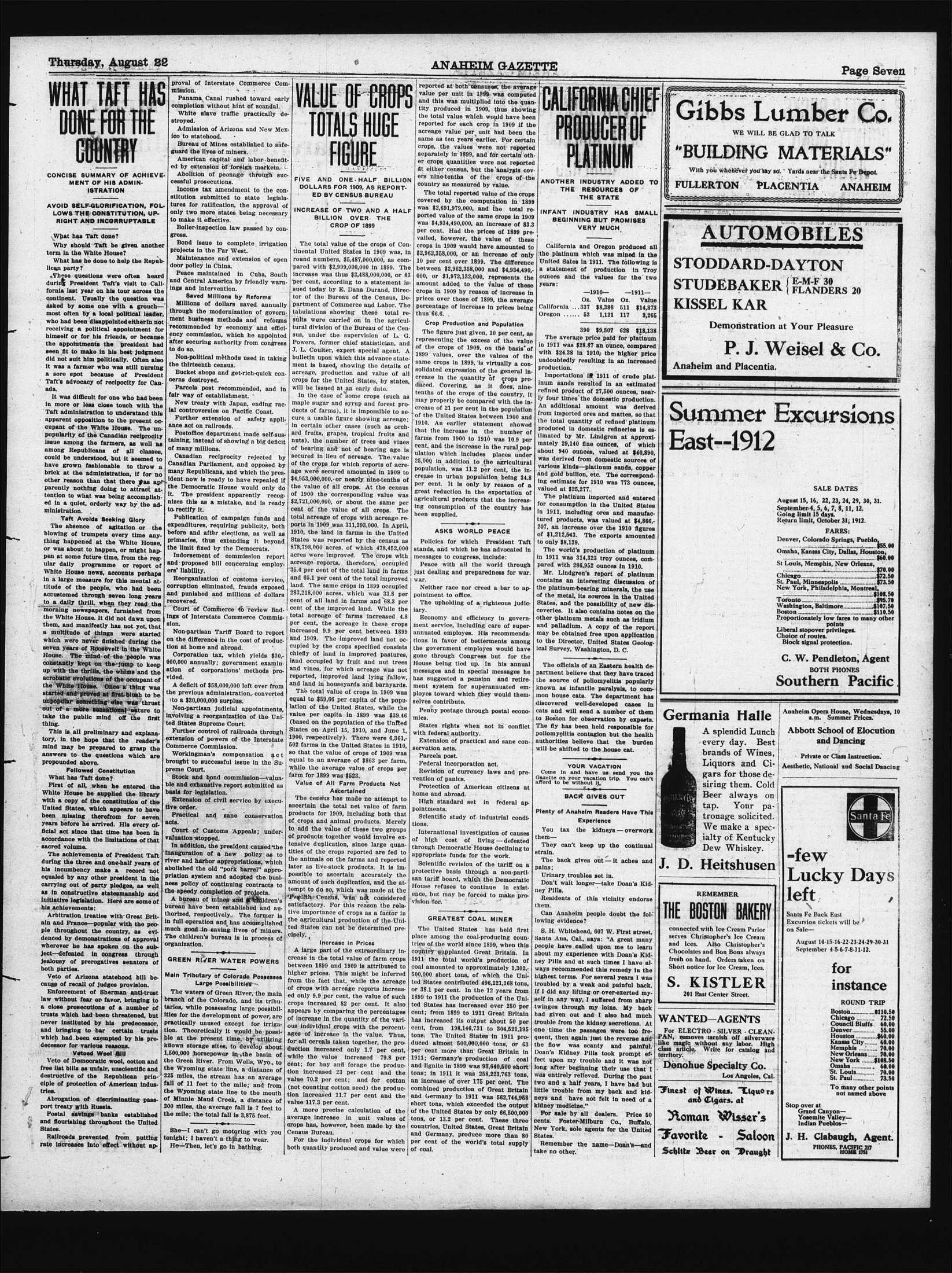
Searchable text
WHAT TAFT HAS DONE FOR THE COUNTRY
CONCISE SUMMARY OF ACHIEVEMENT OF HIS ADMINISTRATION
AVOID SELF-GLORIFICATION, FOLLOWS THE CONSTITUTION, UP-RIGHT AND INCORRUPTABLE
What has Taft done?
Why should Taft be given another term in the White House?
What has he done to help the Republican party?
These questions were often heard during President Taft's visit to California last year on his tour across the continent. Usually the question was asked by some one with a grouch—most often by a local political leader, who had been disappointed either in not receiving a political appointment for himself or for his friends, or because the appointments the president had seen fit to make in his best judgment did not suit him politically. Often also it was a farmer who was still nursing a sore spot because of President Taft's advocacy of reciprocity for Canada.
It was difficult for one who had been in more or less close touch with the Taft administration to understand this apparent opposition to the present occupant of the White House. The unpopularity of the Canadian reciprocity issue among the farmers, as well as among Republicans of all classes, could be understood, but it seemed to have grown fashionable to throw a brick at the administration, if for no proval of Interstate Commerce Commission.
Panama Canal rushed toward early completion without hint of scandal.
White slave traffic practically destroyed.
Admission of Arizona and New Mexico to statehood.
Bureau of Mines established to safeguard the lives of miners.
American capital and labor benefited by extension of foreign markets.
Abolition of peonage through successful prosecutions.
Income tax amendment to the constitution submitted to state legislatures for ratification, the approval of only two more states being necessary to make it effective.
Boiler-inspection law passed by congress.
Bond issue to complete irrigation projects in the Far West.
Maintenance and extension of open door policy in China.
Peace maintained in Cuba, South and Central America by friendly warnings and intervention.
Saved Millions by Reforms
Millions of dollars saved annually through the modernization of government business methods and reforms recommended by economy and efficiency commission, which he appointed after securing authority from congress to do so.
Non-political methods used in taking the thirteenth census.
Bucket shops and get-rich-quick concerns destroyed.
Parcels post recommended, and in fair way of establishment.
New treaty with Japan, ending racial controversies on Pacific Coast.
Further extension of safety appliance act on railroads.
Postoffice department made self-sustaining, instead of showing a big deficit of many millions.
Canadian reciprocity rejected by Canadian Parliament, and opposed by many Republicans, and which the pres-
The total value of tinental United States round numbers, $5,489 pared with $2,999,000 increase was thus $2 per cent, according sued today by E. Davis. Director of the Bureau of Department of Commerce tabulations showing salts were carried out natural division of the US sus, under the super Powers, former chief J. L. Coulter, expert bulletin upon which the ment is based, shows acreage, production crops for the United will be issued at an age were secured amm
It was difficult for one who had been in more or less close touch with the Taft administration to understand this apparent opposition to the present occupant of the White House. The unpopularity of the Canadian reciprocity issue among the farmers, as well as among Republicans of all classes, could be understood, but it seemed to have grown fashionable to throw a brick at the administration, if for no other reason than that there was apparently nothing doing to attract attention to what was being accomplished in a quiet, orderly way by the administration.
Taft Avoids Seeking Glory
The absence of agitation or the blowing of trumpets every time anything happened at the White House, or was about to happen, or might happen at some future time, from the regular daily programme or report of White House news, accounts perhaps in a large measure for this mental attitude of the people, who had been accustomed through seven long years to a daily thrill, when they read the morning newspapers, furnished from the White House. It did not dawn upon them, and manifestly has not yet, that a multitude of things were started which were never finished during the seven years of Roosevelt in the White House. The mind of the people was constantly kept on the jump to keep up with the thrills, the whims and the acrobatic evolutions of the occupant of the White House. Once a thing was started and proved at first blush to be unpopular something else was thrust out of a more sensational nature to take the public mind off the first thing.
This is all preliminary and explanatory, in the hope that the reader's mind may be prepared to grasp the answers to the questions which are propounded above.
Followed Constitution
What has Taft done?
First of all, when he entered the White House he supplied the library with a copy of the constitution of the United States, which appears to have been missing therefrom for seven years before he arrived. His every official act since that time has been in accordance with the limitations of that sacred volume.
The achievements of President Taft during the three and one-half years of his incumbency make a record not equaled by any other president in the carrying out of party pledges, as well as in constructive statesmanship and initiative legislation.
Parcels post recommended, and in fair way of establishment.
New treaty with Japan, ending racial controversies on Pacific Coast.
Further extension of safety appliance act on railroads.
Postoffice department made self-sustaining, instead of showing a big deficit of many millions.
Canadian reciprocity rejected by Canadian Parliament, and opposed by many Republicans, and which the president now is ready to have repealed if the Democratic House would only do it. The president apparently recognizes this as a mistake, and is ready to rectify it.
Publication of campaign funds and expenditures, requiring publicity, both before and after elections, as well as primaries, thus extending it beyond the limit fixed by the Democrats.
Indorsement of commission report and proposed bill concerning employers' liability.
Reorganization of customs service, corruption eliminated, frauds exposed and punished and millions of dollars recovered.
Court of Commerce to review findings of Interstate Commerce Commission.
Non-partisan Tariff Board to report on the difference in the cost of production at home and abroad.
Corporation tax, which yields $30,000,000 annually; government examination of corporations' methods provided.
A deficit of $58,000,000 left over from the previous administration, converted into a $30,000,000 surplus.
Non-partisan judicial appointments, involving a reorganization of the United States Supreme Court.
Further control of railroads through extension of powers of the Interstate Commerce Commission.
Workingman's compensation act brought to successful issue in the Supreme Court.
Stock and bond commission—valuable and exhaustive report submitted as basis for legislation.
Extension of civil service by executive order.
Practical and sane conservation acts.
Court of Customs Appeals; undervaluation stopped.
In addition, the president caused the inauguration of a new policy as to river and harbor appropriations, which abolished the old "pork barrel" appropriation system and adopted the business policy of continuing contracts to the speedy completion of projects.
A bureau of mines and childcare shops and get-rich-quick concerns destroyed.
Parcels post recommended, and in fair way of establishment.
New treaty with Japan, ending racial controversies on Pacific Coast.
Further extension of safety appliance act on railroads.
Postoffice department made self-sustaining, instead of showing a big deficit of many millions.
Canadian reciprocity rejected by Canadian Parliament, and opposed by many Republicans, and which the president now is ready to have repealed if the Democratic House would only do it. The president apparently recognizes this as a mistake, and is ready to rectify it.
Publication of campaign funds and expenditures, requiring publicity, both before and after elections, as well as primaries, thus extending it beyond the limit fixed by the Democrats.
Indorsement of commission report and proposed bill concerning employers' liability.
Reorganization of customs service, corruption eliminated, frauds exposed and punished and millions of dollars recovered.
Court of Commerce to review findings of Interstate Commerce Commission.
Non-partisan Tariff Board to report on the difference in the cost of production at home and abroad.
Corporation tax, which yields $30,000,000 annually; government examination of corporations' methods provided.
A deficit of $58,000,000 left over from the previous administration, converted into a $30,000,000 surplus.
Non-partisan judicial appointments, involving a reorganization of the United States Supreme Court.
Further control of railroads through extension of powers of the Interstate Commerce Commission.
Workingman's compensation act brought to successful issue in the Supreme Court.
Stock and bond commission—valuable and exhaustive report submitted as basis for legislation.
Extension of civil service by executive order.
Practical and sane conservation acts.
Court of Customs Appeals; undervaluation stopped.
In addition, the president caused the inauguration of a new policy as to river and harbor appropriations, which abolished the old "pork barrel" appropriation system and adopted the business policy of continuing contracts to the speedy completion of projects.
A bureau of mines and childcare shops and get-rich-quick concerns destroyed.
Parcels post recommended, and in fair way of establishment.
New treaty with Japan, ending racial controversies on Pacific Coast.
Further extension of safety appliance act on railroads.
Postoffice department made self-sustaining, instead of showing a big deficit of many millions.
Canadian reciprocity rejected by Canadian Parliament, and opposed by many Republicans, and which the president now is ready to have repealed if the Democratic House would only do it. The president apparently recognizes this as a mistake, and is ready to rectify it.
Publication of campaign funds and expenditures, requiring publicity, both before and after elections, as well as primaries, thus extending it beyond the limit fixed by the Democrats.
Indorsement of commission report and proposed bill concerning employers' liability.
Reorganization of customs服务,corruption eliminated,frauds exposed和punishedandmillionsofdollarsrecovered。
A deficit of $58,000,000 left over fromthepreviousadministration.convertedintoa$30,000,000surplus。
Non-partisan judicial appointments,involvingareorganizationoftheUnitedStatesSupremeCourt。
FurthercontrolofrailroaddroughtextensionofpowersoftheInterstateCommerceCommission。
Workingman'scompensationactbroughttosuccessfulissueinthesupremeCourt。
Stockandbondcommission—valuableandexhaustivereportsubmittedasbasisforlegislation。
Extensionof civilservicebyexecutiveorder。
Practicalandsaneconservationacts。
CourtofCustomsAppeals;undervaluationstopped。
In addition,thepresidentcausedtheinaugurationofanewpolicyastoriverandharborappropriationswhichabolishedtheold"porkbarrel"appropriationsystemandadoptedthebusinesspolicyofcontinuingcontractstothespeedycompletionofprojects。
A bureauofminesandchildcareshopsandget-rich-quickconcernsdestroyed。
with a copy of the constitution of the United States, which appears to have been missing therefrom for seven years before he arrived. His every official act since that time has been in accordance with the limitations of that sacred volume.
The achievements of President Taft during the three and one-half years of his incumbency make a record not equaled by any other president in the carrying out of party pledges, as well as in constructive statesmanship and initiative legislation. Here are some of his achievements:
Arbitration treaties with Great Britain and France—popular with the people throughout the country, as evidenced by demonstrations of approval wherever he has spoken on the subject—defeated in congress through jealousy of prerogatives senators of both parties.
Veto of Arizona statehood bill because of recall of judges provision.
Enforcement of Sherman anti-trust law without fear or favor, bringing to a close prosecutions of a number of trusts which had been threatened, but never instituted by his predecessor, and bringing to bar certain trusts which had been exempted by his predecessor for various reasons.
Vetoed Wool Bill
Veto of Democratic wool, cotton and free list bills as unfair, unscientific and destructive of the Republican principle of protection of American industries.
Abrogation of discriminating passport treaty with Russia.
Postal savings banks established and flourishing throughout the United States.
Railroads prevented from putting rate increases into effect without ap-
Extension of civil service by executive order.
Practical and sane conservation acts.
Court of Customs Appeals; undervaluation stopped.
In addition, the president caused the inauguration of a new policy as to river and harbor appropriations, which abolished the old "pork barrel" appropriation system and adopted the business policy of continuing contracts to the speedy completion of projects.
A bureau of mines and a children's bureau have been established and authorized, respectively. The former is in full operation and has accomplished much good in saving lives of miners. The children's bureau is in process of organization.
GREEN RIVER WATER POWERS
Main Tributary of Colorado Possesses Large Possibilities
The waters of Green River, the main branch of the Colorado, and its tributaries, while possessing large possibilities for the development of power, are practically unused except for irrigation. Theoretically it would be possible at the present time, by utilizing known storage sites, to develop about 1,500,000 horsepower in the basin of the Green River. From Wells, Wyo., to the Wyoming state line, a distance of 225 miles, the stream has an average fall of 11 feet to the mile; and from the Wyoming state line to the mouth of Minnie Maud Creek, a distance of 200 miles, the average fall is 7 feet to the mile; the total fall is 3,875 feet.
She—I can't go motoring with you tonight; I haven't a thing to wear.
He—Then, let's go in bathing.
VALUE OF CROPS
TOTALS HUGE
FIGURE
FIVE AND ONE-HALF BILLION
DOLLARS FOR 1909, AS REPORTED BY CENSUS BUREAU
INCREASE OF TWO AND A HALF
BILLION OVER THE
CROP OF 1899
The total value of the crops of Continental United States in 1909 was, in round numbers, $5,487,000,000, as compared with $2,999,000,000 in 1899. The increase was thus $2,488,000,000, or 83 per cent, according to a statement issued today by E. Dana Durand, Director of the Bureau of the Census, Department of Commerce and Labor. The tabulations showing these total results were carried on in the agricultural division of the Bureau of the Census, under the supervision of L. G. Powers, former chief statistician, and J. L. Coulter, expert special agent. A bulletin upon which this advance statement is based, showing the details of acreage, production and value of all crops for the United States, by states, will be issued at an early date.
In the case of some crops (such as maple sugar and syrup and forest products of farms), it is impossible to secure a usable figure showing acreage; in certain other cases (such as orchard fruits, grapes, tropical fruits and nuts), the number of trees and vines of bearing and not of bearing age is secured in lieu of acreage. The value of the crops for which reports of acreage were secured amounted in 1909 to reported at both censuses, the average value per unit in 1899 was computed and this was multiplied into the quantity produced in 1909, thus showing the total value which would have been reported for each crop in 1909 if the acreage value per unit had been the same as ten years earlier. For certain crops, the values were not reported separately in 1899, and for certain other crops quantities were not reported at either census, but the analysis covers nine-tenths of the crops of the country as measured by value.
The total reported value of the crops covered by the computation in 1899 was $2,691,979,000, and the total reported value of the same crops in 1909 was $4,934,490,000, an increase of 83.3 per cent. Had the prices of 1899 prevailed, however, the value of these crops in 1909 would have amounted to $2,962,358,000, or an increase of only 10 per cent over 1899. The difference between $2,962,358,000 and $4,934,490,000, or $1,972,132,000, represents the amount added to the value of these crops in 1909 by reason of increase in prices over those of 1899, the average percentage of increase in prices being thus 66.6.
Crop Production and Population
The figure just given, 10 per cent, as representing the excess of the value of the crops of 1909, on the basis of 1899 values, over the values of the same crops in 1899, is virtually a consolidated expression of the general increase in the quantity of crops produced. Covering, as it does, nineteenth of the crops of the country, it may properly be compared with the increase of 21 per cent in the population of the United States between 1900 and 1910. An earlier statement showed that the increase in the number of farms from 1900 to 1910 was 10.9 per cent, and the increase in the rural population which includes places under 25,000 in addition to the agricultural population, was 11.2 per cent, the increase in domestic sources of various kinds—platinum sands, copper and gold bullion etc. The correspondence...
In the case of some crops (such as maple sugar and syrup and forest products of farms), it is impossible to secure a usable figure showing acreage; in certain other cases (such as orchard fruits, grapes, tropical fruits and nuts), the number of trees and vines of bearing and not of bearing age is secured in lieu of acreage. The value of the crops for which reports of acreage were secured amounted in 1909 to $4,953,000,000, or nearly nine-tenths of the value of all crops. At the census of 1900 the corresponding value was $2,721,000,000, or about the same per cent of the value of all crops. The total acreage of crops with acreage reports in 1909 was 311,293,000. In April, 1910, the land in farms in the United States was reported by the census as 878,798,000 acres, of which 478,452,000 acres were improved. The crops with acreage reports, therefore, occupied 35.4 per cent of the total land in farms and 65.1 per cent of the total improved land. The same crops in 1899 occupied 283,218,000 acres, which was 33.8 per cent of all land in farms and 68.3 per cent of the improved land. While the total acreage of farms increased 4.8 per cent, the acreage in these crops increased 9.9 per cent between 1899 and 1909. The improved land not occupied by the crops specified consists chiefly of land in improved pastures, land occupied by fruit and nut trees and vines, for which acreage was not reported, improved land lying fallow, and land in houseyards and barnyards.
The total value of crops in 1909 was equal to $59,66 per capita of the population of the United States, while the value per capita in 1899 was $39.46 (based on the population of the United States on April 15, 1910, and June 1, 1900, respectively). There were 6,361.502 farms in the United States in 1910, so that the value of crops of 1909 was equal to an average of $863 per farm, while the average value of crops per farm for 1899 was $523.
Value of All Farm Products Not Ascertained
The census has made no attempt to ascertain the total net value of farm products for 1909, including both that of crops and animal products. Merely to add the value of these two groups of products together would involve extensive duplication, since large quantities of the crops reported are fed to the animals on the farms and reported later as live-stock products. It is impossible to ascertain accurately the amount of such duplication, and the attempt to do so, which was made at the Twelfth Census, was not considered increase in the quantity of crops produced. Covering, as it does, nineteenth of the crops of the country, it may properly be compared with the increase of 21 per cent in the population of the United States between 1900 and 1910. An earlier statement showed that the increase in the number of farms from 1900 to 1910 was 10.9 per cent, and the increase in the rural population which includes places under 25,000 in addition to the agricultural population, was 11.2 per cent, the increase in urban population being 34.8 per cent. It is only by reason of a great reduction in the exportation of agricultural products that the increasing consumption of the country has been supplied.
ASKS WORLD PEACE
Policies for which President Taft stands, and which he has advocated in messages to congress, include:
Peace with all the world through just dealing and preparedness for war.
Neither race nor creed a bar to appointment to office.
The upholding of a righteous judiciary.
Economy and efficiency in government service, including care of superannuated employees. His recommendations in favor of betterments among the government employees would have gone through Congress but for the House being tied up. In his annual messages and in special messages he has suggested a pension and retirement system for superannuated employees toward which they would themselves contribute.
Penny postage through postal economies.
States rights when not in conflict with federal authority.
Extension of practical and sane conservation acts.
Parcels post.
Federal incorporation act.
Revision of currency laws and prevention of panics.
Protection of American citizens at home and abroad.
High standard set in federal appointments.
Scientific study of industrial conditions.
International investigation of causes of high cost of living—defeated through Democratic House declining to appropriate funds for the work.
Scientific revision of the tariff on a protective basis through a non-partisan tariff board, which the Democratic House refuses to continue in existence, but may be forced to make pro-
Importations in 1911 of crude platinum sands resulted in an estimated refined product of 27,500 ounces, nearly four times the domestic production. An additional amount was derived from imported ores and mattes, so that the total quantity of refined platinum produced in domestic refineries is estimated by Mr. Lindgren at approximately 29,140 fine ounces, of which about 940 ounces, valued at $40,890, was derived from domestic sources of various kinds—platinum sands, copper and gold bullion, etc. The corresponding estimate for 1910 was 773 ounces, valued at $25,277.
The platinum imported and entered for consumption in the United States in 1911, including ores and manufactured products, was valued at $4,866.207, an increase over the 1910 figures of $1,212,543. The exports amounted to only $8,139.
The world's production of platinum in 1911 was 314,323 troy ounces, compared with 286,952 ounces in 1910.
Mr. Lindgren's report of platinum contains an interesting discussion of the platinum-bearing minerals, the use of the metal, its sources in the United States, and the possibility of new discoveries. It also contains notes on the other platinum metals such as iridium and palladium. A copy of the report may be obtained free upon application to the Director, United States Geological Survey, Washington, D.C.
The officials of an Eastern health department believe that they have traced the source of poliomyelitis popularly known as infantile paralysis, to common house cats. The department has discovered well-developed cases in cats and will send a number of them to Boston for observation by experts. The fly has been held responsible for poliomyelitis contagion but the health authorities believe that the burden will be shifted to the house cat.
YOUR VACATION
Come in and have us send you the Gazette on your vacation trip. You can't afford to be without it.
BACK GIVES OUT
Plenty of Anaheim Readers Have This Experience
You tax the kidneys—overwork them—
They can't keep up the continual strain.
The back gives out—it aches and pains;
Urinary troubles set in.
Don't wait longer—take Doan's Kidney Pills.
Residents of this vicinity endorse
The census has made no attempt to ascertain the total net value of farm products for 1909, including both that of crops and animal products. Merely to add the value of these two groups of products together would involve extensive duplication, since large quantities of the crops reported are fed to the animals on the farms and reported later as live-stock products. It is impossible to ascertain accurately the amount of such duplication, and the attempt to do so, which was made at the Twelfth Census, was not considered satisfactory. For this reason the relative importance of crops as a factor in the agricultural production of the United States can not be determined precisely.
Increase in Prices
A large part of the extraordinary increase in the total value of farm crops between 1899 and 1909 is attributed to higher prices. This might be inferred from the fact that, while the acreage of crops with acreage reports increased only 9.9 per cent, the value of such crops increased 82 per cent. It also appears by comparing the percentages of increase in the quantity of the various individual crops with the percentages of increase in the value. Thus, for all cereals taken together, the production increased only 1.7 per cent, while the value increased 79.8 per cent; for hay and forage the production increased 23 per cent and the value 70.2 per cent; and for cotton (not counting cotton seed) the production increased 11.7 per cent and the value 117.3 per cent.
A more precise calculation of the average increase in unit values of crops has, however, been made by the Census Bureau.
For the individual crops for which both quantity produced and value were high standard set in federal appointments.
Scientific study of industrial conditions.
International investigation of causes of high cost of living—defeated through Democratic House declining to appropriate funds for the work.
Scientific revision of the tariff on a protective basis through a non-partisan tariff board, which the Democratic House refuses to continue in existence, but may be forced to make provision for.
GREATEST COAL MINER
The United States has held first place among the coal-producing countries of the world since 1899, when this country supplanted Great Britain. In 1911 the total world's production of coal amounted to approximately 1,302,500,000 short tons, of which the United States contributed 496,221,168 tons, or 38.1 per cent. In the 12 years from 1899 to 1911 the production of the United States has increased over 250 per cent; from 1899 to 1911 Great Britain has increased its output about 50 per cent, from 198,146,731 to 304,521,195 tons. The United States in 1911 produced almost 500,000,000 tons, or 63 per cent more than Great Britain in 1911; Germany's production of coal and lignite in 1899 was 93,640,500 short tons; in 1911 it was 258,223,763 tons, an increase of over 175 per cent. The combined production of Great Britain and Germany in 1911 was 562,744,958 short tons, which exceeded the output of the United States by only 66,500,000 tons, or 13.2 per cent. These three countries, United States, Great Britain and Germany, produce more than 80 per cent of the world's total supply of coal.
Plenty of Anaheim Readers Have This Experience
You tax the kidneys—overwork them—
They can't keep up the continual strain.
The back gives out—it aches and pains;
Urinary troubles set in.
Don't wait longer—take Doan's Kidney Pills.
Residents of this vicinity endorse them.
Can Anaheim people doubt the following evidence?
S. H. Whitehead, 607 W. First street, Santa Ana, Cal., says: "A great many people have called upon me to learn about my experience with Doan's Kidney Pills and at such times I have always recommended this remedy in the highest terms. For several years I was troubled by a weak and painful back. If I did any lifting or over-exerted myself in any way, I suffered from sharp twinges through my loins. My back had given out and I also had much trouble from the kidney secretions. At one time the passages were too frequent, then again just the reverse and the flow was scanty and painful. Doan's Kidney Pills took prompt effect upon my trouble and it was not long after beginning their use that I was entirely relieved. During the past two and a half years, I have had but little trouble from my back and kidneys and have not felt in need of a kidney medicine."
For sale by all dealers. Price 50 cents. Foster-Milburn Co., Buffalo, New York, sole agents for the United States.
Remember the name—Doan's—and take no other.
Gibbs Lumber Co.
WE WILL BE GLAD TO TALK
"BUILDING MATERIALS"
With you whenever you say so. Yards near the Santa Fe Depot.
FULLERTON PLACENTIA ANAHEIM
AUTOMOBILES
STODDARD-DAYTON
STUDEBAKER {E-M-F 30
FLANDERS 20
KISSEL KAR
Demonstration at Your Pleasure
P. J. Weisel & Co.
Anaheim and Placentia.
Summer Excursions
East--1912
Summer Excursions
East--1912
SALE DATES
August 15, 16, 22, 23, 24, 29, 30, 31.
September 4, 5, 6, 7, 8, 11, 12.
Going limit 15 days.
Return limit, October 31, 1912.
FARES:
Denver, Colorado Springs, Pueblo
$55.00
Omaha, Kansas City, Dallas, Houston
$60.00
St Louis, Memphis, New Orleans
$70.00
Chicago
$72.50
St. Paul, Minneapolis
$73.50
New York, Philadelphia, Montreal,
$108.50
Toronto
$95.70
Washington, Baltimore
$107.50
Boston
$110.50
Proportionately low fares to many other points
Liberal stopover privileges.
Choice of routes.
Block signal protection.
C. W. Pendleton, Agent
BOTH PHONES
Southern Pacific
Germania Halle
A splendid Lunch every day. Best brands of Wines, Liquors and Cigars for those desiring them. Cold Beer always on tap. Your patronage solicited.
We make a specialty of Kentucky Dew Whiskey.
J. D. Heitshusen
Anaheim Opera House, Wednesdays, 10 a.m. Summer Prices.
Abbott School of Elocution and Dancing
Private or Class Instruction.
Aesthetic, National and Social Dancing
=few Lucky Days left
Readers Have This
ence
up the continual
out—it aches and
get in.
-take Doan's Kidvicinity endorse
ple doubt the fol07 W. First street,
s: "A great many
upon me to learn
me with Doan's Kidtimes I have althis remedy in the
several years I was
and painful back.
or over-exerted my
buffered from sharp
loins. My back
I also had much
ney secretions. At
ges were too frest the reverse and
ty and painful.
took prompt efle and it was not
their use that I
During the past
s, I have had but
my back and kidfelt in need of a
tap. Your patronage solicited.
We make a specialy of Kentucky
Dew Whiskey.
J. D. Heitshusen
REMEMBER
THE BOSTON BAKERY
connected with Ice Cream Parlor
serves Christopher's Ice Cream
and Ices. Also Christopher's
Chocolates and Bon Bons always
fresh on hand. Orders taken on
Short notice for Ice Cream, Ices.
S. KISTLER
201 East Center Street.
WANTED—AGENTS
For ELECTRO - SILVER - CLEANPAN, removes tarnish off silverware
like magic without any labor. High
class article. Write for catalog and
territory.
Donohue Specialty Co.
Los Angeles, Cal.
Finest of Wines. Liquors
and Cigars. at
Roman Wisser's
Favorite - Saloon
Schlitz Beer on Draught
-few
Lucky Days left
Santa Fe Back East
Excursion tickets will be
on Sale—
August 14-15-16-22-23-24-29-30-31
September 4-5-6-7-8-11-12.
for instance
ROUND TRIP
Boston.....$110.50
Chicago.....72.50
Council Bluffs.....60.00
Denver.....55.00
Houston.....$60.00
Kansas City.....60.00
Memphis.....70.00
New Orleans.....70.00
New York.....$108.50
Omaha.....60.00
St. Louis.....70.00
St. Paul.....73.50
To many other points
not named above
Stop over at
Grand Canyon—
Yosemite Valley—
Indian Pueblos—
J. H. Clabaugh, Agent.
PHONES, PACIFIC 217
HOME 1751