anaheim-gazette 1912-08-22
Scanned page
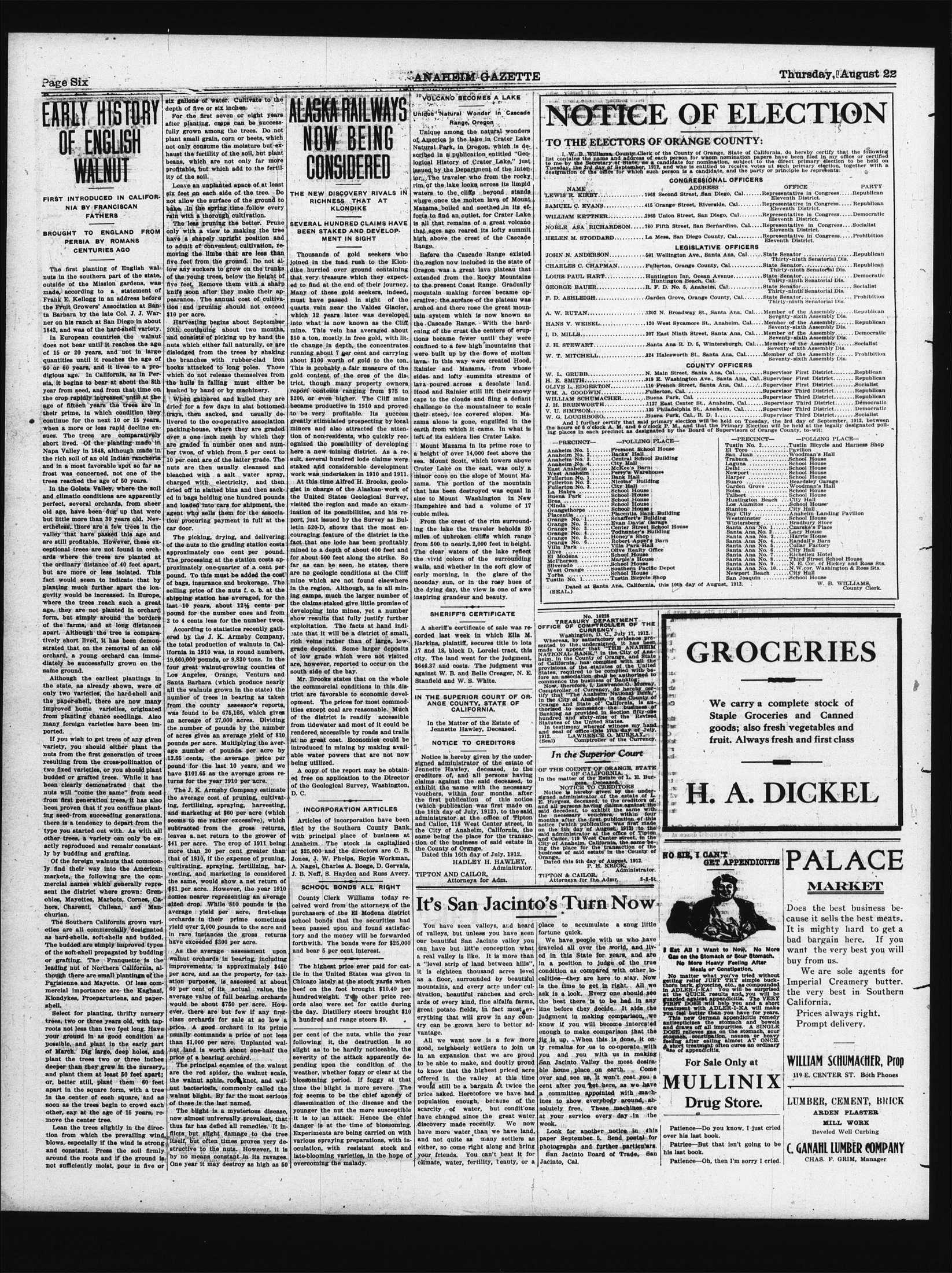
Searchable text
EARLY HISTORY OF ENGLISH WALNUT
FIRST INTRODUCED IN CALIFORNIA BY FRANCISCAN FATHERS
BROUGHT TO ENGLAND FROM PERSIA BY ROMANS CENTURIES AGO
The first planting of English walnuts in the southern part of the state, outside of the Mission gardens, was made, according to a statement of Frank E. Kellogg in an address before the Fruit Growers' Association at Santa Barbara by the late Col. J. J. Warner on his ranch at San Diego in about 1843, and was of the hard-shell variety.
In European countries the walnut does not bear until it reaches the age of 15 or 20 years, and not in large quantities until it reaches the age of 50 or 60 years, and it lives to a prodigious age. In California, as in Persia, it begins to bear at about the 8th year from seed, and from that time on the crop rapidly increases, until at the age of fifteen years the trees are in their prime, in which condition they continue for the next 10 or 15 years, when a more or less rapid decline ensues. The trees are comparatively short lived. Of the planting made in Napa Valley in 1848, although made in the rich soil of an old Indian rancheria and in a most favorable spot so far as frost was concerned, not one of the six gallons of water. Cultivate to the depth of five or six inches.
For the first seven or eight years after planting, crops can be successfully grown among the trees. Do not plant small grain, corn or beets, which not only consume the moisture but exhaust the fertility of the soil, but plant beans, which are not only far more profitable, but which add to the fertility of the soil.
Leave an unplanted space of at least six feet on each side of the tree. Do not allow the surface of the ground to bake. In the spring time follow every rain with a thorough cultivation.
The less pruning the better. Prune only with a view to making the tree have a shapely upright position and to admit of convenient cultivation, removing the limbs that are less than five feet from the ground. Do not allow any suckers to grow on the trunks of the young trees, below the height of five feet. Remove them with a sharp knife soon after they make their appearance. The annual cost of cultivation and pruning should not exceed $10 per acre.
Harvesting begins about September 20th, continuing about two months, and consists of picking up by hand the nuts which either fall naturally, or are dislodged from the trees by shaking the branches with rubber-clad iron hooks attacked to long poles. Those which do not release themselves from the hulls in falling must either be husked by hand or by machinery.
When gathered and hulled they are dried for a few days in slat bottomed trays, then sacked, and usually delivered to the co-operative association packing-house, where they are graded over a one inch mesh by which they are graded in number ones and number twos, of which from 5 per cent to 10 per cent are of the latter grade. The nuts are then usually cleansed and bleached with a salt water spray.
ALASKA RAIN NOW BE CONSIDERED
THE NEW DISCOVERY RICHNESS THE KLONDEN
SEVERAL HUNDREDS BEEN STAKED AND MENT IN
Thousands of gold joined in the mad rush dike hurried over gravel that very treasure wished to find at the end Many of these gold must have passed quartz vein near the which 12 years later into what is now known. This vein has $50 a ton, mostly in fine change in depth, running about 7 per cent about $100 worth of this is probably a fair gold content of the trict, though many report contents range $200, or even higher became productive in to be very profitably stimulated preminers and also attraction of non-residents,ognized the possibility here a new mining o sult, several hundred staked and considers work was undertaken.
In California, as in Persia, it begins to bear at about the 8th year from seed, and from that time on the crop rapidly increases, until at the age of fifteen years the trees are in their prime, in which condition they continue for the next 10 or 15 years, when a more or less rapid decline ensues. The trees are comparatively short lived. Of the planting made in Napa Valley in 1848, although made in the rich soil of an old Indian rancheria and in a most favorable spot so far as frost was concerned, not one of the trees reached the age of 50 years.
In the Goleta Valley, where the soil and climatic conditions are apparently perfect, several orchards, from sheer old age, have been dug up that were but little more than 30 years old. Nevertheless, there are a few trees in the valley that have passed this age and are still profitable. However, these exceptional trees are not found in orchards where the trees are planted at the ordinary distance of 40 feet apart, but are more or less isolated. This fact would seem to indicate that by planting much further apart the longevity would be increased. In Europe, where the trees reach such a great age, they are not planted in orchard form, but simply around the borders of the farms, and at long distances apart. Although the tree is comparatively short lived, it has been demonstrated that on the removal of an old orchard, a young orchard can immediately be successfully grown on the same ground.
Although the earliest plantings in the state, as already shown, were of only two varieties, the hard-shell and the paper-shell, there are now many improved home varieties, originated from planting chance seedlings. Also many foreign varieties have been imported.
If you wish to get trees of any given variety, you should either plant the nuts from the first generation of trees resulting from the cross-pollination of two fixed varieties, or you should plant budded or grafted trees. While it has been clearly demonstrated that the nuts will "come the same" from seed from first generation trees, it has also been proven that if you continue planting seed from succeeding generations, there is a tendency to depart from the type you started out with. As with all other trees, a variety can only be exactly reproduced and remain constantly by budding and grafting.
Of the foreign walnuts that commonly find their way into American markets, the following are the commercial names which generally represent the district where grown: Grenobles, Mayettes, Marmots, Cornes.
The J. K. Armsby Company estimate the average cost of pruning, cultivating, fertilizing, spraying, harvesting, and marketing at $60 per acre (which seems to me rather excessive), which subtracted from the gross returns, leaves a net return to the grower of $41 per acre. The crop of 1911 being more than 20 per cent greater than that of 1910, if the expense of pruning, cultivating, spraying, fertilizing, harvesting, and marketing is considered the same, would show a net return of $61 per acre. However, the year 1910 comes nearer representing an average gold content of the fruit trict, though many report contents range $200, or even higher became productive in order to be very profitably stimulated preminers and also attention of non-residents;ognized the possibility here a new mining oult several hundred staked and considers work was undertaken.
At this time Alfred gist in charge of the United States G visited the region and investigation of its possible port, just issued by the letin 520-D, shows the courageing feature of fact that one lode has mined to a depth of a for about 500 feet along far as can be seen; are no geologic condition which are not in the region. Although ing camps, much the claims staked give developing into mine show results that full exploitation. The fact that it will be a rich veins rather than grade deposits. Some of low grade which are however reported south side of the bay.
Mr. Brooks states that the commercial condtrict are favorable to operation. The prices for titles except coal are not of the district is refrom tidewater and may rendered accessible by at no great cost. Ec introduced in miningable water powers to being utilized.
A copy of the report free on application of the Geological Survey D.C.
INCORPORATION
Articles of incorporation filed by the Southern with principal place Anaheim. The stock at $25,000 and the de Jones, J. W. Phelps,
A. Nagel, Charles A.
J. B. Neff, S. Hayden
from first generation trees, it has also been proven that if you continue planting seed from succeeding generations, there is a tendency to depart from the type you started out with. As with all other trees, a variety can only be exactly reproduced and remain constantly by budding and grafting.
Of the foreign walnuts that commonly find their way into the American markets, the following are the commercial names which generally represent the district where grown: Grenobles, Mayettes, Marbots, Cornes, Cahors, Charenti, Chilean, and Manchurian.
The Southern California grown varieties are all commercially designated as hard-shells, soft-shells and budded. The budded are simply improved types of the soft-shell propagated by budding or grafting. The Franquette is the leading nut of Northern California, although there are small plantings of the Parisienne and Mayette. Of less commercial importance are the Kaghazi, Klondykes, Proeparturiens, and papershell.
Select for planting, thrifty nursery trees, two or three years old, with taproots not less than two feet long. Have your ground in as good condition as possible, and plant in the early part of March. Dig large, deep holes, and plant the trees two or three inches deeper than they grew in the nursery, and plant them at least 50 feet apart; or, better still, plant them 60 feet apart in the square form, with a tree in the center of each square, and as soon as the trees begin to crowd each other, say at the age of 15 years, remove the center tree.
Lean the trees slightly in the direction from which the prevailing wind blows, especially if the wind is strong and constant. Press the soil firmly around the roots and if the ground is not sufficiently moist, pour in five or
the average cost of pruning, cultivating, fertilizing, spraying, harvesting, and marketing at $60 per acre (which seems to me rather excessive), which subtracted from the gross returns, leaves a net return to the grower of $41 per acre. The crop of 1911 being more than 20 per cent greater than that of 1910, if the expense of pruning, cultivating, spraying, fertilizing, harvesting, and marketing is considered the same, would show a net return of $61 per acre. However, the year 1910 comes nearer representing an average sized crop. While 810 pounds is the average yield per acre, first-class orchards in their prime sometimes yield over 2,000 pounds to the acre and in rare instances the gross returns have exceeded $300 per acre.
As the average assessment upon walnut orchards in bearing, including improvements, is approximately $450 per acre, and as the property, for taxation purposes, is assessed at about 60 per cent of its actual value, the average value of full bearing orchards would be about $750 per acre. However, there are but few if any first-class orchards for sale at so low a price. A good orchard in its prime usually commands a price of not less than $1,000 per acre. Unplanted walnut land is worth about one-half the price of a bearing orchard.
The principal enemies of the walnut are the red spider, the walnut scale, the walnut aphis, root knot, and walnut bacteriosis, commonly called the walnut blight. By far the most serious of these is the last named.
The blight is a mysterious disease, now almost universally prevalent, that thus far has defied all remedies. It inflicts but slight damage to the tree itself, but often times proves very destructive to the nuts. However, it is by no means constant in its ravages. One year it may destroy as high as 50
per cent of the nut following it, the slight as to be hard severity of the attack pending upon the weather, whether fog blossoming period. time the blight is not fog seems to be this dissemination of the younger the nut then it is to an attack. danger is at the time Experiments are being various spraying preoculation, with resilient-blooming variety overcoming the mala-
ALASKA RAILWAYS NOW BEING CONSIDERED
THE NEW DISCOVERY RIVALS IN RICHNESS THAT AT KLONDIKE
SEVERAL HUNDRED CLAIMS HAVE BEEN STAKED AND DEVELOPMENT IN SIGHT
Thousands of gold seekers who joined in the mad rush to the Klondike hurried over ground containing that very treasure which they expected to find at the end of their journey. Many of these gold seekers, indeed, must have passed in sight of the quartz vein near the Valdez Glacier, which 12 years later was developed into what is now known as the Cliff mine. This vein has averaged about $50 a ton, mostly in free gold, with little change in depth, the concentrates running about 7 per cent and carrying about $100 worth of gold to the ton. This is probably a fair measure of the gold content of the ores of the district, though many property owners report contents ranging from $75 to $200, or even higher. The Cliff mine became productive in 1910 and proved to be very profitable. Its success greatly stimulated prospecting by local miners and also attracted the attention of non-residents, who quickly recognized the possibility of developing here a new mining district. As a result, several hundred lode claims were staked and considerable development work was undertaken in 1910 and 1911.
VOLCANO BECOMES A LAKE
Unique Natural Wonder in Cascade Range, Oregon
Unique among the natural wonders of America is the lake in Crater Lake Natural Park, in Oregon, which is described in a publication entitled "Geological History of Crater Lake," just issued by the Department of the Interior. The traveler who from the rocky rim of the lake looks across its limpid waters to the cliffs beyond stands where once the molten lava of Mount Mazama boiled and seethed in its efforts to find an outlet, for Crater Lake is all that remains of a great volcano that ages ago reared its lofty summit high above the crest of the Cascade Range.
Before the Cascade Range existed the region now included in the state of Oregon was a great lava plateau that extended from the Rocky Mountains to the present Coast Range. Gradually mountain making forces became operative; the surface of the plateau was arched and there rose the great mountain system which is now known as the Cascade Range. With the hardening of the crust the centers of eruptions became fewer until they were confined to a few high mountains that were built up by the flows of molten lava. In this way were created Hood, Rainier and Mazama, from whose sides and lofty summits streams of lava poured across a desolate land. Hood and Rainier still lift their snowy caps to the clouds and fling a defiant challenge to the mountaineer to scale their steep, ice covered slopes. Mazama alone is gone, engulfed in the earth from which it came. In what is left of its caldera lies Crater Lake.
Mount Mazama in its prime rose to a height of over 14,000 feet above the sea. Mount Scott, which towers above Crater Lake on the east, was only a minor crater on the slope of Mount Mazama.
NOTICE
TO THE ELECTORS OF OUR LIST contains the name and address of each person to me by the Secretary of State, as a candidate Tuesday, the 3rd day of September, 1912, and designation of the office for which such person is nominated.
NAME
LEWIS R. KIRBY...1968 Secondary
SAMUEL C. EVANS...415 Orange
WILLIAM KETTNER...2965 Union
NOBLE ASA RICHARDSON...780 Fifth Street
HELEN M. STODDARD...La Mesa,
JOHN N. ANDERSON...501 Wellin
CHARLES C. CHAPMAN...Fullerton,
LOUIS PAUL HART...Huntington
GEORGE BAUER...R. F. D. Mills
F. D. ASHLEIGH...Garden Grass
A. W. RUTAN...1202 N. B.
HANS V. WEISEL...120 West Street
I. D. MILLS...207 East Street
J. H. STEWART...Santa Anita
W. T. MITCHELL...224 Halesville
W. L. GRUBB...N. Main Street
H. E. SMITH...919 E. Way
OLIVE L. EDGERTON...110 French
WM. A. GOODWIN...Fullerton,
WILLIAM SCHUMACHER...Buena Pa.
J. H. BRUNWORTH...1127 East Street
V. U. SIMPSON...135 Philadelphus
W. G. LOUGHBORO...Buena Pa.
And I further certify that said primary candidate for the hours of 6 o'clock A.M. and 6 o'clock P.M., living places in each precinct as designated by:
PRECINCT—POLLING PLACE
Anaheim No. 1....Fremont School House
Anaheim No. 2....Backs' Hall
Anaheim No. 3....Central School Building
Anaheim No. 4....City Hall
East Anaheim.....McKee's Barn
West Anaheim.....Perry's Warehouse
gold content of the ores of the district, though many property owners report contents ranging from $75 to $200, or even higher. The Cliff mine became productive in 1910 and proved to be very profitable. Its success greatly stimulated prospecting by local miners and also attracted the attention of non-residents, who quickly recognized the possibility of developing here a new mining district. As a result, several hundred lode claims were staked and considerable development work was undertaken in 1910 and 1911.
At this time Alfred H. Brooks, geologist in charge of the Alaskan-work of the United States Geological Survey, visited the region and made an examination of its possibilities, and his report, just issued by the Survey as Bulletin 520-D, shows that the most encouraging feature of the district is the fact that one lode has been profitably mined to a depth of about 400 feet and for about 500 feet along the strike. So far as can be seen, he states, there are no geologic conditions at the Cliff mine which are not found elsewhere in the region. Although, as in all mining camps, much the larger number of the claims staked give little promise of developing into mines, yet a number show results that fully justify further exploitation. The facts at hand indicate that it will be a district of small, rich veins rather than of large, low-grade deposits. Some larger deposits of low grade which were not visited are, however, reported to occur on the south side of the bay.
Mr. Brooks states that on the whole the commercial conditions in this district are favorable to economic development. The prices for most commodities except coal are reasonable. Much of the district is readily accessible from tidewater and most of it could be rendered accessible by roads and trails at no great cost. Economies could be introduced in mining by making available water powers that are not now being utilized.
A copy of the report may be obtained free on application to the Director of the Geological Survey, Washington, D.C.
INCORPORATION ARTICLES
Articles of incorporation have been filed by the Southern County Bank with principal place of business at Anaheim. The stock is capitalized at $25,000 and the directors are C. B. Jones, J. W. Phelps, Boyle Workman, A. Nagel, Charles A. Boege, D. Gervais, J. B. Neff, S. Hayden and Russ Avery.
SCHOOL BONDS ALL RIGHT
County Clerk Williams today re-sides and lofty summits streams of lava poured across a desolate land. Hood and Rainier still lift their snowy caps to the clouds and fling a defiant challenge to the mountaineer to scale their steep, ice covered slopes. Mazama alone is gone, engulfed in the earth from which it came. In what is left of its caldera lies Crater Lake.
Mount Mazama in its prime rose to a height of over 14,000 feet above the sea. Mount Scott, which towers above Crater Lake on the east, was only a minor cone on the slope of Mount Mazama. The portion of the mountain that has been destroyed was equal in size to Mount Washington in New Hampshire and had a volume of 17 cubic miles.
From the crest of the rim surrounding the lake the traveler beholds 20 miles of unbroken cliffs which range from 500 to nearly 2,000 feet in height. The clear waters of the lake reflect the vivid colors of the surrounding walls, and whether in the soft glow of early morning, in the glare of the noonday sun, or in the rosy hues of the dying day, the view is one of awe inspiring grandeur and beauty.
SHERIFF'S CERTIFICATE
A sheriff's certificate of sale was recorded last week in which Ella M. Harkins, plaintiff, secures title to lots 17 and 18, block D, Lorelei tract, this city. The land went for the judgment, $646.37 and costs. The judgment was against W. B. and Belle Creager, N. E. Stanfield and W. S. White.
IN THE SUPERIOR COURT OF ORANGE COUNTY, STATE OF CALIFORNIA.
In the Matter of the Estate of Jennette Hawley, Deceased.
NOTICE TO CREDITORS
Notice is hereby given by the undersigned administrator of the estate of Jennette Hawley, deceased, to the creditors of, and all persons having claims against the said deceased, to exhibit the same with the necessary vouchers, within four months after the first publication of this notice (which publication was first made on the 18th day of July, 1912), to the said administrator at the office of Tipton and Callor, 118 West Center street, in the City of Anaheim, California, the same being the place for the transaction of the business of said estate in the County of Orange.
Dated this 16th day of July, 1912.
HADLEY H. HAWLEY,
Adminitrator.
TIPTON AND CAILOR,
Attorneys for Adm.
No. 10228
TREASURY DEPARTMENT
OFFICE OF COMPTROLLER OF THE CURRENCY
Washington, D.C., July 17, 1912.
Whereas, by satisfactory evidence presented to the undersigned, it has been made to appear that "THE ANAHEIM NATIONAL BANK," in the City of Anaheim, in the County of Orange, and State of California, has compiled with all the provisions of the statutes of the United States, required to be compiled with before an association shall be authorized to commence the business of Banking;
Now therefore I, Lawrence O. Murray,
Comptroller of Currency, do hereby certify that "The Anaheim National Bank," in the City of Anaheim, in the County of Orange and State of California, is authorised to commence the business of Banking as provided in Section fifty-one hundred and sixty-nine of the Revised Statutes of the United States.
In testimony whereof witness my hand and seal of office this 17th day of July, 1912.
LAWRENCE O. MURRAY.
Comptroller of the Currency.
In the Superior Court
OF THE COUNTY OF ORANGE, STATE OF CALIFORNIA.
In the matter of the Estate of L. E. Burgess, Deceased.
NOTICE TO CREDITORS
Notice is hereby given by the undersigned administrator of the estate of L. E. Burgess, deceased, to the creditors of, and all persons having claims against the said decedent, to exhibit the same with the necessary vouchers, within four months after the first publication of this notice (which publication was first made on the 8th day of August, 1912) to the said administrator at the office of Tipton and Callor, 118 West Center street, in the City of Anaheim, California, the same being the place for the transaction of the business of said estate in the County of Orange.
Dated this 5th day of August, 1912.
P. H. KRICK.
Administrator.
TIPTON & CAILOR,
Attorneys for the Adm., 8-8-5t
INCORPORATION ARTICLES
Articles of incorporation have been filed by the Southern County Bank with principal place of business at Anaheim. The stock is capitalized at $25,000 and the directors are C. B. Jones, J. W. Phelps, Boyle Workman, A. Nagel, Charles A. Boege, D. Gervais, J. B. Neff, S. Hayden and Russ Avery.
SCHOOL BONDS ALL RIGHT
County Clerk Williams today received word from the attorneys of the purchasers of the El Modena district school bonds that the securities had been passed upon and found satisfactory and the money will be forwarded forthwith. The bonds were for $25,000 and bear 5 per cent interest.
The highest price ever paid for cattle in the United States was given in Chicago lately at the stock yards when beef on the foot brought $10.40 per hundredweight. Two other price records also were set for cattle during the day. Distillery steers brought $10 a hundred and range steers $9.
per cent of the nuts, while the year following it, the destruction is so slight as to be hardly noticeable, the severity of the attack apparently depending upon the condition of the weather, whether foggy or clear at the blossoming period. If foggy at that time the blight is more severe. The fog seems to be the chief agency of dissemination of the disease and the younger the nut the more susceptible it is to an attack. Hence the chief danger is at the time of blossoming. Experiments are being carried on with various spraying preparations, with inoculation, with resistant stock and late-blooming varieties, in the hope of overcoming the malady.
It’s San Jacinto’s Turn Now
You have seen valleys, and heard of valleys, but unless you have seen our beautiful San Jacinto valley you can have but litt’e conception what a real valley is like. It is more than a “level strip of land between hills”, it is eighteen thousand acres level as a floor, surrounded by beautiful mountains, and every acre under cultivation, beautiful ranches and orchards of every kind, fine alfalfa farms, great potato fields, in fact most everything that will grow in any country can be grown here to better advantage.
All we want now is a few more good, neighborly settlers to join us in an expansion that we are proud to be able to make, and doubly proud to know that the highest priced acre offered in the valley at this time would still be a bargain at twice the price asked. Heretofore we have had population enough, because of the scarcity of water, but conditions have changed since the great water discovery made recently. We now have more water than we have land, and not quite as many settlers as either, so come right along and bring your friends. You can’t beat it for climate, water, fertility, beauty, or a place to accumulate a snug little fortune quick.
We have people with us who have traveled all over the world, and lived in this State for years, and are in a position to judge of the true condition as compared with other localities—they are here to stay. Now is the time to get in right. All we ask is a look. Every one should see the best there is to be had in any line before they decide. It aids the judgment in making comparison, we know if you will become interested enough to make comparison that the fig is up. When this is done, it only remains for us to co-operate with you and you with us in making San Jacinto Valley the most desirable home place on earth. Come over and see us, it won’t cost you a cent after you get here, as we have a committee appointed with machines to show everybody around absolutely free. These machines are at your service every day in the week.
Look for another notice in this paper September 5. Send postal for photographs and further particulars.
San Jacinto Board of Trade, San Jacinto, Cal.
OFFICE OF ELECTION
LECTORS OF ORANGE COUNTY:
Williams, County Clerk of the County of Orange, State of California, do hereby certify that the following name and address of each person for whom nomination papers have been filed in my office or certified by the Secretary of State, as a candidate for nomination, subject to the direct primary election to be held on Tuesday, of September, 1912, and who is entitled to receive votes at such primary election, together with a county office for which such person is a candidate, and the party or principle he represents:
CONGRESSIONAL OFFICERS
ADDRESS OFFICE PARTY
NY 1968 Second Street, San Diego, Cal...Representative in Congress...Republican Eleventh District.
NS 415 Orange Street, Riverside, Cal...Representative in Congress...Republican Eleventh District.
NER 2965 Union Street, San Diego, Cal...Representative in Congress...Democratic Eleventh District.
CHARDSON 780 Fifth Street, San Bernardino, Cal...Representative in Congress...Socialist Eleventh District.
DARD La Mesa, San Diego County, Cal...Representative in Congress...Prohibition Eleventh District.
LEGISLATIVE OFFICERS
JESON 501 Wellington Ave., Santa Ana, Cal...State Senator...Republican Thirty-ninth Senatorial Dis.
APMAN Fullerton, Orange County, Cal...State Senator...Republican Thirty-ninth Senatorial Dis.
ORT Huntington Inn, Ocean Avenue...State Senator...Democratic Thirty-ninth Senatorial Dis.
R. F. D. No. 5, Anaheim, Cal...State Senator...Socialist Thirty-ninth Senatorial Dis.
Garden Grove, Orange County, Cal...State Senator...Prohibition Thirty-ninth Senatorial Dis.
1202 N. Broadway St., Santa Ana, Cal...Member of the Assembly...Republican Seventy-sixth Assembly Dis.
120 West Sycamore St., Anaheim, Cal...Member of the Assembly...Republican Seventy-sixth Assembly Dis.
207 East Ninth Street, Santa Ana, Cal...Member of the Assembly...Democratic Seventy-sixth Assembly Dis.
Santa Ana R. D. 5, Wintersburgh, Cal...Member of the Assembly...Socialist Seventy-sixth Assembly Dis.
224 Halesworth St., Santa Ana, Cal...Member of the Assembly...Prohibition Seventy-sixth Assembly Dis.
COUNTY OFFICERS
N. Main Street, Santa Ana, Cal..Supervisor First District...Republican
919 E. Washington Ave., Santa Ana, Cal..Supervisor First District...Republican
110 French Street, Santa Ana, Cal..Supervisor First District...Socialist
Fullerton, Cal..Supervisor Third District..Republican
MACHER Buena Park, Cal..Supervisor Third District..Republican
TH 1127 East Center St., Anaheim, Cal..Supervisor Third District..Democratic
135 Philadelphia St., Anaheim, Cal..Supervisor Third District..Democratic
RO Buena Park, Cal., R. D. 1..Supervisor Third District..Socialist
For certify that said primary election will be held on Tuesday, the 3rd day of September, 1912, between Rock A. M. and S. o'clock P. M., and that the Primary Election will be held at the legally designated poll-place as designated by the Board of Supervisors of Orange County, to-wit:
—POLLING PLACE—
Fremont School House
Backs Hall
Central School Building
City Hall
McKee's Barn
Perry's Warehouse
—PRECINCT—
Tustin No. 2....Tustin Bicycle and Harness Shop
El Toro Pavilion
San Juan Woodman's Hall
Trabuca School House
Laguna School House
Delhi School House
Newport School House
POLLING PLACE—
Fremont School House
Backa Hall
Central School Building
City Hall
McKee's Barn
Perry's Warehouse
Bank Hall
Nicolas' Building
City Hall
School House
School House
School House
School House
School House
Placentia Bank Building
Schaffert's Building
Evan Davis' Garage
Center Street School House
Todhunter's Building
Honey's Shop
Robert Appel's Barn
Villa Park Hall
Ollive Realty Office
School House
Marple's House
School House
Southern Pacific Depot
School House
Tustin Bicycle Shop
PRECINCT—
Tustin No. 2.... Tustin Bicycle and Harness Shop
El Toro..... Pavillon
San Juan..... Woodman's Hall
Trabuca..... School House
Laguna..... School House
Delhi..... School House
Newport..... School House
Harper..... School House
Buaro..... Beardsley Garage
Garden Grove..... Woodman's Hall
Bolsa..... School House
Talbert..... School House
Huntington Beach..... City Hall
Los Alamitos..... School House
Stanton..... City Hall
Bay City..... Anaheim Landing Pavilion
Westminster..... School House
Wintersberg..... Bradbury Store
Santa Ana No. 1.... Czarske's Place
Santa Ana No. 2.... Lacy House
Santa Ana No. 3.... Harris House
Santa Ana No. 4.... Randall's Barn
Santa Ana No. 5.... Collar Factory
Santa Ana No. 6.... City Hall
Santa Ana No. 7.... Richelieu Hotel
Santa Ana No. 8.... Third Street School House
Santa Ana No. 9.... N.E. Cor. of Hickey and Ross Sts.
Santa Ana No. 10.... N.W.cor. Washington & Ross Sts.
Newport Beach..... City Hall
San Joaquin..... School House
GROCERIES
We carry a complete stock of Staple Groceries and Canned goods; also fresh vegetables and fruit. Always fresh and first class
H. A. DICKEL
NO SIR, I CAN'T GET APPENDICITIS
PALACE MARKET
NO SIR, I CAN'T GET APPENDICITIS
I EAT ALL I WANT TO NOW. NO MORE GAS ON THE STOMACH OR SOUR STOMACH. NO MORE HEAVY FEELING AFTER MEALS OR CONSTIPATION.
No matter what you've tried without getting relief JUST TRY simple buckthorn bark, glycerine, etc., as compounded in ADLER-I-KA! You will be surprised at the QUICK results and you will be guarded against appendicitis. The VERY FIRST DOSE will help you and a short treatment with ADLER-I-KA will make you feel better than you have for years.
This new German appendicitis remedy antisepticizes the stomach and bowels and draws off all impurities. A SINGLE DOSE relieves gas on the stomach, sour stomach, constipation, nausea or heavy feeling after eating almost AT ONCE. A short treatment often cures an ordinary case of appendicitis.
For Sale Only at MULLINIX Drug Store.
Patience—Do you know, I just cried over his last book.
Patrice—But that isn't going to be his last book.
Patience—Oh, then I'm sorry I cried.
PALACE MARKET
Does the best business because it sells the best meats. It is mighty hard to get a bad bargain here. If you want the very best you will buy from us.
We are sole agents for Imperial Creamery butter. the very best in Southern California.
Prices always right.
Prompt delivery.
WILLIAM SCHUMACHER, Prop
119 E. CENTER ST. Both Phones
LUMBER, CEMENT, BRICK
ARDEN PLASTER
MILL WORK
Beveled Well Curbing
C. GANAHL LUMBER COMPANY
CHAS. F. GRIM, Manager