anaheim-gazette 1912-05-30
Scanned page
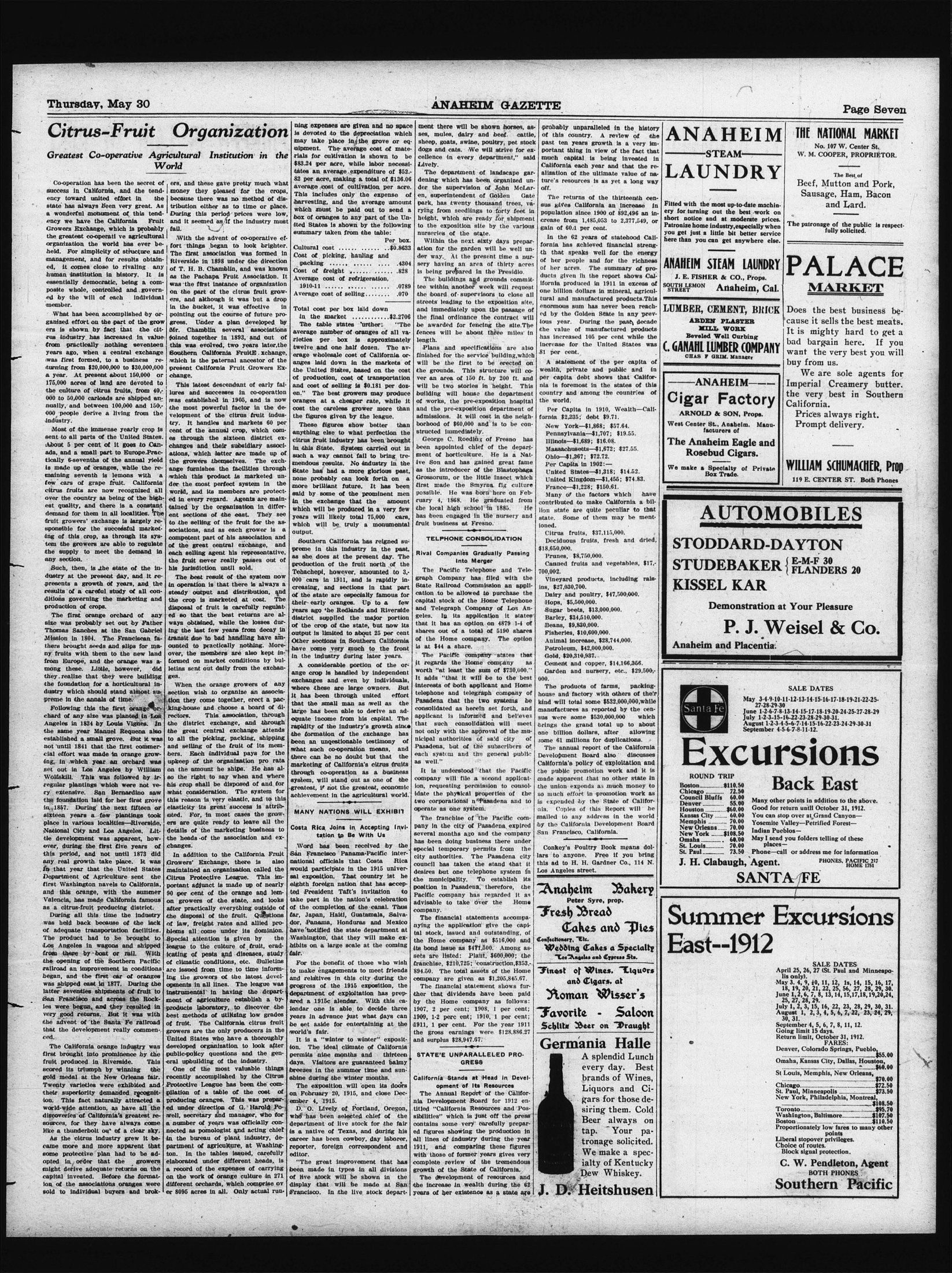
Searchable text
Thursday, May 30
Citrus-Fruit Organization
Greatest Co-operative Agricultural Institution in the World
Co-operation has been the secret of success in California, and the tendency toward united effort in the state has always been very great. As a wonderful monument of this tendency we have the California Fruit Growers Exchange, which is probably the greatest co-operative agricultural organization the world has ever held. For simplicity of structure and management, and for results obtained, it comes close to rivaling any human institution in history. It is essentially democratic, being a composite whole, controlled and governed by the will of each individual member.
What has been accomplished by organized effort on the part of the growers is shown by fact that the citrus industry has increased in value from practically nothing seventeen years ago, when a central exchange was first formed, to a business returning from $20,000,000 to $30,000,000 a year. At present about 150,000 or 175,000 acres of land are devoted to the culture of citrus fruits, from 40,-000 to 50,000 carloads are shipped annually, and between 100,000 and 150,-000 people derive a living from the industry.
Most of the immense yearly crop is sent to all parts of the United States. About 5 per cent of it goes to Canada, and a small part to Europe. Practically 6-sevenths of the annual yield is made up of oranges, while the remaining seventh is lemons with rers, and these gave pretty much what money they pleased for the crops, because there was no method of distribution either as to time or place. During this period prices were low, and it seemed as if the industry must fall.
With the advent of co-operative effort things began to look brighter. The first association was formed in Riverside in 1898 under the direction of T. H. B. Chamblin, and was known as the Pachapa Fruit Association. It was the first instance of organization on the part of the citrus fruit growers, and although it was but a drop in the bucket, it was effective in pointing out the course of future progress. Under a plan developed by Mr. Chamblin several associations joined together in 1893, and out of this was evolved, two years later, the Southern California Fruit Exchange, which is the paternal ancestor of the present California Fruit Growers Exchange.
This latest descendant of early failures and successes in co-operation was established in 1905, and is now the most powerful factor in the development of the citrus fruit industry. It handles and markets 60 per cent of the annual crop, which comes through the sixteen district exchanges and their subsidiary associations, which latter are made up of the growers themselves. The exchange furnishes the facilities through ning expenses are devoted to the day may take place in equipment. The averrials for cultivation $83.24 per acre, wht tates an average ex 82 per acre, making average cost of cult This includes only harvesting, and tha which must be paid box of oranges to an United States is shown summary taken from Cultural cost . Cost of picking, ha packing . Cost of freight Average cost of re 1910-11 Average cost of selli Total cost per box in the market The table states average number of varieties per box twelve and one half average wholesale costs laid down in the United States, of production, cost and cost of selling en." The best grower oranges at a cheap cost the careless give the figures given by These figures show anything else to which citrus fruit industry in this State. System such a way cannot mendous results. New State has had a more
At present about 150,000 or 175,000 acres of land are devoted to the culture of citrus fruits, from 40,000 to 50,000 carloads are shipped annually, and between 100,000 and 150,000 people derive a living from the industry.
Most of the immense yearly crop is sent to all parts of the United States. About 5 per cent of it goes to Canada, and a small part to Europe. Practically 6-sevenths of the annual yield is made up of oranges, while the remaining seventh is lemons with a few cars of grape fruit. California citrus fruits are now recognized all over the country as being of the highest quality, and there is a constant demand for them in all localities. The fruit growers' exchange is largely responsible for the successful marketing of this crop, as through its system the growers are able to regulate the supply to meet the demand in any section.
Such, then, is the state of the industry at the present day, and it represents a growth of years, and the results of a careful study of all conditions governing the marketing and production of crops.
The first orange orchard of any size was probably set out by Father Thomas Sanches at the San Gabriel Mission in 1804. The Franciscan fathers brought seeds and slips for many fruits with them to the new land from Europe, and the orange was among these. Little, however, did they realize that they were building the foundation for a horticultural industry which should stand almost supreme in the annals of time.
Following this the first orange orchard of any size was planted in Los Angeles in 1834 by Louis Vignes. In the same year Manuel Requena also established a small grove. But it was not until 1841 that the first commercial effort was made in orange growing, in which year an orchard was set out in Los Angeles by William Wolfskill. This was followed by irregular plantings which were not very extensive. San Bernardino saw the foundation laid for her first grove in 1857. During the next fifteen or sixteen years a few plantings took place in various localities—Riverside, National City and Los Angeles. Little development was apparent, however, during the first five years of this period, and not until 1873 did any real growth take place. It was in that year that the United States Department of Agriculture sent the first Washington navels to California, and this orange, with the summer Valencia, has made California famous change.
This latest descendant of early failures and successes in co-operation was established in 1905, and is now the most powerful factor in the development of the citrus fruit industry. It handles and markets 60 percent of the annual crop, which comes through the sixteen district exchanges and their subsidiary associations, which latter are made up of the growers themselves. The exchange furnishes the facilities through which this product is marketed under the most perfect system in the world, and its members are protected in every regard. Agents are maintained by the organization in different sections of the east. They see to the selling of the fruit for the associations, and as each grower is a competent part of his association and of the great central exchange, and each selling agent his representative, the fruit never really passes out of his jurisdiction until sold.
The best result of the system now in operation is that there is always a steady output and distribution, and the crop is marketed at cost. The disposal of fruit is carefully regulated so that the best returns are always obtained, while the losses during the last few years from decay in transit due to bad handling have amounted to practically nothing. Moreover, the members are also kept informed on market conditions by bulletins sent out daily from the exchanges.
When the orange growers of any section wish to organize an association they come together, erect a packing-house and choose a board of directors. This association, through the district exchange, and through the great central exchange attends to all the picking, packing, shipping and selling of the fruit of its members. Each individual pays for the upkeep of the organization pro rata on the amount he ships. He has also right to say when and where his crop shall be disposed of and for what consideration. The system for this reason is very elastic, and to this elasticity its great success is attributed. For, in most cases the growers are quite ready to leave all the details of the marketing business to the heads-of-the association and exchanges.
In addition to the California Fruit Growers' Exchange, there is also maintained an organization called the Citrus Protective League. This important adjunct is made up of nearly 90 per cent of the orange and lemons of the state and looks of production, cost and cost of selling them."
The best grow oranges at a cheap cost the careless give the figures given by these figures show anything else to which citrus fruit industry in this State. System such a way cannot mendous results. New State has had a more brilliant future said by some of those in the exchange than which will be produced years will likely to which will be truly output.
Southern California preme in this industry as she does at the production of the farm Teachepi, however, 000 cars in 1911, a creasing, and section of the state are expected their early oranges. Years ago 'the Redland district supplied that of the crop of the crop output is limited to other sections in So have come very much in the industry during A considerable range crop is handled exchanges and even where these are large it has been through that the small man large has been able equate income from rapidity of the industry formation of them been an unquestionable what such co-operation there can be no doubt marketing of California through co-operation system, will stand out greatest, if not the greatest achievement in the area
MANY NATIONS
Costa Rica Joins institution to Be
Word has been San Francisco Panama national officials that would participate in sal exposition. That eighth foreign nation ted President Taft's take part in the nati
the foundation laid for her first grove in 1857. During the next fifteen or sixteen years a few plantings took place in various localities—Riverside, National City and Los Angeles. Little development was apparent, however, during the first five years of this period, and not until 1873 did any real growth take place. It was in that year that the United States Department of Agriculture sent the first Washington navels to California, and this orange, with the summer Valencia, has made California famous as a citrus-fruit producing district.
During all this time the industry was held back because of the lack of adequate transportation facilities. The product had to be brought to Los Angeles in wagons and shipped from there by boat or rail. With the opening of the Southern Pacific railroad an improvement in conditions began, and the first car of oranges was shipped east in 1877. During the latter seventies shipments of fruit to San Francisco and across the Rockies were begun, and they resulted in very good returns. But it was with the advent of the Santa Fe railroad that the development really commenced.
The California orange industry was first brought into prominence by the fruit produced in Riverside. This scored its triumph by winning the gold medal at the New Orleans fair. Twenty varieties were exhibited and their superiority demanded recognition. This fact naturally attracted a world-wide attention, as have all the discoveries of California's greatest resources, for they have always come like a thunderbolt out of a clear sky.
As the citrus industry grew it became more and more apparent that some protective plan had to be adopted in order that the growers might derive adequate returns on the capital invested. Before the formation of the associations oranges were sold to individual buyers and brok-
In addition to the California Fruit Growers' Exchange, there is also maintained an organization called the Citrus Protective League. This important adjunct is made up of nearly 90 per cent of the orange and lemon growers of the state, and looks after practically everything outside of the disposal of the fruit. Questions of law, freight rates and allied problems all come under its dominion. Special attention is given by the league to the culture of fruit, eradicating of pests and diseases, study of climatic conditions, etc. Bulletins are issued from time to time informing the growers of the latest developments in all lines. The league was instrumental in having the department of agriculture establish a by-products laboratory, to discover the best methods of utilizing low grades of fruit. The California citrus fruit growers are the only producers in the United States who have a thoroughly developed organization to look after public-policy questions and the general upbuilding of the industry.
One of the most valuable things recently accomplished by the Citrus Protective League has been the compilation of a table of the cost of producing oranges. This was prepared under direction of G. Harold Powell, secretary and manager, who for a number of years was officially connected as pomologist and acting chief in the bureau of plant industry, department of agriculture, at Washington. In the tables issued, carefully elaborated under different heads, is a record of the expenses of carrying on the work of orange culture in 271 different orchards, which comprise over 8095 acres in all. Only actual run-
ning expenses are given and no space is devoted to the depreciation which may take place in the grove or equipment. The average cost of materials for cultivation is shown to be $83.24 per acre, while labor necessitates an average expenditure of $52.82 per acre, making a total of $136.06 average cost of cultivation per acre. This includes only the expense of harvesting, and the average amount which must be paid out to send a box of oranges to any part of the United States is shown by the following summary taken from the table:
Per box.
Cultural cost ... $0.8633
Cost of picking, hauling and packing ... .4304
Cost of freight ... .828
Average cost of refrigeration, 1910-11 ... .0789
Average cost of selling... .070
Total cost per box laid down in the market ... $2.2706
The table states further: "The average number of oranges of all varieties per box is approximately twelve and one half dozen. The average wholesale cost of California oranges laid down in the markets of the United States, based on the cost of production, cost of transportation and cost of selling is $0.181 per dozen." The best growers may produce oranges at a cheaper rate, while it cost the careless grower more than the figures given by the league.
These figures show better than anything else to what perfection the citrus fruit industry has been brought in this State. System carried out in such a way cannot fail to bring tremendous results. No industry in the State has had a more glorious past,
ment there will be shown horses, asses, mules, dairy and beef. cattle, sheep, goats, swine, poultry, pet stock dogs and cats. We will strive for excellence in every department," said Lively.
The department of landscape gardening which has been organized under the supervision of John McLaren, superintendent of Golden Gate park, has twenty thousand trees, varying from seedlings to forty feet in height, which are ready for shipment to the exposition site by the various nurseries of the state.
Within the next sixty days preparation for the garden will be well under way. At the present time a nursery having an area of thirty acres is being prepared in the Presidio.
The buildings and grounds committee within another week will request the board of supervisors to close all streets leading to the exposition site, and immediately upon the passage of the final ordinance the contract will be awarded for fencing the site. The fences will be about three miles in length.
Plans and specifications are also finished for the service building, which will be the first to be erected on the grounds. This structure will cover an area of 150 ft. by 200 ft. and will be two stories in height. This building will house the department of works, the pre-exposition hospital and the pre-exposition department of admissions. It will cost in the neighborhood of $60,000 and is to be constructed immediately.
George C. Roeding of Fresno has been appointed chief of the department of horticulture. He is a Native Son and has gained great fame as the introducer of the Blastophaga probably unparalleled in the history of this country. A review of the past ten years growth is a very important thing in view of the fact that much capital is being invested in California each year and that the realization of the ultimate value of nature's resources is as yet a long way off.
The returns of the thirteenth census gives California an increase in population since 1900 of 892,496 an increase from 1,485,053 to 2,377,549, or gain of 60.1 per cent.
In the 62 years of statehood California has achieved financial strength that speaks well for the energy of her people and for the richness of her acres. The summary of products given in the report shows California produced in 1911 in excess of one billion dollars in mineral, agricultural and manufactured products. This enormous sum has never been reached by the Golden State in any previous year. During the past decade the value of manufactured products has increased 105 per cent while the increase for the United States was 81 per cent.
A statement of the per capita of wealth, private and public and in per capita debt shows that California is foremost in the states of this country and among the countries of the world.
Per Capita in 1910, Wealth—California $2,235; debt $9.71.
New York—$1,868; $57.64.
Pennsylvania—$1,707; $19.55.
Illinois—$1,689; $16.08.
Massachusetts—$1,672; $27.55.
Ohio—$1,367; $72.72.
Per Capita in 1902:—United States—$1,318; $14.52.
of production, cost of transportation and cost of selling is $0.181 per dozen.” The best growers may produce oranges at a cheaper rate, while it cost the careless grower more than the figures given by the league.
These figures show better than anything else to what perfection the citrus fruit industry has been brought in this State. System carried out in such a way cannot fail to bring tremendous results. No industry in the State has had a more glorious past, none probably can look forth on a more brilliant future. It has been said by some of the prominent men in the exchange that the amount which will be produced in a very few years will likely total 75,000 cars, which will be truly a monumental output.
Southern California has reigned supreme in this industry in the past, as she does at the present day. The production of the fruit north of the Tehachepi, however, amounted to 3,000 cars in 1911, and is rapidly increasing, and sections in that part of the state are especially famous for their early oranges. Up to a few years ago the Redlands and Riverside district supplied the major portion of the crop of the state, but now its output is limited to about 25 per cent Other sections in Southern California have come very much to the front in the industry during later years.
A considerable portion of the orange crop is handled by independent exchanges and even by individuals, where these are large owners. But it has been through united effort that the small man as well as the large has been able to derive an adequate income from his capital. The rapidity of the industry’s growth since the formation of the exchange has been an unquestionable testimony of what such co-operation means, and there can be no doubt but that the marketing of California's citrus fruits through co-operation as a business system, will stand out as one of the greatest, if not the greatest, economic achievement in the agricultural world.
MANY NATIONS WILL EXHIBIT
Costa Rica Joins in Accepting Invitation to Be With Us
Word has been received by the San Francisco Panama-Pacific international officials that Costa Rica would participate in the 1915 universal exposition. That country ist he eighth foreign nation that has accepted President Taft's invitation to take part in the nation's celebration over an area of 150 ft. by 200 ft. and will be two stories in height. This building will house the department of works, the pre-exposition hospital and the pre-exposition department of admissions. It will cost in the neighborhood of $60,000 and is to be constructed immediately.
George C. Roeding of Fresno has been appointed chief of the department of horticulture. He is a Native Son and has gained great fame as the introducer of the Blastophaga Grossorum, or the little insect which first made the Smyrna fig culture possible. He was born here on February 4, 1868. He graduated from the local high school in 1885. He has been engaged in the nursery and fruit business at Fresno.
TELPHONE CONSOLIDATION
Rival Companies Gradually Passing Into Merger
The Pacific Telephone and Telegraph Company has filed with the State Railroad Commission an application to be allowed to purchase the capital stock of the Home Telephone and Telegraph Company of Los Angeles. In its application it states that it has an option on 4879 1-4 of shares out of a total of 5190 shares of the Home company. The option is at $44 a share.
The Pacific company states that it regards the Home company as worth "at least the sum of $730,000." It adds "that it will be to the best interests of both applicant and Home telephone and telegraph company of Pasadena that the two systems be consolidated as herein set forth, and applicant is informed and believes that such consolidation will meet not only with the approval of the municipal authorities of said city of Pasadena, but of the subscribers of each system and the general public as well."
It is understood that the Pacific company will file a second application, requesting permission to consolidate the physical properties of the two corporations in Pasadena and to operate as one system.
The franchise of the Pacific company in the city of Pasadena expired several months ago and the company has been doing business there under special temporary permits from the city authorities. The Pasadena city council has taken the stand that it desires but one telephone system in the municipality. To establish its position in Pasadena, therefore, the Pacific company has regarded it as per capita debt shows that California is foremost in the states of this country and among the countries of the world.
Per Capita in 1910, Wealth—California $2,235; debt $9.71.
New York—$1,868; $57.64.
Pennsylvania—$1,707; $19.55.
Illinois—$1,689; $16.08.
Massachusetts—$1,672; $27.55.
Ohio—$1,367; $72.72.
Per Capita in 1902:—
United States—$1,318; $14.52.
United Kingdom—$1,455; $74.83.
France—$1,228; $150.61.
Many of the factors which have contributed to make California a billion state are quite peculiar to that state. Some of them may be mentioned.
Citrus fruits, $37,115,000.
Deciduous fruits, fresh and dried, $18,650,000.
Prunes, $8,750,000.
Canned fruits and vegetables, $17,-700,002.
Vineyard products, including raisins, $27,030,700.
Dairy and poultry, $47,500,000.
Hops, $5,500,000.
Sugar beets, $13,000,000.
Barley, $34,510,000.
Beans, $9,830,000.
Fisheries, $10,600,000.
Animal increase, $28,744,000.
Petroleum, $42,000,000.
Gold, $20,310,937.
Cement and copper, $14,166,356.
Garden and nursery, etc., $29,500,-ooo.
The products of farms, packing-house and factory with others of their kind will total some $532,000,000 while manufactures as reported by the census were some $530,000,000 which brings the grand total up to about one billion dollars after allowing some 61 millions for duplications.
The annual report of the California Development Board also discusses California's policy of exploitation and the public promotion work and it is made apparent that no other state in the union expends as much money to so much effort in promotion work as is expended by the State of California. Copies of this Report will be mailed to any address in the world by the California Development Board San Francisco, California.
Conkey's Poultry Book means dollars to anyone. Free if you bring this ad to H. H. Gardner Co., 114 N. Los Angeles street.
MANY NATIONS WILL EXHIBIT
Costa Rica Joins in Accepting Invitation to Be With Us
Word has been received by the San Francisco Panama-Pacific international officials that Costa Rica would participate in the 1915 universal exposition. That country is he eighth foreign nation that has accepted President Taft's invitation to take part in the nation's celebration of the completion of the canal. Thus far, Japan, Haiti, Guatamala, Salvador, Panama, Honduras and Mexico have notified the state department at Washington, that they will make exhibits on a large scale at the coming fair.
For the benefit of those who wish to make engagements to meet friends and relatives in this city during the progress of the 1915 exposition, the department of exploitation has prepared a 1915c calendar. With this calendar one is able to decide three years in advance just what days can be set aside for entertaining at the world's fair.
It is a "winter to winter" exposition. The ideal climate of California permits nine months and thirteen days. Visitors are guaranteed balmy breezes in the summer time and sunshine during the winter months.
The exposition will open its doors on February 20, 1915, and close December 4, 1915.
D. O. Lively of Portland, Oregon, who has been selected chief of the department of live stock for the fair is a native of Texas, and during his career has been cowboy, day laborer, reporter, foreign correspondent and editor.
"The great improvement that has been made in types in all divisions of live stock will be shown in the display that will be made at San Francisco. In the live stock depart-
two corporations in Pasadena and to operate as one system.
The franchise of the Pacific company in the city of Pasadena expired several months ago and the company has been doing business there under special temporary permits from the city authorities. The Pasadena city council has taken the stand that it desires but one telephone system in the municipality. To establish its position in Pasadena, therefore, the Pacific company has regarded it as advisable to take over the Home company.
The financial statements accompanying the application give the capital stock, issued and outstanding, of the Home company as $516,000 and its bond issue as $471,500. Among assets are listed: Plant, $600,000; the franchise, $210,725; construction,$353,-894.50. The total assets of the Home company are given as $1,205,845.67.
The financial statement shows further that dividends have been paid by the Home company as follows: 1907, 2 per cent; 1908, 1 per cent; 1909, 1-2 per cent; 1910, 1 per cent; 1911, 1 per cent. For the year 1911 the gross earnings were $128,886.27 and surplus $28,947.67.
STATE'E UNPARALLELED PROGRESS
California Stands at Head in Development of Its Resources
The Annual Report of the California Development Board for 1912 entitled "California Resources and Possibilities" which is just off the press contains some very carefully prepared figures showing the production in all lines of industry during the year 1911, and comparing these figures with those of former years gives very complete review of the tremendous growth of the State of California.
The development of resources and the increase in wealth during the 62 years of her existence as a state are
A splendid Lunch every day. Best brands of Wines, Liquors and Cigars for those desiring them. Cold Beer always on tap. Your patronage solicited. We make a specialty of Kentucky Dew Whiskey.
J. D. Heitshusen
ANAHEIM
STEAM
LAUNDRY
Fitted with the most up-to-date machinery for turning out the best work on short notice and at moderate prices. Patronize home industry, especially when you get just a little bit better service here than you can get anywhere else.
ANAHEIM STEAM LAUNDRY
J. E. FISHER & CO., Props.
SOUTH LEMON STREET Anaheim, Cal.
LUMBER, CEMENT, BRICK
ARDEN PLASTER
MILL WORK
Beveled Well Curbing
C. GANAHL LUMBER COMPANY
CHAS F GRIM. Manager
ANAHEIM
Cigar Factory
ARNOLD & SON, Props.
West Center St., Anaheim. Manufacturers of The Anaheim Eagle and Rosebud Cigars.
We make a Specialty of Private Box Trade.
THE NATIONAL MARKET
No. 107 W. Center St.
W. M. COOPER, PROPRIETOR.
The Best of Beef, Mutton and Pork,
Sausage, Ham, Bacon and Lard.
The patronage of the public is respectfully solicited.
PALACE MARKET
Does the best business because it sells the best meats. It is mighty hard to get a bad bargain here. If you want the very best you will buy from us.
We are sole agents for Imperial Creamery butter. the very best in Southern California.
Prices always right.
Prompt delivery.
WILLIAM SCHUMACHER, Prop
ANAHEIM
Cigar Factory
ARNOLD & SON, Props.
West Center St., Anaheim. Manufacturers of
The Anaheim Eagle and Rosebud Cigars.
We make a Specialty of Private Box Trade.
WILLIAM SCHUMACHER, Prop
119 E. CENTER ST. Both Phones
AUTOMOBILES
STODDARD-DAYTON
STUDEBAKER {E-M-F 30
FLANDERS 20
KISSEL KAR
Demonstration at Your Pleasure
P. J. Weisel & Co.
Anaheim and Placentia.
SALE DATES
May 3-4-9-10-11-12-13-14-15-16-17-18-19-21-22-2527-28-29-30
June 1-2-6-7-8-13-14-15-17-18-19-20-24-25-27-28-29
July 1-2-3-15-16-22-23-28-29-30-31.
August 1-2-3-4-5-6-7-14-15-16-22-23-24-29-30-31
September 4-5-6-7-8-11-12.
Excursions
ROUND TRIP
Boston $110.50
Chicago 72.50
Council Bluffs 60.00
Denver 55.00
Houston $60.00
Kansas City 60.00
Memphis 70.00
New Orleans 70.00
New York $108.50
Omaha 60.00
St. Louis 70.00
St. Paul 73.50
Back East
Many other points in addition to the above.
Good for return until October 31, 1912.
You can stop over at Grand Canyon—
Yosemite Valley—Petrified Forest—
Indian Pueblos—
May I send you folders telling of these places—
Phone—call or address me for information
J. H. Clabaugh, Agent.
PHONES, PACIFIC 217
HOME 1751
SANTA FE
Summer Excursions
East--1912
SALE DATES
April 25, 26, 27 (St. Paul and Minneapolis only).
May 3, 4, 9, 10, 11, 12, 1s, 14, 15, 16, 17,
18, 19, 20, 21, 22, 25, 56, 27, 28, 29, 30.
June 1, 2, 6, 7, 8, 13, 14, 15, 17, 18, 19, 20, 24,
25, 27, 28, 29.
July 1, 2, 3, 15, 16, 22, 23, 28, 29, 30, 31.
August 1, 2, 3, 4, 5, 6, 7, 22, 23, 24, 29,
30, 31.
September 4, 5, 6, 7, 8, 11, 12.
Going limit 15 days.
Return limit October 31, 1912.
FARES:
Denver, Colorado Springs, Pueblo,
$55.00
Omaha, Kansas City, Dallas, Houston,
$60.00
St Louis, Memphis, New Orleans,
$70.00
Chicago,$72.50
St. Paul, Minneapolis,$73.50
New York, Philadelphia,Montreal,
$108.50
Toronto,$95.70
Washington,Baltimore,$107.50
Boston,$110.50
Proportionately low fares to many other points
Liberal stopover privileges.
Choice of routes.
Block signal protection.
C. W. Pendleton, Agent
BOTH PHONES
Southern Pacific