anaheim-gazette 1912-02-29
Scanned page
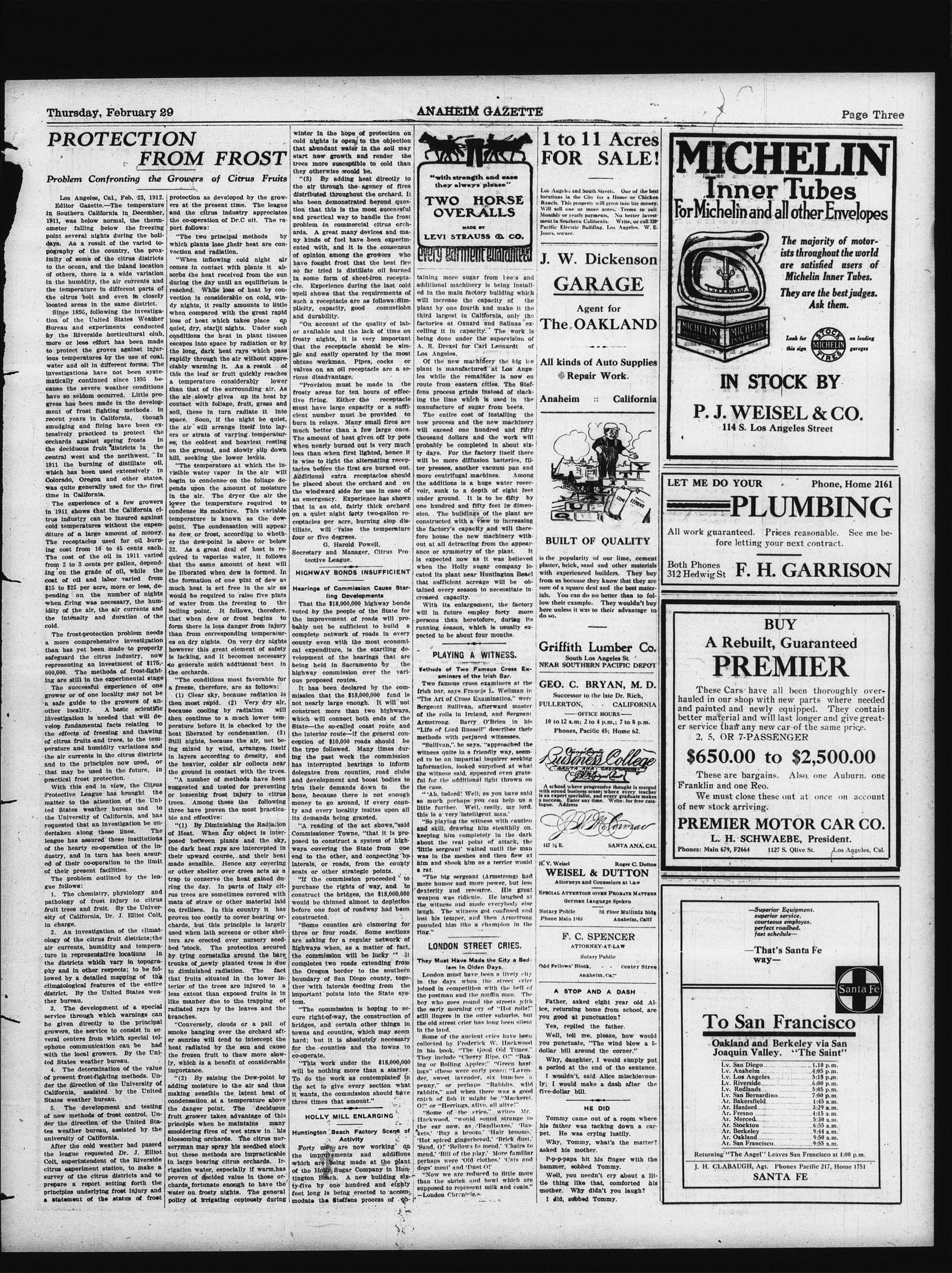
Searchable text
PROTECTION FROM FROST
Problem Confronting the Growers of Citrus Fruits
Los Angeles, Cal., Feb. 23, 1912.
Editor Gazette.—The temperature in Southern California in December, 1911, was below normal, the thermometer falling below the freezing point several nights during the holidays. As a result of the varied topography of the country, the proximity of some of the citrus districts to the ocean, and the inland location of others, there is a wide variation in the humidity, the air currents and the temperature in different parts of the citrus belt and even in closely located areas in the same district.
Since 1895, following the investigation of the United States Weather Bureau and experiments conducted by the Riverside horticultural club, more or less effort has been made to protect the groves against injurious temperatures by the use of coal, water and oil in different forms. The investigations have not been systematically continued since 1895 because the severe weather conditions have so seldom occurred. Little progress has been made in the development of frost fighting methods in recent years in California, though smudging and firing have been extensively practiced to protect the orchards against spring frosts in the deciduous fruit districts in the central west and the northwest. In 1911 the burning of distillate oil, which has been used extensively in protection as developed by the growers at the present time. The league and the citrus industry appreciates the co-operation of Dr.C oit. The report follows:
"The two principal methods by which plants lose their heat are convection and radiation.
"When inflowing cold night air comes in contact with plants it absorbs the heat received from the sun during the day until an equilibrium is reached. While loss of heat by convection is considerable on cold, windy nights, it really amounts to little when compared with the great rapid loss of heat which takes place on quiet, dry, starlit nights. Under such conditions the heat in plant tissues escapes into space by radiation or by the long, dark heat rays which pass rapidly through the air without appreciably warming it. As a result of this the leaf or fruit quickly reaches a temperature considerably lower than that of the surrounding air. As the air slowly gives up its heat by contact with foliage, fruit, grass and soil, these in turn radiate it into space. Soon, if the night be quiet, the air will arrange itself into layers or strata of varying temperatures, the coldest and heaviest resting on the ground, and slowly slip down hill, seeking the lower levels.
"The temperature at which the invisible water vapor in the air will winter in the hope of cold nights is open that abundant water start new growth trees more susceptible they otherwise would."
"(3) By adding the air through the distributed through rabs been demonstration that this is thand practical way to problem in commenards. A great many ny kinds of fuel ha ented with, and it of opinion among t have fought frost t so far tried is dis in some form of sicle. Experience dur spell shows that th such a receptacle am plicity, capacity, go and durability.
"On account of th or available and th frosty nights, it is that the receptacle ple and easily oper obtuse workman. I valves on an oil re ricious disadvantage.
"Provision must frosty areas for ter tive firing. Either must have large ca cient number must burn in relays. Man much better than s The amount of heat when nearly burned less than when first is wise to light th taples before the fir
The experience of a few growers in 1911 shows that the California citrus industry can be insured against cold temperatures without the expenditure of a large amount of money. The receptacles used for oil burning cost from 16 to 45 cents each. The cost of the oil in 1911 varied from 2 to 3 cents per gallon, depending on the grade of oil, while the cost of oil and labor varied from $15 to $25 per acre, more or less, depending on the number of nights when firing was necessary, the humidity of the air, the air currents and the intensity and duration of the cold.
The frost-protection problem needs a more comprehensive investigation than has yet been made to properly safeguard the citrus industry, now representing an investment of $175,000,000. The methods of frost-fighting are still in the experimental stage.
The successful experience of one grower or of one locality may not be a safe guide to the growers of another locality. A basic scientific investigation is needed that will develop fundamental facts relating to the effects of freezing and thawing of citrus fruits and trees, to the temperature and humidity variations and the air currents in the citrus districts and to the principles now used, or that may be used in the future, in practical frost protection.
With this end in view, the Citrus Protective League has brought the matter to the attention of the United States weather bureau and to the University of California, and has requested that an investigation be undertaken along these lines. The league has assured these institutions of the hearty co-operation of the industry, and in turn has been assured of their co-operation to the limit of their present facilities.
The problem outlined by the league follows:
1. The chemistry, physiology and biology involved in citrus trees are sometimes covered with a temperature considerably lower than that of the surrounding air. As the air slowly gives up its heat by contact with foliage, fruit, grass and soil, these in turn radiate it into space. Soon, if the night be quiet, the air will arrange itself into layers or strata of varying temperatures, the coldest and heaviest resting on the ground, and slowly slip down hill, seeking the lower levels.
"The temperature at which the invisible water vapor in the air will begin to condense on the foliage depends upon the amount of moisture in the air. The dryer the air the lower the temperature required to condense its moisture. This variable temperature is known as the dew-point. The condensation will appear as dew or frost, according to whether the dew-point is above or below 32. As a great deal of heat is required to vaporize water, it follows that the same amount of heat will be liberated when dew is formed. In the formation of one pint of dew as much heat is set free in the air as would be required to raise five pints of water from the freezing to the boiling point. It follows, therefore, that when dew or frost begins to form there is less danger from injury than from corresponding temperatures on dry nights. On very dry nights however this great element of safety is lacking, and it becomes necessary to generate much additional heat in the orchards.
"The conditions most favorable for a freeze, therefore, are as follows:
(1) Clear sky, because radiation is then most rapid. (2) Very dry air, because cooling by radiation will then continue to a much lower temperature before it is checked by the heat liberated by condensation. (3) Still nights, because the air, not being mixed by wind, arranges itself in layers according to density, and the heavier, colder air collects near the ground in contact with the trees.
"A number of methods have been suggested and tested for preventing or lessening frost injury to citrus trees. Among these the following three have proven the most practicable and effective:
"(1) By Diminishing the Radiation of Heat. When any object is interposed between plants and the sky, the dark heat rays are intercepted in their upward course, and their heat made sensible. Hence any covering or other shelter over trees acts as a trap to conserve the heat gained during the day. In parts of Italy citrus trees are sometimes covered with this leaf or fruit quickly reaches a temperature considerably lower than that of the surrounding air. As the air slowly gives up its heat by contact with foliage, fruit, grass and soil, these in turn radiate it into space. Soon, if the night be quiet, the air will arrange itself into layers or strata of varying temperatures, the coldest and heaviest resting on the ground, and slowly slip down hill, seeking the lower levels.
"The temperature at which the invisible water vapor in the air will begin to condense on the foliage depends upon the amount of moisture in the air. The dryer the air the lower the temperature required to condense its moisture. This variable temperature is known as the dew-point. The condensation will appear as dew or frost, according to whether the dew-point is above or below 32. As a great deal of heat is required to vaporize water, it follows that the same amount of heat will be liberated when dew is formed. In the formation of one pint of dew as much heat is set free in the air as would be required to raise five pints of water from the freezing to the boiling point. It follows, therefore, that when dew or frost begins to form there is less danger from injury than from corresponding temperatures on dry nights. On very dry nights however this great element of safety is lacking, and it becomes necessary to generate much additional heat in the orchards."
"The conditions most favorable for a freeze, therefore, are as follows:
(1) Clear sky, because radiation is then most rapid. (2) Very dry air, because cooling by radiation will then continue to a much lower temperature before it is checked by the heat liberated by condensation. (3) Still nights, because the air, not being mixed by wind, arranges itself in layers according to density, and the heavier, colder air collects near the ground in contact with the trees.
"A number of methods have been suggested and tested for preventing or lessening frost injury to citrus trees. Among these the following three have proven the most practicable and effective:
"(1) By Diminishing the Radiation of Heat. When any object is interposed between plants and the sky, the dark heat rays are intercepted in their upward course, and their heat made sensible. Hence any covering or other shelter over trees acts as a trap to conserve the heat gained during the day. In parts of Italy citrus trees are sometimes covered with this leaf or fruit quickly reaches a temperature considerably lower than that of the surrounding air. As the air slowly gives up its heat by contact with foliage, fruit, grass and soil, these in turn radiate it into space. Soon, if the night be quiet, the air will arrange itself into layers or strata of varying temperatures, the coldest and heaviest resting on the ground, and slowly slip down hill, seeking the lower levels."
"The temperature at which the invisible water vapor in the air will begin to condense on the foliage depends upon the amount of moisture in the air. The dryer the air the lower the temperature required to condense its moisture. This variable temperature is known as the dew-point. The condensation will appear as dew or frost, according to whether the dew-point is above or below 32. As a great deal of heat is required to vaporize water, it follows that the same amount of heat will be liberated when dew is formed. In the formation of one pint of dew as much heat is set free in the air as would be required to raise five pints of water from the freezing to the boiling point. It follows, therefore, that when dew or frost begins to form there is less danger from injury than from corresponding temperatures on dry nights. On very dry nights however this great element of safety is lacking, and it becomes necessary to generate much additional heat in the orchards."
"The conditions most favorable for a freeze, therefore, are as follows:
(1) Clear sky, because radiation is then most rapid. (2) Very dry air, because cooling by radiation will then continue to a much lower temperature before it is checked by the heat liberated by condensation. (3) Still nights, because the air, not being mixed by wind, arranges itself in layers according to density, and the heavier, colder air collects near the ground in contact with the trees.
"A number of methods have been suggested and tested for preventing or lessening frost injury to citrus trees. Among these the following three have proven the most practicable and effective:"
"("Provision must be frosty areas for sensitive firing. Either must have large capacity numbers must burn in relays. Many much better than others." The amount of heat when nearly burned less than when first is wise to light them.
"Additional extra need be placed about them;the windward side for an emergency.Experience that in an old,fairly on a quiet night for ceptacles per acre,tillate will raise four or five degrees.G.Harold Secretary and Managed League."
HIGHWAY BONDS
Hearings of Commissioning Dealing Devices
That the $18,000,000 voted bythe people,the improvement o bably not be sufficient complete network o county even with tha cal expenditure,i s development o he being held in Sacramento proposed routes.
It has been declared mission thatthe $18 not nearly large enough construct more than which will connect State—the so-called interior route—lception of $10,000 m type followed.
Ingthe past week has interrupted he delegates from councilsand trim their demandsbone,because there moneyto go aroundcity and every localityits demands being g"
"A reading ofthe Commissioner Townsposed to construct a ways coveringthe end tothe other,a laterals.or roads,and seatsor other strait."
"Ifthe commission purchasethe rightsconstructthe bridge."
matter to the attention of the United States weather bureau and to the University of California, and has requested that an investigation be undertaken along these lines. The league has assured these institutions of the hearty co-operation of the industry, and in turn has been assured of their co-operation to the limit of their present facilities.
The problem outlined by the league follows:
1. The chemistry, physiology and pathology of frost injury to citrus fruit trees and fruit. By the University of California, Dr. J. Elliot Coit, in charge.
2. An investigation of the climatology of the citrus fruit districts; the air currents, humidity and temperature in representative locations in the districts which vary in topography and in other respects; to be followed by a detailed mapping of the climatological features of the entire district. By the United States weather bureau.
3. The development of a special service through which warnings can be given directly to the principal growers, the service to consist in several centers from which special telephone communication can be had with the local growers. By the United States weather bureau.
4. The determination of the value of present frost-fighting methods. Under the direction of the University of California, assisted by the United States weather bureau.
5. The development and testing of new methods of frost control. Under the direction of the United States weather bureau, assisted by the university of California.
After the cold weather had passed the league requested Dr. J. Elliot Coit, superintendent of the Riverside citrus experiment station, to make a survey of the citrus districts and to prepare a report setting forth the principles underlying frost injury and a statement of the status of frost trees. Among these the following three have proven the most practicable and effective:
"(1) By Diminishing the Radiation of Heat. When any object is interposed between plants and the sky, the dark heat rays are intercepted in their upward course, and their heat made sensible. Hence any covering or other shelter over trees acts as a trap to conserve the heat gained during the day. In parts of Italy citrus trees are sometimes covered with mats of straw or other material laid on trellises. In this country it has proven too costly to cover bearing orchards, but this principle is largely used when lath screens or other shelters are erected over nursery seedbed stock. The protection secured by tying cornstalks around the bare trunks of newly planted trees is due to diminished radiation. The fact that fruits situated in the lower interior of the trees are injured to a less extent than exposed fruits is in like manner due to the trapping of radiated rays by the leaves and the branches.
"Conversely, clouds or a pall of smoke hanging over the orchard after sunrise will tend to intercept the heat radiated by the sun and cause the frozen fruit to thaw more slowly, which is a benefit of considerable importance."
"(2) By raising the Dew-point by adding moisture to the air and thus making sensible the latent heat of condensation at a temperature above the danger point. The deciduous fruit grower takes advantage of this principle when he maintains many smoldering fires of wet straw in his blossoming orchards. The citrus nurseryman may spray his seedbed stock but these methods are impracticable in large bearing citrus orchards. Irrigation water, especially if warm, has proven of decided value in those orchards fortunate enough to have the water on frosty nights. The general policy of irrigating copiously during money to go around city and every locality its demands being given."
"A reading of the Commissioner Townsend posed to construct ways covering the end to the other, and laterals, or roads, seats or other straits."
"If the commission purchase the rights construct the bridge would be thinned all before one foot of road constructed."
"Some counties are three or four roads are asking for a real highways when, as the commission will complete two roads, the Oregon border boundary with laterals important points intem."
"The commission cure right-of-way, the bridges, and certain towns and counties, hard; but it is absurd for the counties and co-operate."
"This work underwill be nothing more To do the work as the act to give even it wants, the commission three times that am."
winter in the hope of protection on cold nights is open to the objection that abundant water in the soil may start new growth and render the trees more susceptible to cold than they otherwise would be.
"(3) By adding heat directly to the air through the agency of fires distributed throughout the orchard. It has been demonstrated beyond question that this is the most successful and practical way to handle the frost problem in commercial citrus orchards. A great many devices and many kinds of fuel have been experimented with, and it is the consensus of opinion among the growers who have fought frost that the best fire so far tried is distillate oil burned in some form of sheet-iron receptacle. Experience during the last cold spell shows that the requirements of such a receptacle are as follows: Simplicity, capacity, good combustion and durability.
"On account of the quality of labor available and the lack of time on frosty nights, it is very important that the receptacle should be simple and easily operated by the most obtuse workman. Pipes, cocks or valves on an oil receptacle are a serious disadvantage.
"Provision must be made in the frosty areas for ten hours of effective firing. Either the receptacle must have large capacity or a sufficient number must be provided to burn in relays. Many small fires are much better than a few large ones. The amount of heat given off by pots when nearly burned out is very much less than when first lighted, hence it is wise to light the alternating receptacles before the first are burned out."
1 to 11 Acres FOR SALE!
Los Angeles and South Streets. One of the best locations in the City for a Home or Chicken Ranch. This property will grow into big money. Will sell one or more acres. Terms to suit Monthly or yearly payments. No better investment in Southern California. Write, or call 320 Pacific Electric Building, Los Angeles, W. E. Jones, owner.
J. W. Dickenson GARAGE
Agent for The OAKLAND
All kinds of Auto Supplies Repair Work.
Anaheim :: California
“Provision must be made in the frosty areas for ten hours of effective firing. Either the receptacle must have large capacity or a sufficient number must be provided to burn in relays. Many small fires are much better than a few large ones. The amount of heat given off by pots when nearly burned out is very much less than when first lighted, hence it is wise to light the alternating receptacles before the first are burned out. Additional extra receptacles should be placed about the orchard and on the windward side for use in case of an emergency. Experience has shown that in an old, fairly thick orchard on a quiet night forty two-gallon receptacles per acre, burning slop distillate, will raise the temperature four or five degrees.
G. Harold Powell,
Secretary and Manager, Citrus Protective League.
HIGHWAY BONDS INSUFFICIENT
Hearings of Commission Cause Starling Developments
That the $18,000,000 highway bonds voted by the people of the State for the improvement of roads will probably not be sufficient to build a complete network of roads in every county even with the most economical expenditure, is the startling development of the hearings that are being held in Sacramento by the highway commission over the various proposed routes.
It has been declared by the commission that the $18,000,000 fund is not nearly large enough. It will not construct more than two highways, which will connect both ends of the State—the so-called coast route and the interior route—if the general conception of $10,000 roads should be the type followed. Many times during the past week the commission has interrupted hearings to inform delegates from counties, road clubs and development and boost bodies to trim their demands down to the bone, because there is not enough money to go around, if every county and every locality insists upon all its demands being granted.
“A reading of the act shows,” said Commissioner Towne, “that it is proposed to construct a system of highways covering the State from one end to the other, and connecting by laterals, or roads, from the county seats or other strategic points.
“If the commission proceeded to purchase the rights of way, and to construct the bridges, the $18,000,000 les while the remainder is now en route from eastern cities. The Steffens process grinds instead of slacking the lime which is used in the manufacture of sugar from beets.
The entire cost of installing the new process and the new machinery will exceed one hundred and fifty thousand dollars and the work will probably be completed in about sixty days. For the factory itself there will be more diffusion batteries, filter presses, another vacuum pan and more centrifugal machines. Among the additions is a huge water reservoir, sunk to a depth of eight feet under ground. It is to be fifty by one hundred and fifty feet in dimension. The buildings of the plant are constructed with a view to increasing the factory's capacity and will therefore house the new machinery without at all detracting from the appearance or symmetry of the plant. It is expected now as it was believed when the Holly sugar company located its plant near Huntington Beach that sufficient acreage will be obtained every season to necessitate increased capacity.
With its enlargement, the factory will in future employ forty more persons than heretofore, during its running season, which is usually expected to be about four months.
PLAYING A WITNESS.
Methods of Two Famous Cross Examiners of the Irish Bar.
Two famous cross examiners at the frish bar, says Francis L. Wellman in "The Art of Cross Examination," were Sergeant Sullivan, afterward master of the rolls in Ireland, and Sergeant Armstrong. Barry O'Brien in his "Life of Lord Russell" describes their methods with perjured witnesses.
"Sullivan," he says, "approached the witness quite in a friendly way, seemed to be an impartial inquirer seeking information, looked surprised at what the witness said, appeared even grateful for the additional light thrown on the case.
"'Ab, indeed! Well, as you have said so much perhaps you can help us a little further. Well, really, my lord. this is a very intelligent man."
"So playing the witness with caution and skill, drawing him stealthily on, keeping him completely in the dark about the real point of attack, the 'little sergeant' waited until the man was in the meshes and then flew at him and shook him as a terrier would a rat.
"The big sergeant (Armstrong) had more humor and more power, but less dexterity and resource. His great weapon was ridicule. He laughed at..."
money to go around, if every county and every locality insitss upon all its demands being granted.
"A reading of the act shows," said Commissioner Towne, "that it is proposed to construct a system of highways covering the State from one end to the other, and connecting by laterals, or roads, from the county seats or other strategic points.
"If the commission proceeded to purchase the rights of way, and to construct the bridges, the $18,000,000 would be thinned almost to depletion before one foot of roadway had been constructed.
"Some counties are clamoring for three or four roads. Some sections are asking for a regular network of highways when, as a matter of fact, the commission will be lucky." It completes two roads extending from the Oregon border to the southern boundary of San Diego county, together with laterals feeding from the important points into the State system.
"The commission is hoping to secure right-of-way, the construction of bridges, and certain other things in towns and counties, which may seem hard; but it is absolutely necessary for the counties and the towns to co-operate."
"This work under the $18,000,000 will be nothing more than a starter. To do the work as contemplated in the act to give every section what it wants, the commission should have three times that amount."
HOLLY MILL ENLARGING
Huntington Beach Factory Scene of Activity
Forty men are now working on the improvements and additions which are being made at the plant of the Holly Sugar Company in Huntington Beach. A new building sixty-five by one hundred and eighty feet long is being erected to accommodate the Steffens process of obsolete machinery.
So much perhaps you can help us a little further. Well, really, my lord, this is a very intelligent man.
"So playing the witness with caution and skill, drawing him stealthily on, keeping him completely in the dark about the real point of attack, the 'little sergeant' waited until the man was in the meshes and then flew at him and shook him as a terrier would a rat.
"The big sergeant (Armstrong) had more humor and more power, but less dexterity and resource. His great weapon was ridicule. He laughed at the witness and made everybody else laugh. The witness got confused and lost his temper, and then Armstrong pounded him like a champion in the ring."
LONDON STREET CRIES.
They Must Have Made the City a Bedlam in Olden Days.
London must have been a lively city in the days when the street crier joined in competition with the bell of the postman and the muffin man. The boy who goes round the streets with the early morning cry of "Hot rolls!" still lingers in the outer suburbs, but the old street crier has long been silent in the land.
Some of the ancient cries have been collected by Frederick W. Hackwood in his book, "The Good Old Times." They include "Cherry Ripe, O!," "Baking or Bolling Apples;" "Green hastings" (these were early peas); "Lavender, sweet lavender, six bunches a penny," or perhaps "Rabbits, wild rabbits," and when there was a good catch of fish it might be "Mackerel, O!" or "Herrings, alive, all alive."
"Some of the cries," writes Mr. Hackwood, "would sound strange to the ear now, as 'Bandboxes,' 'Baskets,' 'Buy a broom,' 'Hair brooms,' 'Hot spiced gingerbread,' 'Brick dust,' 'Sand, O!' 'Bellows to mend,' 'Chairs to mend,' 'Bill of the play.' More familiar perhaps were 'Old clothes,' 'Cats and dogs' meat' and 'Dust O!'
Now we are reduced to little more than the shriek and howl which are supposed to represent milk and coals."
-London Chronicle-
MICHELIN
Inner Tubes
For Michelin and all other Envelopes
The majority of motorists throughout the world are satisfied users of Michelin Inner Tubes.
They are the best judges. Ask them.
Look for this sign on leading garages
IN STOCK BY
P. J. WEISEL & CO.
114 S. Los Angeles Street
IN STOCK BY
P. J. WEISEL & CO.
114 S. Los Angeles Street
LET ME DO YOUR Phone, Home 2161
PLUMBING
All work guaranteed. Prices reasonable. See me before letting your next contract.
Both Phones
312 Hedwig St F. H. GARRISON
BUY
A Rebuilt, Guaranteed
PREMIER
These Cars have all been thoroughly over-hauled in our shop with new parts where needed and painted and newly equipped. They contain better material and will last longer and give greater service than any new car of the same price.
2, 5, OR 7-PASSENGER
$650.00 to $2,500.00
These are bargains. Also one Auburn, one Franklin and one Reo.
We must close these out at once on account of new stock arriving.
PREMIER MOTOR CAR CO.
L. H. SCHWAEBE, President.
Phones: Main 679, F2664 1127 S. Olive St Los Angeles, Cal.
PREMIER MOTOR CAR CO.
L. H. SCHWAEBE, President.
Phones: Main 679, F2664 1127 S. Olive St Los Angeles, Cal.
—Superior Equipment,
superior service,
courteous employes,
perfect roadbed,
fast schedule—
That’s Santa Fe way—
To San Francisco
Oakland and Berkeley via San Joaquin Valley. “The Saint”
Lv. San Diego 1:10 p.m.
Lv. Anaheim 4:05 p.m.
Lv. Los Angeles 5:15 p.m.
Lv. Riverside 6:00 p.m.
Lv. Redlands 5:05 p.m.
Lv. San Bernardino 7:00 p.m.
Ar. Bakersfield 1:45 a.m.
Ar. Hanford 3:29 a.m.
Ar. Fresno 4:15 a.m.
Ar. Merced 5:30 a.m.
Ar. Stockton 6:55 a.m.
Ar. Berkeley 9:44 a.m.
Ar. Oakland 9:50 a.m.
Ar. San Francisco 9:55 a.m.
Returning “The Angel” Leaves San Francisco at 4:00 p.m.
J. H. CLABAUGH, Agt. Phones Pacific 217, Home 1751
SANTA FE