anaheim-gazette 1912-02-29
Scanned page
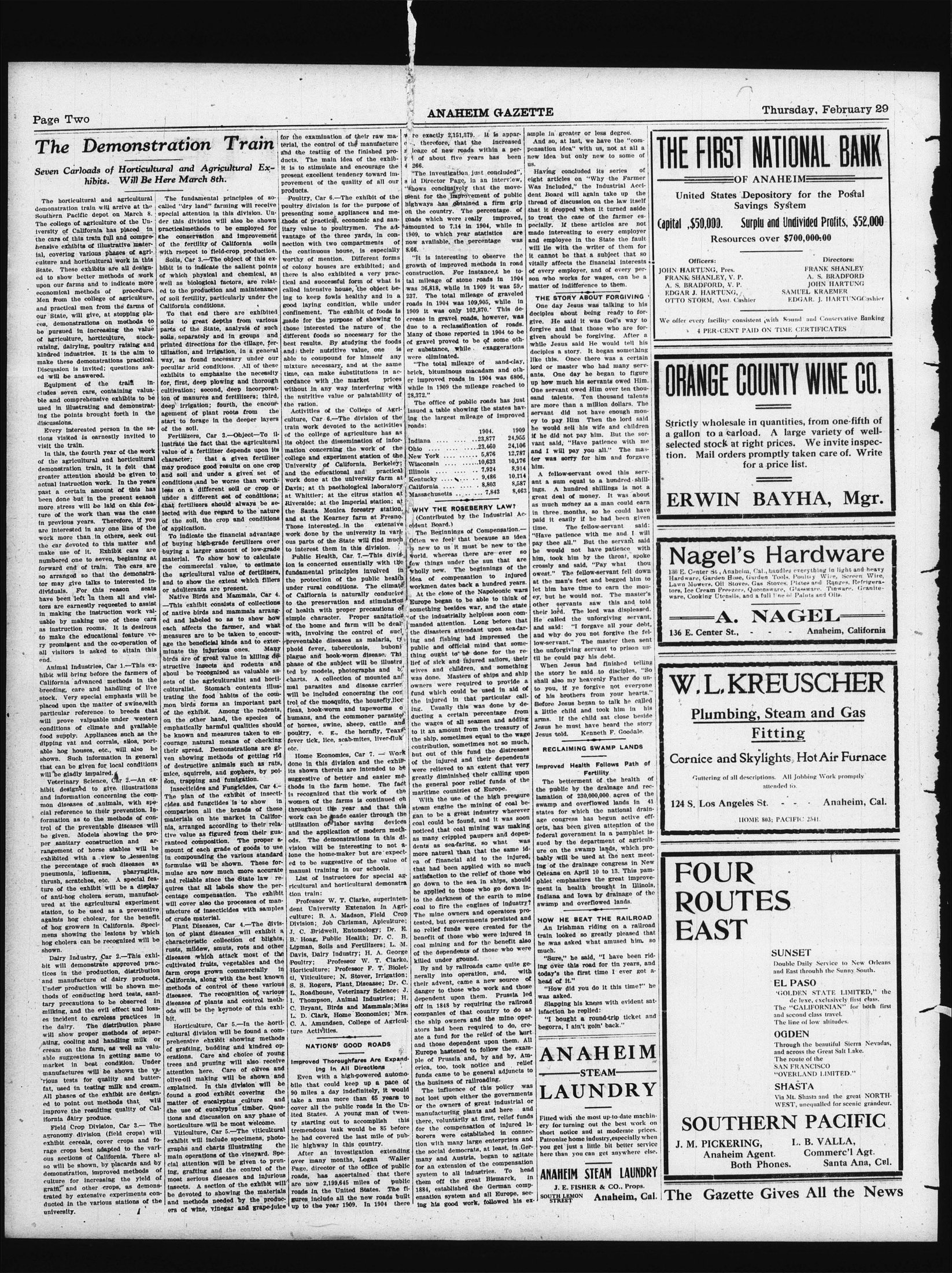
Searchable text
The Demonstration Train
Seven Carloads of Horticultural and Agricultural Exhibits. Will Be Here March 8th.
The horticultural and agricultural demonstration train will arrive at the Southern Pacific depot on March 8. The college of agriculture of the University of California has placed in the cars of this train full and comprehensive exhibits of illustrative material, covering various phases of agriculture and horticultural work in this State. These exhibits are all designed to show better methods of work upon our farms and to indicate more economical methods of procedure. Men from the college of agriculture, and practical men from the farms of our State, will give, at stopping places, demonstrations on methods to be pursued in increasing the value of agriculture, horticulture, stockraising, dairying, poultry raising and kindred industries. It is the aim to make these demonstrations practical. Discussion is invited; questions asked will be answered.
Equipment of the train includes seven cars, containing valuable and comprehensive exhibits to be used in illustrating and demonstrating the points brought forth in the discussions.
Every interested person in the sections visited is earnestly invited to visit the train.
In this, the fourth year of the work of the agricultural and horticultural demonstration train, it is felt that attention should be given to
The fundamental principles of so-called "dry land" farming will receive special attention in this division. Under this division will also be shown practical methods to be employed for the conservation and improvement of the fertility of California soils with respect to field-crop production.
Soils, Car 3.—The object of this exhibit is to indicate the salient points of which physical and chemical, as well as biological factors, are related to the production and maintenance of soil fertility, particularly under the California conditions.
To that end there are exhibited soils to great depths from various parts of the State, analysis of such soils separately and in groups and printed directions for the tillage, fertilization, and irrigation, in a general way, as found necessary under our peculiar arid conditions. All of these exhibits to emphasize the necessity for, first, deep plowing and thorough cultivation; second, deep incorporation of manures and fertilizers; third, deep irrigation; fourth, the encouragement of plant roots from the start to forage in the deeper layers of the soil.
Fertilizers, Car 3.—Object—To illustrate the fact that the agricultural value of a fertilizer depends upon its character; that a given fertilizer may produce good results on one crop and soil and under a given set of for the examination of material, the control of the and the testing of the products. The main idea it is to stimulate and present excellent tenderness provement of the quality products.
Poultry, Car 6.—The poultry division is for presenting some appliance methods of practical, economic value to poultry vantage of the three connection with two compulsive continuous house, worthy of mention. Dof colony houses are there is also exhibited technical and successful form called intensive house, ing to keep fowls healthy good laying condition, confinement. The exhibition made for the purpose those interested the most different foods so need best results. By study and their nutritive variable to compound for mixture necessary, and time, can make substitution with the mait without in any way in the nutritive value or ration.
Activities of the Culture, Car 6.—The train work devoted to of the college of agriculture object the dissemination concerning the college and experiment University of California and the educational
Equipment of the train includes seven cars, containing valuable and comprehensive exhibits to be used in illustrating and demonstrating the points brought forth in the discussions.
Every interested person in the sections visited is earnestly invited to visit the train.
In this, the fourth year of the work of the agricultural and horticultural demonstration train, it is felt that greater attention should be given to actual instruction work. In the years past a certain amount of this has been done but in the present season more stress will be laid on this feature of the work than was the case in previous years. Therefore, if you are interested in any one line of the work more than in others, seek out the car devoted to this matter and make use of it. Exhibit cars are numbered one to seven, beginning at forward end of train. The cars are so arranged so that the demonstrator may give talks to interested individuals. For this reason seats have been left in them all and visitors are earnestly requested to assist in making the instruction work valuable by making use of these cars as instruction rooms. It is desirable to make the educational feature very prominent and the co-operation of all visitors is asked to attain this end.
Animal Industries, Car 1.—This exhibit will bring before the farmers of California advanced methods in the breeding, care and handling of live stock. Very special emphasis will be placed upon the matter of swine, with particular reference to breeds that will prove valuable under western conditions of climate and available food supply. Appliances such as the dipping vat and corrals, silos, portable hog houses, etc., will also be shown. Such information in general that can be given for local conditions will be gladly impaired.
Veterinary Science, Car 2.—An exhibit designed to give illustrations and information concerning the common diseases of animals, with special reference to their prevention. Information as to the methods of control of the preventable diseases will be given. Models showing the proper sanitary construction and arrangement of horse stables will be exhibited with a view to lessening the percentage of such diseases as pneumonia, influenza, pharyngitis, thrush, scratches, etc. A special feature of the exhibit will be a display of anti-hog cholera serum, manufactured will be answered.
Equipment of the train includes seven cars, containing valuable and comprehensive exhibits to be used in illustrating and demonstrating the points brought forth in the discussions.
Every interested person in the sections visited is earnestly invited to visit the train.
In this, the fourth year of the work of the agricultural and horticultural demonstration train, it is felt that greater attention should be given to actual instruction work. In the years past a certain amount of this has been done but in the present season more stress will be laid on this feature of the work than was the case in previous years. Therefore, if you are interested in any one line of the work more than in others, seek out the car devoted to this matter and make use of it. Exhibit cars are numbered one to seven, beginning at forward end of train. The cars are so arranged so that the demonstrator may give talks to interested individuals. For this reason seats have been left in them all and visitors are earnestly requested to assist in making the instruction work valuable by making use of these cars as instruction rooms. It is desirable to make the educational feature very prominent and the co-operation of all visitors is asked to attain this end.
Animal Industries, Car 1.—This exhibit will bring before the farmers of California advanced methods in the breeding, care and handling of live stock. Very special emphasis will be placed upon the matter of swine, with particular reference to breeds that will prove valuable under western conditions of climate and available food supply. Appliances such as the dipping vat and corrals, silos, portable hog houses, etc., will also be shown. Such information in general that can be given for local conditions will be gladly impaired.
Veterinary Science, Car 2.—An exhibit designed to give illustrations and information concerning the common diseases of animals, with special reference to their prevention. Information as to the methods of control of the preventable diseases will be given. Models showing the proper sanitary construction and arrangement of horse stables will be exhibited with a view to lessening the percentage of such diseases as pneumonia, influenza, pharyngitis, thrush, scratches, etc. A special feature of the exhibit will be a display of anti-hog cholera serum, manufactured will be answered.
Equipment of the train includes seven cars, containing valuable and comprehensive exhibits to be used in illustrating and demonstrating the points brought forth in the discussions.
Every interested person in the sections visited is earnestly invited to visit the train.
In this, the fourth year of the work of the agricultural and horticultural demonstration train, it is felt that greater attention should be given to actual instruction work. In the years past a certain amount of this has been done but in the present season more stress will be laid on this feature of the work than was the case in previous years. Therefore, if you are interested in any one line of the work more than in others, seek out the car devoted to this matter and make use of it. Exhibit cars are numbered one to seven, beginning at forward end of train. The cars are so arranged so that the demonstrator may give talks to interested individuals. For this reason seats have been left in them all and visitors are earnestly requested to assist in making the instruction work valuable by making use of these cars as instruction rooms. It is desirable to make the educational feature very prominent and the co-operation of all visitors is asked to attain this end.
Animal Industries, Car 1.—This exhibit will bring before the farmers of California advanced methods in the breeding, care and handling of live stock. Very special emphasis will be placed upon the matter of swine, with particular reference to breeds that will prove valuable under western conditions of climate and available food supply. Appliances such as the dipping vat and corrals, silos, portable hog houses, etc., will also be shown. Such information in general that can be given for local conditions will be gladly impaired.
Veterinary Science, Car 2.—An exhibit designed to give illustrations and information concerning the common diseases of animals, with special reference to their prevention. Information as to the methods of control of the preventable diseases will be given. Models showing the proper sanitary construction and arrangement of horse stables will be exhibited with a view to lessening the percentage of such diseases as pneumonia, influenza, pharyngitis, thrush, scratches, etc. A special feature of the exhibit will be a display of anti-hog cholera serum, manufactured will be answered.
Equipment of the train includes seven cars, containing valuable and comprehensive exhibits to be used in illustrating and demonstrating the points brought forth in discussions.
Every interested person in the sections visited is earnestly invited to visit the train.
In this, the fourth year of the work of the agricultural and horticultural demonstration train, it is felt that greater attention should be given to actual instruction work. In the years past a certain amount of this has been done but in the present season more stress will be laid on this feature of the work than was the case in previous years. Therefore, if you are interested in any one line of the work more than in others, seek out the car devoted to this matter and make use of it. Exhibit cars are numbered one to seven, beginning at forward end of train. The cars are so arranged so that the demonstrator may give talks to interested individuals. For this reason seats have been left in them all and visitors are earnestly requested to assist in making the instruction work valuable by making use of these cars as instruction rooms. It is desirable to make the educational feature very prominent and the co-operation of all visitors is asked to attain this end.
Animal Industries, Car 1.—This exhibit will bring before the farmers of California advanced methods in the breeding, care and handling of live stock. Very special emphasis will be placed upon the matter of swine, with particular reference to breeds that will prove valuable under western conditions of climate and available food supply. Appliances such as the dipping vat and corrals, silos, portable hog houses, etc., will also be shown. Such information in general that can be given for local conditions will be gladly impaired.
Veterinary Science, Car 2.—An exhibit designed to give illustrations and information concerning the common diseases of animals, with special reference to their prevention. Information as to the methods of control of the preventable diseases will be given. Models showing the proper sanitary construction and arrangement of horse stables will be exhibited with a view to lessening the percentage of such diseases as pneumonia, influenza, pharyngitis, thrush, scratches, etc. A special feature of the exhibit will be a display of anti-hog cholera serum, manufactured will be answered.
Equipment of the train includes seven cars, containing valuable and comprehensive exhibits to be used in illustrating and demonstrating the points brought forth in discussions.
Every interested person in the sections visited is earnestly invited to visit the train.
In this, the fourth year of the work of the agricultural and horticultural demonstration train, it is felt that greater attention should be given to actual instruction work. In the years past a certain amount of this has been done but in the present season more stress will be laid on this feature of the work than was the case in previous years. Therefore, if you are interested in any one line of the work more than in others, seek out the car devoted to this matter and make use of it. Exhibit cars are numbered one to seven, beginning at forward end of train. The cars are so arranged so that the demonstrator may give talks to interested individuals. For this reason seats have been left in them all and visitors are earnestly requested to assist in making the instruction work valuable by making use of these cars as instruction rooms. It is desirable to make the educational feature very prominent and the co-operation of all visitors is asked to attain this end.
Animal Industries, Car 1.—This exhibit will bring before the farmers of California advanced methods in the breeding, care and handling of live stock. Very special emphasis will be placed upon the matter of swine, with particular reference to breeds that will prove valuable under western conditions of climate and available food supply. Appliances such as the dipping vat and corrals, silos, portable hog houses, etc., will also be shown. Such information in general that can be given for local conditions will be gladly impaired.
Veterinary Science, Car 2.—An exhibit designed to give illustrations and information concerning the common diseases of animals, with special reference to their prevention. Information as to the methods of control of the preventable diseases will be given. Models showing the proper sanitary construction and arrangement of horse stables will be exhibited with a view to lessening the percentage of such diseases as pneumonia, influenza, pharyngitis, thrush, scratches, etc. A special feature of the exhibit will be a display of anti-hog cholera serum, manufactured will be answered.
Equipment of the train includes seven cars, containing valuable and comprehensive exhibits to be used in illustrating and demonstrating the points brought forth in discussions.
Every interested person in the sections visited is earnestly invited to visit the train.
In this, the fourth year ofthe workofthecollegeofagriculture,theobjectthedisseminationthecollegeandexperimentUniversityofCaliforniaandtheeducationalworkdoneattheuniversalpartsoftheStatetointeresttheminthePublicHealth,CarionisconcernedessertfundamentalprincipletheprotectionoftheunderruralconditionsofCaliforniaisnaturaltothepreservationahealthwithpropertysimplecharacter.Problemofthehomeandfarmwithinvolvingtheco-preventablediseasesphoidfever,tuberculoplasmaandhook-wormphaseofthesubjecttedbymodels,pictures.Acollectionmalparasitesandwillbeincludedconcedrolofthemosquito,the fleas,hook-wormandhumans,andthecomfohorses,swine,shepoultry,e.g.,thefevertick,Lice,scaresetc.
Home Economics,Growndoneinthisdivisionitsshownthereinaresuggestiveofbetterthoughtsinthe farmhousiscognizedthatthewomenofthefarmsthroughouttheyearworkcanbemadeeasilyutilizationoflaborsoandapplicationodds.The demonstratevisionwillbelineartionelehome-makeredtobesuggestivemanualtraininginoc
Listofinstructorsriculturalandhorticulturetrain:
mon diseases of animals, with special reference to their prevention. Information as to the methods of control of the preventable diseases will be given. Models showing the proper sanitary construction and arrangement of horse stables will be exhibited with a view to lessening the percentage of such diseases as pneumonia, influenza, pharyngitis, thrush, scratches, etc. A special feature of the exhibit will be a display of anti-hog cholera serum, manufactured at the agricultural experiment station, to be used as a preventive against hog cholear, for the benefit of hog growers in California. Specimens showing the lesions by which hog cholera can be recognized will be shown.
Dairy Industry, Car 2.—This exhibit will demonstrate approved practices in the production, distribution and manufacture of dairy products. Under production will be shown methods of conducting herd tests, sanitary precautions to be observed in milking, and the evil effect and losses incident to careless practices in the dairy. The distribution phase will show proper methods of separating, cooling and handling milk or cream on the farm, as well as valuable suggestions in getting same to market in best condition. Under manufactures will be shown the various tests for quality and butterfat, used in testing milk and cream. All phases of the exhibit are designed to point out methods that will improve the resulting quality of California dairy produce.
Field Crop Division, Car 3.—The agronomy division (field crops) will exhibit cereals, cover crops and forage crops best adapted to the various sections of California. There also will be shown, by placards and by demonstration, improved methods of culture for increasing the yield of grain, and other crops, as demonstrated by extensive experiments conducted in the various stations of the university.
The plant diseases is to show in comparison all the brands of these materials on hte market in California, arranged according to their relative value as figured from their guaranteed composition. The proper amount of each grade of goods to use in compounding the various standard formulae will be shown. These formulae are now much more accurate and reliable since the State law requires that all labels show the percentage compensation. The exhibit will cover also the processes of manufacture of insecticides with samples of crude material.
Plant Diseases, Car 4.—The division of plant diseases will exhibit a characteristic collection of blights, rusts, mildew, smuts, rots and other diseases which attack most of the cultivated fruits, vegetables and the farm crops grown commercially in California, along with the best known methods of control of these various diseases. The recognition of various diseases of plants and control methods will be the keynote of this exhibit.
Horticulture, Car 5.—In the horticultural division will be found a comprehensive exhibit showing methods of grafting, budding and kindred operations. Care and choice of young trees and pruning will also receive attention here. Care of olives and olive oil making will be shown and explained. In this division will be found a good exhibit covering the matter of eucalyptus culture and the use of eucalyptus timber. Questions and discussion on any phase of horticulture will be most welcome.
Viticulture, Car 6.—The viticultural exhibit will include specimens, photographs and charts illustrating the main operations of the vineyard. Special attention will be given to pruning, grafting and the control of the most serious diseases and injurious insects. A section of the exhibit will be devoted to showing the materials and methods needed by the producers of wine, vinegar and grape juice.
Women of the farms throughout the year work can be made easily utilization of labor so and the application ods. The demonstration vision will be interested alone the home-maker ed to be suggestive manual training in o
List of instructors' cultural and horticulture train:
Professor W. T. Chidest University Extension; B. A. Mads Division; Job Christen J. C. Bridwell, Entro B. Hoag, Public Head Lipman, Soils and F Davis, Dairy Industry Poultry; Professor Horticulture; Professor Viiculture; N. S. S. S. Rogers, Plant L. Roadhouse, Veterin I. Thompson, Animal C. Bryant, Birds and L. D. Clark, Home C. A. Amundsen, Culture Activities.
NATIONS' GOOD
Improved Thoroughfare
Ing In All
Even with a high-bite that could keep 90 miles a day indo take a man more than cover all the public United States. A youth starting out to a tremendous task would he had covered the public highway in this
After an investiture over many months, Page, director of the roads, has ascerta are now 2,199,645 roads in the United gures include all th up to the year 1909
for the examination of their raw material, the control of the manufacture and the testing of the finished products. The main idea of the exhibit is to stimulate and encourage the present excellent tendency toward improvement of the quality of all our products.
Poultry, Car 6.—The exhibit of the poultry division is for the purpose of presenting some appliances and methods of practical, economic and sanitary value to poultrymen. The advantage of the three yards, in connection with two compartments of the continuous house, is especially worthy of mention. Different forms of colony houses are exhibited; and there is also exhibited a very practical and successful form of what is called intensive house, the object being to keep fowls healthy and in a good laying condition, while under confinement. The exhibit of foods is made for the purpose of showing to those interested the nature of the different foods so necessary for the best results. By studying the foods and their nutritive value, one is able to compound for himself any mixture necessary, and at the same time, can make substitutions in accordance with the market prices without in any way interfering with the nutritive value or palatability of the ration.
Activities of the College of Agriculture, Car 6.—The division of the train work devoted to the activities of the college of agriculture has as its object the dissemination of information concerning the work of the college and experiment station of the University of California, Berkeley; and the educational and practical
were exactly 2,151,379. It is apparent, therefore, that the increased mileage of new roads within a period of about five years has been 4,266.
"The investigation just concluded," said Director Page, in an interview, "shows conclusively that the movement for the improvement of public highways has obtained a firm grip on the country. The percentage of roads which were really improved, amounted to 7.14 in 1904, while in 1909, to which year statistics are now available, the percentage was 8.66.
"It is interesting to observe the growth of improved methods in road construction. For instance, he total mileage of stone roads in 1904 was 36,818, while in 1909 it was 59,237. The total mileage of gravelled roads in 1904 was 109,905, while in 1909 it was only 102,870." This decrease in gravel roads, however, was due to a reclassification of roads. Many of those reported in 1904 to be of gravel proved to be of some other substance, while exaggerations were eliminated.
"The total mileage of sand-clay, brick, bituminous macadam and other improved roads in 1904 was 6806, while in 1909 the mileage reached to 28,372."
The office of public roads has just issued a table showing the states having the largest mileage of improved roads:
| State | Mileage |
| :--- | :--- |
| Indiana | 23,877 |
| Ohio | 23,460 |
| New York | 5,876 |
| Wisconsin | 10,633 |
| Illinois | 7,924 |
ample in greater or less degree.
And so, at last, we have the "compensation idea" with us, not at all a new idea but only new to some of us.
Having concluded its series of eight articles on "Why the Farmer Was Included," the Industrial Accident Board will again take up the thread of discussion on the law itself that it dropped when it turned aside to treat the case of the farmer especially. If these articles are not made interesting to every employer and employee in the State the fault will lie with the writer of them for it cannot be that a subject that so vitally affects the financial interests of every employer, and of every person who works for wages, can be a matter of indifference to them.
THE STORY ABOUT FORGIVING
One day Jesus was talking to his disciples about being ready to forgive. He said it was God's way to forgive and that those who are forgiven should be forgiving. After a while Jesus said He would tell his disciples a story. It began something like this. Once there was a certain lord or master who had many servants. One day he began to figure up how much his servants owed Him. One servant owed Him over ten thousand talents. Ten thousand talents are more than a million dollars. The servant did not have enough money to pay Him. Then the lord said he would sell his wife and children if he did not pay him. But the servant said, "Have patience with me and I will pay you all." The master was sorry for him and forgave him.
A fellow-servant owed this servant...
Activities of the College of Agriculture, Car 6.—The division of the train work devoted to the activities of the college of agriculture has as its object the dissemination of information concerning the work of the college and experiment station of the University of California, Berkeley; and the educational and practical work done at the university farm at Davis; at th paethological laboratory at Whittier; at the citrus station at Riverside; at the Imperial station; at the Santa Monica forestry station, and at the Kearney farm at Fresno. Those interested in the extensive work done by the university in various parts of the State will find much to interest them in this division.
Public Health, Car 7.—This division is concerned essentially with the fundamental principles involved in the protection of the public health under rural conditions. The climate of California is naturally conducive to the preservation and stimulation of health with proper precautions of simple character. Proper sanitation of the home and farm will be dealt with, involving the control of such preventable diseases as malaria, typhoid fever, tuberculosis, bubonic plague and hook-worm disease. This phase of the subject will be illustrated by models, photographs and charts. A collection of mounted animal parasites and disease carriers will be included concerning the control of the mosquito, the housefly,lice fleas, hook-worm and tapeworms of humans, and the commoner parasites of horses, swine, sheep, cattle and poultry, e. g., the hornfly, Teaxs fever tick, lice, scab-mites, liver-fluk etc.
Home Economics, Car 7. — Work done in this division and the exhibits shown therein are intended to be suggestive of better and easier methods in the farm home. The fact is recognized that the work of the women of the farms is continued on throughout the year and that this work can be made easier through the utilization of labor saving devices and the application of modern methods. The demonstrations in this division will be interesting to not alone the home-maker but are expected to be suggestive of the value of manual training in our schools.
List of instructors for special agricultural and horticultural demonstration train:
WHY THE ROSEBERRY LAW?
(Contributed by the Industrial Accident Board.)
The Beginnings of Compensation.—Often we feel that because an idea is new to us it must be new to the world. whereas there are ever so few things under the sun that are wholly new. The beginnings of the idea of compensation to injured workmen dates back a hundred years.
At the close of the Napoleonic wars Europe began to be able to think of something besides war, and the state of the industrially helpless soon commanded attention. Long before that the disasters attendant upon sea-faring and fishing had impressed the public and official mind that something ought to be done for the relief of sick and injured sailors, their wives and children, and something was done. Masters of ships and ship owners were required to provide a fund which could be used in aid of the injured in that particular calling. Usually this was done by deducting a certain percentage from the wages of all seamen and adding to it an amount from the treasury of the ship, sometimes equal to the wage contribution, sometimes not so much, but out of this fund the distresses of the injured and their dependents were relieved to an extent that very greatly diminished their calling upon the general poor relief funds of the maritime countries of Europe.
With the use of the high pressure steam engine the mining of coal began to be a great industry wherever coal could be found, and it was soon noticed that coal mining was making as many crippled paupers and dependents as sea-faring, so what was more natural than that the same idea of financial aid to the injured, that had been applied with so much satisfaction to the relief of those who go down to the sea in ships, should be applied to those who go down into the darkness of the earth to mine plants. One day he began to figure up how much his servants owed Him. One servant owed Him over ten thousand talents. Ten thousand talents are more than a million dollars. The servant did not have enough money to pay Him Then the lord said he would sell his wife and children if he did not pay him. But the servant said, "Have patience with me and I will pay you all." The master was sorry for him and forgave him.
A fellow-servant owed this servant a sum equal to a hundred shillings. A hundred shillings is not a great deal of money. It was about as much money as a man could earn in three months, so he could have paid it easily if he had been given time. The fellow-servant said: "Have patience with me and I will pay thee all." But the servant said he would not have patience with him, took him by the throat, spoke crossly and said, "Pay what thou owest." The fellow-servant fell down at the man's feet and begged him to let him have time to earn the money, but he would not. The master's other servants saw this and told their lord. The lord was displeased. He called the unforgiving servant, and said: "I forgave all your debt, and why do you not forgive the fellow-servant." The master then sent the unforgiving servant to prison until he could pay his debt.
When Jesus had finished telling the story he said to disciples, "So shall also my heavenly Father do unto you, if ye forgive not everyone of his brothers from your hearts." Before Jesus began to talk he called a little child and took him in his arms. If the child sat close beside Jesus he must have heard the story Jesus told. Kenneth F. Goodale.
RECLAIMING SWAMP LANDS
Improved Health Follows Path of Fertility
The betterment of the health of the public by the drainage and reclamation of 230,000,000 acres of the swamp and overflowed lands in 41 states for which the national drainage congress has begun active efforts, has been given attention of the federal government in a pamphlet issued by the department of agriculture on the swamp lands, which probably will be used at the next meeting of the drainage congress in New Orleans on April 10 to 13. This pamphlet emphasizes the great improvement in health brought in Illinois, Indiana and Iowa by drainage of the
women of the farms is continued on throughout the year and that this work can be made easier through the utilization of labor saving devices and the application of modern methods. The demonstrations in this division will be interesting to not alone the home-maker but are expected to be suggestive of the value of manual training in our schools.
List of instructors for special agricultural and horticultural demonstration train:
Professor W. T. Clarke, superintendent University Extension in Agriculture; B. A. Madson, Field Crop Division; Job Chrisman, Agriculture; J. C. Bridwell, Entomology; Dr. E. B. Hoag, Public Health; Dr. C. B. Lipman, Soils and Fertilizers; L. M. Davis, Dairy Industry; H. A. George Poultry; Professor W. T. Clarke, Horticulture; Professor F. T. Bioletti, Viticulture; N. Stover, Irrigation; S. S. Rogers, Plant, Disease; Dr. C. L. Roadhouse, Veterinary Science; J. I. Thompson, Animal Industries; H. C. Bryant, Birds and Mammals; Miss L. D. Clark, Home Economics; Mrs. C. A. Amundsen, College of Agriculture Activities.
NATIONS' GOOD ROADS
Improved Thoroughfares Are Expanding In All Directions
Even with a high-powered automobile that could keep up a pace of 90 miles a day indefinitely, it would take a man more than 65 years to cover all the public roads in the United States. A young man of twenty starting out to accomplish this tremendous task would be 85 before he had covered the last mile of public highway in this country.
After an investigation extending over many months, Logan Waller Page, director of the office of public roads, has ascertained that there are now 2,199,645 miles of public roads in the United States. The figures include all the new roads built up to the year 1909. In 1904 there With the use of the high-pressure steam engine the mining of coal began to be a great industry wherever coal could be found, and it was soon noticed that coal mining was making as many crippled paupers and dependents as sea-faring, so what was more natural than that the same idea of financial aid to the injured, that had been applied with so much satisfaction to the relief of those who go down to the sea in ships, should be applied to those who go down into the darkness of the earth to mine coal to fire the engines of industry?
The mine owners and operators protested, but governments persisted and so relief funds were created for the benefit of those who were injured in coal mining and for the benefit also of the dependents of those who were killed under ground.
By and by railroads came quite generally into operation, and, with their advent, came a new source of danger to those who work and those dependent upon them. Prussia led off in 1848 by requiring the railroad companies of that country to do as the ship owners and the mine operators had been required to do, create a fund for the relief of the hurt and those dependent upon them. All Europe hastened to follow the example of Prussia and, by and by America, too, took notice and relief funds came to be general adjuncts to the business of railroading.
The influence of this policy was not lost upon either the governments or the owners of great industrial or manufacturing plants and here and there voluntarily at first, relief funds for the compensation of injured laborers were established in connection with many large enterprises and the social democrats, at least, in Germany and Austria, began to agitate for an extension of the compensation system to all industries. To head them off the great Bismarck, in 1884, established the German compensation system and all Europe, seeing his good work, followed his ex-
HOW HE BEAT THE RAILROAD
An Irishman riding on a railroad train looked so greatly pleased that he was asked what amused him so much.
"Sure," he said, "I have been riding over this road for tin years, and today's the first time I ever got ahead of it."
"How did you do it this time?" he was asked.
Slapping his knees with evident satisfaction he replied:
"I bought a round-trip ticket and begorra, I ain't goin' back."
ANAHEIM STEAM LAUNDRY
Fitted with the most up-to-date machinery for turning out the best work on short notice and at moderate prices. Patronize home industry, especially when you get just a little bit better service here than you can get anywhere else.
ANAHEIM STEAM LAUNDRY
J.E.FISHER & CO., Props.
SOUTH LEMON STREET Anaheim, Cal.
THURSDAY, FEBRIARY 29
THE FIRST NATIONAL BANK
OF ANAHEIM
United States Depository for the Postal Savings System
Capital ,$50,000. Surplu and Undivided Profits, $52,000
Resources over $700,000:00
Officers:
JOHN HARTUNG, Pres.
FRANK SHANLEY
FRANK SHANLEY, V. P.
A. S. BRADFORD
A. S. BRADFORD, V. P.
JOHN HARTUNG
EDGAR J. HARTUNG,
SAMUEL KRAEMER
OTTO STORM, Asst. Cashier
EDGAR. J. HARTUNGCashier
We offer every facility consistent with Sound and Conservative Banking
4 PERCENT PAID ON TIME CERTIFICATES
ORANGE COUNTY WINE CO.
Strictly wholesale in quantities, from one-fifth of a gallon to a carload. A large variety of well-selected stock at right prices. We invite inspection. Mail orders promptly taken care of. Write for a price list.
ORANGE COUNTY WINE GO.
Strictly wholesale in quantities, from one-fifth of a gallon to a carload. A large variety of well-selected stock at right prices. We invite inspection. Mail orders promptly taken care of. Write for a price list.
ERWIN BAYHA, Mgr.
Nagel's Hardware
136 E. Center St., Anaheim, Cal., handles everything in light and heavy Hardware, Garden Hose, Garden Tools, Poultry Wire, Screen Wire, Lawn Mowers, Oil Stoves, Gas Stoves, Plates and Ranges, Refrigerators, Ice Cream Freezers, Queensware, Glassware, Tinware, Graniteware, Cooking Utensils, and a full line of Pallets and Oils.
A. NAGEL
136 E. Center St., Anaheim, California
W.L.KREUSCHER
Plumbing, Steam and Gas Fitting
Cornice and Skylights, Hot Air Furnace
Guttering of all descriptions. All Jobbing Work promptly attended to.
124 S. Los Angeles St. - Anaheim, Cal.
HOME 803; PACIFIC 2541.
FOUR ROUTES
FOUR ROUTES EAST
SUNSET
Double Daily Service to New Orleans and East through the Sunny South.
EL PASO
'GOLDEN STATE LIMITED,' the de luxe, exclusively first class.
The "CALIFORNIAN" for both first and second class travel.
The line of low altitudes.
OGDEN
Through the beautiful Sierra Nevadas, and across the Great Salt Lake.
The route of the SAN FRANCISCO "OVERLAND LIMITED."
SHASTA
Via Mt. Shasta and the great NORTH-WEST, unequalled for scenic grandeur.
SOUTHERN PACIFIC
J. M. PICKERING,
Anaheim Agent.
Both Phones.
L. B. VALLA,
Commerc'l Agt.
Santa Ana, Cal.
The Gazette Gives All the News