anaheim-gazette 1912-02-15
Scanned page
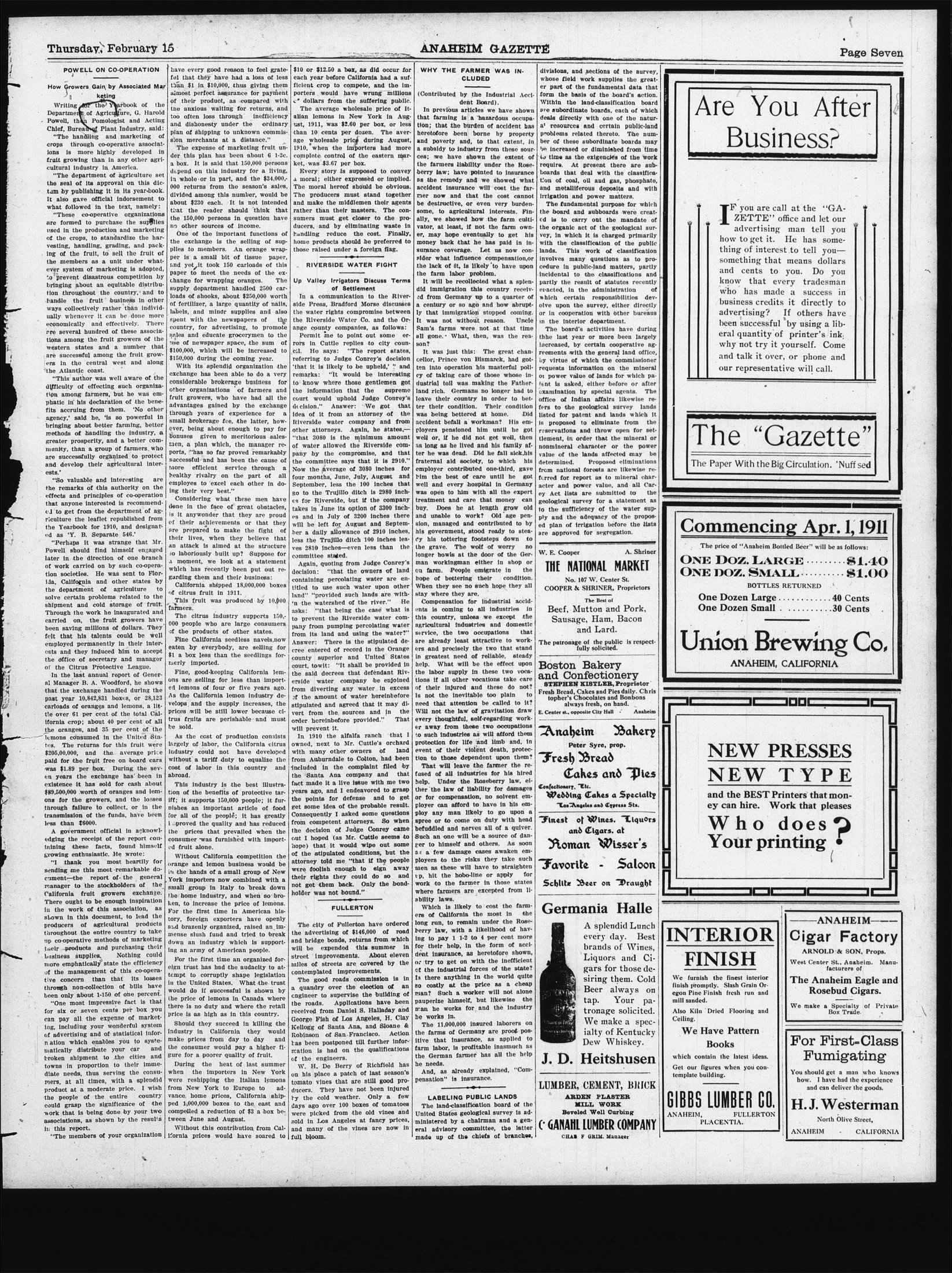
Searchable text
POWELL ON CO-OPERATION
How Growers Gain by Associated Marketing
Writing for the Yearbook of the Department of Agriculture, G. Harold Powell, then Pomologist and Acting Chief, Bureau of Plant Industry, said:
"The handling and marketing of crops through co-operative associations is more highly developed in fruit growing than in any other agricultural industry in America.
"The department of agriculture set the seal of its approval on this dictum by publishing it in its year-book. It also gave official endorsement to what followed in the text, namely:
"These co-operative organizations are formed to purchase the supplies used in the production and marketing of the crops, to standardize the harvesting, handling, grading, and packing of the fruit, to sell the fruit of the members as a unit under whatever system of marketing is adopted, to prevent disastrous competition by bringing about an equitable distribution throughout the country, and to handle the fruit business in other ways collectively rather than individually whenever it can be done more economically and effectively. There are several hundred of these associations among the fruit growers of the western states and a number that are successful among the fruit growers in the central west and along the Atlantic coast.
"This author was well aware of the difficulty of effecting such organization among farmers, but he was emphatic in his declaration of the benefits accruing from them. 'No other agency,' said he, 'is so powerful in bringing about better farming, better methods of handling the industry, a greater prosperity, and a better community, than a group of farmers who are successfully organized to protect and develop their agricultural interests.'"
The expense of marketing fruit under this plan has been about 6 1/2c. a box. It is said that 150,000 persons depend on this industry for a living, in whole or in part, and the $34,000,000 returns from the season's sales, divided among this number, would be about $230 each. It is not intended that the reader should think that the 150,000 persons in question have no other sources of income.
One of the important functions of the exchange is the selling of supplies to members. An orange wrapper is a small bit of tissue paper, and yet it took 150 carloads of this paper to meet the needs of the exchange for wrapping oranges. The supply department handled 2500 carloads of shocks, about $250,000 worth of fertilizer, a large quantity of nails, labels, and minor supplies and also spent with the newspapers of the country, for advertising, to promote sales and educate grocerymen to the use of newspaper space, the sum of $100,000, which will be increased to $150,000 during the coming year.
With its splendid organization the exchange has been able to do a very considerable brokerage business for other organizations of farmers and fruit growers, who have had all the advantages gained by the exchange through years of experience for a small brokerage fee, the latter, however, being about enough to pay for bonuses given to meritorious salesmen, a plan which, the manager reports, "has so far proved remarkably successful and has been the cause of more efficient service through a healthy rivalry on the part of all $10 or $12.50 a box each year before Carnegiefficient crop to commercial porters would have dollars from the average who allian lemons in New York, 1911, was $2.60 than 10 cents per cage wholesale price 1910, when the implemble control of market was $3.67 per berry.
Every story is sure a moral; either expound The moral hereof s. The producers must and make the middle rather than their mumbers must get coducers, and by elimination handling reduce those raised under a RIVERSIDE WATER UP VALLEY Irrigation OF SETTLE In a communication side Press, Bradford the water rights comer the Riverside Water range county company Permit me to polls rors in Cuttle replica. He says: "The referring to Judge that it is likely to remarks: 'It would know where those information that court would uphold decision.' Answer idea of it from an Itiverside water coomer attorneys. As "that 3080 is the number of water allowed tha company the committee says Now the average of
"This author was well aware of the difficulty of effecting such organization among farmers, but he was emphatic in his declaration of the benefits accruing from them. 'No other agency,' said he, 'is so powerful in bringing about better farming, better methods of handling the industry, a greater prosperity, and a better community, than a group of farmers who are successfully organized to protect and develop their agricultural interests."
"So valuable and interesting are the remarks of this authority on the effects and principles of co-operation that anyone interested is recommended to get from the department of agriculture the leaflet republished from the Yearbook for 1910, and designated as 'Y. B. Separate 546.'"
"Perhaps it was strange that Mr. Powell should find himself engaged later in the direction of one branch of work carried on by such co-operation societies. He was sent to Florida, California and other states by the department of agriculture to solve certain problems related to the shipment and cold storage of fruit. Through the work he inaugurated and carried on, the fruit growers have been saving millions of dollars. They felt that his talents could be well employed permanently in their interests and they induced him to accept the office of secretary and manager of the Citrus Protective League.
In the last annual report of General Manager B. A. Woodford, he shows that the exchange handled during the past year 10,842,831 boxes, or 28,123 carloads of oranges and lemons, a little over 61 per cent of the total California crop; about 40 per cent of all the oranges, and 35 per cent of the lemons consumed in the United States. The returns for this fruit were $205,000,000, and the average price paid for the fruit free on board cars was $1.89 per box. During the seven years the exchange has been in existence it has sold for cash about $89,500,000 worth of oranges and lemons for the growers, and the losses through failure to collect, or in the transmission of the funds, have been less than $6000.
A government official in acknowledging the receipt of the report containing these facts, found himself growing enthusiastic. He wrote:
"I thank you most heartily for sending me this most remarkable document—the report of the general manager to the stockholders of the California fruit growers exchange.
Without California competition the orange and lemon business would be in the hands of a small group of New York importers now combined with a small group in Italy to break down the home industry, and when so bro-
exchange has been able to do a very considerable brokerage business for other organizations of farmers and fruit growers, who have had all the advantages gained by the exchange through years of experience for a small brokerage fee, the latter, however, being about enough to pay for bonuses given to meritorious salesmen, a plan which, the manager reports, "has so far proved remarkably successful and has been the cause of more efficient service through a healthy rivalry on the part of all employees to excel each other in doing their very best."
Considering what these men have done in the face of great obstacles, is it any wonder that they are proud of their achievements or that they are prepared to make the fight of their lives, when they believe that an attack is aimed at the structure so laboriously built up? Suppose for a moment, we look at a statement which has recently been put out regarding them and their business:
California shipped 18,000,000 boxes of citrus fruit in 1911.
This fruit was produced by 10,000 farmers.
The citrus industry supports 150,000 people who are large consumers of the products of other states.
Fine California seedless navels now eaten by everybody, are selling for $1 a box less than the seedlings formerly imported.
Fine, good-keeping California lemons are selling for less than imported lemons of four or five years ago. As the California lemon industry develops and the supply increases, the prices will be still lower because citrus fruits are perishable and must be sold.
As the cost of production consists largely of labor, the California citrus industry could not have developed without a tariff duty to equalize the cost of labor in this country and abroad.
This industry is the best illustration of the benefits of protective tariff; it supports 150,000 people; it furnishes an important article of food for all of the people; it has greatly improved the quality and has reduced the prices that prevailed when the consumer was furnished with imported fruit alone.
Without California competition the orange and lemon business would be in the hands of a small group of New York importers now combined with a small group in Italy to break down the home industry, and when so bro-
remarks: "It would know where those information that court would uphold decision." Answer: idea of it from an Riverside water company attorneys. As "that 3080 is the type of water allowed that company by the compartment committee says Now the average of four months, June, September, less there go to the Trujillo district for Riverside, but takes in June its operations and in July of 3 will be left for August a daily allowance less the Trujillo ditto ves 2810 inches—even committee stated.
Again, quoting from decision: "that they contain percolation titled to use such land" "provided such in the watershed of asks: "that being able to prevent the River company from pumping from its land and uu Answer: There is no tree entered of record county superior and court, to wit: "It shall she said decrees that sideside water compartment from diverting any amount of water stipulated and agreed vert from the source order hereinbefore I will prevent it.
In 1910 the alfalfa owned, next to Mr. Woodford with many other owners from Anburndale to included in the Santa Ana fact made it a live in years ago, and I endure the points for defending some idea of the Consequently I asked from competent attentive decision of Judy out I hoped (as Mr. Hope) that it would of the stipulated contract attorney told me "it were foolish enough their rights they could not get them back." holder was not bound..."
ons for the growers, and the losses through failure to collect, or in the transmission of the funds, have been less than $6000.
A government official in acknowledging the receipt of the report containing these facts, found himself growing enthusiastic. He wrote:
"I thank you most heartily for sending me this most remarkable document—the report of the general manager to the stockholders of the California fruit growers exchange. There ought to be enough inspiration in the work of this association, as shown in this document, to lead the producers of agricultural products throughout the entire country to take up co-operative methods of marketing their products and purchasing their business supplies. Nothing could more emphatically state the efficiency of the management of this co-operative concern than that its losses through non-collection of bills have been only about 1-150 of one percent."
"One most impressive fact is that for six or seven cents per box you can pay all the expense of marketing, including your wonderful system of advertising and of statistical information which enables you to systematically distribute your car and broken shipment to the cities and towns in proportion to their immediate needs, thus serving the consumers, at all times, with a splendid product at a moderate price. I wish the people of the entire country could grasp the significance of the work that is being done by your two associations, as shown by the results in this report."
"The members of your organization
it supports 150,000 people; it furnishes an important article of food for all of the people; it has greatly improved the quality and has reduced the prices that prevailed when the consumer was furnished with imported fruit alone.
Without California competition the orange and lemon business would be in the hands of a small group of New York importers now combined with a small group in Italy to break down the home industry, and when so broken, to increase the price of lemons. For the first time in American history, foreign exporters have openly and brazenly organized, raised an immense slush fund and tried to break down an industry which is supporting an army of American people.
For the first time an organized foreign trust has had the audacity to attempt to corruptly shape legislation in the United States. What the trust would do if successful is shown by the price of lemons in Canada where there is no duty and where the retail price is as high as in this country.
Should they succeed in killing the industry in California they would make prices from day to day and the consumer would pay a higher figure for a poorer quality of fruit.
During the heat of last summer when the importers in New York were reshipping the Italian lemons from New York to Europe to advance home prices, California shipped 1,000,000 boxes to the east and compelled a reduction of $3 a box between June and August.
Without this contribution from California prices would have soared to
the points for defending some idea of the Consequently I asked from competent attentive decision of Judges out I hoped (as Mr. hope) that it would of the stipulated court attorney told me "that were foolish enough their rights they cannot get them back." holder was not bound.
The city of Fullerton, the advertising of $ and bridge bonds, will be expended street improvements miles of streets are contemplated improv.
The good roads on a quandry over the engineer to supervising the roads. Applica received from Daniel George Fish of Los Kellogg of Santa Ana Robinson of San Francisco has been postponed mation is had on t of the engineers.
W. H. De Berry on his place a patch tomato vines that areducers. They have by the cold weather days ago over 100 b were picked from th sold in Los Angeles and many of the v full bloom.
ANAHEIM GAZETTE
$10 or $12.50 a box, as did occur for each year before California had a sufficient crop to compete, and the importers would have wrung millions of dollars from the suffering public.
The average wholesale price of Italian lemons in New York in August, 1911, was $2.60 per box, or less than 10 cents per dozen. The average wholesale price during August, 1910, when the importers had more complete control of the eastern market, was $3.67 per box.
Every story is supposed to convey a moral; either expressed or implied. The moral hereof should be obvious. The producers must stand together and make the middlemen their agents rather than their masters. The consumers must get closer to the producers, and by eliminating waste in handling reduce the cost. Finally, home products should be preferred to those raised under a foreign flag.
RIVERSIDE WATER FIGHT
Up Valley Irrigators Discuss Terms of Settlement
In a communication to the Riverside Press, Bradford Morse discusses the water rights compromise between the Riverside Water Co. and the Orange county companies, as follows:
Permit me to point out some errors in Cuttle replies to city council. He says: "The report states, referring to Judge Conrey's decision 'that it is likely to be upheld,'" and remarks: "It would be interesting to know where those gentlemen got the information that the supreme court would uphold Judge Conrey's decision." Answer: "We got that idea of it from an attorney of the Itiverside water company and from other attorneys. Again, he states," "that 3080 is the minimum amount of water allowed the Riverside company by the compromise, and that the committee says that it is 2910."
Now the average of 3080 inches for
WHY THE FARMER WAS INCLUDED
(Contributed by the Industrial Accident Board).
In previous articles we have shown that farming is a hazardous occupation; that the burden of accident has heretofore been borne by property and poverty and, to that extent, in a subsidy to industry from these sources; we have shown the extent of the farmers liability under the Roseberry law; have pointed to insurance as the remedy and we showed what accident insurance will cost the farmer now and that the cost cannot be destructive, or even very burdensome, to agricultural interests. Finally, we showed how the farm cultivator, at least, if not the farm owner, may hope eventually to get his money back that he has paid in insurance coverage. Let us now consider what influence compensation, or the lack of it, is likely to have upon the farm labor problem.
It will be recollected what a splendid immigration this country received from Germany up to a quarter of a century or so ago and how abruptly that immigration stopped coming. It was not without reason. Uncle Sam's farms were not at that time all gone. What, then, was the reason?
It was just this: The great chancellor, Prince von Bismarck, had gotten into operation his masterful policy of taking care of those whose industrial toll was making the Fatherland rich. Germans no longer had to leave their country in order to better their condition. Their condition was being bettered at home. Did accident befall a workman? His employers pensioned him until he got well or, if he did not get well, then as long as he lived and his family after he was dead. Did he fall sick, his fraternal aid society, to which his employer contributed one-third, gave divisions, and sections of the survey, whose field work supplies the greater part of the fundamental data that form the basis of the board's action. Within the land-classification board are subordinate boards, each of which deals directly with one of the natural resources and certain public-land problems related thereto. The number of these subordinate boards may be increased or diminished from time to time as the exigencies of the work require. At present there are subboards that deal with the classification of coal, oil and gas, phosphate, and metalliferous deposits and with irrigation and power matters.
The fundamental purpose for which the board and subboards were created is to carry out the mandate of the organic act of the geological survey, in which it is charged primarily with the classification of the public lands. This work of classification involves many questions as to procedure in public-land matters, partly incidental to the classifications and partly the result of statutes recently enacted, in the administration of which certain responsibilities devolve upon the survey, either directly or in cooperation with other bureaus in the interior department.
The board's activities have during the last year or more been largely increased, by certain cooperative agreements with the general land office, by virtue of which the commissioner requests information on the mineral or power value of lands for which patent is asked, either before or after examination by special agents. The office of Indian affairs likewise refers to the geological survey lands listed for patent and lands which it is proposed to eliminate from the reservations and throw open for settlement, in order that the mineral or nonmineral character or the power value of the lands affected may be determined. Proposed eliminations from national forests are likewise re-
remarks: "It would be interesting to know where those gentlemen got the information that the supreme court would uphold Judge Conrey's decision." Answer: "We got that idea of it from an attorney of the Riverside water company and from other attorneys. Again, he states,—"that 3080 is the minimum amount of water allowed the Riverside company by the compromise, and that the committee says that it is 2910." Now the average of 3080 inches for four months, June, July, August and September, less the 100 inches that go to the Trujillo ditch is 2980 inches for Riverside, but if the company takes in June its option of 3300 inches and in July of 3200 inches there will be left for August and September a daily allowance of 2910 inches, less the Trujillo ditch 100 inches leaves 2810 inches—even less than the committee stated.
Again, quoting from Judge Conrey's decision: "that the owners of land containing percolating water are entitled to use such water upon other land" "provided such lands are within the watershed of the river." He asks: "that being the case what is to prevent the Riverside water company from pumping percolating water from its land and using the water?" Answer: There is the stipulated decree entered of record in the Orange county superior and United States court, toowit: "It shall be provided in the said decrees that defendant Riverside water company be enjoined from diverting any water in excess of the amount of water hereinbefore stipulated and agreed that it may divert from the sources and in the order hereinbefore provided." That will prevent it.
In 1910 the alfalfa ranch that I owned, next to Mr. Cuttle's orchard with many other owners of land from Auburndale to Colton, had been included in the complaint filed by the Santa Ana company and that fact made it a live issue with me two years ago, and I endeavored to grasp the points for defense and to get some idea of the probable result. Consequently I asked some questions from competent attorneys. So when the decision of Judge Conrey came out I hoped (as Mr. Cuttle seems to hope) that it would wipe out some of the stipulated conditions, but the attorney told me "that if the people were foolish enough to sign away their rights they could do so and not get them back. Only the bond-holder was not bound."
Compensation for industrial accidents is coming to all industries in this country, unless we except the agricultural industries and domestic service, the two occupations that are already least attractive to workers and precisely the two that stand in greatest need of reliable, steady help. What will be the effect upon the labor supply in these two vocations if all other vocations take care of their injured and these do not? Is not the inevitable too plain to need that attention be called to it? Will not the law of gravitation draw every thoughtful, self-regarding worker away from these two occupations to such industries as will afford them protection for life and limb and, in event of their violent death, protection to those dependent upon them?
That will leave the farmer the refused of all industries for his hired help. Under the Roseberry law, either the law of liability for damages or for compensation, no solvent employer can afford to have in his employ any man likely to go upon a spree or to come on duty with head befuddled and nerves all of a quiver. Such an one will be a source of danger to himself and others. As soon as a few damage cases awaken employers to the risks they take such men as these will have to straighten up, hit the hobo-line or apply for work to the farmer in those states where farmers are excepted from liability laws.
on power value of lands for which patent is asked, either before or after examination by special agents. The office of Indian affairs likewise refers to the geological survey lands listed for patent and lands which it is proposed to eliminate from the reservations and throw open for settlement, in order that the mineral or nonmineral character or the power value of the lands affected may be determined. Proposed eliminations from national forests are likewise referred for report as to mineral character and power value, and all Carey Act lists are submitted to the geological survey for a statement as to the sufficiency of the water supply and the adequacy of the proposed plan of irrigation before the lists are approved for segregation.
W. E. Cooper A. Shriner
THE NATIONAL MARKET
No. 107 W. Center St.
COOPER & SHRINER, Proprietors
The Best of Beef, Mutton and Pork,
Sausage, Ham, Bacon
and Lard.
The patronage of the public is respectfully solicited.
Boston Bakery and Confectionery
STEPHEN KISTLER, Proprietor
Fresh Bread, Cakes and Pies daily. Chris topher's Chocolates and Bonbons always fresh, on hand.
E. Center st., opposite City Hall Anaheim
Anaheim Bakery
Peter Syre, prop.
Fresh Bread
Cakes and Pies
Confectionery, Etc.
Wedding Cakes a Specialty
Los Angeles and Express Sts.
Finest of Wines, Liquors and Cigars, at
Roman Wisser's
Favorite - Saloon
Schlitz Beer on Draught
the points for defense and to get some idea of the probable result. Consequently I asked some questions from competent attorneys. So when the decision of Judge Conrey came out I hoped (as Mr. Cuttle seems to hope) that it would wipe out some of the stipulated conditions, but the attorney told me "that if the people were foolish enough to sign away their rights they could do so and not get them back. Only the bond-holder was not bound."
FULLERTON
The city of Fullerton have ordered the advertising of $146,000 of road and bridge bonds, returns from which will be expended this summer in street improvements. About eleven miles of streets are covered by the contemplated improvements.
The good roads commission is in a quandry over the election of an engineer to supervise the building of the roads. Applications have been received from Daniel S. Halladay and George Fish of Los Angeles, H. Clay Kellogg of Santa Ana, and Sloane & Robinson of San Francisco. Action has been postponed till further information is had on the qualifications of the engineers.
W. H. De Berry of Richfield has on his place a patch of last season's tomato vines that are still good producers. They have not been injured by the cold weather. Only a few days ago over 100 boxes of tomatoes were picked from the old vines and sold in Los Angeles at fancy prices, and many of the vines are now in full bloom.
LABELING PUBLIC LANDS
The land-classification board of the United States geological survey is administered by a chairman and a general advisory committee, the latter made up of the chiefs of branches,
Are You After Business?
If you are call at the "GAZETTE" office and let our advertising man tell you how to get it. He has something of interest to tell you—something that means dollars and cents to you. Do you know that every tradesman who has made a success in business credits it directly to advertising? If others have been successful by using a liberal quantity of printer's ink, why not try it yourself. Come and talk it over, or phone and our representative will call.
The "Gazette"
The Paper With the Big Circulation. 'Nuff sed
The "Gazette"
The Paper With the Big Circulation. 'Nuff sed
Commencing Apr. 1, 1911
The price of "Anaheim Bottled Beer" will be as follows:
ONE DOZ. LARGE $1.40
ONE DOZ. SMALL $1.00
BOTTLES RETURNED
One Dozen Large 40 Cents
One Dozen Small 30 Cents
Union Brewing Co,
ANAHEIM, CALIFORNIA
NEW PRESSES
NEW TYPE
and the BEST Printers that money can hire. Work that pleases
Who does Your printing?
ey can hire. Work that pleases
Who does Your printing?
INTERIOR
FINISH
We furnish the finest interior finish promptly. Slash Grain Oregon Pine Finish fresh run and mill sanded.
Also Kiln Dried Flooring and Ceiling.
We Have Pattern Books
which contain the latest ideas.
Get our figures when you contemplate building.
GIBBS LUMBER CO.
ANAHEIM, FULLERTON PLACENTIA.
ANAHEIM
Cigar Factory
ARNOLD & SON, Props.
West Center St., Anaheim. Manufacturers of
The Anaheim Eagle and Rosebud Cigars.
We make a Specialty of Private Box Trade.
For First-Class Fumigating
You should get a man who knows how. I have had the experience and can deliver the goods.
H.J. Westerman
North Olive Street,
ANAHEIM CALIFORNIA