anaheim-gazette 1912-02-15
Scanned page
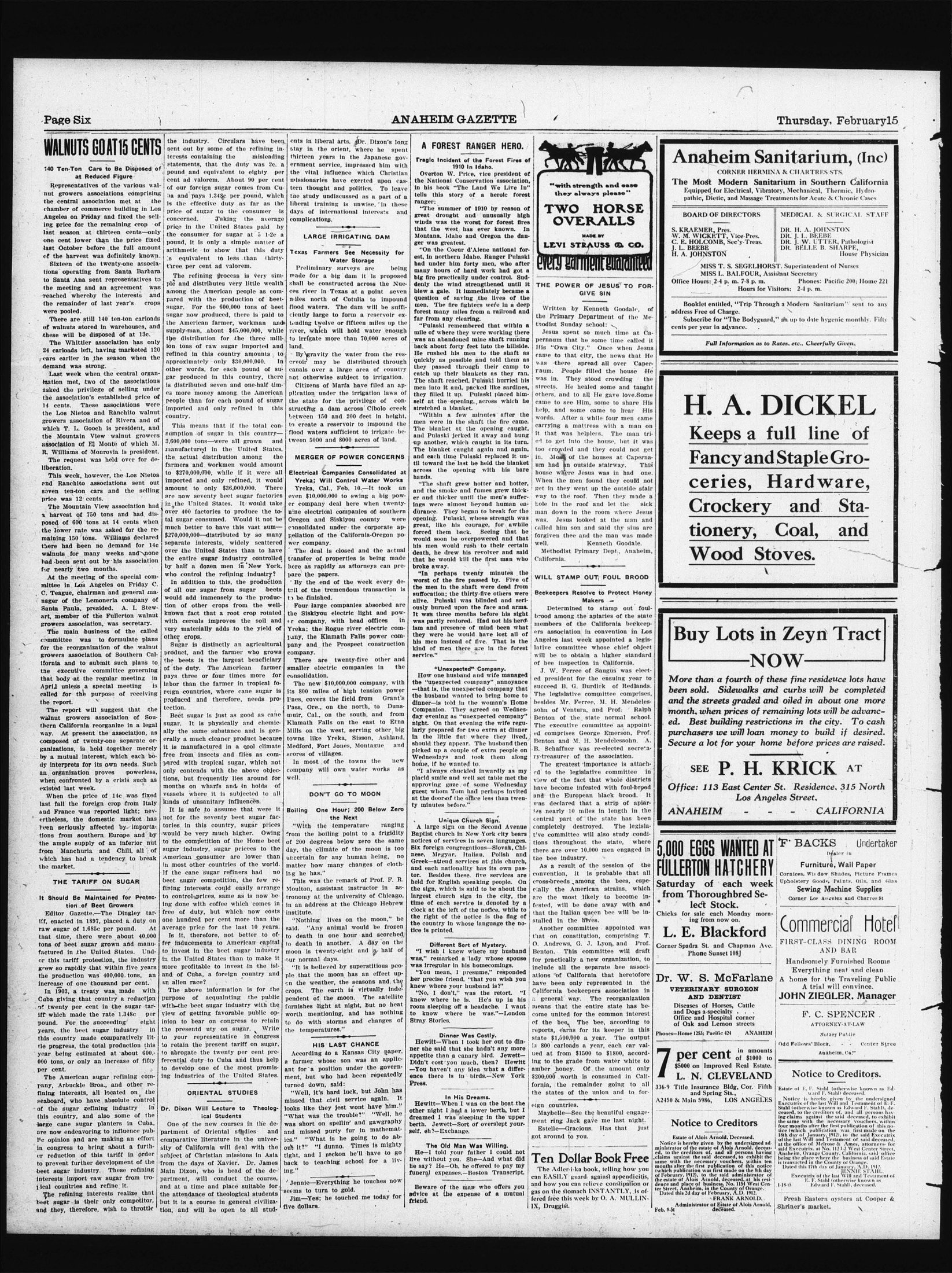
Searchable text
WALNUTS GO AT 15 CENTS
140 Ten-Ton Cars to Be Disposed of at Reduced Figure
Representatives of the various walnut growers associations comprising the central association met at the chamber of commerce building in Los Angeles on Friday and fixed the selling price for the remaining crop of last season at thirteen cents—only one cent lower than the price fixed last October before the full amount of the harvest was definitely known.
Sixteen of the twenty-one associations operating from Santa Barbara to Santa Ana sent representatives to the meeting and an agreement was reached whereby the interests and the remainder of last year's crops were pooled.
There are still 140 ten-ton carloads of walnuts stored in warehouses, and these will be disposed of at 13c.
The Whittier association has only 24 carloads left, having marketed 120 cars earlier in the season when the demand was strong.
Last week when the central organization met, two of the associations asked the privilege of selling under the association's established price of 14 cents. These associations were the Los Nietos and Ranchito walnut growers association of Rivera and of which T. L. Gooch is president, and the Mountain View walnut growers association of El Monte of which M. R. Williams of Monrovia is president.
The request was held over for deliberation.
the industry. Circulars have been sent out by some of the refining interests containing the misleading statements, that the duty was 2c. a pound and equivalent to eighty per cent ad valorem. About 90 per cent of our foreign sugar comes from Cuba and pays 1.348c per pound, which is the effective duty as far as the price of sugar to the consumer is concerned. Taking the average price in the United States paid by the consumer for sugar at 5 1-2c a pound, it is only a simple matter of arithmetic to show that this duty is equivalent to less than thirty-three per cent ad valorem.
The refining process is very simple and distributes very little wealth among the American people as compared with the production of beet-sugar. For the 600,000 tons of beet sugar now produced, there is paid to the American farmer, workman and supply-man, about $45,000,000, while the distribution for the three million tons of raw sugar imported and refined in this country amounts to approximately only $30,000,000. In other words, for each pound of sugar produced in this country, there is distributed seven and one-half times more money among the American people than for each pound of sugar imported and only refined in this country.
This means that if the total consumption of sugar in this country—3,600,000 tons—were all grown and manufactured in the United States, the actual distribution among the farmers and workmen would amount to $270,000,000, while if it were all cents in liberal arts, stay in the orient, thirteen years in the government service, imply the vital influence missionaries have exerted thought and power; the study undiscussed liberal training is used days of international complications.
LARGE IRRIGATION
Texas Farmers See Water S
Preliminary survey made for a big dam shall be constructed across river in Texas and miles north of Cotulla flood waters. The data closely large to form tending twelve or fifteen river, which will hold to irrigate more than land.
By gravity the waterervoir may be discharged over a large not otherwise subject Citizens of Marfa application under the state for the constructing a dam across between 150 and 200 to create a reservoir flood waters sufficient between 5000 and 8000 acre-feet.
Last week when the central organization met, two of the associations asked the privilege of selling under the association's established price of 14 cents. These associations were the Los Nietos and Ranchito walnut growers association of Rivera and of which T. L. Gooch is president, and the Mountain View walnut growers association of El Monte of which M. R. Williams of Monrovia is president.
The request was held over for deliberation.
This week, however, the Los Nietos and Ranchito associations sent out seven ten-ton cars and the selling price was 12 cents.
The Mountain View association had a harvest of 750 tons and had disposed of 600 tons at 14 cents when the lower rate was asked for the remaining 150 tons. Williams declared there had been no demand for 14c walnuts for many weeks and none had been sent out by his association for nearly two months.
At the meeting of the special committee in Los Angeles on Friday C. C. Teague, chairman and general manager of the Lemoneria company of Santa Paula, presided. A. I. Stewart, member of the Fullerton walnut growers association, was secretary.
The main business of the called committee was to formulate plans for the reorganization of the walnut growers association of Southern California and to submit such plans to the executive committee governing that body at the regular meeting in April unless a special meeting is called for the purpose of receiving the report.
The report will suggest that the walnut growers association of Southern California reorganize in a legal way. At present the association, as composed of twenty-one separate organizations, is held together merely by a mutual interest, which each body interprets for its own needs. Such an organization proves powerless, when confronted by a crisis such as existed last week.
When the price of 14c was fixed last fall the foreign crop from Italy and France was reported light; nevertheless, the domestic market has been seriously affected by importations from southern Europe and by the ample supply of an inferior nut from Manchuria and Chili, all of which has had a tendency to break the market.
THE TARIFF ON SUGAR
It Should Be Maintained for Protec-
gar produced in this country, there is distributed seven and one-half times more money among the American people than for each pound of sugar imported and only refined in this country.
This means that if the total consumption of sugar in this country—3,600,000 tons—were all grown and manufactured in the United States, the actual distribution among the farmers and workmen would amount to $270,000,000, while if it were all imported and only refined, it would amount to only $36,000,000. There are now seventy beet sugar factories in the United States. It would take over 400 factories to produce the total sugar consumed. Would it not be much better to have this vast sum—$270,000,000—distributed by so many separate interests, widely scattered over the United States than to have the entire sugar industry controlled by half a dozen men in New York, who control the refining industry?
In addition to this, the production of all our sugar from sugar beets would add immensely to the production of other crops from the well-known fact that a root crop rotated with cereals improves the soil and very materially adds to the yield of other crops.
Sugar is distinctly an agricultural product, and the farmer who grows the beets is the largest beneficiary of the duty. The American farmer pays three or four times more for labor than the farmer in tropical foreign countries, where cane sugar is produced and therefore, needs protection.
Beet sugar is just as good as cane sugar. It is physically and chemically the same substance and is generally a much cleaner product because it is manufactured in a cool climate free from insects and flies as compared with tropical sugar, which not only contends with the above objections, but frequently lies around for months on wharfs and in holds of vessels where it is subjected to all kinds of unsanitary influences.
It is safe to assume that were it not for the seventy beet sugar factories in this country, sugar prices would be very much higher. Owing to the competition of the Home beet sugar industry, sugar prices to the American consumer are lower than in most other countries of the world. If the cane sugar refiners had no beet sugar competition, the few refining interests could easily arrange to control prices, same as is now be-
Citizens of Marfa Publication under the in-state for the prince structuring a dam across between 150 and 200 to create a reservoir flood waters sufficient between 5000 and 8000 s
MERGER OF POW
Electrical Companies
Yreka; Will Control
Yreka, Cal., Feb. 1 even $10,000,000 to swer company deal here nine electrical companies Oregon and Siskiyou consolidated under the appellation of the Californer company.
The deal is closed transfer of properties here as rapidly as attire the papers.
By the end of the tail of the tremendous to be finished.
Four large companies the Siskiyou electric company, with her Yreka; the Rogue river company, the Klamath Fargo company and the Prosper company.
There are twenty smaller electric companies consolidation.
The new $10,000,000 its 800 miles of high lines, covers the field Pass, Ore., on the new muir, Cal., on the so Klamath Falls on the Mills on the west, seetowns like Yreka, S Medford, Fort Jones, scores of villages.
In most of the town company will own well.
DON'T GO TO
Boiling One Hour; 2nd The Next
"With the temperatures from the boiling point of 200 degrees below day, the climate of this uncertain for any hum matter how many chiring he has."
This was the remark Moulton, assistant inspector at the university.
THE TARIFF ON SUGAR
It Should Be Maintained for Protection of Beet Growers
Editor Gazette.—The Dingle tariff, enacted in 1897, placed a duty on raw sugar of 1.685c per pound. At that time, there were about 40,000 tons of beet sugar grown and manufactured in the United States. Under this tariff protection, the industry grew so rapidly that within five years the production was 400,000 tons, an increase of one thousand per cent.
In 1903, a treaty was made with Cuba giving that country a reduction of twenty per cent in the sugar tariff which made the rate 1.348c per pound. For the succeeding eight years, the beet sugar industry in this country made comparatively little progress, the total production this year being estimated at about 600,000 tons, or only an increase of fifty per cent.
The American sugar refining company, Arbuckle Bros., and other refining interests, all located on the seaboard, who have absolute control of the sugar refining industry in this country, and also some of the large cane sugar planters in Cuba, are now endeavoring to influence public opinion and are making an effort in congress to bring about a further reduction of this tariff in order to prevent further development of the beet sugar industry. These refining interests import raw sugar from tropical countries and refine it.
The refining interests realize that beet sugar is their only competitor, and they, therefore, wish to throttle kinds of unsanitary influences.
It is safe to assume that were it not for the seventy beet sugar factories in this country, sugar prices would be very much higher. Owing to the competition of the Home beet sugar industry, sugar prices to the American consumer are lower than in most other countries of the world. If the cane sugar refiners had no beet sugar competition, the few refining interests could easily arrange to control prices, same as is now being done with coffee which comes in free of duty, but which now costs one hundred per cent more than the average price for the last 10 years.
Is it, therefore, not better to offer inducements to American capital to invest in the beet sugar industry in the United States than to make it more profitable to invest in the island of Cuba, a foreign country and an alien race?
The above information is for the purpose of acquainting the public with the beet sugar industry with the view of getting favorable public opinion to bear on congress to retain the present tariff on sugar, to abrogate the twenty per cent preferential duty to Cuba and thus help to develop one of the most promising industries of the United States.
ORIENTAL STUDIES
Dr. Dixon Will Lecture to Theological Students
One of the new courses in the department of Oriental studies and comparative literature in the university of California will deal with the subject of Christian missions in Asia from the days of Xavier. Dr. James Main Dixon, who is head of the department, will conduct the course, and at a time and place suitable for the attendance of theological students but it is a course in general civilization, and will be open to all stud-
ANAHEIM GAZETTE
ents in liberal arts. Dr. Dixon's long stay in the orient, where he spent thirteen years in the Japanese government service, impressed him with the vital influence which Christian missionaries have exerted upon eastern thought and politics. To leave the study undiscussed as a part of a liberal training is unwise, in these days of international interests and complications.
LARGE IRRIGATING DAM
Texas Farmers See Necessity for Water Storage
Preliminary surveys are being made for a big dam it is proposed shall be constructed across the Nueces river in Texas at a point seven miles north of Cotulia to impound flood waters. The dam will be sufficiently large to form a reservoir extending twelve or fifteen miles up the river, which will hold water enough to irrigate more than 70,000 acres of land.
By gravity the water from the reservoir may be distributed through canals over a large area of country not otherwise subject to irrigation.
Citizens of Marfa have filed an application under the irrigation laws of the state for the privilege of constructing a dam across Cibolo creek between 150 and 200 feet in height, to create a reservoir to impound the flood waters sufficient to irrigate between 5000 and 8000 acres of land.
MERGER OF POWER CONCERNS
Electrical Companies Consolidated at
A FOREST RANGER HERO.
Tragic Incident of the Forest Fires of 1910 In Idaho.
Overton W. Price, vice president of the National Conservation association, in his book "The Land We Live In" tells this story of a heroic forest ranger:
"The summer of 1910 by reason of great drought and unusually high winds was the worst for forest fires that the west has ever known. In Montana, Idaho and Oregon the danger was greatest.
"On the Coeur d'Alene national forest, in northern Idaho, Ranger Pulaski had under him forty men, who after many hours of hard work had got a big fire practically under control. Suddenly the wind strengthened until it blew a gale. It immediately became a question of saving the lives of the men. The fire fighters were in a deep forest many miles from a railroad and far from any clearing.
"Pulaski remembered that within a mile of where they were working there was an abandoned mine shaft running back about forty feet into the hillside. He rushed his men to the shaft as quickly as possible and told them as they passed through their camp to catch up their blankets as they ran. The shaft reached, Pulaski hurried his men into it and, packed like sardines, they filled it up. Pulaski placed himself at the opening, across which he stretched a blanket.
"Within a few minutes after the men were in the shaft the fire came. The blanket at the opening caught, and Pulaski jerked it away and hung up another, which caught in its turn. The blanket caught again and again, and each time Pulaski replaced it until toward the last he held the blanket across the opening with his bare
Written by Kenneth Goodale, of the Primary Department of the Methodist Sunday school:
Jesus spent so much time at Capernaum that he some time called it His "Own City." Once when Jesus came to that city, the news that He was there spread all over Capernaum. People filled the house He was in. They stood crowding the streets. He healed some and taught others, and to all He gave love. Some came to see Him, some to share His help, and some came to hear His words. After a while four men came carrying a mattress with a man on it that was helpless. The man tried to get into the house, but it was too crowded and they could not get in. Most of the houses at Capernaum had an outside stairway. This house where Jesus was in had one.
Citizens of Marfa have filed an application under the irrigation laws of the state for the privilege of constructing a dam across Cibolo creek between 150 and 200 feet in height, to create a reservoir to impound the flood waters sufficient to irrigate between 5000 and 8000 acres of land.
MERGER OF POWER CONCERNS
Electrical Companies Consolidated at Yreka; Will Control Water Works
Yreka, Cal., Feb. 10.—It took an even $10,000,000 to swing a big power company deal here when twenty-nine electrical companies of southern Oregon and Siskiyou county were consolidated under the corporate appellation of the California-Oregon power company.
The deal is closed and the actual transfer of properties is being made here as rapidly as attorneys can prepare the papers.
By the end of the week every detail of the tremendous transaction is to be finished.
Four large companies absorbed are the Siskiyou electric light and power company, with head offices in Yreka; the Rogue river electric company, the Klamath Falls power company and the Prospect construction company.
There are twenty-five other and smaller electric companies in the consolidation.
The new $10,000,000 company, with its 800 miles of high tension power lines, covers the field from Grant's Pass, Ore., on the north, to Dunsmuir, Cal., on the south, and from Klamath Falls on the east to Etna Mills on the west, serving other big towns like Yreka, Sisson, Ashland, Medford, Fort Jones, Montague and scores of villages.
In most of the towns the new company will own water works as well.
DON'T GO TO MOON
Boiling One Hour; 200 Below Zero the Next
"With the temperature ranging from the boiling point to a frigidity of 200 degrees below zero the same day, the climate of the moon is too uncertain for any human being, no matter how many changes of clothing he has."
This was the remark of Prof. F. R. Moulton, assistant instructor in astronomy at the university of Chicago,
catch up their blankets as they rain.
The shaft reached. Pulaski hurried his men into it and, packed like sardines, they filled it up. Pulaski placed himself at the opening, across which he stretched a blanket.
"Within a few minutes after the men were in the shaft the fire came. The blanket at the opening caught, and Pulaski jerked it away and hung up another, which caught in its turn. The blanket caught again and again, and each time Pulaski replaced it until toward the last he held the blanket across the opening with his bare hands.
"The shaft grew hotter and hotter, and the smoke and fumes grew thicker and thicker until the men's sufferings were almost beyond human endurance. They began to break for the opening. Pulaski, whose strength was great, like his courage, for awhile forced them back. Seeing that he would soon be overpowered and that his men would rush to their certain death, he drew his revolver and said that he would kill the first man who broke away.
"In perhaps twenty minutes the worst of the fire passed by. Five of the men in the shaft were dead from suffocation; the thirty-five others were alive. Pulaski was blinded and seriously burned upon the face and arms. It was three months before his sight was partly restored. Had not his heroism and presence of mind been what they were he would have lost all of his men instead of five. That is the kind of men there are in the forest service."
"Unexpected Company.
How one husband and wife managed the "unexpected company", annoyance—that is, the unexpected company that the husband wanted to bring home to dinner—is told in the woman's Home Companion. They agreed on Wednesday evening as "unexpected company" night. On that evening the wife regularly prepared for two extra at dinner in the little flat where they lived, should they appear. The husband then picked up a couple of extra people on Wednesdays and took them along home, if he wanted to.
"I always chuckled inwardly as my placid smile and well set table met the approving gaze of some Wednesday guest whom Tom had perhaps invited at the door of the office less than twenty minutes before."
Unique Church Sign.
A large sign on the Second Avenue Baptist church in New York city bears notices of services in seven languages. Six foreign congregations—Slovak, Chinese, Magyar, Italian, Polish and Greek—attend services at this church, and each nationality has its own pastor. Besides these, five services are held for English speaking people. On the sign, which is said to be about the largest church sign in the city, was in. They stood crowding the streets. He healed some and taught others, and to all He gave love.Some came to see Him, some to share His help, and some came to hear His words. After a while four men came carrying a mattress with a man on it that was helpless. The man tried to get into the house, but it was too crowded and they could not get in. Most of the houses at Capernaum had an outside stairway. This house where Jesus was in had one. When the men found they could not get in they went up the outside stair way to the roof. Then they made a hole in the roof and let the sick man down in the room where Jesus was. Jesus looked at the man and called him son and said thy sins are forgiven THEE and THE MAN was made well.
Kenneth Goodale.
Methodist Primary Dept., Anaheim, California.
WILL STAMP OUT FOUL BROOD
Beekeepers Resolve to Protect Honey Makers
Determined to stamp out foul-brood among the apiaries of the state members of the California beekeepers association in convention in Los Angeles last week appointed a legislative committee whose chief object will be to obtain a higher standard of bee inspection in California.
J. W. Ferree of Saugus was elected president for the ensuing year to succeed B. G. Burdick of Redlands. The legislative committee comprises besides Mr. Ferree, M. H. Mendelsohn of Ventura, and Prof. Ralph Benton of the state normal school. The executive committee as appointed comprises George Emerson, Prof. Benton and M. H. Mendelsohn. A. B. Schaffner was re-elected secretary-treasurer of the association.
The greatest importance is attached to the legislative committee in view of the fact that whole districts have become infested with foul-brood and the European black brood. It was declared that a strip of apiaries nearly 10 miles in length in the central part of the state has been completely destroyed. The legislative committee will also study conditions throughout the state, where there are over 10,000 men engaged in the bee industry.
As a result of the session of the convention, it is probable that all cross-breeds among the bees, especially the American strains, which are most likely to become in-
Boiling One Hour; 200 Below Zero the Next
"With the temperature ranging from the boiling point to a frigidity of 200 degrees below zero the same day, the climate of the moon is too uncertain for any human being, no matter how many changes of clothing he has."
This was the remark of Prof. F. R. Moulton, assistant instructor in astronomy at the university of Chicago, in an address at the Chicago Hebrew institute.
"Nothing lives on the moon," he said. "Any animal would be frozen to death in one hour and scorched to death in another. A day on the moon is twenty-eight and a half of our normal days."
"It is believed by superstitious people that the moon has an effect upon the weather, the seasons and the crops. The earth is virtually independent of the moon. The satellite furnishes light at night, but no heat worth mentioning, and has nothing to do with storms and changes of the temperatures."
HIS LAST CHANCE
According to a Kansas City paper, a farmer whose son was an applicant for a position under the government, but who had been repeatedly turned down, said:
"Well, it's hard luck, but John has missed that civil service again. It looks like they jest wont have him." "What was the trouble?" "Well, he was short on spellin' and gawgraphy and missed purty fur in mathematics." "What is he going to do about it?" "I dunno. Times is mighty tight, and I reckon he'll have to go back to teaching school for a living."
Jennie—Everything he touches now seems to turn to gold.
Jim—Yes; he touched me today for five dollars.
Unique Church Sign.
A large sign on the Second Avenue Baptist church in New York city bears notices of services in seven languages. Six foreign congregations—Slovak, Chinese, Magyar, Italian, Polish and Greek—attend services at this church, and each nationality has its own pastor. Besides these, five services are held for English speaking people. On the sign, which is said to be about the largest church sign in the city, the time of each service is denoted by a clock at the left of the notice, while to the right of the notice is the flag of the country in whose language the notice is printed.
Different Sort of Mystery.
"I wish I knew where my husband was," remarked a lady whose spouse was irregular in his homecomings.
"You mean, I presume," responded her precise friend. "that you wish you knew where your husband is?"
"No, I don't," was the retort. "I know where he is. He's up in his room sleeping off a headache. I want to know where he was."—London Stray Stories.
Dinner Was Costly.
Hewitt—When I took her out to dinner she said that she hadn't any more appetite than a canary bird. Jewett—Didn't cost you much, then? Hewitt—You haven't any idea what a difference there is in birds.—New York Press.
In His Dreams.
Hewitt—When I was on the boat the other night I had a lower berth, but I dreamed I was sleeping in the upper berth. Jewett—Sort of overslept yourself, eh?—Exchange.
The Old Man Was Willing.
He—I told your father I could not live without you. She—and what did he say? He—Oh, he offered to pay my funeral expenses.—Boston Transcript.
Beware of the man who offers you advice at the expense of a mutual friend.
was declared that a strip of apiaries nearly 10 miles in length in the central part of the state has been completely destroyed. The legislative committee will also study conditions throughout the state, where there are over 10,000 men engaged in the bee industry.
As a result of the session of the convention, it is probable that all cross-breeds among the bees, especially the American strains, which are the most likely to become infested, will be done away with and that the Italian queen bee will be installed in the hives.
Another committee appointed was that on constitution, comprising T. O. Andrews, G. J. Lyon and Prof. Benton. This committee will draft for practically a new organization, to include all the separate bee associations of California that heretofore have been only represented in the California beekeepers association in a general way. The reorganization means that the entire state has become united for the common interest of the bee. The bee, according to reports, earns for its keeper in this state $1,500,000 a year. The output is 800 carloads a year, each car valued at from $1500 to $1800, according to the grade from water white to amber honey. Of the amount only $200,000 worth is consumed in California, the remainder going to all the states of the union and to foreign countries.
Maybelle—See the beautiful engagement ring Jack gave me last night.
Estelle—Gracious. Has that just got around to you.
Ten Dollar Book Free
The Adler-i-ka book, telling how you can EASILY guard against appendicitis, and how you can relieve constipation or gas on the stomach INSTANTLY, is offered free this week by O. A. MULLINIX, Druggist.
Anaheim Sanitarium, (Inc)
CORNER HERMINA & CHARTRES STS.
The Most Modern Sanitarium in Southern California
Equipped for Electrical, Vibratory, Mechanical, Thermic, Hydropathic, Dietic, and Massage Treatments for Acute & Chronic Cases
BOARD OF DIRECTORS
S. KRAEMER, Pres.
W. M. WICKETT, Vice-Pres.
C. E. HOLCOMB, Sec'y-Treas.
J. L. BEEBE
H. A. JOHNSTON
MEDICAL & SURGICAL STAFF
DR. H. A. JOHNSTON
DR. J. L. BEEBE
DR. J. W. UTTER, Pathologist
DR. BELLE B. SHARPE,
House Physician
MISS T. S. SEGELHORST. Superintendent of Nurses
MISS L. BALFOUR, Assistant Secretary
Office Hours: 2-4 p.m. 7-8 p.m.
Phones: Pacific 200; Home 221
Hours for Visitors: 2-4 p.m.
Booklet entitled, “Trip Through a Modern Sanitarium” sent to any address Free of Charge.
Subscribe for “The Bodyguard,” an up to date hygienic monthly. Fifty cents per year in advance.
Full Information as to Rates, etc., Cheerfully Given
H. A. DICKEL
Keeps a full line of
Fancy and Staple Gro-
H. A. DICKEL
Keeps a full line of
Fancy and Staple Groceries, Hardware,
Crockery and Stationery, Coal, and
Wood Stoves.
Buy Lots in Zeyn Tract
NOW
More than a fourth of these fine residence lots have been sold. Sidewalks and curbs will be completed and the streets graded and oiled in about one more month, when prices of remaining lots will be advanc-ed. Best building restrictions in the city. To cash purchasers we will loan money to build if desired. Secure a lot for your home before prices are raised.
SEE P. H. KRICK AT
Office: 113 East Center St. Residence, 315 North Los Angeles Street.
ANAHEIM - CALIFORNIA
5,000 EGGS WANTED AT
FULLERTON HATCHERY
Saturday of each week
from Thoroughbred Se-
5,000 EGGS WANTED AT FULLERTON HATCHERY
Saturday of each week from Thoroughbred Select Stock.
Chicks for sale each Monday morning from now on.
L. E. Blackford
Corner Spadra St. and Chapman Ave.
Phone Sunset 108J
Dr. W. S. McFarlane
VETERINARY SURGEON AND DENTIST
Diseases of Horses, Cattle and Dogs a specialty
Office and Hospital corner of Oak and Lemon streets
Phones—Home 1253; Pacific 424 ANAHEIM
7 per cent in amounts of $1000 to $5000 on Improved Real Estate.
L. N. CLEVELAND
336-9 Title Insurance Bldg, Cor. Fifth and Spring Sts.
A2450 & Main 5986, LOS ANGELES
Notice to Creditors
Estate of Alois Arnold, Deceased.
Notice is hereby given by the undersigned administrator of the estate of Alois Arnold, deceased, to the creditors of, and all persons having claims against the said deceased, to exhibit the same with the necessary vouchers, within ten months after the first publication of this notice (which publication was first made on the 8th day of February, 1912), to the said administrator of the estate of Alois Arnold, deceased, at his residence and place of business. No. 1154 West Center Street, Anaheim, in the County of Orange.
Dated this 2d day of February, A.D. 1912.
FRANK ARNOLD.
Administrator of Estate of Alois Arnold, deceased.
F. BACKS Undertaker
Dealer in
Furniture, Wall Paper
Cornices, Window Shades, Picture Frames
Upholstery Goods, Paints, Oils, and Glas
Sewing Machine Supplies
Corner Los Angeles and Charles St.
Commercial Hotel
FIRST-CLASS DINING ROOM AND BAR
Handsomely Furnished Rooms Everything neat and clean
A home for the Traveling Public A trial will convince.
JOHN ZIEGLER, Manager
F. C. SPENCER
ATTORNEY-AT-LAW
Notary Public
Odd Fellows' Block,
Center Street
Anaheim, Ca.
Notice to Creditors.
Estate of E. F. Stahl (otherwise known as Edward F. Stahl) deceased.
Notice is hereby given by the undersigned Executrix of the last Will and Testament of E. F. Stahl (otherwise known as Edward F. Stahl), deceased, to the creditors of, and all persons having claims against the said deceased, to exhibit the same with the necessary vouchers, within four months after the first publication of this notice (which publication was first made on the 18th day of January, 1912), to the said Executrix of the last Will and Testament of said deceased, at the office of Melrose & Ames, attorneys for said Executrix at No. 1121-2 West Center Street, Anaheim, Orange County, California, said office being the place where the business of said Estate is transacted in the County of Orange.
Dated this 17th day of January, A.D. 1912.
JENNIE STAHL.
Executrix of the last Will and Testament of E. F. Stahl (otherwise known as Edward F. Stahl), deceased.
Fresh Eastern oysters at Cooper & Shriner's market.