anaheim-gazette 1912-02-01
Scanned page
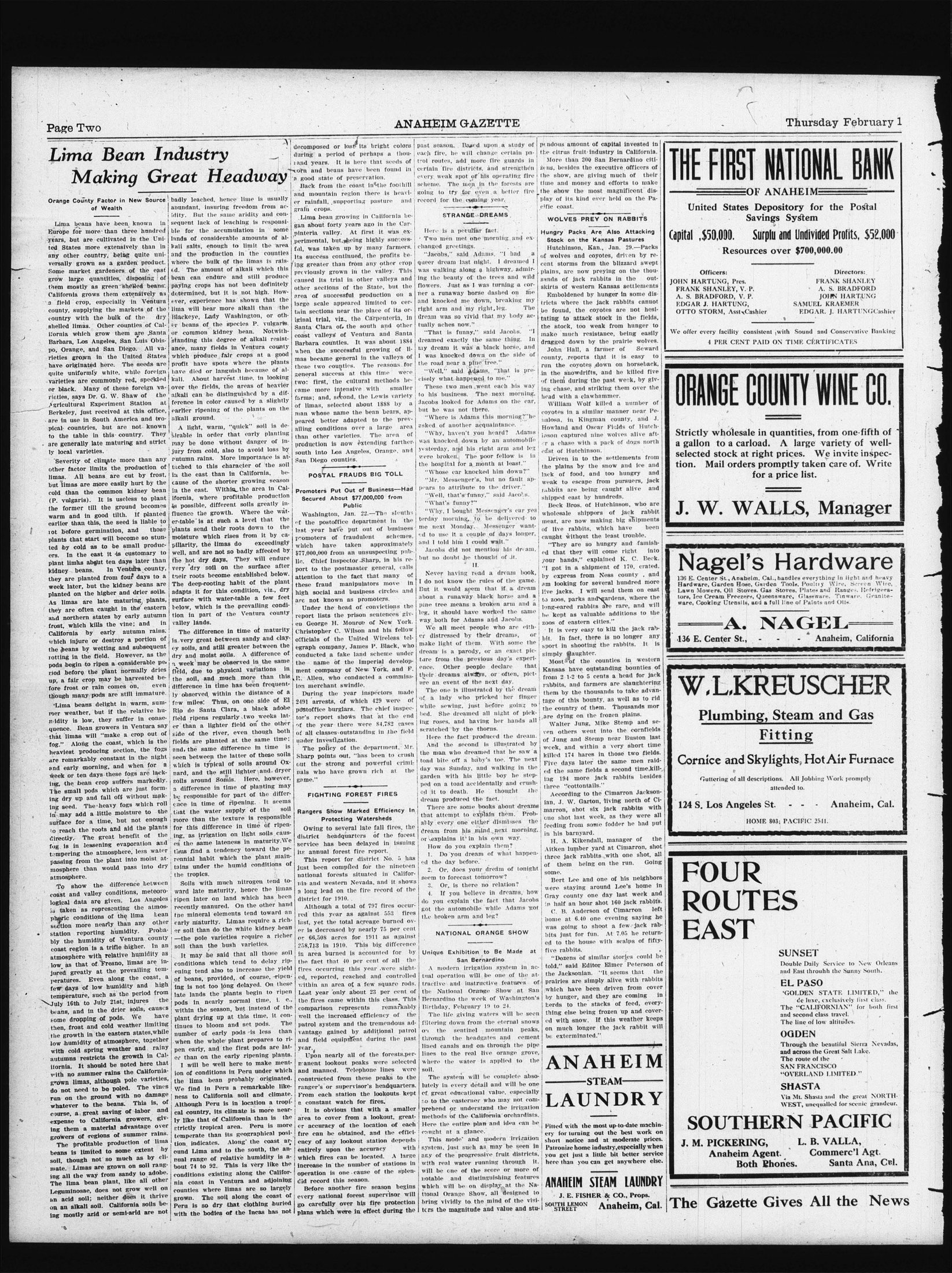
Searchable text
Lima Bean Industry Making Great Headway
Orange County Factor in New Source of Wealth
Lima beans have been known in Europe for more than three hundred years, but are cultivated in the United States more extensively than in any other country, being quite universally grown as a garden product. Some market gardeners of the east grow large quantities, disposing of them mostly as green shelled beans; California grows them extensively as a field crop, especially in Ventura county, supplying the markets of the country with the bulk of the dry shelled limas. Other counties of California which grow them are Santa Barbara, Los Angeles, San Luis Obispo, Orange, and San Diego. All varieties grown in the United States have originated here. The seeds are quite uniformly white, while foreign varieties are commonly red, speckled or black. Many of these foreign varieties, says Dr. G. W. Shaw of the Agricultural Experiment Station at Berkeley, just received at this office, are in use in South America and tropical countries, but are not known to the table in this country. They are generally late maturing and strictly local varieties.
Severity of climate more than any other factor limits the production of Lima beans, badly leached, hence lime is usually abundant, insuring freedom from acidity. But the same aridity and consequent lack of leaching is responsible for the accumulation in some lands of considerable amounts of alkali salts, enough to limit the area and the production in the counties where the bulk of the limas is raised. The amount of alkali which this bean can endure and still produce paying crops has not been definitely determined, but it is not high. However, experience has shown that the lima will bear more alkali than the Blackeye, Lady Washington, or other beans of the species P. vulgaris, or common kidney bean. Notwithstanding this degree of alkali resistance, many fields in Ventura county which produce fair crops at a good profit have spots where the plants have died or languish because of alkali. About harvest time, in looking over the fields, the areas of heavier alkali can be distinguished by a difference in color caused by a slightly earlier ripening of the plants on the alkali ground.
A light, warm, "quick" soil is desirable in order that early planting may be done without danger of injury from cold, also to avoid loss by autumn rains. More importance is attached to this character of the soil in the east than in California, decomposed or lost during a period of sand years. It is low corn and beans having a good state of pre成熟. Back from the coast and mountain regions rainfall, support grain crops.
Lima bean growing gan about forty years pinteria valley. At experimental, but, helpful, was taken up Its success continuing greater than previously grown in caused its trial in other sections of the area of successful large scale appearance sections near its original trial, viz., the Santa Clara of the coast valleys of Viburna Barbara counties. when the successfies became general these two counties. general success at two: first, the cul came more intensive farms; and, second, of limas, selected man whose name peared better adapting conditions o than other varieties production is now south into Los Angeles San Diego counties.
Severity of climate more than any other factor limits the production of limas. All beans are cut by frost, but limas are more easily hurt by the cold than the common kidney bean (P. vulgaris). It is useless to plant the former till the ground becomes warm and in good tilth. If planted earlier than this, the seed is liable to not before germination, and those plants that start will become so stunted by cold as to be small producers. In the east it is customary to plant limas about ten days later than kidney beans. In Ventura county, they are planted from four days to a week later, but the kidney beans are planted on the higher and drier soils. As limas are late maturing plants, they are often caught in the eastern and northern states by early autumn frost, which kills the vine; and in California by early autumn rains, which injure or destroy a portion of the beans by wetting and subsequent rotting in the field. However, as the pods begin to ripen a considerable period before the plant normally dries up, a fair crop may be harvested before frost or rain comes on, even though many pods are still immature.
Lima beans delight in warm, summer weather, but if the relative humidity is low, they suffer in consequence. Bean growers in Ventura say that limas will "make a crop out of fog." Along the coast, which is the heaviest producing section, the fogs are remarkably constant in the night and early morning, and when for a week or ten days these fogs are lacking, the bean crop suffers markedly. The small pods which are just forming dry up and fall off without making seed. The heavy fogs which roll in may add a little moisture to the surface for a time, but not enough to reach the roots and aid the plants directly. The great benefit of the fog is in lessening evaporation and tempering the atmosphere, less water passing from the plant into moist atmosphere than would pass into dry atmosphere.
To show the difference between coast and valley conditions, meteorological observations at Los Angeles.
About harvest time, in looking over the fields, the areas of heavier alkali can be distinguished by a difference in color caused by a slightly earlier ripening of the plants on the alkali ground.
A light, warm, "quick" soil is desirable in order that early planting may be done without danger of injury from cold, also to avoid loss by autumn rains. More importance is attached to this character of the soil in the east than in California, because of the shorter growing season in the east. Within the area in California, where profitable production is possible, different soils greatly influence the growth. Where the water-table is at such a level that the plants send their roots down to the moisture which rises from it by capillarity, the limas do exceedingly well, and are not so badly affected by the hot dry days. They will endure very dry soil on the surface after their roots become established below. The deep-rooting habit of the plant adapts it for this condition, viz., dry surface with water-table a few feet below, which is the prevailing condition in part of the Ventura county valley lands.
The difference in time of maturity is very great between sandy and clayey soils, and still greater between the dry and moist soils. A difference of a week may be observed in the same field, due to physical variations in the soil, and much more than this difference in time has been frequently observed within the distance of a few miles. Thus, on one side of El Rio de Santa Clara, a black adobe field ripens regularly two weeks later than a lighter field on the other side of the river, even though both fields are planted at the same time; and, the same difference in time is seen between the latter of these soils which is typical of soils around Oxnard, and the still lighter and dryer soils around Somis. Here, however, a difference in time of planting may be responsible for part of the difference in time of ripening. It seems that the water supply of the soil more than the texture is responsible for this difference in time of ripening, as irrigation on light soils causes the same lateness in maturity. We thus find a tendency toward the perennial habit which the plant maintains under the humid conditions of the tropics.
Soils with much nitrogen tend toward late maturity, hence the limas ripen later on land which has been general success at two: first, the culinary came more intensive farms; and, second, of limas, selected man whose name peared better adapting conditions owing to other varieties production is now south into Los Angeles San Diego counties.
Promoters Put Out Secured About Public Washington, Jan. 10 of the postoffice day last year have put promoters of fraud which have taken $77,000,000 from an illic. Chief Inspector port to the postmaster attention to the fact these fraud manipulate high social and bui are not known as Under the head report lists the prien George H. Monroe Christopher C. Will officials of the Unigraph company, Jal conducted a fake he name of the ment company of R. Allen, who conion merchant swine During the year 2491 arrests, of w postoffice burglarstor's report shows of the year there of all classes outside under investigation.
The policy of tha Sharp points out," out the strong arnalns who have great game."
FIGHTING FO
Rangers Show Ma Protecting
Owing to several district headquarters service has been its annual forest f This report for just been compiled national forests snia and western N a long lead on th district for 1910.
ing seed. The heavy fogs which roll in may add a little moisture to the surface for a time, but not enough to reach the roots and aid the plants directly. The great benefit of the fog is in lessening evaporation and tempering the atmosphere, less water passing from the plant into moist atmosphere than would pass into dry atmosphere.
To show the difference between coast and valley conditions, meteorological data are given. Los Angeles is taken as representing the atmospheric conditions of the lima bean section more nearly than any other station reporting humidity. Probably the humidity of Ventura county coast region is a trifle higher. In an atmosphere with relative humidity as low as that of Fresno, limas are injured greatly at the prevailing temperatures. Even along the coast, a few days of low humidity and high temperature, such as the period from July 16th to July 21st, injures the beans, and in the drier soils, causes some dropping of pods. We have then, frost and cold weather limiting the growth in the eastern states, while low humidity of atmosphere, together with cold spring weather and rainy autumns restricts the growth in California. It should be noted here that with no summer rains the California-grown limas, although pole varieties, do not need to be poiled. The vines run on the ground with no damage whatever to the beans. This is, of course, a great saving of labor and expense to California growers, giving them a material advantage over growers of regions of summer rains.
The profitable production of lima beans is limited to some extent by soil, though not so much as by climate. Limas are grown on soil ranging all the way from sandy to adobe. The lima bean plant, like all other Leguminosae, does not grow well on an acid soil; neither does it thrive on an alkali soil. California soils being mostly arid or semi-arid are not
Soils with much nitrogen tend toward late maturity, hence the limas ripen later on land which has been recently manured. On the other hand the mineral elements tend toward an early maturity. Limas require a richer soil than do the white kidney bean—the pole varieties require a richer soil than the bush varieties.
It may be said that all those soil conditions which tend to delay ripening tend also to increase the yield of beans, provided, of course, ripening is not too long delayed. On these late lands the plants begin to ripen pods in nearly normal time, i.e., within the season, but instead of the plant drying up at this time, it continues to bloom and set pods. The number of early pods is less than when the whole plant prepares to ripen early, and the first pods are later than on the early ripening plants.
I will be well here to make mention of conditions in Peru under which the lima bean probably originated. We find in Peru a remarkable likeness to California soil and climate. Although Peru is in location a tropical country, its climate is more nearly like that of California than is the strictly tropical area. Peru is more temperate than its geographical position indicates. Along the coast around Lima and to the south, the annual range of relative humidity is about 74 to 92. This is very like the conditions existing along the California coast in Ventura and adjoining counties where limas are so largely grown. The soil along the coast of Peru is so dry that clothing buried with the bodies of the Incas has not
Rangers Show Ma Protecting
Owing to several district headquarters service has been its annual forest f
This report for just been compiled national forests sinaia and western Napa a long lead on the district for 1910.
Although a total red this year as last, yet the total er is decreased by or 66,508 acres for 258,713 in 1910. in area burned is the fact that 40 p fires occurring th ed, reported, reached within an area of Last year only abie the fires came with comparison repres well the increased patrol system and vantage gained b and field equipment year.
Upon nearly all manent lookout point and manned. Tel constructed from ranger's or superv From each station a constant watch
It is obvious th area to cover from er accuracy of th fire can be obtain ency of any lookon entirely upon th which fires can be increase in the nu operation is one o did record this sea Before another every national form go carefully over plans which were f
ANAHEIM GAZETTE
decomposed or lost its bright colors during a period of perhaps a thousand years. It is here that seeds of corn and beans have been found in a good state of preservation.
Back from the coast in the foothill and mountain region there is heavier rainfall, supporting pasture and grain crops.
Lima bean growing in California began about forty years ago in the Carpinteria valley. At first it was experimental, but, being highly successful, was taken up by many farmers. Its success continued, the profits being greater than from any other crop previously grown in the valley. This caused its trial in other valleys and other sections of the State, but the area of successful production on a large scale appeared limited to certain sections near the place of its original trial, viz., the Carpenteria, in Santa Clara of the south and other coast valleys of Ventura and Santa Barbara counties. It was about 1884 when the successful growing of limas became general in the valleys of these two counties. The reasons for general success at this time were two: first, the cultural methods became more intensive with smaller farms; and, second, the Lewis variety of limas, selected about 1888 by a man whose name the bean bears, appeared better adapted to the prevailing conditions over a large area than other varieties. The area of production is now extending further south into Los Angeles, Orange, and San Diego counties.
past season. Based upon a study of each fire, he will change certain patrol routes, add more fire guards in certain fire districts, and strengthen every weak spot of his operating fire scheme. The men in the forests are going to try for even a better fire record for the coming year.
STRANGE DREAMS
Here is a peculiar fact.
Two men met one morning and exchanged greetings.
"Jacobs," said Adams, "I had a queer dream last night. I dreamed I was walking along a highway, admiring the beauty of the trees and wild flowers. Just as I was turning a corner a runaway horse dashed on me and knocked me down, breaking my right arm and my right leg. The dream was so vivid that my body actually aches now."
"That is funny," said Jacobs. "I dreamed exactly the same thing. In my dream it was a black horse, and I was knocked down on the side of the road near a pine tree."
"Well," said Adams, "that is precisely what happened to me."
These two men went each his way to his business. The next morning, Jacobs looked for Adams on the car, but he was not there.
"Where is Adams this morning?" he asked of another acquaintance.
"Why, haven't you heard? Adams was knocked down by an automobile yesterday, and his right arm and leg were broken. The poor fellow is in the hospital for a month at least."
Whose car knocked him down?
pendous amount of capital invested in the citrus fruit industry in California.
More than 200 San Bernardino citizens, besides the executive officers of the show, are giving much of their time and money and efforts to make the show the most magnificent display of its kind ever held on the Pacific coast.
WOLVES PREY ON RABBITS
Hungry Packs Are Also Attacking Stock on the Kansas Pastures
Hutchinson, Kan., Jan. 29.—Packs of wolves and coyotes, driven by recent storms from the blizzard swept plains, are now preying on the thousands of jack rabbits in the outskirts of western Kansas settlements.
Emboldened by hunger in some districts where the jack rabbits cannot be found, the coyotes are not hesitating to attack stock in the fields, the stock, too weak from hunger to make much resistance, being easily dragged down by the prairie wolves.
John Hall, a farmer of Seward county, reports that it is easy to run the coyotes down on horseback, in the snowdrifts, and he killed five of them during the past week, by giving chase, and striking them over the head with a clawhammer.
William Wolf killed a number of coyotes in a similar manner near Penalosa, in Kingman county, and J. Howland and Oscar Fields of Hutchinson captured nine wolves alive after a chase with a pack of dogs north east of Hutchinson.
Driven in to the settlements from the plains by the snow and ice and lack of food and too hungry and
POSTAL FRAUDS BIG TOLL
Promoters Put Out of Business—Had Secured About $77,000,000 from Public
Washington, Jan. 22.—The sleuths of the postoffice department in the last year have put out of business promoters of fraudulent schemes, which have taken approximately $77,000,000 from an unsuspecting public. Chief Inspector Sharp, in his report to the postmaster general, calls attention to the fact that many of these fraud manipulators move in high social and business circles and are not known as promoters.
Under the head of convictions the report lists the prison sentences given George H. Monroe of New York. Christopher C. Wilson and his fellow officials of the United Wireless telegraph company, James P. Black, who conducted a fake land scheme under the name of the Imperial development company of New York, and F. P. Allen, who conducted a commission merchant swindle.
During the year inspectors made 2491 arrests, of which 429 were of postoffice burglars. The chief inspector's report shows that at the end of the year there were 84,782 cases of all classes-outstanding in the field under investigation.
The policy of the department, Mr. Sharp points out, "has been to crush out the strong and powerful criminals who have grown rich at the game."
FIGHTING FOREST FIRES
Rangers Show Marked Efficiency In Protecting Watersheds
Owing to several late fall fires, the district headquarters of the forest service has been delayed in issuing its annual forest fire report.
This report for district No. 5 has just been compiled for the nineteen national forests situated in California and western Nevada, and it shows a long lead on the fire record of the district for 1910.
These two men went each his way to his business. The next morning, Jacobs looked for Adams on the car, but he was not there.
"Where is Adams this morning?" he asked of another acquaintance.
"Why, haven't you heard? Adams was knocked down by an automobile yesterday, and his right arm and leg were broken. The poor fellow is in the hospital for a month at least."
"Whose car knocked him down?"
"Mr. Messenger's, but no fault appears to attribute to the driver."
"Well, that's funny," said Jacobs.
"What's funny?"
"Why, I bought Messenger's car yesterday morning, to be delivered to me next Monday. Messenger wanted to use it a couple of days longer, and I told him I could wait."
Jacobs did not mention his dream, but no doubt he thought of it.
Never having read a dream book, I do not know the rules of the game. But it would seem that if a dream about a runaway black horse and a pine tree means a broken arm and a leg, it should have worked the same way both for Adams and Jacobs.
We all meet people who are either distressed by their dreams, or make light of them. With some the dream is a parody, or an exact picture from the previous day's experience. Other people declare that their dreams always, or often, picture an event of the next day.
The one is illustrated by the dream of a lady who pricked her finger while sewing, just before going to bed. She dreamed all night of picking roses, and having her hands all scratched by the thorns.
Here the fact produced the dream.
And the second is illustrated by the man who dreamed that he saw a toad bite off a baby's toe. The next day was Sunday, and walking in the garden with his little boy he stepped on a toad accidentally and crushed it to death. He thought the dream produced the fact.
There are some books about dreams that attempt to explain them. Probably every one either dismisses the dream from his mind next morning, or explains it in his own way.
How do you explain them?
1. Do you dream of what happened the day before.
2. Or, does your dream of tonight seem to forecast tomorrow?
3. Or, is there no relation?
4. If you believe in dreams, how does your dream work?
In the snowwalls, and by giving chase, and striking them over the head with a clawhammer.
William Wolf killed a number of coyotes in a similar manner near Penalosa, in Kingman county, and J. Howland and Oscar Fields of Hutchinson captured nine wolves alive after a chase with a pack of dogs north east of Hutchinson.
Driven in to the settlements from the plains by the snow and ice and lack of food, and too hungry and weak to escape from pursuers, jack rabbits are being caught alive and shipped east by hundreds.
Beck Bros. of Hutchinson, who are wholesale shippers of jack rabbit meat, are now making big shipments of live rabbits, which have been caught without the least trouble.
"The they are so hungry and famished that they will come right into your hands," explained K. C. Beck.
"I got in a shipment of 170, crated, by express from Ness county , and am looking for several hundred more live jacks. I will send them on east to zoos, parks and gardens, where the long-eared rabbits are rare, and will be kept as valuable additions to the zoos of eastern cities."
It is very easy to kill the jack rabbit. In fact, there is no longer any sport in shooting the rabbits. It is simply slaughter.
Most of the counties in western Kansas have outstanding bounties of from 2 1-2 to 5 cents a head for jack rabbits, and farmers are slaughtering them by the thousands to take advantage of this bounty, as well as to rid the country of them. Thousands mor are dying on the frozen plains.
Walter Jung, Mike Stemp and seven others went into the cornfields of Jung and Stemp near Buston last week, and within a very short time killed 174 hares in those two fields. Five days later the same men raided the same fields a second time,killing 194 more jack rabbits besides three "cottontails."
According to the Cimarron Jacksonian, J. W. Garton, living north of Cimarron, shot six jack rabbits with one shot last week, as they were all feeding from some fodder he had put in his barnyard.
H. A. Kikendall, manager of the Aitken lumber yard at Cimarron, shot three jack rabbits with one shot, all of them being on the run. Going some.
Bert Lee and one of his neighbors were staying around Lee's home in Gray county one day last week and
Rangers Show Marked Efficiency In Protecting Watersheds
Owing to several late fall fires, the district headquarters of the forest service has been delayed in issuing its annual forest fire report.
This report for district No. 5 has just been compiled for the nineteen national forests situated in California and western Nevada, and it shows a long lead on the fire record of the district for 1910.
Although a total of 797 fires occurred this year as against 553 fires last, yet the total acreage burned over is decreased by nearly 75 per cent or 66,508 acres for 1911 as against 258,713 in 1910. This big difference in area burned is accounted for by the fact that 40 per cent of all the fires occurring this year were sighted, reported, reached and controlled within an area of a few square rods. Last year only about 23 per cent of the fires came within this class. This comparison represents remarkably well the increased efficiency of the patrol system and the tremendous advantage gained by additional patrol and field equipment during the past year.
Upon nearly all of the forests, permanent lookout peaks were selected and manned. Telephone lines were constructed from these peaks to the ranger's or supervisor's headquarters. From each station the lookouts kept a constant watch for fires.
It is obvious that with a smaller area to cover from a lookout, greater accuracy of the location of each fire can be obtained, and the efficiency of any lookout station depends entirely upon the accuracy with which fires can be located. A large increase in the number of stations in operation is one cause of the splendid record this season.
Before another fire season begins every national forest supervisor will go carefully over his fire protection plans which were in effect during the dream produced the fact.
There are some books about dreams that attempt to explain them. Probably every one either dismisses the dream from his mind next morning, or explains it in his own way.
How do you explain them?
1. Do you dream of what happened the day before.
2. Or, does your dream of tonight seem to forecast tomorrow?
3. Or, is there no relation?
4. If you believe in dreams, how do you explain the fact that Jacobs got the automobile while Adams got the broken arm and leg?
NATIONAL ORANGE SHOW
Unique Exhibition to Be Made at San Bernardino
A modern irrigation system in actual operation will be one of the attractive and instructive features of the National Orange Show at San Bernardino the week of Washington's Birthday, February 19 to 24.
The life giving waters will be seen filtering down from the eternal snows on the sentinel mountain peaks, through the headgates and cement lined canals and on through the pipe lines to the real live orange grove, where the water is applied to the soil.
The system will be complete absolutely in every detail and will be one of great educational value, especially so to the easterner who may not comprehend or understand the irrigation methods of the California orchardists. Here the entire plan and idea can be caught at a glance.
This mode and modern irrigation system, just such as may be seen in any of the progressive fruit districts, with real water running through it, will be one of the score or more of notable and distinguishing features which will be on display at the National Orange Show, all designed to bring vividly to the mind of the visitors the magnitude and value and stu-
ANAHEIM STEAM LAUNDRY
Fitted with the most up-to-date machinery for turning out the best work on short notice and at moderate prices. Patronize home industry, especially when you get just a little bit better service here than you can get anywhere else.
ANAHEIM STEAM LAUNDRY
J. E. FISHER & CO., Props.
SOUTH LEMON STREET Anaheim, Cal.
THE FIRST NATIONAL BANK
OF ANAHEIM
United States Depository for the Postal Savings System
Capital ,$50,000. Surplu and Undivided Profits, $52,000
Resources over $700,000.00
Officers:
JOHN HARTUNG, Pres.
FRANK SHANLEY
FRANK SHANLEY, V. P.
A. S. BRADFORD
A. S. BRADFORD, V. P.
JOHN HARTUNG
EDGAR J. HARTUNG,
SAMUEL KRAEMER
OTTO STORM, Asst Cashier
EDGAR. J. HARTUNGCashier
We offer every facility consistent with Sound and Conservative Banking
4 PER CENT PAID ON TIME CERTIFICATES
ORANGE COUNTY WINE CO.
Strictly wholesale in quantities, from one-fifth of a gallon to a carload. A large variety of well-selected stock at right prices. We invite inspection. Mail orders promptly taken care of. Write for a price list
ORANGE COUNTY WINE CO.
Strictly wholesale in quantities, from one-fifth of a gallon to a carload. A large variety of well-selected stock at right prices. We invite inspection. Mail orders promptly taken care of. Write for a price list.
J. W. WALLS, Manager
Nagel's Hardware
136 E. Center St., Anaheim, Cal., handles everything in light and heavy Hardware, Garden Hose, Garden Tools, Poultry Wire, Screen Wire, Lawn Mowers, Oil Stoves, Gas Stoves, Plates and Ranges. Refrigerators, Ice Cream Freezers, Queensware, Glassware, Tinware. Granite ware, Cooking Utensils, and a full line of Paints and Oils.
A. NAGEL
136 E. Center St., Anaheim, California
W.L.KREUSCHER
Plumbing, Steam and Gas Fitting
Cornice and Skylights, Hot Air Furnace
Guttering of all descriptions. All Jobbing Work promptly attended to.
124 S. Los Angeles St. - Anaheim, Cal.
HOME 803; PACIFIC 2541.
FOUR ROUTES
124 S. Los Angeles St. Anaheim, Cal.
HOME 803; PACIFIC 2541.
FOUR ROUTES EAST
SUNSET
Double Daily Service to New Orleans and East throuhh the Sunny South.
EL PASO
‘GOLDEN STATE LIMITED,’ the de luxe, exclusively first class.
The “CALIFORNIAN” for both first and second class travel.
The line of low altitudes.
OGDEN
Through the beautiful Sierra Nevadas, and across the Great Salt Lake.
The route of the SAN FRANCISCO “OVERLAND LIMITED.”
SHASTA
Via Mt. Shasta and the great NORTH-WEST, unequalled for scenic grandeur.
SOUTHERN PACIFIC
J. M. PICKERING,
Anaheim Agent.
Both Phones.
L. B. VALLA,
Commerc’l Agt.
Santa Ana, Cal.
The Gazette Gives All the News