anaheim-gazette 1912-02-01
Scanned page
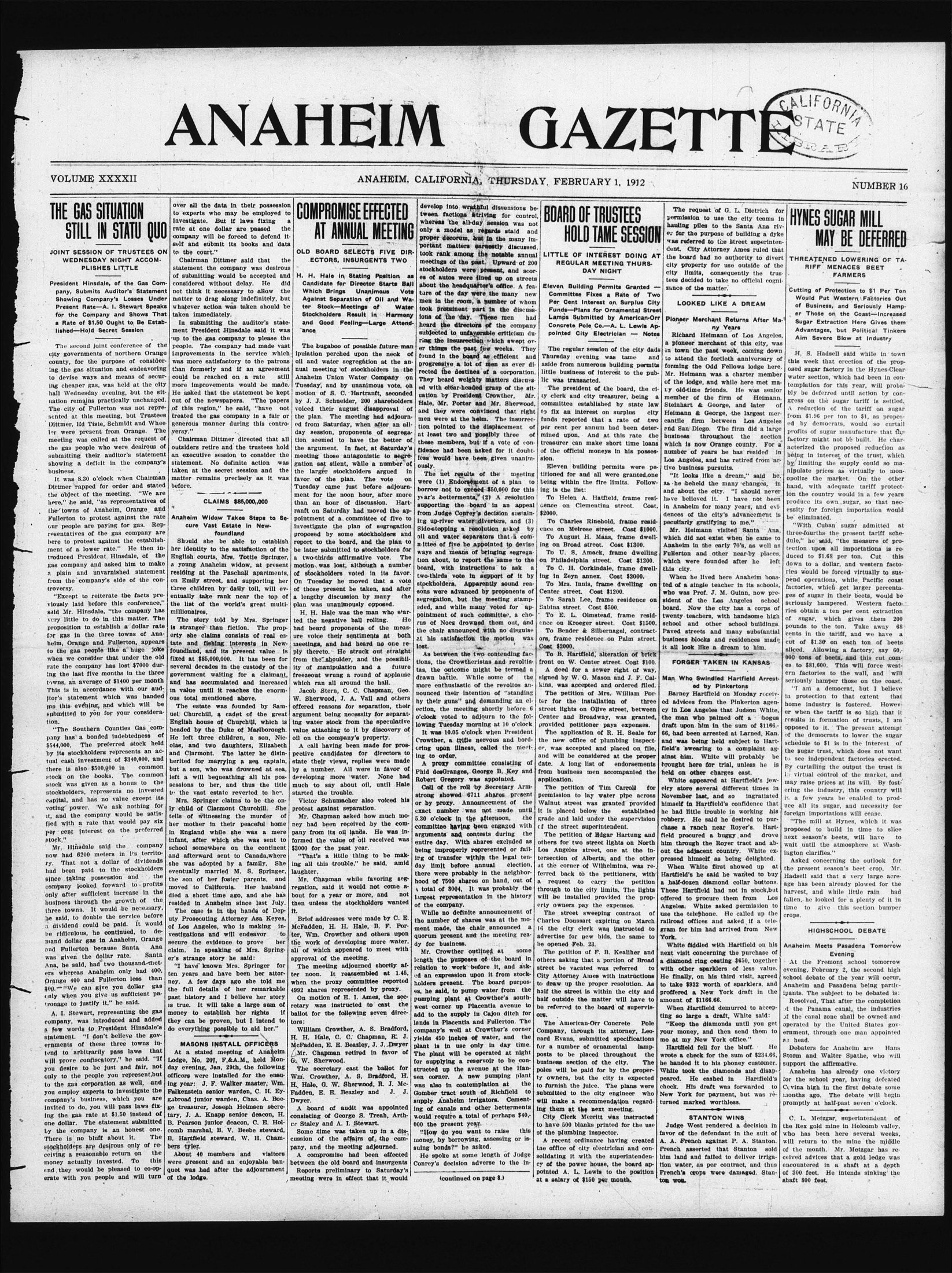
Searchable text
THE GAS SITUATION STILL IN STATU QUO
JOINT SESSION OF TRUSTEES ON WEDNESDAY NIGHT ACCOMPLISHES LITTLE
President Hinsdale, of the Gas Company, Submits Auditor's Statement Showing Company's Losses Under Present Rate—A. I. Stewart Speaks for the Company and Shows That a Rate of $1.50 Ought to Be Established—Hold Secret Session
The second joint conference of the city governments of northern Orange county, for the purpose of considering the gas situation and endeavoring to devise ways and means of securing cheaper gas, was held at the city hall Wednesday evening, but the situation remains practically unchanged. The city of Fullerton was not represented at this meeting, but Trustees Dittmer, Ed Tiste, Schmidt and Wheeler were present from Orange. The meeting was called at the request of the gas people who were desirous of submitting their auditor's statement showing a deficit in the company's business.
over all the data in their possession to experts who may be employed to investigate. But if laws fixing a rate at one dollar are passed the company will be forced to defend itself and submit its books and data to the court."
Chairman Dittmer said that the statement the company was desirous of submitting would be accepted and considered without delay. He did not think it necessary to allow the matter to drag along indefinitely, but whatever action was taken should be taken immediately.
In submitting the auditor's statement President Hinsdale said it was up to the gas company to please the people. The company had made vast improvements in the service which was more satisfactory to the patrons than formerly and if an agreement could be reached on a rate still more improvements would be made. He asked that the statement be kept out of the newspapers. "The papers of this region," he said, "have not treated the gas company in a fair or generous manner during this controversy."
Chairman Dittmer directed that all outsiders retire and the trustees hold an executive session to consider the statement. No definite action was taken at the secret session and the
COMPROMISSION AT ANNUAL
OLD BOARD SELECTORS, INSPECTOR
H. H. Hale in St. Candidate for Deputy Which Brings Against Separation Stock—Meet Stockholders Receiving and Good Feelings
The bugaboo of population perched on oil and water seagrass annual meeting of St. Anaheim Union Water Tuesday, and by motion of S. C. Hale by J. J. Schneider voiced their august plan. The meeting from Saturday, day session, proposition seemed to have the argument. In meeting those antagonization sat silent, with the larger stockho
to devise ways and means of securing cheaper gas, was held at the city hall Wednesday evening, but the situation remains practically unchanged. The city of Fullerton was not represented at this meeting, but Trustees Dittmer, Ed Tiste, Schmidt and Wheeler were present from Orange. The meeting was called at the request of the gas people who were desirous of submitting their auditor's statement showing a deficit in the company's business.
It was 8:30 o'clock when Chairman Dittmer rapped for order and stated the object of the meeting. "We are here," he said, "as representatives of the towns of Anaheim, Orange and Fullerton to protest against the rate our people are paying for gas. Representatives of the gas company are here to protest against the establishment of a lower rate." He then introduced President Hinsdale, of the gas company and asked him to make a plain and unvarnished statement from the company's side of the controversy.
"Except to reiterate the facts previously laid before this conference," said Mr. Hinsdale, "the company has very little to do in this matter. The proposition to establish a dollar rate for gas in the three towns of Anaheim, Orange and Fullerton, appears to the gas people like a huge joke when we consider that under the old rate the company has lost $7000 during the last five months in the three towns, an average of $1400 per month. This is in accordance with our auditor's statement which was handed me this evening, and which will be submitted to you for your consideration."
"The Southern Counties Gas company has a bonded indebtedness of $544,000. The preferred stock held by its stockholders represents an actual cash investment of $340,000, and there is also $500,000 in common stock on the books. The common stock was given as a bonus to the stockholders, represents no invested capital, and has no value except its voting power. We ask nothing for it, and the company would be satisfied with a rate that would pay six percent interest on the preferred stock."
Mr. Hinsdale said the company now had 6200 meters in its territory. That not a dollar of dividends had been paid to the stockholders since taking possession and the company looked forward to profits only after sufficient increase in the more improvements would be made. He asked that the statement be kept out of the newspapers. "The papers of this region," he said, "have not treated the gas company in a fair or generous manner during this controversy."
Chairman Dittmer directed that all outsiders retire and the trustees hold an executive session to consider the statement. No definite action was taken at the secret session and the matter remains precisely as it was before.
CLAIMS $85,000,000
Anaheim Widow Takes Steps to Secure Vast Estate in Newfoundland
Should she be able to establish her identity to the satisfaction of the English courts, Mrs. Tottle Springer, a young Anaheim widow, at present residing at the Paschall apartments, on Emily street, and supporting her three children by daily toll, will eventually take rank near the top of the list of the world's great multimillionaires.
The story told by Mrs. Springer is stranger than fiction. The property she claims consists of real estate and fishing interests in Newfoundland, and its present value is fixed at $85,000,000. It has been for several decades in the custody of the government waiting for a claimant, and has accumulated and increased in value until it reaches the enormous total mentioned above.
The estate was founded by Samuel Churchill, a cadet of the great English house of Churchill, which is headed by the Duke of Marlborough. He left three children, a son, Nicolas, and two daughters, Elizabeth and Clarmont. The latter he disinherited for marrying a sea captain, but a son, who was drowned at sea, left a will bequeathing all his possessions to her, and thus the title to the vast estate reverted to her.
Mrs. Springer claims to be the only child of Clarmont Churchill. She tells of witnessing the murder of her mother in their peaceful home in England while she was a mere infant, after which she was sent to school somewhere on the continent and afterward sent to Canada where she was adopted by a family. She eventually married M. S. Springer, the son of her foster parents, and moved to California. Her husband died a short time ago, and she has could be reached on a rate still more improvements would be made. He asked that the statement be kept out of the newspapers. "The papers of this region," he said, "have not treated the gas company in a fair or generous manner during this controversy."
Chairman Dittmer directed that all outsiders retire and the trustees hold an executive session to consider the statement. No definite action was taken at the secret session and the matter remains precisely as it was before.
CLAIMS $85,000,000
Anaheim Widow Takes Steps to Secure Vast Estate in Newfoundland
Should she be able to establish her identity to the satisfaction of the English courts, Mrs. Tottle Springer, a young Anaheim widow, at present residing at the Paschall apartments, on Emily street, and supporting her three children by daily toll, will eventually take rank near the top of the list of the world's great multimillionaires.
The story told by Mrs. Springer is stranger than fiction. The property she claims consists of real estate and fishing interests in Newfoundland, and its present value is fixed at $85,000,000. It has been for several decades in the custody of the government waiting for a claimant, and has accumulated and increased in value until it reaches the enormous total mentioned above.
The estate was founded by Samuel Churchill, a cadet of the great English house of Churchill, which is headed by the Duke of Marlborough. He left three children, a son, Nicolas, and two daughters, Elizabeth and Clarmont. The latter he disinherited for marrying a sea captain, but a son, who was drowned at sea, left a will bequeathing all his possessions to her, and thus the title to the vast estate reverted to her.
Mrs. Springer claims to be the only child of Clarmont Churchill. She tells of witnessing the murder of her mother in their peaceful home in England while she was a mere infant, after which she was sent to school somewhere on the continent and afterward sent to Canada where she was adopted by a family. She eventually married M. S. Springer, the son of her foster parents, and moved to California. Her husband died a short time ago, and she has could be reached on a rate still more improvements would be made. He asked that the statement be kept out of the newspapers. "The papers of this region," he said, "have not treated the gas company in a fair or generous manner during this controversy."
Chairman Dittmer directed that all outsiders retire and the trustees hold an executive session to consider the statement. No definite action was taken at the secret session and the matter remains precisely as it was before.
CLAIMS $85,000,,000
Anaheim Widow Takes Steps to Secure Vast Estate in Newfoundland
Should she be able to establish her identity to the satisfaction of the English courts, Mrs. Tottle Springer, a young Anaheim widow, at present residing at the Paschall apartments, on Emily street, and supporting her three children by daily toll, will eventually take rank near the top of the list of the world's great multimillionaires.
The story told by Mrs. Springer is stranger than fiction. The property she claims consists of real estate and fishing interests in Newfoundland, and its present value is fixed at $85,000,000. It has been for several decades in the custody of the government waiting for a claimant, and has accumulated and increased in value until it reaches the enormous total mentioned above.
The estate was founded by Samuel Churchill, a cadet of the great English house of Churchill, which is headed by the Duke of Marlborough. He left three children, a son, Nicolas, and two daughters, Elizabeth and Clarmont. The latter he disinherited for marrying a sea captain, but a son, who was drowned at sea, left a will bequeathing all his possessions to her, and thus the title to the vast estate reverted to her.
Mrs. Springer claims to be the only child of Clarmont Churchill. She tells of witnessing the murder of her mother in their peaceful home in England while she was a mere infant, after which she was sent to school somewhere on the continent and afterward sent to Canada where she was adopted by a family. She eventually married M. S. Springer, the son of her foster parents, and moved to California. Her husband died a short time ago, and she has could be reached on a rate still more improvements would be made. He asked that the statement be kept out of the newspapers. "The papers of this region," he said, "have not treated the gas company in a fair or generous manner during this controversy."
Chairman Dittmer directed that all outsiders retire and the trustees hold an executive session to consider the statement. No definite action was taken at the secret session and the matter remains precisely as it was before.
CLAIMS $85,000,,000
Anaheim Widow Takes Steps to Secure Vast Estate in Newfoundland
Should she be able to establish her identity to the satisfaction of the English courts, Mrs. Tottle Springer, a young Anaheim widow, at present residing at the Paschall apartments, on Emily street, and supporting her three children by daily toll, will eventually take rank near the top of the list of the world's great multimillionaires.
The story told by Mrs. Springer is stranger than fiction. The property she claims consists of real estate and fishing interests in Newfoundland, and its present value is fixed at $85,000,000. It has been for several decades in the custody of the government waiting for a claimant, and has accumulated and increased in value until it reaches the enormous total mentioned above.
The estate was founded by Samuel Churchill, a cadet of the great English house of Churchill, which is headed by the Duke of Marlborough. He left three children, a son,Nicolas,and two daughters,ElizabethandClarmont.The latter he disinherited for marryinga sea captain,buta sonwhowasdrownedatsealeftawillbequeathingallhispossessionstothe,andthusthetitletothevastestaterevertedtoher.
Mrs.SpringerclaimstobeonlychildofClarmontChurchill.ShetellsofwitnessingthemurderofhermotherintherpeacefulhomeinEnglandwhileshewasamereinfant,afterwhichshewassenttoschoolsomewhereonthecontinentandafterwardsenttocanadawhereshewasadoptedbyafamily.Seventuallymarriedaseacaptain,butasonwhowasdrownedatsealeftawillbequeathingallhispossessionstothe,andthusthetitletothevastestaterevisedtoher.
VictorSchumacherprotestagainseparateMr.Chapmanaskeyehadbeenreceivingwaterstockfromitsolilformedthevalueoff$3000forthepastyear.
"That'sa little thing allthistrouble laughter.
Mr.Chapmanwheresegation,saiditwouldforayearor
Mr. Hinsdale said the company now had 6200 meters in its territory. That not a dollar of dividends had been paid to the stockholders since taking possession and the company looked forward to profits only after sufficient increase in the business through the growth of the three towns. It would be necessary, he said, to double the service before a dividend could be paid. It would be ridiculous, he continued, to demand dollar gas in Anaheim, Orange and Fullerton because Santa Ana was given the dollar rate. Santa Ana, he said, had two thousand meters whereas Anaheim only had 400, Orange 400 and Fullerton less than 800. "We can give you dollar gas only when you give us sufficient patronage to justify it," he said.
A. I. Stewart, representing the gas company, was introduced and added a few words to President Hinsdale's statement. "I don't believe the governments of these three towns intend to arbitrarily pass laws that will prove confiscatory," he said. "If you desire to be just and fair, not only to the people you represent but to the gas corporation as well, and you employ experts to investigate the company's business, which you are invited to do, you will pass laws fixing the gas rate at $1.50 instead of one dollar. The statement submitted by the company is an honest one. There is no bluff about it. The stockholders are desirous only of receiving a reasonable return on the money actually invested. To this end they would be pleased to co-operate with you people and will turn Mrs. Springer claims to be the only child of Clarmont Churchill. She tells of witnessing the murder of her mother in their peaceful home in England while she was a mere infant, after which she was sent to school somewhere on the continent and afterward sent to Canada where she was adopted by a family. She eventually married M. S. Springer, the son of her foster parents, and moved to California. Her husband died a short time ago, and she has resided in Anaheim since last July.
The case is in the hands of Deputy Prosecuting Attorney Asa Keyes, of Los Angeles, who is making investigations and will endeavor to secure the evidence to prove her claim. In speaking of Mrs. Springer's strange story he said:
"I have known Mrs. Springer for ten years and have been her attorney. A few days ago she told me the full details of her remarkable past history and I believe her story is true. It will take a large sum of money to establish her rights if they can be proven, but I intend to do everything possible to aid her."
MASONS INSTALL OFFICERS
At a stated meeting of Anaheim Lodge, No, 207, F&A.M., held Monday evening, Jan. 29th, the following officers were installed for the ensuing year: J. F. Walker master; Wm. Falkenstein senior warden, C. H. Eygabroad junior warden, Chas. A. Boege treasurer, Joseph Helmsen secretary, J. A. Knapp senior deacon, H. B. Pearson junior deacon, C. E. Holcomb marshal, B. V. Beebe steward, B. Hartfield steward, W. H. Chambers tyler.
About 40 members and visitors were present and an enjoyable banquet was had after the adjournment of the lodge.
Victor Schumacher protest against secession
Mr. Chapman askedney had been received pany from its oil law formed the value of $3000 for the past year.
"That's a little thing all this trouble," laughter.
Mr. Chapman whoregation, said it would bout for a year or then unless the stock it.
Brief addresses were McFadden, H. H. Crowther, Wm. Crowther for the work of develop all of which appear approval of the meet
The meeting adjourner noon. It reassures when the proxy concludes 4992 shares represent
On motion of E. H retary was instructed ballot for the followers:
William Crowther, H. H. Hale, C. C.; McFadden, E. E. Beaulieu;
Mr. Chapman retired G. W. Sherwood.
The secretary case Wm. Crowther, A.
H. Hale, G. W. Sheehan Fadden, E. E. Beazil Dwyer.
A board of audits consisting of George Staley and A. I.
Some time was taken discussion of the affair pany, and the meeting
A compromise had between the old board
Reports preliminar meeting were in offe
ANAHEIM, CALIFORNIA, THURSDAY. FEBRUARY 1, 1912
COMPROMISE EFFECTED AT ANNUAL MEETING
OLD BOARD SELECTS FIVE DIRECTORS, INSURGENTS TWO
H. H. Hale in Stating Position, as Candidate for Director Starts Ball Which Brings Unanimous Vote Against Separation of Oil and Water Stock—Meetings of Water Stockholders Result in Harmony and Good Feeling—Large Attendance
The bugaboo of possible future manipulation perched upon the neck of oil and water segregation at the annual meeting of stockholders in the Anaheim Union Water Company on Tuesday, and by unanimous vote, on motion of S. C. Hartranft, seconded by J. J. Schneider, 200 shareholders voiced their August disapproval of the plan. The meeting had adjourned from Saturday, when after an all-day session, proponents of segregation seemed to have the better of the argument. In fact, at Saturday's meeting those antagonistic segregation sat silent, while a number of the larger stockholders argued in development into wrathful dissensions between factions striving for control, whereas the all-day session was not only a model as regards stalid and proper decorum, but in the many important matters earnestly discussed, took rank among the notable annual meetings of the past. Upward of 200 stockholders were present, and scores of autos were lined up on streets about the headquarters' office. A feature of the day were the many new men in the room, a number of whom took prominent part in the discussions of the day. These men had heard the directors of the company subjected to unfavorable criticism during the insurrection which swept over things the past few weeks. They found in the board as efficient and progressive a lot of men as ever directed the destines of a corporation. They heard weighty matters discussed with clear-headed grasp of the situation by President Crowther, Mr. Hale, Mr. Porter and Mr. Sherwood, and they were convinced that right men were at the helm. The insurrection pointed to the displacement of at least two and possibly three of these members, but if a vote of confidence had been asked for it doubtless would have been given unanimously.
BOARD OF TRUSTEES HOLD TAME SESSION
LITTLE OF INTEREST DOING AT REGULAR MEETING THURSDAY NIGHT
Eleven Building Permits Granted — Committee Fixes a Rate of Two Per Cent Interest on Surplus City Funds—Plans for Ornamental Street Lamps Submitted by American-Orr Concrete Pole Co.—A. L. Lewis Appointed City Electrician — Notes
The regular session of the city dads Thursday evening was tame and aside from numerous building permits little business of interest to the public was transacted.
The president of the board, the city clerk and city treasurer, being a committee established by state law to fix an interest on surplus city funds reported that a rate of two per cent per annum had been determined upon. And at this rate the treasurer can make short time loans of the official moneys in his possession.
Eleven building permits were petitioned for and all were granted one
Anaheim Union Water Company on Tuesday, and by unanimous vote, on motion of S. C. Hartranft, seconded by J. J. Schneider, 200 shareholders voiced their august disapproval of the plan. The meeting had adjourned from Saturday, when after an all-day session, proponents of segregation seemed to have the better of the argument. In fact, at Saturday's meeting those antagonistic to segregation sat silent, while a number of the larger stockholders argued in favor of the plan. The vote on Tuesday came just before adjournment for the noon hour, after more than an hour of discussion. Hartranft on Saturday had moved the appointment of a committee of five to investigate the plan of segregation proposed by some stockholders and report to the board, and the plan to be later submitted to stockholders for a two-thirds affirmative vote. The motion was lost, although a number of stockholders voted in its favor. On Tuesday he moved that a vote of those present be taken, and after a lengthy discussion by many the plan was unanimously opposed.
H. H. Hale was the man who started the negative ball rolling. He had heard proponents of the measure voice their sentiments at both meetings, and had heard no one reply thereto. He struck out straight from the shoulder, and the possibility of manipulation and a future freezeout wrung a round of applause which ran all around the hall.
Jacob Stern, C. C. Chapman, Geo. W. Sherwood, J. A. Vall and others offered reasons for separation, their argument being necessity for separating water stock from the speculative value attaching to it by discovery of oil on the company's property.
A call having been made for prospective candidates for directors to state their views, replies were made by a number. All were in favor of developing more water. None had much to say about oil, until Hale started the trouble.
Victor Schumacher also voiced his protest against separation.
Mr. Chapman asked how much money had been received by the company from its oil lands. He was informed the value of oil received was $3000 for the past year.
"That's a little thing to be making all this trouble," he said, amid laughter.
Mr. Chapman while favoring segregation, said it would not come about for a year or more, and not
They heard weighty matters discussed with clear-headed grasp of the situation by President Crowther, Mr. Hale, Mr. Porter and Mr. Sherwood, and they were convinced that right men were at the helm. The insurrection pointed to the displacement of at least two and possibly three of these members, but if a vote of confidence had been asked for it doubtless would have been given unanimously.
The net results of the meeting were (1) Endorsement of a plan to borrow not to exceed $50,000 for this year's betterments, (2) A resolution supporting the board in an appeal from Judge Conrey's decision sustaining up-river water diverters, and (3) Side-stepping a resolution asked by oil and water separators that a committee of five be appointed to devise ways and means of bringing segregation about, to report the same to the board, with instructions to ask a two-thirds vote in support of it by stockholders. Apparently sound reasons were advanced by proponents of segregation, but the meeting stampeded, and while many voted for appointment of such committee, a chorus of Noes drowned them out, and the chair announced with no disguise at his satisfaction the motion was lost.
As between the two contending factions, the Crowtheristas and revoltistas, the outcome might be termed a drawn battle. While some of the more enthusiastic of the revolos announced their intention of "standing by their guns" and demanding an election, the meeting shortly before 6 o'clock voted to adjourn to the following Tuesday morning at 10 o'clock
It was 10.05 o'clock when President Crowther, a trifle nervous and bordering upon illness, called the meeting to order.
A proxy committee consisting of Phid desGranges, George B. Key and Robert Gregory was appointed.
Call of the roll by Secretary Armstrong showed 6711 shares present or by proxy. Announcement of the exact number was not made until 5.30 o'clock in the afternoon, the committee having been engaged with arguments and contests during the entire day. With shares excluded as being improperly represented or failing of transfer within the legal ten-day limit before annual election, there were probably in the neighborhood of 7500 shares on hand, out of a total of 8004. It was probably the largest representation in the history
The president of the board, the city clerk and city treasurer, being a committee established by state law to fix an interest on surplus city funds reported that a rate of two per cent per annum had been determined upon. And at this rate the treasurer can make short time loans of the official moneys in his possession.
Eleven building permits were petitioned for and all were granted; one being within the fire limits. Following is the list:
To Helen A. Hatfield, frame residence on Clementina street. Cost, $2000.
To Charles Rinehold, frame residence on Melrose street. Cost $1000.
To August H. Maas, frame dwelling on Broad street. Cost $1300.
To U. S. Amack, frame dwelling on Philadelphia street. Cost $1200.
To C. H. Corkindale, frame dwelling in Zeynn annex. Cost $2000.
To Mrs. Innis, frame dwelling on Center street. Cost $1200.
To Sarah Lee, frame residence on Sabina street. Cost $500.
To E. L. Olmstead, frame residence on Kroeger street. Cost $1500.
To Bender & Silbernagel, contractors, frame residence on Palm street. Cost $2000.
To B. Hartfield, alteration of brick front on W. Center street. Cost $100.
A deed for a sewer right of way, signed by W. G. Mason and J. F. Calkins, was accepted and ordered filed.
The petition of Mrs. William Porter for the installation of three street lights on Olive street, between Center and Broadway, was granted, provided petitioner pays expenses.
The application of R. H. Seale for the new office of plumbing inspector, was accepted and placed on file, and will be considered at the proper date. A long list of endorsements from business men accompanied the application.
The petition of Tim Carroll for permission to lay water pipe across Walnut street was granted provided it is placed below the established grade and laid under the supervision of the street superintendent.
The petition of Edgar Hartung and others for two street lights on North Los Angeles street, one at the intersection of Alberta, and the other at the corner of Wilhelmina, was referred back to the petitioners, with a request to carry the petition through to the city limits. The lights will be installed provided the prop-
Victor Schumacher also voiced his protest against separation.
Mr. Chapman asked how much money had been received by the company from its oil lands. He was informed the value of oil received was $3000 for the past year.
"That's a little thing to be making all this trouble," he said, amid laughter.
Mr. Chapman while favoring segregation, said it would not come about for a year or more, and not then unless the stockholders wanted it.
Brief addresses were made by C. E. McFadden, H. H. Hale, B. F. Porter, Wm. Crowther and others upon the work of developing more water, all of which appeared to meet with approval of the meeting.
The meeting adjourned shortly after noon. It reassembled at 1.45, when the proxy committee reported 4992 shares represented by proxy.
On motion of E. I. Ames, the secretary was instructed to cast the ballot for the following seven directors:
William Crowther, A. S. Bradford, H. H. Hale, C. C. Chapman, R. J. McFadden, E. E. Beazley, J. J. Dwyer
Mr. Chapman retired in favor of G. W. Sherwood.
The secretary cast the ballot for Wm. Crowther, A. S. Bradford, H. H. Hale, G. W. Sherwood, R. J. McFadden, E. E. Beazley and J. J. Dwyer.
A board of audit was appointed consisting of George S. Treah, Arthur Staley and A. I. Stewart.
Some time was taken up in a discussion of the affairs of the company, and the meeting adjourned.
A compromise had been effected between the old board and insurgents.
Reports preliminary to Saturday's meeting were in effect that it would order proxy. Announcement of the exact number was not made until 5:30 o'clock in the afternoon, the committee having been engaged with arguments and contests during the entire day. With shares excluded as being improperly represented or failing of transfer within the legal ten-day limit before annual election, there were probably in the neighborhood of 7500 shares on hand, out of a total of 8004. It was probably the largest representation in the history of the company.
While no definite announcement of the number of shares was at the moment made, the chair announced a quorum present and the meeting ready for business.
Mr. Crowther outlined at some length the purposes of the board in relation to work before it, and asked an expression upon it from stockholders present. The board purposes, he said, to pump water from the pumping plant at Crowther's southwest corner up Placentia avenue to add to the supply in Cajon ditch for lands in Placentia and Fullerton. The company's well at Crowther's corner yields 450 inches of water, and the plant is in use only in day time. The plant will be operated at night for supplying a reservoir to be constructed up the avenue at the Hansen corner. A new pumping plant was also in contemplation at the Gomber tract south of Richfield to supply Anaheim irrigators. Cementing of canals and other betterments would require a total of perhaps $40,000 the present year.
"How do you want to raise this money, by borrowing, assessing or issuing bonds?" he asked.
He spoke at some length of Judge Conrey's decision adverse to the in-
Walnut street was granted provided it is placed below the established grade and laid under the supervision of the street superintendent.
The petition of Edgar Hartung and others for two street lights on North Los Angeles street, one at the intersection of Alberta, and the other at the corner of Wilhelmina, was referred back to the petitioners, with a request to carry the petition through to the city limits. The lights will be installed provided the property owners pay the expenses.
The street sweeping contract of Charles Doussart expiring on March 16 the city clerk was instructed to advertise for new bids, the same to be opened Feb. 23.
The petition of F. B. Kealiher and others asking that a portion of Broad street be vacated was referred to City Attorney Ames with instructions to draw up the proper resolution. As half the street is within the city and half outside the matter will have to be referred to the board of supervisors.
The American-Orr Concrete Pole Company, through its attorney, Leonard Evans, submitted specifications for a number of ornamental lamp posts to be placed throughout the business section of the city. The poles will be paid for by the property owners, but the city is expected to furnish the juice. The plans were submitted to the city engineer who will make a recommendation regarding them at the next meeting.
City Clerk Merritt was instructed to have 500 blanks printed for the use of the plumbing inspector.
A recent ordinance having created the office of city electrician and consolidating it with the superintendency of the power house, the board appointed A. L. Lewis to the position at a salary of $150 per month.
CALIFORNIA STATE
JANUARY 1, 1912
NUMBER 16
TRUSTEES TAME SESSION
INTEREST DOING AT MEETING THURS-NIGHT
Permits Granted —
a Rate of Two Interest on Surplus City Ornamental Street Used by American-Orr Co.—A. L. Lewis Applicant — Notes
vision of the city dads was tame androus building permits interest to the publ.
of the board, the treasurer, being aished by state law on surplus city that a rate of two rum had been deter- at this rate the take short time loans money in his possespermits were peall were granted one
The request of G. L. Dietrich for permission to use the city teams in hauling piles to the Santa Ana river for the purpose of building a dyke was referred to the street superintendent. City Attorney Ames ruled that the board had no authority to divert city property for use outside of the city limits, consequently the trustees decided to take no official cognizance of the matter.
LOOKED LIKE A DREAM
Pioneer Merchant Returns After Many Years
Richard Heimann of Los Angeles, a pioneer merchant of this city, was in town the past week, coming down to attend the fortieth anniversary of forming the Odd Fellows lodge here. Mr. Heimann was a charter member of the lodge, and while here met many old-time friends. He was senior member of the firm of Heimann, Steinhart & George, and later of Heimann & George, the largest mercantile firm between Los Angeles and San Diego. The firm did a large business throughout the section which is now Orange county. For a number of years he has resided in Los Angeles, and has retired from active business pursuits.
HYNES SUGAR MILL MAY BE DEFERRED
THREATENED LOWERING OF TA-RIFF MENACES BEET FARMERS
Cutting of Protection to $1 Per Ton Would Put Western Factories Out of Business, and Seriously Hamp- er Those on the Coast—Increased Sugar Extraction Here Gives them Advantages, but Political Tinkers Aim Severe Blow at Industry
H. S. Hadsell said while in town this week that erection of the proposed sugar factory in the Hynes-Clear-water section, which had been in contemplation for this year, will probably be deferred until action by congress on the sugar tariff is settled. A reduction of the tariff on sugar from $1.96 per ton to $1, as proposed by democrats, would so curtail profits of sugar manufacture that the factory might not be built. He characterized the proposed reduction as being in interest of the trust, which by limiting the supply could so manipulate prices as virtually to mon-
of the board, the chief treasurer, being a
finished by state law
at on surplus city
that a rate of two
sum had been deterd at this rate the
take short time loans
moneys in his possespermits were peall were granted, one
fire limits. Followhatfield, frame resitina street. Cost,
hold, frame residstreet. Cost $1000.
Maas, frame dwelling. Cost $1300.
rick, frame dwelling
street. Cost $1200.
andale, frame dwellx. Cost $2000.
frame dwelling on
cost $1200.
frame residence on
cost $500.
stead, frame residstreet. Cost $1500.
albernagel, contractance on Palm street.
alteration of brick or street. Cost $100.
never right of way,
season and J. F. Calle
and ordered filed.
Mrs. William Porlilation of three
live street, between
away, was granted,
or pays expenses.
of R. H. Seale for
plumbing inspectand placed on file,
ordered at the proper
of endorsements
on accompanied the
Tim Carroll for
water pipe across
is granted provided
by the established
under the supervision
intendent.
Edgar Hartung and
set lights on North
out, one at the inerta, and the other
Wilhelmina, was rethe petitioners, with
carry the petition
by limits. The lights
provided the prop-
Mr. Heimann was a charter member
of the lodge, and while here met maly old-time friends. He was senior
member of the firm of Heimann,
Steinhart & George, and later of
Heimann & George, the largest mercantile firm between Los Angeles and San Diego. The firm did a large business throughout the section which is now Orange county. For a number of years he has resided in Los Angeles, and has retired from active business pursuits.
"It looks like a dream," said he,
as he beheld the many changes, in
and about the city. "I should never have believed it. I have not been in Anaheim for many years, and evidences of the city's advancement is peculiarly gratifying to me."
Mr. Heimann visited Santa Ana,
which did not exist when he came to Anaheim in the early 70's, as well as Fullerton and other near-by places, which were founded after he left this city.
When he lived here Anaheim boasted of a single teacher in its schools, who was Prof. J. M. Guinn, now president of the Los Angeles school board. Now the city has a corps of twenty teachers, with handsome high school and other school buildings. Paved streets and many substantial business blocks and residences made it all look like a dream to him.
FORGER TAKEN IN KANSAS
Man Who Swindled Hartfield Arrested by Pinkertons
Barney Hartfield on Monday received advices from the Pinkerton agency in Los Angeles that Judson White, the man who palmed off a bogus draft upon him in the sum of $1166.66, had been arrested at Larned, Kan. and was being held subject to Hartfield's swearing to a complaint against him. White will probably be brought here for trial, unless he is held on other charges east.
White appeared at Hartfield's jewelry store several different times in November last, and so ingratiated himself in Hartfield's confidence that he had little trouble in working his robbery. He said he desired to purchase a ranch near Royer's. Hartfield procured a buggy and drove him through the Royer tract and about the adjacent country. White expressed himself as being delighted.
When White first showed up at Hartfield's he said he wanted to buy a half-dozen diamond collar buttons. These Hartfield had not in stock, but offered to procure them from Los
water section, which had been in contemplation for this year, will probably be deferred until action by congress on the sugar tariff is settled.
A reduction of the tariff on sugar from $1.96 per ton to $1, as proposed by democrats, would so curtail profits of sugar manufacture that the factory might not be built. He characterized the proposed reduction as being in interest of the trust, which by limiting the supply could so manipulate prices as virtually to monopolize the market. On the other hand, with adequate tariff protection the country would in a few years produce its own sugar, so that necessity for foreign importation would be eliminated.
"With Cuban sugar admitted at three-fourths the present tariff schedule," he said, "the measure of protection upon all importations is reduced to $1.68 per ton. Cut this down to a dollar, and western factories would be forced virtually to suspend operations, while Pacific coast factories, which get larger percentages of sugar in their beets, would be seriously hampered. Western factories obtain a ten per cent extraction of sugar, which gives them 200 pounds to the ton. Take away 68 cents in the tariff, and we have a cut of $1.30 on each ton of beets sliced. Allowing a factory, say 60,000 tons of beets, and this cut comes to $81,600. This will force western factories to the wall, and will seriously hamper those on the coast.
"I am a democrat, but I believe in protection to that extent that home industry is fostered. However when the tariff is so high that it results in formation of trusts, I am opposed to it. The present attempt of the democrats to lower the sugar schedule to $1 is in the interest of the sugar trust, which does not want to see independent factories erected. By curtailing the output the trust is in virtual control of the market, and may raise prices at its will. By fostering the industry, this country will it a few years be enabled to produce all its sugar, and necessity for foreign importations will cease.
"The mill at Hynes, which it was proposed to build in time to slice next season's beets, will have to wait until the atmosphere at Washington clarifies."
Granted provided by the established order under the supervision of the intendent.
Hedgar Hartung and street lights on North Street, one at the in-erta, and the other Wilhelmina, was re-petitioners, with carry the petition limits. The lights provided the propane expenses.
Applying contract of expiring on March 1st was instructed to rebids, the same to F. B. Kealiher and a portion of Broad was referred to us with instructions super resolution. As within the city and matter will have to board of supervisors Concrete Pole its attorney, Leo-tted specifications ornamental lamp throughout the city. The for by the proper city is expected. The plans were city engineer who recommendation regard next meeting.
It was instructed printed for the use inspector. Since having created electrician and con- the superintendence, the board ap- pels to the position per month.
himself in Hartfield's confidence that he had little trouble in working his robbery. He said he desired to purchase a ranch near Royer's. Hartfield procured a buggy and drove him through the Royer tract and about the adjacent country. White expressed himself as being delighted.
When White first showed up at Hartfield's he said he wanted to buy a half-dozen diamond collar buttons. These Hartfield had not in stock, but offered to procure them from Los Angeles. White asked permission to use the telephone. He called up the railroad offices and asked if a telegram for him had arrived from New York.
White fiddled with Hartfield on his next visit concerning the purchase of a diamond ring costing $650, together with other sparklers of less value. He finally, on his third visit, agreed to take $932 worth of sparklers, and proffered a New York draft in the amount of $1166.66.
When Hartfield demurred to accepting so large a draft, White said:
"Keep the diamonds until you get your money, and then send them to me at my New York office."
Hartfield fell for the bluff. He wrote a check for the sum of $234.66, he handed it to his phoney customer. White took the diamonds and disappeared. He cashed in Hartfield's check. His draft was forwarded to New York for payment, but was returned marked worthless.
STANTON WINS
Judge West rendered a decision in favor of the defendant in the suit of A. A. French against P. A. Stanton. French asserted that Stanton sold him land and failed to deliver irrigation water, as per contract, and thus French's crops were damaged. Stanton won.
C. L. Metzgar, superintendent of the Rex gold mine in Holcomb valley, who has been here several weeks, will return to the mine the middle of the month. Mr. Metzgar has received advices that a gold ledge was encountered in a shaft at a depth of 300 feet. He intends sinking the shaft 800 feet.
The mill at Hynes, which it was proposed to build in time to slice next season's beets, will have to wait until the atmosphere at Washington clarifies."
Asked concerning the outlook for the present season's beet crop, Mr. Hadsell said that a very large acreage has been already plowed for the harvest, and while little rain had fallen, he looked for a plenty of it in time to give this section bumper crops.
HIGHSCHOOL DEBATE
Anaheim Meets Pasadena Tomorrow Evening
At the Fremont school tomorrow evening, February 2, the second high school debate of the year will occur, Anaheim and Pasadena being participants. The subject to be debated is:
Resolved, That after the completion of the Panama canal, the industries of the canal zone shall be owned and operated by the United States government, through one man appointed as head.
Debaters for Anaheim are Hans Storm and Walter Spathe, who will support the affirmative.
Anaheim has already one victory for the school year, having defeated Cevina high in the first debate some months ago. The debate will begin promptly at half-past seven o'clock.