anaheim-gazette 1912-01-11
Scanned page
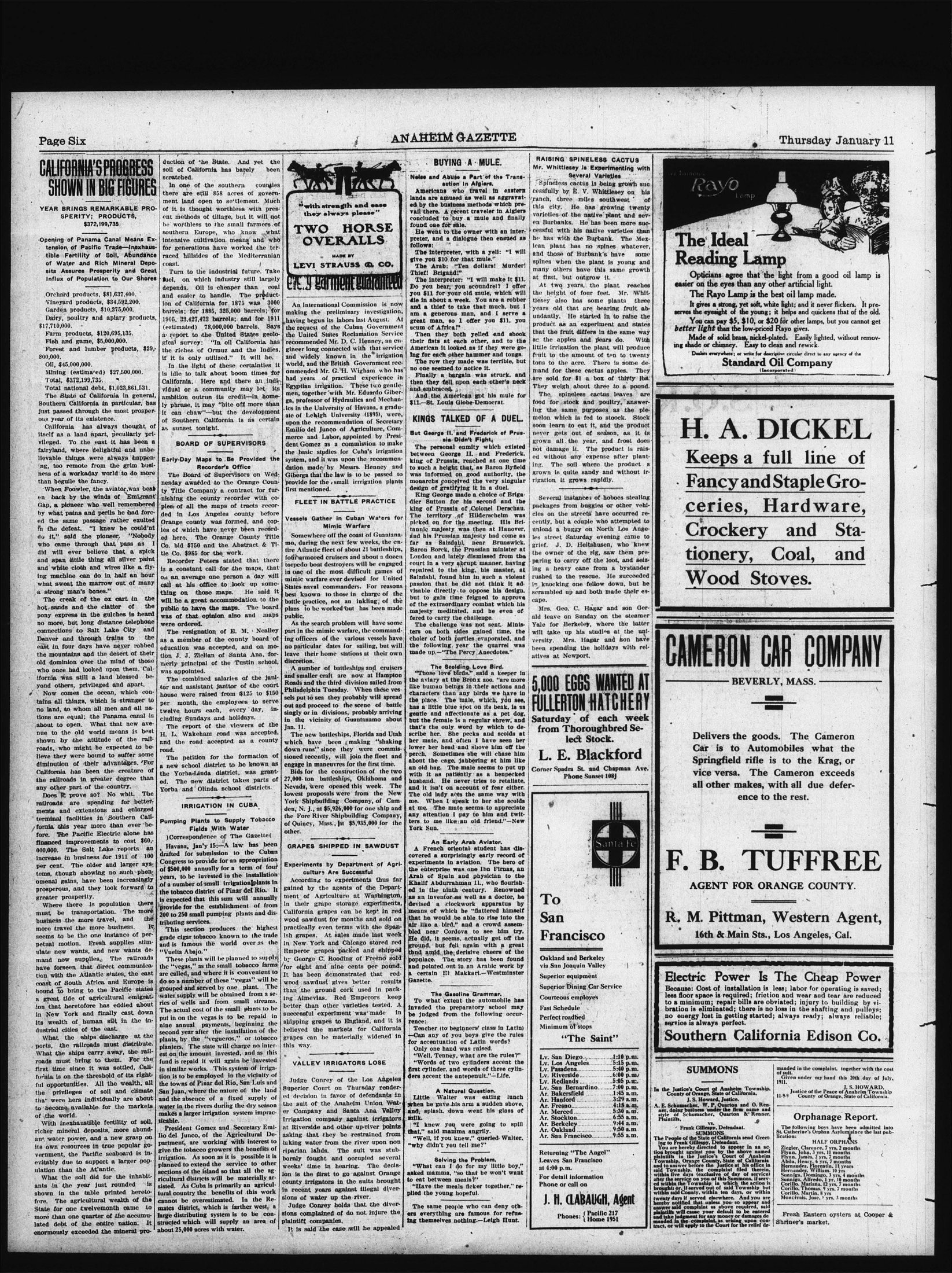
Searchable text
CALIFORNIA'S PROGRESS SHOWN IN BIG FIGURES
YEAR BRINGS REMARKABLE PROSPERITY; PRODUCTS,
$372,199,735
Opening of Panama Canal Means Extension of Pacific Trade—Inexhaustible Fertility of Soil, Abundance of Water and Rich Mineral Deposits Assures Prosperity and Great Influx of Population to Our Shores
Orchard products, $81,637,400.
Vineyard products, $34,592,200.
Garden products, $10,275,000.
Dairy, poultry and apiary products, $17,710,000.
Farm products, $120,695,135.
Fish and game, $5,000,000.
Forest and lumber products, $29,-800,000.
Oil, $45,000,000.
Mining (estimated) $27,500,000.
Total, $372,199,735.
Total national debt, $1,023,861,531.
The State of California in general, Southern California in particular, has just passed through the most prosperous year of its existence.
California has always thought of itself as a land apart, peculiarly privileged. To the east it has been a fairyland, where delightful and unbelievable things were always happening, too remote from the grim business of a workaday world to do more production of the State. And yet the soil of California has barely been scratched.
In one of the southern counties there are still 858 acres of government land open to settlement. Much of it is thought worthless with present methods of tillage, but it will not be worthless to the small farmers of southern Europe, who know what intensive cultivation means and who for generations have worked the terraced hillsides of the Mediterranean coast.
Turn to the industrial future. Take fuel, on which industry still largely depends. Oil is cheaper than coal and easier to handle. The production of California for 1875 was 3000 barrels; for 1885, 325,000 barrels; for 1905, 33,427,473 barrels; and for 1911 (estimated) 78,000,000 barrels. Says a report to the United States geological survey: "In oil California has the riches of Ormuz and the Indies, if it is only utilized." It will be.
In the light of these certainties it is idle to talk about boom times for California. Here and there an individual or a community may let its ambition outrun its credit—in homey phrase, it may "bite off more than it can chaw"—but the development of Southern California is as certain as sunset tonight.
BOARD OF SUPERVISORS
Early-Day Maps to Be Provided the Recorder's Office
The Board of Supervisors on Wed-
Total national debt, $1,023,861,531.
The State of California in general, Southern California in particular, has just passed through the most prosperous year of its existence.
California has always thought of itself as a land apart, peculiarly privileged. To the east it has been a fairyland, where delightful and unbelievable things were always happening, too remote from the grim business of a workaday world to do more than beguile the fancy.
When Fowler, the aviator, was beaten back by the winds of Emigrant Gap, a pioneer who well remembered by what pains and perils he had forced the same passage rather exulted in the defeat. "I knew he couldn't do it," said the pioneer, "Nobody who came through that pass as I did will ever believe that a spick and span little thing all silver paint and white cloth and wires like a flying machine can do in half an hour what sweat the marrow out of many a strong man's bones."
The creak of the ox cart in the hot sands and the clatter of the pony express in the gulches is heard no more, but long distance telephone connections to Salt Lake City and Denver and through trains to the east in four days have never robbed the mountains and the desert of their old dominion over the mind of those who once had looked upon them. California was still a land blessed beyond others, privileged and apart.
Now comes the ocean, which contains all things, which is stranger to no land, to whom all men and all nations are equal; the Panama canal is about to open. What that new avenue to the old world means is best shown by the attitude of the railroads, who might be expected to believe they were bound to suffer some diminution of their advantages. For California has been the creature of the railroads in greater degree than any other part of the country.
Does it prove so? No whit. The railroads are spending for betterments and extensions and enlarged terminal facilities in Southern California this year more than ever before. The Pacific Electric alone has financed improvements to cost $60,000,000. The Salt Lake reports an increase in business for 1911 of 100 per cent. The older and larger systems, though showing no such phenomenal gains, have been increasingly prosperous, and they look forward to greater prosperity.
BOARD OF SUPERVISORS
Early-Day Maps to Be Provided the Recorder's Office
The Board of Supervisors on Wednesday awarded to the Orange County Title Company a contract for furnishing the county recorder with copies of all the maps of tracts recorded in Los Angeles county before Orange county was formed, and copies of which have never been recorded here. The Orange County Title Co. bid $750 and the Abstract & Title Co. $985 for the work.
Recorder Peters stated that there is a constant call for the maps, that on an average one person a day will call at his office to look up something on those maps. He said it will be a great accommodation to the public to have the maps. The board was of that opinion also and maps were ordered.
The resignation of E. M. Nealley as a member of the county board of education was accepted, and on motion J. J. Zielian of Santa Ana, formerly principal of the Tustin school, was appointed.
The combined salaries of the janitor and assistant janitor of the court house were raised from $125 to $150 per month, the employees to serve twelve hours each, every day, including Sundays and holidays.
The report of the viewers of the H. L. Wakeham road was accepted, and the road accepted as a county road.
The petition for the formation of a new school district to be known as the Yorba-Linda district, was granted. The new district takes parts of Yorba and Olinda school districts.
IRRIGATION IN CUBA
Pumping Plants to Supply Tobacco Fields With Water
)Correspondence of The Gazette(
Havana, Jan'y 15:—A law has been drafted for submission to the Cuban Congress to provide for an appropriation of $500,000 annually for a term of four years, to be invested in the installation of a number of small irrigation plants in the tobacco district of Pinar del Rio. It is expected that this sum will annually had years of practical Egyptian irrigation. The men, together with Mr. Gaiga, professor of Hydraulics in the University of Lehigh University upon the recommendation Emilio del Junco of Apmerce and Labor, appointe Domez as a compilateur basic studies for C system, and it was upon dedication made by Messrs Giberga that the law is provide for the small in first mentioned.
FLEET IN BATTLE
Vessels Gather in Cuba
Mimic War
Somewhere off the coast mo., during the next few tire Atlantic fleet of about four armored cruisers and torpedo boat destroyers in one of the most difficult mimic warfare ever developed States naval commander best known to those in battle practice, not an plans to be worked out public.
As the search problem part in the mimic warfare officers of the variety no particular dates for leave their home station discretion.
A number of battleships and smaller craft are now Roads and the third division Philadelphia Tuesday. Vessels put to sea they probably out and proceed to the singly or in divisions, partly in the vicinity of Guam Jan. 11.
The new battleships, which have been maid down runs" since they joined recently, will join engage in maneuvers for Bids for the construction 27,000-ton battleships, Nevada, were opened the lowest proposals were York Shipbuilding Conden, N. J., at $5,926,000 for the Fore River Shipbuilding of Quincy, Mass., at $5,926,000 other.
GRAPES SHIPPED IN
Experiments by Deparculture Are Successful
According to experience gained by the agents in agriculture
railroads are spending for betterments and extensions and enlarged terminal facilities in Southern California this year more than ever before. The Pacific Electric alone has financed improvements to cost $60,000,000. The Salt Lake reports an increase in business for 1911 of 100 per cent. The older and larger systems, though showing no such phenomenal gains, have been increasingly prosperous, and they look forward to greater prosperity.
Where there is population there must be transportation. The more business the more travel, and the more travel the more business. It seems to be the one instance of perpetual motion. Fresh supplies stimulate new wants, and new wants demand new supplies. The railroads have foreseen that direct communication with the Atlantic states, the east coast of South Africa and Europe is bound to bring to the Pacific states a great tide of agricultural emigration that heretofore has eddied about in New York and finally cast down its wealth of human silt in the industrial cities of the east.
What the ships discharge at the ports, the railroads must distribute. What the ships carry away, the railroads must bring to them. For the first time since it was settled, California is on the threshold of its rightful opportunities. All the wealth, all the privileges of soil and climate that were hers individually are about to become available for the markets of the world.
With inexhaustible fertility of soil, richer mineral deposits, more abundant water power, and a new grasp on its own resources in true popular government, the Pacific seaboard is inevitably due to support a larger population than the Atlantic.
What the soil did for the inhabitants in the year just rounded is shown in the table printed heretofore. The agricultural wealth of the State for one twelvemonth came to more than one quarter of the accumulated debt of the entire nation. It enormously exceeded the mineral pro-
IRRIGATION IN CUBA
Pumping Plants to Supply Tobacco Fields With Water
)Correspondence of The Gazette(
Havana, Jan'y 15:—A law has been drafted for submission to the Cuban Congress to provide for an appropriation of $500,000 annually for a term of four years, to be invested in the installation of a number of small irrigation plants in the tobacco district of Pinar del Rio. It is expected that this sum will annually provide for the establishment of from 200 to 250 small pumping plants and distributing services.
This section produces the highest grade cigar tobacco known to the trade and is famous the world over as the "Vuelta Abajo."
These plants will be planned to supply the "vegas," as the small tobacco farms are called, and where it is convenient to do so a number of these "vegas" will be grouped and served by one plant. The water supply will be obtained from a series of wells and from small streams. The actual cost of the small plants to be put in on the vegas is to be repaid in nine annual payments, beginning the second year after the installation of the plants, by the "vegueros," or tobacco planters. The state will charge no interest on the amount invested, and as this fund is repaid it will again be invested in similar works. This system of irrigation is to be employed in the vicinity of the towns of Pinar del Rio, San Luis and San Juan, where the nature of the land and the absence of a fixed supply of water in the rivers during the dry season makes a larger irrigation system impracticable.
President Gomez and Secretary Emilio del Junco, of the Agricultural Department, are working with interest to give the tobacco growers the benefits of irrigation. As soon as it is possible it is planned to extend the service to other sections of the island so that all the agricultural districts will be materially assisted. As Cuba is primarily an agricultural country the benefits of this work cannot be overestimated. In the Remates district, which is farther west, a large distributing system is to be constructed which will supply an area of about 25,000 acres with water.
Judge Conrey of the Superior Court on The ed decision in favor of the suit of the Anaheler Company and Santa Irrigation company again at Riverside and other asking that they be re-taking water from the ripearian lands. The s bornly fought and occ weeks' time in hearing ion is the first to go a county irrigators in ther in recent years against slions of water up the ar Judge Conrey holds th slions complained of do plaintiff companies.
It is said the case wh
ANAHEIM GAZETTE
"with strength and ease they always please"
TWO HORSE OVERALLS
MADE BY LEVI STRAUSS & CO.
An International Commission is now making the preliminary investigation, having begun its labors last August. At the request of the Cuban Government the United States Reclamation Service recommended Mr. D. C. Henney, an engineer long connected with that service and widely known in the irrigation world, and the British Government recommended Mr. G. H. Wigham who has had years of practical experience in Egyptian irrigation. These two gentlemen, together with Mr. Eduardo Giberga, professor of Hydraulics and Mechanics in the University of Havana, a graduate of Lehigh University (1895), were upon the recommendation of Secretary Emilio del Junco of Agriculture, Commerce and Labor, appointed by President Gomez as a commission to make the basic studies for Cuba's irrigation system, and it was upon the recommendation made by Messrs. Henney and Giberga that the law is to be passed to
BUYING A MULE.
Neise and Abuse a Part of the Transaction in Algiers.
Americans who travel in eastern lands are amused as well as aggravated by the business methods which prevail there. A recent traveler in Algiers concluded to buy a mule and finally found one for sale.
He went to the owner with an interpreter, and a dialogue then ensued as follows:
The interpreter, with a yell: "I will give you $10 for that mule."
The Arab: "Ten dollars! Murder! Thief! Brigand!"
The interpreter: "I will make it $11. Do you hear, you scoundrel? I offer you $11 for your old mule, which will die in about a week. You are a robber and a thief to take that much, but I am a generous man, and I serve a great man, so I offer you $11, you scum of Africa!"
Then they both yelled and shook their fists at each other, and to the American it looked as if they were going for each other hammer and tongs.
The row they made was terrible, but no one seemed to notice it.
Finally a bargain was struck, and then they fell upon each other's neck and embraced.
And the American got his mule for $11.—St. Louis Globe-Democrat.
KINGS TALKED OF A DUEL.
But George II. and Frederick of Prussia Didn't Fight,
The personal enmity which existed between George II. and Frederick, king of Prussia, reached at one time to such a height that, as Baron Byfield was informed on good authority, the RAISING SPINELESS CACTUS
Mr. Whittlesey is Experimenting with Several Varieties
Spineless cactus is being grown successfully by E. V. Whittlesey on his ranch, three miles southwest of this city. He has growing twenty varieties of the native plant and seven Burbanks. He has been more successful with his native varieties than he has with the Burbank. The Mexican plant has no spines whatever, and those of Burbank's have some spines when the plant is young and many others have this same growth at first, but outgrow it.
At two years, the plant reaches the height of four feet. Mr. Whittlesey also has some plants three years old that are bearing fruit abundantly. He started in to raise the product as an experiment and states that the fruit differs in the same way as the apples and pears do. With little irrigation the plant will produce fruit to the amount of ten to twenty tons to the acre. There is some demand for these cactus apples. They are sold for $1 a box of thirty lbs. They weigh about three to a pound.
The spineless cactus leaves are food for stock and poultry, answering the same purposes as the plemelon which is fed to stoock. Stock soon learn to eat it, and the product never gets out of season, as it is grown all the year, and frost does not damage it. The product is raised without any expense after planting. The soil where the product is grown is quite sandy and without ir-
had years of practical experience in Egyptian irrigation. These two gentlemen, together with Mr. Eduardo Giberga, professor of Hydraulics and Mechanics in the University of Havana, a graduate of Lehigh University (1895), were upon the recommendation of Secretary Emilio del Junco of Agriculture, Commerce and Labor, appointed by President Gomez as a commission to make the basic studies for Cuba's irrigation system, and it was upon the recommendation made by Messrs. Henney and Giberga that the law is to be passed to provide for the small irrigation plants first mentioned.
FLEET IN BATTLE PRACTICE
Vessels Gather in Cuban Wa'ers for Mimic Warfare
Somewhere off the coast of Guantanamo, during the next few weeks, the entire Atlantic fleet of about 21 battleships, four armored cruisers and about a dozen torpedo boat destroyers will be engaged in one of the most difficult games of mimic warfare ever devised for United States naval commanders. For reasons best known to those in charge of the battle practice, not an inkling of the plans to be worked out has been made public.
As the search problem will have some part in the mimic warfare, the commanding officers of the various vessels have no particular dates for sailing, but will leave their home stations at their own discretion.
A number of battleships and cruisers and smaller craft are now at Hampton Roads and the third division sailed from Philadelphia Tuesday. When these vessels put to sea they probably will spread out and proceed to the scene of battle singly or in divisions, probably arriving in the vicinity of Guantanamo about Jan. 11.
The new battleships, Florida and Utah which have been making "shaking down runs" since they were commissioned recently, will join the fleet and engage in maneuvers for the first time.
Bids for the construction of the two 27,000-ton battleships, Oklahoma and Nevada, were opened this week. The lowest proposals were from the New York Shipbuilding Company, of Camden, N. J., at $5,926,000 for one ship and the Fore River Shipbuilding Company, of Quincy, Mass., at $5,935,000 for the other.
GRAPES SHIPPED IN SAWDUST
Experiments by Department of Agriculture Are Successful
According to experiments thus far gained by the agents of the Department of Agriculture at Washington,
Finally a bargain was struck, and then they fell upon each other's neck and embraced.
And the American got his mule for $11.-St. Louis Globe-Democrat.
KINGS TALKED OF A DUEL.
But George II. and Frederick of Prussia Didn't Fight,
The personal enmity which existed between George II. and Frederick, king of Prussia, reached at one time to such a height that, as Baron Byfield was informed on good authority, the monarchs conceived the very singular design of gratifying it in a duel.
King George made a choice of Brigadier Sutton for his second and the king of Prussia of Colonel Derschau. The territory of Hilderschelm was picked on for the meeting. His Britannic majesty was then at Hanover, and his Prussian majesty had come as far as Salzdahl, near Brunswick. Baron Borck, the Prussian minister at London and lately dismissed from the court in a very abrupt manner, having repaired to the king, his master, at Salzdahl, found him in such a violent passion that he did not think it advisable directly to oppose his design, but to gain time feigned to approve of the extraordinary combat which his majesty meditated, and he even offered to carry the challenge.
The challenge was not sent. Ministers on both sides gained time, the choler of both parties evaporated, and the following year the quarrel was made up.—"The Percy Anecdotes."
The Scolding Love Bird.
"Those love birds," said a keeper in the aviary at the Bronx zoo. "are more like human beings in their actions and characters than any birds we have in the place. The male, which you see, has a little blue spot on its beak, is as gentle and affectionate as a pet dog, but the female is a regular shrew, and that's the only word by which to describe her. She pecks and scolds at her mate, and often I have seen her lower her head and shove him off the perch. Sometimes she will chase him about the cage, jabbering at him like an old hag. The male seems to put up with it as patiently as a henpecked husband. He never tries to retaliate, and it isn't on account of fear either. The old lady acts the same way with me. When I speak to her she scolds at me. The mate seems to appreciate any attention I pay to him and twitters to me like an old friend."—New York Sun.
An Early Arab Aviator.
A French oriental student has discovered a surprisingly early record of experiments in aviation. The hero of the enterprise was one Ibn Firnas, an Arab of Spain and physician to the Khalif Abdurrahman II., who flourished in the ninth century. Renowned as an inventor as well as a doctor, he are sold for $1 a box of thirty lbs. They weigh about three to a pound.
The spineless cactus leaves are food for stock and poultry, answering the same purposes as the piemelon which is fed to stoock. Stock soon learn to eat it, and the product never gets out of season, as it is grown all the year, and frost does not damage it. The product is raised without any expense after planting. The soil where the product is grown is quite sandy and without irrigation it grows rapidly.
Several instances of hoboes stealing packages from buggies or other vehicles on the streets have occurred recently, but a couple who attempted to unload a buggy on North Los Angeles street Saturday evening came to grief. J. D. Heltshusen, who knew the owner of the rig, saw them preparing to carry off the loot, and seizing a heavy cane from a bystander rushed to the rescue. He succeeded in knocking one fellow down, but he scrambled up and both made their escape.
Mrs. Geo. C. Hagar and son Gerald leave on Sunday on the steamer Yale for Berkeley, where the latter will take up his studies at the university. Mrs. Hagar and son have been spending the holidays with relatives at Newport.
GRAPES SHIPPED IN SAWDUST
Experiments by Department of Agriculture Are Successful
According to experiments thus far gained by the agents of the Department of Agriculture at Washington, in their grape storage experiments, California grapes can be kept in red wood sawdust for months and sold on practically even terms with the Spanish grapes. At sales made last week in New York and Chicago stored red Emperor grapes packed and shipped by George C. Rooding of Fresno sold for eight and nine cents per pound. It has been demonstrated that redwood sawdust gives better results than the ground cork used in packing Almevias. Red Emperors keep better than other varieties tested. A successful experiment was made in shipping grapes to England, and it is believed the markets for California grapes can be materially widened in this way.
VALLEY IRRIGATORS LOSE
Judge Conrey of the Los Angeles Superior Court on Thursday rendered decision in favor of defendants in the suit of the Anaheim Union Water Company and Santa Ana Valley Irrigation company against irrigators at Riverside and other up-river points asking that they be restrained from taking water from the river upon non riparian lands. The suit was stubbornly fought and occupied several weeks' time in hearing. The decision is the first to go against Orange county irrigators in the suits brought in recent years against illegal diversions of water up the river.
Judge Conrey holds that the diversions complained of do not injure the plaintiff companies.
It is said the case will be appealed me. When I speak to her she scolds at me. The mate seems to appreciate any attention I pay to him and twitters to me like an old friend."—New York Sun.
An Early Arab Aviator.
A French oriental student has discovered a surprisingly early record of experiments in aviation. The hero of the enterprise was one Ibn Firnas, an Arab of Spain and physician to the Khalif Abdurrahman II., who flourished in the ninth century. Renowned as an inventor as well as a doctor, he devised a clockwork apparatus by means of which he "flattered himself that he would be able to rise into the air like a bird," and a crowd assembled near Cordova to see him try. He did, it seems, actually get off the ground, but fell again with a great thud amid the derisive cheers of the populace. The story has been found and pointed out in an Arabic work by a certain El Makkari.—Westminster Gazette.
The Gasoline Grammar.
To what extent the automobile has invaded the preparatory school may be judged from the following occurrence:
Teacher (to beginners' class in Latin)
—Can any of you boys give the rules for accentuation of Latin words?
Only one hand was raised.
"Well, Tenney, what are the rules?"
"Words of two cylinders accent the first cylinder, and words of three cylinders accent the antepenult."—Life.
A Natural Question.
Little Walter was eating lunch when he gave his arm a sudden shove, and splash, down went his glass of milk.
"I knew you were going to spill that," said mamma angrily.
"Well, if you knew," queried Walter, "why didn't you tell me?"
Solving the Problem.
“What can I do for my little boy,” asked mamma, "so that he won't want to eat between meals?”
“Have the meals flicker together,” replied the young hopeful.
The same people who can deny others everything are famous for refusing themselves nothing.—Leigh Hunt.
To San Francisco
Oakland and Berkeley via San Joaquin Valley
Superior equipment
Superior Dining Car Service
Courteous employees
Fast Schedule
Perfect roadbed
Minimum of stops
"The Saint"
Lv. San Diego 1:10 p.m.
Lv. Los Angeles 5:15 p.m.
Lv. Pasadena 5:40 p.m.
Lv. Riverside 6:00 p.m/
Lv. Redlands 5:05 p.m.
Lv. San Bernardino 7:00 p.m.
Ar. Bakersfield 1:45 a.m.
Ar. Hanford 3:29 a.m.
Ar. Fresno 4:15 a.m.
Ar. Merced 5:30 a.m.
Ar. Stockton 6:55 a.m.
Ar. Berkeley 9:44 a.m.
Ar. Oakland 9:50 a.m.
Ar. San Francisco 9:55 a.m.
Returning "The Angel"
Leaves San Francisco at 4:00 p.m.
For detail information
Phone or call on
J. H. CLABAUGH, Agent
Phones: { Pacific 217
Home 1951}
Thursday January 11
Rayo Lamp
The Ideal Reading Lamp
Opticians agree that the light from a good oil lamp is easier on the eyes than any other artificial light.
The Rayo Lamp is the best oil lamp made.
It gives a strong, yet soft, white light; and it never flickers. It preserves the eyesight of the young; it helps and quickens that of the old.
You can pay $5, $10, or $20 for other lamps, but you cannot get better light than the low-priced Rayo gives.
Made of solid brass, nickel-plated. Easily lighted, without removing shade or chimney. Easy to clean and rewick.
Dealers everywhere; or write for descriptive circular direct to any agency of the Standard Oil Company
(Incorporated)
H. A. DICKEL
Keeps a full line of
H. A. DICKEL
Keeps a full line of
Fancy and Staple Groceries, Hardware,
Crockery and Stationery, Coal, and
Wood Stoves.
CAMERON CAR COMPANY
BEVERLY, MASS.
Delivers the goods. The Cameron Car is to Automobiles what the Springfield rifle is to the Krag, or vice versa. The Cameron exceeds all other makes, with all due deference to the rest.
F. B. TUFFREE
AGENT FOR ORANGE COUNTY.
F. B. TUFFREE
AGENT FOR ORANGE COUNTY.
R. M. Pittman, Western Agent,
16th & Main Sts., Los Angeles, Cal.
Electric Power Is The Cheap Power
Because: Cost of installation is less; labor for operating is saved;
less floor space is required; friction and wear and tear are reduced
to a minimum; repair bills are obviated; injury to building by vibration is eliminated; there is no loss in the shafting and pulleys;
no energy lost in getting started; always ready; always reliable;
service is always perfect.
Southern California Edison Co.
SUMMONS
In the Justice's Court of Anaheim Township,
County of Orange, State of California,
J. S. Howard, Justice.
A. E. Schumacher, W. P. Quarton and O. Renner, doing business under the firm name and style of Schumacher, Quarton & Renner, Plaintiffs,
vs.
Frank Gillespy, Defendant.
SUMMONS
The People of the State of California send Greeting to Frank Gillespy, Defendant.
You are hereby directed to appear in an action brought against you by the above named plaintiffs in the Justice's Court of Anaheim Township, Orange County, State of California and to answer before the Justice at his office in said Township, the complaint filed therein, within five days (exclusive of day of service) after the service on you of this Summons, if served within the Township in which the action is brought; or, if served out of said Township but within said County, within ten days, or within twenty days if served elsewhere. And you are hereby notified that unless you so appear and answer said complaint as above required, said plaintiffs will cause your default to be entered and take judgment for any money or damages de manded in the complaint, as arising upon contract, or will apply to the Court for the relief de-
manded in the complaint, together with the cost of suit.
Given under my hand this 20th day of July, 1911.
J. S. HOWARD,
Justice of the Peace of Anaheim Township
11-9-9
County of Orange, State of California.
Orphanage Report.
The following boys have been admitted into St. Catherine's Orphan Asylum since the last publication:
HALF ORPHANS
Ziegler, Clarence, 7 yrs, 2 months
Flynn, John, 3 yrs, 11 months
Flynn, James, 2 yrs, 7 months
Abila, Henry, 6 yrs, 7 months
Hernandez, Florentin, 11 years
Hernandez, William, 10 yrs
Sunniga, Domingo, 3 yrs, 4 months
Sunniga, Alfredo, 1 yr, 10 months
Corillo, Mariana, 12 yrs, 7 months
Corillo, Thomas, 9 yrs, 7 months
Corillo, Martin, 8 yrs
Moncivais, Jose, "yrs, 3 months
Fresh Eastern oysters at Cooper & Shriner's market.