anaheim-gazette 1912-01-04
Scanned page
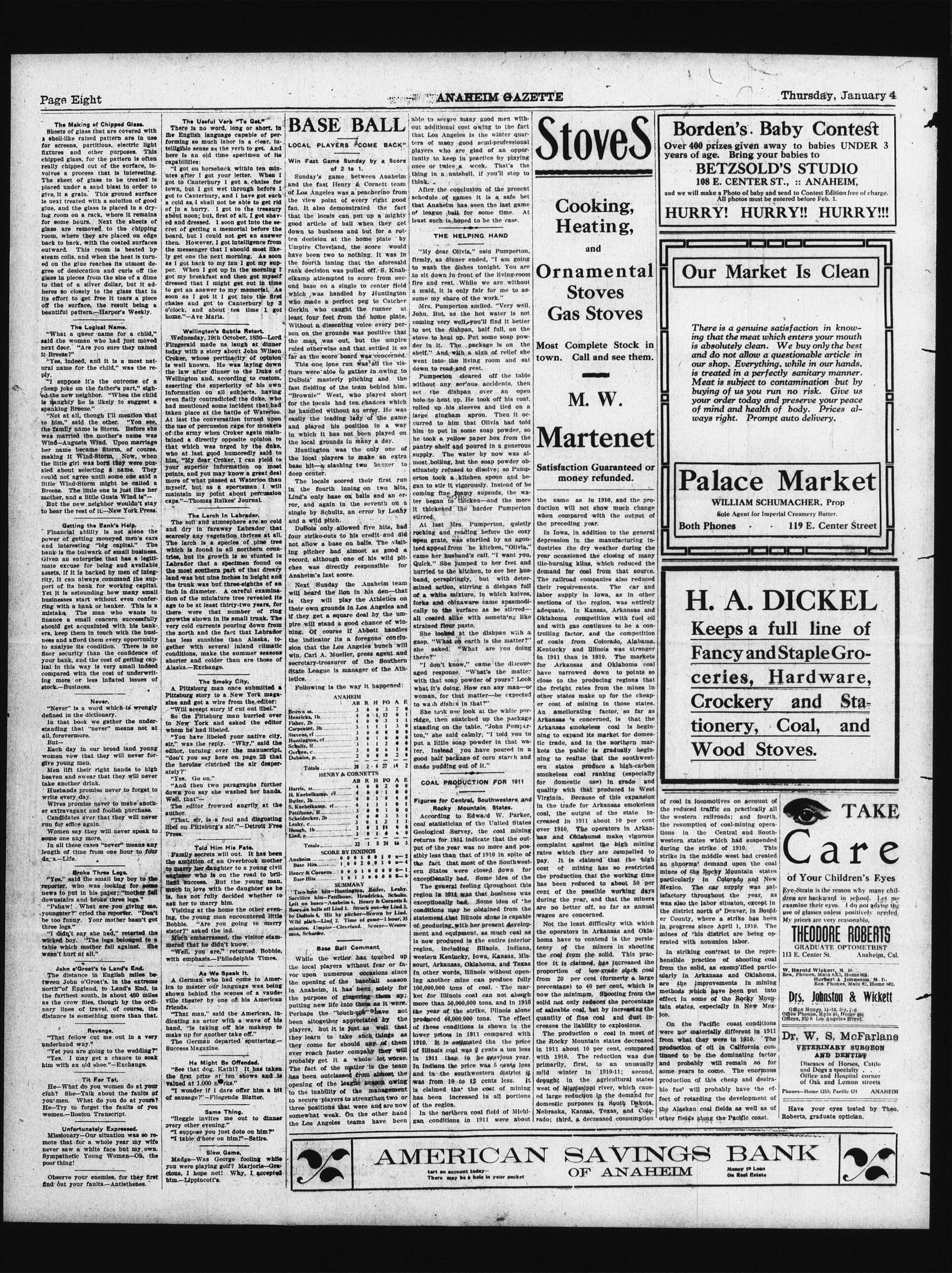
Searchable text
The Making of Chipped Glass.
Sheets of glass that are covered with a shell-like raised pattern are in use for screens, partitions, electric light fixtures and other purposes. This chipped glass, for the pattern is often really chipped out of the surface, involves a process that is interesting. The sheet of glass to be treated is placed under a sand blast in order to give it a grain. This ground surface is next treated with a solution of good glue, and the glass is placed in a drying room on a rack, where it remains for some hours. Next the sheets of glass are removed to the chipping room, where they are placed on edge back to back, with the coated surfaces outward. This room is heated by steam collars, and when the heat is turned on the glue reaches its utmost degree of desiccation and curls off the glass in pieces from the size of a dime to that of a silver dollar, but it adheres so closely to the glass that in its effort to get free it tears a piece off the surface, the result being a beautiful pattern.—Harper's Weekly.
The Logical Name.
"What a queer name for a child," said the woman who had just moved next door. "Are you sure they named it Breeze?"
"Yes, indeed, and it is a most natural name for the child," was the reply.
"I suppose it's the outcome of a cheap joke on the father's part," sighed the new neighbor. "When the child is naughty he is likely to suggest a spanking Breeze."
"Not at all, though I'll mention that to him," said the other. "You see, the family name is Storm. Before she was married the mother's name was Wind—Augusta Wind. Upon marriage her name became Storm, of course, making it Wind-Storm. Now, when the little girl was born they were puzzled about selecting a name. They
The Useful Verb "To Get."
There is no word, long or short, in the English language capable of performing so much labor in a clear, intelligible sense as the verb to get. And here is an old time specimen of its capabilities:
"I got on horseback within ten minutes after I got your letter. When I got to Canterbury I got a chaise for town, but I got wet through before I got to Canterbury, and I have got such a cold as I shall not be able to get rid of in a hurry. I got to the treasury about noon; but, first of all, I got shaved and dressed. I soon got into the secret of getting a memorial before the board, but I could not get an answer then. However, I got intelligence from the messenger that I should most likely get one the next morning. As soon as I got back to my inn I got my supper. When I got up in the morning I got my breakfast and then got myself dressed that I might get out in time to get an answer to my memorial. As soon as I got it I got into the first chaise and got to Canterbury by 3 o'clock, and about tea time I got home."—Ave Maria.
Wellington's Subtle Retort.
Wednesday, 19th October, 1836—Lord Fitzgerald made us laugh at dinner today with a story about John Wilson Croker, whose pertinacity of opinion is well known. He was laying down the law after dinner to the Duke of Wellington and, according to custom, asserting the superiority of his own information on all subjects, having even flatly contradicted the duke, who had mentioned some incident that had taken place at the battle of Waterloo. At last the conversation turned upon the use of percussion caps for muskets of the army when Croker again maintained a directly opposite opinion to that which was urged by the duke, who at last good humoredly said to him, "My dear Croker, I can yield to your superior information on most points, and you may know a great deal."
BASE D
LOCAL PLAYERS
Win Fast Game Sunday
of 2 to
Sunday's game be
and the fast Henry
of Los Angeles was a
the view point of efan. It also demonstrathat the locals can p
good article of ball
down to business and
ten decision at the
Umpire Cleveland, tha
have been two to no
the fourth inning tha
rank decision was pulelkamp attempted to
ond base on a single
which was handled
who made a perfect
Gerkin who caught
least four feet from
Without a dissenting
son on the grounds wi
the man was out,
ruled otherwise and t
far as the score board.
This one lone run
itors were able to gai
DuBois' masterly pit
fast fielding of the to
"Brownie" West, whi
for the locals had te
he handled without a
easily the leading laand played his posiin which it has not
the local grounds in
Huntington was tha
the local players to
base hit—a slashing deep center.
"I suppose it's the outcome of a cheap joke on the father's part," sighed the new neighbor. "When the child isaughty he is likely to suggest a spanking Breeze."
"Not at all, though I'll mention that to him," said the other. "You see, the family name is Storm. Before she was married the mother's name was Wind—Augusta Wind. Upon marriage her name became Storm, of course, making it Wind-Storm. Now, when the little girl was born they were puzzled about selecting a name. They could not agree until some one said a little Wind-Storm might be called a Breeze. The little one is just like her mother, and a little Gusta Wind is." But the new neighbor wouldn't stay to hear the rest of it—New York Press.
Getting the Bank's Help.
Financial ability is not alone the power of getting moneyed men's cars and interesting "big capital." The bank is the bulwark of small business. Given an enterprise that has a legitimate excuse for being and available assets, if it is backed by men of integrity, it can always command the support of its bank for working capital. Yet it is astounding how many small businesses start without even conferring with a bank or banker. This is a mistake. The man who wants to finance a small concern successfully should get acquainted with his bankers, keep them in touch with the business and afford them every opportunity to analyze its condition. There is no finer security than the confidence of your bank, and the cost of getting capital in this way is very small indeed compared with the cost of underwriting more or less inflated issues of stock.—Business.
Never.
"Never" is a word which is wrongly defined in the dictionary.
In that book we gather the understanding that "never" means not at all, forevermore.
But—
Each day in our broad land young women vow that they will never forgive young men.
Men lift their right hands to high heaven and swear that they will never take another drink.
Husbands promise never to forget to write every day.
Wives promise never to make another extravagant and foolish purchase.
Candidates aver that they will never run for office again.
Women say they will never speak to some one any more.
In all these cases "never" means any length of time from one hour to four days.—Life.
Broke Three Legs.
"Yes," said the small bay boy to the reporter, who was looking for some news to put in his paper; "mother fell downstairs and broke three legs."
The Larch In Labrador.
The soil and atmosphere are so cold and dry in faraway Labrador that scarcely any vegetation thrives at all. The larch is a species of pine tree which is found in all northern countries, but its growth is so stunted in Labrador that a specimen found on the most southern part of that dreary land was but nine inches in height and the trunk was but three-eighths of an inch in diameter. A careful examination of the miniature tree revealed its age to be at least thirty-two years, for there were that number of ring growths shown in its small trunk. The very cold currents pouring down from the north and the fact that Labrador has less sunshine than Alaska, together with several inland climatic conditions, make the summer seasons shorter and colder than are those of Alaska.—Exchange.
The Smoky City.
A Pittsburg man once submitted a Pittsburg story to a New York magazine and got a wire from the editor: "Will accept story if cut out libel."
So the Pittsburg man hurried over to New York and asked the editor whom he had libeled.
"You have libeled your native city, sir," was the reply. "Why," said the editor, turning over the manuscript, "don't you say here on page 23 that the heroine clutched the air desperately?"
"Yes. Go on."
"And then two paragraphs further down you say she washed her hands. Well, that"—
The editor frowned angrily at the author.
"That, sir, is a foul and disgusting libel on Pittsburg's air."—Detroit Free Press.
Told Him His Fate.
Family secrets will out. It has been the ambition of an Overbrook mother to marry her daughter to a young civil engineer who is on the road to brilliant success. But the young man, much in love with the daughter as he is, has not fully decided whether to
DuBois' masterly plot fast fielding of the title "Brownie" West, while for the locals had teased him handled without easily the leading lace and played his position in which it has not the local grounds in Huntington was the local players to base hit—a slashing deep center.
The locals scored in the fourth innings Lind's only base on error, and again in the single by Schultz, and a wild pitch.
DuBois only allowed four strike-outs to him not allow a base on ing pitcher had alm record, although one ches was directly Anaheim's last score.
Next Sunday they will be heard the lion is they will play their own grounds in if they get a square pile will stand a good ning. Of course if the indicator its a sion that the Los An win. Carl A. Mueller, secretary-treasurer of State League is manletics.
Following is the wa
ANAHEIM
Brown ss.
Henricks, 1b
Fisher, 2b
Carpenter, 3b
Stevens rf
Huntington cf
Schulr, lf
Gerken c
Dubois p
Totals
SCORE BY IN
Anaheim
Base Hits
Henry & Cornetts
Base Hits
SUMMA
Two-base hits—Huntingt
Wives promise never to make another extravagant and foolish purchase.
Candidates aver that they will never run for office again.
Women say they will never speak to some one any more.
In all these cases "never" means any length of time from one hour to four days.—Life.
Broke Three Legs.
"Yes," said the small bay boy to the reporter, who was looking for some news to put in his paper; "mother fell downstairs and broke three legs."
"Pshaw! What are you giving me, youngster?" cried the reporter. "Don't be too funny. Your mother hasn't got three legs."
"I didn't say she had," retorted the wicked boy. "The legs belonged to a table which mother fell against. She wasn't hurt at all."
John o'Groat's to Land's End.
The distance in English miles between John o'Groat's, in the extreme north of England, to Land's End, in the farthest south, is about 480 miles as the crow flies, though by the ordinary lines of travel, of course, the distance is something more than that.
Revenge.
"That fellow cut me out in a very underhand way."
"Yet you are going to the wedding?"
"Yes. I may get a chance to soak him with an old shoe."—Exchange.
Tit For Tat.
He—What do you women do at your club? She—Talk about the faults of you men. What do you do at yours?
He—Try to forget the faults of you women.—Boston Transcript.
Unfortunately Expressed.
Missionary—Our situation was so remote that for a whole year my wife never saw a white face but my own. Sympathetic Young Woman—Oh, the poor thing!
Observe your enemies, for they first find out your faults.—Antisthenes.
Well, that!
The editor frowned angrily at the author.
"That, sir, is a foul and disgusting libel on Pittsburg's air."—Detroit Free Press.
Told Him His Fate.
Family secrets will out. It has been the ambition of an Overbrook mother to marry her daughter to a young civil engineer who is on the road to brilliant success. But the young man, much in love with the daughter as he is, has not fully decided whether to ask her to marry him.
Visiting at the home the other evening, the young man encountered little Bobbie. "Are you going to marry sister?" asked the lad.
Much embarrassed, the visitor stammered that he didn't know.
"Well, you are," returned. Bobbie, with emphasis.—Philladelphia Times.
As We Speak It.
A German who had come to America to master our language was being shown behind the scenes of a vaudeville theater by one of his American friends.
"That man," said the American, indicating an actor with a wave of his hand, "is taking off his makeup to make up for another take off."
The German departed sputtering.—Success Magazine.
He Might Be Offended.
"See that dog. Kathl? It has taken the first prize at ten shows and is valued at 1,000 norks."
"I wonder if I dare offer him a bit of sausage?"—Fliegende Blatter.
Same Thing.
"Reggle invites me out to dinner every other evening."
"I suppose you just dote on him?"
"I table d'hote on him!"—Satire.
Slow Game.
Madge—Was George fooling while you were playing golf? Marjorie—Gracious, I hope not! Why, I accepted him.—Lippincott's.
BASE BALL
LOCAL PLAYERS "COME BACK"
Win Fast Game Sunday by a Score of 2 to 1.
Sunday's game between Anaheim and the fast Henry & Cornett team of Los Angeles was a peacherino from the view point of every right good fan. It also demonstrated the fact that the locals can put up a mighty good article of ball when they get down to business and but for a rotten decision at the home plate by Umpire Cleveland, the score would have been two to nothing. It was in the fourth inning that the aforesaid rank decision was pulled off. S. Knabelkamp attempted to score from second base on a single to center field which was handled by Huntington who made a perfect peg to Catcher Gerkin who caught the runner at least four feet from the home plate. Without a dissenting voice every person on the grounds was positive that the man, was out, but the umpire ruled otherwise and that settled it so far as the score board was concerned.
This one lone run was all the visitors were able to gather in owing to DuBois' masterly pitching and the fast fielding of the team behind him. "Brownie" West, who played short for the locals had ten chances which he handled without an error. He was easily the leading lady of the game and played his position in a way in which it has not been played on the local grounds in many a day.
Huntington was the only one of the local players to make an extra base hit—a slashing two baggers to deep center.
able to secure many good men without additional cost owing to the fact that Los Angeles is the winter quarters of many good semi-professional players who are glad of an opportunity to keep in practice by playing once or twice a week. That's the thing in a nutshell, if you'll stop to think.
After the conclusion of the present schedule of games it is a safe bet that Anaheim has seen the last game of league ball for some time. At least such is hoped to be the case.
THE HELPING HAND
"My dear Olivia," said Pumperton, firmly, as dinner ended, "I am going to wash the dishes tonight. You are to sit down in front of the living-room fire and rest. While we are without a maid, it is only fair for me to assume my share of the work."
Mrs. Pumperton smiled. "Very well, John. But, as the hot water is not coming very well you'll find it better to set the dishpan, half full, on the stove to heat up. Put some soap powder in it. The package is on the shelf." And with a sigh of relief she went into the living room and sat down to read and rest.
Pumperton cleared off the table without any serious accidents, then set the dishpan over an open hole to heat up. He took off his coat, rolled up his sleeves and tied on a large gingham apron. Then it occurred to him that Olivia had told him to put in some soap powder, so he took a yellow paper box from the pantry shelf and poured in a generous supply. The water by now was almost boiling, but the soap powder obstinately refused to dissolve; so Pump-
DuBois' masterly pitching and the fast fielding of the team behind him. "Brownie" West, who played short for the locals had ten chances which he handled without an error. He was easily the leading lady of the game and played his position in a way in which it has not been played on the local grounds in many a day.
Huntington was the only one of the local players to make an extra base hit—a slashing two baggers to deep center.
The locals scored their first run in the fourth inning on two hits, Lind's only base on balls and an error, and again in the seventh on a single by Schultz, an error by Leahy and a wild pitch.
DuBois only allowed five hits, had four strike-outs to his credit and did not allow a base on balls. The visiting pitcher had almost as good a record, although one of his wild pitches was directly responsible for Anaheim's last score.
Next Sunday the Anaheim team will beard the lion in his den—that is they will play the Athletics on their own grounds in Los Angeles and if they get a square deal by the umpire will stand a good chance of winning. Of course if Abbott handles the indicator its a foregone conclusion that the Los Angeles bunch will win. Carl A. Mueller, press agent and secretary-treasurer of the Southern State League is manager of the Athletics.
Following is the way it happened:
ANAHEIM
AB R H PO A E
Brown ss. 3 0 0 3 7 0
Henricks, 1b. 4 0 1 12 0 1
Fisher, 2b. 4 0 0 3 1 1
Carpenter, 3b. 3 1 1 1 3 0
Stevens, rf. 3 0 0 0 0 0
Huntington, cf. 3 0 1 0 0 0
Schultr, lf. 3 1 1 2 0 0
Gerken, c. 3 0 0 6 1 0
Duboise, p. 2 0 0 0 2 0
Totals. 28 2-4 27 14-2
HENRY & CORNETTS
AB R H PO A E
Harris, ss. 4 0 0 2 0 0
H. Knebelkamp, cf. 4 0 0 1 0 0
Butler, 3b. 4 0 1 0 0 0
S. Knebelkamp, rf. 4 1 1 1 0 1
Pettibone, lf. 3 0 0 1 0 0
Scheidecker, 2b. 4 0 0 3 5 1
Leahy, c. 3 0 1 2 1 1
Hough, lb. 3 0-1-14-0-0
Lind, p. -3-1-0-6-0
Totals. 32-1-5-24-16-3
SCORE BY INNINGS
Anaheim. -0-0-1-1-0-1-x-2
Base Hits. -1-0-2-0-1-0-x-4
Henry & Cornetts. -0-0-1-0-0-0-1Base Hits. -1-0-3-0-0-0-5
SUMMARY
Two-base hits-Huntington, Bailer, Leahy, Sacrifice hits-Pettibone, Hendricka, Schultz.
Pumperton cleared off the table without any serious accidents, then set the dishpan over an open hole to heat up. He took off his coat, rolled up his sleeves and tied on a large gingham apron. Then it occurred to him that Olivia had told him to put in some soap powder, so he took a yellow paper box from the pantry shelf and poured in a generous supply. The water by now was almost boiling, but the soap powder obstinately refused to dissolve; so Pumperton took a kitchen spoon and began to stir it vigorously. Instead of being fine foamy supsuds, the water began to thicken—and the more it thickened the harder Pumperton stirred.
At last Mrs. Pumperton, quietly rocking and reading before the cozy open grate, was startled by an agonized appeal from the kitchen, "Olivia," came her husband's call. "I want you, Quick." She jumped to her feet and hurried to the kitchen, to see her husband, perspiringly, but with determined action, stirring a dishpan full of a white mixture, in which knives, forks and chinaware came spasmodically to the surface as he stirred—all coated alike with something like strained flour paste.
She looked at the dishpan with a gasp. "What on earth is the matter?" she asked. "What are you doing there?"
"I don't know," came the discouraged response. "What's the matter with that soap powder of yours? Look what it's doing. How can any man—or woman, for that matter—be expected to wash dishes in that?"
She took one look at the white porridge, then snatched up the package standing on the table. "John Pumperton," she said calmly, "I told you to put a little soap powder in that water. Instead you have poured in a good half package of corn starch and made pudding out of it."
COAL PRODUCTION FOR 1911
Figures for Central, Southwestern, and Rocky Mountain States.
According to Edward W. Parker, coal statistician of the United States Geological Survey, the coal mining returns for 1911 indicate that the output of the year was no more and possibly less than that of 1910 in spite of the fact that most of the Southwestern States were closed down for exceptionally bad. Some idea of the general feeling throughout this region in 1911 was that business was
the same as in 1910, and the production will not show much change when compared with the output of the preceding year.
In Iowa, in addition to the general depression in the manufacturing industries the dry weather during the year occasioned the closing of many tile-burning kilns, which reduced the demand for coal from that source. The railroad companies also reduced their requirements. The car and labor supply in Iowa, as in other sections of the region, was entirely adequate. In Kansas, Arkansas and Oklahoma competition with fuel oil and with gas continues to be a controlling factor, and the competition of coals from Colorado, Alabama, Kentucky and Illinois was stronger in 1911 than in 1910. The markets for Arkansas and Oklahoma coal have narrowed down to points so close to the producing regions that the freight rates from the mines in other states make up for the cheaper cost of mining in those states.
An ameliorating factor, so far as Arkansas 's concerned, is that the Arkansas smokeless coal is beginning to expand its market for domestic trade, and in the northern markets the public is gradually beginning to realize that the southwestern states produce a high-carbon smokeless coal ranking (especially for domestic use) in grade and quality with that produced in West Virginia. Because of this expansion in the trade for Arkansas smokeless coal, the output of the state increased in 1911 about十 per cent over 1910. The operators in Arkansas and Oklahoma make vigorous complaint against the high mining rates which they are compelled to pay. It is claimed that the high cost of mining has so restricted the production that the working time has been reduced to about五十 percent of the possible working days during the year and that the miners
SCORE BY INNINGS
Anaheim 0 0 0 1 0 0 1 0 x-2
Base Hits 1 0 0 2 0 0 1 0 x-4
Henry & Cornetts 0 0 1 0 0 0 0-1
Base Hits 1 0 1 3 0 0 0 0-6
SUMMAKY
Two-base hits—Huntington, Builer, Leahy.
Sacrifice hits—Pettibone, Hendricks, Schultz.
Left on bases—Anaheim 6, Henry & Cornetts 5.
Bases on balls off Lind 1. Struck out—by Lind 2.
by DuBois 4. Hit by pitcher—Brown by Lind.
Wild pitch—Lind 2. Time of game—1 hour, 35 minutes.
Umpire—Cleveland. Scorer—Westerman, Scharzer.
Base Ball Comment
While the writer has touched up the local players without fear or favor upon numerous occasions since the opening of the baseball season in Anaheim, it has been solely for the purpose of gingering them up; putting new life into them as it were. Perhaps the "touch-up" have not been altogether appreciated by the players, but it is just as well that they learn to take such things as they come for should any of them ever reach faster company they will probably get it a whole lot worse. The fact of the matter is the team has been outclassed from almost the opening of the league season owing to the inability of the management to secure players to strengthen two or three positions that were and are now somewhat weak. On the other hand the Los Angeles teams have been
Figures for Central, Southwestern, and Rocky Mountain States.
According to Edward W. Parker, coal statistician of the United States Geological Survey, the coal mining returns for 1911 indicate that the output of the year was no more and possibly less than that of 1910 in spite of the fact that most of the Southwestern States were closed down for exceptionally bad. Some idea of the general feeling throughout this region in 1911 was that business was exceptionally bad. Some idea of the conditions may be obtained from the statement that Illinois alone is capable of producing, with her present development and equipment, as much coal as is now produced in the entire interior region, including Illinois, Indiana, western Kentucky, Iowa, Kansas, Missouri, Arkansas, Oklahoma, and Texas. In other words, Illinois without opening another mine can produce fully 100,000,000 tons of coal. The market for Illinois coal can not absorb more than 50,000,000 tons, and in 1910 the year of the strike, Illinois alone produced 46,000,000 tons. The effect of these conditions is shown in the lower prices in 1911 compared with 1910. It is estimated that the price of Illinois coal was $2 cents a ton less in 1911 than in he previous year. In Indiana the price was $5 cents less and in the southwestern district it was from 10 to 12 cents less. It is claimed that the cost of mining has been increased in all portions of the region.
In the northern coal field of Michigan conditions in 1911 were about
Because of this expansion in the trade for Arkansas smokeless coal, the output of the state increased in 1911 about 10 per cent over 1910. The operators in Arkansas and Oklahoma make vigorous complaint against the high mining rates which they are compelled to pay. It is claimed that the high cost of mining has so restricted the production that the working time has been reduced to about 50 per cent of the possible working days during the year, and that the miners are no better off, so far as annual wages are concerned.
Not the least difficulty with which the operators in Arkansas and Oklahoma have to contend is the persistence of the miners in shooting the coal from the solid. This practice it is claimed has increased the proportion of low-grade slack coal from 20 per cent (formerly a large percentage) to 40 per cent, which is now the minimum. Shooting from the solid not only reduces the percentage of saleable coal, but by increasing the quantity of fine coal and dust increases the liability to explosions.
The production o coal in most of the Rocky Mountain states decreased in 1911 about 10 per cent, compared with 1910. The reduction was due primarily, first, to an unusually mild winter in 1910-11; second, drought in the agricultural states west of Mississippi river, which caused large reduction in the demand for domestic purposes in South Dakota, Nebraska, Kansas, Texas, and Colorado; third, a decreased consumption
Thursday, January 4
Borden's Baby Contest
Over 400 prizes given away to babies UNDER 3 years of age. Bring your babies to BETZSOLD'S STUDIO
108 E. CENTER ST., :: ANAHEIM,
and we will make a Photo of baby and send to Contest Edition free of charge.
All photos must be entered before Feb. 1.
HURRY! HURRY!! HURRY!!!
Our Market Is Clean
There is a genuine satisfaction in knowing that the meat which enters your mouth is absolutely clean. We buy only the best and do not allow a questionable article in our shop. Everything, while in our hands, is treated in a perfectly sanitary manner. Meat is subject to contamination but by buying of us you run no risk. Give us your order today and preserve your peace of mind and health of body. Prices always right. Prompt auto delivery.
Palace Market
WILLIAM SCHUMACHER, Prop
Sole Agent for Imperial Creamery Butter.
Both Phones - 119 E. Center Street
H. A. DICKEL
Keeps a full line of
Fancy and Staple Groceries, Hardware,
Crockery and Stationery, Coal, and
Wood Stoves.
TAKE
Care
of Your Children's Eyes
Eye-Strain is the reason why many children are backward in school. Let me
of coal in locomotives on account of the reduced traffic on practically all the western railroads; and fourth, the resumption of coal-mining operations in the Central and Southwestern states which had suspended during the strike of 1910. This strike in the middle west had created an abnormal demand upon the coal mines of the Rocky Mountain states particularly in Colorado and New Mexico. The car supply was satisfactory throughout the year, as was also the labor situation, except in the district north of Denver, in Boulder County, where a strike has been in progress since April 1, 1910. The mines of this district are being operated with nonunion labor.
In striking contrast to the reprehensible practice of shooting coal from the solid, as exemplified particularly in Arkansas and Oklahoma, are the improvements in mining methods which have been put into effect in some of the Rocky Mountain states, especially in New Mexico.
On the Pacific coast conditions were not materially different in 1911 from what they were in 1910. The production of oil in California continued to be the dominating factor and probably will remain so for some years to come. The enormous production of this cheap and desirable fuel will probably have the effect of retarding the development of the Alaskan coal fields as well as of other fields along the Pacific coast.
TAKE Care of Your Children's Eyes
Eye-Strain is the reason why many children are backward in school. Let me examine their eyes. I do not advise the use of glasses unless positively needed. My prices are very reasonable.
THEODORE ROBERTS
GRADUATE OPTOMETRIST
113 E. Center St. Anaheim, Cal.
W. Harold Wickett, M.D.
Res. Phones, Main 8X3, Home 863.
Herbert A Johnston, M.D.
Res. Phones, Main 82, Home 862.
Drs. Johnston & Wickett
Office Hours: 11-12, 2-4, 7-8
Office Phones: Main 81, Home 864
Offices: 310 S Los Angeles Street.
Dr. W. S. McFarlane
VETERINARY SURGEON AND DENTIST
Diseases of Horses, Cattle and Dogs a specialty.
Office and Hospital corner of Oak and Lemon streets
Phones—Home 1253; Pacific 424 ANAHEIM
Have your eyes tested by Theo Roberts, graduate optician.