anaheim-gazette 1912-01-04
Scanned page
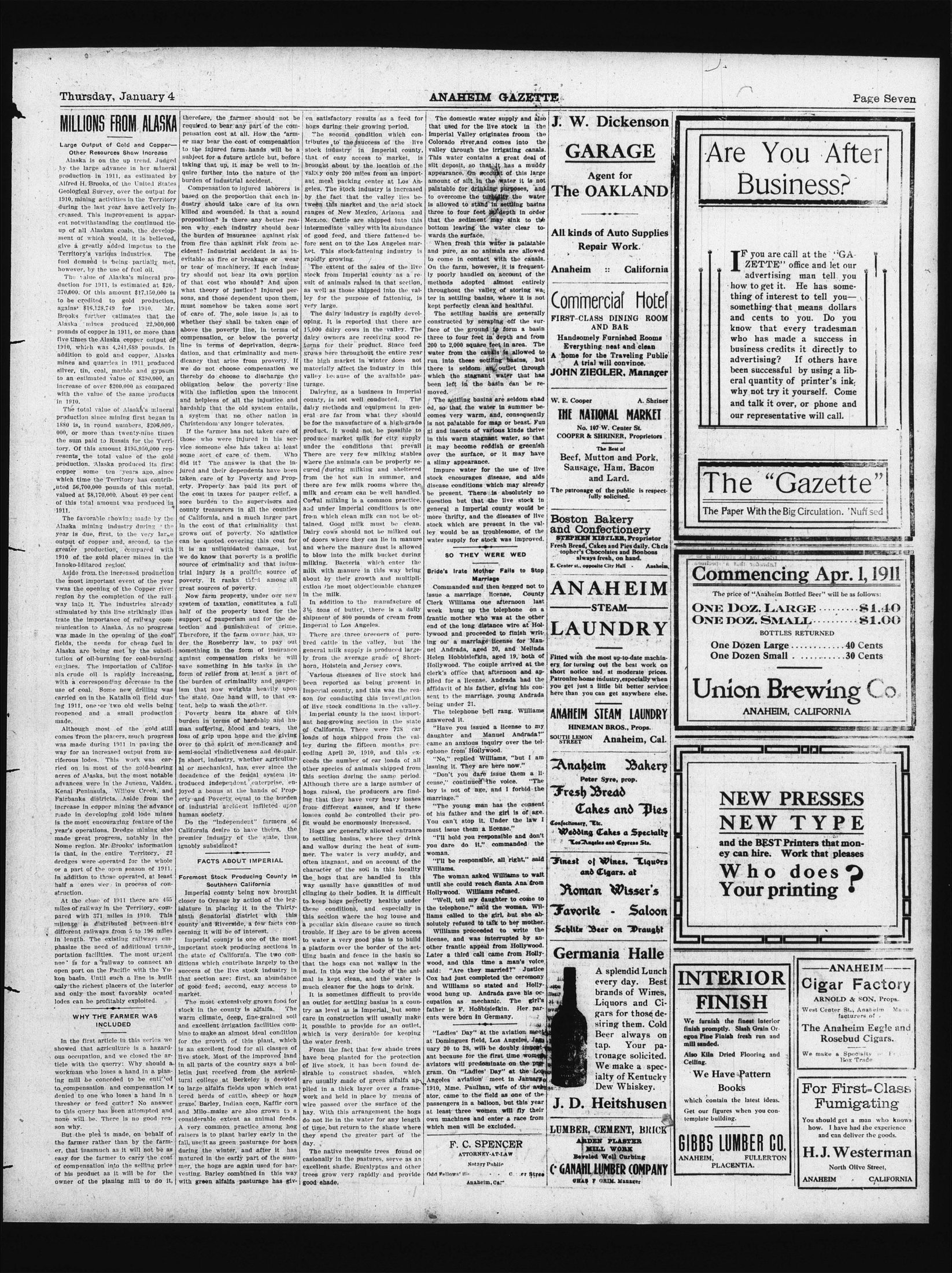
Searchable text
MILLIONS FROM ALASKA
Large Output of Gold and Copper—Other Resources Show Increase
Alaska is on the up trend. Judged by the large advance in her mineral production in 1911, as estimated by Alfred H. Brooks, of the United States Geological Survey, over the output for 1910, mining activities in the Territory during the last year have actively increased. This improvement is apparent notwithstanding the continued tie-up of all Alaskan coals, the development of which would, it is believed, give a greatly added impetus to the Territory's various industries. The fuel demand is being partially met, however, by the use of fuel oil.
The value of Alaska's mineral production for 1911, is estimated at $20,-370,000. Of this amount $17,150,000 is to be credited to gold production, against $16,128,749 for 1910. Mr. Brooks further estimates that the Alaska mines produced 22,900,000 pounds of copper in 1911, or more than five times the Alaska copper output of 1910, which was 4,241,689 pounds. In addition to gold and copper, Alaska mines and quarries in 1911 produced silver, tin, coal, marble and gypsum to an estimated value of $390,000, an increase of over $200,000 as compared with the value of the same products in 1910.
The total value of Alaska's mineral production since mining first began in 1880 is, in round numbers, $206,000,000, or more than twenty-nine times the sum paid to Russia for the Territory. Of this amount $195,950,000 represents the total value of the gold production. Alaska produced its first copper some ten years ago, since therefore, the farmer should not be required to bear any part of the compensation cost at all. How the farmer may bear the cost of compensation to the injured farm hands will be a subject for a future article but, before taking that up, it may be well to inquire further into the nature of the burden of industrial accident.
Compensation to injured laborers is based on the proportion that each industry should take care of its own killed and wounded. Is that a sound proposition? Is there any better reason why each industry should bear the burden of insurance against risk from fire than against risk from accident? Industrial accident is as inevitable as fire or breakage or wear or tear of machinery. If each industry should not bear its own portion of that cost who should? And upon what theory of justice? Injured persons, and those dependent upon them, must somehow be taken some sort of care of. The sole issue is as to whether they shall be taken care of above the poverty line, in terms of compensation, or below the poverty line in terms of deprivation, degradation, and that criminality and menicancy that arise from proverty. If we do not choose compensation we thereby do choose to discharge the obligation below the poverty line with the infliction upon the innocent and helpless of all the injustice and hardship that the old system entails, a system that no other nation in Christendom any longer tolerates.
If the farmer has not taken care of those who were injured in his service someone else has taken at least some sort of care of them. Who did it? The answer is that the injured and their dependents have been satisfactory hogs during their second tributes to the stock industry that of easy and brought about by valley only 200 million meat packing gales. The stock by the fact that tween this market ranges of New Mexico. Cattle are intermediate values of good feed, and fore sent on to market. This stock-rapidly growing.
The extent of stock from Import result of animals not as well as those ley for the purity very large.
The dairy industry. It is reported 15,000 dairy cow dairy owners are turns for their grows here through the high market materially affect valley because of turage.
Dairying, as a county, is not widely dairy methods anderal are far frost be for the manufacture product. It would produce market under the condition There are very where the animal cured during m
to an estimated value of $390,000, an increase of over $200,000 as compared with the value of the same products in 1910.
The total value of Alaska's mineral production since mining first began in 1880 is, in round numbers, $206,000,000, or more than twenty-nine times the sum paid to Russia for the Territory. Of this amount $195,950,000 represents the total value of the gold production. Alaska produced its first copper some ten years ago, since which time the Territory has contributed 56,700,000 pounds of this metal, valued at $8,170,000. About 40 per cent of this total amount was produced in 1911.
The favorable showing made by the Alaska mining industry during the year is due, first, to the very large output of copper and, second, to the greater production compared with 1910 of the gold placer mines in the Innoko-Iditarod region.
Aside from the increased production the most important event of the year was the opening of the Copper river region by the completion of the railway into it. The industries already stimulated by this line strikingly illus trate the importance of railway communication to Alaska. As no progress was made in the opening of the coal fields, the needs for cheap fuel in Alaska are being met by the substitution of oil-burning for coal-burning engines. The importation of California crude oil is rapidly increasing, with a corresponding decrease in the use of coal. Some new drilling was carried on in the Katalla oil field during 1911, one or two old wells being reopened and a small production made.
Although most of the gold still comes from the placers, much progress was made during 1911 in paving the way for an increased output from auriferous lodes. This work was carried on in most of the gold-bearing acres of Alaska, but the most notable advances were in the Juneau, Valdez, Kenai Peninsula, Willow Creek, and Fairbanks districts. Aside from the increase in copper mining the advance made in developing gold lode mines is the most encouraging feature of the year's operations. Dredge mining also made great progress, notably in the Nome region. Mr. Brooks' information is that, in the entire Territory, 22 dredges were operated for the whole or a part of the open season of 1911. In addition to those operated, at least half a dozen were in process of construction.
If the farmer has not taken care of those who were injured in his service someone else has taken at least some sort of care of them. Who did it? The answer is that the injured and their dependents have been taken care of by Poverty and Property. Property has paid its part of the cost in taxes for pauper relief, a sore burden to the supervisors and county treasurers in all the counties of California, and a much larger part in the cost of that criminality that grows out of poverty. No statistics can be quoted covering this cost for it is an unliquidated damage, but we do know that poverty is a prolific source of criminality and that industrial injury is a prolific source of poverty.
Now farm property, under our new system of taxation, constitutes a full half of the property taxed for the support of pauperism and for the detection and punishment of crime. Therefore, if the farm owner has under the Roseberry law, to pay out something in the form of insurance against compensation risks he will save something in his tasks in the form of relief from at least a part of the burden of criminality and pauperism that now weights heavily upon the state. One hand will, to that extent, help to wash the other.
Poverty bears its share of this burden in terms of hardship and human suffering, blood and tears, the loss of grip upon hope and the giving over to the spirit of mendicancy and semi-social vindictiveness and despair. In short, industry, whether agricultural or mechanical, has, ever since the decadence of the feudal system introduced independent enterprise, enjoyed a bonus at the hands of Property and Poverty equal to the burden of industrial accident inflicted upon human society.
Do the "independent" farmers of California desire to have theirs, the premier industry of the state, thus ignobly subsidized?
FACTS ABOUT IMPERIAL
Foremost Stock Producing County in Southhern California
Imperial county being now brought thereby do choose to discharge the obligation below the poverty line with the infliction upon the innocent and helpless of all the injustice and hardship that the old system entails, a system that no other nation in Christendom any longer tolerates.
If the farmer has not taken care of those who were injured in his service someone else has taken at least some sort of care of them. Who did it? The answer is that the injured and their dependents have been taken care of by Poverty and Property. Property has paid its part of the cost in taxes for pauper relief, a sore burden to the supervisors and county treasurers in all the counties of California, and a much larger part in the cost of that criminality that grows out of poverty. No statistics can be quoted covering this cost for it is an unliquidated damage, but we do know that poverty is a prolific source of criminality and that industrial injury is a prolific source of poverty.
Now farm property, under our new system of taxation, constitutes a full half of the property taxed for the support of pauperism and for the detection and punishment of crime. Therefore, if the farm owner has under the Roseberry law, to pay out something in the form of insurance against compensation risks he will save something in his tasks in the form of relief from at least a part of the burden of criminality and pauperism that now weights heavily upon the state. One hand will, to that extent, help to wash the other.
Poverty bears its share of this burden in terms of hardship and human suffering, blood and tears, the loss of grip upon hope and the giving over to the spirit of mendicancy and semi-social vindictiveness and despair. In short, industry, whether agricultural or mechanical, has, ever since the decadence of the feudal system introduced independent enterprise, enjoyed a bonus at the hands of Property and Poverty equal to the burden of industrial accident inflicted upon human society.
Do the "independent" farmers of California desire to have theirs, the premier industry of the state, thus ignobly subsidized?
Hogs are generally used to settling basin and wallow durer. The water often stagnant; a character of these hogs that a way usually have clinging to their valley because o
Fairbanks districts. Aside from the increase in copper mining the advance made in developing gold lode mines is the most encouraging feature of the year's operations. Dredge mining also made great progress, notably in the Nome region. Mr. Brooks' information is that, in the entire Territory, 22 dredges were operated for the whole or a part of the open season of 1911. In addition to those operated, at least half a dozen were in process of construction.
At the close of 1911 there are 465 miles of railway in the Territory, compared with 371 miles in 1910. This mileage is distributed between nine different railways from 5 to 196 miles in length. The existing railways emphasize the need of additional transportation facilities. The most urgent nee is for a railway to connect an open port on the Pacific with the Yukon basin. Until such a line is built only the richest placers of the interior and only the most favorably ocated lodges can be profitably exploited.
WHY THE FARMER WAS INCLUDED
In the first article in this series we showed that agriculture is a hazardous occupation, and we closed the article with the query: Why should a workman who loses a hand in a planning mill be conceded to be entitled to compensation and compensation denied to one who loses a hand in a thresher or feed cutter? No answer to this query has been attempted and none will be. There is no good reason why.
But the plea is made, on behalf of the farmer rather than by the farmer, that inasmuch as it will not be as easy for the farmer to carry the cost of compensation into the selling price of his product as it will be for the owner of the planing mill to do it,
FACTS ABOUT IMPERIAL
Foremost Stock Producing County in Southhern California
Imperial county being now brought closer to Orange by action of the legislature in placing it in the Thirty-ninth Senatorial district with this county and Riverside, a few facts concerning it will be of interest.
Imperial county is one of the most important stock producing sections in the state of California. The two conditions which contribute largely to the success of the live stock industry in that section are: first, an abundance of good feed; second, easy access to market.
The most extensively grown food for stock in the county is alfalfa. The warm climate, deep, fine-grained soil and excellent irrigation facilities combine to make an almost ideal condition for the growth of this plant, which is an excellent food for all classes of live stock. Most of the improved land in all parts of the country says a bulletin just received from the agricultural college at Berkeley is devoted to large alfalfa fields upon which scattered herds of cattle, sheep or hogs graze. Barley, Indian corn, Kaffir corn and Milo-maize are also grown to a considerable extent as animal feeds. A very common practice among hog raisers is to plant barley early in the fall, use it as green pasturage for hogs during the winter, and after it has matured in the early part of the summer, the hogs are again used for harvesting. Barley combined in this way with green alfalfa pasturage has given Hogs are generally to settling basins and wallow durer. The water is often stagnant, and character of these conditions this section where a peculiar skin disease trouble. If they are to water a very small platform over tilling basin and find that the hogs can mud. In this way mal is kept clean much cleaner for it is sometimes an outlet for settling as level as care in constructing it possible to prune which is very dry the water fresh.
From the fact have been planted of live stock, it isirable to constrain are usually made plied in a thick work and held in wire passed over hay. With this aid do not lie in the time, but return they spend the day.
The native mesasionally in the excellent shade trees grow very good shade.
ANAHEIM GAZETTE
en satisfactory results as a feed for hogs during their growing period.
The second condition which contributes to the success of the live stock industry in Imperial county, that of easy access to market, is brought about by the location of the valley only 200 miles from an important meat packing center at Los Angeles. The stock industry is increased by the fact that the valley lies between this market and the arid stock ranges of New Mexico, Arizona and Mexico. Cattle are shipped into this intermediate valley with its abundance of good feed, and there fattened before sent on to the Los Angeles market. This stock-fattening industry is rapidly growing.
The extent of the sales of the live stock from Imperial county as a result of animals raised in that section, as well as those shipped into the valley for the purpose of fattening, is very large.
The dairy industry is rapidly developing. It is reported that there are 15,000 dairy cows in the valley. The dairy owners are receiving good returns for their product. Since feed grows here throughout the entire year the high market in winter does not materially affect the industry in this valley because of the available pasturage.
Dairying, as a business in Imperial county, is not well conducted. The dairy methods and equipment in general are far from what they should be for the manufacture of a high-grade product. It would not be possible to produce market milk for city supply under the conditions that prevail. There are very few milking stables where the animals can be properly secured during milking and sheltered.
The domestic water supply and also that used for the live stock in the Imperial Valley originates from the Colorado river and comes into the valley through the irrigating canals. This water contains a great deal of silt deposit, so that it has a muddy appearance. On account of this large amount of silt in the water it is not palatable for drinking purposes, and to overcome the turbidity the water is allowed to stand in settling basins three to four feet in depth in order that the sediment may sink to the bottom leaving the water clear towards the surface.
When fresh this water is palatable and pure, as no animals are allowed to come in contact with the canals. On the farm, however, it is frequently poorly handled on account of the methods adopted almost entirely throughout the valley of storing water in settling basins, where it is not kept perfectly clean and healthful.
The settling basins are generally constructed by scraping off the surface of the ground to form a basin three to four feet in depth and from 200 to 2,000 square feet in area. The water from the canals is allowed to run into these settling basins, but there is seldom an outlet through which the stagnant water that has been left in the basin can be removed.
The settling basins are seldom shaded, so that the water in summer becomes very warm, and, consequently is not palatable for map or beast. FunGI and insects of various kinds thrive in this warm stagnant water, so that it may become reddish or greenish over the surface, or it may have a slimy appearance.
Impure water for the use of live
Dairying, as a business in Imperial county, is not well conducted. The dairy methods and equipment in general are far from what they should be for the manufacture of a high-grade product. It would not be possible to produce market milk for city supply under the conditions that prevail. There are very few milking stables where the animals can be properly secured during milking and sheltered from the hot sun in summer, and there are few milk rooms where the milk and cream can be well handled. Cortal milking is a common practice, and under Imperial conditions is one from which clean milk can not be obtained. Good milk must be clean. Dairy cows should not be milked out of doors where they can lie in manure and where the manure dust is allowed to blow into the milk bucket during milking. Bacteria which enter the milk with manure in this way bring about by their growth and multiplication the most objectionable changes in the milk.
In addition to the manufacture of 3½ tons of butter, there is a daily shipment of 800 pounds of cream from Imperial to Los Angeles.
There are three breeders of purebred cattle in the valley, but the general milk supply is produced largely from the average grade of Shorthorn, Holstein and Jersey cows.
Various diseases of live stock had been reported as being present in Imperial county, and this was the reason for conducting this investigation of live stock conditions in the valley.
Imperial county is the most important hog-growing section in the state of California. There were 728 car loads of hogs shipped from the valley during the fifteen months preceding April 30, 1910, and this exceeds the number of car loads of all other species of animals shipped from this section during the same period. Although there are a large number of hogs raised, the producers are finding that they have very heavy losses from different causes, and if these losses could be controlled their profit would be enormously increased.
Hogs are generally allowed entrance to settling basins, where they drink and wallow during the heat of summer. The water is very muddy, and often stagnant, and on account of the character of the soil in this locality the hogs that are handled in this way usually have quantities of mud clinging to their bodies. It is difficult which the stagnant water that has been left in the basin can be removed.
The settling basins are seldom shaded, so that the water in summer becomes very warm, and consequently is not palatable for man or beast. FunGI and insects of various kinds thrive in this warm stagnant water, so that it may become reddish or greenish over the surface, or it may have a slimy appearance.
Impure water for the use of live stock encourages disease, and aids disease conditions which may already be present. There is absolutely no question but that the live stock in general n Imperial county would be more thrifty, and the diseases of live stock which are present in the valley would be as troublesome, of the water supply for stock was improved.
SO THEY WERE WED
Bride's Irate Mother Fails to Stop Marriage
Commanded and then begged not to issue a marriage license, County Clerk Williams one afternoon last week hung up the telephone on a frantic mother who was at the other end of the long distance wire at Hollywood and proceeded to finish writing out a marriage license for Manuel Andrada, aged 20, and Melinda Helen Hobblisfeldn, aged 19, both of Hollywood. The couple arrived at the clerk's office that afternoon and applied for a license. Andrada had the affidavit of his father, giving his consent to the marriage, young Andrada being under 21.
The telephone bell rang. Williams answered it.
"Have you issued a license to my daughter and Manuel Andrada?" came an anxious inquiry over the telephone from Hollywood.
"No," replied Williams, "but I am issuing it. They are here now."
"Don't you dare issue them a license," continued the voice. "The boy is not of age, and I forbid the marriage."
"The young man has the consent of his father and the girl is of age. You can't stop it. Under the law I must issue them a license."
"I'll hold you responsible and don't you dare do it," commanded the woman.
"I'll be responsible, all right," said Williams.
The woman asked Williams to wait until she could reach Santa Ana from Hollywood. Williams refused.
Hogs are generally allowed entrance to settling basins, where they drink and wallow during the heat of summer. The water is very muddy, and often stagnant, and on account of the character of the soil in this locality the hogs that are handled in this way usually have quantities of mud clinging to their bodies. It is difficult to keep hogs perfectly healthy under these conditions, and especially in this section where the hog louse and a peculiar skin disease cause so much trouble. If they are to be given access to water a very good plan is to build a platform over the border of the settling basin and fence in the basin so that the hogs can not wallow in the mud. In this way the body of the animal is kept clean, and the water is much cleaner for the hogs to drink.
It is sometimes difficult to provide an outlet for settling basins in a country as level as is Imperial, but some care in construction will usually make it possible to provide for an outlet, which is very desirable for keeping the water fresh.
From the fact that few shade trees have been planted for the protection of live stock, it has been found desirable to construct shades, which are usually made of green alfalfa applied in a thick layer over a framework and held in place by means of wire passed over the surface of the hay. With this arrangement the hogs do not lie in the water for any length of time, but return to the shade where they spend the greater part of the day.
The native mesquite trees found occasionally in the pastures, serve as an excellent shade. Eucalyptus and other trees grow very rapidly and provide good shade.
"The young man has the consent of his father and the girl is of age. You can't stop it. Under the law I must issue them a license."
"I'll hold you responsible and don't you dare do it," commanded the woman.
"I'll be responsible, all right," said Williams.
The woman asked Williams to wait until she could reach Santa Ana from Hollywood. Williams refused.
"Well, tell my daughter to come to the telephone," said the woman. Williams called to the girl, but she absolutely refused to talk to her mother.
Williams proceeded to write the license, and was interrupted by another frantic appeal from Hollywood. Later a third call came from Hollywood, and this time a man's voice said: "Are they married?" Justice Cox had just completed the ceremony and Williams so stated and Hollywood hung up. Andrada gave his occupation as mechanic. The girl's father is F. Hobbislefkin. Her parents were born in Germany.
"Ladies' Day" at the aviation meet at Dominguez field, Los Angeles, January 20 to 28, will be doubly important because for the first time women aviators will predominate on the program. On "Ladies' Day" at the Los Angeles aviation meet in January 1910, Mme. Paulhan, wife of the aviator, came to the field as one of the passengers in a balloon, but this year at least three women will fly their own machines and enter a race from which men will be excluded.
F. C. SPENCER
ATTORNEY-AT-LAW
Notary Public
Odd Fellows' Hill
Anaheim, Ca."
Are You After Business?
If you are call at the "GAZETTE" office and let our advertising man tell you how to get it. He has something of interest to tell you—something that means dollars and cents to you. Do you know that every tradesman who has made a success in business credits it directly to advertising? If others have been successful by using a liberal quantity of printer's ink, why not try it yourself. Come and talk it over, or phone and our representative will call.
A. Shriner
NATIONAL MARKET
W. Center St.
HRINER, Proprietors
The Best of
Botton and Pork,
Ham, Bacon
and Lard.
of the public is respectly solicited.
Bakery
fectionery
ISTLER, Proprietor
kes and Pies daily. Chris
colates and Bonbons
fresh, on hand.
ite City Hall - Anaheim
AHEIM
TEAM
NDRY
most up-to-date machinout the best work on
at moderate prices.
industry, especially when
little bit better service
can get anywhere else.
STEAM LAUNDRY
N BROS., Props.
Anaheim, Cal.
m Bakery
Syre, prop.
Bread
es and Pies
Cakes a Specialty
kes and Cypress Sts.
Wines. Liquors
Cigars. at
n Wisser's
eral quantity of printer's ink,
why not try it yourself. Come
and talk it over, or phone and
our representative will call.
The "Gazette"
The Paper With the Big Circulation. 'Nuff sed
Commencing Apr. 1, 1911
The price of "Anaheim Bottled Beer" will be as follows:
ONE DOZ. LARGE $1.40
ONE DOZ. SMALL $1.00
BOTTLES RETURNED
One Dozen Large 40 Cents
One Dozen Small 30 Cents
Union Brewing Co.
ANAHEIM, CALIFORNIA
NEW PRESSES
NEW TYPE
and the BEST Printers that money can hire. Work that pleases
Who does Your printing?
NEW TYPE
and the BEST Printers that money can hire. Work that pleases
Who does Your printing?
INTERIOR
FINISH
We furnish the finest interior finish promptly. Slash Grain Oregon Pine Finish fresh run and mill sanded.
Also Kiln Dried Flooring and Ceiling.
We Have Pattern Books
which contain the latest ideas.
Get our figures when you contemplate building.
GIBBS LUMBER CO.
ANAHEIM, FULLERTON
PLACENTIA.
ANAHEIM
Cigar Factory
ARNOLD & SON, Props.
West Center St., Anaheim Manufacturers of
The Anaheim Eagle and Rosebud Cigars.
We make a Specialty Box Trade
For First-Class Fumigating
You should get a man who knows how. I have had the experience and can deliver the goods.
H.J. Westerman
North Olive Street,
ANAHEIM CALIFORNIA