anaheim-gazette 1911-12-28
Scanned page
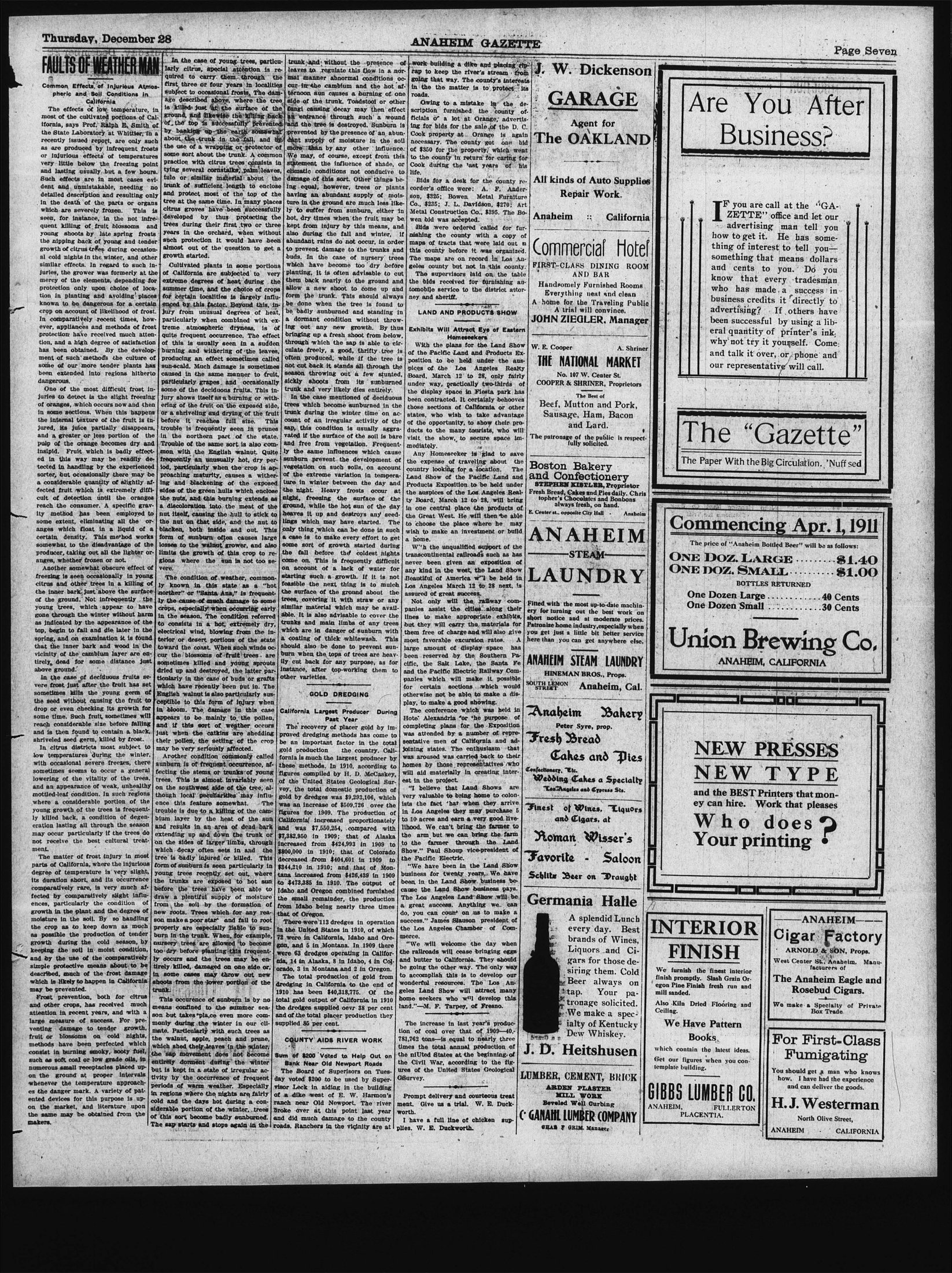
Searchable text
FAULTS OF WEATHER MAN
Common Effects of Injurious Atmospheric and Soil Conditions in California
The effects of low temperature, in most of the cultivated portions of California, says Prof. Ralph E. Smith of the State Laboratory at Whittier, in a recently issued report, are only such as are produced by infrequent frosts or injurious effects of temperatures very little below the freezing point and lasting usually but a few hours. Such effects are in most cases evident and unmistakable, needing no detailed description and resulting only in the death of the parts or organs which are severely frozen. This is seen, for instance, in the not infrequent killing of fruit blossoms and young shoots by late spring frosts the nipping back of young and tender growth of citrus trees during occasional cold nights in the winter, and other similar effects. In regard to such injuries, the grower was formerly at the mercy of the elements, depending for protection only upon choice of location in planting and avoiding places known to be dangerous for a certain crop on account of likelihood of frost. In comparatively recent times, however, appliances and methods of frost protection have received much attention, and a high degree of satisfaction has been obtained. By the development of such methods the culture of some of our more tender plants has been extended into regions hitherto dangerous.
One of the most difficult frost injuries to detect is the slight freezing of oranges, which occurs now and then in some sections. When this happens the internal texture of the fruit is injured, its juice partially disappears, and a greater or less portion of the pulp of the orange becomes dry and insipid. Fruit which is badly effected in this way may be readily detected in handling by the experienced sorter but occasionally there may be
In the case of young trees, particularly citrus, special attention is required to carry them through the first three or four years in localities subject to occasional frosts. The damage described above, where the tree is killed just at the surface of the ground, and likewise the killing back of the top is successfully prevented by banking up the earth somewhat about the trunk in the fall, and by the use of a wrapping or protector of some sort about the trunk. A common practice with citrus trees consists in tying several cornstalks, palm leaves, tule or similar material about the trunk of sufficient length to enclose and protect most of the top of the tree at the same time. In many places citrus groves have been successfully developed by thus protecting the trees during their first two or three years in the orchard, when without such protection it would have been almost out of the question to get a growth started.
Cultivated plants in some portions of California are subjected to very extreme degrees of heat during the summer time, and the choice of crops for certain localities is largely influenced by this factor. Beyond this, injury from unusual degrees of heat, particularly when combined with extreme atmospheric dryness, is of quite frequent occurrence. The effect of this is usually seen in a sudden burning and withering of the leaves, producing an effect sometimes called sun-scald. Much damage is sometimes caused in the same manner to fruit, particularly grapes and occasionally some of the deciduous fruits. This injury shows itself as a burning or withering of the fruit on the exposed side, or a shriveling and drying of the fruit before it reaches full size. This trouble is frequently seen in prunes in the northern part of the state. Trouble of the same sort is also common with the English walnut. Quite frequently an unusually hot, dry period, particularly when the crop is approaching maturity causes a withered trunk and without that leaves to regulate their normal manner abnormally cur in the cambium after ternoon sun causes a side of the trunk. To fungi causing decay an entrance through it and the tree is destroyed prevented by the presence dant supply of moisture more than by any one We may, of course, ex- statement the influence climatic conditions no damage of this sort. O ing equal, however, having an abundant suture in the ground area to suffer from sun hot, dry times when th e kept from injury by th e also during the fall abundant rains do not to prevent damage to buds. In the case o f which have become planting, it is often a them back nearly to allow a new shoot to form the trunk. This be done when the trunk be badly sunburned a dormant condition ing out any new grub bringing up a fresh shear through which the sap culate freely, a good often produced, while not cut back it stands season throwing out sickly shoots from trunk and very likely die.
In the case mentioned trees which become su trunk during the winter count of an irregular sap, this condition is eva lated if the surface o f and free from vegetation ythe same influenced sunburn prevent the d vegetation on such soils of the extreme vari
One of the most difficult frost injuries to detect is the slight freezing of oranges, which occurs now and then in some sections. When this happens the internal texture of the fruit is injured, its juice partially disappears, and a greater or less portion of the pulp of the orange becomes dry and insipid. Fruit which is badly effected in this way may be readily detected in handling by the experienced sorter, but occasionally there may be a considerable quantity of slightly affected fruit which is extremely difficult of detection until the oranges reach the consumer. A specific gravity method has been employed to some extent, eliminating all the oranges which float in a liquid of certain density. This method works somewhat to the disadvantage of the producer, taking out all the lighter oranges, whether frozen or not.
Another somewhat obscure effect of freezing is seen occasionally in young citrus and other trees in a killing of the inner bark just above the surface of the ground. Not infrequently the young trees, which appear to have gone through the winter without harm as indicated by the appearance of the top, begin to fall and die later in the spring, and on examination it is found that the inner bark and wood in the vicinity of the cambium layer are entirely dead for some distance just above ground.
In the case of deciduous fruits severe frost just after the fruit has set sometimes kills the young germ of the seed without causing the fruit to drop or even checking its growth for some time. Such fruit sometimes will reach considerable size before falling and is then found to contain a black, shriveled seed germ, killed by frost.
In citrus districts most subject to low temperatures during the winter, with occasional severe freezes, there sometimes seems to occur a general lowering of the vitality of the trees, and an appearance of weak, unhealthy mottled-leaf condition. In such regions where a considerable portion of the young growth of the trees is frequently killed back, a condition of degeneration lasting all through the season may occur particularly if the trees do not receive the best cultural treatment.
The matter of frost injury in most parts of California, where the injurious degree of temperature is very slight, its duration short, and its occurrence comparatively rare, is very much affected by comparatively slight influenza.
The condition of weather, commonly known in this state as a "hot norther" or "Santa Ana," is frequently the cause of much damage to some crops, especially when occurring early in the season. The condition referred to consists in a hot, extremely dry, electrical wind, blowing from the interior or desert portions of the state toward the coast. When such winds occur the blossoms of fruit trees are sometimes killed and young sprouts dried up and destroyed, the latter particularly in the case of buds or grafts which have recently been put in. The English walnut is also particularly susceptible to this form of injury when in bloom. The damage in this case appears to be mainly to the pollen, and if this sort of weather occurs just when the catkins are shedding their pollen, the setting of the crop may be very seriously affected.
Another condition commonly called sunburn is of frequent occurrence, affecting the stems or trunks of young trees. This is almost invariably seen on the southwest side of the tree, although local peculiarities may influence this feature somewhat. The trouble is due to a killing of the cambium layer by the heat of the sun and results in an area of dead bark extending up and down the trunk or on the sides of larger limbs, through which decay often sets in and the tree is badly injured or killed. This form of sunburn is seen particularly in young trees recently set out, where the trunks are exposed to hot sun before the trees have been able to draw a plentiful supply of moisture caused in the same manner to fruit, particularly grapes, and occasionally some of the deciduous fruits. This injury shows itself as a burning or withering of the fruit on the exposed side, or a shriveling and drying of the fruit before it reaches full size. This trouble is frequently seen in prunes in the northern part of the state. Trouble of the same sort is also common with the English walnut. Quite frequently an unusually hot, dry period, particularly when the crop is approaching maturity, causes a withering and blackening of the exposed sides of the green hulls which enclose the nuts, and this burning extends as a discoloration into the meat of the nut itself, causing the hull to stick to the nut on that side, and the nut to blacken, both inside and out. This form of sunburn often causes large losses to the walnut grower, and also limits the growth of this crop to regions where the sun is not too severe.
The condition of weather, commonly known in this state as a "hot norther" or "Santa Ana," is frequently the cause of much damage to some crops, especially when occurring early in the season. The condition referred to consists in a hot, extremely dry, electrical wind, blowing from the interior or desert portions of the state toward the coast. When such winds occur the blossoms of fruit trees are sometimes killed and young sprouts dried up and destroyed, the latter particularly in the case of buds or grafts which have recently been put in. The English walnut is also particularly susceptible to this form of injury when in bloom. The damage in this case appears to be mainly to the pollen, and if this sort of weather occurs just when the catkins are shedding their pollen, the setting of the crop may be very seriously affected.
Another condition commonly called sunburn is of frequent occurrence, affecting the stems or trunks of young trees. This is almost invariably seen on the southwest side of the tree, although local peculiarities may influence this feature somewhat. The trouble is due to a killing of the cambium layer by the heat of the sun and results in an area of dead bark extending up and down the trunk or on the sides of larger limbs, through which decay often sets in and the tree is badly injured or killed. This form of sunburn is seen particularly in young trees recently set out, where the trunks are exposed to hot sun before the trees have been able to draw a plentiful supply of moisture caused in the same manner to fruit, particularly grapes, and occasionally some of the deciduous fruits. This injury shows itself as a burning or withering of the fruit on the exposed side, or a shriveling and drying of the fruit before it reaches full size. This trouble is frequently seen in prunes in the northern part of the state. Trouble of the same sort is also common with the English walnut. Quite frequently an unusually hot, dry period, particularly when the crop is approaching maturity, causes a withering and blackening of the exposed sides of the green hulls which enclose the nuts, and this burning extends as a discoloration into the meat of the nut itself, causing the hull to stick to the nut on that side, and the nut to blacken, both inside and out. This form of sunburn often causes large losses to the walnut grower, and also limits the growth of this crop to regions where the sun is not too severe.
The condition of weather, commonly known in this state as a "hot norther" or "Santa Ana," is frequentlythe cause of much damage to some crops, especially when occurring early inthe season.The condition referredto consistsin a hot,extremelydry,electricalwind,blowingfromtheinteriorordesertportionsofthestatetowardthecoastWhensuchwindsoccurtheblossomsoffruittreesareSometimeskilledandyoungsproutsdriedupanddestroyed,thelatterparticularlyinthecaseofbudsorgraftwhichhaverecentlybeenputin.TheEnglishwalnutisalsoparticularlysusceptibletothisformofinjurywheninbloom.Thedamageinthiscaseappeartobemainlytothepollen,andifthissortofweatheroccursjustwhenthecatkinsaresheddingtheirpollen,thesettingofthecropmaybeveryseriouslyaffected.
Another condition commonly called sunburn is of frequent occurrence,affectingthestemsortrunksofyoungtreesThisisalmostinvariablyseenonthesouthwestsideofthetreealthoughlocalpeculiaritiesmayinfusethisfeaturesomewhat.Thetroubleisduetoakillingofthecambiumlayerbytheheatofthesunandresultsinanareaofdeadbarkextendingupanddownthetrunkorontheslidesoflargerlimbs,troughwhichdecayoftensetsinandthetreeisbadlyinjuredorkilled.Theformofsunburnisseenparticularlyinyoungtreesrecentlysetoutwherethetrunksareexposedtohotsunbeforethetreeshavebeenabletodrawaplentifulsupplyofmoisturecausedinthesamemannertofruit,particularlygrapes,andoccasionallysomeofthedeciduousfruits.pinterestshowsitselfasaburningorwitheringofthefruitontheexposedsideorashrivellinganddryingofthefruitbeforeitreachesfullsize.Troubleisfrequentlyseeninprunesinthenorthernpartofthestate.TroubleofthesamesortisalsocommonwiththeEnglishwalnut.Quietfrequentlyanusuallyhot,dryperiod,speciallywhenthecropisapproachingmaturity,causeawitheringandblackeningoftheexposedsidesofthegreenhullswhichenclosethenuts,andthisburningextendsasdiscolorationintothemeatofthenutitself,causeingthenthushticktothenutonthatside,andthenuttoblacken,bothinsideandout.Theformofsunburnoffcauseslargelossestothewalnutgrower,andalsolimitsthegrowthofthescpotregionswherethesunisnottoosevere.
The condition of weather,commonlyknowninthisstateasa“hotnorther”or“SantaAna,”isfrequentlythecauseofmuchdamagetosomecropsespeciallywhenoccurringearlyintheseason.Theconditionreferredtoconsistsinahot,extremelydry,electricalwind,blowingfromtheinteriorordesertportionsofthestatetowardthecoastWhensuchwindsoccurtheblossomsoffruittreesareSometimeskilledandyoungsproutsdriedupanddestroyed,thelaterparticularlyinthecaseofbudsorgraftwhichhaverecentlybeenputin.TheEnglishwalnutisalsoparticularlysusceptibletothisformofinjurywheninbloom.Thedamageinthiscaseappeartobemainlytothepollen,andifthissortofweatheroccursjustwhenthecatkinsaresheddingtheirpollen,thesettingofthecropmaybeveryseriouslyaffected.
Another condition commonly called sunburn is of frequent occurrence,affectingthestemsortrunksofyoungtreesThisisalmostinvariablyseenonthesouthwestsideofthetreealthoughlocalpeculiaritiesmayinfusethisfeaturesomewhat.Thetroubleisduetoakillingofthecambiumlayerbytheheatofthesunandresultsinanareaofdeadbarkextendingupanddownthetrunkorontheslidesoflargerlimbs,troughwhichdecayoftensetsinandthetreeisbadlyinjuredorkilled.Theformofsunburnoffcauseslargelossestothewalnutgrower,andalsolimitsthegrowthofthescpotregionswherethesunisnottoosevere.
The condition of weather,commonlyknowninthisstateasa“hotnorther”or“SantaAna,”isfrequentlythecauseofmuchdamagetosomecropsespeciallywhenoccurringearlyintheseason.Theconditionreferredtoconsistsinahot,extremelydry,electricalwind,blowingfromtheinteriorordesertportionsofthestatetowardthecoastWhensuchwindsoccurtheblossomsoffruittreesareSometimeskilledandyoungsproutsdriedupanddestroyed,thelaterparticularlyinthecaseofbudsorgraftwhichhaverecentlybeenputin.TheEnglishwalnutisalsoparticularlysusceptibletothisformofinjurywheninbloom.Thedamageinthiscaseappeartobemainlytothepollen,andifthissortofweatheroccursjustwhenthecatkinsaresheddingtheirpollen,thesettingofthecropmaybeveryseriouslyaffected.
Another condition commonly called sunburn is of frequent occurrence,affectingthestemsortrunksofyoungtreesThisisalmostinvariablyseenonthesouthwestsideofthe树althoughlocalpeculiaritiesmayinfusethisfeaturesomewhat.Thetroubleisduetoakillingofthecambiumlayerbytheheatofthesunandresultsinanareaofdeadbarkextendingupanddownthetrunkorontheslidesoflargerlimbs,troughwhichdecayoftensetsinandthetreeisbadlyinjuredorkilled.Theformofsunburnoffcauseslargelossestothewalnutgrower,andalsolimitsthegrowthofthescpotregionswherethesunisnottoosevere.
The condition of weather,commonlyknowninthisstateasa“hotnorther”or“SantaAna,”isfrequentlythecauseofmuchdamagetosomecropspeciallywhenoccurringearlyintheseason.Theconditionreferredtoconsistsinahot,extremelydry,electricalwind,blowingfromtheinteriorordesertportionsofthestatetowardthecoastWhensuchwindsoccurtheblossomsoffruittreesareSometimeskilledandyoungsproutsdriedupanddestroyed,thelaterparticularlyinThecaseOfBudgsOrGraftWhichHaveRecentlyBeenPutIn.TheCaliforniaLargestProducePastYearTheRecoveryOfPlacesProvenDredgingMethodsBeAnImportantFactorGold ProductionTheCornIsMuchTheLargestTheseMethods.In1910FiguresCompiledByH.H.ofTheUnitedStatesGeologyTheTotalDomesticGoldByDredgesWas$92000In1910;ThatDecreasedFrom$404601In1910;AndTreatedTanaIncreasedFrom$42000To$47385In1910.TheIdahoAndOregonCombinedTheSmallRemainderTheSmallRemainderTheSmallRemainderTheSmallRemainderTheSmallRemainderTheSmallRemainderTheSmallRemainderTheSmallRemainderTheSmallRemainderTheSmallRemainderTheSmallRemainderTheSmallRemainderTheSmallRemainderTheSmallRemainderTheSmallRemainderTheSmallRemainderTheSmallRemainderTheSmallRemainderTheSmallRemainderTheSmallRemainderTheSmallRemainderTheSmallRemainderTheSmallRemainderTheSmallRemainderTheSmallRemainderTheSmallRemainderTheSmallRemainderTheSmallRemainderTheSmallRemainderTheSmallRemainderTheSmallRemainderTheSmallRemainderTheSmallRemainderTheSmallRemainderTheSmallRemainderTheSmallRemainderTheSmallRemainderTheSmallRemainderTheSmallRemainderTheSmallRemainderTheSmallRemainderTheSmallRemainderTheSmallRemainderTheSmallRemainderTheSmallRemainderTheSmallRemainderTheSmallRemainderTheSmallRemainderTheSmallRemainderTheSmallRemainderTheSmallRemainderTheSmallRemainderTheSmallRemainderTheSmallRemainderTheSmall RemainingThe Small Remaining The Small Remaining The Small Remaining The Small Remaining The Small Remaining The Small Remaining The Small Remaining The Small Remaining The Small Remaining The Small Remaining The Small Remaining The Small Remaining The Small Remaining The Small Remaining The Small Remaining The Small Remaining The Small Remaining The Small Remaining The Small Remaining The Small Remaining The Small Remaining The Small Remaining The Small Remaining The Small Remaining The Small Remaining The Small Remaining The Small Remaining The Small Remaining The Small Remaining The Small Remaining The Small Remaining The Small Remaining The Small Remaining The Small Remaining The Small Remaining The Small Remaining The Small Remaining The Small Remaining The Small Remaining The Small Remaining The Small Remaining The Small Remaining The Small Remaining The Small Remaining The Small Remaining The Small Remaining The Small Remaining The Small Remaining The Small Remaining THE Small Remaining THE Small Remaining THE Small Remining THE Small Remining THE Small Remining THE Small Remining THE Small Remining THE Small Remining THE Small Remining THE Small Remining THE Small Remining THE Small Remining THE Small Remining THE Small Remining THE Small Remining THE Small Remining THE Small Remining THE Small Remining THE Small Remining THE Small Remining THE Small Remining THE Small Remining THE Small Remining THE Small Remining THE Small Remining THE Small Remining THE Small Remining THE Small Remining THE Small Remining THE Small Remining THE Small Remining THE Small remindingTHE Ssmall remindingTHE Ssmall remindingTHE Ssmall remindingTHE Ssmall remindingTHE Ssmall remindingTHE Ssmall remindingTHE Ssmall remindingTHE Ssmall remindingTHE Ssmall remindingTHE Ssmall remindingTHE Ssmall remindingTHE Ssmall remindingTHE Ssmall remindingTHE Ssmall remindingTHE Ssmall remindingTHE Ssmall remindingTHE Ssmall remindingTHE Ssmall remindingTHE Ssmall remindingTHE Ssmall remindingTHE S small remindingTHE S small remindingTHE S small remindingTHE S small remindingTHE S small remindingTHE S small remindingTHE S small remindingTHE S small remindingTHE S small remindingTHE S small remindingTHE S small remindingTHE S small remindingTHE S small remindingTHE S small remindingTHE S small remindingTHE S small remindingTHE S small remindingTHE S small remindingTHE S small remindingTHE S small remindingTHESmall remindingTHESmall remindingTHESmall remindingTHESmall remindingTHESmall remindingTHESmall remindingTHESmall remindingTHESmall remindingTHESmall remindingTHESmall remindingTHESmall remindingTHESmall remishingTHESmall remishingTHESmall remishingTHESmall remishingTHESmall remishingTHESmall remishingTHESmall remishingTHESmall remishingTHESmall remishingTHESmall remishingTHESmall remishingTHESmall remishingTHESmall remishingTHESmall remishingTHESmall remishingTHESmall remishingTHESmall remishingTHESmall remishingTHESmall remishingTHESmall remishingTHESmallremishingTHESmallremishingTHESmalremishingTHESmalremishingTHESmalremISINGTHESmalremisingTHESmalremisingTHESmalremisingTHESmalremisingTHESmalremisingTHESmalremisingTHESmalremisingTHESmalremisingTHESmalremisingTHESmalremisingTHESmalremisingTHESmalremisingTHESmalremisingTHESmalremisingTHESmalremisingTHESmalremisingTHESmalremisingTHESmalremisingTHESmalremisingTHESmalremisingTHESmalremisingThETHESmalremisingTHETHESmalremisingTHETHESmalremisingTHETHESmalremisingTHETHESmalremisingTHETHESmalremisingTHETHESmalremisingTHETHESmalremisingTHETHESmalremisingTHETHESmalremisingTHETHESmalremisingTHETHESmalremisingTHETHESmalremisingTHETHESmalremisingTHETHESmalremisingTHETHESmalremisingTHETHEsMalremissingThETHEsMalremissingThETHEsMalremissingThETHEsMalremissingThETHEsMalremissingThETHEsMalremissingThETHEsMalremissingThETHEsMalremissingThETHEsMalremissingThETHEsMalremissingThETHEsMalremissingThETHEsMalremissingThETHEsMalremissingThETHEsMalremissingThETHEsMalremissingThETHEsMalremissingThETHEsMalremissingThETHEsMalremissingThETHEsMalremissingThETHEsMalremissingThETHEsMalremissingThETHEsMalremissingThETHEsMalREMISSING THETHEsMalREMISSING THETHEsMalREMISSING THETHEsMalREMISSING THETHEsMalREMISSING THETHEsMalREMISSING THETHEsMalREMISSING THETHEsMalREMISSING THETHEsMalREMISSING THETHEsMalREMISSING THETHEsMalREMISSING THETHEsMalREMISSING THETHEsMalREMISSING THETHEsMalREMISSING THETHEsMalREMISSING THETHEsMalREMISSING THETHEsMalREMISSING THETHEsMalREMISSING ThethEscapesMadeFromGroundWaterInFreshwaterInFreshwaterInFreshwaterInFreshwaterInFreshwaterInFreshwaterInFreshwaterInFreshwaterInFreshwaterInFreshwaterInFreshwaterInFreshwaterInFreshwaterInFreshwaterInFreshwaterInFreshwaterInFreshwaterInFreshwaterInFreshwaterInFreshwaterInFreshwaterInFreshwaterInFreshwaterInFreshwaterInFreshwaterINFreshwaterINFreshwaterINFreshwaterINFreshwaterINFreshwaterINFreshwaterINFreshwaterINFreshwaterINFreshwaterINFreshwaterINFreshwaterINFreshwaterINFreshwaterINFreshwaterINFreshwaterINFreshwaterINFreshwaterINFreshwaterINFreshwaterINFreshwaterINFreshwaterINFreshwaterINFreshwaterINFreshwaterINFIN FreshwaterINFIN FreshwaterINFIN FreshwaterINFIN FreshwaterINFIN FreshwaterINFIN FreshwaterINFIN FreshwaterINFIN FreshwaterINFIN FreshwaterINFIN FreshwaterINFIN Fresh水源INFIN Fresh水源INFIN Fresh水源INFIN Fresh水源INFIN Fresh水源INFIN Fresh水源INFIN Fresh水源INFIN Fresh水源INFIN Fresh水源INFIN Fresh水源INFIN Fresh水源INFIN Fresh水源INFIN Fresh水源INFIN Fresh水源INFIN Fresh水源 INFIN Fresh水源 INFIN Fresh水源 INFIN Fresh水源 INFIN Fresh水源 INFIN Fresh水源 INFIN Fresh水源 INFIN Fresh水源 INFIN Fresh水源 INFIN Fresh水源 INFIN Fresh水源 INFIN Fresh水源 INFIN Fresh水源 INFIN Fresh水源 INFIN Fresh水源 INFIN Fresh水源 INFIN Fresh水源 INFIN Fresh水源 INFIN Fresh水源 INFIN Fresh水源 INFIN Fresh水源 INFIN Fresh水源 INFIN Fresh水源 INFIN Fresh水源 IN FINISH Fresh水源 IN FINISH Fresh水源 IN FINISH Fresh水源 IN FINISH Fresh水源 IN FINISH Fresh水源 IN FINISH Fresh水源 IN FINISH Fresh水源 IN FINISH Fresh水源 IN FINISH Fresh水源 IN FINISH Fresh水源 IN FINISH Fresh水源 IN FINISH Fresh水源 IN FINISH Fresh水源 IN FINISH Fresh水源 IN FINISH Fresh水源 IN FINISH Fresh水源 IN FINISH Finish Fresh水源 IN FINISH Finish Fresh光源 IN FINISH Finish Fresh光源 IN FINISH Finish Fresh光源 IN FINISH Finish Fresh光源 IN FINISH Finish Fresh光源 IN FINISH Finish Finish Fresh光源 IN FINISH Finish Finish Finish Finish Finish Finish Finish Finish Finish Finish Finish Finish Finish Finish Finish Finish Finish Finish Finish Finish Finish Finish Finish Finish Finish Finish Finish FinishFinish Finish Finish Finish Finish Finish Finish Finish Finish Finish Finish Finish Finish Finish Finish Finish Finish Finish Finish Finish Finish Finish Finish Finish Finish Finish Finish Finish Finish Finish Finish Finish Finish Finish Finish Finish Finish Finish Finish Finish Finish Finish Finish Finish Fi finish Fi finish Fi finish Fi finish Fi finish Fi finish Fi finish Fi finish Fi finish Fi finish Fi finish Fi finish Fi finish Fi finish Fi finish Fi finish Fi finish Fi finish Fi finish Fi finish Fi finish Fi finish Fi finish Fi finish Fi finish Fi finish Fi finish Fi finish Fi finish Fi finish Fi finish Fi finish Fi finish Fi finish Fi finish Fi finish Fi finish Fi finish Fi finish Fi finish Fi finishFi finishFi finishFiinishFiinishFiinishFiinishFiinishFiinishFiinishFiinishFiinishFiinishFiinishFiinishFiinishFiinishFiinishFiinishFiinishFiinishFiinishFiinishFiinishFiinishFiinishFiinishFiinishFiinishFiinishFiinishFiinishFiinishFiinishFiinishFiinishFiinishFiinishFiinishFiinishFiinishFiinishFiinishFiinishFiinishFiinishFiinishFiinishFiinishFiinishFiinishFiinishFiinishFIinishFinishesFiinishFiinishFiinishFiinishFiinishFiinishFiinishFiinishFiinishFiinishFiinishFiinishFiinishFiinishFiinishFiinishFiinishFiinishFiinishFiinishFiinishFiinishFiinishFiinishFiinishFiinishFiinishFiinishFiinishFiinishFiinishFiinishFiinishFiinishFiinishFiinishFiinishFiinishFiinanceFinishesFIinanceFinishesFIinanceFinishesFIinanceFinishesFIinanceFinishesFIinanceFinishesFIinanceFinishesFIinanceFinishesFIinanceFinishesFIinanceFinishesFIinanceFinishesFIinanceFinishesFIinanceFinishesFIinanceFinishesFIinanceFinishesFIinanceFinishesFIinanceFinishesFIinanceFinishesFIinanceFinishesFIinanceFinishesFIinanceFinishesFIinanceFinishesFIinanceFinishesFIianceFinishesFIinanceFinishesFIinanceFinishedFIinanceFinishesFIinanceFinishesFIinanceFinancesFIinanceFinancesFIinanceFinancesFIanceFinancesFIanceFinancesFIanceFinancesFIanceFinancesFIanceFinancesFIanceFinancesFIanceFinancesFIanceFinancesFIanceFinancesFIanceFinancesFIanceFinancesFIanceFinancesFIanceFinancesFIanceFinancesFIanceFinancesFIanceFinancesFIanceFinancesFIanceFinancesFIanceFinancesFIanceFinancesFIanceFinancesFIanceFinancesFIANCEfinchesFIANCEfinchesFIANCEfinchesFIANCEfinchesFIANCEfinchesFIANCEfinchesFIANCEfinchesFIANCEfinchesFIANCEfinchesFIANCEfinchesFIANCEfinchesFIANCEfinchesFIANCEfinchesFIANCEfinchesFIANCEfinchesFIANCEfinchesFIANCEfinchesFIANCEfinchesFIANCEfinchesFIANCEfinchesFIANCEfinchesFIANCEfinchesFIANCEfinchesFIANCEfinches fianciesfianciesfianciesfianciesfianciesfianciesfianciesfianciesfianciesfianciesfianciesfianciesfianciesfianciesfianciesfianciesfianciesfianciesfianciesfianciesfianciesfianciesfianciesfianciesfianciesfianciesfianciesfianciesfianciesfianciesfianciesfianciesfianciesfiancies fianciesfianciesfianciesfianciesfianciesfianciesfianciesfianciesfianciesfianciesfianciesfianciesfianciesfianciesfianciesfianciesfianciesfianciesfianciesfianciesfianciesfianciesfiancies fiancies fiancers fiancers fiancers fiancers fiancers
where a considerable portion of the young growth of the trees is frequently killed back, a condition of degeneration lasting all through the season may occur particularly if the trees do not receive the best cultural treatment.
The matter of frost injury in most parts of California, where the injurious degree of temperature is very slight, its duration short, and its occurrence comparatively rare, is very much affected by comparatively slight influences, particularly the condition of growth in the plant and the degree of moisture in the soil. By so handling the crop as to keep down as much as possible the production of tender growth during the cold season, by keeping the soil in moist condition, and by the use of the comparatively simple protective means about to be described, much of the frost damage which is likely to happen in California may be prevented.
Frost prevention, both for citrus and other crops, has received much attention in recent years, and with a large measure of success. For preventing damage to tender growth, fruit or blossoms on cold nights, methods have been perfected which consist in burning smoky, sooty fuel, such as soft coal or low grade oils, in numerous small receptacles placed upon the ground at proper intervals whenever the temperature approaches the danger mark. A variety of patented devices for this purpose is upon the market, and literature upon the same may be obtained from the makers.
This occurrence of sunburn is by no means confined to the summer season but takes place even more commonly during the winter in our climate. Particularly with such trees as the walnut, apple, peach and prune, which shed their leaves in the winter, the sap movement does not become entirely dorment during the winter but is kept in a state of irregular activity by the occurrence of frequent periods of warm weather. Especially in regions where the nights are fairly cold and the days hot during a considerable portion of the winter, trees of this sort become badly sunburned. The sap starts and stops again in the trouble is due to a killing of the cambium layer by the heat of the sun and results in an area of dead bark extending up and down the trunk or on the sides of larger limbs, through which decay often sets in and the tree is badly injured or killed. This form of sunburn is seen particularly in young trees recently set out, where the trunks are exposed to hot sun before the trees have been able to draw a plentiful supply of moisture from the soil by the formation of new roots. Trees which for any reason make a poor star and fail to root properly are especially liable to sunburn in the trunk. When, for example, nursery trees are allowed to become too dry before planting this frequently occurs and the trees may be entirely killed, damaged on one side or, in some cases may throw out new shoots from the lower portion of the trunk.
This occurrence of sunburn is by no means confined to the summer season but takes place even more commonly during the winter in our climate. Particularly with such trees as the walnut, apple, peach and prune, which shed their leaves in the winter, the sap movement does not become entirely dorment during the winter but is kept in a state of irregular activity by the occurrence of frequent periods of warm weather. Especially in regions where the nights are fairly cold and the days hot during a considerable portion of the winter, trees of this sort become badly sunburned. The sap starts and stops again in the trouble is due to a killing of the cambium layer by the heat of the sun and results in an area of dead bark extending up and down the trunk or on the sides of larger limbs, through which decay often sets in and the tree is badly injured or killed. This form of sunburn is seen particularly in young trees recently set out, where the trunks are exposed to hot sun before the trees have been able to draw a plentiful supply of moisture from the soil by the formation of new roots. Trees which for any reason make a poor star and fail to root properly are especially liable to sunburn in the trunk. When, for example, nursery trees are allowed to become too dry before planting this frequently occurs and the trees may be entirely killed, damaged on one side or, in some cases may throw out new shoots from the lower portion of the trunk.
This occurrence of sunburn is by no means confined to the summer season but takes place even more commonly during the winter in our climate. Particularly with such trees as the walnut, apple, peach and prune, which shed their leaves in the winter, the sap movement does not become entirely dorment during the winter but is kept in a state of irregular activity by the occurrence of frequent periods of warm weather. Especially in regions where the nights are fairly cold and the days hot during a considerable portion of the winter, trees of this sort become badly sunburned. The sap starts and stops again in the trouble is due to a killing of the cambium layer by the heat of the sun and results in an area of dead bark extending up and down the trunk or on the sides of larger limbs, through which decay often sets in and the tree is badly injured or killed. This form of sunburn is seen particularly in young trees recently set out, where the trunks are exposed to hot sun before the trees have been able to draw a plentiful supply of moisture from the soil by the formation of new roots. Trees which for any reason make a poor star and fail to root properly are especially liable to sunburn in the trunk. When, for example, nursery trees are allowed to become too dry before planting this frequently occurs and the trees may be entirely killed, damaged on one side or, in some cases may throw out new shoots from the lower portion of the trunk.
This occurrence of sunburn is by no means confined to the summer season but takes place even more commonly during the winter in our climate. Particularly with such trees as the walnut, apple, peach and prune, which shed their leaves in the winter, the sap movement does not become entirely dorment during the winter but is kept in a state of irregular activity by the occurrence of frequent periods of warm weather. Especially in regions where the nights are fairly cold and the days hot during a considerable portion of the winter, trees of this sort become badly sunburned. The sap starts and stops again in the trouble is due to a killing of the cambium layer by the heat of the sun and results in an area of dead bark extending up and down the trunk or on the sides of larger limbs, through which decay often sets in and the tree is badly injured or killed. This form of sunburn is seen particularly in young trees recently set out, where the trunks are exposed to hot sun before the trees have been able to draw a plentiful supply of moisture from the soil by the formation of new roots. Trees which for any reason make a poor star and fail to root properly are especially liable to sunburn in the trunk. When, for example, nursery trees are allowed to become too dry before planting this frequently occurs and the trees may be entirely killed, damaged on one side or, in some cases may throw out new shoots from the lower portion of the trunk.
This occurrence of sunburn is by no means confined to the summer season but takes place even more commonly during the winter in our climate. Particularly with such trees as the walnut, apple, peach and prune, which shed their leaves in the winter, the sap movement does not become entirely dorment during the winter but is kept in a state of irregular activity by the occurrence of frequent periods of warm weather. Especially in regions where the nights are fairly cold and the days hot during a considerable portion of the winter, trees of this sort become badly sunburned. The sap starts and stops again in this trouble is due to a killing of the cambium layer by the heat of the sun and results in an area of dead bark extending up and down the trunk or on the sides of larger limbs, through which decay often sets in and the tree is badly injured or killed. This form of sunburn is seen particularly in young trees recently set out, where the trunks are exposed to hot sun before the trees have been able to draw a plentiful supply of moisture from the soil bythe formation of new roots. Trees which for any reason make a poor star and fail to root properly are especially liable to sunburn in this trunk. When, for example, nursery trees are allowed to become too dry before planting this frequently occurs andthe trees may be entirely killed, damaged on one side orin some cases may throw out new shoots fromthe lower portionofthetrunk.
This occurrence of sunburn is by no means confined tothesummerseasonbuttakesplaceevenmorecommonlyduringthewinterinourclimate.Particularlywithsuchtreesasthewalnutapplepeachandprunewhichshaddethyellowleavesinthewinter,thesapmovementdoesnotbecome entirelydormentduringthewinterbutiskeptinastateofirregularactivitybytheoccurrenceoffrequentperiodsofwarmweatherEspeciallyinregionswherethenightsarefairlycoldandthedayshotduringconsiderableportionofthewintertreesofthissortbecomebadlysunburned.Thesapstartsandstopsagaininthetroubleisduetoakillingofthecambiumlayerbytheheatofthesunandresultsinanareaofdeadbarkextendingupanddownthetrunkoronthesidesoflargerlimbs,thelengthoflargerlimbs,thelengthoflargerlimbs,thelengthoflargerlimbs,thelengthoflargerlimbs,thelengthoflargerlimbs,thelengthoflargerlimbs,thelengthoflargerlimbs,thelengthoflargerlimbs,thelengthoflargerlimbs,thelengthoflargerlimbs,thelengthoflargerlimbs,thelengthoflargerlimbs,thelengthoflargerlimbs,thelengthoflargerlimbs,thelengthoflargerlimbs,thelengthoflargerlimbs,thelengthoflargerlimbs,thelengthoflargerlimbs,thelengthoflargerlimbs,thelengthoflargerlimbs,thelengthoflargerlimbs,thelengthoflargerlimbs,thelengthoflargerlimbs,thelengthoflargerlimbs,thelengthoflargerlimbs,thelengthoflargerlimbs,thelengthoflargerlimbs,thelengthoflargerlimbs,thelengthoflargerlimbs,thelengthoflargerlimbs,thelengthoflargerlimbs,thelengthoflargerlimbs,thelengthoflargerlimbs,thelengthoflargerlimbs,thelengthoflargerlimbs,thelengthoflargerlimbs,thelengthoflargerlimbs,thelengthoflargerlimbs,thelengthoflargerlimbs,thelengthoflargerlimbs,thelengthoflargerlimbs,thelengthoflargerlimbs,thelengthoflargerlimbs,thelengthoflargerlimbs,thelengthoflargerlimbs,thelengthoflargerlimbs,thelengthOflargerlimbs,thellengthOflargerlimbs,thellengthOflargerlimbs,thellengthOflargerlimbs,thellengthOflargerlimbs,thellengthOflargerlimbx,thellenthoughtOflargerlimbx,thellenthoughtOflargerlimbx,thellenthoughtOflargerlimbx,thellenthoughtOflargerlimbx,thellenthoughtOflargerlimbx,thellenthoughtOflargerlimbx,thellenthoughtOflargerlimbx,thellenthoughtOflargerlimbx,thellenthoughtOflargerlimbx,thellenthoughtOflargerlimbx,thellenthoughtOflargerlimbx,thellenthoughtOflargerlimbx,thellenthoughtOfIARGERLIMBX,THEAUGHTOFIARGERLIMBX,THEAUGHTOFIARGERLIMBX,THEAUGHTOFIARGERLIMBX,THEAUGHTOFIARGERLIMBX,THEAUGHTOFIARGERLIMBX,THEAUGHTOFIARGERLIMBX,THEAUGHTOFIARGERLIMBX,THEAUGHTOFIARGERLIMBX,THEAUGHTOFIARGERLIMBX,THEAUGHTOFIARGERLIMBX,THEAUGHTOFIARGERLIMBX,THEAUGHTOFIARGERLIMBX,THEAUGHTOFIARGERLIMBX,THEAUGHTOFIARGERLIMBX,THEAUGHTOFIARGERLIMBX,THEAUGHTOFIARGERLIMBX,THEAUGHTOFIARGERLIMBX,THEAUGHTOFIARGERLIMBX,THEAUGHTOFIARGERLIMBX,THEAUGHTOFIARGERLIMBX,THEAUGHTOFIARGERLIMBX,THEAUGHTOFIARGERLIMBX,THEAUGHTOFIARGERLIMBX,THEAUGHTOFIARGERLIMBX,THEAUGHTOFIARGERLIMBX,THEAUGHTOFIARGERLIMBX,THEAUGHTOFIARGERLIMBX,THEAUGHTOFIARGERLIMBX,THEAUGHTOFIARGERLIMBX,THEAUGHTOFIARGERLIMBX,THEAUGHTOFIARGERLIMBX,THEAUGHTOFIARGERLIMBX,THEAUGHTOFIARGERLIMBX,THEAUGHTOFIARGERLIMBX,THEAUGHTOFIARGERLIMBX,THEAUGHTOFIARGERLIMBX,THEAUGHTOFIAGGERLIMBX,THEAUGHTOFIAGGERLIMBX,THEAUGHT OFIAGGERLIMBX,THEAUGHT OFIAGGERLIMBX,THEAUGHT OFIAGGERLIMBX,TTHEAUGHT OFIAGGERLIMBX,TTHEAUGHT OFIAGGERLIMBX,TTHEAUGHT OFIAGGERLIMBX,TTHEAUGHT OFIAGGERLIMBX,TTHEAUGHT OFIAGGERLIMBX,TTHEAUGHT OFIAGGERLIMBX,TTHEAUGHT OFIAGGERLIMBX,TTHEAUGHT OFIAGGERLIMBX,TTHEAUGHT OFIAGGERLIMBX,TTHEAUGHT OFIAGGERLIMBX,TTHEAUGHT OFIAGGERLIMBX,TTHEAUGHT OFIAGGERLIMBX,TTHEAUGHT OFIAGGERLIMBX,TTHEAUGHT OFIAGGERLIMBX,TTHEAUGHT OFIIAGGERLIMBX,THEAUGHT OFIIAGGERLIMBX,THEAUGHT OFIIAGGERLIMBX,TTHEAUGHT OFIIAGGERLIMBX,TTHEAUGHT OFIIAGGERLIMBX,TTHEAUGHT OFIIAGGERLIMBX,TTHEAUGHT OFIIAGGERLIMBX,TTHEAUGHT OFIIAGGERLIMBX,TTHEAUGHT OFIIAGGERLIMBX,TTHEAUGht OFIIAGGERLimbx,TTheaught Of IIagger LImbx ,TTheaught Of IIagger LImbx ,TTheaught Of IIagger LImbx ,TTheaught Of IIagger LImbx ,TTheaught Of IIagger LImbx ,TTheaught Of IIagger LImbx ,TTheaught Of IIagger LImbx ,TTheaught Of IIagger LImbx ,TTheaught Of IIagger LImbx ,TTheaught Of IIagger LImbx ,TTheaught Of IIagger LImbx ,TTheaught Of IIagger LImbx ,TTheaught Of IIagger LImbx ,TTheaught Of IIagger LImbx ,TTheaught Of IIagger LImbx ,TTheaught Of IIagger LImbx ,TTheaught Of IIagger LImbx ,TTheaught Of IIagger LImbx ,TTheaught Of IIagger LImbx ,TTheaught Of IIagger LImbx ,TTheaaught Of IIagger LImbx ,TTheaaught Of IIagger LImbx ,TTheaaught Of IIagger LImbx ,TTheaaught Of IIagger LImbx ,TTheaaught Of IIagger LImbx ,TTheaaught Of IIagger LImbx ,TTheaaught Of IIagger LImbx ,TTheaaught Of IIagger LImbx ,TTheaaught Of IIagger LImbx ,TTheaaught Of IIagger LImbx ,TTheaaught Of IIagger LImbx ,TTheaaught Of IIagger LImbx ,TTheaaught Of IIagger LImbx ,TTheaaught Of IIagger LImbx ,TTheaaught Of IAGGER Limbx ,TTheaaught Of IAGGER Limbx ,TTheaaught Of IAGGER Limbx ,TTheaaught Of IAGGER Limbx ,TTheaaught Of IAGGER Limbx ,TTheaaught Of IAGGER Limbx ,TTheaaught Of IAGGER Limbx ,TTheaaught Of IAGGER Limbx ,TTheaaught Of IAGGER Limbx ,TTheaaught Of IAGGER Limbx ,TTheaaught Of IAGGER Limbx ,TTheaaught Of I AGGER Limb x ,TTheaaught Of I AGGER Limb x ,TTheaaught Of I AGGER Limb x ,TTheaaught Of I AGGER Limb x ,TTheaaught Of I AGGER Limb x ,TTheaaught Of I AGGER Limb x ,TTheaaught Of I AGGER Limb x ,TTheaaught Of I AGGER Limb x ,TTheaaught Of I AGGER Limb x ,TTheaaught Of I AGGER Limb x ,TTheaaught Of I AGGER Limb x ,TThenaulghttOfiAggerLimblxx.THenaulghttOfiAggerLimblxx.THenaulghttOfiAggerLimblxx.THenaulghttOfiAggerLimblxx.THenaulghttOfiAggerLimblxx.THenaulghttOfiAggerLimblxx.THenaulghttOfiAggerLimblxx.THenaulghttOfiAggerLimblxx.THenaulghttOfiAggerLimblxx.THenaulgttOfiAggerLimblxx.THenaulgttOfiAggerLimblxx.THenaulgttOfiAggerLimblxx.THenaulgttOfiAggerLimblxx.THenaulgttOfiAggerLimblxx.THenaulgttOfiAggerLimblxx.THenaulgttOfiAggerLimblxx.THenaulgttOfiAggerLimblxx.THenaulgttOfiiAggerLimblxx.THenaulgttOfiiAggerLimblxx.THenaulgttOfiiAggerLimblxx.THenaulgttOfiiAggerLimblxx.THenaulgttOfiiAggerLimblxx.THenaulgttOfiiAggerLimblxx.THenaulgttOfiiAggerLimblxx.THenaulgttOfiiAggerLimblxx.THenaulgttOfiiAggerLimblxx.THenaulgttOfiiAggerLimblxx.THenaulgttOfiiAgger.Limblxx.THenaolgttOfiiAgger.Limblxx.THenaolgttOfiiAgger.Limblxx.THenaolgttOfiiAgger.Limblxx.THenaolgttOfiiAgger.Limblxx.THenaolgttOfiiAgger.Limblxx.THenaolgttOfiiAgger.Limblxx.THenaolgttOfiiAgger.Limblxx.THenaolgttOfiiAgger.Limblxx.THenaulgttOfiiAgger.Limblxx.THenaulgttOfiiAgager.Limblxx.THenaulgttOfiiAgager.Limblxx.THenaulgttOfiiAgager.Limblxx.THenaulgttOfiiAgager.Limblxx.THenaulgttOfiiAgager.Limblxx.THenaulgttOfiiAgager.Limblxx.THenaulgttOfiiAgager.LimblXX.THenaolgttOfiiAgager.LimblXX.THenaolgttOfiiAgager.LimblXX.THenaolgttOfiiAgager.LimblXX.THenaolgTTOfiiAgager.LimblXX.THenaolgTTOfiiAgager.LimblXX.THenaolgTTOfiiAgager.LimblXX.THenaolgTTOfiiAgager.LimblXX.THenaolgTTOfiiAgager.LimblXX.THenaolgTTOfiiAgager.LimblXX.THenaolgTTOfiiAgager.LimblXX.THenaolgTTOffiiAgager.LimblXX.THenaolgTTOffiiAgager.LimblXX.THenaolgTTOffiiAgager.LimblXX.THenaolgTTOffiiAgager.LimblXX.THenaolgTTOffiiAgager.LimblXX.THenaolgTTOffii Agager.LimblXX.THenaolgTTOffii Agager.LimblXX.THenaolgTTOffii Agager.LimblXX.THenaolgTTOffii Agager.LimblXX.ThenealgTTOffii Agager.LimblXX.ThenealgTTOffii Agager.LimblXX.ThenealgTTOffii Agager.LimblXX.ThenealgTTOffii Agager.LimblXX.ThenealgTTOffii Agager.LimblXX.ThenealgTTOffiii Agager.LimblXX.ThenealgTTOffiii Agager.LimblXX.ThenealgTTOffiii Agager.LimblXX.ThenealgTTOffiii Agager.LimblXX.ThenealgTTOffiii Agager.LimblXX.ThenealgTTOffiii Agager.Limble XX .THenealgTTOffiii Agager.Lime XX .THenealgTTOffiii Agager.Lime XX .THenealgTTOffiii Agager.Lime XX .THenealgTTOffiii Agager.Lime XX .THenealgTTOffiii Agager.Lime XX .THenealgTTOffiii Agager.Lime XX .THenealgTTOffiii Agager.Lime XX .THenealgTTOffiii Agager.Lime XX .THenealgTTOffiii Agagers .THenealgTTOffiii Agagers .THenealgTTOffiii Agagers .THenealgTTOffiii Agagers .THenealgTTOffiii Agagers .THenealgTTOffiii Agagers .THenealgTTOffiii Agagers .THenealgTTOffiii Agagers .THenealgTTOffiii Agagers .THenealgTTOffiii Agagers .THenealgTTOffiii Agagers .THenealgTTOffiii AGagers .THenealgTTOffiii AGagers .THenealgTTOffiii AGagers .THenealgTTOffiii AGagers .THenealgTTOffiii AGagers .THenealgTT Offiii AGagers .THenealg TT Offiii AGagers .THenealg TT Offiii AGagers .THenealg TT Offiii AGagers .THenealg TT Offiii AGagers .THenealg TT Offiii AGagers .THenealg TT Offiii AGagers .THenealg TT Offiii AGagers .THenealg TT Offiii AGagers .THenealg TT Offiii AGagers .THenealg TT Offiii AGagers .THenealg TT Offiii AGagers .THenealg TT Offiii AGagers .
Sum-of $200 \text{ Voted to }$ Hearn Bank Near Old Newport
The Board of Supervisor
voted $200 \text{ to }$ be used visor Lecking in aiding it
to danae west oE.W.
ranch near Old Newport,
broke over at this point
and did much damage to
roads.Ranchers in this vicinity.
Sum-of $200 \text{ Voted to }$ Boulden Newport
the Board of Supervisor
voted $200 \text{ to }$ be used visor Lecking in aiding it
to danae west oE.W.
ranch near Old Newport,
broke over at this point
and did much damage to
roads.Ranchers in this vicinity.
Sum-of $200 \text{ Voted to }$ Boulden Newport
the Board of Supervisor
voted $200 \text{ to }$ be used visor Lecking in aiding it
to danae west oE.W.
ranch near Old Newport,
broke over at this point
and did much damage to
roads.Ranchers in this vicinity.
Sum-of $200 \text{ Voted to }$ Boulden Newport
the Board of Supervisor
voted $200 \text{ to }$ be used visor Lecking in aiding it
to danae west oE.W.
ranch near Old Newport,
broke over at this point
and did much damage to
roads.Ranchers in this vicinity.
Sum-of $200 \text{ Voted to }$ Boulden Newport
the Board of Supervisor
voted $200 \text{ to }$ be used visor Lecking in aiding it
to danae west oE.W.
ranch near Old Newport,
broke over at this point
and did much damage to
roads.Ranchers in this vicinity.
Sum-of $200 \text{ Voted to }$ Boulden Newport
the Board of Supervisor
voted $200 \text{ to }$ be used visor Lecking in aiding it
to danae west oE.W.
ranch near Old Newport,
broke over at this point
and did much damage to
roads.Ranchers in this vicinity.
Sum-of $200 \text{ Voted to }$ Boulden Newport
the Board of Supervisor
voted $2
ANAHEIM GAZETTE
trunk and without the presence of leaves to regulate this flow in a normal manner abnormal conditions occur in the cambium and the hot afternoon sun causes a burning of one side of the trunk. Toadstool or other fungi causing decay may then effect an entrance through such a wound and the tree is destroyed. Sunburn is prevented by the presence of an abundant supply of moisture in the soil more than by any other influence: We may, of course, except from this statement the influence of shade, or climatic conditions not conducive to damage of this sort. Other things being equal, however, trees or plants having an abundant supply of moisture in the ground are much less likely to suffer from sunburn, either in hot, dry times when the fruit may be kept from injury by this means, and also during the fall and winter, if abundant rains do not occur, in order to prevent damage to the trunks and buds. In the case of nursery trees which have become too dry before planting, it is often advisable to cut them back nearly to the ground and allow a new shoot to come up and form the trunk. This should always be done when the tree is found to be badly sunburned and standing in a dormant condition without throwing out any new growth. By thus bringing up a fresh shoot from below, through which the sap is able to circulate freely, a good, thrifty tree is often produced, while if the tree is not cut back it stands all through the season throwing out a few stunted, sickly shoots from its sunburned trunk and very likely dies entirely.
In the case mentioned of deciduous trees which become sunburned in the trunk during the winter time on account of an irregular activity of the sap, this condition is usually aggravated if the surface of the soil is bare and free from vegetation. Frequently the same influences which cause sunburn prevent the development of vegetation on such soils, on account of the extreme variation in temperatures.
work building a dike and placing riprap to keep the river's stream from going that way. The county's interests in the matter is to protect its roads.
Owing to a mistake in the description furnished the county officials o' a lot at Orange; advertising for bids for the sale of the D. C. Cook property at Orange is again necessary. The county got one bid of $350 for the property, which went to the county in return for caring for Cook during the last years of his life.
Bids for a desk for the county recorder's office were: A. F. Anderson, $325; Bowen Metal Furniture Co., $235; J. L. Davidson, $270; Art Metal Construction Co., $395. The Bowen bid was accepted.
Bids were ordered called for furnishing the county with a copy of maps of tracts that were laid out in this county before it was organized. The maps are on record in Los Angeles county but not in this county.
The supervisors laid on the table the bids received for furnishing automobile service to the district attorney and sheriff.
LAND AND PRODUCTS SHOW
Exhibits Will Attract Eye of Eastern Homesekers
With the plans for the Land Show of the Pacific Land and Products Exposition to be held under the auspices of the Los Angeles Realty Board, March 12 to 28, only fairly under way, practically two-thirds of the display space in Fiesta park has been contracted. It certainly behooves those sections of California or other states, who wish to take advantage of the opportunity, to show their products to the many tourists, who will visit the show, to secure space immediately.
Any Homeseeker is glad to save the expense of traveling about the country looking for a location.
season throwing out a few stunted,
sickly shoots from its sunburned
trunk and very likely dies entirely.
In the case mentioned of deciduous trees which become sunburned in the trunk during the winter time on account of an irregular activity of the sap, this condition is usually aggravated if the surface of the soil is bare and free from vegetation. Frequently the same influences which cause sunburn prevent the development of vegetation on such soils, on account of the extreme variation in temperature in winter between the day and the night. Heavy frosts occur at night, freezing the surface of the ground, while the hot sun of the day heaves it up and destroys any seedlings which may have started. The only thing which can be done in such a case is to make every effort to get some sort of growth started during the fall before the coldest nights come on. This is frequently difficult on account of a lack of water for starting such a growth. If it is not feasible the next thing is to mulch the surface of the ground about the trees, covering it with straw or any similar material which may be available. It is also advisable to cover the trunks and main limbs of any trees which are in danger of sunburn with a coating of thick whitewash. This should also be done to prevent sunburn when the tops of trees are heavily cut back for any purpose, as for instance, after top-working them to other varieties.
GOLD DREDGING
California Largest Producer During Past Year
The recovery of placer gold by improved dredging methods has come to be an important factor in the total gold production in the country. California is much the largest producer by these methods. In 1910, according to figures compiled by H. D. McCaskey, of the United States Geological Survey, the total domestic production of gold by dredges was $9,293,106, which was an increase of $509,726 over the figures for 1909. The production of California/ increased proportionately and was $7,550,254, compared with $7,382,950 in 1909; that of Alaska increased from $424,993 in 1909 to $800,000 in 1910; that of Colorado decreased from $404,601 in 1909 to $344,210 in 1910; and that of Montana increased from $426,439 in 1909 to $473,385 in 1910. The output of Idaho and Oregon combined furnished the small remainder the production Board, March 12 to 28, only fairly under way, practically two-thirds of the display space in Fiesta park has been contracted. It certainly behooves those sections of California or other states, who wish to take advantage of the opportunity, to show their products to the many tourists, who will visit the show, to secure space immediately.
Any Homeseeker is glad to save the expense of traveling about the country looking for a location. The Land Show of the Pacific Land and Products Exposition to be held under the auspices of the Los Angeles Reality Board, March 12 to 28, will bring in one central place the products of the Great West. He will then be able to choose the place where he may wish to make an investment or build a home.
W"h the unqualified support of the transcontinental railroads such as has never been given an exposition of any kind in the west, the Land Show Beautiful of America w"l be held in Los Angeles March 12 to 28 next, is assured of great success.
Not only will the railway companies assist the cities along their lines to make appropriate exhibits, but they will carry the materials for them free of charge and will also give most favorable excursion rates. A large amount of display space has been reserved by the Southern Pacific, the Salt Lake, the Santa Fe and the Pacific Electric Railway Companies which will make it possible for certain sections which would otherwise not be able to make a display, to make a good showing.
The conference which was held in Hote' Alexandria 'or 'the purpose of completing plans for the Exposition was attended by a number of representative men of California and adjoining states. The enthusiasm that was aroused was carried back to their homes by those representatives who will aid materially in creating interest in the project.
"I believe that Land Shows are very valuable to bring home to colonists the fact that when they arrive in Los Angeles they may purchase 5 to 10 acres and earn a very good livelihood. We can't bring the farmer to the arm but we can bring the farm to the farmer through the Land Show." Paul Shoup vice-president of the Pacific Electric.
"We have been in the Land Show business for twenty years. We have been in the Land Show business because the Land Show business pays. The Los Angeles Land Show will be
was an increase of $509,726 over the figures for 1909. The production of California increased proportionately and was $7,550,254, compared with $7,382,950 in 1909; that of Alaska increased from $424,993 in 1909 to $800,000 in 1910; that of Colorado decreased from $404,601 in 1909 to $344,210 in 1910; and that of Montana increased from $426,439 in 1909 to $473,385 in 1910. The output of Idaho and Oregon combined furnished the small remainder, the production from Idaho being nearly three times that of Oregon.
There were 113 dredges in operation on the United States in 1910, of which 62 were in California, Idaho and Oregon, and 5 in Montana. In 1909 there were 63 dredges operating in California, 14 in Alaska, 8 in Idaho, 4 in Colorado, 3 in Montana and 2 in Oregon.
The total production of gold from dredging in California to the end of 1910 has been $40,318,775. Of the total gold output of California in 1910 the dredges supplied oevr 38 per cent and of the total placer production they supplied 85 per cent.
COUNTY AIDS RIVER WORK
Sum of $200 Voted to Help Out on Bank Near Old Newport Roads
The Board of Supervisors on Tuesday voted $200 to be used by Supervisor Leck in aiding in the building of a dike west of E. W. Harmon'sanch near Old Newport. The river broke over at this point last year and did much damage to the county roads. Ranchers in the vicinity are at lists the fact 'hat when they arrive in Los Angeles they may purchase 5 to 10 acres and earn a very good livelihood. We can't bring the farmer to the arm but we can bring the farm to the farmer through the Land Show." Paul Shoup vice-president of the Pacific Electric.
"We have been in the Land Show business for twenty years. We have been in the Land Show business because the Land Show business pays. The Los Angeles Land Show will be a great success. Anything we can do, you can count on us to make a success." James Slauson president of the Los Angeles Chamber of Commerce.
"We will welcome the day when the railroads will cease bringing eggs and butter to California. They should be going the other way. The only way to accomplish this is to develop our wonderful resources. The Los Angeles Land Show will attract many home seekers who will develop this land."—M. F. Tarpey, of Fresno.
The increase in last year's production of coal over that of 1909—40,781,762 tons—is equal to nearly three times the total annual production of the niUted States at the beginning of the Civil War, according to the figures of the United States Geological Survey.
Prompt delivery and courteous treatment. Give us a trial. W. E. Duckworth.
I have a full line of chicken supplies. W. E. Duckworth.
Finest of Wines, Liquors and Cigars, at Roman Wisser's Favorite - Saloon Schlitz Beer on Draught
Germania Halle
A splendid Lunch every day. Best brands of Wines, Liquors and Cigars for those desiring them. Cold Beer always on tap. Your patronage solicited. We make a specialty of Kentucky Dew Whiskey.
J. D. Heitshusen
LUMBER, CEMENT, BRICK
ARDEN PLASTER MILL WORK
Beveled Well Gurbing
C·GANAHL LUMBER COMPANY
GRAB F GRIM Manager
Are You After Business?
If you are call at the "GA-ZETTE" office and let our advertising man tell you how to get it. He has something of interest to tell you—something that means dollars and cents to you. Do you know that every tradesman who has made a success in business credits it directly to advertising? If others have been successful by using a liberal quantity of printer's ink, why not try it yourself. Come and talk it over, or phone and our representative will call.
The "Gazette"
The Paper With the Big Circulation. 'Nuff sed
The "Gazette"
The Paper With the Big Circulation. 'Nuff sed
Commencing Apr. 1, 1911
The price of "Anaheim Bottled Beer" will be as follows:
ONE DOZ. LARGE $1.40
ONE DOZ. SMALL $1.00
BOTTLES RETURNED
One Dozen Large 40 Cents
One Dozen Small 30 Cents
Union Brewing Co.
ANAHEIM, CALIFORNIA
NEW PRESSES
NEW TYPE
and the BEST Printers that money can hire. Work that pleases
Who does Your printing?
ey can hire. Work that pleases
Who does Your printing?
INTERIOR
FINISH
We furnish the finest interior finish promptly. Slash Grain Oregon Pine Finish fresh run and mill sanded.
Also Kiln Dried Flooring and Ceiling.
We Have Pattern Books
which contain the latest ideas.
Get our figures when you contemplate building.
GIBBS LUMBER CO.
ANAHEIM, FULLERTON PLACENTIA.
ANAHEIM
Cigar Factory
ARNOLD & SON, Props.
West Center St., Anaheim. Manufacturers of
The Anaheim Eagle and Rosebud Cigars.
We make a Specialty of Private Box Trade.
For First-Class Fumigating
You should get a man who knows how. I have had the experience and can deliver the goods.
H.J. Westerman
North Olive Street,
ANAHEIM CALIFORNIA