anaheim-gazette 1911-12-14
Scanned page
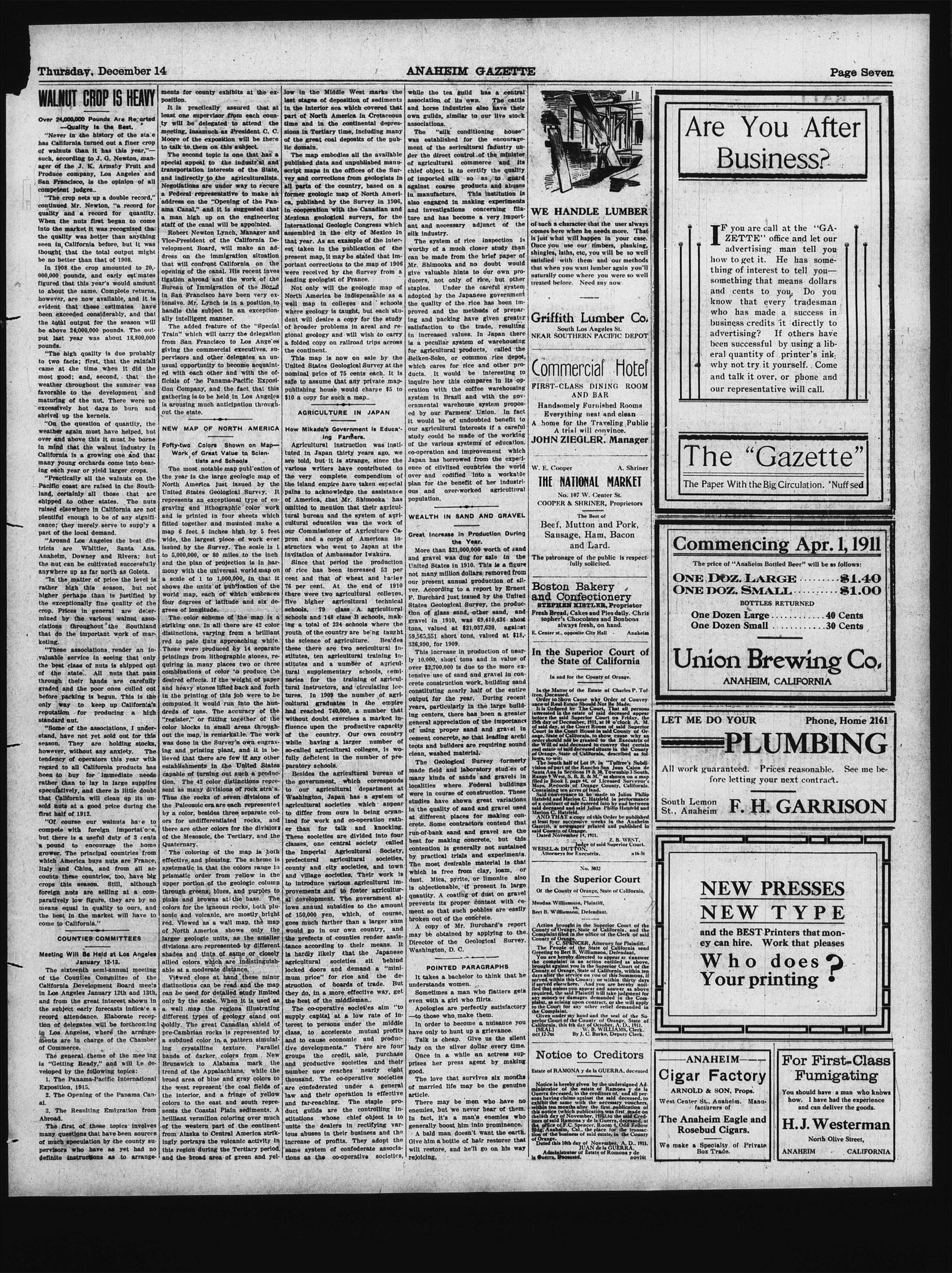
Searchable text
WALNUT CROP IS HEAVY
Over 24,000,000 Pounds Are Reported — Quality is the Best.
"Never in the history of the state has California turned out a finer crop of walnuts than it has this year,"—such, according to J. G. Newton, manager of the J. K. Armsby Fruit and Produce company, Los Angeles and San Francisco, is the opinion of all competent judges.
"The crop sets up a double record," continued Mr. Newton, "a record for quality and a record for quantity. When the nuts first began to come into the market it was recognized that the quality was better than anything seen in California before, but it was thought that the total output might be no better than that of 1908.
In 1908 the crop amounted to 20,000,000 pounds, and early estimates figured that this year's would amount to about the same. Complete returns, however, are now available, and it is evident that these estimates have been exceeded considerably, and that the total output for the season will be above 24,000,000 pounds. The output last year was about 18,800,000 pounds.
"The high quality is due probably to two facts; first, that the rainfall came at the time when it did the most good; and, second, that the weather throughout the summer was favorable to the development and maturing of the nut. There were no excessively hot days to burn and shrivel up the kernels.
"On the question of quantity, the weather again must have helped, but over and above this it must be borne in mind that the walnut industry in California is a growing one and that many young orchards come into bearing each year or yield larger crops."
It is practically assured that at least one supervisor from each county will be delegated to attend the meeting, inasmuch as President C. C. Moore of the exposition will be there to talk to them on this subject.
The second topic is one that has a special appeal to the industrial and transportation interests of the State, and indirectly to the agriculturalists. Negotiations are under way to secure a Federal representative to make an address on the "Opening of the Panama Canal," and it is suggested that a man high up on the engineering staff of the canal will be appointed.
Robert Newton Lynch, Manager and Vice-President of the California Development Board, will make an address on the immigration situation that will confront California on the opening of the canal. His recent inves tigation abroad and the work of the Bureau of Immigration of the Board in San Francisco have been very extensive. Mr. Lynch is in a position to handle this subject in an exceptionally intelligent manner.
The added feature of the "Special Train" which will carry the delegation from San Francisco to Los Ange' es giving the commercial executives, supervisors and other delegates an unusual opportunity to become acquainted with each other and with the officials of 'the Panama-Pacific Exposition Company, and the fact that this gathering is to be held in Los Angeles is arousing much anticipation through-out the state.
NEW MAP OF NORTH AMERICA
Fofty-two Colors Shown on Map—Work of Great Value to Scientists and Schools
The most notable map publication low in the Middle Wast last stages of deposition in the interior sea which part of North America time and in the conti nctions in Tertiary time, of the great coal deposit lic domain.
The map embodies all published data and unp script maps in the offi vevey and corrections from all parts of the coun ty former geologic map o ca, published by the S in cooperation with th e Mexican geological su pter International Geologic Or assembled in the city that year. As an exam ple est taken in the publ iess present map, it may be important corrections to th e were received by the leading geologist of Fran
Not only will the g North America be indi wall map in colleges where geology is taught dent will desire a copy of broader problems in regional geology and will a folded copy on railro ad the continent.
This map is now o United States Geologica nominal price of 75 cedar safe to assume that an publishing house would $10 a copy for such a m
AGRICULTURE
How Mikado's Governme ning Farm
Agricultural instruc tuted in Japan thirty are told, but it is stra various writers have
most good; and, second, that the weather throughout the summer was favorable to the development and maturing of the nut. There were no excessively hot days to burn and shrivel up the kernels.
"On the question of quantity, the weather again must have helped, but over and above this it must be borne in mind that the walnut industry in California is a growing one and that many young orchards come into bearing each year or yield larger crops.
"Practically all the walnuts on the Pacific coast are raised in the Southland, certainly all those that are shipped to other states. The nuts raised elsewhere in California are not plentiful enough to be of any significance; they merely serve to supply a part of the local demand.
"Around Los Angeles the best districts are Whittier, Santa Ana, Anaheim, Downey and Rivera; but the nut can be cultivated successfully anywhere up as far north as Goleta.
"In the matter of price the level is rather high this season, but not higher perhaps than is justified by the exceptionally fine quality of the crop. Prices in general are determined by the various walnut associations throughout the Southland that do the important work of marketing.
"These associations render an invaluable service in seeing that only the best class of nuts is shipped out of the state.. All nuts that pass through their hands are carefully graded and the poor ones culled out before packing is begun. This is the only way to keep up California's reputation for producing a high standard nut.
"Some of the associations, I understand, have not yet sold out for this season. They are holding stocks, however, without any anxiety. The tendency of operators this year with regard to all California products has been to buy for immediate needs rather than to lay in large supplies speculatively, and there is little doubt that California will clean up its unsold nuts at a good price during the first half of 1912.
"Of course our walnuts have to compete with foreign importations, but there is a useful duty of 3 cents a pound to encourage the home grower. The principal countries from which America buys nuts are France, Italy and China, and from all accounts these countries, too, have big crops this season. Still, although foreign nuts are selling at a comparatively low figure they are by no means safe; and second, that the weather throughout the summer was favorable to the development and maturing of the nut. There were no excessively hot days to burn and shrivel up the kernels.
"On the question of quantity, the weather again must have helped, but over and above this it must be borne in mind that the walnut industry in California is a growing one and that many young orchards come into bearing each year or yield larger crops.
"Practically all the walnuts on the Pacific coast are raised in the Southland, certainly all those that are shipped to other states. The nuts raised elsewhere in California are not plentiful enough to be of any significance; they merely serve to supply a part of the local demand.
"Around Los Angeles the best districts are Whittier, Santa Ana, Anaheim, Downey and Rivera; but the nut can be cultivated successfully anywhere up as far north as Goleta.
"In the matter of price the level is rather high this season, but not higher perhaps than is justified by the exceptionally fine quality of the crop. Prices in general are determined by the various walnut associations throughout the Southland that do the important work of marketing.
"These associations render an invaluable service in seeing that only the best class of nuts is shipped out of the state.. All nuts that pass through their hands are carefully graded and the poor ones culled out before packing is begun. This is the only way to keep up California's reputation for producing a high standard nut.
"Some of the associations, I understand, have not yet sold out for this season. They are holding stocks, however, without any anxiety. The tendency of operators this year with regard to all California products has been to buy for immediate needs rather than to lay in large supplies speculatively, and there is little doubt that California will clean up its unsold nuts at a good price during the first half of 1912.
"Of course our walnuts have to compete with foreign importations, but there is a useful duty of 3 cents a pound to encourage the home grower. The principal countries from which America buys nuts are France, Italy and China, and from all accounts these countries, too, have big crops this season. Still, although foreign nuts are selling at a comparatively low figure they are by no means safe; and second, that the weather throughout the summer was favorable to the development and maturing of the nut. There were no excessively hot days to burn and shrivel up the kernels.
"On the question of quantity, the weather again must have helped, but over and above this it must be borne in mind that the walnut industry in California is a growing one and that many young orchards come into bearing each year or yield larger crops.
"Practically all the walnuts on the Pacific coast are raised in the Southland, certainly all those that are shipped to other states. The nuts raised elsewhere in California are not plentiful enough to be of any significance; they merely serve to supply a part of the local demand.
"Around Los Angeles the best districts are Whittier, Santa Ana, Anaheim, Downey and Rivera; but the nut can be cultivated successfully anywhere up as far north as Goleta.
"In the matter of price the level is rather high this season, but not higher perhaps than is justified by the exceptionally fine quality of the crop. Prices in general are determined by the various walnut associations throughout the Southland that do the important work of marketing.
"These associations render an invaluable service in seeing that only the best class of nuts is shipped out of the state.. All nuts that pass through their hands are carefully graded and the poor ones culled out before packing is begun. This is the only way to keep up California's reputation for producing a high standard nut.
"Some of the associations, I understand, have not yet sold out for this season. They are holding stocks, however, without any anxiety. The tendency of operators this year with regard to all California products has been to buy for immediate needs rather than to lay in large supplies speculatively, and there is little doubt that California will clean up its unsold nuts at a good price during the first half of 1912."
NEW MAP OF NORTH AMERICA
Fofty-two Colors Shown on Map—Work of Great Value to Scientists and Schools
The most notable map publication of the year is the large geologic map of North America just issued by the United States Geological Survey. It represents an exceptional type of engraving and lithographic color work and is printed in four sheets which fitted together and mounted make a map 6 feet 5 inches high by 5 feet wide, the largest piece of work ever issued by the Survey. The scale is 1 to 5,000,000, or 80 miles to the inch and the plan of projection is in harmony with the universal world map on a scale of 1 to 1,000,000, in that it shows the units of publication of the world map, each of which embraces four degrees of latitude and six degrees of longitude.
The color scheme of the map is a striking one. In all there are 42 color distinctions, varying from a brilliant red to pale tints approaching white. These were produced by 14 separate printings from lithographic stones, requiring in many places two or three combinations of color to produce desired effects. If the weight of paper and heavy stones lifted back and forth in the printing of this job were to be computed it would run into the hundreds of tons. The accuracy of the "register," or fitting together of the color blocks in small areas throughout the map, is remarkable. The work was done in the Survey's own engraving and printing plant, and it is believed that there are few if any other establishments in the United States capable of turning out such a production. The 42 color distinctions represent as many divisions of rock strata. Thus the rocks of seven divisions of the Paleozoic era are each represented by a color, besides three separate colors for undifferentiated rocks, and there are other colors for the divisions of the Mesozoic, the Tertiary, and the Quaternary.
The coloring of the map is both effective and pleasing. The scheme is systematic in that the colors range in prismatic order from yellow in the upper portion of the geologic column through greens, blues, and purples to pinks and browns at the base. The
COUNTIES COMMITTEES
Meeting Will Be Held at Los Angeles January 12-13.
The sixteenth semi-annual meeting of the Counties Committee of the California Development Board meets in Los Angeles January 12th and 13th, and from the great interest shown in the subject early forecasts indicate a record attendance. Elaborate reception of delegates will be forthcoming in Los Angeles, where the arrangements are in charge of the Chamber of Commerce.
The general theme of the meeting is "Getting Ready," and will be developed by the following topics:
1. The Panama-Pacific International Exposition, 1915.
2. The Opening of the Panama Canal.
3. The Resulting Emigration from Abroad.
The first of these topics involves many questions that have been sources of much speculation by the county supervisors who have as yet had no definite instructions as to arrange-
Thus the rocks of seven divisions of the Paleozoic era are each represented by a color, besides three separate colors for undifferentiated rocks, and there are other colors for the divisions of the Mesozoic, the Tertiary, and the Quaternary.
The coloring of the map is both effective and pleasing. The scheme is systematic in that the colors range in prismatic order from yellow in the upper portion of the geologic column through greens, blues, and purples to pinks and browns at the base. The colors for the igneous rocks, both plutonic and volcanic, are mostly bright red. Viewed as a wall map, the map of North America shows only the larger geologic units, as the smaller divisions are represented by different shades and tints of same or closely allied colors which are indistinguishable at a moderate distance.
Viewed close at hand these minor distinctions can be read and the map can be used for detailed study limited only by the scale. When it is used as a wall map the regions illustrating different types of geology stand out boldly. The great Canadian shield of pre-Cambrian rocks is represented by a subdued color in a pattern simulating crystalline texture. Parallel bands of darker colors from New Brunswick to Alabama mark the trend of the Appalachians; while the broad area of blue and gray colors to the west represent the coal fields of the interior, and a fringe of yellow colors to the east and south represents the Coastal Plain sediments. A brilliant vermilion coloring over much of the western part of the continent from Alaska to Central America strikingly portrays the volcanic activity in this region during the Tertiary period, and the broad area of green and yellow groups the credit, and productive societies number now reaches thousands. The co-operative society law and their operations and far-reaching. The duct gulds are the institutions whose children unite the dealers in numerous abuses in their business increase of profits. The same system of conventions as the co-operative society...
low in the Middle West marks the last stages of deposition of sediments in the interior sea which covered that part of North America in Cretaceous time and in the continental depressions in Tertiary time, including many of the great coal deposits of the public domain.
The map embodies all the available published data and unpublished manuscript maps in the offices of the Survey and corrections from geologists in all parts of the country, based on a former geologic map of North America, published by the Survey in 1906, in cooperation with the Canadian and Mexican geological surveys, for the International Geologic Congress which assembled in the city of Mexico in that year. As an example of the interest taken in the publication of the present map, it may be stated that important corrections to the map of 1906 were received by the Survey from a leading geologist of France.
Not only will the geologic map of North America be indispensable as a wall map in colleges and schools where geology is taught, but each student will desire a copy for the study of broader problems in area and regional geology and will wish to carry a folded copy on railroad trips across the continent.
This map is now on sale by the United States Geological Survey at the nominal price of 75 cents each. It is safe to assume that any private map-publishing house would charge $5 to $10 a copy for such a map.
AGRICULTURE IN JAPAN
How Mikado's Government is Educating Farmers.
Agricultural instruction was instituted in Japan thirty years ago, we are told, but it is strange, since the various writers have contributed to this complete compendium of while the tea guild has a central association of its own. The cattle and horse industries also have their own gulds, similar to our live stock associations.
The "silk conditioning house" was established for the encouragement of the sericultural industry under the direct control of the minister of agricultural commerce and its chief object is to certify the quality of imported silk so as to guard against coarse products and abuses in manufacture. This institution is also engaged in making experiments and investigations concerning filature and has become a very important and necessary adjunct of the silk industry.
The system of rice inspection is worthy of a much closer study than can be made from the brief paper of Mr. Shimooka and no doubt would give valuable hints to our own producers, not only of rice, but other staples. Under the careful system adopted by the Japanese government the quality of the rice has been improved and the methods of preparing and packing have given greater satisfaction to the trade, resulting in increased values. In Japan there is a peculiar system of warehousing for agricultural products, called the Beiken-Soko, or common rice depot, which cares for rice and other products. It would be interesting to inquire how this compares in its operation with the coffee warehousing system in Brazil and with the governmental warehouse system proposed by our Farmers' Union. In fact it would be of undoubted benefit to our agricultural interests if a careful study could be made of the working of the various systems of education, co-operation and improvement which Japan has borrowed from the experience of civilized countries the world over and codified into a workable
AGRICULTURE IN JAPAN
How Mikado's Government is Educating Farmers.
Agricultural instruction was instituted in Japan thirty years ago, we are told, but it is strange, since the various writers have contributed to the very complete compendium of the island empire have taken especial pains to acknowledge the assistance of America, that Mr. Shimooka has omitted to mention that their agricultural bureau and the system of agricultural education was the work of our Commissioner of Agriculture Capron and a corps of American instructors who went to Japan at the invitation of Ambassador Iwakura.
Since that period the production of rice has been increased 53 per cent and that of wheat and barley 76 per cent. At the end of 1910 there were two agricultural colleges, five higher agricultural technical schools, 79 class A agricultural schools and 148 class B schools, making a total of 234 schools where the youth of the country are being taught the science of agriculture. Besides these there are two sericultural institutes, ten agricultural training institutes and a number of agricultural supplementary schools, seminaries for the training of agricultural instructors, and circulating lectures. In 1909 the number of agricultural graduates in the empire had reached 740,000, a number that without doubt exercises a marked influence upon the productive capacity of the country. Our own country while having a larger number of so-called agricultural colleges, is wofully deficient in the number of preparatory schools.
Besides the agricultural bureau of the government, which corresponds to our agricultural department at Washington, Japan has a system of agricultural societies which appear to differ from ours in being organized for work and co-operation rather than for talk and knocking. These societies are divided into four classes, one central society called the Imperial Agricultural Society, prefectural agricultural societies, county and city societies, and town and village societies. Their work is to introduce various agricultural improvements and to foster agricultural development. The government al-
WEALTH IN SAND AND GRAVEL
Great Increase in Production During the Year.
More than $21,000,000 worth of sand and gravel was dug for sale in the United States in 1910. This is a figure not many million dollars removed from our present annual production of silver. According to a report by Ernest F. Burchard just issued by the United States Geological Survey, the production of glass sand, other sand, and gravel in 1910, was 69,410,436 short tons, valued at $21,037,630, against 59,565,551 short tons, valued at $18,336,990, for 1909.
This increase in production of nearly 10,000, short tons and in value of over $2,700,000 is due to the more extensive use of sand and gravel in concrete construction work, building sand constituting nearly half of the entire output for the year. During recent years, particularly in the large building centers, there has been a greater general appreciation of the importance of using proper sand and gravel in cement concrete, so that leading architects and builders are requiring sound clean, washed material.
The Geological Survey formerly made field and laboratory studies of many kinds of sands and gravel in localities where Federal buildings were in course of construction. These studies have shown great variations in the quality of sand and gravel used at different places for making concrete. Some contractors contend that run-of-bank sand and gravel are the best for making concrete, but this contention is generally not sustained by practical trials and experiments. The most desirable material is that which is free from clay, loam, or dust. Mica, pyrite, or limonite also is objectionable; if present in large quantity. A coating of dust on gravel
FIRST-CLASS DINING ROOM AND BAR
Handsomely Furnished Rooms Everything neat and clean
A home for the Traveling Public A trial will convince.
JOHN ZIEGLER. Manager
W. E. Cooper A. Shriner
THE NATIONAL MARKET
No. 107 W. Center St.
COOPER & SHRINER, Proprietors
The Best of Beef, Mutton and Pork, Sausage, Ham, Bacon and Lard.
The patronage of the public is respectfully solicited.
Boston Bakery and Confectionery STEPHEN KISTLER, Proprietor Fresh Bread, Cakes and Pies daily. Chris topher's Chocolates and Bonbons always fresh, on hand.
E. Center st., opposite City Hall Anaheim
In the Superior Court of the State of California
In and for the County of Orange.
In the Matter of the Estate of Charles P. Tuffree, Deceased.
Order to Show Cause why Order of Conveyance of Real Estate Should Not Be Made.
It is Ordered by The Court That all persons interested in the estate of said deceased appear before the said Superior Court on Friday, the 15th day of December, 1911, at 10 o'clock A.M. Of said day, at the Court Room of said Superior Court in the Court House in said County of Orange, State of California, to show cause why an order should be granted to the Executrix of the Will of said deceased to convey that certain real estate of said deceased situate in the County of Orange, State of California, described as follows: to-wit:
The South half of Lot 18 in "Tuffree's Subdivision of part of the Rancho San Juan Cajon de Santa Ana in Sections 19 & 30,Township 3 South,Range 9 West,S.B. B.& M."as shown on a map filed in Book I page 44.of Licensed Surveyor's Maps.Records of Orange County,California.Contains ten acres of land.
Said conveyance to be made to Julius Philip Hatzfeld and Marion C.Hatzfeld in performance of a contract of sale entered into by and between said deceased and said Julius Philip Hatzfeld and Marion C.Hatzfeld.
AND THAT a copy of this Order be published at least four successive weeks in the Anaheim Gazette,a newspaper printed and published in said County.of Orange.
Dated November 14,1911.
Z. B. WEST,
WEISEL & DUTTON,
Attorneys for Executrix.
No. 5032
In the Superior Court
Of the County of Orange.State of California.
Washington, supra has a system of agricultural societies which appear to differ from ours in being organized for work and co-operation rather than for talk and knocking. These societies are divided into four classes, one central society called the Imperial Agricultural Society, prefectural agricultural societies, county and city societies, and town and village societies. Their work is to introduce various agricultural improvements and to foster agricultural development. The government allows annual subsidies to the amount of 150,000 yen, which, of course, goes much farther than a larger sum would go in our own country, and the prefects of counties render assistance according to their means. It is hardly likely that the Japanese agricultural societies sit behind locked doors and demand a "minimum price" for rice and the destruction of boards of trade. But they do, in a more effective way, get the best of the middleman.
The co-operative societies aim "to supply capital at a low rate of interest to persons under the middle class, to accelerate mutual profits and to cause economic and productive developments." There are four groups the credit, sale, purchase and productive societies and their number now reaches nearly eight thousand. The co-operative societies are confederated under a general law and their operation is effective and far-reaching. The staple product guilds are the controlling institutions whose chief object is to unite the dealers in rectifying various abuses in their business and the increase of profits. They adopt the same system of confederate associations as the co-operative societies, studies have shown great variations in the quality of sand and gravel used at different places for making concrete. Some contractors contend that run-of-bank sand and gravel are the best for making concrete, but this contention is generally not sustained by practical trials and experiments. The most desirable material is that which is free from clay, loam, or dust. Mica, pyrite, or limonite also is objectionable, if present in large quantity. A coating of dust on gravel prevents its proper contact with cement so that such pebbles are easily broken out of the concrete.
A copy of Mr. Burchard's report may be obtained by applying to the Director of the Geological Survey, Washington, D.C.
POINTED PARAGRAPHS
It takes a bachelor to think that he understands women.
Sometimes a man who flatters gets even with a girl who flirts.
Apologies are perfectly satisfactory—to those who make them.
In order to become a nuisance you have only to hunt up a grievance.
Talk is cheap. Give us the silent lady on the silver dollar every time.
Once in a while an actress suppresses her press agent by making good.
The love that survives six months of married life may be the genuine article.
There may be men who have no enemies, but we never hear of them. In fact, it's a man's enemies who generally boost him into prominence.
A bald man doesn't want the earth. Give him a bottle of hair restorer that will restore, and he'll go on his way rejoicing.
Are You After Business?
If you are call at the "GA-ZETTE" office and let our advertising man tell you how to get it. He has something of interest to tell you—something that means dollars and cents to you. Do you know that every tradesman who has made a success in business credits it directly to advertising? If others have been successful by using a liberal quantity of printer's ink, why not try it yourself. Come and talk it over, or phone and our representative will call.
The "Gazette"
The "Gazette"
The Paper With the Big Circulation. 'Nuff sed
Commencing Apr. 1, 1911
The price of "Anaheim Bottled Beer" will be as follows:
ONE DOZ. LARGE $1.40
ONE DOZ. SMALL $1.00
BOTTLES RETURNED
One Dozen Large 40 Cents
One Dozen Small 30 Cents
Union Brewing Co,
ANAHEIM, CALIFORNIA
LET ME DO YOUR Phone, Home 2161
PLUMBING
All work guaranteed. Prices reasonable. See me before letting your next contract.
South Lemon St., Anaheim F. H. GARRISON
NEW PRESSES
NEW PRESSES
NEW TYPE
and the BEST Printers that money can hire. Work that pleases
Who does Your printing?
ANAHEIM
Cigar Factory
ARNOLD & SON, Props.
West Center St., Anaheim. Manufacturers of
The Anaheim Eagle and Rosebud Cigars.
We make a Specialty of Private Box Trade.
For First-Class Fumigating
You should have a man who knows how. I have had the experience and can deliver the goods.
H.J. Westerman
North Olive Street,
ANAHEIM CALIFORNIA