anaheim-gazette 1911-12-07
Scanned page
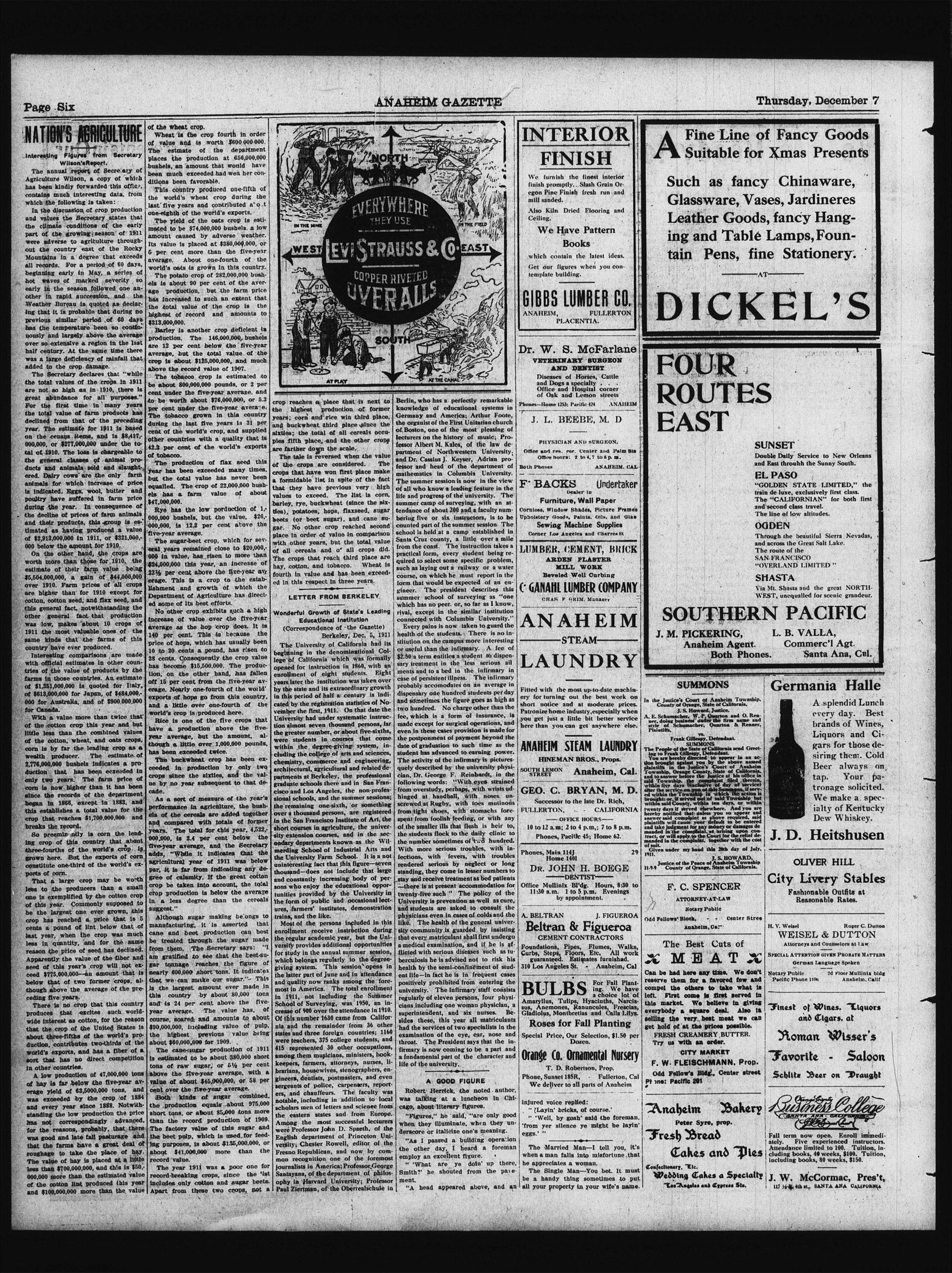
Searchable text
NATION'S AGRICULTURE
Interesting Figures from Secretary Wilson's Report.
The annual report of Secretary of Agriculture Wilson, a copy of which has been kindly forwarded this office, contains much interesting data, from which the following is taken:
In the discussion of crop production and values the Secretary states that the climate conditions of the early part of the growing season of 1911 were adverse to agriculture throughout the country east of the Rocky Mountains in a degree that exceeds all records. For a period of 60 days, beginning early in May, a series of hot waves of marked severity so early in the season followed one another in rapid succession, and the Weather Bureau is quoted as declaring that it is probable that during no previous similar period of 60 days has the temperature been so continuously and largely above the average over so extensive a region in the last half century. At the same time there was a large deficiency of rainfall that added to the crop damage.
The Secretary declares that "while the total values of the crops in 1911 are not so high as in 1910, there is great abundance for all purposes."
For the first time in many years the total value of farm products has declined from that of the preceding year. The estimate for 1911 is based on the census items, and is $8,417,000,000, or $277,000,000 under the total of 1910. The loss is chargeable to the general classes of animal products and animals sold and slaughtered. Dairy crops are the only form of the wheat crop.
Wheat is the crop fourth in order of value and is worth $600,000,000. The estimate of the department places the production at 656,000,000 bushels, an amount that would have been much exceeded had wea her conditions been favorable.
This country produced one-fifth of the world's wheat crop during the last five years and contributed about one-eighth of the world's exports.
The yield of the oats crop is estimated to be 874,000,000 bushels, a low amount caused by adverse weather. Its value is placed at $380,000,000, or 5 per cent more than the five-year average. About one-fourth of the world's oats is grown in this country.
The potato crop of 282,000,000 bushels is about 90 per cent of the average production, but the farm price has increased to such an extent that the total value of the crop is the highest of record and amounts to $213,000,000.
Barley is another crop deficient in production. The 146,000,000 bushels are 12 per cent below the five-year average, but the total value of the crop is about $125,000,000, and much above the record value of 1907.
The tobacco crop is estimated to be about 800,000,000 pounds, or 2 per cent under the five-year average, and to be worth about $76,000,000, or 5.3 per cent under the five-year average. The tobacco grown in this country during the last five years is 31 per cent of the world's crop, and supplied other countries with a quality that is 42.3 per cent of the world's exports of tobacco.
The production of flax seed this year has been exceeded many times,
crop reaches a place that
the highest production
years; corn and rice win
and buckwheat third place
sixties; the total of all ce
piles fifth place, and the
are farther down the scale.
The tale is reversed when
of the crops are consider
crops that have won first
The Secretary declares that while the total values of the crops in 1911 are not so high as in 1910, there is great abundance for all purposes."
For the first time in many years the total value of farm products has declined from that of the preceding year. The estimate for 1911 is based on the census items, and is $8,417,000,000, or $277,000,000 under the total of 1910. The loss is chargeable to the general classes of animal products and animals sold and slaughtered. Dairy cows are the only farm animals for which increase of price is indicated. Eggs, wool, butter and poultry have suffered in farm price during the year. In consequence of the decline of prices of farm animals and their products, this group is estimated as having produced a value of $2,913,000,000 in 1911, or $321,000,000 below the amount for 1910.
On the other hand, the crops are worth more than those for 1910, the estimate of their farm value being $5,504,000,000, a gain of $44,000,000 over 1910. Farm prices of all crops are higher than for 1910 except for cotton, cotton seed, and flax seed, and this general fact, notwithstanding the other general fact that production was low, makes about 10 crops of 1911 the most valuable ones of the same kinds that the farms of this country have ever produced.
Interesting comparisons are made with official estimates in other countries. An estimate of $1,351,000,000 is quoted for Italy, of $613,000,000 for Japan, of $484,000,000 for Australia, and of $900,000,000 for Canada.
With a value more than twice that of the cotton crop this year and but little less than the combined values of the cotton, wheat, and oats crops, corn is by far the leading crop as a wealth producer. The estimate of 2,776,000,000 bushels indicates a production that has been exceeded in only two years. The farm price of corn is now higher than it has been since the records of the department began in 1866, except in 1883, and this establishes a total value for the crop that reaches $1,700,000,000 and breaks the record.
So preeminently is corn the leading crop of this country that about three-fourths of the world's crop is grown here. But the exports of corn constitute one-third of the world's exports of corn.
That a large crop may be worth less to the producers than a small one is exemplified by the cotton crop.
The tobacco crop is estimated to be about 800,000,000 pounds, or 2 per cent under the five-year average, and to be worth about $76,000,000, or 5.3 per cent under the five-year average. The tobacco grown in this country during the last five years is 31 per cent of the world's crop, and supplied other countries with a quality that is 42.3 per cent of the world's exports of tobacco.
The production of flax seed this year has been exceeded many times, but the total value has never been equalled. The crop of 22,000,000 bushels has a farm value of about $47,000,000.
Rye has the low porduction of 1,000,000 bushels, but the value, $26,000,000, is 12.2 per cent above the five-year average.
The sugar-beet crop, which for several years remained close to $20,000,-ooo in value, has risen to more than $24,000,ooo this year, an increase of 23½ per cent above the five-year average. This is a crop to the establishment and growth of which the Department of Agriculture has directed some of its best efforts.
No other crop exhibits such a high increase of value over the five-year average as the hop crop does. It is 140 per cent. This is because the price of hops, which has usually been 10 to 20 cents a pound, has risen to 38 cents. Consequently the crop value has become $15,500,ooo. The production on the other hand, has fallen off 15 per cent from the five-year average. Nearly one-fourth of the world's exports of hops go from this country, and a little over one-fourth of the world's crop is produced here.
Rice is one of the five crops that have a production above the five-year average, but the amount although a little over 1,ooo,ooo pounds has been exceeded twice.
The buckwheat crop has been exceeded in production by only two crops since the sixties, and the value by no year subsequent to that decade.
As a sort of measure of the year's performance in agriculture, the bushels of the cereals are added together and compared with totals of former years. The total for this year, 4,522,-ooo,ooo is 3.4 per cent below the five-year average, and the Secretary adds,"While it indicates that the agricultural year of 1911 was below par, it is far from indicating any degree of calamity. If the great cotton crop be taken into account, the total crop production is below the average crop reaches a place that at the highest production years; corn and rice win and buckwheat third place sixties; the total of all cereals fifth place; and they are farther down the scale.
The tale is reversed when of the crops are considered crops that have won first in a formidable list in spite that they have previous values to exceed. The lily barley, rye, buckwheat (sixties), potatoes, hops, flax beets (or beet sugar), and gar. No other crop reach place in order of value in with other years; but they do not all cereals and o' all. The crops that reach third hay, cotton, and tobacco fourth in value and have been in this respect in three
LETTER FROM BERKELEWDER
Wonderful Growth of State
Educational Institute
(Corrrespondence to Berkeley,
I)
The University of California beginning in the denomination lege of California which was opened for instruction in its enrollment of eight students later the institution was by the state and its extraordinaire in this period of half a century cited by the registration statement verberthe first, 1911. On University had under systemation almost seven thousand greater number or about were students in courses within the degree-giving including college of arts chemistry commerce and architectural,agricultural and partments at Berkeley,the graduate schools there and i cisco and Los Angeles,the national schools,and the summthe remaining one-sixthovera thousand persons,and in San Francisco Institutes short courses in agriculture,sity extension courses,and ordinary departments known merding School of Industrialsthe University Farm School uninteresting fact that this fife thousand—does not include and constantly increasing b sons who enjoy the educational tunities provided by the U
began in 1866, except in 1883, and this establishes a total value for the crop that reaches $1,700,000,000 and breaks the record.
So preeminently is corn the leading crop of this country that about three-fourths of the world's crop is grown here. But the exports of corn constitute one-third of the world's exports of corn.
That a large crop may be worth less to the producers than a small one is exemplified by the cotton crop of this year. Commonly supposed to be the largest one ever grown, this crop has reached a price that is 5 cents a pound of lint below that of last year, when the crop was much less in quantity, and for the same reason the price of seed has declined. Apparently the value of the fiber and seed of this year's crop will not exceed $775,000,000—an amount that is below that of two former crops, although above the average of the preceding five years.
There is no crop that this country produces that excites such worldwide interest as cotton, for the reason that the crop of the United States is about three-fifths of the world's production, contributes two-thirds of the world's exports, and has a fiber of a sort that has no direct competition in other countries.
A low production of 47,000,000 tons of hay is far below the five-year average yield of 63,500,000 tons, and was exceeded by the crop of 1884 and every year since 1888. Notwithstanding the low production the price has not correspondingly advanced, for the reasons, probably, that there was good and late fall pasturage and that the farms have a great deal of roughage to take the place of hay. The value of hay is placed at a little less than $700,000,000, and this is $50-100,000 more than the estimated value of the cotton lint produced this year and $100,000,000 more than the value
As a sort of measure of the year's performance in agriculture, the bushels of the cereals are added together and compared with totals of former years. The total for this year, 4,522,000,000, is 3.4 per cent below the five-year average, and the Secretary adds, "While it indicates that the agricultural year of 1911 was below par, it is far from indicating any degree of calamity. If the great cotton crop be taken into account, the total crop production is below the average in a less degree than the cereals suggest."
Although sugar making belongs to manufacturing, it is asserted that cane and beet production can best be treated through the sugar made from them. The Secretary says: "I am gratified to see that the beet-sugar tonnage reaches the figure of nearly 600,000 short tons. It indicates that we can make our sugar." This is the largest amount ever made in this country by about 80,000 tons and is 24 per cent above the five-year average. The value has, of course, soared and amounts to about $90,000,000, including value of pulp, the highest previous value being about $60,000,000 for 1909.
The cane-sugar production of 1911 is estimated to be about 380,000 short tons of raw sugar, or 5½ per cent above the five-year average, with a value of about $45,000,000, or 58 per cent over the five-year average.
Both kinds of sugar combined, the production equals about 975,000 short tons, or about 85,000 tons more than the record production of 1909. The factory value of this sugar and the beet pulp, which is used for feeding purposes, is about $135,000,000, or about $41,000,000 more than the record value.
The year 1911 was a poor one for record-breaking crops, since the '1st includes only cotton and sugar beets. Apart from these two crops, not a
ANAHEIM GAZETTE
NORTH
IN THE MINE
WEST
IN THE FIELD
EVERYWHERE
THEY USE
LEVI STRAUSS & CO.
COPPER RIVETED
OVERALLS
SOUTH
AT PLAY
AT THE CANAL
INTERIOR FINISH
We furnish the finest interior finish promptly... Slash Grain Oregon Pine Finish fresh run and mill sanded.
Also Kiln Dried Flooring and Ceiling.
We Have Pattern Books which contain the latest ideas.
Get our figures when you contemplate building.
GIBBS LUMBER CO.
ANAHEIM, FULLERTON
PLACENTIA.
Dr. W. S. McFarlane
VETERINARY SURGEON AND DENTIST
Diseases of Horses, Cattle and Dogs a specialty...
Office and Hospital corner of Oak and Lemon streets
Phones—Home 1253; Pacific 424 ANAHEIM
J. L. BEEBE, M. D
PHYSICIAN AND SURGEON.
Office and res. cor. Center and Palm Sts
Office hours: 2 to 4, 7 to 8 p.m.
Both Phones ANAHEIM. CAL
TOP reaches a place that is next to the highest production of former crops; corn and rice win third place, and buckwheat third place since the twenties; the total of all cereals occupies fifth place, and the other crops farther down the scale.
The tale is reversed when the value of the crops are considered. The crops that have won first place make formidable list in spite of the fact that they have previous very high values to exceed. The list is corn, barley, rye, buckwheat (since the sixes), potatoes, hops, flaxseed, sugar beets (or beet sugar), and cane sugar. No other crop reached second place in order of value in comparison with other years, but the total value of all cereals and o'all crops did. The crops that reach third place are soy, cotton, and tobacco. Wheat is fourth in value and has been exceeded in this respect in three years.
LETTER FROM BERKELEY
Wonderful Growth of State's Leading Educational Institution
(Corrrespondence of the Gazette)
Berkeley, Dec. 5, 1911
The University of California had its beginning in the denominational College of California which was formally opened for instruction in 1860, with an enrollment of eight students. Eight years later the institution was taken over by the state and its extraordinary growth in this period of half a century is indicated by the registration statistics of November the first, 1911. On that date the university had under systematic instruction almost seven thousand persons, far greater number, or about five-sixths, were students in courses that come within the degree-giving system, including the college of arts and sciences, chemistry, commerce and engineering, architectural, agricultural and related departments at Berkeley, the professional graduate schools there and in San Francisco and Los Angeles, the non-professional schools, and the summer sessions; the remaining one-sixth, or something over a thousand persons, are registered in the San Francisco Institute of Art, the short courses in agriculture, the university extension courses, and in the secondary departments known as the Wilberding School of Industrial Arts and the University Farm School. It is a noteworthy fact that this figure—seven thousand—does not include that large and constantly increasing body of persons who enjoy the educational opportunities provided by the University in Berlin, who has a perfectly remarkable knowledge of educational systems in Germany and America; Arthur Foote, the organist of the First Unitarian church of Boston, one of the most pleasing of lecturers on the history of music; Professor Albert M. Kales, of the law department of Northwestern University; and Dr. Cassius J. Keyser, Adrian professor and head of the department of mathematics in Columbia University.
The summer session is now in the view of all who know a leading feature in the life and progress of the university. The summer camp of surveying, with an attendance of about 200 and a faculty numbering five or six instructors, is to be counted part of the summer session. The school is held at a camp established in Santa Cruz county, a little over a mile from the coast. The instruction takes a practical form, every student being required to select some specific problem, such as laying out a railway or a water course, on which he must report in the form that would be expected of an engineer. The president describes this summer school of surveying as "one which has no peer. or, so far as I know, rival, except in the similar institution connected with Columbia University."
Every pains is now taken to guard the health of the students. There is no institution on the campus more interesting or useful than the infirmary. A fee of $2.50 a term entitles a student to dispensary treatment in the less serious ailments and to a bed in the infirmary in case of persistent illness. The infirmary probably accommodates on an average in dispensary one hundred students per day and sometimes the figure goes as high as two hundred. No charge other than the fee, which is a form of insurance, is made except for surgical operations, and even in these cases provision is made for the postponement of payment beyond the date of graduation to such time as the student has advanced to earning power.
The activity of the infirmary is picturesque described by the university physician, Dr. George F. Reinhardt, in the following words: "With eyes strained from overstudy, perhaps, with wrists udhinged at handball, with noses unscrewed at Rugby, with toes mutinous from tight shoes, with stomachs forespent from foolish feeding, or with any of the smaller ills that flesh is heir to, the students flock to the daily clinic to the number sometimes of two hundred. With more serious troubles, with infections, with fevers, with troubles rendered serious by neglect or long standing, they come in lesser numbers to stay and receive treatment as bed patients—there is at present accommodation for twenty-five such." The policy of the disease of Horses, Cattle and Dogs a specialty... Office and Hospital corner of Oak and Lemon streets
Phones—Home 1253; Pacific 424 ANAHEIM
J. L. BEEBE, M. D
PHYSICIAN AND SURGEON.
Office and res. cor. Center and Palm Sts
Office hours: 2 to 4,7 to 8 p.m.
Both Phones ANAHEIM.CAL
F BACKS Undertaker Dealer in Furniture, Wall Paper
Cornices Window Shades Picture Frames Upholstery Goods Paints Oilis and Glass Sewing Machine Supplies
Corner Los Angeles and Charles St
LUMBER, CEMENT, BRICK ARDEN PLASTER MILL WORK Beveled Well Curbing C GANAHL LUMBER COMPANY CHAS F GRIM. Manager
ANAHEIM STEAM LAUNDRY
Fitted with the most up-to-date machinery for turning out the best work on short notice and at moderate prices. Patronize home industry especially when you get just a little bit better service here than you can get anywhere else.
ANAHEIM STEAM LAUNDRY HINEMAN BROS., Props.
SOUTH LEMON STREET Anaheim, Cal.
GEO. C. BRYAN, M. D.
Successor to the late Dr. Rich,
FULLERTON,
CALIFORNIA
OFFICE HOURS
10 to 12 a.m.; 2 to 4 p.m.; 7 to 8 p.m.
Phones, Pacific 45; Home 62.
Phones, Main 114J
Home 1401
Dr. JOHN H. BOEGE
DENTIST
Office Mullinix Bl'dg. Hours, 8:30 to 11:30 a.m. 1 to 5 p.m. Evenings by appointment.
Most of the persons included in this enrollment receive instruction during the regular academic year, but the University provides additional opportunities for study in the annual summer session, which belongs regularly to the degree-driving system. This session opens in the latter part of June and in attendance and quality now ranks among the foremost in America. The total enrollment in 1911, not including the Summer School of Surveying, was 1950, an increase of 900 over the attendance in 1910. Of this number 1630 came from California and the remainder from 36 other states and three foreign countries; 1160 were teachers, 375 college students, and 15 represented 30 other occupations, among them musicians, ministers, bookkeepers, farmers, attorneys, nurses, librarians, housewives, stenographers, engineers, dentists, postmasters, and evenergeants of police, carpenters, reporters, and chauffeurs. The faculty was notable, including in addition to local scholars men of letters and science from the eastern states and from Europe. Among the most successful lecturers were Professor John D. Spaeth, of the English department of Princeton University; Chester Rowell, editor of the Presno Republican, and now by common recognition one of the foremost journalists in America; Professor George Santayana, of the department of philosophy in Harvard University; Professor Paul Ziertman, of the Oberrealschule in screwed at Rugby, with toes mutinous from tight shoes, with stomachs forespent from foolish feeding, or with any of the smaller illis that flesh is heir to, the students flock to the daily clinic to the number sometimes of two hundred. With more serious troubles, with infections, with fevers, with troubles rendered serious by neglect or long standing, they come in lesser numbers to stay and receive treatment as bed patients—there is at present accommodation for twenty-five such." The policy of the University is prevention as well as cure, and students are asked to consult the physicians even in cases of colds and the like. The health of the general university community is guarded by insisting that every matriculant shall first undergo a medical examination, and if he is afflicted with serious diseases such as tuberculosis he is advised not to risk his health by the semi-confinement of student life—in fact he is in frequent cases positively prohibited from entering the university. The infirmary staff consists regularly of eleven persons, four physicians including one woman physician, a superintendent, and six nurses. Besides these, this year all matriculants had the services of two specialists in the examination of the eye, ear, nose and throat. The President says that the infirmary is now coming to be a part and a fundamental part of the character and life of the university.
A GOOD FIGURE
Robert Herrick, the noted author, was talking at a luncheon in Chicago, about literary figures.
"Figures," he said, "are only good when they illuminate, when they underscore or italicize one's meaning.
"As I passed a building operation the other day, I heard a foreman employ an excellent figure.
"What are ye doin' up there, Smith?" he shouted from the pavement.
"A head appeared above, and an injured voice replied:
"'Layin' bricks, of course.'
"'Well, by gosh' said the foreman,'from yer silence ye might be layin' eggs.'"
The Married Man—I tell you, it's when a man falls into misfortune that he appreciates a woman.
The Single Man—You bet. It must be a handy thing sometimes to put all your property in your wife's name.
Thursday, December 7
A Fine Line of Fancy Goods Suitable for Xmas Presents
Such as fancy Chinaware,
Glassware, Vases, Jardineres
Leather Goods, fancy Hanging and Table Lamps, Fountain Pens, fine Stationery.
AT
DICKEL'S
FOUR ROUTES EAST
SUNSET
Double Daily Service to New Orleans
and East throuhh the Sunny South.
ROUTES
EAST
SUNSET
Double Daily Service to New Orleans and East through the Sunny South.
EL PASO
"GOLDEN STATE LIMITED," the train de luxe, exclusively first class.
The "CALIFORNIAN" for both first and second class travel.
The line of low altitudes.
OGDEN
Through the beautiful Sierra Nevadas, and across the Great Salt Lake.
The route of the SAN FRANCISCO "OVERLAND LIMITED"
SHASTA
Via Mt. Shasta and the great NORTH-WEST, unequalled for scenic grandeur.
SOUTHERN PACIFIC
J. M. PICKERING,
Anaheim Agent.
Both Phones.
L. B. VALLA,
Commerc'l Agt.
Santa Ana, Cal.
SUMMONS
In the Justice's Court of Anaheim Township, County of Orange, State of California,
J. S. Howard, Justice.
A. E. Schumacher, W. P. Quarton and O. Renner, doing business under the firm name and style of Schumacher, Quarton & Renner, Plaintiffs.
vs.
Frank Gillespy, Defendant.
SUMMONS
The People of the State of California send Greeting to Frank Gillespy, Defendant.
You are hereby directed to appear in an action brought against you by the above named plaintiffs in the Justice's Court of Anaheim Township, Orange County, State of California, and to answer before the Justice at his office in said Township, the complaint filed therein within five days (exclusive of day of service) after the service on your of this Summons, if served within the Township in which the action is brought; or, if served out of said Township but within said County, within ten days, or within twenty days if served elsewhere. And you are hereby notified that unless you so appear and answer said complaint as above required, said plaintiffs will cause your default to be entered and take judgment for any money or damages de manded in the complaint, as arising upon contract, or will apply to the Court for the relief demanded in the complaint, together with the cost of suit.
Given under my hand this 20th day of July, 1911.
J. S. HOWARD,
Justice of the Peace of Anaheim Township
County of Orange, State of California.
F. C. SPENCER
ATTORNEY AT LAW
Germania Halle
A splendid Lunch every day. Best brands of Wines, Liquors and Cigars for those desiring them. Cold Beer always on tap. Your patronage solicited. We make a specialty of Kentucky Dew Whiskey.
J. D. Heitshusen
OLIVER HILL
City Livery Stables
Fashionable Outfits at
F. C. SPENCER
ATTORNEY-AT-LAW
Notary Public
Odd Fellow's Block, Center Street
Anaheim, Cal.
The Best Cuts of MEAT
Can be had here any time. We don't reserve them for a favored few and compel the others to take what is left. First come is first served in this market. We believe in giving everybody a square deal. Also in selling the very best meat we can get hold of at the prices possible.
FRESH CREAMERY BUTTER.
Try us with an order.
CITY MARKET
F. W. FLEISCHMANN, Prop.
Odd Fellow's Bldg., Center street
Phone: Pacific 201
Anaheim Bakery
Peter Syre, prop.
Fresh Bread
Cakes and Pies
Confectionery, Etc.
Wedding Cakes a Specialty
Los Angeles and Cypress Sts.
OLIVER HILL
City Livery Stables
Fashionable Outfits at Reasonable Rates.
H. V. Weisel
Roger C. Dutton
WEISEL & DUTTON
Attorneys and Counselors at Law
SPECIAL ATTENTION GIVEN PROBATE MATTERS
German Language Spoken
Notary Public
2d Floor Mullinix bldg
Pacific Phone 1106
Anaheim, Cal.
Finest of Wines, Liquors and Tigars, at
Roman Wisser's
Favorite - Saloon
Schlitz Beer on Draught
Business College
Fall term now open. Enroll immediately. Five experienced instructors.
Attendance limited to 100. Tuition, including books, 40 weeks, $100. Tuition, including books, 80 weeks, $150.
J. W. McCormac, Pres't,
117 3rd st., Santa Ana California