anaheim-gazette 1911-11-23
Scanned page
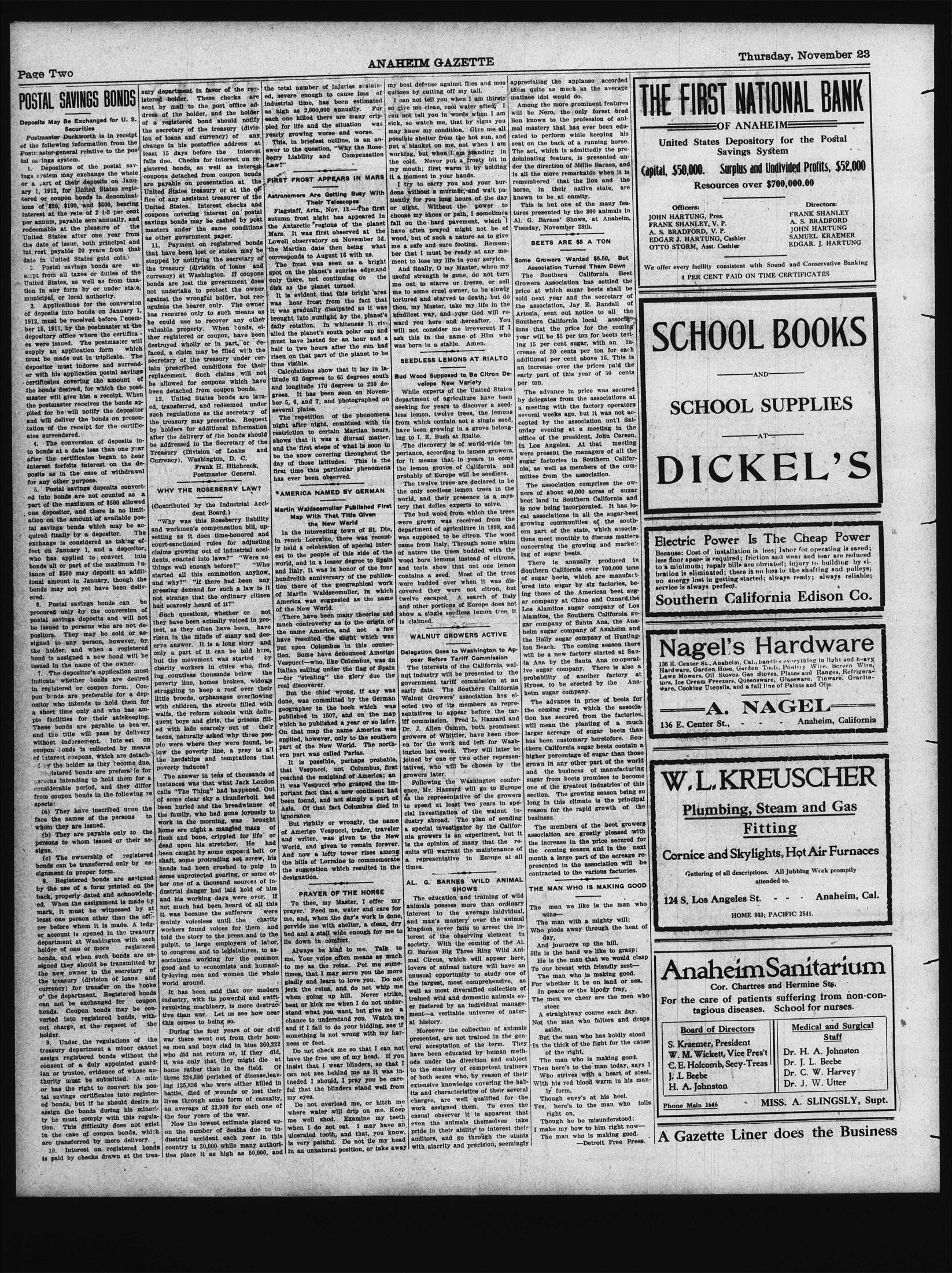
Searchable text
POSTAL SAVINGS BONDS
Deposits May Be Exchanged for U. S. Securities
Postmaster Duckworth is in receipt of the following information from the Postmaster-general relative to the postal savings system.
1. Depositors of the postal savings system may exchange the whole or a part of their deposits on January 1, 1912, for United States registered or coupon bonds in denominations of $20, $100, and $500, bearing interest at the rate of 2 1/2 per cent per annum, payable semi-annually, and redeemable at the pleasure of the United States after one year from the date of issue, both principal and interest payable 20 years from that date in United States gold coin.
2. Postal savings bonds are exempt from all taxes or duties of the United States, as well as from taxation in any form by or under state, municipal, or local authority.
3. Applications for the conversion of deposits into bonds on January 1, 1912, must be received before December 15, 1911, by the postmaster at the depository office where the certificates were issued. The postmaster will supply an application form which must be made out in triplicate. The depositor must indorse and surrender with his application postal savings certificates covering the amount of the bonds desired, for which the postmaster will give him a receipt. When the postmaster receives the bonds applied for he will notify the depositor and will deliver the bonds on presentation of the receipt for the certificates surrendered.
4. The conversion of deposits into bonds at a date less than one year after the certificates began to bear interest forfeits interest on the deposits as in the case of withdrawal sury department in favor of the registered holder. These checks are sent by mail to the post office address of the holder, and the holder of a registered bond should notify the secretary of the treasury (division of loans and currency) of any change in his postoffice address at least 15 days before the interest falls due. Checks for interest on registered bonds, as well as interest coupons detached from coupon bonds are payable on presentation at the United States treasury or at the office of any assistant treasurer of the United States. Interest checks and coupons covering interest on postal savings bonds may be cashed by post masters under the same conditions as other government paper.
11. Payment on registered bonds that have been lost or stolen may be stopped by notifying the secretary of the treasury (division of loans and currency) at Washington. If coupons bonds are lost the government does not undertake to protect the owner against the wrongful holder, but recognizes the bearer only. The owner has recourse only to such means as he could use to recover any other valuable property. When bonds, either registered or coupon, have been destroyed wholly or in part, or defaced, a claim may be filed with the secretary of the treasury under certain prescribed conditions for their replacement. Such claims will not be allowed for coupons which have been detached from coupon bonds.
12. United States bonds are issued, transferred, and redeemed under such regulations as the secretary of the treasury may prescribe. Request by holders for additional information after the delivery of the bonds should be addressed to the Secretary of the Treasury (Division of Loans and Currency), Washington, D.C.
Frank H. Hitchcock,
Postmaster General,
the total number of injuries suffered, severe enough to cause industrial time, has been exchanged as high as 2,000,000 annually each one killed there are managed for life and the situation yearly growing worse and worse.
This, in briefest outline, is answer to the question, "Why do berry Liability and Comprehensive Law?"
FIRST FROST APPEARS IN ASTRonomers Are Getting Back Their Telescope
Flagstaff, Ariz., Nov. 13.-autumn frost night has appeared the Antarctic regions of the Mars. It was first observed Lowell observatory on November 16 when correspondents to August 16 visited it. The frost was seen as spot on the planet's sunrise only there, not continuing disk as the planet turned.
It is evident that this berry was hoar frost from then it was gradually dissipated brought into sunlight by daily rotation. In whiteness allied the planet's south pole must have lasted for an hour half to two hours after the rise on that part of the planet thus visible.
Calculations show that its temperature 62 degrees to 65 degrees and longitude 170 degrees degrees. It has been seen berries 5, 6, and 7, and photos several plates.
The repetition of the night after night, combined restriction to certain Mars shows that it was a diurnal and the first steps of what be the snow covering thre day of those latitudes. First time this particular
with his application postmaster certificates covering the amount of the bonds desired, for which the postmaster will give him a receipt. When the postmaster receives the bonds applied for he will notify the depositor and will deliver the bonds on presentation of the receipt for the certificates surrendered.
4. The conversion of deposits into bonds at a date less than one year after the certificates began to bear interest forfeits interest on the deposits as in the case of withdrawal for any other purpose.
5. Postal savings deposits converted into bonds are not counted as a part of the maximum of $500 allowed one depositor, and there is no limitation on the amount of available postal savings bonds which may be acquired finally by a depositor. The exchange is considered as taking effect on January 1, and a depositor, who has applied to convert into bonds all or part of the maximum balance of $500 may deposit an additional amount in January, though the bonds may not yet have been delivered.
6. Postal savings bonds can be procured only by the conversion of postal savings deposits and will not be issued to persons who are not depositors. They may be sold or assigned to any person, however, by the holder, and when a registered bond is assigned a new bond will be issued in the name of the owner.
7. The depositor's application must indicate whether bonds are desired in registered or coupon form. Coupon bonds are preferable for a depositor who intends to hold them for a short time only and who has ample facilities for their safekeeping. These bonds are payable to bearer, and the title will pass by delivery without indorsement. Interest on coupon bonds is collected by means of interest coupons, which are detached by the holder as they become due. Registered bonds are preferable for persons intending to hold them for a considerable period, and they differ from coupon bonds in the following respects:
(a) They have inscribed upon the face the names of the persons to whom they are issued.
(b) They are payable only to the persons to whom issued or their assigns.
(c) The ownership of registered bonds can be transferred only by assignment in proper form.
8. Registered bonds are assigned by the use of a form printed on the back, properly dated and acknowledgement with his application postmaster certificates covering the amount of the bonds desired, for which the postmaster will give him a receipt. When the postmaster receives the bonds applied for he will notify the depositor and will deliver the bonds on presentation of the receipt for the certificates surrendered.
4. The conversion of deposits into bonds at a date less than one year after the certificates began to bear interest forfeits interest on the deposits as in the case of withdrawal for any other purpose.
5. Postal savings deposits converted into bonds are not counted as a part of the maximum of $500 allowed one depositor, and there is no limitation on the amount of available postal savings bonds which may be acquired finally by a depositor. The exchange is considered as taking effect on January 1, and a depositor, who has applied to convert into bonds all or part of the maximum balance of $500 may deposit an additional amount in January, though the bonds may not yet have been delivered.
6. Postal savings bonds can be procured only by the conversion of postal savings deposits and will not be issued to persons who are not depositors. They may be sold or assigned to any person, however, by the holder, and when a registered bond is assigned a new bond will be issued in the name of the owner.
7. The depositor's application must indicate whether bonds are desired in registered or coupon form. Coupon bonds are preferable for a depositor who intends to hold them for a short time only and who has ample facilities for their safekeeping. These bonds are payable to bearer, and the title will pass by delivery without indorsement. Interest on coupon bonds is collected by means of interest coupons, which are detached by the holder as they become due. Registered bonds are preferable for persons intending to hold them for a considerable period, and they differ from coupon bonds in the following respects:
(a) They have inscribed upon the face the names of the persons to whom they are issued.
(b) They are payable only to the persons to whom issued or their assigns.
(c) The ownership of registered bonds can be transferred only by assignment in proper form.
8. Registered bonds are assigned by the use of a form printed on the back, properly dated and acknowledgement with his application postmaster certificates covering the amount of the bonds desired, for which the postmaster will give him a receipt. When the postmaster receives the bonds applied for he will notify the depositor and will deliver the bonds on presentation of the receipt for the certificates surrendered.
4. The conversion of deposits into bonds at a date less than one year after the certificates began to bear interest forfeits interest on the deposits as in the case of withdrawal for any other purpose.
5. Postal savings deposits converted into bonds are not counted as a part of the maximum of $500 allowed one depositor, and there is no limitation on the amount of available postal savings bonds which may be acquired finally by a depositor. The exchange is considered as taking effect on January 1, and a depositor, who has applied to convert into bonds all or part of the maximum balance of $500 may deposit an additional amount in January, though the bonds may not yet have been delivered.
6. Postal savings bonds can be procured only by the conversion of postal savings deposits and will not be issued to persons who are not depositors. They may be sold or assigned to any person, however, by the holder, and when a registered bond is assigned a new bond will be issued in the name of the owner.
7. The depositor's application must indicate whether bonds are desired in registered or coupon form. Coupon bonds are preferable for a depositor who intends to hold them for a short time only and who has ample facilities for their safekeeping. These bonds are payable to bearer, and the title will pass by delivery without indorsement. Interest on coupon bonds is collected by means of interest coupons, which are detached by the holder as they become due. Registered bonds are preferable for persons intending to hold them for a considerable period, and they differ from coupon bonds in the following respects:
(a) They have inscribed upon the face the names of the persons to whom they are issued.
(b) They are payable only to the persons to whom issued or their assigns.
(c) The ownership of registered债券可以被转移至他们手中,但这些债券仅适用于特定的人或物。某些债券可能由不同的人持有,而另一些债券只能由同一人持有。
8. Registered bonds are assigned by the use of a form printed on the back, properly dated and acknowledgement with his application postmaster certificates covering the amount of the bonds desired, for which the postmaster will give him a receipt. When the postmaster receives the bonds applied for he will notify the depositor and will deliver the bonds on presentation of the receipt for the certificates surrendered.
4. The conversion of deposits into bonds at a date less than one year after the certificates began to bear interest forfeits interest on the deposits as in the case of withdrawal for any other purpose.
5. Postal savings deposits converted into bonds are not counted as a part of the maximum of $500 allowed one depositor, and there is no limitation on the amount of available postal savings bonds which may be acquired finally by a depositor. The exchange is considered as taking effect on January 1, and a depositor, who has applied to convert into bonds all or part of the maximum balance of $500 may deposit an additional amount in January, though the bonds may not yet have been delivered.
6. Postal savings bonds can be procured only by the conversion of postal savings deposits and will not be issued to persons who are not depositors. They may be sold or assigned to any person, however, by the holder, and when a registered bond is assigned a new bond will be issued in the name of the owner.
7. The depositor's application must indicate whether bonds are desired in registered or coupon form. Coupon bonds are preferable for a depositor who intends to hold them for a short time only and who has ample facilities for their safekeeping. These bonds are payable to bearer, and the title will pass by delivery without indorsement. Interest on coupon bonds is collected by means of interest coupons, which are detached by the holder as they become due. Registered bonds are preferable for persons intending to hold them for a considerable period, and they differ from coupon bonds in the following respects:
(a) They have inscribed upon the face the names of the persons to whom they are issued.
(b) They are payable only to the persons to whom issued or their assigns.
(c) The ownership of registered债券可以被转移至他们手中,但这些债券仅适用于特定的人或物。某些债券可能由不同的人持有,而另一些债券只能由同一人持有。
8. Registered bonds are assigned by the use of a form printed on the back, properly dated and acknowledgement with his application postmaster certificates covering the amount ofthe bonds desired, for which the postmaster will give him a receipt. When the postmaster receives theonds applied for he will notifythe depositor and will delivertheonds on presentationofthereceiptforthecertificatessurrendered.
WHY THE ROSEBERRY LAW?
(Contributed by the Industrial Accident Board.) "Why was this Roseberry liability and workmen's compensation bill, upsetting as it does time-honored and court-sanctioned rules for adjusting claims growing out of industrial accidents, enacted into laws?" "Were no things well enough before?" "Who started all this commotion anyhow, and why?" "If there had been any pressing demand for such a law is it not strange that the ordinary citizen had scarcely heard of it?"
Such questions, whether or not they have been actually voiced in protest, as they often have been, have risen in the minds of many and deserve answer. It is a long story and only a part of it can be told here, but the movement was started by charity workers in cities who, finding countless thousands below poverty line, homes broken, wild dogs struggling to keep a roof over their little broods, orphanages overflowing with children, the streets filled with walfs, the reform schools with delinquent boys and girls, the prisons filled with lads scarcely out of their teens, naturally asked why these people were where they were found, below poverty line, a prey to allthe hardships and temptations that poverty induces?
The answer in tens of thousands of instances was that what Jack London calls "The Thing" had happened. Out of some clear sky a thunderbolt had been hurled and the breadwinner ofthe family, who had gone joyously to work inthe morning, was brought home ere night a mangled mass of flesh and bone, crippled for life or dead upon his stretcher. He had been caught by some exposed belt or shaft, some protruding set screw, his hands had been crushed to pulp in some unprotected gearing, or some other one of a thousand sources of industrial danger had laid hold of him and his working days were over. If
(a) They have inscribed upon the face the names of the persons to whom they are issued.
(b) They are payable only to the persons to whom issued or their assigns.
(c) The ownership of registered bonds can be transferred only by assignment in proper form.
8. Registered bonds are assigned by the use of a form printed on the back, properly dated and acknowledged. When the assignment is made by mark, it must be witnessed by at least one person other than the officer before whom it is made. A ledger account is opened in the treasury department at Washington with each holder of one or more registered bonds, and when such bonds are assigned they should be transmitted by the new owner to the secretary of the treasury (division of loans and currency) for transfer on the books of the department. Registered bonds cannot be exchanged for coupon bonds. Coupon bonds may be converted into registered bonds without charge, at the request of the holder.
9. Under the regulations of the treasury department a minor cannot assign registered bonds without the consent of a duly appointed guardian or trustee, evidence of whose authority must be submitted. A minor has the right to convert his postal savings certificates into registered bonds, but if he should desire to assign the bonds during his minority he must comply with this regulation. This difficulty does not exist in the case of coupon bonds, which are transferred by mere delivery.
10. Interest on registered bonds is paid by checks drawn at the trea-
ANAHEIM GAZETTE
A total number of injuries sustained severe enough to cause loss of industrial time, has been estimated high as 2,000,000 annually. For one killed there are many cripples for life and the situation was only growing worse and worse.
In briefest outline, is an answer to the question, "Why the Rosey Liability and Compensation?"
FROST FROST APPEARS IN MARS
Economers Are Getting Busy With Their Telescopes
Flagstaff, Ariz., Nov. 13.—The first sunn frost night has appeared in Antarctic regions of the planet Mars. It was first observed at the well observatory on November 3d, Martian date then being what corresponds to August 16 with us.
The frost was seen as a bright spot on the planet's sunrise edge, and by there, not continuing on the back as the planet turned.
It is evident that this bright area is hoar frost from the fact that it was gradually dissipated as it was brought into sunlight by the planet's daily rotation. In whiteness it riveted the planet's south polar cap and must have lasted for an hour and a half to two hours after the sun had been on that part of the planet to be visible.
Calculations show that it lay in latitude 62 degrees to 65 degrees south and longitude 170 degrees to 230 degrees. It has been seen on November 5, 6, and 7, and photographed on several plates.
The repetition of the phenomena right after night, combined with its restriction to certain Martian hours, shows that it was a diurnal matter, and the first steps of what is soon to be the snow covering throughout the day of those latitudes. This is the first time this particular phenomena my best defense against flies and mosquitoes by cutting off my tail.
I can not tell you when I am thirsty so give me clean, cool water often. I can not tell you in words when I am sick, so watch me, that by signs you may know my condition. Give me all possible shelter from the hot sun, and put a blanket on me, not when I am working, but when I am standing in the cold. Never put a frosty bit in my mouth; first warm it by holding it a moment in your hands.
I try to carry you and your burdens without a murmur, and wait patiently for you long hours of the day or night. Without the power to choose my shoes or path, I sometimes fall on the hard pavement, which I have often prayed might not be of wood, but of such a nature as to give me a safe and sure footing. Remember that I must be ready at any moment to lose my life in your service.
And finally, O my Master, when my useful strength is gone, do not turn me out to starve or freeze, or sell me to some cruel owner, to be slowly tortured and starved to death; but do thou, my Master, take my life in the kindlest way, and your God will reward you here and hereafter. You will not consider me irreverent if I ask this in the name of Him who was born in a stable. Amen.
SEEDLESS LEMONS AT RIALTO
Bud Wood Supposed to Be Citron Develops New Variety
While experts of the United States department of agriculture have been seeking for years to discover a seedless lemon, twelve trees, the lemons from which contain not a single seed, have been growing in a grove belonging to I. E. Bush at Rialto.
The discovery is of world-wide importance, according to lemon growers, for it means that in years to come the lemon groves of California and probably Europe will be seedless.
appreciating the applause accorded them quite as much as the average matinee idol would do.
Among the more prominent features will be Nero, the only forest bred lion known to the profession of animal mastery that has ever been educated to perform while keeping his seat on the back of a running horse. The act, which is admittedly the predominating feature, is presented under the direction of Millie Barnes, and is all the more remarkable when it is remembered that the lion and the horse, in their native state, are known to be at enmity.
This is but one of the many features presented by the 300 animals in Al. G. Barnes' Shows, at Anaheim, Tuesday, November 28th.
BEETS ARE $5 A TON
Some Growers Wanted $5.50, But Association Turned Them Down
The Southern California Beet Growers Association has settled the price at which sugar beets shall be sold next year and the secretary of the association, Jay E. Randall of Artesia, sent out notice to all the Southern California local associations that the price for the coming year will be $5 per ton for beets testing 15 per cent sugar, with an increase of 30 cents per ton for each additional per cent above 15. This is an increase over the prices paid the early part of this year of 50 cents per ton.
The advance in price was secured by delegates from the associations at a meeting with the factory operators several weeks ago, but it was not accepted by the association until Saturday evening at a meeting in the office of the president, John Carson, in Los Angeles. At that meeting were present the managers of all the sugar factories in Southern California, as well as members of the committee from the association.
AMERICA NAMED BY GERMAN
Martin Waldseemuller Published First Map With That Title Given the New World
In the interesting town of St. Die, a rench Lorraine, there was recently held a celebration of special interest to the people of this side of the world, and in a lesser degree to Spain and Italy. It was in honor of the four hundredth anniversary of the publication there of the geographical work of Martin Waldseemuller, in which America was suggested as the name of the New World.
There have been many theories and much controversy as to the origin of the name America, and not a few have resented the slight which was put upon Columbus in this connection. Some have denounced Amerigo Vespucci—who, like Columbus, was an Italian sailing under the flag of Spain—for "stealing" the glory due the real discoverer.
But the chief wrong, if any was done, was committed by the German geographer in the book which was published in 1507, and on the map which he published a year or so later. On that map the name America was applied, however, only to the southern part of the New World. The northern part was called Parias.
It is possible, perhaps probable, that Vespucci, not Columbus, first reached the mainland of America; an it was Vespucci who grasped the important fact that a new continent had been found, and not simply a part of Asia. Of that fact Columbus died in ignorance.
But rightly or wrongly, the name of Amerigo Vespucci, trader, traveler and writer, was given to the New World, and given to remain forever. And now a lofty tower rises among the hills of Lorraine to commemorate the suggestion which resulted in the designation.
BUD WOOD Supposed to Be Citron Develops New Variety
While experts of the United States department of agriculture have been seeking for years to discover a seedless lemon, twelve trees, the lemons from which contain not a single seed, have been growing in a grove belonging to I. E. Bush at Rialto.
The discovery is of world-wide importance, according to lemon growers, for it means that in years to come the lemon groves of California and probably of Europe will be seedless.
The twelve trees are declared to be the only seedless lemon trees in the world, and their presence is a mystery that defies experts to solve.
The bud wood from which the trees were grown was received from the department of agriculture in 1898, and was supposed to be citron. The wood came from Italy. Through some whim of nature the trees budded with the wood bore lemons instead of citrons, and tests show that not one lemon contains a seed. Most of the trees were budded over when it was discovered they were not citron, but twelve escaped. A search of Italy and other portions of Europe does not show a single seedless lemon tree, it is claimed.
WALNUT GROWERS ACTIVE
Delegation Goes to Washington to Appear Before Tariff Commission
The interests of the California walnut industry will be presented to the government tariff commission at an early date. The Southern California Walnut Growers' association has elected two of its members as representatives to appear before the tariff commission. Fred L. Hazzard and Dr. J. Allen Osmun, both prominent growers of Whittier, have been chosen for the work and left for Washington last week. They will later be joined by one or two other representatives, who will be chosen by the growers later.
Following the Washington conference, Mr. Hazzard will go to Europe as the representative of the growers to spend at least two years in special investigation of the walnut industry abroad. The plan of sending a special investigator by the California growers is an experiment, but it is the opinion of many that the results will warrant the maintenance of a representative in Europe at all times.
AL. G. BARNES WILD ANIMAL SHOWS
The education and training of wild early part of this year of 50 cents per ton.
The advance in price was secured by delegates from the associations at a meeting with the factory operators several weeks ago, but it was not accepted by the association until Saturday evening at a meeting in the office of the president, John Carson, in Los Angeles. At that meeting were present the managers of all the sugar factories in Southern California, as well as members of the committee from the association.
The association comprises the owners of about 40,000 acres of sugar beet land in Southern California and is now being incorporated. It has local associations in all the sugar-beet growing communities of the southern part of the state, which associations meet monthly to discuss matters concerning the growing and marketing of sugar beets.
There is annually produced in Southern California over 700,000 tons of sugar beets, which are manufactured into sugar by six factories, being those of the American beet sugar company at Chino and Oxnard,the Los Alamitos sugar company of Los Alamitos, the Southern California sugar company of Santa Ana, the Anaheim sugar company of Anaheim and the Holly sugar company of Huntington Beach. The coming season there will be a new factory started at Santa Ana by the Santa Ana co-operative sugar company. There is also a probability of another factory at Hynes, to be erected by the Anaheim sugar company.
The advance in price of beets for the coming year, which the association has secured from the factories, will mean the planting of a much larger acreage of sugar beets than has been customary heretofore. Southern California sugar beets contain a higher percentage of sugar than those grown in any other part of the world and the business of manufacturing sugar from beets promises to become one of the greatest industries of this section. The growing season being so long in this climate is the principal reason for the rapid growth of the business.
The members of the beet grower association are greatly pleased with the increase in the price secured for the coming season and in the next month a large part of the acreage represented in the association will be contracted to the various factories.
THE MAN WHO IS MAKING GOOD
PRAYER OF THE HORSE
To thee, my Master, I offer my prayer. Feed me, water and care for me, and, when the day's work is done, porvide me with shelter, a clean, dry bed and a stall wide enough for me to lie down in comfort.
Always be kind to me. Talk to me. Your voice often means as much to me as the reins. Pet me sometimes, that I may serve you the more gladly and learn to love you. Do not jerk the reins, and do not whip me when going up hill. Never strike, beat or kick me when I do not understand what you want, but give me a chance to understand you. Watch me and if I fall to do your bidding, see if something is not wrong with my harness or feet.
Do not check me so that I can not have the free use of my head. If you insist that I wear blinders, so that I cannot see behind me as it was intended I should, I pray you be careful that the blinders stand well from my eyes.
Do not overload me, or hitch me where water will drip on me. Keep me well shod. Examine my teeth when I do not eat. I may have an ulcerated tooth, and that, you know, is very painful. Do not tie my head in an unnatural position, or take away
AL. G. BARNES WILD ANIMAL SHOWS
The education and training of wild animals possess more than ordinary interest to the average individual, and man's mastery over the animal kingdom never fails to arrest the interest of the observing element in society. With the coming of the Al. G. Barnes Big Three Ring Wild Animal Circus, which will appear here, lovers of animal nature will have an unusual opportunity to study one of the largest, most comprehensive, as well as most diversified collection of trained wild and domestic animals ever fostered by an individual management—a veritable universe of natural history.
Moreover the collection of animals presented, are not trained in the general acceptance of the term. They have been educated by human methods under the direction and subject to the mastery of competent trainers of both sexes who, by reason of their extensive knowledge covering the habits and characteristics of their several charges, are well qualified for the work assigned them. To even the casual observer it is apparent that even the animals themselves take pride in their ability to interest their auditors, and go through the stunts with alacrity and precision, seemingly long in this climate is the principal reason for the rapid growth of the business.
The members of the beet growers association are greatly pleased with the increase in the price secured for the coming season and in the next month a large part of the acreage represented in the association will be contracted to the various factories.
THE MAN WHO IS MAKING GOOD
The man we like is the man who wins—
The man with a mighty will;
Who plods away through the heat of day,
And journeys up the hill.
His is the hand we like to grasp;
He is the man that we would clasp To our breast with friendly zest—
The man who is making good.
For whether it be on land or sea,
In peace or the bloody fray,
The men we cheer are the men who steer
A straightway course each day.
Not the man who falters and drops aside,
But the man who has boldly stood In the thick of the fight for the cause of the right,
The man who is making good.
Then here's to the man today, says I Who strives with a heart of steel,
With his red blood warm in his manly form,
Though envy's at his heel.
Yes, here's to the man who tolls right on,
Though he be misunderstood;
I make my bow to him right now—
The man who is making good.
—Detroit Free Press.
THURSDAY, NOVEMBER 23
THE FIRST NATIONAL BANK
OF ANAHEIM
United States Depository for the Postal Savings System
Capital, $50,000. Surplus and Undivided Profits, $52,000
Resources over $700,000.00
Officers:
JOHN HARTUNG, Pres.
FRANK SHANLEY, V. P.
A. S. BRADFORD, V. P.
EDGAR J. HARTUNG, Cashier
OTTO STORM, Asst. Cashier
Directors:
FRANK SHANLEY
A. S. BRADFORD
JOHN HARTUNG
SAMUEL KRAEMER
EDGAR J. HARTUNG
We offer every facility consistent with Sound and Conservative Banking
4 PER CENT PAID ON TIME CERTIFICATES
SCHOOL BOOKS
AND
SCHOOL SUPPLIES
AT
DICKEL'S
SCHOOL SUPPLIES
AT
DICKEL'S
Electric Power Is The Cheap Power
Because: Cost of installation is less; labor for operating is saved;
less floor space is required; friction and wear and tear are reduced
to a minimum; repair bills are obviated; injury to building by vibration is eliminated; there is no loss in the shafting and pulleys;
no energy lost in getting started; always ready; always reliable;
service is always perfect.
Southern California Edison Co.
Nagel's Hardware
136 E. Center St., Anaheim, Cal., handles everything in light and heavy
Hardware, Garden Hose, Garden Tools, Poultry Wire, Screen Wire,
Lawn Mowers, Oil Stoves, Gas Stoves, Plates and Ranges, Refrigerators,
Ice Cream Freezers, Queensware, Glassware, Tinware, Graniteware, Cooking Utensils, and a full line of Paints and Oils.
A. NAGEL
136 E. Center St., Anaheim, California
W.L.KREUSCHER
Plumbing, Steam and Gas
Fitting
Cornice and Skylights, Hot Air Furnaces
Guttering of all descriptions. All Jobbing Work promptly attended to.
124 S. Los Angeles St., Anaheim, Cal.
Plumbing, Steam and Gas
Fitting
Cornice and Skylights, Hot Air Furnaces
Guttering of all descriptions. All Jobbing Work promptly attended to.
124 S. Los Angeles St. - Anaheim, Cal.
HOME 803; PACIFIC 2541.
AnaheimSanitarium
Cor. Chartres and Hermine Sts.
For the care of patients suffering from non-contagious diseases. School for nurses.
Board of Directors
S. Kraemer, President
W. M. Wickett, Vice Pres't
C. E. Holcomb, Secy-Treas
J. L Beebe
H. A. Johnston
Medical and Surgical
Staff
Dr. H. A. Johnston
Dr. J. L Beebe
Dr. C. W. Harvey
Dr. J. W. Utter
Phone Main 1646
MISS. A. SLINGSLY, Supt.
A Gazette Liner does the Business