anaheim-gazette 1911-10-26
Scanned page
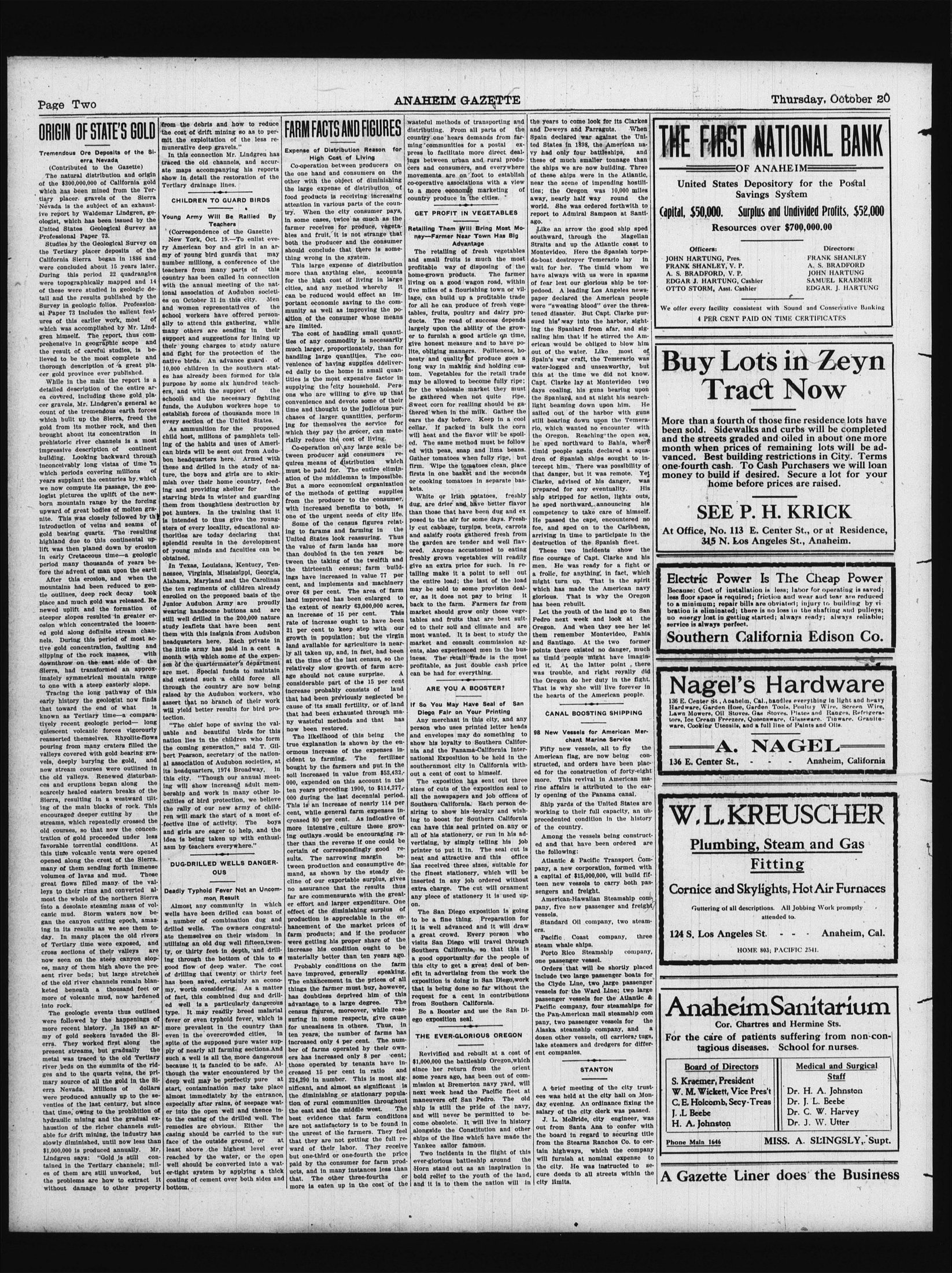
Searchable text
ORIGIN OF STATE'S GOLD
Tremendous Ore Deposits of the Sierra Nevada
(Contributed to the Gazette)
The natural distribution and origin of the $300,000,000 of California gold which has been mined from the Tertiary placer gravels of the Sierra Nevada is the subject of an exhaustive report by Waldemar Lindgren, geologist, which has been issued by the United States Geological Survey as Professional Paper 73.
Studies by the Geological Survey on the Tertiary placer deposits of the California Sierra began in 1886 and were concluded about 15 years later. During this period 22 quadrangles were topographically mapped and 14 of these were studied in geologic detail and the results published by the Survey in geologic folios. Professional Paper 73 includes the salient features of this earlier work, most of which was accomplished by Mr. Lindgren himself. The report, thus comprehensive in geographic scope and the result of careful studies, is believed to be the most complete and thorough description of a great placer gold province ever published.
While in the main the report is a detailed description of the entire area covered, including these gold placer gravels, Mr. Lindgren's general account of the tremendous earth forces which built up the Sierra, freed the gold from its mother rock, and then brought about its concentration in prehistoric river channels is a most impressive description of continent building. Looking backward through inconceivably long vistas of time in which periods covering millions of
from the debris and how to reduce the cost of drift mining so as to permit the exploitation of the less remunerative deep gravels."
In this connection Mr. Lindgren has traced the old channels, and accurate maps accompanying his reports show in detail the restoration of the Tertiary drainage lines.
CHILDREN TO GUARD BIRDS
Young Army Will Be Rallied By Teachers
(Correspondence of the Gazette)
New York, Oct. 19.—To enlist every American boy and girl in an army of young bird guards that may number millions, a conference of the teachers from many parts of this country has been called in connection with the annual meeting of the national association of Audubon societies on October 31 in this city. Men and women representatives of the school workers have offered personally to attend this gathering, while many others are sending in their support and suggestions for lining up their young charges to study nature and fight for the protection of the native birds. An advance guard of 10,000 children in the southern states has already been formed for this purpose by some six hundred teachers, and with the support of the schools and the necessary fighting funds, the Audubon workers hope to establish forces of thousands more in every section of the United States.
As ammunition for the proposed child host, millions of pamphlets telling of the habits and uses of American birds will be sent out from Audubon headquarters here. Armed with these and drilled in the study of nature, the boys and girls are to skim
FARM FACTS AND EXPENSE OF DISTRIBUTION
Co-operation between the one hand and conserve other with the object to large expense of food products is receive attention in various part try. When the city or in some cases, twice a farmer receives for plants and fruit, it is not both the producer and should conclude that thing wrong in the system.
This large expense more than anything eats for the high cost of cities, and any method can be reduced would important economic saving munity as well as imposition of the consumers are limited.
The cost of handling ties of any commodity much larger, proportion handling large quantities venience of having sued daily to the home titles is the most expensive supplying the city homes who are willing to convenience and devote time and thought to th chases of larger quan ing for themselves that which they pay the grisally reduce the cost.
Co-operation on any tween producer and o quires means of distribution must be paid for. Th
While in the main the report is a detailed description of the entire area covered, including these gold place gravels, Mr. Lindgren's general account of the tremendous earth forces which built up the Sierra, freed the gold from its mother rock, and then brought about its concentration in prehistoric river channels is a most impressive description of continent building. Looking backward through inconceivably long vistas of time in which periods covering millions of years supplant the centuries by which we now compute its passage, the geologist pictures the uplift of the newborn mountain range by the forcing upward of great bodies of molten granite. This was closely followed by the introduction of veins and seams of gold bearing quartz. The resulting highland due to this continental uplift was then planed down by erosion in early Cretaceous time—a geologic period many thousands of years before the advent of man upon the earth.
After this erosion, and when the mountains had been reduced to gentle outlines, deep rock decay took place and much gold was released. Renewed uplift and the formation of steeper slopes resulted in greater erosion which concentrated the loosened gold along definite stream channels. During this period of most active gold concentration, faulting and slipping of the rock masses, with downthrow on the east side of the Sierra, had transformed an approximately symmetrical mountain range to one with a steep easterly slope.
Tracing the long pathway of this early history the geologist now finds that toward the end of what is known as Tertiary time—a comparatively recent geologic period—long quiescent volcanic forces vigorously reasserted themselves. Rhyolite-flows pouring from many craters filled the valleys covered with gold bearing gravels, deeply burying the gold, and new stream courses were outlined in the old valleys. Renewed disturbances and eruptions began along the scarcely healed eastern breaks of the Sierra, resulting in a westward tilting of the main blocks of rock. This encouraged deeper cutting by the streams, which repeatedly crossed the old courses, so that now the concentration of gold proceeded under less favorable torrential conditions. At this time volcanic vents were opened opened along the crest of the Sierra. many of them sending forth immense volumes of lavas and mud. These great flows filled many of the valleys to their rims and converted almost the whole of the northern Sierra
As ammunition for the proposed child host, millions of pamphlets telling of the habits and uses of American birds will be sent out from Audubon headquarters here. Armed with these and drilled in the study of nature, the boys and girls are to skirmish over their home country, feeding and providing shelter for the starving birds in winter and guarding them from thoughtless destruction by pot hunters. In the training that it is intended to thus give the youngsters of every locality, educational authorities are today declaring that splendid results in the development of young minds and faculties can be obtained.
In Texas, Louisiana, Kentucky, Tennessee, Virginia, Mississippi, Georgia, Alabama, Maryland and the Carolinas the ten regiments of children already enrolled on the proposed basis of the Junior Audubon Army are proudly wearing handsome buttons and are still well drilled in the 200,000 nature study leaflets that have been sent them with this insignia from Audubon headquarters here. Each private in the little army has paid in a cent a month with which some of the expenses of the quartermaster's department are met. Special funds to maintain and extend such a child force all through the country are now being raised by the Audubon workers, who assert that no branch of their work will yield better results for bird protection.
"The chief hope of saving the valuable and beautiful birds for this nation lies in the children who form the coming generation," said T. Gilbert Pearson, secretary of the national association of Audubon societies, at its headquarters, 1974 Broadway, in this city. "Though our annual meeting will show increased adult membership and work in many other localities of bird protection, we believe the rally of our new army of children will mark the start of a most effective line of activity. The boys and girls are eager to help, and the idea is being taken up with enthusiasm by teachers everywhere."
DUG-DRILLED WELLS DANGEROUS
Deadly Typhoid Fever Not an Uncommon Result
es has already been formed for this purpose by some six hundred teachers, and with the support of the schools and the necessary fighting funds, the Audubon workers hope to establish forces of thousands more in every section of the United States.
As ammunition for the proposed child host, millions of pamphlets telling of the habits and uses of American birds will be sent out from Audubon headquarters here. Armed with these and drilled in the study of nature, the boys and girls are to skirmish over their home country, feeding and providing shelter for the starving birds in winter and guarding them from thoughtless destruction by pot hunters. In the training that it is intended to thus give the youngsters of every locality, educational authorities are today declaring that splendid results in the development of young minds and faculties can be obtained.
In Texas, Louisiana, Kentucky, Tennessee, Virginia, Mississippi, Georgia, Alabama, Maryland and the Carolinas the ten regiments of children already enrolled on the proposed basis of the Junior Audubon Army are proudly wearing handsome buttons and are still well drilled in the 200,000 nature study leaflets that have been sent them with this insignia from Audubon headquarters here. Each private in the little army has paid in a cent a month with which some of the expenses of the quartermaster's department are met. Special funds to maintain and extend such a child force all through the country are now being raised by the Audubon workers, who assert that no branch of their work will yield better results for bird protection.
"The chief hope of saving the valuable and beautiful birds for this nation lies in the children who form the coming generation," said T. Gilbert Pearson, secretary of the national association of Audubon societies, at its headquarters, 1974 Broadway, in this city. "Though our annual meeting will show increased adult membership and work in many other localities of bird protection, we believe the rally of our new army of children will mark the start of a most effective line of activity. The boys and girls are eager to help, and the idea is being taken up with enthusiasm by teachers everywhere."
Sierra, resulting in a westward cutting of the main blocks of rock. This encouraged deeper cutting by the streams, which repeatedly crossed the old courses, so that now the concentration of gold proceeded under less favorable torrential conditions. At this time volcanic vents were opened along the crest of the Sierra. many of them sending forth immense volumes of lavas and mud. These great flows filled many of the valleys to their rims and converted almost the whole of the northern Sierra into a desolate steaming mass of volcanic mud. Storm waters now began the canyon cutting epoch, amazing in its results as we see them today. In many places the old rivers of Tertiary time were exposed, and cross sections of their valleys are now seen on the steep canyon slopes, many of them high above the present river beds; but large stretches of the old river channels remain blanketed beneath a thousand feet or more of volcanic mud, now hardened into rock.
The geologic events thus outlined were followed by the happenings of more recent history. In 1849 an army of gold seekers invaded the Sierra. They worked first along the present streams, but gradually the metal was traced to the old Tertiary river beds on the summits of the ridges and to the quartz veins, the primary source of all the gold in the Sierra Nevada. Millions of dollars were produced annually up to the seventies of the last century, but since that time, owing to the prohibition of hydraulic mining and the gradual exhaustion of the richer channels suitable for drift mining, the industry has slowly diminished, until now less than $1,000,000 is produced annually. Mr. Lindgren says: "Gold is still contained in the Tertiary channels; miles of them are still unworked, but the problems are how to extract it without damage to other property
DUG-DRILLED WELLS DANGEROUS
Deadly Typhoid Fever Not an Uncommon Result
Almost any community in which wells have been drilled can boast of a number of combination dug and drilled wells. The owners congratulate themselves on their wisdom in utilizing an old dug well fifteen,twenty, or thirty feet in depth,and drilling through the bottom of this to good flow of deep water. The cost of drilling that twenty or thirty feet has been saved, certainly an economy, worth considering. As a matter of fact, this combined dug and drilled well is a particularly dangerous type. It may readily breed malarial fever or even typhoid fever,which is more prevalent in the country than even in the overcrowded cities,in spite of the supposed pure water supply of nearly all farming sections.And such a well is all the more dangerous because it is fancied to be safe.Although the water encountered by the deep well may be perfectly pure at start, contamination may take place almost immediately by the entrance, especially after rains,of seepage water into the open well and thence into the casing of the drilled well.The remedies are obvious.Either the casing should be carried to the surface of the outside ground,or at least above the highest level ever reached by the water,or the open well should be converted into a water-tight system by applying a thick coating of cement over both sides and bottom.
Probably conditions have improved,generally.The enhancement in things the farmer must has doubtless deprived advantage to a larger census figures,more suring in some respect for uneasiness in other ten years,the number increased only 4 per number of farms operated.ers has increased only those operated bythe increased 15 per cent.324,290 in number.Tnificant,and almost asthe diminishing or station of rural communities east and the middle best evidence thatare not satisfactory ifthe unrest of the farmthat they are not get ward of their laborbut one-third or one-fifthby the consumerducts,and in many ins that.The other threemore is eaten up in
FARM FACTS AND FIGURES
Expense of Distribution Reason for High Cost of Living
Co-operation between producers on the one hand and consumers on the other with the object of diminishing the large expense of distribution of food products is receiving increasing attention in various parts of the country. When the city consumer pays, in some cases, twice as much as the farmer receives for produce, vegetables and fruit, it is not strange that both the producer and the consumer should conclude that there is something wrong in the system.
This large expense of distribution more than anything else, accounts for the high cost of living in large cities, and any method whereby it can be reduced would effect an important economic saving to the community as well as improving the position of the consumer whose means are limited.
The cost of handling small quantities of any commodity is necessarily much larger, proportionately, than for handling large quantities. The convenience of having supplies delivered daily to the home in small quantities is the most expensive factor in supplying the city household. Persons who are willing to give up that convenience and devote some of their time and thought to the judicious purchases of larger quantities, performing for themselves the service for which they pay the grocer, can materially reduce the cost of living.
Co-operation on any large scale between producer and consumers requires means of distribution which must be paid for. The entire elimination methods of transporting and distributing. From all parts of the country one hears demands from farming communities for a postal express to facilitate more direct dealings between urban and rural producers and consumers, and everywhere movements are on foot to establish co-operative associations with a view to a more economic marketing of country produce in the cities.
GET PROFIT IN VEGETABLES
Retailing Them Will Bring Most Money—Farmer Near Town Has Big Advantage
The retailing of fresh vegetables and small fruits is much the most profitable way of disposing of the home-grown products. The farmer living on a good wagon road, within five miles of a flourishing town or village, can build up a profitable trade for all he can produce of fresh vegetables, fruits, poultry and dairy products. The road of success depends largely upon the ability of the grower to furnish a good article on time, give honest measure and to have polite, obliging manners. Politeness, honesty and quality of produce goes a long way in making and holding custom. Vegetables for the retail trade may be allowed to become fully ripe; for the wholesale market they must be gathered when not quite ripe. Sweet corn for realling should be gathered when in the milk. Gather the ears the day before. Keep in a cool cellar. If packed in bulk the corn will heat and the flavor will be spoiled. The same method must be followed with peas, snap and lima beans. Gather tomatoes when fully ripe, but firm. Wipe the tomatoes clean, place firsts in one basket and the seconds the years to come look for its Clarkes and Deweys and Farraguts. When Spain declared war against the United States in 1898, the American navy had only four battleships, and these of much smaller tonnage than the ships we are now building. Three of these ships were in the Atlantic, near the scene of impending hostilities; the Oregon was 10,000 miles away, nearly half way round the world. She was ordered forthwith to report to Admiral Sampson at Santiago.
Like an arrow the good ship sped southward, through the Magellan Straits and up the Atlantic coast to Montevideo. Here the Spanish torpedo-boat destroyer Temerario lay in wait for her. The timid whom we have always with us were in spasms of fear lest our glorious ship be torpedoed. A leading Los Angeles newspaper declared the American people were "sweating blood" over the threatened disaster. But Capt. Clarke pursued his way into the harbor, sighting the Spanlard from afar, and signaling him that if he stirred the American would be obliged to blow him out of the water. Like most of Spain's war craft, the Temerario was water-logged and unseaworthy, but this at the time we did not know. Capt. Clarke lay at Montevideo two days coaling, his guns bearing upon the Spanlard, and at night his searchlight beaming down upon him. He sailed out of the harbor with guns still bearing down upon the Temerario, which wanted no encounter with the Oregon. Reaching the open sea, he sped northward to Bahia, where timid people again declared a squadron of Spanish ships sought to intercept him.. There was possibility of that danger, but it was remote. Yet
titles is the most expensive factor in supplying the city household. Persons who are willing to give up that convenience and devote some of their time and thought to the judicious purchases of larger quantities, performing for themselves the service for which they pay the grocer, can materially reduce the cost of living.
Co-operation on any large scale between producer and consumers requires means of distribution which must be paid for. The entire elimination of the middleman is impossible. But a more economical organization of the methods of getting supplies from the producer to the consumer, with increased benefits to both, is one of the urgent needs of city life.
Some of the census figures relating to farams and farming in the United States look reassuring. Thus the value of farm lands has more than doubled in the ten years between the taking of the twelfth and the thirteenth census; farm buildings have increased in value 77 per cent, and implements and machinery over 68 per cent. The area of farm land improved has been enlarged to the extent of nearly 63,000,000 acres, an increase of 15 per cent. This rate of increase ought to have been 21 per cent to keep step with our growth in population; but the virgin land available for agriculture is nearly all taken up, and, in fact, had been at the time of the last census, so the relatively slow growth of farm acreage should not cause surprise. A considerable part of the 15 per cent increase probably consists of land that had been previously neglected because of its small fertility, or of land that had been exhausted through many wasteful methods and that has now been restored.
The likelihood of this being the true explanation is shown by the enormous increase of the expenses incident to farming. The fertilizer bought by the farmers and put in the soil increased in value from $53,432,000, expended on this account in the ten years preceding 1900, to $114,277,000 during the last decennial period. This is an increase of nearly 114 per cent, while general farm expenses increased 80 per cent. As indicative of more intensive culture these growing outlays would be encouraging rather than the reverse if one could be certain of correspondingly good results. The narrowing margin between production and consumptive demand, as shown by the steady decline of our exportable surplus, gives no assurance that the results thus far are commensurate with the great
are you a booster?
If So You May Have Seal of San Diego Fair on Your Printing
Any merchant in this city, and any person who uses printed letter heads and envelopes may do something to show his loyalty to Southern California and the Panama-California International Exposition to be held in the southernmost city in California without a cent of cost to himself.
The exposition has sent out three sizes of cuts of the exposition seal to all the newspapers and job offices of Southern California. Each person desiring to show his loyalty and wishing to boost for Southern California can have this seal printed on any or all of his stationery, or run in his advertising, by simply telling his job printer to put it in. The seal cut is neat and attractive and this office has received three sizes, suitable for the finest stationery, which will be inserted in any job ordered without extra charge. The cut will ornament any piece of stationery it is used upon vegetables for the retail trade may be allowed to become fully ripe; for the wholesale market they must be gathered when not quite ripe. Sweet corn for reallling should be gathered when in the milk. Gather the ears the day before. Keep in a cool cellar. If packed in bulk the corn will heat and the flavor will be spoiled. The same method must be followed with peas, snap and lima beans. Gather tomatoes when fully ripe, but firm. Wipe the tomatoes clean, place firsts in one basket and the seconds or cooking tomatoes in separate baskets.
White or Irish potatoes, freshly dug, are drier and have better flavor than those that have been dug and exposed to the air for some days. Freshly cut cabbage, turnips, beets, carrots and salsify roots gathered fresh from the garden are tender and well flavored. Anyone accustomed to eating freshly grown vegetables will readily give an extra price for such. In retailing make it a point to sell out the entire load; the last of the load may be sold to some provision dealer, as it does not pay to bring it back to the farm. Farmers far from market should grow only those vegetables and fruits that are best suited to their soil and climate and are most wanted. It is best to study the market and consult commission agents, also experienced men in the business. The retail trade is the most profitable, as just double cash price can be had for everything.
are you a booster?
If So You May Have Seal of San Diego Fair on Your Printing
Any merchant in this city, and any person who uses printed letter heads and envelopes may do something to show his loyalty to Southern California and the Panama-California International Exposition to be held in the southernmost city in California without a cent of cost to himself.
The exposition has sent out three sizes of cuts of the exposition seal to all the newspapers and job offices of Southern California. Each person desiring to show his loyalty and wishing to boost for Southern California can have this seal printed on any or all of his stationery, or run in his advertising, by simply telling his job printer to put it in. The seal cut is neat and attractive and this office has received three sizes, suitable for the finest stationery, which will be inserted in any job ordered without extra charge. The cut will ornament any piece of stationery it is used upon vegetables for the retail trade may be allowed to become fully ripe; for the wholesale market they must be gathered when not quite ripe. Sweet corn for reallling should be gathered when in the milk. Gather the ears the day before. Keep in a cool cellar. If packed in bulk the corn will heat and the flavor will be spoiled. The same method must be followed with peas, snap and lima beans. Gather tomatoes when fully ripe, but firm. Wipe the tomatoes clean, place firsts in one basket and the seconds or cooking tomatoes in separate baskets.
White or Irish potatoes, freshly dug, are drier and have better flavor than those that have been dug and exposed to the air for some days. Freshly cut cabbage, turnips, beets, carrots and salsify roots gathered fresh from the garden are tender and well flavored. Anyone accustomed to eating freshly grown vegetables will readily give an extra price for such. In retailing make it a point to sell out the entire load; the last of the load may be sold to some provision dealer, as it does not pay to bring it back to the farm. Farmers far from market should grow only those vegetables and fruits that are best suited to their soil and climate and are most wanted. It is best to study the market and consult commission agents, also experienced men in the business. The retail trade is the most profitable, as just double cash price can be had for everything.
ARE YOU A BOOSTER?
If So You May Have Seal of San Diego Fair on Your Printing
Any merchant in this city, and any person who uses printed letter heads and envelopes may do something to show his loyalty to Southern California and the Panama-California International Exposition to be held in the southernmost city in California without a cent of cost to himself.
The exposition has sent out three sizes of cuts of the exposition seal to all the newspapers and job offices of Southern California. Each person desiring to show his loyalty and wishing to boost for Southern California can have this seal printed on any or all of his stationery, or run in his advertising, by simply telling his job printer to put it in. The seal cut is neat and attractive and this office has received three sizes, suitable for the finest stationery, which will be inserted in any job ordered without extra charge. The cut will ornament any piece of stationery it is used upon vegetables for the retail trade may be allowed to become fully ripe; for the wholesale market they must be gathered when not quite ripe. Sweet corn for reallling should be gathered when in the milk. Gather the ears the day before. Keep in a cool cellar. If packed in bulk the corn will heat and the flavor will be spoiled. The same method must be followed with peas, snap and lima beans. Gather tomatoes when fully ripe, but firm. Wipe the tomatoes clean, place firsts in one basket and the seconds or cooking tomatoes in separate baskets.
White or Irish potatoes, freshly dug, are drier and have better flavor than those that have been dug and exposed to the air for some days. Freshly cut cabbage, turnips, beets, carrots and salsify roots gathered fresh from the garden are tender and well flavored. Anyone accustomed to eating freshly grown vegetables will readily give an extra price for such. In retailing make it a point to sell out the entire load; the last of the load may be sold to some provision dealer, as it does not pay to bring it back to the farm. Farmers far from market should grow only those vegetables and fruits that are best suited to their soil and climate and are most wanted. It is best to study the market and consult commission agents, also experienced men in the business. The retail trade is the most profitable, as just double cash price can be had for everything.
CANAL BOOSTING SHIPPING
98 New Vessels for American Merchant Marine Service
Fifty new vessels, all to fly American flag, are now being constructed, and orders have been placed for the construction of forty-eight more. This revival in American marine affairs is attributed to the early opening of the Panama canal.
Ship yards of United States are working to their full capacity, an unprecedented condition in the history of the country.
Among the vessels being constructed and that have been ordered are the following:
Atlantic & Pacific Transport Company, a new corporation, formed with a capital of $15,000,000, will build fifteen new vessels to carry both passengers and freight.
American-Hawaiian Steamship company
This is an increase of nearly 114 per cent, while general farm expenses increased 80 per cent. As indicative of more intensive culture these growing outlays would be encouraging rather than the reverse if one could be certain of correspondingly good results. The narrowing margin between production and consumptive demand, as shown by the steady decline of our exportable surplus, gives no assurance that the results thus far are commensurate with the greater effort and larger expenditure. One effect of the diminishing surplus of production is appreciable in the enhancement of the market prices of farm products; and if the producer were getting his proper share of the increase his condition ought to be materially better than ten years ago.
Probably conditions on the farm have improved, generally speaking. The enhancement in the prices of all things the farmer must buy, however, has doubtless deprived him of this advantage to a large degree. The census figures, moreover, while reassuring in some respects, give cause for uneasiness in others. Thus, in ten years, the number of farms has increased only 4 per cent. The number of farms operated by their owners has increased only 8 per cent; those operated by tenants have increased 15 per cent in ratio and 324,290 in number. This is most significant, and almost as significant is the diminishing or stationary population of rural communities throughout the east and the middle west. The best evidence that farm conditions are not satisfactory is to be found in the unrest of the farmers. They feel that they are not getting the full reward of their labor. They receive but one-third or one-fourth the price paid by the consumer for farm products, and in many instances less than that. The other three-fourths or more is eaten up in the cost of the Southern California. Each person desiring to show his loyalty and wishing to boost for Southern California can have this seal printed on any or all of his stationery, or run in his advertising, by simply telling his job printer to put it in. The seal cut is neat and attractive and this office has received three sizes, suitable for the finest stationery, which will be inserted in any job ordered without extra charge. The cut will ornament any piece of stationery it is used upon.
The San Diego exposition is going to be a fine thing. Preparation for it is well advanced and it will draw a great crowd. Every person who visits San Diego will travel through Southern California, so that this is a good opportunity for the people of this city to get a great deal of benefit in advertising from the work the exposition is doing in San Diego, work that is being done so far without the request for a cent in contributions from Southern California.
Be a Booster and use the San Diego exposition seal.
THE EVER-GLORIOUS OREGON
Revivified and rebuilt at a cost of $1,000,000 the battleship Oregon, which since her return from the orient some years ago, has been out of commission at Bremerton navy yard, will next week head the Pacific fleet at maneuvers off San Pedro. The old ship is still the pride of the navy, and will never be permitted to become obsolete. It will live in history alongside the Constitution and other ships of the line which have made the Yankee sailor famous.
Two incidents in the flight of this ever-glorious battleship around the Horn stand out as an inspiration in bold relief to the youth of the land, and it is to them the nation will in Ship yards of the United States are working to their full capacity, an unprecedented condition in the history of the country.
Among the vessels being constructed and that have been ordered are the following:
Atlantic & Pacific Transport Company, a new corporation, formed with a capital of $15,000,000, will build fifteen new vessels to carry both passengers and freight.
American-Hawaiian Steamship company, five new passenger and freight vessels.
Standard Oil company, two steamers.
Pacific Coast company, three steam whale ships.
Porto Rico Steamship company, one passenger vessel.
Orders that will be shortly placed include two large passenger boats for the Clyde Line, two large passenger vessels for the Ward Line; two large passenger vessels for the Atlantic & Pacific company, four steamships for the Pan-American mail steamship company, two passenger vessels for the Alaska steamship company, and a dozen other vessels, oil carriers; tugs, lake steamers and dredgers for different companies.
STANTON
A brief meeting of the city trustees was held at the city hall on Monday evening. An ordinance fixing the salary of the city clerk was passed.
J. L. McBride, city engineer, was out from Santa Ana to confer with the board in regard to securing title from the Stearns Ranchos Co. to certain highways, which the company will furnish at nominal expense to the city. He was instructed to secure deeds to all streets within the city limits.
Thursday, October 20
THE FIRST NATIONAL BANK
OF ANAHEIM
United States Depository for the Postal Savings System
Capital, $50,000. Surplus and Undivided Profits, $52,000
Resources over $700,000.00
Officers:
JOHN HARTUNG, Pres.
FRANK SHANLEY
FRANK SHANLEY, V. P.
A. S. BRADFORD
A. S. BRADFORD, V. P.
EDGAR J. HARTUNG, Cashier
SAMUEL KRAEMER
OTTO STORM, Asst. Cashier
EDGAR. J. HARTUNG
We offer every facility consistent with Sound and Conservative Banking
4 PER CENT PAID ON TIME CERTIFICATES
Buy Lots in Zeyn Tract Now
More than a fourth of those fine residence lots have been sold. Sidewalks and curbs will be completed and the streets graded and oiled in about one more month when prices of remaining lots will be advanced. Best building restrictions in City. Terms one-fourth cash. To Cash Purchasers we will loan money to build if desired. Secure a lot for your
Tract Now
More than a fourth of those fine residence lots have been sold. Sidewalks and curbs will be completed and the streets graded and oiled in about one more month when prices of remaining lots will be advanced. Best building restrictions in City. Terms one-fourth cash. To Cash Purchasers we will loan money to build if desired. Secure a lot for your home before prices are raised.
SEE P. H. KRICK
At Office, No. 113 E. Center St., or at Residence,
315 N. Los Angeles St., Anaheim.
Electric Power Is The Cheap Power
Because: Cost of installation is less; labor for operating is saved;
less floor space is required; friction and wear and tear are reduced
to a minimum; repair bills are obviated; injury to building by vibration is eliminated; there is no loss in the shafting and pulleys;
no energy lost in getting started; always ready; always reliable;
service is always perfect.
Southern California Edison Co.
Nagel's Hardware
136 E. Center St., Anaheim, Cal., handles everything in light and heavy
Hardware, Garden Hose, Garden Tools, Poultry Wire, Screen Wire,
Lawn Mowers, Oil Stoves, Gas Stoves, Plates and Ranges, Refrigerators,
Ice Cream Freezers, Queensware, Glassware, Tinware, Graniteware, Cooking Utensils, and a full line of Palnts and Olls.
A. NAGEL
136 E. Center St., - - Anaheim, California
W.L.KREUSCHER
Plumbing, Steam and Gas
Fitting
Cornice and Skylights, Hot Air Furnaces
W.L.KREUSCHER
Plumbing, Steam and Gas
Fitting
Cornice and Skylights, Hot Air Furnaces
Guttering of all descriptions. All Jobbing Work promptly attended to.
124 S. Los Angeles St. - Anaheim, Cal.
HOME 803; PACIFIC 2541.
AnaheimSanitarium
Cor. Chartres and Hermine Sts.
For the care of patients suffering from non-contagious diseases. School for nurses.
Board of Directors
S. Kraemer, President
W. M. Wickett, Vice Pres't
C.E. Holcomb, Secy-Treas
J. .L Beebe
H. A. Johnston
Medical and Surgical
Staff
Dr. H. A. Johnston
Dr. J. L. Beebe
Dr. C. W. Harvey
Dr. J. W. Utter
Phone Main 1646
MISS. A. SLINGSLY., Supt.
A Gazette Liner does the Business