anaheim-gazette 1911-10-19
Scanned page
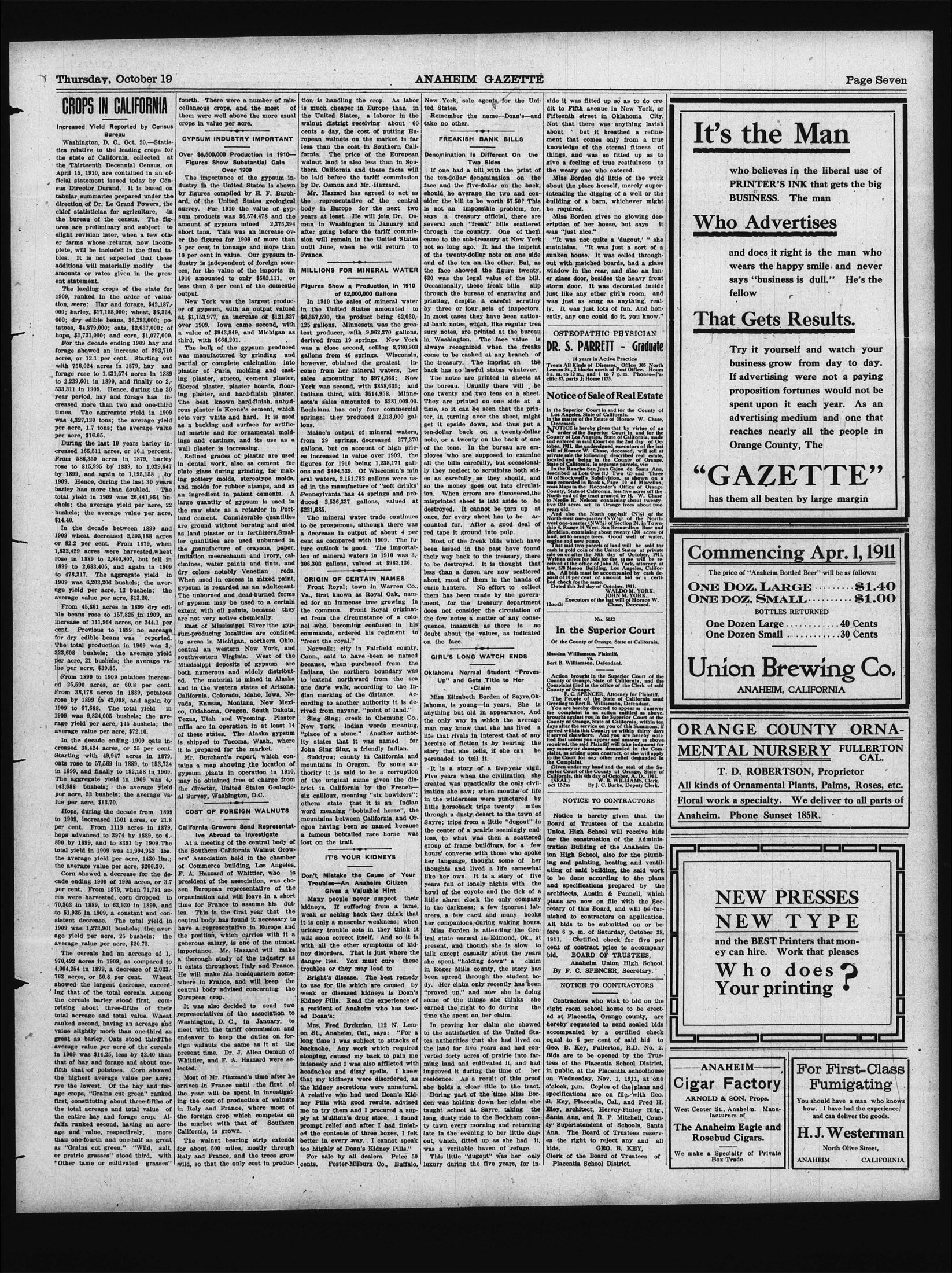
Searchable text
CROPS IN CALIFORNIA
Increased Yield Reported by Census Bureau
Washington, D. C., Oct. 20.—Statistics relative to the leading crops for the state of California, collected at the Thirteenth Decennial Census, on April 15, 1910, are contained in an official statement issued today by Census Director Durand. It is based on tabular summaries prepared under the direction of Dr. Le Grand Powers, the chief statistician for agriculture, in the bureau of the census. The figures are preliminary and subject to slight revision later, when a few other farms whose returns, now incomplete, will be included in the final tables. It is not expected that these additions will materially modify the amounts or rates given in the present statement.
The leading crops of the state for 1909, ranked in the order of valuation, were: Hay and forage, $42,187,000; barley, $17,185,000; wheat, $6,324,000; dry edible beans, $6,293,000; potatoes, $4,879,000; oats, $2,637,000; of hops, $1,731,000; and corn, $1,077,000.
For the decade ending 1909 hay and forage showed an increase of 293,710 acres, or 13.1 per cent. Starting out with 758,024 acres in 1879, hay and forage rose to 1,431,574 acres in 1889 to 2,239,601 in 1899, and finally to 2,533,311 in 1909. Hence, during the 30 year period, hay and forage has increased more than two and one-third times. The aggregate yield in 1909 was 4,327,130 tons; the average yield per acre, 1.7 tons; the average value per acre, $16.65.
During the last 10 years barley increased 165,511 acres, or 16.1 percent. From 586,350 acres in 1879, barley rose to 815,995 by 1889, to 1,029,647 by 1899, and again to 1,195,158 by fourth. There were a number of miscellaneous crops, and the most of them were well above the more usual crops in value per acre.
GYPSUM INDUSTRY IMPORTANT
Over $6,500,000 Production in 1910—Figures Show Substantial Gain Over 1909
The importance of the gypsum industry in the United States is shown by figures compiled by E. F. Burchard, of the United States geological survey. For 1910 the value of gypsum products was $6,574,478 and the amount of gypsum mined 2,375,394 short tons. This was an increase over the figures for 1909 of more than 5 per cent in tonnage and more than 10 per cent in value. Our gypsum industry is independent of foreign sources, for the value of the imports in 1910 amounted to only $502,111, or less than 8 per cent of the domestic output.
New York was the largest producer of gypsum, with an output valued at $1,153,977, an increase of $121,327 over 1909. Iowa came second, with a value of $943,849, and Michigan as third, with $668,201.
The bulk of the gypsum produced was manufactured by grinding and partial or complete calcination into plaster of Paris, molding and casting plaster, stucco, cement plaster, fibered plaster, plaster boards, flooring plaster, and hard-finish plaster. The best known hard-finish, anhydrous plaster is Keene's cement, which sets very white and hard. It is used as a backing and surface for artificial marble and for ornamental moldings and castings, and its use as a wall plaster is increasing.
Refined grades of plaster are used in dental work, also as cement for plate glass during grinding, for making handling is much cheaper than the United States walnut district reprints a day; the European walnuts are less than the cost of California. The price walnut land is also northern California can be laid before the by Dr. Osmun and Mr. Hazzard has represented body in Europe many years at least. Hum in Washington after going before session will remain until June; when France.
MILLIONS FOR FIGURES SHOW A OF 62,000
In 1910 the sales in the United States $6,357,590; the prices 125 gallons. Minimum test producer; will derived from 19 was a close second gallons from 46 however obtained come from her sales amounting York was second Indiana third; with soota's sales amount Louisiana has one springs; they pro lions.
Maine's output from 29 springs gallons but on an increase in figures for 1910 tons and $404,539.
During the last 10 years barley increased 165,511 acres, or 16.1 percent. From 586,350 acres in 1879, barley rose to 815,995 by 1889, to 1,029,647 by 1899, and again to 1,195,158 by 1909. Hence, during the last 30 years barley has more than doubled. The total yield in 1909 was 26,441,954 bushels; the average yield per acre, 22 bushels; the average value per acre, $14.40.
In the decade between 1899 and 1909 wheat decreased 2,205,188 acres or 82.2 per cent. From 1879, when 1,832,429 acres were harvested, wheat rose in 1889 to 2,840,807, but fell in 1899 to 2,683,405, and again in 1909 to 478,217. The aggregate yield in 1909 was 6,203,206 bushels; the average yield per acre, 13 bushels; the average value per acre, $13.20.
From 45,861 acres in 1899 dry edible beans rose to 157,825 in 1909, an increase of 111,964 acres, or 244.1 per cent. Previous to 1899 no acreage for dry edible beans was reported. The total production in 1909 was 3,323,608 bushels; the average yield per acre, 21 bushels; the average value per acre, $39.85.
From 1899 to 1909 potatoes increased 25,590 acres, or 60.8 per cent. From 38,178 acres in 1889, potatoes rose by 1899 to 42,098, and again by 1909 to 67,688. The total yield in 1909 was 9,824,005 bushels; the average yield per acre, 145 bushels; the average value per acre, $72.10.
In the decade ending 1909 oats increased 38,424 acres, or 25 per cent. Starting with 49,947 acres in 1879, oats rose to 57,569 in 1889, to 153,734 in 1899, and finally to 192,158 in 1909. The aggregate yield in 1909 was 4,143,688 bushels; the average yield per acre, 22 bushels; the average value per acre, $13.70.
Hops, during the decade from 1899 to 1909, increased 1501 acres, or 21.8 per cent. From 1119 acres in 1879, hops advanced to 3974 by 1889, to 6,890 by 1899, and to 8391 by 1909.The total yield in 1909 was 11,994,953 lbs. the average yield per acre, 1430 lbs.; the average value per acre, $206.30.
Corn showed a decrease for the decade ending 1909 of 1995 acres, or 3.7 per cent. From 1879, when 71,781 acres were harvested, corn dropped to
Refined grades of plaster are used in dental work, also as cement for plate glass during grinding; for making pottery molds, stereotype molds, and molds for rubber stamps, and as an ingredient in patent cements. A large quantity of gypsum is used in the raw state as a retarder in Portland cement. Considerable quantities are ground without burning and used as land plaster or in fertilizers.Smaller quantities are used unburned in the manufacture of crayons, paper, imitation meerschaum and ivory; calcimines, water paints and tints; and dry colors notably Venetian reds. When used in excess in mixed paint, gypsum is regarded as an adulterant. The unburned and dead-burned forms of gypsum may be used to a certain extent with oil paints because they are not very active chemically.
East of Mississippi River the gypsum-producing localities are confined to areas in Michigan, northern Ohio central an western New York,and southwestern Virginia.West of the Mississippi deposits of gypsum are both numerous and widely distributed.The material is mined in Alaska and in the western states of Arizona California Colorado Idaho Iowa Nevada Kansas Montana New Mexico Oklahoma Oregon South Dakota Texas Utah and Wyoming.Plaster mills are in operation in at least 14 of these states.The Alaska gypsum is shipped to Tacoma Wash., where it is prepared for the market.
Mr. Burchard's report which contains a map showing the location of gypsum plants in operation in 1910,may be obtained free of charge from the director United States Geological Survey Washington,D.C.
COST OF FOREIGN WALNUTS
California Growers Send Representative Abroad to Investigate
At a meeting of the central body of the Southern California Walnut Growers' Association held in the chamber of Commerce building Los Angeles,F.A.Hazzard of Whittier who is president of the association was chosen European representative of the organization and will leave in a short plaster, stucco,cement plaster,fiberated plaster,plaster boards,floor-plaster,and hard-finish plaster.The best known hard-finish,anhydrous plaster is Keene's cementwhich sets very white and hard.It is used as a backing and surface for artificial marble and for ornamental moldings and castings,and its use as a wall plaster is increasing.
Don't Mistake the Troubles—An A Gives a V Many people m
Hops, during the decade from 1899 to 1909, increased 1501 acres, or 21.8 per cent. From 1119 acres in 1879, hops advanced to 3974 by 1889, to 6;890 by 1899, and to 8391 by 1909.The total yield in 1909 was 11,994,953 lbs. the average yield per acre, 1430 lbs.; the average value per acre, $206.30.
Corn showed a decrease for the decade ending 1909 of 1995 acres, or 3.7 per cent. From 1879, when 71,781 acres were harvested, corn dropped to 70,303 in 1889, to 63,930 in 1899, and to 51,935 in 1909, a constant and consistent decrease. The total yield in 1909 was 1,273,901 bushels; the average yield per acre, 25 bushels; the average value per acre, $20.75.
The cereals had an acreage of 1,970,492 acres in 1909, as compared to 4,004,254 in 1899, a decrease of 2,033,762 acres, or 50.8 per cent. Wheat showed the largest decrease, exceeding that of the total cereals. Among the cereals barley stood first, comprising about three-fifths of their total acreage and total value. Wheat ranked second, having an acreage and value slightly more than one-third as great as barley. Oats stood third.The average value per acre of the cereals in 1909 was $14.25, less by $2.40 than that of hay and forage and about one-fifth that of potatoes. Corn showed the highest average value per acre; rye the lowest. Of the hay and forage crops,"Grains cut green" ranked first, constituting about three-fifths of the total acreage and total value of the entire hay and forage crop. Alfalfa ranked second, having an acreage and value, respectively, more than one-fourth and one-half as great as "Grains cut green." "Wild, salt, or prairie grasses" stood third, with "Other tame or cultivated grasses"
COST OF FOREIGN WALNUTS
California Growers Send Representative Abroad to Investigate
At a meeting of the central body of the Southern California Walnut Growers' Association held in the chamber of Commerce building, Los Angeles, F. A. Hazzard of Whittier, who is president of the association, was chosen European representative of the organization and will leave in a short time for France to assume his duties. This is the first year that the central body has found it necessary to have a representative in Europe and the position which carries with it a generous salary, is one of the utmost importance. Mr. Hazzard will make a thorough study of the industry as it exists throughout Italy and France. He will make his headquarters somewhere in France, and will keep the central body advised concerning the European crop.
It was also decided to send two representatives of the association to Washington, D.C., in January, to meet with the tariff commission and endeavor to keep the duties on foreign walnuts the same as it at the present time. Dr. J. Allen Osmun of Whittier, and F. A. Hazzard were selected.
Most of Mr. Hazzard's time after he arrives in France until the first of the year will be spent investigating the cost of production of walnuts in Italy and France, where most of the foreign crop which competes on the market with that of Southern California, is grown.
The walnut bearing strip extends for about 500 miles, mostly through Italy and France, and the trees grow wild, so that the only cost in produc-
ANAHEIM GAZETTE
tion is handling the crop. As labor is much cheaper in Europe than in the United States, a laborer in the walnut district receiving about 60 cents a day, the cost of putting European walnuts on the market is far less than the cost in Southern California. The price of the European walnut land is also less than in Southern California and these facts will be laid before the tariff commission by Dr. Osmun and Mr. Hazzard.
Mr. Hazzard has agreed to act as the representative of the central body in Europe for the next two years at least. He will join Dr. Osmun in Washington in January and after going before the tariff commission will remain in the United States until June, when he will return to France.
MILLIONS FOR MINERAL WATER
Figures Show a Production in 1910 of 62,000,000 Gallons
In 1910 the sales of mineral water in the United States amounted to $6,357,590, the product being 62,030,-125 gallons. Minnesota was the greatest producer, with 9,962,370 gallons, derived from 19 springs. New York was a close second, selling 8,780,903 gallons from 46 springs. Wisconsin, however, obtained the greatest income from her mineral waters, her sales amounting to $974,366; New York was second, with $858,635; and Indiana third, with $514,958. Minnesota's sales amounted to $281,009.00. Louisiana has only four commercial springs; they produced 2,313,000 gallons.
Maine's output of mineral waters, from 29 springs, decreased 277,370 gallons, but on account of high prices increased in value over 1909, the figures for 1910 being 1,238,171 gallons and $404,539. Of Wisconsin's min
New York, sole agents for the United States.
Remember the name—Doan's—and take no other.
FREAKISH BANK BILLS
Denomination Is Different On the Two Sides
If one had a bill with the print of the ten-dollar denomination on the face and the five-dollar on the back, should he average the two and consider the bill to be worth $7.50? This is not an impossible problem, for says a treasury official, there are several such "freak" bills scattered through the country. One of them came to the sub-treasury at New York not so long ago. It had the imprint of the twenty-dollar note on one side and of the ten on the other. But, as the face showed the figure twenty,$20 was the legal value of the bill. Occasionally, these freak bills slip through the bureau of engraving and printing, despite a careful scrutiny by three or four sets of inspectors.
In most cases they have been national bank notes, which, like regular treasury notes, are printed at the bureau in Washington. The face value is always recognized when the freaks come to be cashed at any branch of the treasury. The imprint on the back has no lawful status whatever.
The notes are printed in sheets at the bureau. Usually there will be one twenty and two tens on a sheet. They are printed on one side at a time, so it can be seen that the printer, in turning over the sheet, might get it upside down, and thus put a ten-dollar back on a twenty-dollar note, or a twenty on the back of one of the tens. In the bureau are employees who are supposed to examine all the bills carefully, but occasionally they neglect to scrutinize both sides it was fitted up so as to do credit to Fifth avenue in New York, or Fifteenth street in Oklahoma City. Not that there was anything lavish about but it breathed a refinement that comes only from a true knowledge of the eternal fitness of things, and was so fitted up as to give a feeling of true restfulness to the weary one who entered.
Miss Borden did little of the work about the place herself, merely superintending the digging of a well or the building of a barn, whichever might be required.
Miss Borden gives no glowing description of her house, but says it was "just nice."
"It was not quite a 'dugout,'" she maintains. "It was just a sort of a sunken house. It was celled throughout with matched boards, had a glass window in the rear, and also an inner glass door, besides the heavy front storm door. It was decorated inside just like any other girl's room, and was just as snug as anything, really. It was just lots of fun. And honestly, any one could do it, you know."
OSTEOPATHIC PHYSICIAN
DR. S. PARRETT - Graduate
14 years in Active Practice
Treats All Kinds of Diseases. Office 305 North Lemon St., 2 blocks north of Post Office. Hours 8 a.m. to 12 m., and 1 to 7 p.m. Phones—Pacific 87, party J; Home 1173.
Notice of Sale of Real Estate
In the Superior Court in and for the County of Los Angeles, State of California.
In the matter of the Estate of Horace W. Chase,
Deceased.
NOTICE is hereby given that by virtue of an order of the Superior Court in and for the County of Los Angeles, State of California, made and entered in said Court on the 2nd day of October, 1911, the undersigned executors of the last will of Horace W. Chase, deceased, will sell at private sale the following described real estate, located and being in the County of Orange State of California, in separate parcels, viz:
In the Rancho San Juan Cajon de Santa Ana, described as Lots One (L.) Two (2) and Three
NOTICE OF SALE OF REAL ESTATE
In the Superior Court in and for the County of Los Angeles, State of California.
In the matter of the Estate of Horace W. Chase,
Decessed.
NOTICE is hereby given that by virtue of an order of the Superior Court in and for the County of Los Angeles, State of California, made and entered in said Court on the 2nd day of October, 1911, the undersigned executors of the last will of Horace W. Chase, deceased, will sell at private sale the following described real estate, located and being in the County of Orange, State of California, in separate parcels, viz:
In the Rancho San Juan Cajon de Santa Ana, described as Lots One (1.) Two (2) and Three (3) of Stockwell's Subdivision, as shown on a map recorded in Book 6, Page 10 of Miscellanea; eous Maps in the Recorder's Office of Orange County, State of California, less five acres off the North end of the tract granted by H. W. Chase to Neelie H. Nelson; containing about twenty-five (25) acres set to Orange trees about two years old.
And also the North one-half (N/4) of the North-west one-quarter (NW/4) of the Northwest one-quarter (NW/4) of Section 24, in Township 4, Range 14 West, San Bernardino Base and Meridian, containing about twenty (20) acres of land, set to orange trees. Good well of water, engine and new pump.
That said two parcels of land will be sold for cash in gold coin of the United States at private sale on or after the 30th day of October, 1911. Written offers for bids for the same will be received at the office of John M. York, attorney at law, 528 Mason Building, Los Angeles, California. All bids must be accompanied by cash deposit of 10 per cent of amount bid or a certified check for the same.
Dated this 3rd day of October, 1911.
WALDO M. YORK,
JOHN M. YORK,
Executors of the last will of Horace W. Chase, Decased.
No. 5032
In the Superior Court
Of the County of Orange, State of California.
Maudna Williamson, Plaintiff,
Bert B. Williamson, Defendant.
Action brought in the Superior Court of the County of Orange, State of California, and the Complaint filed in the office of the Clerk of said County of Orange.
F. C. SPENCER, Attorney for Plaintiff.
The People of the State of California send Greeting to Bert B. Williamson, Defendant.
You are hereby directed to appear at answer the complaint in an action entitled as above, brought against you in the Superior Court of the County of Orange, State of California, within ten days after the service on you of this Summons, if served within this County; or within thirty days if served elsewhere. And you are hereby notified that unless you appear and answer as above required, the said Plaintiff will take judgment for any money or damages demanded in the Complaint, as arising upon contract, or she will apply to the Court for any other relief demanded in the Complaint.
Given under my hand and the seal of the Superior Court of the County of Orange, State of California, this 4th day of October, A.D. 1911.
[SEAL]
W. B. WILLIAMS, Clerk.
oct 12-2m
By J. C. Burke, Deputy Clerk.
NOTICE TO CONTRACTORS
Notice is hereby given that the Board of Trustees of the Anaheim Union High School will receive bids for the construction of the Administration Building of the Anaheim Union High School, also for the plumbing and painting, heating and ventilating of said building, the said work to be done according to the plans and specifications prepared by the architects, Austin & Pennell, which sales amounting to $974,366; New York was second, with $858,635; and Indiana third, with $514,958. Minnesota's sales amounted to $281,009.00. Louisiana has only four commercial springs; they produced 2,313,000 gallons.
Maine's output of mineral waters, from 29 springs, decreased 277,370 gallons, but on account of high prices increased in value over 1909, the figures for 1910 being 1,238,171 gallons and $404,539. Of Wisconsin's mineral waters, 2,151,782 gallons were used in the manufacture of "soft drinks" Pennsylvania has 44 springs and produced 2,536,337 gallons, valued at $221,685.
The mineral water trade continues to be prosperous, although there was a decrease in output of about 4 percent as compared with 1909. The future outlook is good. The importation of mineral waters in 1910 was 3:306,303 gallons, valued at $983,136.
ORIGIN OF CERTAIN NAMES
Front Royal; town in Warren Co., Va., first known as Royal Oak, named for an immense tree growing in the common. Front Royal originated from the circumstance of a colonel who, becoming confused in his commands, ordered his regiment to "front the royal."
Norwalk; city in Fairfield county, Conn., said to have been so named because when purchased from Indians, the northern boundary was to extend northward from the sea one day's walk, according to Indian marking of the distance. According to another authority it is derived from nayang, "point of land."
Sing Sing; creek in Chemung Co., New York. Indian words meaning "place of a stone." Another authority states that it was named for John Sing Sing, a friendly Indian.
Siskiyou; county in California and mountains in Oregon. By some authority it is said to be a corruption of the original name given the district in California by the French—six calloux; meaning "six bowlders"; others state that it is an Indian word meaning "bobtailed horse", the mountains between California and Oregon having been so named because a famous bobtailed race horse was lost on the trail.
IT'S YOUR KIDNEYS
Don't Mistake the Cause of Your Troubles—An Anaheim Citizen Gives a Valuable Hint
Many people never suspect their notes are printed in sheets at the bureau. Usually there will be one twenty and two tens on a sheet. They are printed on one side at a time, so it can be seen that the printer in turning over the sheet might get it upside down, and thus put a ten-dollar back on a twenty-dollar note, or a twenty on the back of one of the tens. In the bureau are employees who are supposed to examine all the bills carefully, but occasionally they neglect to scrutinize both sides as carefully as they should, and so the money goes out into circulation. When errors are discovered,the misprinted sheet is laid aside to be destroyed. It cannot be torn up at once, for every sheet has to be accounted for. After a good deal of red tape it ground into pulp.
Most of the freak bills which have been issued in the past have found their way back to the treasury; there to be destroyed. It is thought that less than a dozen are now scattered about most of them in the hands of curio hunters. No effort to collect them has been made by the government; for the treasury department does not consider the circulation of the few notes a matter of any consequence; inasmuch as there is no doubt about the values, as indicated on the face.
GIRL'S LONG WATCH ENDS
Oklahoma Normal Student "Proves Up" and Gets Title to Her Claim
Miss Elizabeth Borden of Sayre Oklahoma is young—in years. She is anything but old in appearance. And the only way in which the average man may know that she has lived a life that rivals in interest that of any heroine of fiction is by hearing the story that she tells; if she can be persuaded to tell it.
It is a story of a five-year vigil. Five years when the civilization she created was practically the only civilization she saw; when months of life in the wilderness were punctured by little horseback trips twenty miles through a dusty desert to the town of Sayre; trips from a little "dugout" in the center of a prairie seemingly endless; to what was then a scattered group of frame buildings; for a few hours' converse with those who spoke her language; thought some of her thoughts and lived a life somewhat like her own. It is a story of five years full of lonely nights with the howl of coyote and the tick of a little alarm clock on the only company...
IT'S YOUR KIDNEYS
Don't Mistake the Cause of Your Troubles—An Anaheim Citizen Gives a Valuable Hint
Many people never suspect their kidneys. If suffering from a lame, weak or aching back they think that it is only a muscular weakness; when urinary trouble sets in they think it will soon correct itself. And so it is with all the other symptoms of kidney disorders. That is just where the danger lies. You must cure these troubles or they may lead to.
Bright's disease. The best remedy to use for ills which are caused by weak or diseased kidneys is Doan's Kidney Pills. Read the experience of a resident of Anaheim who has tested Doan's:
Mrs. Fred Dyckman, 112 N. Lemon St., Anaheim, Cal., says: "For a long time I was subject to attacks of backache. Any work which required stooping, caused my back to pain me intensely and I was also afflicted with headaches and dizzy spells. I knew that my kidneys were disordered, as the kidney secretions were unnatural. A relative who had used Doan's Kidney Pills with good results, advised me to try them and I procured a supply at Mullinix's drug store. I found prompt relief and after I had finished the contents of three boxes, I felt better in every way. I cannot speak too highly of Doan's Kidney Pills."
For sale by all dealers. Price 50 cents. Foster-Milburn Co., Buffalo,
In proving her claim she showed to the satisfaction of the United States authorities that she had lived on the land for five years and had converted forty acres of prairie into farming land and cultivated it, and had improved it during the time of her residence. As a result of this proof she holds a clear title to the tract.
During part of the time Miss Borden was holding down her claim she taught school at Sayre, taking the long, dusty ride to the Beckham county town every morning and returning late in the evening to her little dugout, which, fitted up as she had it, was a veritable haven of refuge.
This little "dugout" was her only luxury during the five years, for in the wilderness were punctured by little horseback trips twenty miles through a dusty desert to the town of Sayre; trips from a little "dugout" in the center of a prairie seemingly endless, to what was then a scattered group of frame buildings, for a few hours' converse with those who spoke her language, thought some of her thoughts and lived a life somewhat like her own. It is a story of five years full of lonely nights with the howl of the coyote and the tick of a little alarm clock the only company in the darkness; a few ignorant laborers, a few cacti and many books her companions during waking hours.
Miss Borden is attending the Central state normal in Edmond, Ok., at present, and though she is slow to talk except casually about the years she spent "holding down" a claim in Roger Mills county, the story has been spread through the student body. Her claim only recently has been "proved up," and now she is doing some of the things she thinks she earned the right to do during the time she spent on her claim.
Contractors who wish to bid on the eight room school house to be erected at Placentia, Orange county, are hereby requested to send sealed bids accompanied by a certified check equal to 5 per cent of said bid to Geo. B. Key, Fullerton, R.D. No. 2. Bids are to be opened by the Trustees of the Placentia School District, in public, at the Placentia schoolhouse on Wednesday, Nov. 1, 1911, at one o'clock, p.m. Copies of the plans and specifications are on file with Geo. B. Key, Placentia, Cal., and Fred H. Eley, architect, Hervey-Finley Bldg., Santa Ana, and R. P. Mitchell, County Superintendent of Schools, Santa Ana. The Board of Trustees reserves the right to reject any and all bids.
GEO. B. KEY,
Clerk of the Board of Trustees of Placentia School District.
It’s the Man
who believes in the liberal use of PRINTER’S INK that gets the big BUSINESS. The man
Who Advertises
and does it right is the man who wears the happy smile and never says “business is dull.” He’s the fellow
That Gets Results.
Try it yourself and watch your business grow from day to day. If advertising were not a paying proposition fortunes would not be spent upon it each year. As an advertising medium and one that reaches nearly all the people in Orange County, The
“CAZETTE”
If advertising were not a paying proposition fortunes would not be spent upon it each year. As an advertising medium and one that reaches nearly all the people in Orange County, The
"GAZETTE"
has them all beaten by large margin
Commencing Apr. 1, 1911
The price of "Anaheim Bottled Beer" will be as follows:
ONE DOZ. LARGE $1.40
ONE DOZ. SMALL $1.00
BOTTLES RETURNED
One Dozen Large 40 Cents
One Dozen Small 30 Cents
Union Brewing Co,
ANAHEIM, CALIFORNIA
ORANGE COUNTY ORNA-MENTAL NURSERY FULLERTON CAL.
T. D. ROBERTSON, Proprietor
All kinds of Ornamental Plants, Palms, Roses, etc.
Floral work a specialty. We deliver to all parts of Anaheim. Phone Sunset 185R.
NEW PRESSES
NEW TYPE
and the BEST Printers that money can hire. Work that pleases
Who does Your printing?
ANAHEIM,
Cigar Factory
ARNOLD & SON, Props.
West Center St., Anaheim. Manufacturers of
The Anaheim Eagle and Rosebud Cigars.
We make a Specialty of Private Box Trade.
For First-Class Fumigating
You should have a man who knows how. I have had the experience and can deliver the goods.
H.J. Westerman
North Olive Street,
ANAHEIM CALIFORNIA