anaheim-gazette 1911-09-28
Scanned page
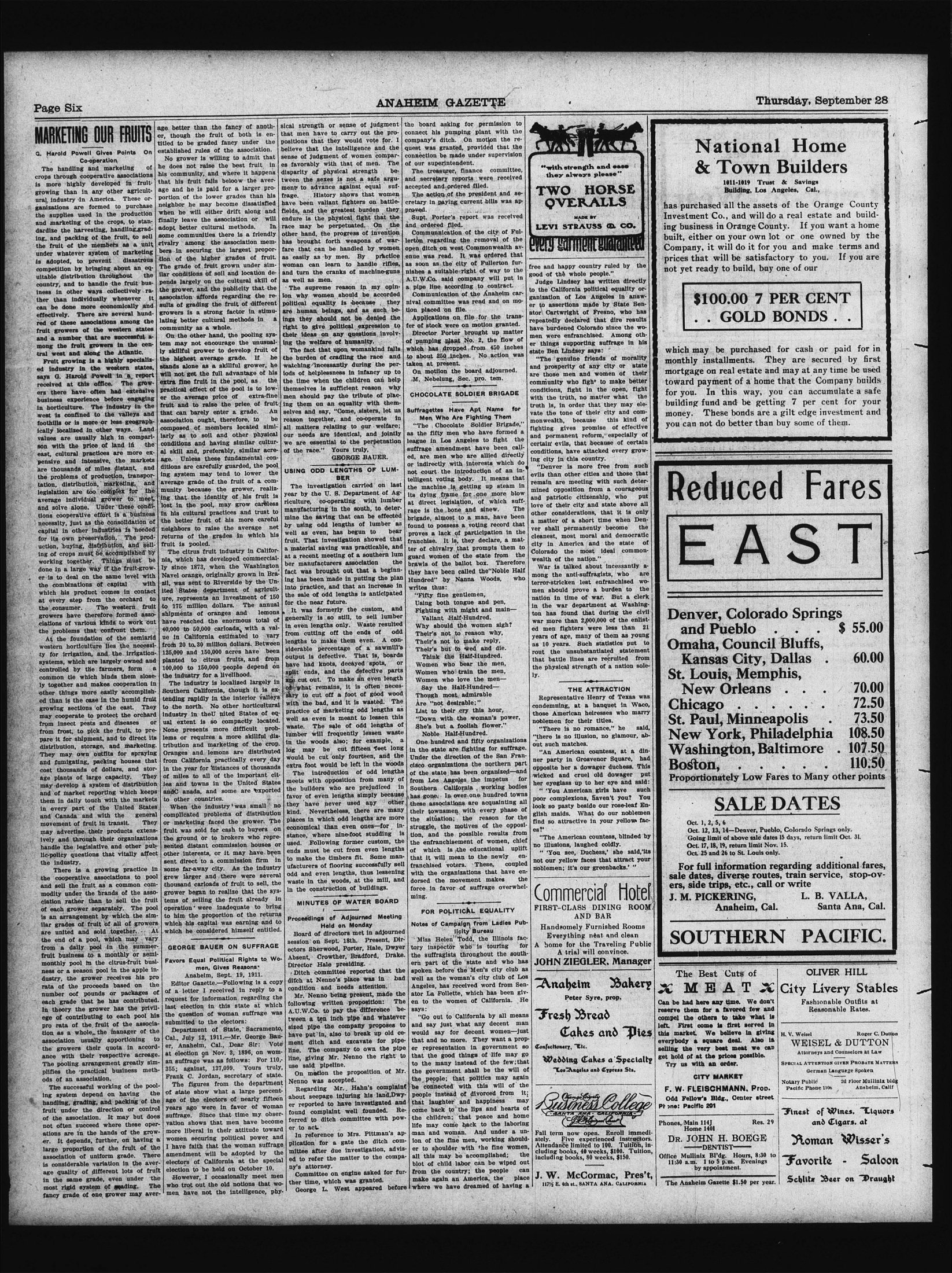
Searchable text
MARKETING OUR FRUITS
G. Harold Powell Gives Points On Co-operation
The handling and marketing of crops through cooperative associations is more highly developed in fruit-growing than in any other agricultural industry in America. These organizations are formed to purchase the supplies used in the production and marketing of the crops, to standardize the harvesting, handling, grading, and packing of the fruit, to sell the fruit of the members as a unit under whatever system of marketing is adopted, to prevent disastrous competition by bringing about an equitable distribution throughout the country, and to handle the fruit business in other ways collectively rather than individually whenever it can be done more economically and effectively. There are several hundred of these associations among the fruit growers of the western states and a number that are successful among the fruit growers in the central west and along the Atlantic.
Fruit growing is a highly specialized industry in the western states, says G. Harold Powell in a report received at this office. The growers there have often had extensive business experience before engaging in horticulture. The industry in the west is confined to the valleys and foothills or is more or less geographically localized in other ways. Land values are usually high in comparison with the price of land in the east, cultural practices are more expensive and intensive, the markets are thousands of miles distant, and age better than the fancy of another, though the fruit of both is entitled to be graded fancy under the established rules of the association.
No grower is willing to admit that he does not raise the best fruit in his community, and where it happens that his fruit falls below the average and he is paid for a larger proportion of the lower grades than his neighbor he may become dissatisfied when he will either drift along and finally leave the association or will adopt better cultural methods. In some communities there is a friendly rivalry among the association members in securing the largest proportion of the higher grades of fruit. The grade of fruit grown under similar conditions of soil and location depends largely on the cultural skill of the grower, and the publicity that the association affords regarding the results of grading the fruit of different growers is a strong factor in stimulating better cultural methods in a community as a whole.
On the other hand, the pooling system may not encourage the unusually skillful grower to develop fruit of the highest average grade. If he stands alone as a skillful grower, he will not get the full advantage of his extra fine fruit in the pool, as the practical effect of the pool is to lower the average price of extra-fine fruit and to raise the price of fruit that can barely enter a grade. An association ought, therefore, to be composed of members located similarly as to soil and other physical conditions and having similar cultural skill and, preferably, similar acreage. Unless these fundamental conditions are carefully guarded, the pooling system may tend to lower the physical strength or sense that men have to carry positions that they would believe that the intelligence sense of judgment of women favorably with that disparity of physical size between the sexes is not meant to advance against frage. History shows have been valiant fight fields, and the greatest endure is the physical race may be perpetual other hand, the progress has brought forth we fare that can be handled as easily as by men. A woman can learn to turn the cranks of her well as men.
The supreme reasonion why women should political equality is because human beings, andings they should not right to give political their ideas on any questioning the welfare of humankind.
The fact that upon waking of burden of cradling watching incessantly doodles of helplessness in time when the child themselves is sufficient men should pay them on an equally selfes and say, "Come, reason together, and all matters relating to our needs are identical we are essential to them of the race." Yours t
says G. Harold Powell in a report received at this office. The growers there have often had extensive business experience before engaging in horticulture. The industry in the west is confined to the valleys and foothills or is more or less geographically localized in other ways. Land values are usually high in comparison with the price of land in the east, cultural practices are more expensive and intensive, the markets are thousands of miles distant, and the problems of production, transportation, distribution, marketing, and legislation are too complex for the average individual grower to meet, and solve alone. Under these conditions cooperative effort is a business necessity, just as the consolidation of capital in other industries is needed for its own preservation. The production, buying, distribution, and selling of crops must be accomplished by working together. Things must be done in a large way if the fruit-grower is to deal on the same level with the combinations of capital with which his product comes in contact at every step from the orchard to the consumer. The western fruit growers have therefore formed associations of various kinds to work out the problems that confront them.
At the foundation of the semiarid western horticulture lies the necessity for irrigation, and the irrigation systems, which are largely owned and controlled by the farmers, form a common tie which binds them closely together and makes cooperation in other things more easily accomplished than is the case in the humid fruit growing sections of the east. They may cooperate to protect the orchard from insect pests and diseases or from frost, to pick the fruit, to prepare it for shipment, and to direct its distribution, storage, and marketing. They may own outfits for spraying and fumigating, packing houses that cost thousands of dollars, and storage plants of large capacity. They may develop a system of distribution and of market reporting which keeps them in daily touch with the markets in every part of the United States and Canada and with the general movement of fruit in transit. They may advertise their products extensively and through their organizations handle the legislative and other public-policy questions that vitally affect the industry.
There is a growing practice in the cooperative associations to pool and sell the fruit as a common commodity under the brands of the association says G. Harold Powell in a report received at this office. The growers there have often had extensive business experience before engaging in horticulture. The industry in the west is confined to the valleys and foothills or is more or less geographically localized in other ways. Land values are usually high in comparison with the price of land in the east, cultural practices are more expensive and intensive, the markets are thousands of miles distant, and the problems of production, transportation, distribution, marketing, and legislation are too complex for the average individual grower to meet, and solve alone. Under these conditions cooperative effort is a business necessity, just as the consolidation of capital in other industries is needed for its own preservation. The production, buying, distribution, and selling of crops must be accomplished by working together. Things must be done in a large way if the fruit-grower is to deal on the same level with the combinations of capital with which his product comes in contact at every step from the orchard to the consumer. The western fruit growers have therefore formed associations of various kinds to work out the problems that confront them.
At the foundation of the semiarid western horticulture lies the necessity for irrigation, and the irrigation systems, which are largely owned and controlled by the farmers, form a common tie which binds them closely together and makes cooperation in other things more easily accomplished than is the case in the humid fruit growing sections of the east. They may cooperate to protect the orchard from insect pests and diseases or from frost, to pick the fruit, to prepare it for shipment, and to direct its distribution, storage, and marketing. They may own outfits for spraying and fumigating, packing houses that cost thousands of dollars, and storage plants of large capacity. They may develop a system of distribution and of market reporting which keeps them in daily touch with the markets in every part of the United States and Canada and with the general movement of fruit in transit. They may advertise their products extensively and through their organizations handle the legislative and other public-policy questions that vitally affect the industry.
There is a growing practice in the cooperative associations to pool and sell the fruit as a common commodity under the brands of the association says G. Harold Powell in a report received at this office. The growers there have often had extensive business experience before engaging in horticulture. The industry in the west is confined to the valleys and foothills or is more or less geographically localized in other ways. Land values are usually high in comparison with the price of land in the east, cultural practices are more expensive and intensive, the markets are thousands of miles distant, and the problems of production, transportation, distribution, marketing, and legislation are too complex for the average individual grower to meet, and solve alone. Under these conditions cooperative effort is a business necessity, just as the consolidation of capital in other industries is needed for its own preservation. The production, buying, distribution, and selling of crops must be accomplished by working together. Things must be done in a large way if the fruit-grower is to deal on the same level with the combinations of capital with which his product comes in contact at every step from the orchard to the consumer. The western fruit growers have therefore formed associations of various kinds to work out the problems that confront them.
At the foundation of the semiarid western horticulture lies the necessity for irrigation, and the irrigation systems, which are largely owned and controlled by the farmers, form a common tie which binds them closely together and makes cooperation in other things more easily accomplishled than is the case in the humid fruit growing sections of the east. They may cooperate to protect the orchard from insect pests and diseases or from frost, to pick the fruit, to prepare it for shipment, and to direct its distribution, storage, and marketing. They may own outfits for spraying and fumigating, packing houses that cost thousands of dollars, and storage plants of large capacity. They may develop a system of distribution and of market reporting which keeps them in daily touch with the markets in every part of the United States and Canada and with the general movement of fruit in transit. They may advertise their products extensively and through their organizations handle the legislative and other public-policy questions that vitally affect the industry.
There is a growing practice in the cooperative associations to pool and sell the fruit as a common commodity under the brands of the association says G. Harold Powell in a report received at this office. The growers there have often had extensive business experience before engaging in horticulture. The industry in the west is confined to the valleys and foothills or is more or less geographically localized in other ways. Land values are usually high in comparison with the price of land in the east, cultural practices are more expensive and intensive, the markets are thousands of miles distant, and the problems of production, transportation, distribution, marketing, and legislation are too complex for the average individual grower to meet, and solve alone. Under these conditions cooperative effort is a business necessity, just as the consolidation of capital in other industries is needed for its own preservation. The production, buying, distribution, and selling of crops must be accomplished by working together. Things must be done in a large way if the fruit-grower is to deal on the same level with the combinations of capital with which his product comes in contact at every step from the orchard to the consumer. The western fruit growers have therefore formed associations of various kinds to work out the problems that confront them.
At the foundation of the semiarid western horticulture lies the necessity for irrigation, and the irrigation systems, which are largely owned and controlled by the farmers, form a common tie which binds them closely together and makes cooperation in other things more easily accomplishled than is the case in the humid fruit growing sections of the east. They may cooperate to protect the orchard from insect pests and diseases or from frost, to pick the fruit, to prepare it for shipment, and to direct its distribution, storage, and marketing. They may own outfits for spraying and fumigating, packing houses that cost thousands of dollars, and storage plants of large capacity. They may develop a system of distribution and of market reporting which keeps them in daily touch with the markets in every part of the United States and Canada and with the general movement of fruit in transit. They may advertise their products extensively and through their organizations handle the legislative and other public-policy questions that vitally affect the industry.
There is a growing practice in the cooperative associations to pool and sell the fruit as a common commodity under the brands of the association says G. Harold Powell in a report received at this office. The growers there have often had extensive business experience before engaging in horticulture. The industry in the west is confined to the valleys和 foothills or is more or less geographically localized in other ways. Land values are usually high in comparison with the price of land inthe east, cultural practices are more expensiveand intensive,the markets are thousandsof miles distant,andthe problemsofproduction,transportation,distribution,marketing,and legislationaretoocomplexfortheaverageindividualgrowertolertheaveragegradeofthefruitofacommunitybecausethegrowerrealizingthattheidentityofhisfruitislostinthepoolmaygrowcarelessinhisculturalpracticesandtrusttobethebetterfruitofhismorecarefulneighborstoraisetheaveragenetreturnsofthegradesinwhichhisfruitispooled.
The citrus fruit industry in California,which has developed commerciallysince1873,whentheWashington Navel orange,originally growninBrazil,was senttoRiversidebytheUnitedStatesdepartmentofagriculture,representsaninvestmentof150to175milliondollars.Theannualshipmentsoforangesandlemonshavereachedtheenormoustotalof40000to50000carloadswithavalueinCaliforniaestimatedtovaryfrom20to30milliondollars.Between125000and150000acreshavebeentreatedtocitrusfruits,andfrom100000to150000peopledependontheindustryfora livelihood.
The industry is localized largelyinSouthernCalifornia,thoughitextendingrapidlyintheintervalvalleystothenorth.NootherhorticulturalindustryintheUrithedStatesofequal extentissocompactlylocated.Nonepresentsmoredifficultproblemsorrequiresamoreskillfuldistributionandmarketingofthecrop.OrangesandlemonsaredistributedfromCaliforniapracticallyeverydayintheyearfordistancesofthousandsofmilestoalloftheimportantcitiesandtownsintheUnitedStatesandCanada,andsomeareexportedtotothercountries.
Whentheindustrywassmallno complicatedproblemsofdistributionormarketingfacedthegrower.Thefruitwassoldforcashtobuyersonthegroundortobrokerswhorepresentdistantcommissionhousesorotherinterests,或itmayhavebeensentdirecttoa commission firmin somefarawaycity.Astheindustrygrewlargerandtherewereseveralthousandcarloadsoffruitto sell,thegrowerbegotorealizethatthesystemsoffellingthefruitalready.in
The investigationcarriedbytheU.S.DepartmentofAgriculture,co-operatingmanufacturinginthesime,thesavingthatoccurbyusingoddlengthswellasevenismeanswaste.Thesaleoflumberwillfrequentlyinthewoodsalso;forglogmaybecuriedowntothecutonlyfortextrafootwouldbelengted.
The introductionmeetswithoppositionthebuilderswhosearefavorofevenlengthssheyhaveneverusedkind.Nevertheless,theplacesinwhichoddleconomicalthanevennaturewhereineveryinstancewhereineveryform.Followingformendmustbecutfromtomakethetimbersinfactoryurersofflooringoddandevenlengthswasteinthewoods,a
intheconstructionof
them in daily touch with the markets in every part of the United States and Canada and with the general movement of fruit in transit. They may advertise their products extensively and through their organizations handle the legislative and other public-policy questions that vitally affect the industry.
There is a growing practice in the cooperative associations to pool and sell the fruit as a common commodity under the brands of the association rather than to sell the fruit of each grower separately. The pool is an arrangement by which the similar grades of fruit of all of growers are united and sold together. At the end of a pool, which may vary from a daily pool in the summer-fruit business to a monthly or semi-monthly pool in the citrus-fruit business or a season pool in the apple industry, the grower receives his pro rata of the proceeds based on the number oof pounds or packages of each grade that he has contributed. In theory the grower has the privilege of contributing to each pool his pro rata of the fruit of the association as a whole, the manager of the association usually apportioning to the growers their quota in accordance with their respective acreage. The pooling arrangement greatly simplifies the practical business methods of an association.
The successful working of the pooling system depend on having the handling, grading, and packing of the fruit under the direction or control of the association. It may but does not often succeed where these operations are in the hands of the grower. It depends, further, on having a large proportion of the fruit of the association of uniform grade. There is considerable variation in the average quality of different lots of fruit in the same grade, even under the most rigid system of grading. The fancy grade of one grower may aver-
When the industry was small no complicated problems of distribution or marketing faced the grower. The fruit was sold for cash to buyers on the ground or to brokers who represented distant commission houses or other interests, or it may have been sent direct to a commission firm in some far-away city. As the industry grew larger and there were several thousand carloads of fruit to sell, the grower began to realize that the systems of selling the fruit already in operation were inadequate to bring to him the proportion of the returns which his capital was earning and to which he considered himself entitled.
GEORGE BAUER ON SUFFRAGE
Favors Equal Political Rights to Women, Gives Reasons.
Anaheim, Sept. 19, 1911.
Editor Gazette.—Following is a copy of a letter I received in reply to a request for information regarding the last election in this state at which the question of woman suffrage was submitted to the electors:
Department of State, Sacramento, Cal., July 12, 1911.—Mr. George Bauer, Anaheim, Cal., Dear Sir: Vote at election on Nov. 3, 1896, on woman suffrage was as follows: For 110,-355; against, 137,099. Yours truly, Frank C. Jordan, secretary of state.
The figures from the department of state show what a large percentage of the electors of nearly fifteen years ago were in favor of woman suffrage. Since that time my observation shows that men have become more liberal in their attitude toward women securing political power and I have faith that the woman suffrage amendment will be adopted by the electors of California at the special election to be held on October 10.
However, I occasionally meet men who trot out the old notions that women have not the intelligence, phy-
sical strength or sense of judgment that men have to carry out the propositions that they would vote for. I believe that the intelligence and the sense of judgment of women compare favorably with that of men. The disparity of physical strength between the sexes is not a safe argument to advance against equal suffrage. History shows that women have been valiant fighters on battlefields, and the greatest burden they endure is the physical fight that the race may be perpetuated. On the other hand, the progress of invention has brought forth weapons of warfare that can be handled by women as easily as by men. By practice woman can learn to handle rifles, and turn the cranks of machine-guns as well as men.
The supreme reason in my opinion why women should be accorded political equality is because they are human beings, and as such beings they should not be denied the right to give political expression to their ideas on any questions involving the welfare of humanity.
The fact that upon womankind falls the burden of cradling the race and watching incessantly during the periods of helplessness in infancy up to the time when the children can help themselves is sufficient reason why men should pay the tribute of placing them on an equality with themselves and say, "Come, sisters, let us reason together, and co-operate in all matters relating to our welfare; our needs are identical, and jointly we are essential to the perpetuation of the race." Yours truly,
GEORGE BAUER.
USING ODD LENGTHS OF LUM-
the board asking for permission to connect his pumping plant with the company's ditch. On motion the request was granted, provided that the connection be made under supervision of our superintendent.
The treasurer, finance committee, and secretary reports were received accepted and ordered filed.
The action of the president and secretary in paying current bills was approved.
Supt. Porter's report was received and ordered filed.
Communication of the city of Fullerton regarding the removal of the open ditch on west Commonwealth avenue was read. It was ordered that as soon as the city of Fullerton furnishes a suitable right of way to the A.U.W.Co. said company will put in a pipe line according to contract.
Communication of the Ánaheim carnival committee was read and on motion placed on file.
Applications on file for the transfer of stock were on motion granted.
Director Porter brought up matter of pumping plant No. 2, the flow of which has dropped from 450 inches to about 250 inches. No action was taken at present.
On motion the board adjourned.
M. Nebelung, Sec. pro. tem.
CHOCOLATE SOLDIER BRIGADE
Suffragettes Have Apt Name for Men Who Are Fighting Them
"The Chocolate Soldier Brigade," as the fifty men who have formed a league in Los Angeles to fight the suffrage amendment have been called, are men who are allied directly or indirectly with interests which do not court the introduction of an in-
free and happy country ruled by the good of the whole people."
Judge Lindsey has written directly to the California political equality organization of Los Angeles in answer to assertions made by State Senator Cartwright of Fresno, who has repeatedly declared that dire results have burdened Colorado since the women were enfranchised. Among other things supporting suffrage in his state Ben Lindsey says:
"The genuine friends of morality and prosperity of any city or state are those men and women of their community who fight to make better conditions, fight in the open, fight with the truth, no matter what the truth is, in order that they may elevate the tone of their city and commonwealth, because this kind of fighting gives promise of effective and permanent reform, especially of certain evils, that because of certain conditions, have attacked every growing city in this country.
"Denver is more free from such evils than other cities and those that
USING ODD LENGTHS OF LUMBER
The investigation carried on last year by the U.S. Department of Agriculture, co-operating with lumber manufacturing in the south, to determine the saving that can be effected by using odd lengths of lumber as well as even, has begun to bear fruit. That investigation showed that a material saving was practicable, and at a recent meeting of a southern lumber manufacturers association the fact was brought out that a beginning has been made in putting the plan into practice, and that an increase in the sale of odd lengths is anticipated for the near future.
It was formerly the custom, and generally is so still, to sell lumber in even lengths only. Waste resulted from cutting off the ends of odd lengths to make them even. A considerable percentage of a sawmill's output is defective. That is, boards have had knots, decayed spots, or split ends, and the defective parts are cut out. To make an even length of what remains, it is often necessary to cut off a foot of good wood with the bad, and it is wasted. The practice of marketing odd lengths as well as even is meant to lessen this waste. The sale of odd lengths of lumber will frequently lessen waste in the woods also; for example, a log may be cut fifteen feet long would be cut only fourteen, and the extra foot would be left in the woods.
The introduction of odd lengths meets with opposition from many of the builders who are prejudiced in favor of even lengths simply because they have never used any other kind. Nevertheless, there are many places in which odd lengths are more economical than even ones—for instance, where nine-foot studding is used. Following former custom, the ends must be cut from even lengths to make the timbers fit. Some manufacturers of flooring successfully sell odd and even lengths, thus lessening waste in the woods, at the mill, and in the construction of buildings.
CHOCOLATE SOLDIER BRIGADE
Suffragettes Have Apt Name for Men Who Are Fighting Them
"The Chocolate Soldier Brigade," as the fifty men who have formed a league in Los Angeles to fight the suffrage amendment have been called, are men who are allied directly or indirectly with interests which do not court the introduction of an intelligent voting body. It means that the machine is getting up steam in its dying frame for one more blow at direct legislation, of which suffrage is the bone and sinew. The brigade, almost to a man, have been found to possess a voting record that proves a lack of participation in the franchise. It is, they declare, a matter of chivalry that prompts them to guard women of the state from the brawls of the ballot box. Therefore they have been called the "Noble Half Hundred" by Nanna Woods, who writes thus:
"Fifty fine gentlemen,
Using both tongue and pen,
Fighting with might and main—
Vallant Half-Hundred.
Why should the women sigh?
Their's not to reason why,
Their's not to make reply,
Their's but to wed and die.
Think the Half-Hundred.
Women who bear the men,
Women who train the men,
Women who love the men—
Say the Half-Hundred—
Though most admirable
Are "not desirable;"
List to their cry this hour,
"Down with the woman's power,
She's but a foolish flower."
Noble Half-Hundred.
One hundred and fifty organizations in the state are fighting for suffrage. Under the direction of the San Francisco organizations the northern part of the state has been organized—and from Los Angeles the impetus for Southern California working bodies has gone. In over one hundred towns these associations are acquainting all their townsmen with every phase of the situation; the reason for the struggle, the motives of the opposition, and the possible results from the enfranchisement of women, chief of which is the educational uplift that it will mean to the newly enfranchised voters. These, coupled with the organizations that have endorsed the movement makes the force in favor of suffrage overwhelming.
are those men and women of their community who fight to make better conditions, fight in the open, fight with the truth, no matter what the truth is, in order that they may elevate the tone of their city and commonwealth, because this kind of fighting gives promise of effective and permanent reform, especially of certain evils, that because of certain conditions, have attacked every growing city in this country.
"Denver is more free from such evils than other cities and those that remain are meeting with such determined opposition from a courageous and patriotic citizenship, who put love of their city and state above all other considerations, that it is only a matter of a short time when Denver shall permanently become the cleanest, most moral and democratic city in America and the state of Colorado the most ideal commonwealth of the nation."
War is talked about incessantly among the anti-suffragists, who are terror-stricken lest enfranchised women should prove a burden to the nation in time of war. But a clerk in the war department at Washington has found that during the civil war more than 200,000 of the enlisted men fighters were less than 21 years of age, many of them as young as 10 years. Such statistics put to rout the unsubstantiated statement that battle lines are recruited from the physical strength of a nation solely.
THE ATTRACTION
Representative Henry of Texas was condemning, at a banquet in Waco, those American heiresses who marry noblemen for their titles.
"There is no romance," he said, "there is no illusion, no glamour, about such matches.
"An American countess, at a dinner party in Grosvenor Square, had opposite her a dowager duchess. This wicked and cruel old dowager put her eyeglass up to her eye and said:
"You American girls have such poor complexions, haven't you? You look so pasty beside our rose-leaf English maids. What do our noblemen find so attractive in your yellow faces?
"The American countess, blinded by no illusions, laughed coldly.
"You see, Duchess,' she said,'its not our yellow faces that attract your noblemen; it's our greenbacks.'"
they have never used any other kind. Nevertheless, there are many places in which odd lengths are more economical than even ones—for instance, where nine-foot studding is used. Following former custom, the ends must be cut from even lengths to make the timbers fit. Some manufacturers of flooring successfully sell odd and even lengths, thus lessening waste in the woods, at the mill, and in the construction of buildings.
MINUTES OF WATER BOARD
Proceedings of Adjourned Meeting Held on Monday
Board of directors met in adjourned session on Sept. 18th. Present, Directors Sherwood, Porter, Hale, Dwyer Absent, Crowther, Bradford, Drake. Director Hale presiding.
Ditch committee reported that the ditch at Nenno's place was in bad condition and needs attention.
Mr. Nenno being present, made the following written proposition: The A.U.W.Co. to pay the difference between a ten inch pipe and whatever sized pipe the company proposes to have put in, also to break up old cement ditch and excavate for pipeline. The company to own the pipe line, giving Mr. Nenno the right to use said pipeline.
On motion the proposition of Mr. Nenno was accepted.
Regarding Mr. Hahn's complaint about seepage injuring his land, Dwyer reported to have investigated and found complaint well founded. Referred to ditch committee with power to act.
In reference to Mrs. Pittman's application for a gate the ditch committee after due investigation, advised to refer the matter to the company's attorney.
Committee on engine asked for further time, which was granted.
George L. West appeared before these associations are acquainting all their townsmen with every phase of the situation; the reason for the struggle, the motives of the opposition, and the possible results from the enfranchisement of women, chief of which is the educational uplift that it will mean to the newly enfranchised voters. These, coupled with the organizations that have endorsed the movement makes the force in favor of suffrage overwhelming.
FOR POLITICAL EQUALITY
Notes of Campaign from Ladies Publicity Bureau
Miss Helen Todd, the Illinois factory inspector who is touring for the suffragists throughout the southern part of the state and who has spoken before the Men's city club as well as the woman's city club of Los Angeles, has received word from Senator La Follette, which has been given to the women of California. He says:
"Go out to California by all means and say just what any decent man would say for decent women—just that and no more. They want a proper representation in government so that the good things of life may go to the many instead of the few; that the government shall be the will of the people; that politics may again be connected with this will of the people instead of divorced from it; that laughter and happiness may come back to the lips and hearts of the children; that peace and home life may come back to the laboring man and woman. And under a union of the fine men, working shoulder to shoulder with the fine women, all this may be accomplished; the blot of child labor can be wiped out from the country; the people can make again an America, the place where we have dreamed of having a..."
Commercial Hotel
FIRST-CLASS DINING ROOM AND BAR
Handsomely Furnished Rooms
Everything neat and clean
A home for the Traveling Public
A trial will convince.
JOHN ZIEGLER, Manager
Anaheim Bakery
Peter Syre, prop.
Fresh Bread Cakes and Pies
Confectionery, Etc.
Wedding Cakes a Specialty
Los Angeles and Express Sts.
Business College
Fall term now open. Enroll immediately. Five experienced instructors. Attendance limited to 100. Tuition, including books, 40 weeks, $100. Tuition, including books, 80 weeks, $150.
J. W. McCormac, Pres't,
117½ E. 4th st., SANTA ANA, CALIFORNIA
National Home & Town Builders
1011-1019 Trust & Savings
Building, Los Angeles, Cal.,
has purchased all the assets of the Orange County Investment Co., and will do a real estate and building business in Orange County. If you want a home built, either on your own lot or one owned by the Company, it will do it for you and make terms and prices that will be satisfactory to you. If you are not yet ready to build, buy one of our
$100.00 7 PER CENT
GOLD BONDS.
which may be purchased for cash or paid for in monthly installments. They are secured by first mortgage on real estate and may at any time be used toward payment of a home that the Company builds for you. In this way, you can accumulate a safe building fund and be getting 7 per cent for your money. These bonds are a gilt edge investment and you can not do better than buy some of them.
Reduced Fares
EAST
Denver, Colorado Springs and Pueblo $ 55.00
Omaha, Council Bluffs, Kansas City, Dallas 60.00
St. Louis, Memphis, New Orleans 70.00
Chicago 72.50
St. Paul, Minneapolis 73.50
New York, Philadelphia 108.50
Washington, Baltimore 107.50
Boston 110.50
Proportionately Low Fares to Many other points
SALE DATES
Oct. 1, 2, 5, 6
Oct. 12, 13, 14—Denver, Pueblo, Colorado Springs only.
Going limit of above sale dates 15 days, return limit Oct. 31.
Oct. 17, 18, 19, return limit Nov. 15.
Oct. 25 and 26 to St. Louis only.
For full information regarding additional fares, sale dates, diverse routes, train service, stop-overs, side trips, etc., call or write
J. M. PICKERING L. B. VALLA,
SALE DATES
Oct. 1, 2, 5, 6
Oct. 12, 13, 14—Denver, Pueblo, Colorado Springs only.
Going limit of above sale dates 15 days, return limit Oct. 31.
Oct. 17, 18, 19, return limit Nov. 15.
Oct. 25 and 26 to St. Louis only.
For full information regarding additional fares,
sale dates, diverse routes, train service, stop-overs, side trips, etc., call or write
J. M. PICKERING,
L. B. VALLA,
Anaheim, Cal.
Santa Ana, Cal.
SOUTHERN PACIFIC.
The Best Cuts of MEAT
Can be had here any time. We don't
reserve them for a favored few and
compel the others to take what is
left. First come is first served in
this market. We believe in giving
everybody a square deal. Also in
selling the very best meat we can
get hold of at the prices possible.
Try us with an order.
CITY MARKET
F. W. FLEISCHMANN, Prod.
Odd Fellow's Bldg., Center street
Phone: Pacific 201
Phones, Main 114J Res. 29
Home 140l
DR. JOHN H. BOEGE
DENTIST
Office Mullinix Bl'dg. Hours, 8:30 to
11:30 a.m. 1 to 5 p.m. Evenings
by appointment.
The Anaheim Gazette $1.50 per year.
OLIVER HILL
City Livery Stables
Fashionable Outfits at
Reasonable Rates.
H. V. Weisel Roger C. Dutton
WEISEL & DUTTON
Attorneys and Counselors at Law
SPECIAL ATTENTION GIVEN PROBATE MATTERS
German Language Spoken
Notary Public
Pacific Phone 1106 Anaheim, Calif
Finest of Wines, Liquors
and Tigars, at
Roman Wisser's
Favorite - Saloon
Schlitz Beer on Draught