anaheim-gazette 1911-09-21
Scanned page
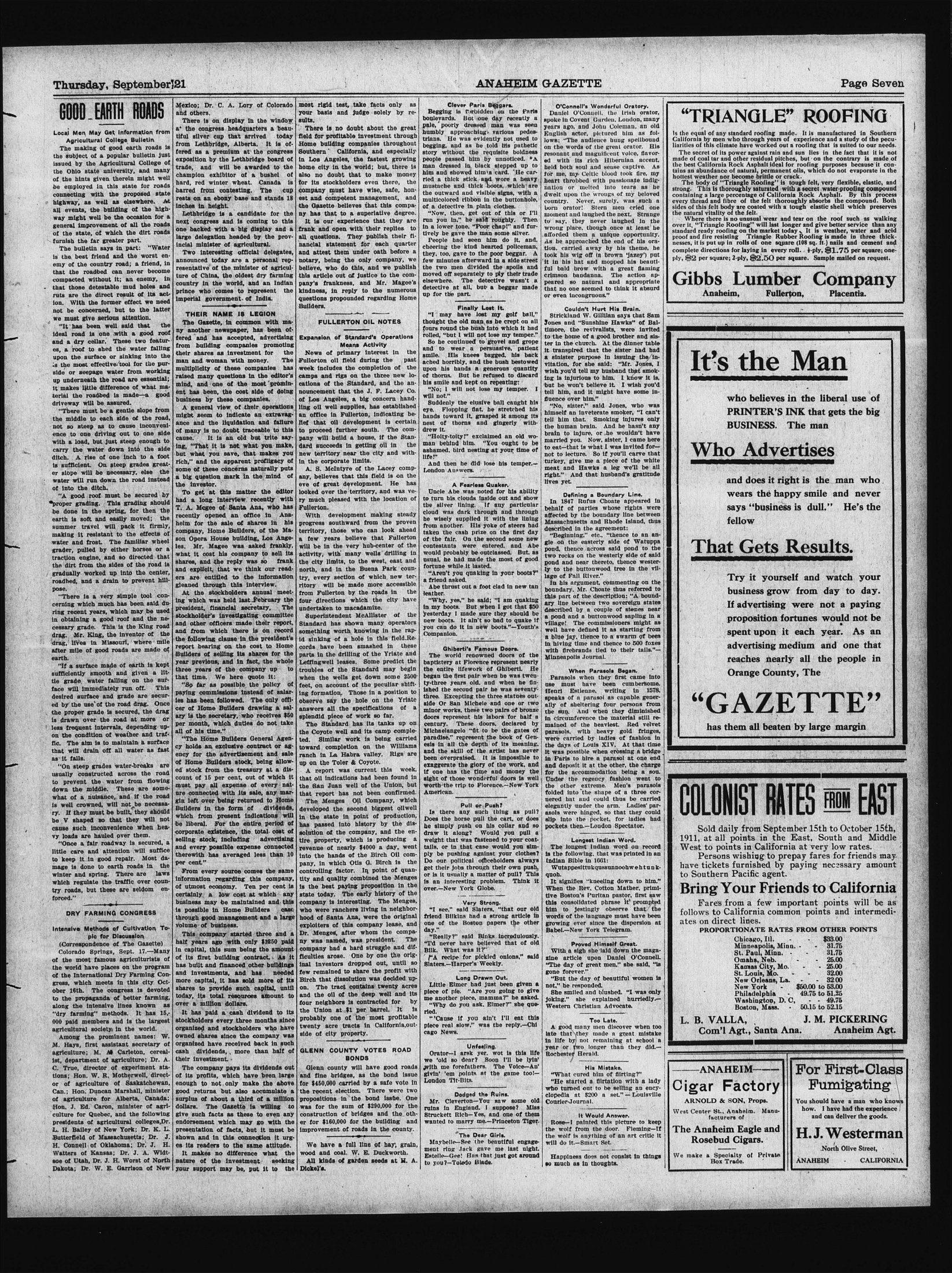
Searchable text
GOOD EARTH ROADS
Local Men May Get Information from Agricultural College Bulletin.
The making of good earth roads is the subject of a popular bulletin just issued by the Agricultural College of the Ohio state university, and many of the hints given therein might well be employed in this state for roads connecting with the proposed state highway, as well as elsewhere. At all events, the building of the highway might well be the occasion for a general improvement of all the roads of the state, of which the dirt roads furnish the far greater part.
The bulletin says in part: "Water is the best friend and the worst enemy of the country road; a friend, in that the roadbed can never become compacted without it; an enemy, in that those detestable mud holes and ruts are the direct result of its action. With the former effect we need not be concerned, but to the latter we must give serious attention.
"It has been well said that the ideal road is one with a good roof and a dry cellar. These two features, a roof to shed the water falling upon the surface or sinking into the is the most effective tool for the purpose or seepage water from working up underneath the road are essential; it makes little difference of what material the roadbed is made—a good driveway will be assured.
"There must be a gentle slope from the middle to each side of the road, not so steep as to cause inconvenience to one driving out to one side with a load, but just steep enough to carry the water down into the side ditch. A rise of one inch to a foot is sufficient. On steep grades greater slope will be necessary, else the Mexico; Dr. C. A. Lory of Colorado and others.
There is on display in the window at the congress headquarters a beautiful silver cup that arrived today from Lethbridge, Alberta. It is offered as a premium at the congress exposition by the Lethbridge board of trade, and will be awarded to the champion exhibitor of a bushel of hard, red winter wheat. Canada is barred from contesting. The cup rests on an ebony base and stands 18 inches in height.
Lethbridge is a candidate for the next congress and is coming to this one backed with a big display and a large delegation headed by the provincial minister of agricultural.
Two interesting official delegates, announced today are a personal representative of the minister of agriculture of China, the oldest dry farming country in the world, and an Indian prince who comes to represent the imperial government of India.
THEIR NAME IS LEGION
The Gazette, in common with many another newspaper, has been offered and has accepted, advertising from building companies promoting their shares as investment for the man and woman with money. The multiplicity of these companies has raised many questions in the editor's mind, and one of the most prominent has been, the cost side of doing business by these companies.
A general view of their operations might seem to indicate an extravagance and the liquidation and failure of many is no doubt traceable to this cause. It is an old but trite saying, "That it is not what you make, but what you save, that makes you rich," and the apparent profligacy of some of these concerns naturally puts most rigid test, to your basis and results.
There is no doubt field for profitable Home building company in Los Angeles, the home city in the west also no doubt that for its stockholder company must have best and competent the Gazette believe ny has that to a point.
It is our expert frank and open with all questions. The financial statement and attest them unnotary, being the belief, who do this article out of pany's frankness, kindness, in reply questions propound Builders.
FULLERTON
Expansion of State Mean
News of primary Fullerton oil field week includes these camps and rigs on occasions of the Stainnouncement that t of Los Angeles, al ling oil well supply an office in Fullerton lifef that oil develop to proceed further pany will build a dard succeeds in new territory near in the corporate l.
A. S. McIntyre
up underneath the road are essential; it makes little difference of what material the roadbed is made—a good driveway will be assured.
"There must be a gentle slope from the middle to each side of the road, not so steep as to cause inconvenience to one driving out to one side with a load, but just steep enough to carry the water down into the side ditch. A rise of one inch to a foot is sufficient. On steep grades greater slope will be necessary, else the water will run down the road instead of into the ditch.
"A good roof must be secured by proper grading. This grading should be done in the spring, for then the earth is soft and easily moved; the summer travel will pack it firmly, making it resistant to the effects of water and frost. The familiar wheel grader, pulled by either horses or a traction engine, and so directed that the dirt from the sides of the road is gradually worked up into the center, roadbed, and a drain to prevent hill-pose.
"There is a very simple tool concerning which much has been said during recent years, which may be used in obtaining a good roof and the necessary grade. This is the King road drag. Mr. King, the inventor of the drag, lives in Missouri, where mile after mile of good roads are made of earth.
"If a surface made of earth is kept sufficiently smooth and given a little grade water falling on the surface will immediately run off. This desired surface and grade are secured by the use of the road drag. Once the proper grade is secured, the drag is drawn over the road at more or less frequent intervals, depending upon the condition of weather and traffic. The aim is to maintain a surface that will drain off all water as fast as it falls.
"On steep grades water-breaks are usually constructed across the road to prevent the water from flowing down the middle. These are somewhat of a nuisance, and if the road is well crowned, will not be necessary. If they must be built, they should be V shaped so that they will not cause such inconvenience when heavy loads are hauled over them.
"Once a fair roadway is secured, a little care and attention will suffice to keep it in good repair. Most damage is done to earth roads in the winter and spring. There are laws which regulate the traffic over country roads, but these are seldom enforced."
A general view of their operations might seem to indicate an extravagance and the liquidation and failure of many is no doubt traceable to this cause. It is an old but trite saying, "That it is not what you make, but what you save, that makes you rich," and the apparent profligacy of some of these concerns naturally puts a big question mark in the mind of the investor.
To get at this matter the editor had a long interview recently with T. A. Mcgee of Santa Ana, who has recently opened an office in Anaheim for the sale of shares in his company, Home Builders, of the Mason Opera House building, Los Angeles. Mr. Magee was asked frankly, what it cost his company to sell its shares, and the reply was so frank and explicit, that we think our readers are entitled to the information gleaned through this interview.
At the stockholders annual meeting which was held last February the president, financial secretary, The stockholder's investigating committee and other officers made their report, and from which there is on record the following clause in the president's report bearing on the cost to Home Builders of selling its shares for the year previous, and in fact, the whole three years of the company up to that time. We here quote it:
"So far as possible the policy of paying commissions instead of salaries has been followed. The only officer of Home Builders drawing a salary is the secretary, who receives $50 per month, which duties do not take all of his time."
"The Home Builders General Agency holds an exclusive contract or agency for the advertisement and sale of Home Builders stock, being allowed stock from the treasury at a discount of 15 per cent, out of which it must pay all expense of every nature connected with its sale, any margin left over being returned to Home Builders in the form of dividends, which from present indications will be liberal. For the entire period of corporate existence, the total cost of selling stock, including advertising and every possible expense connected therewith has averaged less than 10 per cent."
From every source comes the same information regarding this company, of utmost economy. Ten per cent is certainly a low cost at which any camps and rigs or cessions of the State nouncement that to Los Angeles, an oil well supply an office in Fullerton Hef that oil develop to proceed further pany will build a dard succeeds in new territory near in the corporate line.
A. S. McIntyre any, believes that even of great development looked over the territory much pleased with Fullerton.
With developments southward territory, those ww a few years bell will be in the very activity, with many city limits, to north, and in the try, every section ritory will be made from Fullerton by four directions ww undertaken to mac Superintendent Standard has shown something worth h id sinking of a he cords have been parts in the drilling Leffingwell leases troubles of the S when the wells go feet, on account oo ing formation. The observe say tha answers all the s splendid piece of f
The Standard hie Coyote well ar ted. Similar work toward completion ranch in La Habra up on the Toler & A report was o that oil indications tha San Juan well that report has m The Menges O developed the sec in the state in p has passed into o solution of the co tire property, whi revenue of nearly into the hands of pany, in which Ot controlling factor. tity and quality co is the best paying state today. The
DRY FARMING CONGRESS
Intensive Methods of Cultivation, Topic for Discussion
(Correspondence of The Gazette)
Colorado Springs, Sept. 17.—Many of the most famous agriculturists of the world have places on the program of the International Dry Farming Congress, which meets in this city October 16th. The congress is devoted to the propaganda of better farming, along the intensive lines known as "dry farming" methods. It has 15,000 paid members and is the largest agricultural society in the world.
Among the prominent names: W. M. Hays, first assistant secretary of agriculture; M. A. Carleton, cerealist, department of agriculture; Dr. A. C. True, director of experiment stations; Hon. W. R. Motherwell, director of agriculture of Saskatchewan, Can.; Hon. Duncan Marshall, minister of agriculture for Alberta, Canada; Hon. J. Ed. Caron, minister of agriculture for Quebec, and the following presidents of agricultural colleges, Dr. L. H. Bailey of New York; Dr. K. L. Butterfield of Massachusetts; Dr. J. H. Connell of Oklahoma; Dr. J. H. Watters of Kansas; Dr. J. A. Widtsoe of Utah, Dr. J. H. Worst of North Dakota; Dr. W. E. Garrison of New
The company started three and a half years ago with only $1250 paid in capital, this sum being the amount of its first building contract. As it has built and financed other buildings and investments, and has needed more capital, it has sold more of its shares to provide such capital, until today, its total resources amount to over a million dollars.
It has paid a cash dividend to its stockholders every three months since organized and stockholders who have owned shares since the company was organized have received back in such cash dividends, more than half of their investment.
The company pays its dividends out of its profits, which have been large enough to not only make the above good returns but also accumulate a surplus of about a third of a million dollars. The Gazette is willing to give such facts as these to even any endorsement which may go with the presentation of facts, but it must be shown and in this connection it urges its readers to the same attitude.
It makes no difference what the nature of the investment seeking your support may be, put it to the
The Menges Oral developed the second in the state in pany has passed into a solution of the co- tire property, which revenue of nearly into the hands of pany, in which O'controlling factor, quantity and quality co- is the best paying state today. The company is interested who were ranchers hood of Santa Ana exploiters of this Dr. Menges, after nery was named, w company had a ha fliculties arose. O'final investors drew few remained to s Birch that dissolut ion. The tract co- and the oil of the four neighbors is the Union at $1 probably one of twenty acre tract side of city proper.
GLENN COUNTY BOO
Glenn county w and fine bridges, for $450,000 carries the recent election propositions in tha was for the sum construction of borer for $160,000 for improvement of re-
ANAHEIM GAZETTE
most rigid test, take facts only as your basis and judge solely by results.
There is no doubt about the great field for profitable investment through Home building companies throughout Southern California, and especially in Los Angeles, the fastest growing home city in the world; but, there is also no doubt that to make money for its stockholders even there, the company must have wise, safe, honest and competent management, and the Gazette believes that this company has that to a superlative degree.
It is our experience that they are frank and open with their replies to all questions. They publish their financial statement for each quarter and attest them under oath before a notary, being the only company, we believe, who do this, and we publish this article out of justice to the company's frankness, and Mr. Magee's kindness, in reply to the numerous questions propounded regarding Home Builders.
FULLERTON OIL NOTES
Expansion of Standard's Operations Means Activity
News of primary interest in the Fullerton oil field during the past week includes the completion of the camps and rigs on the three new locations of the Standard, and the announcement that the J. F. Lacey Co. of Los Angeles, a big concern handling oil well supplies, has established an office in Fullerton, indicating belief that oil development is certain to proceed further south. The company will build a house, if the Standard succeeds in getting oil in the new territory near the city and within the corporate limits.
A. S. McIntyre of the Lacey company takes this field on the
Clever Paris Beggars.
Begging is forbidden on the Paris boulevards. But one day recently a pale, poorly dressed man was seen humbly approaching various pedestrians. He was evidently not used to begging, and as he told his pathetic story without the requisite boldness people passed him by unnoticed. A man dressed in black stepped up to him and showed him a card. He carried a thick stick and wore a heavy mustache and thick boots, which are the outward and visible signs, with a multicolored ribbon in the buttonhole, of a detective in plain clothes.
"Now, then, get out of this or I'll run you in," he said roughly. Then in a lower tone, "Poor chap!" and furiously he gave the man some silver.
People had seen him do it, and cheering the kind hearted policeman, they, too, gave to the poor beggar. A few minutes afterward in a side street the two men divided the spoils and moved off separately to ply their trade elsewhere. The detective wasn't a detective at all, but a beggar made up for the part.
Finally Lost It.
"I may have lost my golf ball," thought the old man as he crept on all fours round the bush into which it had rolled, "but I will not lose my temper."
So he continued to grovel and grope and to wear a persuasive, patient smile. His knees bagged, his backached horribly, and the bush bestowed upon his hands a generous quantity of thorns. But he refused to discard his smile and kept on repeating:
"No; I will not lose my temper. I will not."
Suddenly the elusive ball caught his eye. Flopping flat, he stretched his hands toward it, grasped it among its nest of thorns and gingerly withdrew it.
"Holty-toily!" exclaimed an old woman behind him. "You ought to be ashamed, bird nesting at your time of life!"
And then he did lose his temper—London Answers.
O'Connell's Wonderful Oratory.
Daniel O'Connell, the Irish orator, spoke in Covent Garden, London, many years ago, and John Coleman, an old English actor, pictured him as follows: "The audience hung spellbound on the words of the great orator. His resonant and magnificent voice, flavored with its rich Hibernian accent, held both soul and sense captive. As for me, my Celtic blood took fire, my heart throbbed with passionate indignation or melted into tears as he dwelt upon the wrongs of my beloved country. Never, surely, was such a born orator! Stern men cried one moment and laughed the next. Strange to say, they never laughed in the wrong place, though once at least he afforded them a unique opportunity. As he approached the end of his oration, carried away by his theme, he took his wig off (a brown 'jazey') put it in his hat and mopped his beautiful bald brow with a great flaming crimson bandanna. The action appeared so natural and appropriate that no one seemed to think it absurd or even incongruous."
Couldn't Hurt His Brain.
Strickland W. Gillilan says that Sam Jones and "Sunshine Hawks" of Baltimore, the revivalists, were invited to the home of a good brother and sister in the church. At the dinner table it transpired that the sister had had a sinister purpose in issuing the invitation, for she said: "Mr. Jones, I wish you'd tell my husband that smoking is injurious to him. I know it is, but he won't believe it. I wish you'd tell him, and it might have some influence over him."
"No, sister," said Jones, who was himself an inveterate smoker, "I can't tell him that. Smoking injures only the human brain. And he hasn't any brain to injure, or he wouldn't have married you. Now, sister, I came here to eat—that is what I was invited for—not to lecture. So if you'll carve that turkey, give me a piece of the white meat and Hawks a leg we'll be all right." And that husband's gratitude...
camps and rigs on the three new locations of the Standard, and the announcement that the J. F. Lacey Co. of Los Angeles, a big concern handling oil well supplies, has established an office in Fullerton, indicating belief that oil development is certain to proceed further south. The company will build a house, if the Standard succeeds in getting oil in the new territory near the city and within the corporate limits.
A. S. McIntyre of the Lacey company, believes that this field is on the eve of great development. He has looked over the territory, and was very much pleased with the location of Fullerton.
With development making steady progress southward from the proven territory, those who can look ahead a few years believe that Fullerton will be in the very hub-center of the activity, with many wells drilling in the city limits, to the west, east and north, and in the Buena Park country, every section of which new territory will be made more accessible from Fullerton by the roads in the four directions which the city have undertaken to macadamize.
Superintendent McAllister of the Standard has shown many operators something worth knowing in the rapid sinking of a hole in this field. Records have been smashed in these parts in the drilling of the Yriate and Lefflingwell leases. Some predict the troubles of the Standard may begin when the wells get down some 2500 feet, on account of the peculiar shifting formation. Those in a position to observe say the hole on the Yriate answers all the specifications of a splendid piece of work so far.
The Standard has its tanks up on the Coyote well and its camp completed. Similar work is being carried toward completion on the Williams ranch in La Habra valley. Rigs are up on the Toler & Coyote.
A report was current this week, that oil indications had been found in the San Juan well of the Union, but that report has not been confirmed.
The Menges Oil Company, which developed the second biggest oilwell in the state in point of production, has passed into history by the dissolution of the company, and the entire property, which is producing a revenue of nearly $4000 a day, went into the hands of the Birch Oil company, in which Otis G. Birch is the controlling factor. In point of quantity and quality combined the Menges is the best paying proposition in the state today. The early history of the
A Fearless Quaker.
Uncle Abe was noted for his ability to turn his clouds inside out and show the silver lining. If any particular cloud was dark through and through he wisely supplied it with the lining from another. His yoke of steers had taken the cash prize on the first day of the fair. On the second some new contestants were entered, and Abe would probably be outclassed. But, as usual, he had made most of good fortune while it lasted.
"Aren't you quaking in your boots?" a friend asked.
Abe thrust out a foot clad in new tan leather.
"Why, yes," he said; "I am quaking in my boots. But when I got that $50 yesterday I made sure they should be new boots. It ain't so bad to quake if you can do it in new boots."—Youth's Companion.
Ghiberti's Famous Doors.
The world renowned doors of the baptistery at Florence represent nearly the entire lifework of Ghiberti. He began the first pair when he was twenty-three years old, and when he finished the second pair he was seventy-three. Excepting the three statues outside Or San Michele and one or two minor works, these two pairs of bronze doors represent his labors for half a century. These doors, declared by Michaelangelo "fit to be the gates of paradise," represent the book of Genesis in all the depth of its meaning, and the skill of the artist has never been overpraised. It is impossible to exaggerate the glory of the work, and if one has the time and money the sight of those wonderful doors is well worth the trip to Florence.—New York American.
Pull or Push?
Is there any such thing as pull? Does the horse pull the cart, or does he simply push on his collar and so draw it along? Would you pull a weight that was fastened to your coat-tails, or in that case would you simply be pushing against your clothes? Do our political officeholders always get their jobs through their own push, or is it usually a matter of pull? This is an interesting problem. Think it over.—New York Globe.
Defining a Boundary Line.
In 1847 Rufus Choate appeared in behalf of parties whose rights were affected by the boundary line between Massachusetts and Rhode Island, thus described in the agreement:
"Beginning," etc., "thence to an angle on the easterly side of Watuppa pond, thence across said pond to the two rocks on the westerly side of said pond and near thereto, thence westerly to the buttonwood tree in the village of Fall River."
In his argument, commenting on the boundary, Mr. Choate thus referred to this part of the description: "A boundary line between two sovereign states described by a couple of stones near a pond and a buttonwood sapling in a village! The commissioners might as well have defined it as starting from a blue jay, thence to a swarm of bees in hiving time and thence to 500 foxes with firebrands tied to their tails."—Minneapolis Journal.
When Parasols Began.
Parasols when they first came into use must have been cumbersome. Henri Estienne, writing in 1578, speaks of a parasol as capable generally of sheltering four persons from the sun. And when they diminished in circumference the material still remained of the heaviest. Red velvet parasols, with heavy gold fringes, were carried by ladies of fashion in the days of Louis XIV. At that time it was possible when crossing a bridge in Paris to hire a parasol at one end and deposit it at other, the charge for the accommodation being a sou. Under the regency fashion went to the other extreme. Men's parasols folded into the shape of a three cornered hat and could thus be carried elegantly under the arm. Ladies' parasols were hinged, so that they could slip into the pocket, for ladies had pockets then.—London Spectator.
Longest Indian Word.
The longest Indian word on record is the following, that was printed in an Indian Bible in 1661:
Wutappesittukqussunnoohwehtunk-quoh.
It signifies "kneeling down to him."
When the Rev. Cotton Mather, primitive Boston's Puritan pastor, first saw
The Menges Oil Company, which developed the second biggest oilwell in the state in point of production, has passed into history by the dissolution of the company, and the entire property, which is producing a revenue of nearly $4000 a day, went into the hands of the Birch Oil company, in which Otis G. Birch is the controlling factor. In point of quantity and quality combined the Menges is the best paying proposition in the state today. The early history of the company is interesting. The Menges, who were ranchers living in neighborhood of Santa Ana, were the original exploiters of this company lease, and Dr. Menges, after whom the company was named, was president. The company had a hard struggle and difficulties arose. One by one the original investors dropped out, until so few remained to share the profit with Birch that dissolution was decided upon. The tract contains twenty acres and the oil of the deep well and its four neighbors is contracted for by the Union at $1 per barrel. It is probably one of the most profitable twenty acre tracts in California, outside of city property.
GLENN COUNTY VOTES ROAD BONDS
Glenn county will have good roads and fine bridges, as the bond issue for $450,000 carried by a safe vote in the recent election. There were two propositions in the bond issue. One was for the sum of $290,000 for the construction of bridges and the other for $160,000 for the building and improvement of roads in the county.
We have a full line of hay; grain, wood and coal. W. E. Duckworth.
All kinds of garden seeds at H. A. Dickel's.
Pull or Push?
Is there any such thing as pull? Does the horse pull the cart, or does he simply push on his collar and so draw it along? Would you pull a weight that was fastened to your coat-tails, or in that case would you simply be pushing against your clothes? Do our political officeholders always get their jobs through their own push, or is it usually a matter of pull? This is an interesting problem. Think it over.—New York Globe.
Very Strong.
"I see," said Slaters, "that our old friend Bilkins had a strong article in one of the Boston papers the other day."
"Really?" said Binks incredulously. "I'd never have believed that of old Bilk. What was it?"
"A recipe for pickled onions," said Slaters.—Harper's Weekly.
Long Drawn Out.
Little Elmer had just been given a piece of pie. "Are you going to give me another piece, mamma?" he asked.
"Why do you ask, Elmer?" she queried.
"'Cause if you ain't I'll eat this piece real slow,' was the reply.—Chicago News.
Unfeeling.
Orator—I arsk yer. wot is this life we 'old so dear? Soon I'll be lyin' with me forefathers. The Voice—An' givin' 'em points at the game too!—London Tit-Bits.
Dodged the Ruins.
Mr. Cleverton—You saw some old ruins in England. I suppose? Miss Struckett Rich—Yes, and one of them wanted to marry me.—Princeton Tiger.
The Dear Girls.
Maybelle—See the beautiful engagement ring Jack gave me last night. Estelle—Gee! Has that just got around to you?—Toledo Blade.
Longest Indian Word.
The longest Indian word on record is the following: that was printed in an Indian Bible in 1661:
Wutappesittukqussunnoohwehtunkquoh.
It signifies "kneeling down to him." When the Rev. Cotton Mather, primitive Boston's Puritan pastor, first saw this consolidated phrase it prompted him to jestingly observe that the words of the language must have been growing ever since the dispersion at Babel.—New York Telegram.
Proved Himself Great.
With a sigh she laid down the magazine article upon Daniel O'Connell. "The day of great men," she said, "is gone forever."
"But the day of beautiful women is not," he responded.
She smiled and blushed. "I was only joking." she explained hurriedly.—Western Christian Advocate.
Too Late.
A good many men discover when too late that they made a great mistake in life by not remaining at school a year or two longer than they did.—Rochester Herald.
His Mistake.
"What cured him of flirting?"
"He started a flirtation with a lady who turned out to be selling an encyclopedia at $200 a set."—Louisville Courier-Journal.
It Would Answer.
Rose—I painted this picture to keep the wolf from the door. Fleming—If the wolf is anything of an art critic it will do it.—Smart Set.
Happiness does not consist in things so much as in thoughts.
“TRIANGLE” ROOFING
is the equal of any standard roofing made. It is manufactured in Southern California by men who through years of experience and a study of the peculiarities of this climate have worked out a roofing that is suited to our needs.
The secret of its power against rain and sun lies in the fact that it is not made of coal tar and other residual pitches, but on the contrary is made of the best California Rock Asphalt ideal for roofing purposes because it contains an abundance of natural, permanent oils, which do not evaporate in the hottest weather nor become brittle or crack.
The body of “Triangle Roofing” is tough felt, very flexible, elastic, and strong. This is thoroughly saturated with a secret water-proofing compound containing a large percentage of California Rock Asphalt. By this process every thread and fibre of the felt thoroughly absorbs the compound. Both sides of this felt body are coated with a tough elastic shell which preserves the natural vitality of the felt.
Where there is no unusual wear and tear on the roof such as walking over it, “Triangle Roofing” will last longer and give better service than any standard ready roofing on the market today. It is weather, water and acid proof and fire resisting. Triangle Rubber Roofing is made in three thicknesses, it is put up in rolls of one square (108 sq. ft.) nails and cement and complete directions for laying in every roll. 1-ply, $1.75 per square; one-ply, $2 per square; 2-ply, $2.50 per square. Sample mailed on request.
Gibbs Lumber Company
Anaheim, Fullerton, Placentia.
It’s the Man
who believes in the liberal use of PRINTER’S INK that gets the big BUSINESS. The man
Who Advertises
who believes in the liberal use of PRINTER'S INK that gets the big BUSINESS. The man
Who Advertises
and does it right is the man who wears the happy smile and never says "business is dull." He's the fellow
That Gets Results.
Try it yourself and watch your business grow from day to day. If advertising were not a paying proposition fortunes would not be spent upon it each year. As an advertising medium and one that reaches nearly all the people in Orange County, The
"GAZETTE"
has them all beaten by large margin
COLONIST RATES FROM EAST
Sold daily from September 15th to October 15th, 1911, at all points in the East, South and Middle West to points in California at very low rates.
Persons wishing to prepay fares for friends may have tickets furnished by paying necessary amount to Southern Pacific agent.
Bring Your Friends to California
Sold daily from September 15th to October 15th, 1911, at all points in the East, South and Middle West to points in California at very low rates.
Persons wishing to prepay fares for friends may have tickets furnished by paying necessary amount to Southern Pacific agent.
Bring Your Friends to California
Fares from a few important points will be as follows to California common points and intermediates on direct lines.
PROPORTIONATE RATES FROM OTHER POINTS
Chicago, Ill. - $33.00
Minneapolis, Minn. - 31.75
St. Paul, Minn. - 31.75
Omaha, Neb. - 25.00
Kansas City, Mo. - 25.00
St. Louis, Mo. - 32.00
New Orleans, La. - 32.00
New York - $50.00 to $53.00
Philadelphia - 49.75 to 51.25
Washington, D.C. - 49.75
Boston, Mass. - 50.15 to 52.15
L. B. VALLA,
Com'l Agt., Santa Ana.
J. M. PICKERING
Anaheim Agt.
ANAHEIM Cigar Factory
ARNOLD & SON, Props.
West Center St., Anaheim. Manufacturers of The Anaheim Eagle and Rosebud Cigars.
We make a Specialty of Private Box Trade.
For First-Class Fumigating
You should have a man who knows how. I have had the experience and can deliver the goods.
H.J. Westerman
North Olive Street,
ANAHEIM CALIFORNIA