anaheim-gazette 1911-08-31
Scanned page
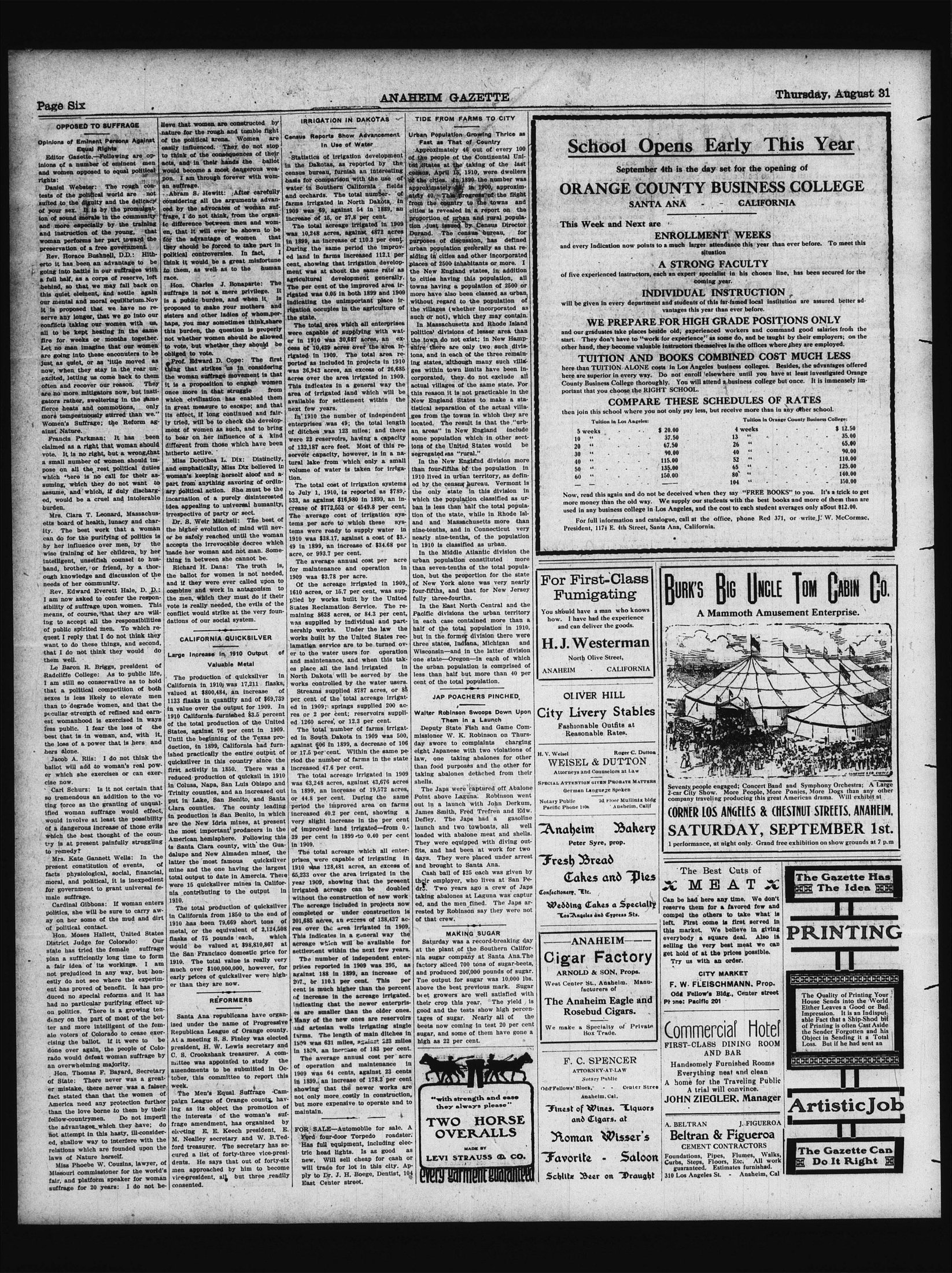
Searchable text
OPPOSED TO SUFFRAGE
Opinions of Eminent Persons Against Equal Rights
Editor Gazette.—Following are opinions of a number of eminent men and women opposed to equal political rights:
Daniel Webster: The rough contests of the political world are not suited to the dignity and the delicacy of your sex. It is by the promulgation of sound morals in the community and more especially by the training and instruction of the young, that woman performs her part toward the preservation of a free government.
Rev. Horace Bushnell, D.D.: Hitherto it has been an advantage to be going into battle in our suffrages with a full half, as a corps of reserve, left behind, so that we may fall back on this quiet element, and settle again our mental and moral equilibrium. Nov it is proposed that we have no reserve any longer, that we go into our conflicts taking our women with us, all to be kept heating in the same fire for weeks or months together. Let no man imagine that our women are going into these enunciators to be just as quiet, or as 'little moved as now, when they stay in the rear unexcited, letting us come back to them often and recover our reason. They are no more mitigators now, but instigators rather, sweltering in the same fierce heats and commotions, only more tempestuously stirred than we.' Women's Suffrage; the Reform against Nature.
Francis Parkman: It has been claimed as a right that woman should vote. It is no right, but a wrong, that a small number of women should impose on all the rest political duties
leave that women are constructed by nature for the rough and tumble fight of the political arena. Women are easily influenced. They do not stop to think of the consequences of their acts, and in their hands the ballot would become a most dangerous weapon. I am through forever with woman suffrage.
Abram S. Hewitt: After carefully considering all the arguments advanced by the advocates of woman suffrage, I do not think, from the organic difference between men and women, that it will ever be shown to be for the advantage of women that they should be forced to take part in political controversies. In fact, I think it would be a great misfortune to them, as well as to the human race.
Hon. Charles J. Bonaparte: The suffrage is not a mere privilege. It is a public burden, and when it is proposed to make your mothers and sisters and other ladies of whom perhaps you may sometimes think share this burden, the question is properly not whether women should be allowed to vote, but whether they should be obliged to vote.
Prof. Edward D. Cope: The first thing that strikes us in considering the woman suffrage movement is that it is a proposition to engage women once more in that struggle from which civilization has enabled them in great measure to escape; and that its effect, if long continued and fairly tried, will be to check the development of women as such, and to bring to bear on her influence of a kind different from those which have been hitherto active.
Miss Dorothea L. Dix: Distinctly, and emphatically, Miss Dix believed in women's keeping herself aloof and a-
excited, letting us come back to them often and recover our reason. They are no more mitigators now, but instigators rather, sweltering in the same fierce heats and commotions, only more tempestuously stirred than we." Women's Suffrage; the Reform against Nature.
Francis Parkman: It has been claimed as a right that woman should vote. It is no right, but a wrong that a small number of women should impose on all the rest political duties which "here is no call for their assuming, which they do not want to assume, and which, if duly discharged, would be a cruel and intolerable burden.
Mrs. Clara T. Leonard, Massachusetts board of health, lunacy and charity. The best work that a woman can do for the purifying of politics is by her influence over men, by the wise training of her children, by her intelligent, unselfish counsel to husband, brother, or friend, by a thorough knowledge and discussion of the needs of her community.
Rev. Edward Everett Hale, D. D.: I am now asked to confer the responsibility of suffrage upon women. This means, of course, that they are willing to accept all the responsibilities of public spirited men. To which request I reply that I do not think they want to do these things, and second, that I do not think they would do them well.
Le Baron R. Briggs, president of Radcliffe College: As to public life, I am still so conservative as to hold that a political competition of both sexes is less likely to elevate men than to degrade women, and that the peculiar strength of refined and earnest womanhood is exercised in ways less public. I fear the loss of the best that is in woman, and, with it, the loss of a power that is hers and hers alone.
Jacob A. Rlis: I do not think the ballot will add to woman's real power which she exercises or can exercise now.
Carl Schurz: Is it not certain that so tremendous an addition to the voting force as the granting of unqualified woman suffrage would effect, would involve at least the possibility of a dangerous increase of those evils which the best thought of the country is at present painfully struggling to remedy?
Mrs. Kate Gannett Wells: In the present constitution of events, of facts physiological, social, financial, moral, and political, it is inexpedient for government to grant universal female suffrage.
The woman suffrage movement is that it is a proposition to engage women once more in that struggle from which civilization has enabled them in great measure to escape; and that its effect, if long continued and fairly tried, will be to check the development of women as such, and to bring to bear on her influence of a kind different from those which have been hitherto active.
Miss Dorothea L. Dix: Distinctly, and emphatically, Miss Dix believed in woman's keeping herself aloof and apart from anything savoring of ordinary political action. She must be the incarnation of a purely disinterested idea appealing to universal humanity, irrespective of party or sect.
Dr. S. Weir Mitchell: The best of the higher evolution of mind will never be safely reached until the woman accepts the irrevocable decree which made her woman and not man. Something in between she cannot be.
Richard H. Dana: The truth is, the ballot for women is not needed, and if they were ever called upon to combine and work in antagonism to the men, which they must do if their vote is really needed, the evils of the conflict would strike at the very foundations of our social system.
CALIFORNIA QUICKSILVER
Large Increase in 1910 Output of Valuable Metal
The production of quicksilver in California in 1910 was 17,211 flasks, valued at $800,484, an increase of 1133 flasks in quantity and of $69,739 in value over the output for 1909. In 1910 California furnished 83.5 percent of the total production of the United States, against 76 per cent in 1909. Until the beginning of the Texas production, in 1899, California had furnished practically the entire output of quicksilver in this country since the first activity in 1850. There was a reduced production of quicksilver in 1910 in Colusa, Napa, San Luis Obispo and Trinity counties, and an increased output in Lake, San Benito, and Santa Clara counties. The county leading in production is San Benito, in which are the New Idria mines, at present the most important producers in the American hemisphere. Following this Santa Clara county, with the Guadalupe and New Almaden mines, the latter the most famous quicksilver mine and the one having the largest total output to date in America. There were 15 quicksilver mines in California contributing to the output in 1910.
The total acreage was 63,248 acres, aged in 1899, an increase or 44.8 per cent. During the improved increased 40.2 per cent very slight increase of improved land increased 39 per cent in 1899 in 1909.
The total acreage prises were capable of 1910 was 128,481 acres 65,233 over the area year 1909, showing irrigated acreage without the construc-
Mrs. Kate Gannett Wells: In the present constitution of events, of facts physiological, social, financial, moral, and political, it is inexpedient for government to grant universal female suffrage.
Cardinal Gibbons: If woman enters politics, she will be sure to carry away on her some of the mud and dirt of political contact.
Hon. Moses Hallett, United States District Judge for Colorado: Our state has tried the female suffrage plan a sufficiently long time to form a fair idea of its workings. I am not prejudiced in any way, but honestly do not see where the experiment has proved of benefit. It has produced no special reforms and it has had no particular purifying effect upon politics. There is a growing tendency on the part of most of the better and more intelligent of the female voters of Colorado to cease exercising the ballot. If it were to be done over again, the people of Colorado would defeat woman suffrage by an overwhelming majority.
Hon. Thomas F. Bayard, Secretary of State: There never was a greater mistake, there never was a falser fact stated than that the women of America need any protection further than the love borne to them by their fellow-countrymen. Do not imperil the advantages which they have; do not attempt in this hasty, ill-considered, shallow way to interfere with the relations which are founded upon the laws of Nature herself.
Miss Phoebe W. Couzins, lawyer, of Missouri commissioner for the world's fair, and platform speaker for woman suffrage for 20 years: I do not be put in Lake, San Benito, and Santa Clara counties. The county leading in production is San Benito, in which are the New Idria mines, at present the most important producers in the American hemisphere. Following this is Santa Clara county, with the Guadalupe and New Almaden mines, the latter the most famous quicksilver mine and the one having the largest total output to date in Amercia. There were 15 quicksilver mines in California contributing to the output in 1910.
The total production of quicksilver in California from 1850 to the end of 1910 has been 79,669 short tons of metal, or the equivalent of 2,124,508 flasks of 75 pounds each, which would be valued at $98,810,867 at the San Francisco domestic price for 1910. The total value is really very much over $100,000,000, however, for early prices of quicksilver were higher than they are now.
REFORMERS
Santa Ana republicans have organized under the name of Progressive Republican League of Orange county. At a meeting S. S. Finley was elected president, H. W. Lewis secretary and C. S. Crookshank treasurer. A committee was appointed to study the amendments to be submitted in October, this committee to report this week.
The Men's Equal Suffrage Campaign League of Orange county having as its object the promotion of the interests of the woman's suffrage amendment, has organized by electing E. E. Keech president, E. M. Nealley secretary and W. B.Tedford treasurer. The secretary has secured a list of forty-three vice-presidents. He says that out of forty-six men approached by him to become vice-president, all but three readily consented.
The total acreage prises were capable of increased 40.2 per cent very slight increase of improved land in 39 per cent in 1899 in 1909.
The number of prises reported in 18 against 188 in 1899 207., or 110.1 per cent is much higher of increase in the indicating that these are smaller than Many of the new or artesian wells farms. The length of 1909 was 631 miles, in 1899, an increase.
The average annual operation and 1909 was 64 cents, in 1899, an increase showing that the not only more costly but more expensive maintain.
FOR SALE—Automobiles Ford four-door Truck Has full equipment tric head lights. New Will sell or will trade for lot ply to Dr. J. H. East Center street
IRRIGATION IN DAKOTAS
Census Reports Show Advancement in Use of Water
Statistics of irrigation development in the Dakotas, as reported by the census bureau, furnish an interesting basis for comparison with the use of water in Southern California fields and orchards. The total number of farms irrigated in North Dakota, in 1909 was 69, against 54 in 1889, an increase of 15, or 27.8 per cent.
The total acreage irrigated in 1909 was 10,248 acres, against 4872 acres in 1899, an increase of 110.3 per cent. During the same period the improved land in farms increased 112.1 per cent, showing that irrigation development was at about the same rate as agricultural development generally. The per cent of the improved area irrigated was 0.05 in both 1899 and 1909 indicating the unimportant place irrigation occupies in the agriculture of the state.
The total area which all enterprises were capable of supplying with water in 1910 was 30,687 acres, an excess of 10,439 acres over the area irrigated in 1909. The total area reported as included in projects in 1910 was 36,943 acres, an excess of 26,685 acres over the area irrigated in 1909. This indicates in a general way the area of irrigated land which will be available for settlement within the next few years.
In 1910 the number of independent enterprises was 49; the total length of ditches was 123 miles; and there were 22 reservoirs, having a capacity of 132,187 acre feet. Most of this reservoir capacity, however, is in a natural lake from which only a small volume of water is taken for irrigation.
TIDE FROM FARMS TO CITY
Urban Population Growing Thrice as Fast as That of Country
Approximately 46 out of every 100 of the people of the Continental United States at the taking of the last census, April 15, 1910, were dwellers of the cities. In 1890 the number was approximately 38; in 1900, approximately 40. This progress of the flight from the country to the towns and cities is revealed in a report on the proportion of urban and rural population just issued by Census Director Durand. The census bureau, for purposes of discussion, has defined urban population generally as that residing in cities and other incorporated places of 2500 inhabitants or more. I the New England states, in addition to cities having this population, all towns having a population of 2500 or more have also been classed as urban without regard to the population of the villages (whether incorporated as such or not), which they may contain.
In Massachusetts and Rhode Island political divisions of lesser area than the town do not exist; in New Hampshire there are only two such divisions, and in each of the three remaining states, although many such villages within town limits have been incorporated, they do not exclude all actual villages of the same state. For this reason it is not practicable in the New England States to make a statistical separation of the actual villages from the towns in which they are located. The result is that the "urban areas" in New England include some population which in other sections of the United States would be segregated as "rural."
In the New England division more than four-fifths of the population in
acres over the area irrigated in 1909. This indicates in a general way the area of irrigated land which will be available for settlement within the next few years.
In 1910 the number of independent enterprises was 49; the total length of ditches was 123 miles; and there were 22 reservoirs, having a capacity of 132,187 acre feet. Most of this reservoir capacity, however, is in a natural lake from which only a small volume of water is taken for irrigation.
The total cost of irrigation systems to July 1, 1910, is reported as $789.533, as against $16,980 in 1899, an increase of $772,553 or 4549.8 per cent. The average cost of irrigation systems per acre to which these systems were ready to supply water in 1910 was $38.17, against a cost of $3.49 in 1899, an increase of $34.68 per acre, or 993.7 per cent.
The average annual cost per acre for maintenance and operation in 1909 was $3.78 per acre.
Of the acreage irrigated in 1909, 1610 acres, or 15.7 per cent, was supplied by works built by the United States Reclamation Service. The remaining 8638 acres, or 84.3 per cent, was supplied by individual and partnership works. Under the law the works built by the United States reclamation service are to be turned over to the water users for operation and maintenance, and when this takes place all the land irrigated in North Dakota will be served by the works controlled by the water users.
Streams supplied 8787 acres, or 85 per cent of the total acreage irrigated in 1909; springs supplied 200 acres or 2 per cent; reservoirs supplied 1260 acres, or 12.3 per cent.
The total number of farms irrigated in South Dakota in 1909 was 500, against 606 in 1899, a decrease of 106 or 17.5 per cent. Within the same period the number of farms in the state increased 47.6 per cent.
The total acreage irrigated in 1909 was 63,248 acres, against 43,676 acres in 1899, an increase of 19,572 acres, or 44.8 per cent. During the same period the improved area on farms increased 40.2 per cent, showing a very slight increase in the per cent of improved land irrigated—from 0.39 per cent in 1899 to 0.40 per cent in 1909.
The total acreage which all enterprises were capable of irrigating in 1910 was 128,481 acres, an excess of 65,233 over the area irrigated in the year 1909, showing that the present irrigated acreage can be doubled without the construction of new work corporated, they do not exclude all actual villages of the same state. For this reason it is not practicable in the New England States to make a statistical separation of the actual villages from the towns in which they are located. The result is that the "urban areas" in New England include some population which in other sections of the United States would be segregated as "rural."
In the New England division more than four-fifths of the population in 1910 lived in urban territory, as defined by the census bureau. Vermont is the only state in this division in which the population classified as urban is less than half the total population of the state, while in Rhode Island and Massachusetts more than nine-tenths, and in Connecticut very nearly nine-tenths, of the population in 1910 is classified as urban.
In the Middle Atlantic division the urban population constituted more than seven-tenths of the total population, but the proportion for the state of New York alone was very nearly four-fifths, and that for New Jersey fully three-fourths.
In the East North Central and the Pacific divisions the urban territory in each case contained more than a half of the total population in 1910, but in the former division there were three states, Indiana, Michigan and Wisconsin—and in the latter division one state—Oregon—in each of which the urban population is comprised of less than half but more than 40 per cent of the total population.
JAP POACHERS PINCHED.
Walter Robinson Swoops Down Upon Them in a Launch
Deputy State Fish and Game Commissioner W. K. Robinson on Thursday swore to complaints charging eight Japanese with two violations of law, one taking abalones for other than food purposes and the other for taking abalones detached from their shells.
The Japs were captured off Abalone Point above Laguna. Robinson went out in a launch with John Derkum, James Smith, Fred Trefren and Edw. Defley. The Japs had a gasoline launch and two towboats, all well loaded with abalone meat and shells. They were equipped with diving outfits, and had been at work for two days. They were placed under arrest and brought to Santa Ana.
Cash bail of $25 each was given by their employer, who lives at San Pedro. Two years ago a crew of Japs taking abalones at Laguna was captur
period the improved area on farms increased 40.2 per cent, showing a very slight increase in the per cent of improved land irrigated—from 0.39 per cent in 1899 to 0.40 per cent in 1909.
The total acreage which all enterprises were capable of irrigating in 1910 was 128,481 acres, an excess of 65,233 over the area irrigated in the year 1909, showing that the present irrigated acreage can be doubled without the construction of new work. The acreage included in projects now completed or under construction is 201,685 acres, an excess of 138,437 acres over the area irrigated in 1909. This indicates in a general way the acreage which will be available for settlement within the next few years.
The number of independent enterprises reported in 1909 was 395, as against 188 in 1899, an increase of 207., br 110.1 per cent. This percent is much higher than the percent of increase in the acreage irrigated, indicating that the newer enterprises are smaller than the older ones. Many of the new ones are reservoirs and artesian wells irrigating single farms. The length of main ditches in 1909 was 631 miles, against 223 miles in 1899, an increase of 183 per cent.
The average annual cost per acre of operation and maintenance in 1909 was 64 cents, against 23 cents in 1899, an increase of 178.3 per cent showing that the newer works are not only more costly in construction, but more expensive to operate and to maintain.
FOR SALE—Automobile for sale. A Ford four-door Torpedo roadster. Has full equipment, including electric head lights. Is as good as new. Will sell cheap for cash or will trade for lot in this city. Apply to Dr. J. H. Boege, Dentist, 104 East Center street.
MAKING SUGAR
Saturday was a record-breaking day at the plant of the Southern California sugar company at Santa Ana. The factory sliced 700 tons of sugar-beets, and produced 200,000 pounds of sugar. The output for sugar was 10,000 lbs. above the best previous mark. Sugar beet growers are well satisfied with their crop this year. The yield is good and the tests show high percentages of sugar. Nearly all of the beets now coming in test 20 per cent sugar, and some of them have gone a high as 22 per cent.
ANAHEIM
Cigar Factory
ARNOLD & SON, Props.
West Center St., Anaheim. Manufacturers of
The Anaheim Eagle and Rosebud Cigars.
We make a Specialty of Private Box Trade.
F. C. SPENCER
ATTORNEY-AT-LAW
Notary Public
Odd'Fellows' Block,
Center Street
Anaheim, Cal.
Finest of Wines, Liquors and Cigars, at
Roman Wisser's
Favorite - Saloon
Schlitz Beer on Draught
School Opens Early This Year
September 4th is the day set for the opening of
ORANGE COUNTY BUSINESS COLLEGE
SANTA ANA - CALIFORNIA
Week and Next are
ENROLLMENT WEEKS
Indication now points to a much larger attendance this year than ever before. To meet this situation
A STRONG FACULTY
Experienced instructors, each an expert specialist in his chosen line, has been secured for the coming year.
INDIVIDUAL INSTRUCTION
In every department and students of this far-famed local institution are assured better advantages this year than ever before.
THE PREPARE FOR HIGH GRADE POSITIONS ONLY
Graduates take places beside old, experienced workers and command good salaries from the job they don't have to "work for experience" as some do, and be taught by their employers; on the other hand, they become valuable instructors themselves in the offices where they are employed.
TITION AND BOOKS COMBINED COST MUCH LESS
TITION ALONE costs in Los Angeles business colleges. Besides, the advantages offered superior in every way. Do not enroll elsewhere until you have at least investigated Orange Business College thoroughly. You will attend a business college but once. It is immensely im-portant if you choose the RIGHT SCHOOL.
COMPARE THESE SCHEDULES OF RATES
This school where you not only pay less, but receive more than in any other school.
Tuition in Los Angeles:
$20.00
4 weeks $12.50
37.50
13 “
35.00
67.50
26 “
65.00
90.00
40 “
90.00
115.00
52 “
110.00
135.00
65 “
125.00
150.00
80 “
140.00
COMPARE THESE SCHEDULES OF RATES
this school where you not only pay less, but receive more than in any other school.
Tuition in Los Angeles:
$ 20.00 4 weeks $ 12.50
37.50 13 " 35.00
67.50 26 " 65.00
90.00 40 " 90.00
115.00 52 " 110.00
135.00 65 " 125.00
150.00 80 " 140.00
104 " 150.00
This again and do not be deceived when they say “FREE BOOKS” to you. It’s a trick to get away than the old way. We supply our students with the best books and more of them than are business college in Los Angeles, and the cost to each student averages only about $12.00.
Information and catalogue, call at the office, phone Red 371, or write J. W. McCormac,
1174 E. 4th Street, Santa Ana, California.
BURK'S BIG UNCLE TOM GABIN CO.
A Mammoth Amusement Enterprise.
Seventy people engaged; Concert Band and Symphony Orchestra; A Large 2-car City Show. More People, More Ponies, More Dogs than any other company traveling producing this great American drama. Will exhibit at CORNER LOS ANGELES & CHESTNUT STREETS, ANAHEIM,
SATURDAY, SEPTEMBER 1st.
1 performance, at night only. Grand free exhibition on show grounds at 7 p.m.
The Best Cuts of MEAT
The Gazette Has The Idea
CORNER LOS ANGELES & CHESTNUT STREETS, ANAHEIM,
SATURDAY, SEPTEMBER 1st.
1 performance, at night only. Grand free exhibition on show grounds at 7 p.m.
The Best Cuts of MEAT
Can be had here any time. We don't reserve them for a favored few and compel the others to take what is left. First come is first served in this market. We believe in giving everybody a square deal. Also in selling the very best meat we can get hold of at the prices possible.
Try us with an order.
CITY MARKET
F. W. FLEISCHMANN, Prop.
Odd Fellow's Bldg., Center street
Phone: Pacific 201
Commercial Hotel
FIRST-CLASS DINING ROOM AND BAR
Handsomely Furnished Rooms
Everything neat and clean
A home for the Traveling Public
A trial will convince.
JOHN ZIEGLER, Manager
A. BELTRAN J. FIGUEROA
Beltran & Figueroa
CEMENT CONTRACTORS
Foundations, Pipes, Flumes, Walks, Curbs, Steps, Floors, Etc. All work guaranteed. Estimates furnishad.
310 Los Angeles St. - Anaheim, Cal
The Gazette Has The Idea
PRINTING
The Quality of Printing Your House Sends into the World Either Leaves a Good or Bad Impression. It is an Indisputable Fact that a Ship-Shod bit of Printing is often Cast Aside the Sender Forgotten and his Object in Sending it a Total Loss. But if he had sent an Artistic Job
The Gazette Can Do It Right