anaheim-gazette 1911-08-10
Scanned page
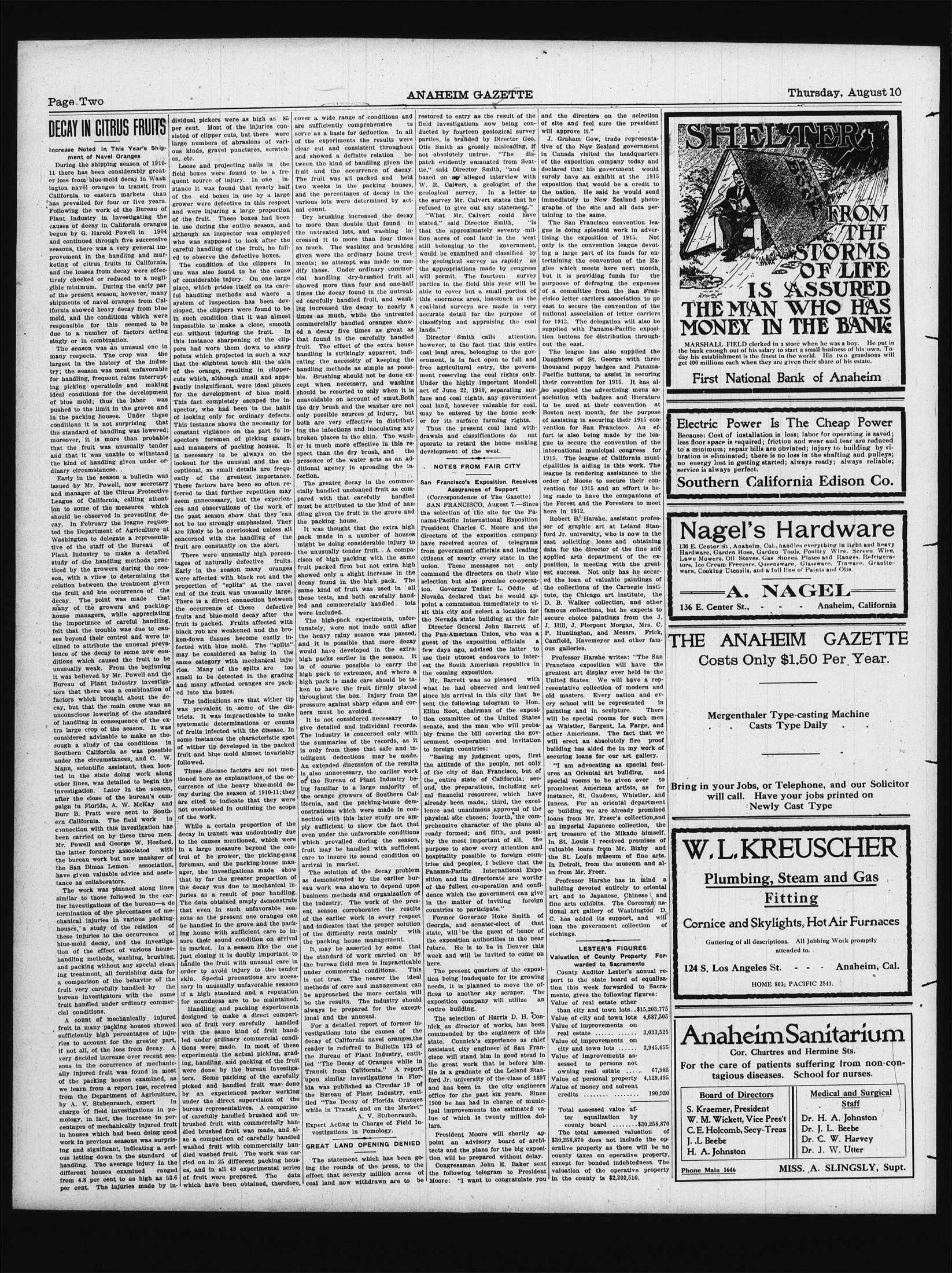
Searchable text
DECAY IN CITRUS FRUITS
Increase Noted in This Year's Shipment of Navel Oranges
During the shipping season of 1910-11 there has been considerably greater loss from blue-mold decay in Washington navel oranges in transit from California to eastern markets than has prevailed for four or five years. Following the work of the Bureau of Plant Industry in investigating the causes of decay in California oranges begun by G. Harold Powell in 1904 and continued through five successive seasons, there was a very general improvement in the handling and marketing of citrus fruits in California, and the losses from decay were effectively checked or reduced to a negligible minimum. During the early par of the present season, however, many shipments of navel oranges from California showed heavy decay from blue mold, and the conditions which were responsible for this seemed to be due to a number of factors acting singly or in combination.
The season was an unusual one in many respects. The crop was the largest in the history of the industry; the season was most unfavorable for handling, frequent rains interrupting picking operations and making ideal conditions for the development of blue mold; thus the labor was pushed to the limit in the groves and in the packing houses. Under these conditions it is not surprising that the standard of handling was lowered; moreover, it is more than probable that the fruit was unusually tender and that it was unable to withstand the kind of handling given under ordinary circumstance.
dividual pickers were as high as 85 per cent. Most of the injuries consisted of clipper cuts, but there were large numbers of abrasions of various kinds, gravel punctures, scratches, etc.
Loose and projecting nails in the field boxes were found to be a frequent source of injury. In one instance it was found that nearly half of the eld boxes in use by a large grower were defective in this respect and were injuring a large proportion of the fruit. These boxes had been in use during the entire season, and although an inspector was employed who was supposed to look after the careful handling of the fruit, he failed to observe the defective boxes.
The condition of the clippers in use was also found to be the cause of considerable injury. On one large place, which prides itself on its careful handling methods and where a system of inspection has been developed, the clippers were found to be in such condition that it was almost impossible to make a close, smooth cut without injuring the fruit. In this instance sharpening of the clippers had worn them down to sharp points which projected in such a way that the slightest touch slit the skin of the orange, resulting in clippercuts which, although small and apparently insignificant, were ideal places for the development of blue mold. This fact completely escaped the inspector, who had been in the habit of looking only for ordinary defects. This instance shows the necessity for constant vigilance on the part fo inspectors foremen of picking gangs, and managers of packing houses. It is necessary to be always on the lookout for the unusual and exceptional, as small details are frequently covered a wide range are sufficiently conserved as a basis for of the experiments clear cut and confined and showed a definite between the kind of fruit and the occurrence. The fruit was all two weeks in the year and the percentage various lots were on usual count.
Dry brushing increased to more than doubled the untreated lots, creased it to more as much. The was given were the orders; no attempt diffy these. Under special handling dry showed more than times the decay followed carefully handled increased the times as much, while commercially handled a decay five times that found in the fruit. The effect of handling is striking cating the necessities handling methods so able. Brushing should when necessary should be resorted to unavoidable on account of the dry brush and only possible sources both are very effective in treating infections broken places in ther er is much more evident than the dry presence of the waditional agency in
for handling, frequent rains interrupting picking operations and making ideal conditions for the development of blue mold; thus the labor was pushed to the limit in the groves and in the packing houses. Under these conditions it is not surprising that the standard of handling was lowered; moreover, it is more than probable that the fruit was unusually tender and that it was unable to withstand the kind of handling given under ordinary circumstance.
Early in the season a bulletin was issued by Mr. Powell, now secretary and manager of the Citrus Protective League of California, calling attention to some of the measures which should be observed in preventing decay. In February the league requested the Department of Agriculture at Washington to delegate a representative of the staff of the Bureau of Plant Industry to make a detailed study of the handling methods practiced by the growers during the season, with a view to determining the relation between the treatment given the fruit and hte occurrence of the decay. The point was made that many of the growers and packing-house managers, while appreciating the importance of careful handling, felt that the trouble was due to causes beyond their control and were inclined to attribute the unusual prevalence of the decay to some new conditions which caused the fruit to be unusually weak. From the beginning it was believed by Mr. Powell and the Bureau of Plant Industry investigators that there was a combination of factors which brought about the decay, but that the main cause was an unconscious lowering of the standard of handling in consequence of the extra large crop of the season. It was considered advisable to make as thorough a study of the conditions in Southern California as was possible under the circumstances, and C. W. Mann, scientific assistant, then located in the state doing work along other lines, was detailed to begin the investigation. Later in the season, after the close of the bureau's campaign in Florida, A. W. McKay and Burr B. Pratt were sent to Southern California. The field work in connection with this investigation has been carried on by these three men. Mr. Powell and George W. Hosford, the latter formerly associated with the bureau work but now manager of the San Dimas Lemon association, have given valuable advice and assistance as collaborators.
The work was planned along lines similar to those followed in the ear-
cuts which, although small and apparently insignificant, were ideal places for the development of blue mold. This fact completely escaped the inspector, who had been in the habit of looking only for ordinary defects. This instance shows the necessity for constant vigilance on the part fo inspectors foremen of picking gangs, and managers of packing houses. It is necessary to be always on the lookout for the unusual and the exceptional, as small details are frequently of the greatest importance. These factors have been so often referred to that further repetition may seem unnecessary, but the experiences and observations of the work of the past season show that they can not be too strongly emphasized. They are likely to be overlooked unless all concerned with the handling of the fruit are constantly on the alert.
There were unusually high percentages of naturally defective fruits. Early in the season many oranges were affected with black rot and the proportion of "splits" at the navel end of the fruit was unusually large. There is a direct connection between the occurrence of these defective fruits and blue-mold decay after the fruit is packed. Fruits affected with black rot are weakened and the broken-down tissues become easily infected with blue mold. The "splits" may be considered as being in the same category with mechanical injuries. Many of the splits are too small to be detected in the grading and many affected oranges are packed into the boxes.
The indications are that wither tip was prevalent in some of the districts. It was impracticable to make systematic determinations or counts of fruits infected with the disease. In some instances the characteristic spot of wither tip developed in the packed fruit and blue mold almost invariably followed.
These disease factors are not mentioned here as explanations of the occurrence of the heavy blue-mold decay during the season of 1910-11; they are cited to indicate that they were not overlooked in outlining the scope of the work.
While a certain proportion of the decay in transit was undoubtedly due to the causes mentioned, which were in a large measure beyond the control of he grower, the picking-gang foreman, and the packing-house manager, the investigations made show that by far the greater proportion of the decay was due to mechanical injuries as a result of poor handling.
Brushing should cease when necessary should be resorted to unavoidable on account of dry brush and only possible source both are very effective in treating infections at broken places in ther er is much more efficient than the dry presence of the waste additional agency infection.
The greater decadically handled uncleared with that must be attributed to dling given the fruiting house.
It was thought that pack made in a might be doing correct use of unusually tender rison of high pack fruit packed firm showed only a slip decay found in ther same kind of fruiting these tests, and bled and commercial were included.
The high-pack tunately, were not heavy rainy snd it is possible would have developed high packs earlier is of course posi high pack to extra high pack is made ken to have ther throughout the box pressure against sners must be avail.
It is not consider give detailed and The industry is othe summaries o f is only from these telligent deductio An extended discus is also unnecessa af of the Bureau o f ing familiar to ad ther orange grower ifornia, and ther onstrations which nection with this pply sufficient to even under ther uch which prevailed fruit may be hard care to insure its arrival in market.
The solution o as demonstrated de eau work was sh business methods
after the close of the bureau's paign in Florida, A. W. McKay and Burr B. Pratt were sent to Southern California. The field work in connection with this investigation has been carried on by these three men. Mr. Powell and George W. Hosford, the latter formerly associated with the bureau work but now manager of the San Dimas Lemon association, have given valuable advice and assistance as collaborators.
The work was planned along lines similar to those followed in the earlier investigations of the bureau—a determination of the percentages of mechanical injuries in various packing houses, a study of the relation of these injuries to the occurrence of blue-mold decay, and the investigation of the effect of various house-handling methods, washing, brushing, and packing without any special cleaning treatment, all furnishing data for a comparison of the behavior of the fruit very carefully handled by the bureau investigators with the same fruit handled under ordinary commercial conditions.
A count of mechanically injured fruit in many packing houses showed sufficiently high percentages of injuries to account for the greater part, if not all, of the loss from decay. A very decided increase over recent seasons in the occurrence of mechanically injured fruit was found in most of the packing houses examined, as we learn from a report just received from the Department of Agriculture, by A. V. Stubenrauch, expert in charge of field investigations in pomology, in fact, the increase in percentages of mechanically injured fruit in houses which had been doing good work in previous seasons was surprising and significant, indicating a serious letting down in the standard of handling. The average injury in the different houses examined ranged from 4.8 per cent to as high as 53.6 per cent. The injuries made by in-
While a certain proportion of the decay in transit was undoubtedly due to the causes mentioned, which were in a large measure beyond the control of he grower, the picking-gang foreman, and the packing-house manager, the investigations made show that by far the greater proportion of the decay was due to mechanical injuries as a result of poor handling. The data obtained amply demonstrate that even in such unfavorable seasons as the present one oranges can be handled in the grove and the packing house with sufficient care to insure their sound condition on arrival in market. In a season like the one just closing it is doubly important to handle the fruit with unusual care in order to avoid injury to the tender skin. Special precautions are necessary in unusually unfavorable seasons if a high standard and a reputation for soundness are to be maintained.
Handling and packing experiments designed to make a direct comparison of fruit very carefully handled with the same kind of fruit handled under ordinary commercial conditions were made. In most of these experiments the actual picking, grading, handling, and packing of the fruit were done by the bureau investigators. Some packing of the carefully picked and handled fruit was done by an experienced packer working under the direct supervision of the bureau representatives. A comparison of carefully handled brushed and unbrushed fruit with commercially handled brushed fruit was made, and also a comparison of carefully handled washed fruit with commercially handled washed fruit. The work was carried on in 25 different packing houses, and in all 49 experimental series of fruit were prepared. The data which have been obtained, therefore,
are cited to indicate that they were not overlooked in outlining the scope of the work.
While a certain proportion of the decay in transit was undoubtedly due to the causes mentioned, which were in a large measure beyond the control of he grower, the picking-gang foreman, and the packing-house manager, the investigations made show that by far the greater proportion of the decay was due to mechanical injuries as a result of poor handling. The data obtained amply demonstrate that even in such unfavorable seasons as the present one oranges can be handled in the grove and the packing house with sufficient care to insure their sound condition on arrival in market. In a season like the one just closing it is doubly important to handle the fruit with unusual care in order to avoid injury to the tender skin. Special precautions are necessary in unusually unfavorable seasons if a high standard and a reputation for soundness are to be maintained.
Handling and packing experiments designed to make a direct comparison of fruit very carefully handled with the same kind of fruit handled under ordinary commercial conditions were made. In most of these experiments the actual picking, grading, handling, and packing of the fruit were done by the bureau investigators. Some packing of the carefully picked and handled fruit was done by an experienced packer working under the direct supervision of the bureau representatives. A comparison of carefully handled brushed and unbrushed fruit with commercially handled brushed fruit was made, and also a comparison of carefully handled washed fruit with commercially handled washed fruit. The work was carried on in 25 different packing houses, and in all 49 experimental series of fruit were prepared. The data which have been obtained, therefore,
are cited to indicate that they were not overlooked in outlining the scope of the work.
While a certain proportion of the decay in transit was undoubtedly due to the causes mentioned, which were in a large measure beyond the control of he grower, the picking-gang foreman, and the packing-house manager, the investigations made show that by far the greater proportion of the decay was due to mechanical injuries as a result of poor handling. The data obtained amply demonstrate that even in such unfavorable seasons as the present one oranges can be handled in the grove and the packing house with sufficient care to insure their sound condition on arrival in market. In a season like the one just closing it is doubly important to handle the fruit with unusual care in order to avoid injury to the tender skin. Special precautions are necessary in unusually unfavorable seasons if a high standard and a reputation for soundness are to be maintained.
Handling and packing experiments designed to make a direct comparison of fruit very carefully handled with the same kind of fruit handled under ordinary commercial conditions were made. In most of these experiments the actual picking, grading, handling, and packing of the fruit were done by the bureau investigators. Some packing of the carefully picked and handled fruit was done by an experienced packer working under the direct supervision of the bureau representatives. A comparison of carefully handled brushed and unbrushed fruit with commercially handled brushed fruit was made, and also a comparison of carefully handled washed fruit with commercially handled washed fruit. The work was carried on in 25 different packing houses, and in all 49 experimental series of fruit were prepared. The data which have been obtained, therefore,
are cited to indicate that they were not overlooked in outlining the scope of the work.
While a certain proportion of the decay in transit was undoubtedly due to the causes mentioned, which were in a large measure beyond the control of he grower, the picking-gang foreman, and the packing-house manager, the investigations made show that by far the greater proportion of the decay was due to mechanical injuries as a result of poor handling. The data obtained amply demonstrate that even in such unfavorable seasons as the present one oranges can be handled in the grove and the packing house with sufficient care to insure their sound condition on arrival in market. In a season like the one just closing it is doubly important to handle the fruit with unusual care in order to avoid injury to the tender skin. Special precautions are necessary in unusually unfavorable seasons if a high standard and a reputation for soundness are to be maintained.
Handling and packing experiments designed to make a direct comparison of fruit very carefully handled with the same kind of fruit handled under ordinary commercial conditions were made. In most of these experiments the actual picking, grading, handling, and packing of the fruit were done by the bureau investigators. Some packing of the carefully picked and handled fruit was done by an experienced packer working under the direct supervision of the bureau representatives. A comparison of carefully handled brushed and unbrushed fruit with commercially handled brushed fruit was made, and also a comparison of carefully handled washed fruit with commercially handled washed fruit. The work was carried on in 25 different packing houses, and in all 49 experimental series of fruit were prepared. The data which have been obtained, therefore,
are cited to indicate that they were not overlooked in outlining the scope of the work.
While a certain proportion of the decay in transit was undoubtedly due to the causes mentioned, which were in a large measure beyond the control of he grower, the picking-gang foreman, and the packing-house manager, the investigations made show that by far farthe greater proportionofthedecaywasduetomechanicalinjuriesasaresultofpoorhandling.Thedataobtainedamplydemonstratethateveninsuchunfavorableseasonsasthepresentoneorangescanbehandledinthegroveandthepackinghousewithsufficientcaretoinsuretheirsoundconditiononarrivalinmarket.Inaseasonlikethejustclosingitisdoublyimportanttohandlethefruitwithunusualcareinordertoavoidinjurytothetenderskin.Specialprecautionsaredesecessaryinunusuallyunfavorableseasonsifahighstandardandapreputationforsoundnessaretobemaintained.
Handling and packing experiments designed to make a direct comparison of fruit very carefully handled with the same kind of fruit handled under ordinary commercial conditions were made. In most of these experiments the actual picking, grading, handling, and packing of the fruit were done by the bureau investigators. Some packing of the carefully picked and handled fruit was done by an experienced packer working under the direct supervision of the bureau representatives. A comparison of carefully handled brushed and unbrushed fruit with commercially handled brushed fruit was made, and also a comparison of carefully handled washed fruit with commercially handled washed fruit. The work was carried on in 25 different packing houses, and in all 49 experimental series of fruit were prepared. The data which have been obtained, therefore,
are cited to indicate that they were not overlooked in outliningthescopeofthework.
While a certain proportion ofthedecayintransitwasundoubtedlyduetothecausesmentionedwhichwereinalargemeasurebeyondthecontrolofhegrower,thepicking-gangforeman,andthepacking-housewithsufficientcaretoinsuretheirsoundconditiononarrivalinmarket.Inaseasonlikethejustclosingitisdoublyimportanttohandlethefruitwithunusualcareinordertoavoidinjurytothetenderskin.Specialprecautionsaredesecessaryinunusuallyunfavorableseasonsifahighstandardandapreputationforsoundnessaretobemaintained.
Handling and packing experiments designed to make a direct comparison of fruit very carefully handed with the same kind of fruit handled under ordinary commercial conditions were made. In most of these experiments the actual picking, grading, handling, and packing of the fruit were done by the bureau investigators. Some packing of the carefully picked and handled fruit was done by an experienced packer working under the direct supervision ofthe bureau representatives. A comparison of carefully handled brushed and unbrushed fruit with commercially handled brushed fruit was made, and also a comparison of carefully handled washed fruit with commercially handled washed fruit. The work was carried on in 25 different packing houses, and in all 49 experimental series of fruit were prepared. The data which have been obtained, therefore,
are cited to indicate that they were not overlooked in outliningthescopeofthework.
While a certain proportionofthedecayintransitwasundoubtedlyduetothecausesmentionedwhichwereinalargemeasurebeyondthecontrolofhegrower,thepicking-gangforeman,andthepacking-housewithsufficientcaretoinsuretheirsoundconditiononarrivalinmarket.Inaseasonlikethejustclosingitisdoublyimportanttohandlethefruitwithunusualcareinordertoavoidinjurytothetenderskin.Specialprecautionsaredesecessaryinunusuallyunfavorableseasonsifahigh标准和apreputationforsoundnessaretobemaintained.
Handling and packing experiments designed to make a direct comparison of fruit very carefully handed with the same kind of fruit handled under ordinary commercial conditions were made. In most of these experiments the actual picking, grading, handling, and packing of the fruit were done by the bureau investigators. Some packing of the carefully picked and handled fruit was done by an experienced packer working under the direct supervision ofthe bureau representatives. A comparison of carefully handles brushed and unbrushed fruit with commercially handles brushed fruit was made, and also a comparison of carefully handles washed fruits with commercially handles washed fruits. The work was carried on in 25 different packing houses, and in all 49 experimental series of fruits were prepared. The data which have been obtained, therefore,
are cited to indicate that they were not overlooked in outliningthescopeofthework.
While a certain proportionofthedecayintransitwasundoubtedlyduetothecausesmentionedwhichwereinalargemeasurebeyondthecontrolofhegrower,thepicking-gangforeman,andthepacking-housewithsufficientcaretoinsuretheirsoundconditiononarrivalinmarket.InaseasonlikethejustclosingitisdoublyimportanttohANDLETHEFruit WITHUNUSUALCAREINORDERTOAVIOLISHINGTHEROUNDSTANDINGEFFECTTHATSEVERALCOALLANDNOW
ANAHEIM GAZETTE
cover a wide range of conditions and are sufficiently comprehensive to serve as a basis for deduction. In all of the experiments the results were clear cut and consistent throughout and showed a definite relation between the kind of handling given the fruit and the occurrence of decay. The fruit was all packed and held two weeks in the packing houses, and the percentages of decay in the various lots were determined by actual count.
Dry brushing increased the decay to more than double that found in the untreated lots, and washing increased it to more than four times as much. The washing and brushing given were the ordinary house treatments; no attempt was made to modify these. Under ordinary commercial handling dry-brushed fruit all showed more than four and one-half times the decay found in the untreated carefully handled fruit, and washing increased the decay to nearly 8 times as much, while the untreated commercially handled oranges showed a decay five times as great as that found in the carefully handled fruit. The effect of the extra house handling is strikingly apparent, indicating the necessity of keeping the handling methods as simple as possible. Brushing should not be done except when necessary, and washing should be resorted to only when it is unavoidable on account of smut. Both the dry brush and the washer are not only possible sources of injury, but both are very effective in distributing the infections and inoculating any broken places in the skin. The washer is much more effective in this respect than the dry brush, and the presence of the water acts as an additional agency in spreading the infection.
restored to entry as the result of the field investigations now being conducted by fourteen geological survey parties, is branded by Director Geo. Otis Smith as grossly misleading, if not absolutely untrue. "The dispatch evidently emanated from Seattle," said Director Smith, "and is based on an alleged interview with W. R. Calvert, a geologist of the geological survey. In a letter to the survey Mr. Calvert states that he refused to give out any statement."
"What Mr. Calvert could have stated," said Director Smith, "is that the approximately seventy million acres of coal land in the west still belonging to the government, would be examined and classified by the geological survey as rapidly as the appropriations made by congress will permit. The fourteen survey parties in the field this year will be able to cover but a small portion of this enormous area, inasmuch as the coal-land surveys are made in very accurate detail for the purpose of classifying and appraising the coal lands."
Director Smith calls attention, however, to the fact that this entire coal land area, belonging to the government, is in fact open to full and free agricultural entry, the government reserving the coal rights only. Under the highly important Mondell act of June 22, 1910, separating surface and coal rights, any government coal land, however valuable for coal, may be entered by the home seeker for its surface farming rights.
Thus the present coal land withdrawals and classifications do not operate to retard the home making development of the west.
NOTES FROM FAIR CITY
and the directors on the selection of site and feel sure the president will approve it."
J. Graham Gow, trade representative of the New Zealand government in Canada visited the headquarters of the exposition company today and declared that his government would surely have an exhibit at the 1915 exposition that would be a credit to the nation. He said he would send immediately to New Zealand photographs of the site and all data pertaining to the same.
The San Francisco convention league is doing splendid work in advertising the exposition of 1915. Not only is the convention league devoting a large part of its funds for entertaining the convention of the Eagles which meets here next month, but it is providing funds for the purpose of defraying the expenses of a committee from the San Francisco letter carriers association to go east to secure the convention of the national association of letter carriers for 1913. The delegation will also be supplied with Panama-Pacific exposition buttons for distribution throughout the east.
The league has also supplied the Daughters of St. George with three thousand poppy badges and Panama-Pacific buttons, to assist in securing their convention for 1915. It has also supplied the advertising mens association with badges and literature to be used at their convention at Boston next month, for the purpose of assisting in securing their 1915 convention for San Francisco. An effort is also being made by the league to secure the convention of the international municipal congress for 1915. The league of California municipalities is aiding in this work. The league is rendering assistance to
Brushing should not be done except when necessary, and washing should be resorted to only when it is unavoidable on account of smut. Both the dry brush and the washer are not only possible sources of injury, but both are very effective in distributing the infections and inoculating any broken places in the skin. The washer is much more effective in this respect than the dry brush, and the presence of the water acts as an additional agency in spreading the infection.
The greater decay in the commercially handled uncleaned fruit as compared with that carefully handled must be attributed to the kind of handling given the fruit in the grove and the packing house.
It was thought that the extra high pack made in a number of houses might be doing considerable injury to the unusually tender fruit. A comparison of high packing with the same fruit packed firm but not extra high showed only a slight increase in the decay found in the high pack. The same kind of fruit was used in all these tests, and both carefully handled and commercially handled lots were included.
The high-pack experiments, unfortunately, were not made until after the heavy rainy season was passed, and it is possible that more decay would have developed in the extra-high packs earlier in the season. It is of course possible to carry the high pack to extremes, and where a high pack is made care should be taken to have the fruit firmly placed throughout the box. Injury from the pressure against sharp edges and corners must be avoided.
It is not considered necessary to give detailed and individual records. The industry is concerned only with the summaries of the records, as it is only from these that safe and intelligent deductions may be made. An extended discussion of the results is also unnecessary, the earlier work of the Bureau of Plant Industry being familiar to a large majority of the orange growers of Southern California, and the packing-house demonstrations which were made in connection with this later study are amply sufficient to show the fact that even under the unfavorable conditions which prevailed during the season, fruit may be handled with sufficient care to insure its sound condition on arrival in market.
The solution of the decay problem as demonstrated by the earlier bureau work was shown to depend upon business methods and organization of
NOTES FROM FAIR CITY
San Francisco's Exposition Receives Assurances of Support
(Correspondence of The Gazette)
SAN FRANCISCO, August 7.—Since the selection of the site for the Panama-Pacific International Exposition President Charles C. Moore and the directors of the exposition company have received scores of telegrams from government officials and leading citizens of nearly every state in the union. These messages not only commend the directors on their wise selection but also promise co-operation. Governor Tasker L. Oddie of Nevada declared that he would appoint a commission immediately to visit this city and select a location for the Nevada state building at the fair.
Director General John Barrett of the Pan-American Union, who was a guest of the exposition officials a few days ago, advised the latter to use their utmost endeavors to interest the South American republics in the coming exposition.
Mr. Barrett was so pleased with what he had observed and learned since his arrival in this city that he sent the following telegram to Hon. Elihu Root, chairman of the exposition committee of the United States senate, and the man who will probably frame the bill covering the government co-operation and invitation to foreign countries:
"Basing my judgment upon, first the attitude of the people, not only of the city of San Francisco, but of the entire state of California; second, the preparations, including actual financial resources, which have already been made.; third, the excellence and unanimous approval of the physical site chosen; fourth, the comprehensive character of the plans already formed; and fifth, possibly the most important of all, the purpose to show every attention and hospitality possible to foreign countries and peoples, I believe that the Panama-Pacific International Exposition and its directorate are worthy of the fullest co-operation and confidence which the government can give
Pacific buttons, to assist in securing their convention for 1915. It has also supplied the advertising mens association with badges and literature to be used at their convention at Boston next month, for the purpose of assisting in securing their 1915 convention for San Francisco. An effort is also being made by the league to secure the convention of the international municipal congress for 1915. The league of California municipalities is aiding in this work. The league is rendering assistance to the order of Moose to secure their convention for 1915 and an effort is being made to have the companions of the Forest and the Foresters to meet here in 1912.
Robert B. Harshe, assistant professor of graphic art at Leland Stanford Jr. university, who is now in east soliciting loans and obtaining data for the director of the fine and applied arts department of the exposition, is meeting with the greatest success. Not only has he secured the loan of valuable paintings of the collections of the Carnegie institute, the Chicago art institute, the D. B. Walker collection, and other famous collections, but he expects to secure choice paintings from J. Hill, J. Pierpont Morgan, Mrs. C. P. Huntington, and Messrs. Frick, Canfield, Havemeyer and other famous galleries.
Professor Harshe writes: "The San Francisco exposition will have the greatest art display ever held in United States. We will have a representative collection of modern and old masters. Every nation and every school will be represented in painting and in sculpture. There will be special rooms for such men as Whistler, Sargent, La Farge, and other Americans. The fact that we will erect an absolutely fire proof building has aided me in my work of securing loans for our art gallery.
"I am advocating as special features an Oriental art building, and special rooms to be given over to prominent American artists, as for instance, St. Gaudens, Whistler, and Inness. For an oriental department or building we are already promised loans from Mr. Freer's collection,and an imperial Japanese collection,the art treasure of the Mikado himself.In St. Louis I received promises of valuable loans from Mr. Bixby and the St. Louis museum of fine arts.In Detroit, from the museum and also from Mr. Freer.
Professor Harshe has in mind a building devoted entirely to oriental art and to Japanese, Chinese and
GREAT LAND OPENING DENIED
The statement which has been going the rounds of the press, to the effect that seventy million acres of coal land now withdrawn are to be already been made; third, the excellence and unanimous approval of the physical site chosen; fourth, the comprehensive character of the plans already formed; and fifth, and possibly the most important of all, the purpose to show every attention and hospitality possible to foreign countries and peoples, I believe that the Panama-Pacific International Exposition and its directorate are worthy of the fullest co-operation and confidence which the government can give in the matter of inviting foreign countries to participate."
Former Governor Hoke Smith of Georgia, and senator-elect of that state, will be the guest of honor of the exposition authorities in the near future. He is to be in Denver this week and will be invited to come on here.
The present quarters of the exposition being inadequate for its growing needs, it is planned to move the offices to another sky scraper. The exposition company will utilize an entire building.
The selection of Harris D. H. Connick as director of works, has been commended by the engineers of this state. Connick's experience as chief assistant city engineer of San Francisco will stand him in good stead in the great work that is before him. He is a graduate of the Leland Stanford Jr. university of the class of 1897 and has been in the city engineers office for the past six years. Since 1900 he has had in charge of municipal improvements the estimated value of which is twenty million dollars.
President Moore will shortly appoint an advisory board of architects and the plans for the big exposition will be prepared without delay.
Congressman John E. Baker sent the following telegram to President Moore: "I want to congratulate you
LESTER'S FIGURES
Valuation of County Property Forwarded to Sacramento
County Auditor Lester's annual report to the state board of equalization this week forwarded to Sacramento, gives the following figures:
Value of real estate other than city and town lots...$15,203,775
Value of city and town lots ...4,687,505
Value of improvements on real estate ...3,033,525
Value of improvements on city and town lots ...2,945,655
Value of improvements assessed to persons not owning real estate ...67,985
Value of personal property ...4,129,495
Value of money and solvent credits ...190,930
Total assessed value after equalization by county board ...$30,258,870
The total assessed valuation of $30,258,870 does not include the operative property as there will be no county taxes on operative property, except for bonded indebtedness. The valuation of the operative property in the county is $2,202,510.
Thursday, August 10
SHELTER
FROM THE STORMS OF LIFE IS ASSURED THE MAN WHO HAS MONEY IN THE BANK
MARSHALL FIELD clerked in a store when he was a boy. He put in the bank enough out of his salary to start a small business of his own. Today his establishment is the finest in the world. His two grandsons will get 400 millions each when they are given their share of his estate.
First National Bank of Anaheim
Electric Power Is The Cheap Power
Because: Cost of installation is less; labor for operating is saved; less floor space is required; friction and wear and tear are reduced to a minimum; repair bills are obviated; injury to building by vibration is eliminated; there is no loss in the shafting and pulleys; no energy lost in getting started; always ready; always reliable; service is always perfect.
Electric Power Is The Cheap Power
Because: Cost of installation is less; labor for operating is saved;
less floor space is required; friction and wear and tear are reduced
to a minimum; repair bills are obviated; injury to building by vibration is eliminated; there is no loss in the shafting and pulleys;
no energy lost in getting started; always ready; always reliable;
service is always perfect.
Southern California Edison Co.
Nagel's Hardware
136 E. Center St., Anaheim, Cal., handles everything in light and heavy
Hardware, Garden Hose, Garden Tools, Poultry Wire, Screen Wire,
Lawn Mowers, Oil Stoves, Gas Stoves, Plates and Ranges, Refrigerators,
Ice Cream Freezers, Queensware, Glassware, Tinware, Graniteware, Cooking Utensils, and a full line of Paints and Oils.
A. NAGEL
136 E. Center St., Anaheim, California
THE ANAHEIM GAZETTE
Costs Only $1.50 Per Year.
Mergenthaler Type-casting Machine
Casts Type Daily
Bring in your Jobs, or Telephone, and our Solicitor
will call. Have your jobs printed on
Newly Cast Type
W.L.KREUSCHER
Plumbing, Steam and Gas
Fitting
W.L.KREUSCHER
Plumbing, Steam and Gas
Fitting
Cornice and Skylights, Hot Air Furnaces
Guttering of all descriptions. All Jobbing Work promptly attended to.
124 S. Los Angeles St. - Anaheim, Cal.
HOME 803; PACIFIC 2541.
AnaheimSanitarium
Cor. Chartres and Hermine Sts.
For the care of patients suffering from non-contagious diseases. School for nurses.
Board of Directors
S. Kraemer, President
W. M. Wickett, Vice Pres't
C.E. Holcomb, Secy-Treas
J .L Beebe
H. A. Johnston
Medical and Surgical Staff
Dr. H. A. Johnston
Dr. J. L. Beebe
Dr. C. W. Harvey
Dr. J. W. Utter
Phone Main 1646
MISS. A. SLINGSLY, Supt.