anaheim-gazette 1911-08-03
Scanned page
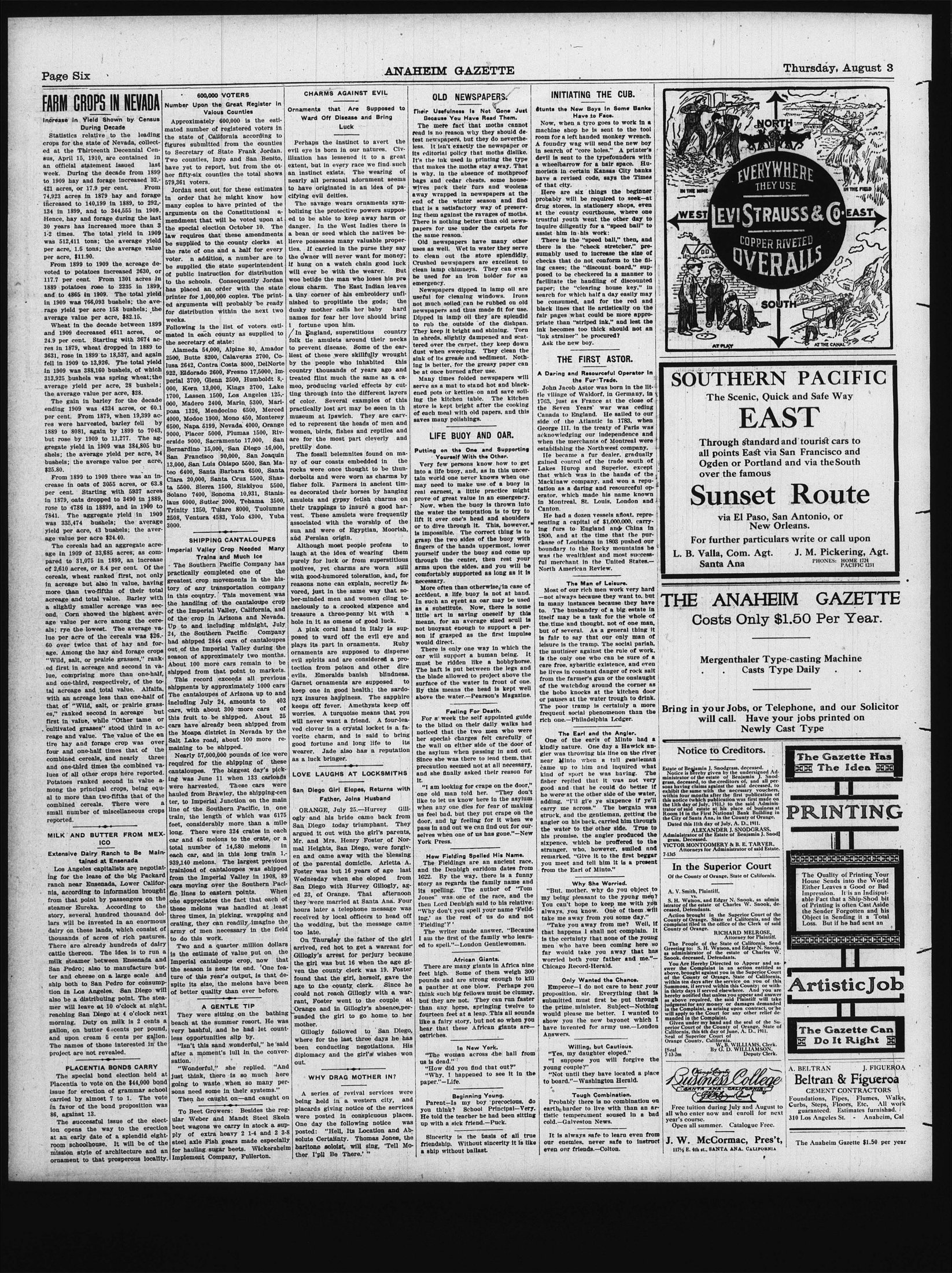
Searchable text
FARM CROPS IN NEVADA
Increase in Yield Shown by Census During Decade
Statistics relative to the leading crops for the state of Nevada, collected at the Thirteenth Decennial Census, April 15, 1910, are contained in an official statement issued last week. During the decade from 1899 to 1909 hay and forage increased 52.421 acres, or 17.9 per cent. From 74,923 acres in 1879 hay and forage increased to 140,199 in 1889, to 292.134 in 1899, and to 344,555 in 1909. Hence, hay and forage during the last 30 years has increased more than 3-1-2 times. The total yield in 1909 was 512,411 tons; the average yield per acre, 1.5 tons; the average value per acre, $11.90.
From 1899 to 1909 the acreage devoted to potatoes increased 2630, or 117.7 per cent. From 1301 acres in 1889 potatoes rose to 2235 in 1899, and to 4865 in 1909. The total yield in 1909 was 766,093 bushels; the average yield per acre 158 bushels; the average value per acre, $82.15.
Wheat in the decade between 1899 and 1909 decreased 4611 acres, or 24.9 per cent. Starting with 3674 acres in 1879, wheat dropped in 1889 to 3631, rose in 1899 to 18,537, and again fell in 1909 to 13,926. The total yield in 1909 was 388,160 bushels, of which 313,925 bushels was spring wheat; the average yield per acre, 28 bushels; the average value per acre, $28.
The gain in barley for the decade ending 1909 was 4234 acres, or 60.1 per cent. From 1879, when 19,399 acres were harvested, barley fell by 1889 to 8081, again by 1899 to 7043, but rose by 1909 to 11,277. The aggregate yield in 1909 was 384,805 bushels; the average yield per acre, 34 bushels; the average value per acre, $25.80.
600,000 VOTERS
Number Upon the Great Register in Valous Counties
Approximately 600,000 is the estimated number of registered voters in the state of California according to figures submitted from the counties to Secretary of State Frank Jordan. Two counties, Inyo and San Benito, have yet to report, but from the other fifty-six counties the total shows 579,361 voters.
Jordan sent out for these estimates in order that he might know how many copies to have printed of the arguments on the Constitutional amendment that will be voted upon at the special election October 10. The law requires that these amendments be supplied to the county clerks at the rate of one and a half for every voter. In addition, a number are to be supplied the state superintendent of public instruction for distribution to the schools. Consequently Jordan has placed an order with the state printer for 1,000,000 copies. The printed arguments will probably be ready for distribution within the next two weeks.
Following is the list of voters estimated in each county as supplied to the secretary of state:
Alameda 54,000, Alpine 80, Amador 2500, Butte 8200, Calaveras 2700, Colusa 2642, Contra Costa 8000, DelNorte 922, Eldorado 2600, Fresno 17,5000, Imperial 3700, Glenn 2500, Humboldt 8,000, Kern 13,000, Kings 3700, Lake L700, Lassen 1500, Los Angeles 125,-000, Madera 2400, Marin 5300, Mariosa 1326, Mendocino 6500, Merced 4000, Modoc 1900, Mono 450, Monterey 6500, Napa 5199, Nevada 4000, Orange 9000, Placer 5000, Plumas 1500, Riverside 9000, Sacramento 17,000, San Bernardino 15,000, San Diego 16,000, San Francisco 90,000, San Joaquin 13,000, San Luis Obispo 5500, San Mateo 6400, Santa Barbara 6500, Santa
CHARMS AGAINST
Ornaments that Are Ward Off Disease
Luckily,
Perhaps the instinct evil eye is born in our illization has lessened extent, but in every rainstorm an instinct exists. The nearly all personal attention have originated in cifying evil deities.
The savage wears bolizing the protective ed to be able to keep danger. In the West a bean or seed which lie possesses many ties. If carried in the owner will never if hung on a watch will ever be with the woe betide the man wivescious charm. The East a tiny corner of his finished to propitiate dusky mother calls her names for fear her loft fortune upon him.
/ In England, supersoft folk tie amulets are to prevent disease. Slightest of these were slain by the people who country thousands of treated flint much thiee meo; producing varied through into their of color. Several ect practically lost art man museum at Ipswich ed to represent the h women,birds,fishes are for the most part prettily done.
The fossil belemnity of our coasts em rocks were once thou
The gain in barley for the decade ending 1909 was 423 acres, or 60.1 per cent. From 1879, when 19,399 acres were harvested, barley fell by 1889 to 8081, again by 1899 to 7043, but rose by 1909 to 11,277. The aggregate yield in 1909 was 384,805 bushels; the average yield per acre, 34 bushels; the average value per acre, $25.80.
From 1899 to 1909 there was an increase in oats of 3055 acres, or 63.8 per cent. Starting with 5937 acres in 1879, oats dropped to 3490 in 1889, rose to 4786 in 18899, and in 1909 to 7841. The aggregate yield in 1909 was 335,474 bushels; the average yield per acre, 43 bushels; the average value per acre $24.40.
The cereals had an aggregate acreage in 1909 of 33,685 acres, as compared to 31,075 in 1899, an increase of 2,610 acres, or 8.4 per cent. Of the cereals, wheat ranked first, not only in acreage but also in value, having more than two-fifths of their total acreage and total value. Barley with a slightly smaller acreage was second. Corn showed the highest average value per acre among the cereals; rye the lowest. The average value per acre of the cereals was $26.60 over twice that of hay and forage. Among the hay and forage crops "Wild, salt, or prairie grasses," ranked first in acreage and second in value, comprising more than one-half, and one-third, respectively, of the total acreage and total value. Alfalfa, with an acreage less than one-half of that of "Wild, salt, or prairie grasses," ranked second in acreage but first in value, while "Other tame or cultivated grasses" stood third in acreage and value. The value of the entire hay and forage crop was over four and one-half times that of the combined cereals, and nearly three and one-third times the combined values of all other crops here reported. Potatoes ranked second in value among the principal crops, being equal to more than two-fifths that of the combined cereals. There were a small number of miscellaneous crops reported.
MILK AND BUTTER FROM MEXICO
Extensive Dairy Ranch to Be Maintained at Ensenada
Los Angeles capitalists are negotiating for the lease of the big Packard ranch near Ensenada, Lower California, according to information brought from that point by passengers on the
SHIPPING CANTALOUPES
Imperial Valley Crop Needed Many Trains and Much Ice
The Southern Pacific Company has practically completed one of the greatest crop movements in the history of any transportation company in this country. This movement was the handling of the cantaloupe crop of the Imperial Valley, California, and of the crop in Arizona and Nevada. Up to and including midnight, July 24, the Southern Pacific Company had shipped 2844 cars of cantaloupes out of the Imperial Valley during the season of approximately two months. About 100 more cars remain to be shipped from that point to markets.
This record exceeds all previous shipments by approximately 1000 cars. The cantaloupes of Arizona up to and including July 24, amounts to 403 cars, with about 300 more cars of this fruit to be shipped. About 25 cars have already been shipped from the Moapa district in Nevada by the Salt Lake road, about 100 more remaining to be shipped.
Nearly 57,000,000 pounds of ice were required for the shipping of these cantaloupes. The biggest day's picking was June 11 when 133 carloads were harvested. These cars were hauled from Brawley, the shipping-center, to Imperial Junction on the main line of the Southern Pacific, in one train, the length of which was 6175 feet, considerably more than a mile long. There were 324 crates in each car and 45 melons to the crate, or a total number of 14,580 melons in each car, and in this long train 1,939,140 melons. The largest previous trainload of cantaloupes was shipped from the Imperial Valley in 1908, 89 cars moving over the Southern Pacific lines to eastern points.
Although most people laugh at the idea of purely for luck or fright motives, yet charms with good-humored to reasons none can evoke just in the same ber-minded men and naaciously to a crook treasure a three-pen hole in it as omens.
A pink coral hand posed to ward off plays its part in ornateornaments are supposed evil spirits and aretection from poison evils. Emeralds bashed Garnet ornaments are kept one in good hynx insures happiness keeps off fever. An worries. A turquoise will never want a frived clover in a crys favorite charm, and is good fortune and lively wearer. Jade also as a luck bringer.
LOVE LAUGHS AT
San Diego Girl Elopar Father, Join
ORANGE, July 25
ogly and his bride San Diego today argued it out with Mr. and Mrs. Henrimal Heights, San Diego en and came away of the parental donor Foster was but 16 yrs Wednesday when she San Diego with Hu ed 23, of Orange.
MILK AND BUTTER FROM MEXICO
Extensive Dairy Ranch to Be Maintained at Ensenada
Los Angeles capitalists are negotiating for the lease of the big Packard ranch near Ensenada, Lower California, according to information brought from that point by passengers on the steamer Eureka. According to the story, several hundred thousand dollars will be invested in an enormous dairy on these lands, which consist of thousands of acres of rich pastures. There are already hundreds of dairy cattle thereon. The idea is to run a milk steamer between Ensenada and San Pedro; also to manufacture butter and cheese on a large scale and ship both to San Pedro for consumption in Los Angeles. San Diego will also be a distributing point. The steamer will leave at 10 o'clock at night, reaching San Diego at 4 o'clock next morning. Duty on milk is 2 cents a gallon, on butter 6 cents per pound, and upon cream 5 cents per gallon. The names of those interested in the project are not revealed.
PLACENTIA BONDS CARRY
The special bond election held at Placentia to vote on the $44,000 bond issue for erection of grammar school carried by almost 7 to 1. The vote in favor of the bond proposition was 86, against 13.
The successful issue of the election opens the way to the erection at an early date of a splendid eightroom schoolhouse. It will be of the mission style of architecture and an ornament to that prosperous locality.
ter, to Imperial Junction on the main line of the Southern Pacific, in one train, the length of which was 6175 feet, considerably more than a mile long. There were 324 crates in each car and 45 melons to the crate, or a total number of 14,580 melons in each car, and in this long train 1,939,140 melons. The largest previous trainload of cantaloupes was shipped from the Imperial Valley in 1908, 89 cars moving over the Southern Pacific lines to eastern points. When one appreciates the fact that each of these melons was handled at least three times, in picking, wrapping and crating, they can readily imagine the army of men necessary in the field to do this work.
Two and a quarter million dollars is the estimate of value put on the Imperial cantaloupe crop, now that the season is near its end. One feature of this year's output, is that despite its size, the melons have been of better quality than ever before.
A GENTLE TIP
They were sitting on the bathing beach at the summer resort. He was very bashful, and he had let countless opportunities slip by.
"Isn't this sand wonderful," he said after a moment's lull in the conversation.
"Wonderful," she replied. "And just think, there is so much here going to waste when so many persons need some in their systems."
Then he caught on—and caught on
To Beet Growers: Besides the regular Weber and Mandt Steel Skein beet wagons we carry in stock a supply of extra heavy 2 1-4 and 2 3-8 steel axle Fish gears made especially for hauling sugar beets. Wickersheim Implement Company, Fullerton.
CHARMS AGAINST EVIL
Ornaments that Are Supposed to Ward Off Disease and Bring Luck
Perhaps the instinct to avert the evil eye is born in our natures. Civilization has lessened it to a great extent, but in every race we find such an instinct exists. The wearing of nearly all personal adornment seems to have originated in an idea of pacifying evil deities.
The savage wears ornaments symbolizing the protective powers supposed to be able to keep away harm or danger. In the West Indies there is a bean or seed which the natives believe possesses many valuable properties. If carried in the purse they say the owner will never want for money; if hung on a watch chain good luck will ever be with the wearer. But woe betide the man who loses his precious charm. The East Indian leaves a tiny corner of his embroidery unfinished to propitiate the gods; the dusky mother calls her baby hard names for fear her love should bring fortune upon him.
In England, superstitious country folk tie amulets around their necks to prevent disease. Some of the earliest of these were skillfully wrought by the people who inhabited this country thousands of years ago and treated flint much the same as a ca meo, producing varied effects by cutting through into the different layers of color. Several examples of this practically lost art may be seen in the museum at Ipswich. They are carved to represent the heads of men and women, birds, fishes and reptiles and are for the most part cleverly and prettily done.
The fossil belemnites found on many of our coasts embedded in the rocks were once thought to be thun-
OLD NEWSPAPERS.
Their Usefulness Is Not Gone Just Because You Have Read Them.
The mere fact that moths cannot read is no reason why they should defeat newspapers, but they do nevertheless. It isn't exactly the newspaper or its editorial policy that moths dislike. It's the ink used in printing the type that makes the moths stay away. That is why, in the absence of mothproof bags and cedar chests, some housewives pack their furs and woolens away wrapped in newspapers at the end of the winter season and find that is a satisfactory way of preserving them against the ravages of moths. There is nothing better than old newspapers for use under the carpets for the same reason.
Old newspapers have many other uses as well. Wet in water they serve to clean out the stove splendidly. Crushed newspapers are excellent to clean lamp chimneys. They can even be used for an iron holder for an emergency.
Newspapers dipped in lamp oil are useful for cleaning windows. Irons not much soled can be rubbed on old newspapers and thus made fit for use. Dipped in lamp oil they are splendid to rub the outside of the dishpan. They keep it bright and shining. Torn in shreds, slightly dampened and scattered over the carpet, they keep down dust when sweeping. They clean the sink of its grease and sediment. Nothing is better, for the greasy paper can be at once burned after use.
Many times folded newspapers will serve as a mat to stand hot and blackened pots or kettles on and save soling the kitchen table. The kitchen stove is kept bright after the cooking of each meal with old papers, and this saves many polishings.
LIFE BUOY AND OAR.
Putting on the One and Supporting Yourself With the Other.
Very few persons know how to get into a life buoy, and, as in this uncertain
INITIATING THE CUB.
Stunts the New Boys In Some Banks Have to Face.
Now, when a tyro goes to work in a machine shop he is sent to the tool room for a left handed monkey wrench. A foundry wag will send the new boy in search of "core holes." A printer's devil is sent to the typefounders with a wheelbarrow for a hair space. Humorists in certain Kansas City banks have a revised code, says the Times of that city.
Here are six things the beginner probably will be required to seek—at drug stores, in stationery shops, even at the county courthouse, where one trustful youth went the other day to inquire diligently for a "speed ball" to assist him in his work:
There is the "speed ball," then, and there is the "check stretcher," presumably used to increase the size of checks that do not conform to the filing cases; the "discount board," supposed to be checkered in a manner to facilitate the handling of discounted paper; the "clearing house key," in search for which half a day easily may be consumed, and for the red and black lines that lie artistically on the fair pages what could be more appropriate than "striped ink," and lest the ink becomes too thick should not an "ink strainer" be procured?
Ask the new boy.
THE FIRST ASTOR.
A Daring and Resourceful Operator in the Fur Trade.
John Jacob Astor was born in the little village of Waldorf, in Germany, in 1763. Just as France at the close of the Seven Years' war was ceding Canada to England. He sailed to our side of the Atlantic in 1783, when George III. in the treaty of Paris was acknowledging our independence and when the merchants of Montreal were establishing the Northwest company.
He became a fur dealer, gradually gained control of the trade south of Lakes Huron and Superior, except that which was in the hands of the
treated flint much the same as a ca meo, producing varied effects by cut ing through into the different layers of color. Several examples of this practically lost art may be seen in th museum at Ipswich. They are carved to represent the heads of men and women, birds, fishes and reptiles and are for the most part cleverly and prettily done.
The fossil belemnites found on many of our coasts embedded in the rocks were once thought to be thunderbolts and were worn as charms by fisher folk. Farmers in ancient times decorated their horses by hanging amulets and gypsy fetish charms on their trappings to insure a good harvest. These amulets were frequently associated with the worship of the sun and were of Egyptian, Moorish, and Persian origin.
Although most people profess to laugh at the idea of wearing them purely for luck or from superstitious motives, yet charms are worn still with good-humored toleration, and, for reasons none can explain, secretly favored, just in the same way that sober-minded men and women cling tenaciously to a crooked sixpence and treasure a three-penny bit with a hole in it as omens of good luck.
A pink coral hand in Italy is supposed to ward off the evil eye and plays its part in ornaments. Ruby ornaments are supposed to disperse evil spirits and are considered a protection from poison and other dire evils. Emeralds banish blindness. Garnet ornaments are supposed to keep one in good health; the sardonyx insures happiness. The sapphire keeps off fever. Amethysts keep off worries. A turquoise means that you will never want a friend. A four-leaved clover in a crystal locket is a favorite charm, and is said to bring good fortune and long life to its wearer. Jade also has a reputation as a luck bringer.
LOVE LAUGHS AT LOCKSMITHS
San Diego Girl Elopes, Returns with Father, Joins Husband
ORANGE, July 25.—Hurvey Gillogly and his bride came back from San Diego today triumphant. They argued it out with the girl's parents, Mr. and Mrs. Henry Foster of Normal Heights, San Diego, were forgiven and came away with the blessing of the parental domicile. Arletta A. Foster was but 16 years of age last Wednesday when she eloped from San Diego with Hurvey Gillogly, aged 23, of Orange. That afternoon Many times folded newspapers will serve as a mat to stand hot and blackened pots or kettles on and save solling the kitchen table. The kitchen stove is kept bright after the cooking of each meal with old papers, and this saves many polishings.
LIFE BUOY AND OAR.
Putting on the One and Supporting Yourself With the Other.
Very few persons know how to get into a life buoy, and, as in this uncertain world one never knows when one may need to make use of a buoy in real earnest, a little practice might prove of great value in an emergency.
Now, when the buoy is thrown into the water the temptation is to try to lift it over one's head and shoulders or to dive through it. This, however, is impossible. The correct thing is to grasp the two sides of the buoy with fingers of the hands uppermost, lower yourself under the buoy and come up through the center, then rest your arms upon the sides, and you will be comfortably supported as long as it is necessary.
More often than otherwise, in case of accident, a life buoy is not at hand. In such an event an oar may be used as a substitute. Now, there is some little art in saving oneself by this means, for an average sized scull is not buoyant enough to support a person if grasped as the first impulse would direct.
There is only one way in which the oar will support a human being. It must be ridden like a hobbyhorse. The haft is put between the legs and the blade allowed to project above the surface of the water in front of one. By this means the head is kept well above the water.—Pearson's Magazine.
Feeling For Death.
For a week the self appointed guide to the blind on their daily walks had noticed that the two men who were her special charges felt carefully of the wall on either side of the door of the asylum when passing in and out. Since she was there to lead them, that precaution seemed not at all necessary, and she finally asked their reason for it.
"I am looking for crape on the door," one old man told her. "They don't like to let us know here in the asylum when any one dies for fear of making us feel bad, but they put crape on the door, and by feeling for it when we pass in and out we can find out for ourselves when one of us has gone."—New York Press.
How Fielding Spelled His Name.
The Fieldings are an ancient race, and the Denbigh earldom dates from 1622. By the way, there is a funny story as regards the family name and its spelling. The author of "Tom Jones" was one of the race, and the
A Daring and Resourceful Operator in the Fur Trade.
John Jacob Astor was born in the little village of Waldorf, in Germany, in 1763, just as France at the close of the Seven Years' war was ceding Canada to England. He sailed to our side of the Atlantic in 1783, when George III. in the treaty of Paris was acknowledging our independence and when the merchants of Montreal were establishing the Northwest company.
He became a fur dealer, gradually gained control of the trade south of Lakes Hurop and Superior, except that which was in the hands of the Mackinaw company, and won a reputation as a daring and resourceful operator, which made his name known in Montreal, St. Louis, London and Canton.
He had a dozen vessels afloat, representing a capital of $1,000,000, carrying furs to England and China in 1800, and at the time that the purchase of Louisiana in 1803 pushed our boundary to the Rocky mountains he was the wealthiest and most successful merchant in the United States.—North American Review.
The Man of Leisure.
Most of our rich men work very hard —not always because they want to, but in many instances because they have to. The husbandry of a big estate in itself may be a task for the whole of the time and thought, not of one man, but of several. As a general thing it is fair to say that our only man of leisure is the tramp. The social pariah, the mutineer against the rule of work, is the only one who can be sure of a care free, sybaritic existence, and even he lives in constant danger of rock salt from the farmer's gun or the onslaught of the watchdog around the corner as the hobo knocks at the kitchen door or pauses at the water trough to drink. The poor tramp is certainly a more frequent social phenomenon than the rich one.—Philadelphia Ledger.
The Earl and the Angler.
One of the earls of Minto had a kindly nature. One day a Hawick angler was throwing his line on the river near Minto when a tall gentleman came up to him and inquired what kind of sport he was having. The fisher replied that it was not very good and that he could do better if he were at the other side of the water, adding, "I'll gl'e ye sixpence if ye'll carry me across." The bargain was struck, and the gentleman, getting the angler on his back, carried him through the water to the other side. True to his promise, the angler produced the sixpence, which he proffered to the stranger, who, however, smiled and remarked. "Give it to the first beggar you meet and tell him it is a present from the Earl of Minto."
Why She Worried.
But, mother, why do you object to my being pleasant to the young men?
ORANGE, July 25.—Hurvey Gillogly and his bride came back from San Diego today triumphant. They argued it out with the girl's parents, Mr. and Mrs. Henry Foster of Normal Heights, San Diego, were forgiven and came away with the blessing of the parental domicile. Arletta A. Foster was but 16 years of age last Wednesday when she eloped from San Diego with Hurvey Gillogly, aged 23, of Orange. That afternoon they were married at Santa Ana. Four hours later a telephone message was received by local officers to head off the wedding, but the message came too late.
On Thursday the father of the girl arrived, red hot to get a warrant for Gillogly's arrest for perjury because the girl was but 16 when the age given the county clerk was 19. Foster found that the girl, herself, gave the age to the county clerk. Since he could not reach Gillogly with a warrant, Foster went to the couple at Orange and in Gillogly's absence, persuaded the girl to go home to her mother.
Gillogly followed to San Diego, where for the last three days he has been conducting negotiations. His diplomacy and the girl's wishes won out.
WHY DRAG MOTHER IN?
A series of revival services were being held in a western city, and placards giving notice of the services were posted in conspicuous places. One day the following notice was posted: "Hell, Its Location and Absolute Certainty. Thomas Jones, the baritone soloist, will sing, 'Tell Mother I'll Be There.'"
How Fielding Spelled His Name.
The Fieldings are an ancient race, and the Denbigh earldom dates from 1622. By the way, there is a funny story as regards the family name and its spelling. The author of "Tom Jones" was one of the race, and the then Lord Denbigh said to his relative: "Why don't you spell your name 'Felding,' as the rest of us do and not 'Fielding'?'
The writer made answer, "Because I am the first of the family who learned to spell."—London Gentlewoman.
African Giants.
There are many giants in Africa nine feet high. Some of them weigh 300 pounds and are strong enough to kill a panther at one blow. Perhaps you think such big fellows must be clumsy, but they are not. They can run faster than any horse, springing twelve to fourteen feet at a leap. This all sounds like a fairy story, but not so when you hear that these African giants are ostriches.
In New York.
"The woman across the hall from us is dead."
"How did you find that out?"
"Why. I happened to see it in the paper."—Life.
Beginning Young.
Parent—Is my boy precocious, do you think? School Principal—Very. He told the teacher he had been sitting up with a sick friend.—Puck.
Sincerity is the basis of all true friendship. Without sincerity it is like a ship without ballast.
adding, "I'll gl'e ye sixpence if ye'll carry me across." The bargain was struck, and the gentleman, getting the angler on his back, carried him through the water to the other side. True to his promise, the angler produced the sixpence, which he proffered to the stranger, who, however, smiled and remarked. "Give it to the first beggar you meet and tell him it is a present from the Earl of Minto."
Why She Worried.
"But, mother, why do you object to my being pleasant to the young men? You can't hope to keep me with you always, you know. One of them will take me away from you some day."
"Take you away from me? Well, if that happens I shall not complain. It is the certainty that none of the young men who have been coming here so far would take you away that has worried both your father and me."—Chicago Record-Herald.
Only Wanted the Chance.
Emperor—I do not care to hear your proposition, sir. Everything that is submitted must first be put through the prime minister. Subject—Nothing would please me better. I wanted to show you the new bayonet which I have invented for army use.—London Answers.
Willing, but Cautious.
"Yes, my daughter eloped."
"I suppose you will forgive the young couple?"
"Not until they have located a place to board."—Washington Herald.
Tough Combination.
Probably there is no combination on earth harder to live with than an artistic temperament soused in a bad cold.—Galveston News.
It is always safe to learn even from our enemies, never safe to instruct even our friends.—Colton.
THURSDAY, August 3
NORTH
EVERYWHERE
THEY USE
LEVI STRAUSS & CO.
COPPER RIVETED
OVERALLS
WEST
EAST
SOUTH
AT PLAY
AT THE CANAL
SOUTHERN PACIFIC
The Scenic, Quick and Safe Way
EAST
Through standard and tourist cars to all points East via San Francisco and Ogden or Portland and via the South over the famous
SOUTHERN PACIFIC
The Scenic, Quick and Safe Way
EAST
Through standard and tourist cars to all points East via San Francisco and Ogden or Portland and via the South over the famous
Sunset Route
via El Paso, San Antonio, or New Orleans.
For further particulars write or call upon
L. B. Valla, Com. Agt. J. M. Pickering, Agt.
Santa Ana
PHONES: HOME 1224
PACIFIC 1231
THE ANAHEIM GAZETTE
Costs Only $1.50 Per Year.
Mergenthaler Type-casting Machine
Casts Type Daily
Bring in your Jobs, or Telephone, and our Solicitor will call. Have your jobs printed on Newly Cast Type
Notice to Creditors.
Estate of Benjamin J. Snodgrass, deceased.
Notice is hereby given by the undersigned Administrator of the estate of Benjamin J. Snodgrass, deceased, to the creditors of, and all persons having claims against the said deceased, to exhibit the same with the necessary vouchers, within four months after the first publication of this notice (which publication was first made on the 13th day of July, 1911) to the said Administrator of said estate at his place of business at Room 14 in the First National Bank Building in the City of Santa Ana, in the County of Orange.
Dated this 11th day of July, A. D., 1911.
ALEXANDER J. SNODGRASS,
Administrator of the Estate of Benjamin J. Snodgrass, Decessed.
VICTOR MONTGOMERY & B. E. TARVER,
Attorneys for Administrator of said Estate.
7-1315
In the Superior Court
Of the County of Orange, State of California.
A. V. Smith, Plaintiff,
vs.
In the Superior Court
Of the County of Orange, State of California.
A. V. Smith, Plaintiff,
vs.
S. H. Watson, and Edgar N. Snook, as administrator of the estate of Charles W. Snook, deceased, Defendants.
Action brought in the Superior Court of the
County of Orange, State of California, and the
complaint filed in the office of the Clerk of said
County of Orange.
RICHARD MELROSE,
Attorney for Plaintiff.
The People of the State of California Send
Greeting to: S. H. Watson, and Edgar N. Snook,
as administrator of the estate of Charles W.
Snook, deceased, Defendants.
You Are Hereby Directed to Appear and answer the Complaint in an action entitled as above, brought against you in the Superior Court
of the County of Orange, State of California,
within ten days after the service on you of this
Summons, if served within this County; or within thirty days if served elsewhere. And you are
hereby notified that unless you appear and answer
as above required, the said Plaintiff will take
judgment for any money or damages demanded
in the Complaint, as arising upon contract, or he
will apply to the Court for any other relief demanded in the Complaint.
Given under my hand and the seal of the Superior Court of the County of Orange, State of
California, this 6th day of June, A. D., 1911.
Seal of Superior Court of
Orange County, California.
W. B. WILLIAMS, Clerk.
[Seal]
By G. D. WILLIAMSON,
Deputy Clerk.
Free tuition during July and August to all who enter now and enroll for next year's course.
Open all summer. Catalogue Free.
J. W. McCormac, Pres't,
117½ E. 4th st., SANTA ANA, CALIFORNIA
The Quality of Printing Your House Sends into the World Either Leaves a Good or Bad Impression. It is an Indisputable Fact that a Ship-Shod bit of Printing is often Cast Aside the Sender Forgotten and his Object in Sending it a Total Loss. But if he had sent an
Artistic Job
The Gazette Can Do It Right
A. BELTRAN J. FIGUEROA
Beltran & Figueroa
CEMENT CONTRACTORS
Foundations, Pipes, Flumes, Walks,
Curbs, Steps, Floors, Etc. All work guaranteed. Estimates furnishad.
310 Los Angeles St. - Anaheim, Cal
The Anaheim Gazette $1.50 per year