anaheim-gazette 1911-07-27
Scanned page
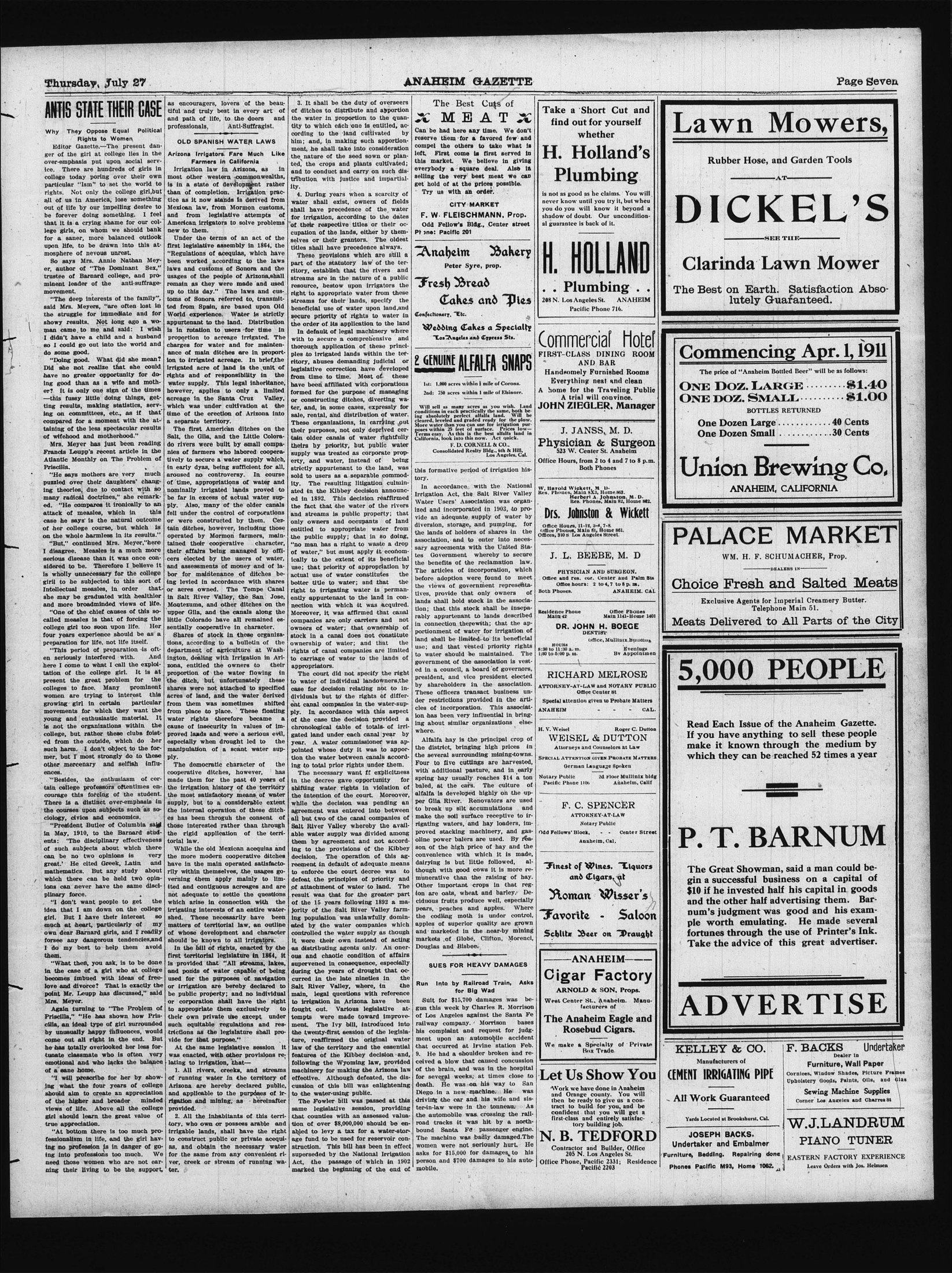
Searchable text
ANTIS STATE THEIR CASE
Why They Oppose Equal Political Rights to Women
Editor Gazette.—The present danger of the girl at college lies in the over-emphasis put upon social service. There are hundreds of girls in college today poring over their own particular "Ism" to set the world to rights. Not only the college girl, but all of us in America, lose something out of life by our impelling desire to be forever doing something. I feel that it is a crying shame for our college girls, on whom we should bank for a saner, more balanced outlook upon life, to be drawn into this atmosphere of nevous unrest.
So says Mrs. Annie Nathan Meyer, author of "The Dominant Sex," trustee of Barnard college, and prominent leader of the anti-suffrage movement.
"The deep interests of the family", said Mrs. Meyers, "are often lost in the struggle for immediate and for showy results. Not long ago a woman came to me and said: I wish I didn't have a child and a husband so I could go out into the world and do some good.
"Doing good. What did she mean? Did she not realize that she could have no greater opportunity for doing good than as a wife and mother? It is only one sign of the times —this fussy little doing things, getting results, making statistics, serving on committees, etc., as if that compared for a moment with the attaining of the less spectacular results of wifehood and motherhood."
Mrs. Meyer has just been reading Francis Leupp's recent article in the Atlantic Monthly on The Problem of Priscilla.
"He says mothers are very much as encouragers, lovers of the beautiful and truly best in every art of and path of life, to the doers and professionals." Anti-Suffragist.
OLD SPANISH WATER LAWS
Arizona Irrigators Fare Much Like Farmers in California
Irrigation law in Arizona, as in most other western commonwealths, is in a state of development rather than of completion. Irrigation practice as it now stands is derived from Mexican law, from Mormon customs, and from legislative attempts of American irrigators to solve problems new to them.
Under the terms of an act of the first legislative assembly in 1864, the "Regulations of acequias, which have been worked according to the laws laws and customs of Sonora and the usages of the people of Arizona, shall remain as they were made and used up to this day." The laws and customs of Sonora referred to, transmitted from Spain, are based upon Old World experience. Water is strictly appurtenant to the land. Distribution is in rotation to users for time in proportion to acreage irrigated. The charges for water and for maintenance of main ditches are in proportion to irrigated acreage. In brief,the irrigated acre of land is the unit of rights and of responsibility in the water supply. This legal inheritance, however, applies to only a limited acreage in the Santa Cruz Valley, which was under cultivation at the time of the erection of Arizona into a separate territory.
The first American ditches on the Salt, the Gila, and the Little Colorado rivers were built by small companies of farmers who labored cooperatively to secure a water supply which, in early dasa, being sufficient for all, aroused no controversy. In course
have no greater opportunity for doing good than as a wife and mother? It is only one sign of the times—this fussy little doing things, getting results, making statistics, serving on committees, etc., as if that compared for a moment with the attaining of the less spectacular results of wifehood and motherhood."
Mrs. Meyer has just been reading Francis Leupp's recent article in the Atlantic Monthly on The Problem of Priscilla.
"He says mothers are very much puzzled over their daughters' changing theories, due to contact with so many radical doctrines," she remarked. "He compares it ironically to an attack of measles, which in this case he says is the natural outcome of her college course, but which is on the whole harmless in its results."
"But," continued Mrs. Meyer, "here I disagree. Measles is a much more serious disease than it was once considered to be. Therefore I believe it is wholly unnecessary for the college girl to be subjected to this sort of Intellectual measles, in order that she may be graduated with healthier and more broadminded views of life.
"One of the chief causes of this so-called measles is that of forcing the college girl too soon upon life. Her four years experience should be as a preparation for life, not life itself.
"This period of preparation is often seriously interfered with. And here I come to what I call the exploitation of the college girl. It is at present the great problem for the colleges to face. Many prominent women are trying to interest this growing girl in certain particular movements for which they want the young and enthusiastic material. It is not the organizations within the college, but rather these clubs foisted from the outside, which do her such harm. I don't object to the former, but I most strongly do to these other mercenary and selfish influences.
"Besides, the enthusiasm of certain college professors oftentimes encourage this forcing of the student. There is a distinct over-emphasis in the courses upon subjects such as sociology, civics and economics.
"President Butler of Columbia said in May, 1910, to the Barnard students: 'The disciplinary effectiveness of such subjects about which there can be no two opinions is very great.' He cited Greek, Latin and mathematics. But any study about which there can be held two opinions can never have the same disciplinary force."
The first American ditches on the Salt, the Gila, and the Little Colorado rivers were built by small companies of farmers who labored cooperatively to secure a water supply which, in early dyas, being sufficient for all, aroused no controversy. In course of time, appropriations of water and nominally irrigated lands proved to be far in excess of actual water supply. Also, many of the older canals fell under the control of corporations or were constructed by them. Certain ditches, however, including those operated by Mormon farmers, maintained their cooperative character, their affairs being managed by officers elected by the users of water, and assessments of money and of labor for maintenance of ditches being levied in accordance with shares or acres owned. The Tempe Canal in Salt River Valley, the San Jose, Montezuma, and other ditches on the upper Gila, and the canals along the little Colorado have all remained essentially cooperative in character.
Shares of stock in these organizations, according to a bulletin of the department of agriculture at Washington, dealing with Irrigation in Arizona, entitled the owners to their proportion of the water flowing in the ditch, but unfortunately these shares were not attached to specified acres of land, and the water derived from them was sometimes shifted from place to place. These floating water rights therefore became a cause of insecurity in values of improved lands and were a serious evil, especially when drought led to the manipulation of a scant water supply.
The democratic character of the cooperative ditches, however, has made them for the past 40 years of the irrigation history of the territory the most satisfactory means of water supply, but to a considerable extent the internal operation of these ditches has been through the consent of those interested rather than through the rigid application of the territorial law.
While the old Mexican acequias and the more modern cooperative ditches have in the main operated satisfactorily within themselves, the usages governing them apply mainly to limited and contiguous acreages and are not adequate to settle the questions rights and of responsibility in the water supply. This legal inheritance, however, applies to only a limited acreage in the Santa Cruz Valley, which was under cultivation at the time of the erection of Arizona into a separate territory.
The first American ditches on the Salt, the Gila, and the Little Colorado rivers were built by small companies of farmers who labored cooperatively to secure a water supply which, in early dyas, being sufficient for all, aroused no controversy. In course of time, appropriations of water and nominally irrigated lands proved to be far in excess of actual water supply. Also, many of the older canals fell under the control of corporations or were constructed by them. Certain ditches, however, including those operated by Mormon farmers, maintained their cooperative character, their affairs being managed by officers elected by the users of water, and assessments of money and of labor for maintenance of ditches being levied in accordance with shares or acres owned. The Tempe Canal in Salt River Valley, the San Jose, Montezuma, and other ditches on the upper Gila, and the canals along the little Colorado have all remained essentially cooperative in character.
Shares of stock in these organizations, according to a bulletin of the department of agriculture at Washington, dealing with Irrigation in Arizona, entitled the owners to their proportion of the water flowing in the ditch, but unfortunately these shares were not attached to specified acres of land, and the water derived from them was sometimes shifted from place to place. These floating water rights therefore became a cause of insecurity in values of improved lands and were a serious evil, especially when drought led to the manipulation of a scant water supply.
The democratic character of the cooperative ditches, however, has made them for the past 40 years of the irrigation history of the territory the most satisfactory means of water supply, but to a considerable extent the internal operation of ditches has been through the consent of those interested rather than through the rigid application of the territorial law.
While the old Mexican acequias and the more modern cooperative ditches have in the main operated satisfactorily within themselves, the usages governing them apply mainly to limited and contiguous acreages and are not adequate to settle the questions rights and of responsibility in the water supply. This legal inheritance, however, applies to only a limited acreage in the Santa Cruz Valley, which was under cultivation at the time of the erection of Arizona into a separate territory.
The first American ditches on the Salt, the Gila, and the Little Colorado rivers were built by small companies of farmers who labored cooperatively to secure a water supply which, in early dyas, being sufficient for all, aroused no controversy. In course of time, appropriations of water and nominally irrigated lands proved to be far in excess of actual water supply. Also, many of the older canals fell under the control of corporations or were constructed by them. Certain ditches, however, including those operated by Mormon farmers, maintained their cooperative character, their affairs being managed by officers elected by the users of water, and assessments of money and of labor for maintenance of ditches being levied in accordance with shares or acres owned. The Tempe Canal in Salt River Valley, the San Jose, Montezuma, and other ditches on the upper Gila, and the canals along the little Colorado have all remained essentially cooperative in character.
Shares of stock in these organizations, according to a bulletin of the department of agriculture at Washington, dealing with Irrigation in Arizona, entitled the owners to their proportion of the water flowing in the ditch, but unfortunately these shares were not attached to specified acres of land, and the water derived from them was sometimes shifted from place to place. These floating water rights therefore became a cause of insecurity in values of improved lands and were a serious evil, especially when drought led to the manipulation of a scant water supply.
The democratic character of the cooperative ditches, however, has made them for the past 40 years of the irrigation history of the territory the most satisfactory means of water supply, but to a considerable extent the internal operation of ditches has been through the consent of those interested rather than through the rigid application of the territorial law.
While the old Mexican acequias and the more modern cooperative ditches have in the main operated satisfactorily within themselves, the usages governing them apply mainly to limited and contiguous acreages and are not adequate to settle the questions rights and of responsibility in the water supply. This legal inheritance, however, applies to only a limited acreage in the Santa Cruz Valley, which was under cultivation at the time of the erection of Arizona into a separate territory.
The first American ditches on the Salt, the Gila, and the Little Colorado rivers were built by small companies of farmers who labored cooperatively to secure a water supply which, in early dyas, being sufficient for all, aroused no controversy. In course of time, appropriations of water and nominally irrigated lands proved to be far in excess of actual water supply. Also, many of the older canals fell under the control of corporations or were constructed by them. Certain ditches, however, including those operated by Mormon farmers, maintained their cooperative character, their affairs being managed by officers elected by the users of water, and assessments of money and of labor for maintenance of ditches being levied in accordance with shares or acres owned. The Tempe Canal in Salt River Valley, the San Jose, Montezuma, and other ditches on the upper Gila, and the canals along the little Colorado have all remained essentially cooperative in character.
Shares of stock in these organizations, according to a bulletin of the department of agriculture at Washington, dealing with Irrigation in Arizona, entitledthe owners to their proportionofthewaterflowingintheditchbutunfortunatelytheseshareswerenotattachedtospecifiedacresofland,andthewaterderivedfromthemenwassometimesshiftedfromplacetowhere
The democratic characterofthecooperativeditcheshoweverhasmadethemforthepast40yearsoftheirinheritancehoweverappliedforthepurpleorconstructingtheditchesterand.insomecasestale sale,rental,anddistrictTheseorganizations,their purposes,notontainoldercanalsofthetheirsbypriority,b Supplywastreatedaerterty,andwater,intstrictlyappurtenantedsoldtousersasasecurity.Theresultinginthekibbeycitedin1892Thisdefeatfactthatthewatersandstreamsispubliconlyownersandoccultiertitledtoappropriatepublicsupply;thatanomanhasarightofwater,'butmustlicatelytostheextentuse;thatpriorityoffactualuseofwaterbettertitletowaterrighttoirrigatingwentlyappurtenanttoconnectionwithwhichMoreover,它wasaffectcompaniesonlyownersofwater;thatastockinan canaldocompanytocarriageofwaterappropriators.
The court did not tryto水ofindividualcasefordecisionreceivedindividualbuttotheentrantcanalcompaniesapply.Inaccordanceofthecasethedecisionchronologicaltablegainedlandundereachyear.Awatercommencedwhortheydetentionthewaterbetweentingtototalpriorright.
The necessarywaiverinthedecree gaveshiftingwaterrighttheintentionofthewhilethedecisionagreementwasenteredallbuttwoofthecausalSaltRiverValleywouldablewatersupplywhetherbyagreementingtotheprovisiondecision.Theopererelementindefaultofoitenoefoundto enforcethecourt defeattheprinciplesofattachmentofwaterresultwasthatfor
There is a distinct over-emphasis in the courses upon subjects such as sociology, civics and economics.
"President Butler of Columbia said in May, 1910, to the Barnard students: 'The disciplinary effectiveness of such subjects about which there can be no two opinions is very great.' He cited Greek, Latin and mathematics. But any study about which there can be held two opinions can never have the same disciplinary force.
"I don't want people to get the idea that I am down on the college girl. But I have their interest so much at heart, particularly of my own dear Barnard girls, and I readily forsee any dangerous tendencies, and I do my best to help them avoid them.
"What then, you ask, is to be done in the case of a girl who at college becomes imbued with ideas of free love and divorce? That is exactly the point Mr. Leupp has discussed," said Mrs. Meyer.
Again turning to "The Problem of Priscilla," "He has shown how Priscilla, an ideal type of girl surrounded by unusually happy influences, would come out all right in the end. But he has totally overlooked her less fortunate classmate who is often very emotional and who lacks the balance of a sane home.
"I will prescribe for her by showing what the four years of college should aim to create an appreciation of the higher and broader minded views of life. Above all the college girl should learn the great value of true appreciation.
"At bottom there is too much professionalism in life, and the girl having no profession is in danger of going into professions too much. We need those women who are not earning their living to be the support supply, but to a considerable extent the internal operation of these ditches has been through the consent of those interested rather than through the rigid application of the territorial law.
While the old Mexican acequias and the more modern cooperative ditches have in the main operated satisfactorily within themselves, the usages governing them apply mainly to limited and contiguous acreages and are not adequate to settle the questions which arise in connection with the irrigating interests of an entire watershed. These necessarily have been matters of territorial law, an outline of whose development and character should be known to all irrigators.
In the bill of rights, enacted by the first territorial legislature in 1864, it is provided that "All streams, lakes, and ponds of water capable of being used for the purposes of navigation or irrigation are hereby declared to be public property; and no individual or corporation shall have the right to appropriate them exclusively to their own private use except under such equitable regulations and restrictions as the legislature shall provide for that purpose."
At the same legislative session it was enacted, with other provisions relating to irrigation, that—
1. All rivers, creeks, and streams of running water in the territory of Arizona are hereby declared public, and applicable to the purposes of irrigation and mining, as hereinafter provided.
2. All the inhabitants of this territory, who own or possess arable and irrigable lands, shall have the right to construct public or private acreas, and obtain the necessary water for the same from any convenient river, creek or stream of running water.
while the decision agreement was entered all but two of the cases Salt River Valley was able water supply was them by agreement leading to the provision decision. The operation in default order to enforce the court's defeat the principles of attachment of water result was that for one of the 15 years following jority of the Salt River population was ratified by the water controlled the water it were their own as distributing agents ous and chaotic conspirations supervened in consequence during the years of curred in the late Salt River Valley, main legal question to irrigation in Arizona fought out. Various tempts were made ment. The Ivy bill,the twenty-first session nature, reaffirmed the law of the territory features of the Kibbutz following the Wyoming machinery for making effective. Although discussion of this bill led to the water-using process.
The Fowler bill was same legislative service that counties with a total of over $8,000,000 abled to levy a taxage fund to be used for construction. This bill superseded by the New Act, the passage marked the beginning
3. It shall be the duty of overseers of ditches to distribute and apportion the water in proportion to the quantity to which each one is entitled, according to the land cultivated by him; and, in making such apportionment, he shall take into consideration the nature of the seed sown or planted, the crops and plants cultivated; and to conduct and carry on such distribution with justice and impartiality.
4. During years when a scarcity of water shall exist, owners of fields shall have precedence of the water for irrigation, according to the dates of their respective titles or their occupation of the lands, either by themselves or their grantors. The oldest titles shall have precedence always.
These provisions which are still a part of the statutory law of the territory, establish that the rivers and streams are in the nature of a public resource, bestow upon irrigators the right to appropriate water from these streams for their lands, specify the beneficial use of water upon land, and secure priority of rights to water in the order of its application to the land.
In default of legal machinery where with to secure a comprehensive and thorough application of these principles to irrigated lands within the territory, abuses demanding judicial or legislative correction have developed from time to time. Most of these have been affiliated with corporations formed for the purpose of managing or constructing ditches, diverting water, and, in some cases, expressly for sale, rental, and distribution of water. These organizations, in carrying out their purposes, not only deprived certain older canals of water rightfully theirs by priority, but public water supply was treated as corporate property, and water, instead of being strictly appurtenant to the land, was sold to users as a separate commodity.
from time to time. Most of these have been affiliated with corporations formed for the purpose of managing or constructing ditches, diverting water, and, in some cases, expressly for sale, rental, and distribution of water. These organizations, in carrying out their purposes, not only deprived certain older canals of water rightfully theirs by priority, but public water supply was treated as corporate property, and water, instead of being strictly appurtenant to the land, was sold to users as a separable commodity. The resulting litigation culminated in the Kibbey decision announced in 1892. This decision reaffirmed the fact that the water of the rivers and streams is public property; that only owners and occupants of land entitled to appropriate water from the public supply; that in so doing, "no man has a right to waste a drop of water," but must apply it economically to the extent of its beneficial use; that priority of appropriation by actual use of water constitutes the better title to water; and that the right to irrigating water is permanently appurtenant to the land in connection with which it was acquired. Moreover, it was affirmed that canal companies are only carriers and not owners of water; that ownership of stock in a canal does not constitute ownership of water; and that the rights of canal companies are limited to carriage of water to the lands of appropriators.
The court did not specify the right to water of individual landowners, the case for decision relating not to individuals but to the rights of different canal companies in the water-supply. In accordance with this aspect of the case the decision provided a chronological table of totals of irrigated land under each canal year by year. A water commissioner was appointed whose duty it was to apportion the water between canals according to total prior rights under them.
The necessary want explicitness in the decree gave opportunity for shifting water rights in violation of the intention of the court. Moreover, while the decision was pending an agreement was entered into between all but two of the canal companies of Salt River Valley whereby the available water supply was divided among them by agreement and not according to the provisions of the Kibbey decision. The operation of this agreement in default of adequate means to enforce the court decree was to defeat the principles of priority and of attachment of water to land. The result was that for the greater part
this formative period of irrigation history.
In accordance with the National Irrigation Act, the Salt River Valley Water Users' Association was organized and incorporated in 1903, to provide an adequate supply of water by diversion, storage, and pumping, for the lands of holders of shares in the association, and to enter into necessary agreements with the United States Government whereby to secure the benefits of the reclamation law. The articles of incorporation, which before adoption were found to meet the views of government representatives, provide that only owners of lands shall hold stock in the association; that this stock shall be inseparably appurtenant to lands described in connection therewith; that the apportionment of water for irrigation of land shall be limited to its beneficial use; and that vested priority rights to water should be maintained. The government of the association is vested in a council, a board of governors, president, and vice president elected by shareholders in the association. These officers transact business under restrictions provided in the articles of incorporation. This association has been very influential in bringing about similar organizations elsewhere.
Alfalfa hay is the principal crop of the district, bringing high prices in the several surrounding mining-towns. Four to five cuttings are harvested, with additional pasture, and in early spring hay usually reaches $14 a ton baled, at the cars. The culture of alfalfa is developed highly on the upper Gila River. Renovators are used to break up silt accumulations and make the soil surface receptive to irrigating waters, and hay loaders, improved stacking machinery, and gasoline power balers are used. By reason of the high price of hay and the convenience with which it is made, dairying is but little followed, although with good cows it is more remunerative than the raising of hay. Other important crops in that region are oats, wheat and barley.
Handwritten Purchased Rooms
Everything neat and clean
A home for the Traveling Public
A trial will convince.
JOHN ZIEGLER, Manager
J. JANSS, M. D.
Physician & Surgeon
523 W. Center St. Anaheim
Office Hours, from 2 to 4 and 7 to 8 p.m.
Both Phones
W, Harold Wickett, M. D.
Res. Phones, Main 8X8, Home 863.
Herbert A. Johnston, M. D.
Res. Phones, Main 82, Home 862.
Drs. Johnston & Wickett
Office Hours, 11-12, 2-4, 7-8.
Office Phones, Main 81, Home 861.
Offices, 310 S Los Angeles Street.
J. L. BEEBE, M. D
PHYSICIAN AND SURGEON.
Office and res. cor. Center and Palm Sts
Office hours: 2 to 4, 7 to 8 p.m.
Both Phones.
ANAHEIM CAL
Residence Phone
Main 42
Office Phones
Main 1141-Home 1401
DR. JOHN H. BOEGE
DENTIST
HOURS
8:30 to 11:30 a.m.
1:30 to 5:00 p.m.
Evenings
By Appointmen
RICHARD MELROSE
ATTORNEY-AT-LAW and NOTARY PUBLIC
Office Center St
Special attention given to Probate Matters
ANAHEIM
H. V. Weisel
Roger C. Dutton
WEISEL & DUTTON
Attorneys and Counselors at Law
SPECIAL ATTENTION GIVEN PROBATE MATTERS
German Language Spoken
Notary Public
2d Floor Mullinix bldg
Pacific Phone 1106
Anahelm, Calif.
F. C. SPENCER
ATTORNEY-AT-LAW
Notary Public
Odd Fellows' Block,
Center Street
Anahelm, Cal.
Finest of Wines, Liquors and Tigars, at Roman Wasser's
while the decision was pending an agreement was entered into between all but two of the canal companies of Salt River Valley whereby the available water supply was divided among them by agreement and not according to the provisions of the Kibbey decision. The operation of this agreement in default of adequate means to enforce the court decree was to defeat the principles of priority and of attachment of water to land. The result was that for the greater part of the 15 years following 1892 a majority of the Salt River Valley farming population was unlawfully dominated by the water companies which controlled the water supply as though it were their own instead of acting as distributing agents only. An onerous and chaotic condition of affairs supervened in consequence, especially during the years of drought that occurred in the late nineties in the Salt River Valley, where, in the main, legal questions with reference to irrigation in Arizona have been fought out. Various legislative attempts were made toward improvement. The Ivy bill, introduced into the twenty-first session of the legislature, reaffirmed the original water law of the territory and the essential features of the Kibbey decision and, following the Wyoming law, provided machinery for making the Arizona law effective. Although defeated, the discussion of this bill was enlightening to the water-using public.
The Fowler bill was passed at this same legislative session, providing that counties with an assessed valuation of over $8,000,000 should be enabled to levy a tax for a water-storage fund to be used for reservoir construction. This bill has been in effect superseded by the National Irrigation Act, the passage of which in 1902 marked the beginning of the end of
Run Into by Railroad Train, Asks for Big Wad
Suit for $15,700 damages was begun this week by Charles R. Morrison of Los Angeles against the Santa Fe railway company. Morrison bases his complaint and request for judgment upon an automobile accident that occurred at Irvine station Feb. 9. He had a shoulder broken and received a blow that caused concussion of the brain, and was in the hospital for several weeks, at times close to death. He was on his way to San Diego in a new machine. He was driving the car and his wife and sister-in-law were in the tonneau. As the automobile was crossing the railroad tracks it was hit by a northbound Santa Fe passenger engine. The machine was badly damaged. The women were not seriously hurt. He asks for $15,000 for damages to his person and $700 damages to his automobile.
Lawn Mowers,
Rubber Hose, and Garden Tools
AT
DICKEL'S
SEE THE
Clarinda Lawn Mower
The Best on Earth. Satisfaction Absolutely Guaranteed.
Commencing Apr. 1, 1911
The price of "Anaheim Bottled Beer" will be as follows:
ONE DOZ. LARGE $1.40
ONE DOZ. SMALL $1.00
BOTTLES RETURNED
One Dozen Large 40 Cents
One Dozen Small 30 Cents
Union Brewing Co.
ONE DOZ. LARGE $1.40
ONE DOZ. SMALL $1.00
BOTTLES RETURNED
One Dozen Large 40 Cents
One Dozen Small 30 Cents
Union Brewing Co,
ANAHEIM, CALIFORNIA
PALACE MARKET
WM. H. F. SCHUMACHER, Prop.
DEALERS IN
Choice Fresh and Salted Meats
Exclusive Agents for Imperial Creamery Butter.
Telephone Main 51.
Meats Delivered to All Parts of the City
5,000 PEOPLE
Read Each Issue of the Anaheim Gazette.
If you have anything to sell these people make it known through the medium by which they can be reached 52 times a year
P. T. BARNUM
The Great Showman, said a man could begin a successful business on a capital of $10 if he invested half his capital in goods
P. T. BARNUM
The Great Showman, said a man could begin a successful business on a capital of $10 if he invested half his capital in goods and the other half advertising them. Barnum's judgment was good and his example worth emulating. He made several fortunes through the use of Printer's Ink. Take the advice of this great advertiser.
ADVERTISE
KELLEY & CO.
Manufacturers of CEMENT IRRIGATING PIPE
All Work Guaranteed
Yards Located at Brookshurst, Cal.
JOSEPH BACKS,
Undertaker and Embalmer
Furniture, Bedding. Repairing done
Phones Pacific M93, Home 1062.
F. BACKS Undertaker
Dealer in Furniture, Wall Paper
Cornices, Window Shades, Picture Frames
Upholstery Goods, Paints, Oils, and Glas
Sewing Machine Supplies
Corner Los Angeles and Charres St
W.J.LANDRUM
PIANO TUNER
EASTERN FACTORY EXPERIENCE
Leave Orders with Jos. Helmsen