anaheim-gazette 1911-06-08
Scanned page
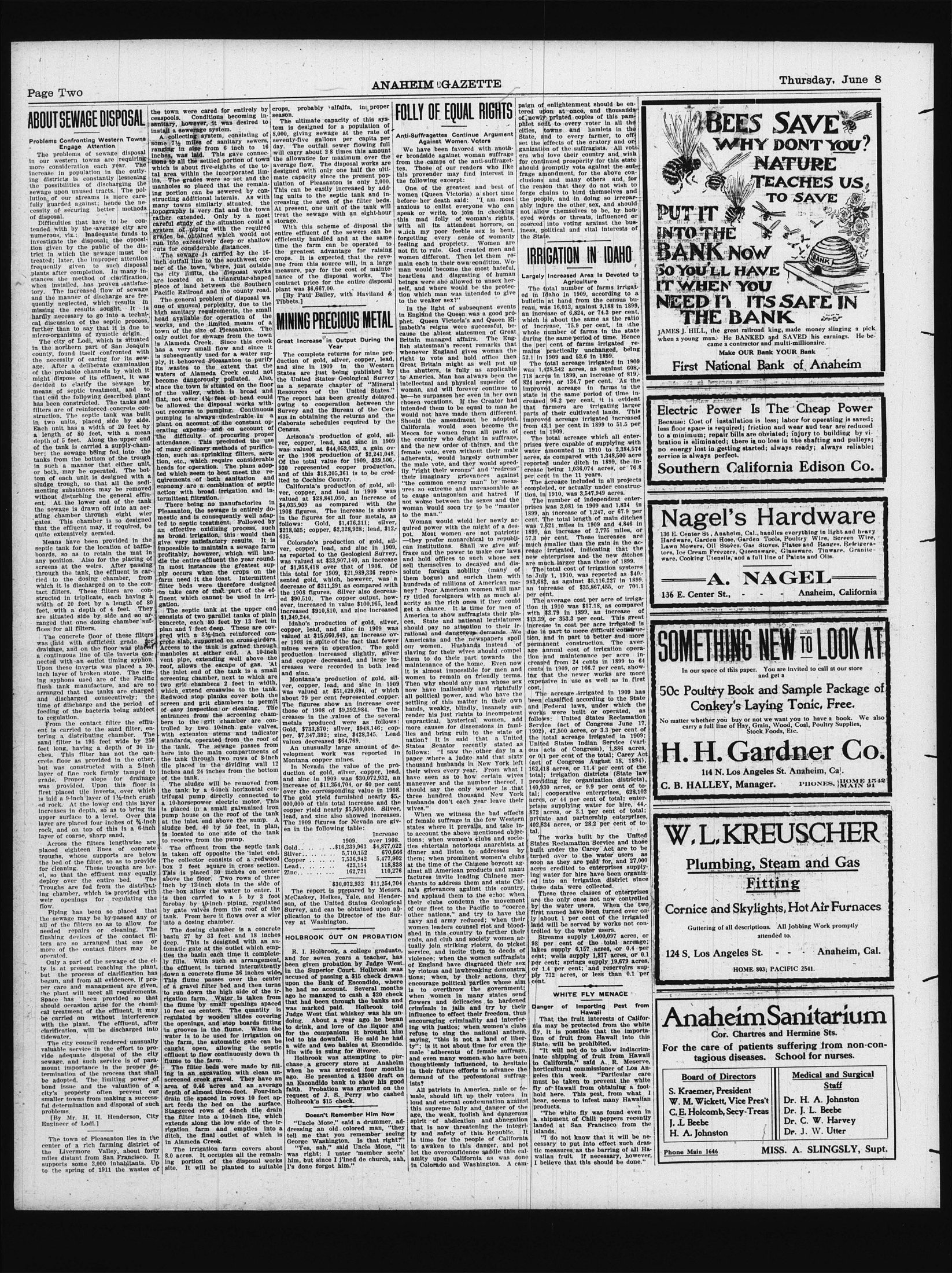
Searchable text
ABOUT SEWAGE DISPOSAL
Problems Confronting Western Towns Engage Attention
The problems of sewage disposal in our western towns are requiring more consideration each year. The increase in population in the outlying districts is constantly lessening the possibilities of discharging the sewage upon unused tracts. The pollution of our streams is more carefully guarded against; hence the necessity of securing better methods of disposal.
Difficulties that have to be contended with by the average city are numerous, viz.: Inadequate funds to investigate the disposal; the opposition given by the public of the district in which the sewage must be treated; later, the improper attention frequently given to such disposal plants after completion. In many instances the method of clarification, when installed, has proven satisfactory. The increased flow of sewage and the manner of discharge are frequently neglected, which results in missing the results sought. It is hardly necessary to go into a technical discussion of the septic process, further than to say that it is due to micro-organisms of zymotic origin.
The city of Lodi, which is situated in the northern part of San Joaquin county, found itself confronted with the necessity of caring for its sewage. After a deliberate examination of the probable channels by which it might dispose of its effluent, it was decided to clarify the sewage by means of septic treatment, and to that end the following described plant has been constructed. The tanks and filters are of reinforced concrete construction. The septic tank was built in two units, placed side by side. Each unit has a width of 20 feet by a length of 80 feet, with a mean depth of 5 feet. Along the upper end of the tank is carried a supply-chamber; the sewage being fed into the tanks from the bottom of the trough in such a manner that either unit, or both, may be operated. The bottleneck town were cared for entirely by cesspools. Conditions becoming insanitary, however, it was desired to install a sewerage system.
A collecting system, consisting of some 7½ miles of sanitary sewers, ranging in size from 6 inch to 16 inches, was laid. This gave connections to all the settled portion of town which is about five-eighths of the total area within the incorporated limits. The grades were so set and the manholes so placed that the remaining portion can be sewered by constructing additional laterals. As with many towns similarly situated, the topography is very flat and the town rather extended. Only by a most careful study of the situation could a system of piping with the required grades be obtained which would not run into excessively deep or shallow cuts for considerable distances.
The sewage is carried by the 16-inch outfall line to the southwest corner of the town, where, just outside the city limits, the disposal works are located on a triangular-shaped piece of land between the Southern Pacific Railroad and the county road.
The general problem of disposal was one of unusual perplexity, due to the high sanitary requirements, the small head available for operation of the works, and the limited means of a town of the size of Pleasanton. The only outlet for sewage from the town is Alameda Creek. Since this creek has a very small flow and since it is subsequently used for a water supply, it behooved Pleasanton to purify its wastes to the extent that the waters of Alameda Creek could not become dangerously polluted. Also, since the town is situated on the floor of the valley, which is broad and flat, not over 4¼ feet of head could be allowed the disposal works without recourse to pumping. Continuous pumping is always undesirable in a plant on account of the constant operating expense and on account of the difficulty of procuring proper attendance. This precluded the use of many ordinary methods of purification, such as sprinkling filters, aeration, etc., which require considerable heads for operation. The plans adopted which seem to best meet the crops, probably \alfalfa, and season.
The ultimate capacity of term is designed for a pool 8,000 giving sewage at the seventy-five gallons per day. The outfall sewer will carry about 28 times the allowance for maximum average flow. The disposal designed with only one large capacity since the population of Pleasanton is This can be easily increasing units to the septic tank creasing the area of the town At present, one unit of the treat the sewage with any storage.
With this scheme of entire effluent of the sewage efficiently handled and at time the farm can be on the greatest advantage crops. It is expected that now from this source will measure, pay for the cost nature of the disposal we contract price for the entire plant was $6,667.00.
[By Paul Bailey, with Tibbets.]
might dispose of its effluent, it was decided to clarify the sewage by means of septic treatment, and to that end the following described plant has been constructed. The tanks and filters are of reinforced concrete construction. The septic tank was built in two units, placed side by side. Each unit has a width of 20 feet by a length of 80 feet, with a mean depth of 5 feet. Along the upper end of the tank is carried a supply-chamber; the sewage being fed into the tanks from the bottom of the trough in such a manner that either unit, or both, may be operated. The bottom of each unit is designed with a sludge trough, so that all the sedimenting substances may be removed without disturbing the general effluent. At the lower end of the tank the sewage is drawn off into an aerating chamber through eight wier gates. This chamber is so designed that the effluent may, if required, be quite extensively aerated.
Means have been provided in the septic tank for the location of baffle boards, so as to retain the mat in any position. Also for the placing of screens at the weirs. After passing through the tank, the effluent is carried to the dosing chamber, from which it is discharged on to the contact filters. These filters are constructed in triplicate, each having a width of 20 feet by a length of 80 feet, with a depth of 4 feet. They are situated side by side and so arranged that one dosing chamber suffices for all filters.
The concrete floor of these filters was laid with sufficient grade for drainage, and on the floor was placed a continuous line of tile invertts connected with an outlet timing syphon. Upon these invertts was placed a 30-inch layer of broken stone. The timing syphons used are of the Pacific flush tank manufacture, and are so arranged that the tanks are charged and discharged consecutively; the time of discharge and the period of feeding of the bacteria being subject to regulation.
From the contact filter the effluent is carried to the sand filter, entering a distributing chamber. The sand filter is 195 feet wide by 250 feet long, having a depth of 30 inches. This filter has not the concrete floor as provided in the other, but was constructed with a 2-inch layer of fine rock firmly tamped to grade. Proper slope for drainage was provided. Upon this floor is first placed tile invertts, over which is laid a 9-inch layer of 1½-inch crushed rock. At the lower end this layer increases in depth, so as to bring its upper surface to a level. Over this layer are placed four inches of ¼-inch rock, and on top of this is a 6-inch layer of coarse, sharp sand.
Across the filters lengthwise are placed eighteen lines of concrete troughs, whose supports are below the bed of the filter, so as to provide for cleaning. These troughs are level, so that the effluent may equally deploy over the entire bed. The Troughs are fed from the distributing chamber, which is provided with weir openings for regulating the waters of Alameda Creek and become dangerously polluted. Also, since the town is situated on the floor of the valley, which is broad and flat, not over 4¼ feet of head could be allowed the disposal works without recourse to pumping. Continuous pumping is always undesirable in a plant on account of the constant operating expense and on account of the difficulty of procuring proper attendance. This precluded the use of many ordinary methods of purification, such as sprinkling filters, aeration, etc., which require considerable heads for operation. The plans adopted which seem to best meet the requirements of both sanitation and economy are a combination of septic action with broad irrigation and intermittent filtration.
There being no manufactories in Pleasanton, the sewage is entirely domestic and is consequently well adapted to septic treatment. Followed by an effective oxidizing process, such as broad irrigation, this would then give very satisfactory results. It is impossible to maintain a sewage farm profitably, however, which will handle the entire effluent the year round. In most instances the greatest supply occurs when the crops on the farm need it the least. Intermittent filter beds were therefore designed to take care of that part of the effluent which cannot be used in irrigation.
The septic tank at the upper end consists of two parallel tanks of plain concrete, each 80 feet by 13 feet in plan and 7 feet deep. These are covered with a 3½-inch reinforced concrete slab, supported on cross-girders. Access to the tank is gained through manholes at either end. A 10-inch vent pipe, extending well above the roof, allows the escape of gas. At the inlet end of the tank is a small screening chamber, next to which are two grit chambers 2 feet in width, which extend crosswise to the tank. Redwood stop planks cover both the screen and grit chambers to permit easy inspection or cleaning. The entrances from the screening chambers to the grit chamber are controlled by two 10-inch gate valves, with extension stems and indicator standards, operated from the roof of the tank. The sewage passes from here into the main compartments of the tank through two rows of 8-inch tile placed in the dividing wall 12 inches and 24 inches from the bottom of the tank.
The sludge will be removed from the tank by a 6-inch horizontal centrifugal pump directly connected to a 10-horsepower electric motor. This is placed in a small galvanized iron pump house on the roof of the tank at the inlet end above the sump. A sludge bed, 40 by 50 feet, in plan, is located to one side of the tank to receive from the pump.
The effluent from the septic tank is taken off opposite inlet end. The collector consists of a redwood box 2 feet square in cross section. This is placed 30 inches on center above the floor. Two rows of three inch by 12-inch slots in the side of the box allow the water to enter. It is then carried to a 5 by 3 foot
Arizona's production ver, copper, lead, and was valued at $44,053,022 er the 1908 production Of the total value for 1930 represented copper and of this $18,305,361 ited to Cochise County.
California's production ver, copper, and lead is valued at $28,841,050, and $4,035,909 as compared 1908 figures. The increase in the figures for all follows: Gold, $1,476; $218,035; copper, $2,328,963.
Colorado's production ver, copper, lead, and was valued at $33,907,146 of $1,958,418 over that this total for 1909, $211 sented gold, which how decrease of $311,291 as on this 1908 figures. Silver ed $90,510. The copper ever increased in value increased $910,810,and $1,349,244.
Idaho's production ver, copper, lead,and zinc valued at $15,660,849,and er 1908 in spite ofthe fines were in operatic production increased s and copper decreased,s creases were recorded and zinc.
Montana's production ver, copper, lead,and was valued at $51,429 about 79 per cent reprete The figures show an those of 1908of $9,392 creases inthe values ometals produced were Gold,$733,870;silver per,$7,347,392;zinc,$values decreased$64,766.
An unusually large development work was Montana copper mines.
In Nevada the valueduction of gold,silver,and zinc in 1909 was increase of $11,254,704overthe corresponding.The gold yield furnished 000,000ofthis total incopper yield nearly $5.5lead,and zinc also shown.The 1909 figures for Nenin inthe following tab
At the lower end this layer increases in depth, so as to bring its upper surface to a level. Over this layer are placed four inches of ¼-inch rock, and on top of this is a 6-inch layer of coarse, sharp sand.
Across the filters lengthwise are placed eighteen lines of concrete troughs, whose supports are below the bed of the filter, so as to provide for cleaning. These troughs are level, so that the effluent may equally deploy over the entire bed. The Troughs are fed from the distributing chamber, which is provided with weir openings for regulating the flow.
Piping has been so placed that the sewage may be by-passed any or all of the filters so as to allow for needed repairs or cleaning. The flushing devices of the contact filters are so arranged that one or more of the contact filters may be operated.
Only a part of the sewage of the city is at present reaching the plant, but the process of clarification has begun, and from all evidences, if proper care and management are given, the plant will meet all requirements. Space has been provided so that should occasion arise for the chemical treatment of the effluent, it may be carried on without interference with the plant. The effluent, after clarification, will be discharged into tidewater.
The city council rendered unusually valuable service in the effort to provide adequate disposal of the city sewage, and such service is of paramount importance in the proper determination of the process that shall be adopted. The limiting power of bond issue and the valuation of a city's property often prevent our smaller towns from making a successful determination and disposal of such problems.
[By Mr. H. H. Henderson, City Engineer of Lodi.]
The town of Pleasanton lies in the center of a rich farming district of the Livermore Valley, about forty miles distant from San Francisco. It supports some 2,000 inhabitants. Up to the spring of 1911 the wastes of
a 10-horsepower electric motor. This is placed in a small galvanized iron pump house on the roof of the tank at the inlet end above the sump. A sludge bed, 40 by 50 feet, in plan, is located to one side of the tank to receive from the pump.
The effluent from the septic tank is taken off opposite the inlet end. The collector consists of a redwood box 2 feet square in cross section. This is placed 30 inches on center above the floor. Two rows of three inch by 12-inch slots in the side of the box allow the water to enter. It is then carried to a 5 by 3 foot forebay by 10-inch piping, regulated by gate valves from the roof of the tank. From here it flows over a wier into a dosing chamber.
The dosing chamber is a concrete basin 27 by 33 feet and 18 inches deep. This is designed with an automatic gate at the outlet which empties the basin each time it completely fills. With such an arrangement, the effluent is turned intermittently down a concrete flume 36 inches wide. This flume passes over the center of a gravel filter bed and then turns to run down the high side of the irrigation farm. Water is taken from the flume by small openings spaced 10 feet on centers. The quantity is regulated by wooden slides covering the openings, and stop boards fitting in grooves in the flume. When the water is to be used for irrigation on the farm, the automatic gate can be caught open, allowing the septic effluent to flow continuously down th flume to the farm.
The filter beds were made by filling in an excavation with clean unscreened creek gravel. They have an area of 0.46 acres and an average depth of almost three-feet. Four-inch drain tile spaced in rows 10 feet apart feeds the bed on the surface. Staggered rows of 4-inch tile drain the filter into a 10-inch line, which extends along the low side of the irrigation farm and empties into a ditch, the final outlet of which is in Alameda Creek.
The irrigation farm covers about 8.0 acres. It occupies all the remaining portion of the disposal works site. It will be planted to suitable
ANAHEIM GAZETTE
FOLLY OF EQUAL RIGHTS
Anti-Suffragettes Continue Argument Against Women Voters
We have been favored with another broadside against woman suffrage from the camps of the anti-suffragettes. Those of our readers who like this provender may find interest in the following excerpt:
One of the greatest and best of women (Queen Victoria) a short time before her death said: "I am most anxious to enlist everyone who can speak or write, to join in checking this mad folly of woman's rights, with all its attendant horrors, on which my poor feeble sex is bent, forgetting every sense of womanly feeling and propriety. Women are not fit to rule. God created men and women different. Then let them remain each in their own condition. Woman would become the most hateful, heartless and disgusting of human beings were she allowed to unsex herself, and where would be the protection which man was intended to give to the weaker sex?"
In the light of subsequent events in England the Queen was a good prophet. Queen Victoria's and Queen Elizabeth's reigns were successful, because the ablest statesmen of Great Britain managed affairs. The English statesman's recent remarks that whenever England gives woman the right to vote and hold office then Great Britain might as well put up the shutters, is fully as applicable to America. Man has always been the intellectual and physical superior of woman, and will forever continue to he—he surpasses her even in her own chosen vocations. If the Creator had intended them to be equal to man he would not have made them different. Should the amendment be adopted, California would soon become the Mecca for women from all parts of the country who delight in suffrage, and the new order of things, and the female vote, even without their male adherents, would largely outnumber the male vote, and they would speedily "right their wrongs" and "redress"
paign of enlightenment should be entered upon at once, and thousands of newly printed copies of this pamphlet sent to every voter in all the cities, towns and hamlets in the State, and to every farmer, to off-set the effects of the oratory and organization of the suffragists. All voters who love their country and wish for continued prosperity for this state should promptly vote against the suffrage amendment, for the above conclusions and many others and for the reason that they do not wish to forge chains to bind themselves and the people, and in doing so irreparably injure the other sex, and should not allow themselves to be, by honeyed words or threats, influenced or coerced into voting against the business, political and vital interests of the State.
IRRIGATION IN IDAHO
Largely Increased Area Is Devoted to Agriculture
The total number of farms irrigated in Idaho in 1909, according to a bulletin at hand from the census bureau, was 16,012, against 9,188 in 1899, an increase of 6,824, or 74.3 per cent, which is about the same as the ratio of increase, 75.9 per cent, in the whole number of farms in the state during the same period of time. Hence the per cent of farms irrigated remains practically unchanged, being 52.1 in 1909 and 52.6 in 1899.
The total acreage irrigated in 1909 was 1,428,542 acres, as against 608,-718 acres in 1899, an increase of 819,-824 acres, or 134.7 per cent. As the improved acreage in farms in the state in the same period of time increased 96.2 per cent, it is evident that farmers are irrigating larger parts of their cultivated lands. This improved acreage irrigated increased from 43.1 per cent in 1899 to 51.5 per cent in 1909.
The total acreage which all enterprises were capable of supplying with water amounted in 1910 to 2,384,574 acres, as compared with 1,348,500 acres reported under ditch in 1899, the increase being 1,036,074 acres, or 76.8 percent in the 11 years.
Arizona's production of gold, silver, copper, lead, and zinc in 1909 was valued at $44,053,023, a gain over the 1908 production of $2,241,048. Of the total value for 1909, $39,506,930 represented copper production, and of this $18,305,361 is to be credited to Cochise County.
California's production of gold, silver, copper, lead, and zinc in 1909 was valued at $28,841,050, an increase of $4,035,909 as compared with the 1908 figures. The increase is shown in the figures for all four metals, as follows: Gold, $1,476,311; Silver, $218,035; Copper, $2,328,928; Lead, $12,635.
Colorado's production of gold, silver, copper, lead, and zinc in 1909 was reported to the Geological Survey, was valued at $33,907,140, an increase of $1,958,418 over that of 1908. Of this total for 1909, $21,989,336 represented gold, which, however, was a decrease of $311,291 as compared with the 1908 figures. Silver also decreased $90,510. The copper output, however, increased in value $100,165, lead increased $910,810, and zinc increased $1,349,244.
Idaho's production of gold, silver, copper, lead, and zinc in 1909 was valued at $15,660,849, an increase over 1908 in spite of the fact that fewer mines were in operation. The gold production increased slightly, silver and copper decreased, and large increases were recorded in both lead and zinc.
Montana's production of gold, silver, copper, lead, and zinc in 1909 was valued at $51,429,694, of which about 79 per cent represented copper. The figures show an increase over those of 1908 of $9,392,984. The increases in the values of the several metals produced were as follows: Gold, $733,870; silver, $948,146; copper, $7,347,392; zinc, $428,345. Lead values decreased $64,769.
An unusually large amount of development work was reported in Montana copper mines.
In Nevada the value of the production of gold, silver, copper, lead, and zinc in 1909 was $30,072,932 an increase of $11,254,704 or 60 per cent over the corresponding value in 1908. The gold yield furnished nearly $5.000.000 of this total increase and the copper yield nearly $5.500.000. Silver lead, and zinc also showed increases. The 1909 figures for Nevada are given in the following table:
| Increase | 1909 | over 1908 |
| :--- | :--- | :--- |
| Gold | $16,239,963 | $4,877,022 |
| Silver | 5,710.152 | 670.666 |
| Copper | 7,536.942 | 5.477.902 |
| Lead | 423.154 | 118.838 |
| Zinc | 162.721 | 110.276 |
$30,072,932 $11,254,704
The report is prepared by Messrs. McCaskey, Helkes Yale, and Hender.
Man has always been the intellectual and physical superior of woman,and will forever continue to be—he surpasses her even in her own chosen vocations. If the Creator had intended them to be equal to man would not have made them different. Should the amendment be adopted California would soon become the Mecca for women from all parts of the country who delight in suffrage,and the new order of things,and the female vote,even without their male adherents,the would largely outnumber the male vote,and they would speedily "right their wrongs" and "redress" their imaginary grievances against "the common enemy man" by measures so extreme and unreasonable as to cause antagonism and hatred if not worse between the sexes and the woman would soon try to be "master to the man."
Woman would wield her newly acquired power with the might of a despot.Most women are not patriotic—they prefer monarchical to republican institutions.Shall we give suffrage and the power to make our laws and hold offices to such whose sex sell themselves to decayed and dissolute foreign nobility (many of them bogus) and enrich them with hundreds of millions of American money? Poor American women will marry titled foreigners with as much alacrity as the rich ones if they could get a chance. It is time for men of America to show suffragists their places.State and national legislatures should pay no attention to their irrational and dangerous demands.We Americans and the newspapers spoil our women.Husbands instead of slaving for their wives should compel them to do their part towards the maintenance of the home.Even now it is almost impossible for men and women to remain on friendly terms.Then why should any man whose sex now have inallenably and rightfully all political power,and who have the settling of this matter in their own hands,weakly,blindly,insanely surrender his just rights to incompetent unpractical,hysterical women,add more causes for dissensions in families and bring ruin to the state or nation? It is said that a United States Senator recently stated as follows: "I saw the other day in a paper where a judge said that sixty thousand husbands in New York left their wives every year.From what I have seen as to how certain wives maneuver and the number thereof.I should say the only wonder is that three hundred thousand New York husbands don't each year leave their wives."
When we witness the bad effects of female suffrage in the few Western states where it prevails,and take into account the above mentioned objections;when women's clubs and societies entertain notorious anarchists at dinner and listen to addresses by them;when prominent women's clubs at the time of the Chinese boycott against all American products and manufactures invite leading Chinese merchants to address them and state China's grievances against this country,and applaud them to the echo;when America to women from all parts of the country who delight in suffrage,and the new order of things,and the female vote,even without their male adherents,the would largely outnumber the male vote,and they would speedly "right their wrongs" and "redress" their imaginary grievances against "the common enemy man" by measures so extreme and unreasonable as to cause antagonism and hatred if not worse between the sexes and the woman would soon try to be "master to the man."
The total acreage which all enterprises were capable of supplying with water amounted in 1910 to 2,384.574 acres,as compared with 1.348.500 acres reported under ditch in 1899,the increase being 1.036.074 acres,或76.8 percent in the 11 years.
The acreage included in all projects completed,or actually under construction,in 1910,是3.547.949 acres.
The number of independent enterprises was 3.081 in 1909和1.834 in 1899,an increase of 1.247,或67.9 percent.The total length of main ditches was 7.621 miles in 1909和4.846 in 1899,an increase of 2.775 miles,或57.3 percent。这些 increases are much smaller than the gain in the acreage irrigated,indicating that the new enterprises and the new ditches are much larger than those of 1899.
The total cost of irrigation systems to July 1,1910,was reported as $40.983.682,as against $5.116.227 in 1899,an increase of $35.867.455,或701.1 percent.
The average cost per acre of irrigation in 1910 was $17.18,as compared with $3.79在1899,an increase of $13.39,或353.3 percent。这 great increase in cost per acre irrigated is due in part to more difficult construction,和 in part to better and more permanent construction.The average annual cost of irrigation operation and maintenance per acre increased from 24 cents in 1899 to 64 cents in 1909,或166.7 percent,showing that the newer works are more expensive in use as well as in first cost.
The acreage irrigated in 1909 has been classified according to the State and Federal laws,under which the works were built or operated,as follows:United States Reclamation Service(act of Congress June 17,1902),47.500 acres,或3.3 percent of the total acreage irrigated in 1909;United States Indian Service(various acts of Congress),1.886 acres,或0.1 percent of the total;Carey Act(act of Congress August 18,1894),162.418 acres,或11.4 percent of the total;irrigation districts(State law providing for organization districts),140.930 acres,或9.9 percent of total;cooperative enterprises,628.102 acres,或44 percent of total;enterprises supplying water for hire,44.872 acres,或3.1 percent of total;private and partnership enterprises,402.834 acres,或28.2 percent of total.
The works built by the United States Reclamation Service and those built under the Carey Act are to be turned over to the water users as soon as they are paid for,and 27.000 acres credited to enterprises supplying water for hire have been organized into an irrigation district since these data were collected.
These three classes of enterprises are the only ones not now controlled
The gold yield remained nearly 000,000 of this total increase and the copper yield nearly $5,500,000. Silver, lead, and zinc also showed increases. The 1909 figures for Nevada are given in the following table:
Increase
1909. over 1908.
Gold. $16,239,963 $4,877,022
Silver. 5,710,152 670,666
Copper. 7,536,942 5,477,902
Lead. 423,154 118,838
Zinc. 162,721 110,276
$30,072,932 $11,254,704
The report is prepared by Messrs. McCaskey, Helkes, Yale, and Henderson, of the United States Geological Survey, and can be obtained upon application to the Director of the Survey at Washington.
HOLBROOK OUT ON PROBATION
R. I. Holbrook, a college graduate, and for seven years a teacher, has been given probation by Judge West in the Superior Court. Holbrook was accused of passing a $15 check drawn upon the Bank of Escondido, where he had no account. Several months ago he managed to cash a $20 check that had been through the banks and was marked paid. Holbrook told Judge West that whiskey was his undoing. About a year ago he began to drink, and love of the liquor and for the companions it brought him led to his downfall. He said he had a wife and two babies at Escondido. His wife is suing for divorce.
Holbrook was attempting to purchase a grocery store at Anaheim when he was arrested four months ago. He presented a $2500 draft on an Escondido bank to show his good faith. Probation was granted on the request of J. S. Perry who cashed Holbrook's $15 check.
Doesn't Remember Him Now
"Uncle Mose," said a drummer, addressing an old colored man, "they tell me that you remember seeing George Washington. Is that right?"
"Yes, sah," said Uncle Mose, "it was right; I uster 'member seen' him, but since I jined de church, sah, I'm done forgot him."
When we witness the bad effects of female suffrage in the few Western states where it prevails, and take into account the above mentioned objections; when women's clubs and societies entertain notorious anarchists at dinner and listen to addresses by them; when prominent women's clubs at the time of the Chinese boycott against all American products and manu factures invite leading Chinese merchants to address them and state China's grievances against this country, and applaud them to the echo; when their clubs condemn the movement of our fleet to the Pacific to "coerce other nations," and try to have the navy and army reduced; when their women leaders counsel riot and bloodshed in this country to further their ends, and club and society women actually join striking rioters, do picket service, and incite them to deeds of violence; when the women suffragists of England have disgraced their sex by riotous and lawbreaking demonstrations; when, by their actions, they encourage political parties whose aim is to overthrow the government; when women in many states send flowers and delicacies to hardened criminals in jails and try by their influence to effect their freedom, thus encouraging criminality and interfering with justice; when women's clubs refuse to sing the national anthem, saying, "this is not a land of liberty"; is it not about time for even the male adherents of female suffrage, and even many women who have been thoughtlessly influenced, to hesitate in their future efforts to advance the demand of the professional suffragists?
All patriots in America, male or female, should lift up their voices in loud and eternal condemnation against this supreme folly and danger of the age, the weak, foolish and dangerous spirit of abdication and abnegation that is now threatening the integrity and safety of this Republic. It is time for the people of California to awaken to this danger, and not let the overconfidence saddle this calamity upon California as was done in Colorado and Washington. A cam-
WHITE FLY MENACE
Danger of Importing Pest from Hawaii
That the fruit interests of California may be protected from the white fly, it is possible that the importation of fruit from Hawaii into this State will be prohibited.
"It will not do to allow indiscriminate shipping of fruit from Hawaii to California," said A. R. Meserve, horticultural commissioner of Los Angeles this week. "Particular care must be taken to prevent the white fly of Hawaii from obtaining a foothold here. This pest, from what I hear, seems to infest many Hawaiian products.
"The white fly was found even in a shipment of Chili peppers recently landed at San Francisco from the islands.
"I do not know that it will be necessary to put into effect such drastic measures as the barring of all Hawaiian fruit. If necessary, however, I believe that this should be done."
BEES SAVE WHY DONT YOU?
NATURE TEACHES US TO SAVE
PUT IT INTO THE BANK NOW
SO YOULL HAVE IT WHEN YOU NEED IT ITS SAFE IN THE BANK
JAMES J. HILL, the great railroad king, made money slinging a pick when a young man. He BANKED and SAVED his earnings. He became a contractor and multi-millionaire.
Make OUR Bank YOUR Bank
First National Bank of Anaheim
Electric Power Is The Cheap Power
Because: Cost of installation is less; labor for operating is saved; less floor space is required; friction and wear and tear are reduced to a minimum; repair bills are obviated; injury to building by vibration is eliminated; there is no loss in the shafting and pulleys; no energy lost in getting started; always ready; always reliable; service is always perfect.
Southern California Edison Co.
Electric Power Is The Cheap Power
Because: Cost of installation is less; labor for operating is saved;
less floor space is required; friction and wear and tear are reduced
to a minimum; repair bills are obviated; injury to building by vibration is eliminated; there is no loss in the shafting and pulleys;
no energy lost in getting started; always ready; always reliable;
service is always perfect.
Southern California Edison Co.
Nagel's Hardware
136 E. Center St., Anaheim, Cal., handles everything in light and heavy
Hardware, Garden Hose, Garden Tools, Poultry Wire, Screen Wire,
Lawn Mowers, Oil Stoves, Gas Stoves, Plates and Ranges, Refrigerators,
Ice Cream Freezers, Queensware, Glassware, Tinware, Graniteware, Cooking Utensils, and a full line of Paints and Oils.
A. NAGEL
136 E. Center St., Anaheim, California
SOMETHING NEW TO LOOK AT
In our space of this paper. You are invited to call at our store
and get a
50c Poultry Book and Sample Package of Conkey's Laying Tonic, Free.
No matter whether you buy or not we want you to have a book. We also
carry a full line of Hay, Grain, Wood, Coal, Poultry Supplies,
Stock Foods, Etc.
H. H. Gardner Co.
114 N. Los Angeles St. Anaheim, Cal.
C. B. HALLEY, Manager.
PHONES. HOME 1542
MAIN 91
W.L.KREUSCHER
Plumbing, Steam and Gas
Fitting
W.L.KREUSCHER
Plumbing, Steam and Gas
Fitting
Cornice and Skylights, Hot Air Furnaces
Guttering of all descriptions. All Jobbing Work promptly attended to.
124 S. Los Angeles St. - Anaheim, Cal.
HOME 803; PACIFIC 2541.
AnaheimSanitarium
Cor. Chartres and Hermine Sts.
For the care of patients suffering from non-contagious diseases. School for nurses.
Board of Directors
S. Kraemer, President
W. M. Wickett, Vice Pres't
C.E. Holcomb, Secy-Treas
J. .L Beebe
H. A. Johnston
Medical and Surgical Staff
Dr. H. A. Johnston
Dr. J. L. Beebe
Dr. C. W. Harvey
Dr. J. W. Utter
Phone Main 1646
MISS. A. SLINGSLY, Supt.