anaheim-gazette 1911-05-18
Scanned page
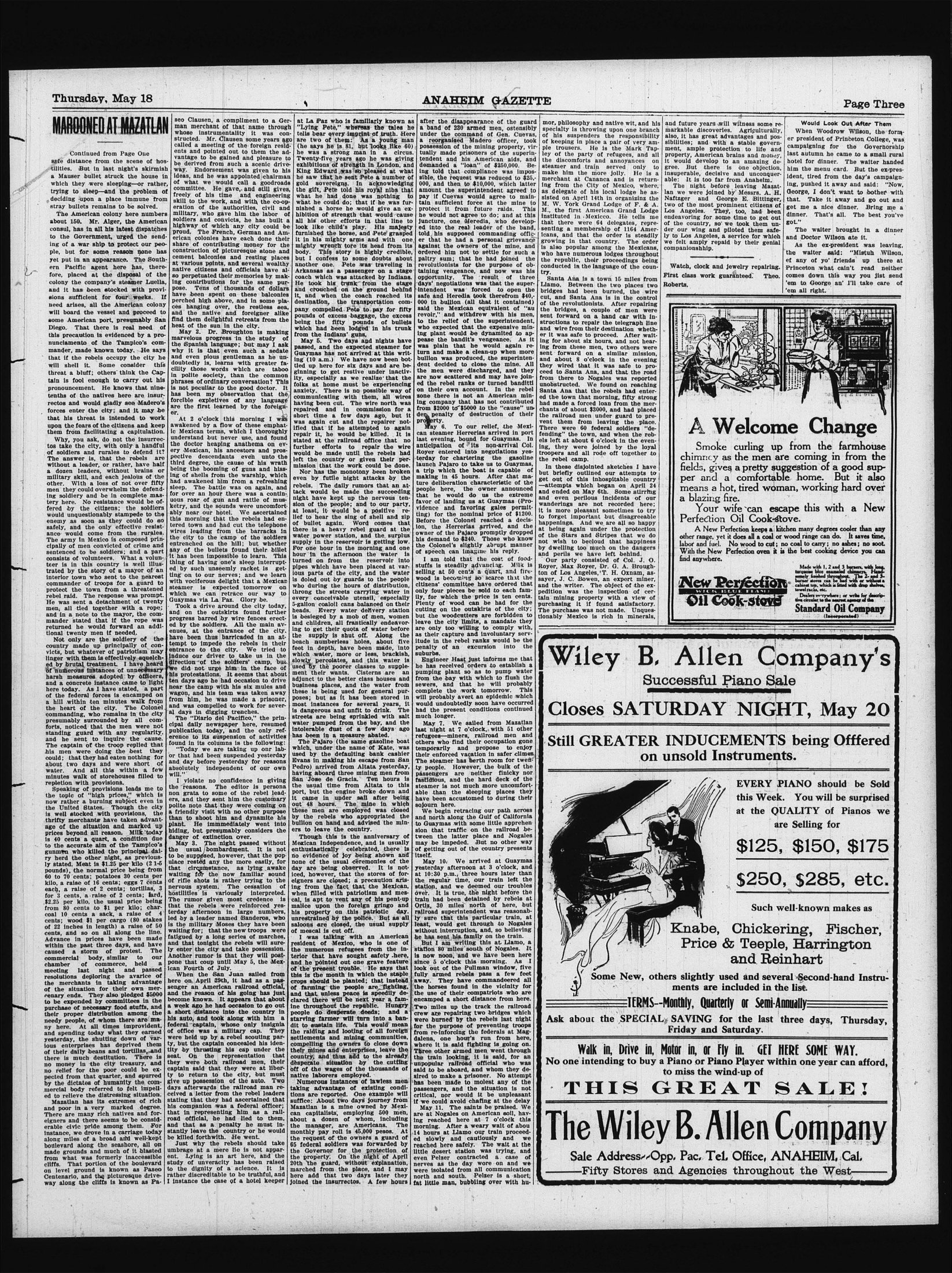
Searchable text
MAROONED AT MAZATLAN
Continued from Page One
safe distance from the scene of hostilities. But in last night's skirmish a Mauser bullet struck the house in which they were sleeping—or rather, trying to sleep—and the problem of deciding upon a place immune from stray bullets remains to be solved.
The American colony here numbers about 150. Mr. Alger, the American consul, has in all his latest dispatches to the Government, urged the sending of a war ship to protect our people, but for some reason none has yet put in an appearance. The Southern Pacific agent here has, therefore, placed at the disposal of the colony the company's steamer Luella, and it has been stocked with provisions sufficient for four weeks. If need arises, all the American colony will board the vessel and proceed to some American port, presumably San Diego. That there is real need of this precaution is evidenced by a pronunciamento of the Tampico's commander, made known today. He says that if the rebels occupy the city he will shell it. Some consider this threat a bluff; others think the Captain is fool enough to carry out his pronouncement. He knows that nineteenth of the natives here are insurrectos and would gladly see Madero's forces enter the city; and it may be that his threat is intended to work upon the fears of the citizens and keep them from facilitating a capitulation.
Why, you ask, do not the insurrectos take the city, with only a handful of soldiers and rurales to defend it? The answer is, that the rebels are without a leader, or rather, have half a dozen leaders, without brains or seo Clausen, a compliment to a German merchant of that name through whose instrumentality it was constructed. Mr. Clausen some years ago called a meeting of the foreign residents and pointed out to them the advantage to be gained and pleasure to be derived from such a scenic driveway. Endorsement was given to his ideas, and he was appointed chairman of what we would call a goodroads committee. He gave, and still gives, freely of his time and engineering skill to the work, and with the co-operation of the authorities, civil and military, who gave him the labor of soldiers and convicts, he has built a highway of which any city could be proud. The French, German and American colonies have each done their share of contributing money for the construction of picturesque stone and cement balconies and resting places at various points, and several wealthy native citizens and officials have also perpetuated their memories by making contributions for the same purpose. Tens of thousands of dollars have been spent on these balconies perched high above, and in some places hanging over, the restless sea, and the native and foreigner alike find them delightful retreats from the heat of the sun in the city.
May 2. Dr. Broughton is making marvelous progress in the study of the Spanish language; but may I ask why it is that even such a sedate and even plious gentleman as he undoubtedly is, learns with greater facility those words which are taboo in polite society, than the common phrases of ordinary conversation? This is not peculiar to the good doctor. It has been my observation that the forcible expletives of any language are the first learned by the foreigner.
At 2 o'clock this morning I was awakened by a flow of these emphatic Mexican terms, which I thoroughly understand but never use, and found the doctor heaping anathema on every Mexican, his ancestors and prospective descendants even unto the third degree, the cause of his wrath being the booming of guns and hissing of shells from the warship which at La Paz who is fled "Lying Pete," tells bear every imminent two of them: (he says he is 81), he was a strong man. Twenty-five years later exhibitions of strength King Edward was held; he saw that he sent gold sovereigns. The gift, Pete told me what he had done what he could do; nished a horse he exhibited of strength all his other efforts; look like child's pearl furnished the horse; it in his mighty arm mighty wrench torpedo body. This story was but I confess to say another one. Peter Arkansas as a pass coach which was at He took his trunk and crouched on it it, and when the destination, the trepany compelled Peter pounds of excess baggage being the fifty pence which had been lost from the Indians' garrison.
May 5. Two days passed, and the expiry Guaymas has not arrived (10 a.m.) We have tied up here for six minutes getting into get restility, especially as we folks at home must anxiety. There is no communicating with having been cut. The repaired and in short time a few was again cut and afflicted that if he attire repair it, he would stated at the railroad further efforts to would be made until left the country or mission that the woNor has the monologue
threat is a blunt, others think the captain is fool enough to carry out his pronouncement. He knows that nineteenth of the natives here are insurrectos and would gladly see Madero's forces enter the city; and it may be that his threat is intended to work upon the fears of the citizens and keep them from facilitating a capitulation.
Why, you ask, do not the insurrectos take the city, with only a handful of soldiers and rurales to defend it? The answer is, that the rebels are without a leader, or rather, have half a dozen leaders, without brains or military skill, and each jealous of the other. With a loss of not over fifty men they could overwhelm the defending soldiery and be in complete mastery here. No resistance would be offered by the citizens; the soldiers would unquestionably stampede to the enemy as soon as they could do so safely, and the only effective resistance would come from the rurales. The army in Mexico is composed principally of men convicted of crime and sentenced to be soldiers; and a part consists of volunteers. What a volunteer is in this country is well illustrated by the story of a mayor of an interior town who sent to the nearest commander of troops for a guard to protect the town from a threatened rebel raid. The response was prompt. He was sent a detachment of twenty men, all tied together with a rope; and in a note to the mayor, the commander stated that if the rope was returned he would forward an additional twenty men if needed.
Not only are the soldiers of the country made up principally of convicts, but whatever of patriotism may linger with them is effectively squelched by brutal treatment. I have heard of numerous instances of unnecessary harsh measures adopted by officers, and a concrete instance came to light here today. As I have stated, a part of the federal forces is encamped on a hill within ten minutes walk from the heart of the city. The Colonel commanding, who remains in the city presumably surrounded by all comforts, noticed that the men were not standing guard with any regularity, and he sent to inquire the cause. The captain of the troop replied that his men were doing the best they could; that they had eaten nothing for about two days and were short of water. And all this within a few minutes walk of storehouses filled to repletion with provisions.
Speaking of provisions leads me to the topic of "high prices," which is now rather a burning subject even in the United States. Though the city is well stocked with provisions, the thrifty merchants have taken advantage of the situation and marked up prices beyond all reason. Milk today is 40 cents a quart, a condition due to the accurate aim of the Tampico's gunmen who killed the principal dairy herd the other night, as previously stated. Meat is $1.25 per kilo (21-5 pounds), the normal price being from 60 to 70 cents; potatoes 30 cents per kilo, a raise of 16 cents; eggs 7 cents each, a raise of 2 cents; tortillas, 3 for 3 cents, a raise of 2 cents; fard, in polite society, than the common phrases of ordinary conversation? This is not peculiar to the good doctor. It has been my observation that the forcible expletives of any language are the first learned by the foreigner.
At 2 o'clock this morning I was awakened by a flow of these emphatic Mexican terms, which I thoroughly understand but never use, and found the doctor heaping anathema on every Mexican, his ancestors and prospective descendants even unto the third degree, the cause of his wrath being the booming of guns and hissing of shells from the warship, which had awakened him from a refreshing sleep. The battle was on again, and for over an hour there was a continuous roar of gun and rattle of musketry, and the sounds were uncomfortable near our hotel. We ascertained this morning that the rebels had entered town and had cut the telephone wires leading from the barracks in the city to the camp of the soldiers entrenched on the hill; but whether any of the bullets found their billet it has been impossible to learn. This thing of having one's sleep interrupted by such unseemly racket is getting on to our nerves; and we learn with vociferous delight that a Mexican steamer is expected tomorrow on which we can retrace our way to Guaymas via La Paz. Glory be.
Took a drive around the city today, and on the outskirts found further progress barred by wire fences erected by the soldiers. All the main avenues, at the entrance of the city, have been thus barricaded in an attempt to impede the rebels in their entrance to the city. We tried to induce our driver to take us in the direction of the soldiers' camp, but we did not urge him in the face of his protestations. It seems that about ten days ago he had occasion to drive near the camp with his six mules and wagon, and his team was taken away from him, he was made a prisoner, and was compelled to work for several days in digging trenches.
The "Diarlo del Pacifico," the principal daily newspaper here, resumed publication today, and the only reference to its suspension of activities found in its columns is the following:
"Today we are taking up our labor that had been suspended yesterday and day before yesterday for reasons absolutely independent of our own will."
I violate no confidence in giving the reasons. The editor is persona non grata to some of the rebel leaders, and they sent him the customary polite note that they were coming on a friendly visit with no other purpose than to shoot him and dynamite his plant. He immediately went into hiding, but presumably considers the danger of extinction over.
May 3. The night passed without the usual bombardment. It is not to be supposed, however, that the populace rested any more easily, for that circumstance, as lying awake waiting for the now familiar sound of rifle shots is rather trying to the nervous system. The cessation of hostilities is variously interpreted.
In polite society, than the common phrases of ordinary conversation? This is not peculiar to the good doctor. It has been my observation that the forcible expletives of any language are the first learned by the foreigner.
At 2 o'clock this morning I was awakened by a flow of these emphatic Mexican terms, which I thoroughly understand but never use, and found the doctor heaping anathema on every Mexican, his ancestors and prospective descendants even unto the third degree, the cause of his wrath being the booming of guns and hissing of shells from the warship, which had awakened him from a refreshing sleep. The battle was on again, and for over an hour there was a continuous roar of gun and rattle of musketry, and the sounds were uncomfortably near our hotel. We ascertained this morning that the rebels had entered town and had cut the telephone wires leading from the barracks in the city to the camp of the soldiers entrenched on the hill; but whether any of the bullets found their billet it has been impossible to learn. This thing of having one's sleep interrupted by such unseemly racket is getting on to our nerves; and we learn with vociferous delight that a Mexican steamer is expected tomorrow on which we can retrace our way to Guaymas via La Paz. Glory be.
There is a heavy reverence for water power stations supply in the reserve. For one hour in the afternoon turned on from these pipes which have been loosed parts of the city is doled out by guards who during the hours throngthe streets on every conceivable umpire's heads. Every water is besieged by a moor and children, all fragrant to get their quotient;the supply is shut beach numberless feet in depth, have which water, more slowly percolates, are used by the poorer element their wants.
Adjunct to the better business places,and these is being used poses;but as it has most instances for it is dangerous and unintolerable dust off has been in a measure.
The Pajaro (the sea which, under the naval used by the default Evans in making his Pedro) arrived from having aboard three San Jose de Gracia,the usual time from port,but the engine it came in under 48 hours.The these men are empty by the rebels who bollion on hand and others to leave the coast.
Though this is tha Mexican Independence enthusiastically celebrates no evidence of joy nor none ofthe usual day are being observedhoweverthat theseigners are closed;and ing fromthe fact that when filled with patrolis ant to vent air
now rather a burning subject even in the United States. Though the city is well stocked with provisions, the thrifty merchants have taken advantage of the situation and marked up prices beyond all reason. Milk today is 40 cents a quart, a condition due to the accurate aim of the Tampico's gunmen who killed the principal dairy herd the other night, as previously stated. Meat is $1.25 per kilo (21.5 pounds), the normal price being from 60 to 70 cents; potatoes 30 cents per kilo, a raise of 16 cents; eggs 7 cents each, a raise of 2 cents; tortillas, 3 for 3 cents, a raise of 2 cents; lard, $2.25 per kilo, the usual price being from 80 cents to $1 per kilo; charcoal 10 cents a sack, a raise of 4 cents; wood $1 per cargo (80 stakes of 22 inches in length) a raise of 50 cents, and so on all along the line. Advance in prices have been made within the past three days, and have caused a storm of protest. The commercial body, similar to our chamber of commerce, held a meeting last night and passed resolutions deploring the avarice of the merchants in taking advantage of the situation for their own mercenary ends. They also pledged $5000 to be expended by committees in the purchase of necessary food stuffs, and their proper distribution among the needy people, of whom there are many here. At all times improvident, and spending today what they earned yesterday, the shutting down of various enterprises has deprived them of their daily beans and tortillas, and there is much destitution. There is no money in the city treasury, and no relief for the poor could be expected from that quarter, and spurred by the dictates of humanity the commercial body referred to felt impelled to relieve the distressing situation.
Mazatlan has its extremes of rich and poor in a very marked degree. There are many rich natives and foreigners and there seems to be considerable civic pride among them. For instance, we drove in a carriage today along miles of a broad and well-kept boulevard along the seashore, all on made grounds and much of it blasted from what was formerly inaccessible cliffs. That portion of the boulevard on level ground is known as Paseo Centenario, and the picturesque driveway along the cliffs is known as Pa-
May 3. The night passed without the usual bombardment. It is not to be supposed, however, that the populace rested any more easily, for that circumstance, as lying awake waiting for the now familiar sound of rifle shots is rather trying to the nervous system. The cessation of hostilities is variously interpreted. The rumor given most credence is that the rebels were reinforced yesterday afternoon in large numbers, led by a leader named Banderos, who is the military Moses they have been waiting for; that the new troops were fatigued by a long series of marches, and that tonight the rebels will surely enter the city and take possession. Another rumor is that they will postpone that coup until May 5, the Mexican Fourth of July.
When the San Juan sailed from here on April 29th, it had as a passenger an American railroad official, and the reason of his going has just become known. It appears that about a week ago he had occasion to go out a short distance into the country in his auto, and took along with him a federal captain, whose only insignia of office was a military cap. They were held up by a rebel scouting party, but the captain concealed his identity by thrusting his cap under the seat. On the representation that they were both railroad men, their captain said that they were at liberty to return to the city, but must give up possession of the auto. Two days afterwards the railroad man received a letter from the rebel leaders stating that they had ascertained that his companion was a federal officer; that in representing him as a railroad official, he had lied to them, and that as a penalty he must instantly leave the country or he would be killed forthwith. He went.
Just why the rebels should take umbrage at a mere lie is not apparent. Lying is an art here, and the study of unveracity has been raised to the dignity of a science. It is rather discreditable to be truthful, and I instance the case of a hotel keeper
Though this is the Mexican Independence enthusiastically celebrating no evidence of joy or none of the usual day are being observed, however, that we eigners are closed; and ing from the fact that when filled with patrols, is apt to vent malice upon the form his property on this unrestrained by the police saloons are closed, off of mescal is cut off.
I was talking with resident of Mexico, who the numerous refugees interior that have souls and he pointed out one of the present troubles this is the month in crops should be planted of farming the people and that unless peace clared there will be no line throughout the river people do desperate starving farmer will dit to sustain life. To the raiding and lootling settlements and mines compelling the owners their mines and entering country, and thus add desperate situation off of the wages of native laborers employ.
Numerous instances taking advantage of tensions are reported. Suffice: About two days Mazatlan is a mine can capitalists, empires about a dozen of the manager, are monthly pay roll is on request of the over 65 federal soldiers with Governor for this property. On the 20th guard, with marched from the place here add that two joined the insurrection
ANAHEIM GAZETTE
at La Paz who is familiarly known as "Lying Pete," whereas the tales he tells bear every imprint of truth. Here are two of them: As a young man (he says he is 81, but looks like 60) he was a strong man in a circus. Twenty-five years ago he was giving exhibitions of strength in London, and King Edward was so pleased at what he saw that he sent Pete a number of gold sovereigns. In acknowledging the gift, Pete told his royal nibs that what he had done was nothing to what he could do; that if he was furnished a horse he would give an exhibition of strength that would cause all his other efforts in that line to look like child's play. His majesty furnished the horse, and Pete grasped it in his mighty arms and with one mighty wrench tore its head from its body. This story is highly credible, but I confess to some doubts about another one. Pete was traveling in Arkansas as a passenger on a stage coach which was attacked by Indians. He took his trunk from the stage and crouched on the ground behind it, and when the coach reached its destination, the transportation company compelled Pete to pay for fifty pounds of excess baggage, the excess being the fifty pounds of bullets which had been lodged in his trunk from the Indians' guns.
May 5. Two days and nights have passed, and the expected steamer for Guaymas has not arrived at this writing (10 a.m.) We have now been bottled up here for six days and are beginning to get restive under inactivity, especially as we realize that the folks at home must be experiencing anxiety. There is no possible way of communicating with them, all wires having been cut. The wire north was repaired and in commission for a short time a few days ago, but it was again cut and the repairer notified that if he attempted to again repair it, he would be killed. It is stated at the railroad office that no further efforts to repair the wire would be made until the rebels had left the country or given their permission that the work could be done. Nor has the monotony been broken after the disappearance of the guard a band of 230 armed men, ostensibly under the command of Gen. Cuevas, a reorganized Madero officer, took possession of the mining property, virtually made prisoners of the superintendent and his American aids, and demanded a "loan" of $250,000. Being told that compliance was impossible, the request was reduced to $25,-000, and then to $10,000, which latter amount the superintendent agreed to pay if Cuevas would agree to maintain sufficient force at the mine to protect it from future raids. This he would not agree to do; and at this juncture, one Heredia, who developed into the real leader of the band, told his supposed commanding officer that he had a personal grievance against the owners of the mine, and ordered him not to settle for such a paltry sum; that he had joined the revolutionists for the purpose of obtaining vengeance, and now was his opportunity. The result of three days' negotiations was that the superintendent was forced to open the safe and Heredia took therefrom $40,-000 in bullion (all that it contained) said the Mexican equivalent of "au revoir," and withdrew with his men, to the relief of the superintendent, who expected that the expensive mining plant would be dynamited to appease the bandit's vengeance. As it was plain that he would again return and make a clean-up when more bullion was produced, the superintendent decided to close the mine. All the men were discharged, and they are now scattered and may have joined the rebel ranks or turned banditti on their own account. In the rebel zone there is not an American mining company that has not contributed from $2000 to $5000 to the "cause" under penalty of destruction of their property.
May 6. To our relief, the Mexican steamer Herreras arrived in port last evening, bound for Guaymas. In anticipation of its non-arrival Col. Royer entered into negotiations yesterday for chartering the gasoline launch Pajaro to take us to Guaymas, a trip which the boat is capable of mor, philosophy and native wit, and his specialty is throwing upon one branch of his suspenders the responsibility of keeping in place a pair of very ample trousers. He is the Mark Tapley of the party of refugees, and all the discomforts and annoyances on steamer and train served only to make him the more jolly. He is a merchant at Cananca and is returning from the City of Mexico, where, as delegate of his local lodge he assisted on April 14th in organizzinz the M. W. York Grand Lodge of F. & A. M., the first American Grand Lodge instituted in Mexico. He tells me that there were 64 delegates, representing a membership of 1164 Americans, and that the order is steadily growing in that country. The order is also popular among the Mexicans, who have numerous lodges throughout the republic, their proceedings being conducted in the language of the country.
Santa Ana is a town 15 miles from Llamo. Between the two places two bridges had been burned, the wire cut, and Santa Ana is in the control of the revolutionists. After repairing the bridges, a couple of men were sent forward on a hand car with instructions to repair the telegraph line and wire from their destination whether it was safe to proceed. After waiting for about six hours, and not hearing from these men, two others were sent forward on a similar mission, and about 8 o'clock in the evening they wired that it was safe to proceed to Santa Ana, and that the road from there to Nogales was reported unobstructed. We found on reaching Santa Ana that the rebels had entered the town that morning, fifty strong had made a forced loan from the merchants of about $3000, and had placed the railroad men under guard to prevent them from leaving the place. There were 60 federal soldiers "defending" the town, and when the rebels left at about 6 o'clock in the evening, they were joined by the loyal troopers and all rode off together to the rebel camp.
In these disjointed sketches I have but briefly outlined our attempts to
city, especially as we realize that the folks at home must be experiencing anxiety. There is no possible way of communicating with them, all wires having been cut. The wire north was repaired and in commission for a short time a few days ago, but it was again cut and the repairer notified that if he attempted to repair it, he would be killed. It is stated at the railroad office that no further efforts to repair the wire would be made until the rebels had left the country or given their permission that the work could be done.
Nor has the monotony been broken even by futile night attacks by the rebels. The daily rumors that an attack would be made the succeeding night have kept up the nervous tension of the people; and to our party, at least, it would be a positive relief to hear the sing of shell and zip of bullet again. Word comes that there is a heavy rebel guard at the water power station, and the surplus supply in the reservoir is getting low. For one hour in the morning and one hour in the afternoon the water is turned on from the reservoir into pipes which have been placed at various parts of the city, and the water is doled out by guards to the people who during the hours of distribution, throng the streets carrying water in every conceivable utensil, especially 5-gallon coal oil cans balanced on their heads. Every water delivery station is besieged by a mob of men, women and children, all frantically endeavoring to get their quota of water before the supply is shut off. Along the beach numberless holes, about five feet in depth, have been made, into which water, more or less, brackish, slowly percolates, and this water is used by the poorer classes to supplement their wants. Cisterns are an adjunct to the better class houses and business places, and the water from these is being used for general purposes; but as it has been stored in most instances for several years, it is dangerous and unfit to drink. The streets are being sprinkled with salt water pumped from the bay, and the intolerable dust of a few days ago has been in a measure abated.
The Pajaro (the same gasoline boat which, under the name of Kate, was used by the defaulting bank cashier Evans in making his escape from San Pedro) arrived from Altata yesterday, having aboard three mining men from San Jose de Gracia. Ten hours is the usual time from Altata to this port, but the engine broke down and it came in under sail after being out 48 hours. The mine in which these men are employed was closed by the rebels who appropriated the bullion on hand and advised the miners to leave the country.
Though this is the anniversary of Mexican Independence, and is usually enthusiastically celebrated, there is no evidence of joy being shown and none of the usual ceremonies of the day are being observed. It is noticed, however, that the stores of foreigners are closed; a precaution arising from the fact that the Mexican, when filled with patriotism and mescal ant to vent any of his pent-up are now scattered and may have joined the rebel ranks or turned banditti on their own account. In the rebel zone there is not an American mining company that has not contributed from $2000 to $5000 to the "cause" under penalty of destruction of their property.
May 6. To our relief, the Mexican steamer Herreras arrived in port last evening, bound for Guaymas. In anticipation of its non-arrival Col. Royer entered into negotiations yesterday for chartering the gasoline launch Pajaro to take us to Guaymas, a trip which the boat is capable of making in 45 hours. After that mature deliberation characteristic of the people here, the owner announced that he would do us the extreme favor of landing us at Guaymas (Providence and favoring gales permitting) for the nominal price of $1200. Before the Colonel reached a decision, the Herreras arrived, and the owner of the Pajaro promptly dropped his demand to $240. Those who know the Colonel's slightly abrupt manner of speech can imagine his reply.
I am told that the cost of foodstuffs is steadily advancing. Milk is selling at 50 cents a quart, and firewood is becoming so scarce that the citizens' committee have ordered that only four pieces be sold to each family, for which the price is ten cents. Plenty of wood can be had for the cutting on the outskirts of the city; but the woodcutters are forbidden to leave the city limits, a mandate they are only too willing to comply with, as their capture and involuntary servitude in the rebel ranks would be the penalty of an excursion into the suburbs.
Engineer Hast just informs me that he has received orders to establish a pumping plant so as to pump water from the bay with which to flush the sewers, and that he will probably complete the work tomorrow. This will probably avert an epidemic which would undoubtedly soon have occurred had the present conditions continued much longer.
May 7. We sailed from Mazatlan last night at 7 o'clock, with 51 other refugees—miners, railroad men and others who find their occupation gone temporarily and propose to enjoy their enforced vacation in safer climes. The steamer has berth room for twenty people. However, the bulk of the passengers are neither finicky nor fastidious, and the hard deck of the steamer is not much more uncomfortable than the sleeping places they have been accustomed to during their sojourn here.
We begin retracing our path across and north along the Gulf of California to Guaymas with some little apprehension that traffic on the railroad between the latter place and Nogales may be impeded. But no other way of getting out of the country presents itself.
May 10. We arrived at Guaymas yesterday afternoon at 3 o'clock, and at 10:30 p.m., three hours later than the regular time, our train left the station, and we deemed our troubles over. It is true, the night before the train had been detained by rebels at
It came in under sail after being out 48 hours. The mine in which these men are employed was closed by the rebels who appropriated the bullion on hand and advised the miners to leave the country.
Though this is the anniversary of Mexican Independence, and is usually enthusiastically celebrated, there is no evidence of joy being shown and none of the usual ceremonies of the day are being observed. It is noticed, however, that the stores of foreigners are closed; a precaution arising from the fact that the Mexican, when filled with patriotism and mescal, is apt to vent any of his pent-up malice upon the foreign gringo and his property on this patriotic day. unrestrained by the police. But as all saloons are closed, the usual supply of mescal is cut off.
I was talking with an American resident of Mexico, who is one of the numerous refugees from the interior that have sought safety here, and he pointed out one grave feature of the present trouble. He says that this is the month in which the staple crops should be planted; that instead of farming the people are fighting, and that unless peace is speedily declared there will be next year a famine throughout the republic. Hungry people do desperate deeds; and a starving farmer will turn into a bandit to sustain life. This would mean the raiding and looting of all foreign settlements and mining communities, compelling the owners to close down their mines and enterprises, leave the country, and thus add to the already desperate situation by the cutting off of the wages of the thousands of native laborers employed.
Numerous instances of lawless men taking advantage of existing conditions are reported. One example will suffice: About two days journey from Mazatlan is a mine owned by Mexican capitalists, employing 500 men, about a dozen of whom, including the manager, are Americans. The monthly pay roll is 45,000 pesos. At the request of the owners a guard of 65 federal soldiers was forwarded by the Governor for the protection of the property. On the night of April 20th the guard, without explanation, marched from the place, and I may here add that two days later they joined the insurrectos. A few hours
We begin retracing our path across and north along the Gulf of California to Guaymas with some little apprehension that traffic on the railroad between the latter place and Nogales may be impeded. But no other way of getting out of the country presents itself.
May 10. We arrived at Guaymas yesterday afternoon at 3 o'clock, and at 10:30 p.m., three hours later than the regular time, our train left the station, and we deemed our troubles over. It is true, the night before the train had been detained by rebels at Ortiz, 30 miles north of here, but railroad superintendent was reasonably sure that this particular train, at least, would get through to Nogales without interruption, and, so believing he has sent his family on the train.
But I am writing this at Llamo, a station 80 miles south of Nogales. It is now noon, and we have been here since 5 o'clock this morning. As I look out of the Pullman window, five fully armed rebels pass a few feet away. They have commandeered all the horses found in the vicinity for the use of their compatriots who are encamped a short distance from here. Two miles up the track the railroad crew are repairing two bridges which were burned by the rebels last night for the purpose of preventing troops from re-inforcing the federals at Magdalena, one hour's run from here, where it is said fighting is going on. Three other armed men went through the train looking, it is said, for an unpopular railroad official who was said to be aboard, and whom they desired to make a prisoner. No attempt has been made to molest any of the passengers, and the situation is not critical, nor would it be unpleasant if we could avoid chafing at the delay.
May 11. The saints be praised. We are at Nogales on American soil, having reached here at 7 o'clock this morning. After a weary wait of about 14 hours at Llamo our train proceeded slowly and cautiously and we reached here safely. The wait at the little desert station was trying, and even Pelzer contracted a case of nerves as the day wore on and we were isolated from all communication north and south. Pelzer is a short, fat little man, bubbling over with hu-
and native wit, and his
singing upon one branch
is the responsibility
for a pair of very ammute is the Mark Tapof refugees, and all
and annoyances on
served only to
more jolly. He is a
banca and is returnly of Mexico, where,
his local lodge he assists in organizzinz the
Lodge of F. & A.
American Grand Lodge
Nico. He tells me
164 delegates, represorship of 1164 Amerthe order is steadily
country. The order
among the Mexicans,
us lodges throughout
our proceedings being
language of the countown 15 miles from
the two places two
burned, the wire
na is in the control
ents. After repairing
couple of men were
a hand car with inter the telegraph line
or destination whethproceed. After waithours, and not hearon, two others were
a similar mission,
lock in the evening
it was safe to pro-
, and that the road
gales was reported
found on reaching
the rebels had entermorning, fifty strong
loan from the mer000, and had placed
under guard to preleaving the place.
Federal soldiers "deand when the reboclock in the evennined by the loyal
code off together to
and future years will witness some remarkable discoveries. Agriculturally,
also, it has great advantages and posibilities; and with a stable government, ample protection to life and
property, American brains and money,
it would develop to an amazing degree. But there is one objection,
insuperable, decisive and unconquer-able: It is too far from Anaheim.
The night before leaving Mazatlan we were joined by Messrs. A. H.
Naftzger and George E. Bittinger,
two of the most prominent citizens of Los Angeles. They, too, had been endeavoring for some time to get out of the country, so we took them under our wing and piloted them safely to Los Angeles, a service for which we felt amply repaid by their genial companionship.
Watch, clock and jewelry repairing.
First class work guaranteed. Theo.
Roberts.
Would Look Out After Them
When Woodrow Wilson, the former president of Princeton College, was campaigning for the Governorship last autumn he came to a small rural hotel for dinner. The waiter handed him the menu card. But the ex-president, tired from the day's campaigning, pushed it away and said: "Now, George, I don't want to bother with that. Take it away and go out and get me a nice dinner. Bring me a dinner. That's all. The best you've got."
The waiter brought in a dinner and Doctor Wilson ate it.
As the ex-president was leaving, the waiter said: "Mistuh Wilson, ef any of yo' friends up there at Princeton what can't read neither comes down this way you just send 'em to George an' I'll take care of 'em all right.
A Welcome Change
Smoke curling up from the farmhouse chimney as the men are coming in from the fields, gives a pretty suggestion of a good sup-
A Welcome Change
Smoke curling up from the farmhouse chimney as the men are coming in from the fields, gives a pretty suggestion of a good supper and a comfortable home. But it also means a hot, tired woman, working hard over a blazing fire.
Your wife can escape this with a New Perfection Oil Cook-stove.
A New Perfection keeps a kitchen many degrees cooler than any other range, yet it does all a coal or wood range can do. It saves time, labor and fuel. No wood to cut; no coal to carry; no ashes; no soot. With the New Perfection oven it is the best cooking device you can find anywhere.
New Perfection
WICK BLUE PIANO
Oil Cook-stove
Made with 1, 2 and 3 burners, with long, turquoise blue enamel chimneys. Hand-sumely finished throughout. The 2- and 3-burner stoves can be had with or without a cabinet top, which is fitted with drop shelves, towel racks, etc.
Deskers everywhere; or write for descriptive circular to the nearest agency of the Standard Oil Company (Incorporated)
ey B. Allen Company's
Successful Piano Sale
SATURDAY NIGHT, May 20
GREATER INDUCEMENTS being Offffered on unsold Instruments.
EVERY PIANO should be Sold this Week. You will be surprised at the QUALITY of Pianos we are Selling for
$125, $150, $175
$250, $285, etc.
at the QUALITY of Pianos we are Selling for
$125, $150, $175
$250, $285, etc.
Such well-known makes as
Knabe, Chickering, Fischer,
Price & Teeple, Harrington
and Reinhart
Some New, others slightly used and several Second-hand Instruments are included in the list.
TERMS--Monthly, Quarterly or Semi-Annually
the SPECIAL SAVING for the last three days, Thursday,
Friday and Saturday.
in, Drive in, Motor in, or Fly in. GET HERE SOME WAY.
ending to buy a Piano or Piano Player within one year can afford,
to miss the wind-up of
GREAT SALE!
Wiley B. Allen Company
Address--Opp, Pac, Tel, Office, ANAHEIM, Cal.
City Stores and Agencies throughout the West