anaheim-gazette 1911-05-18
Scanned page
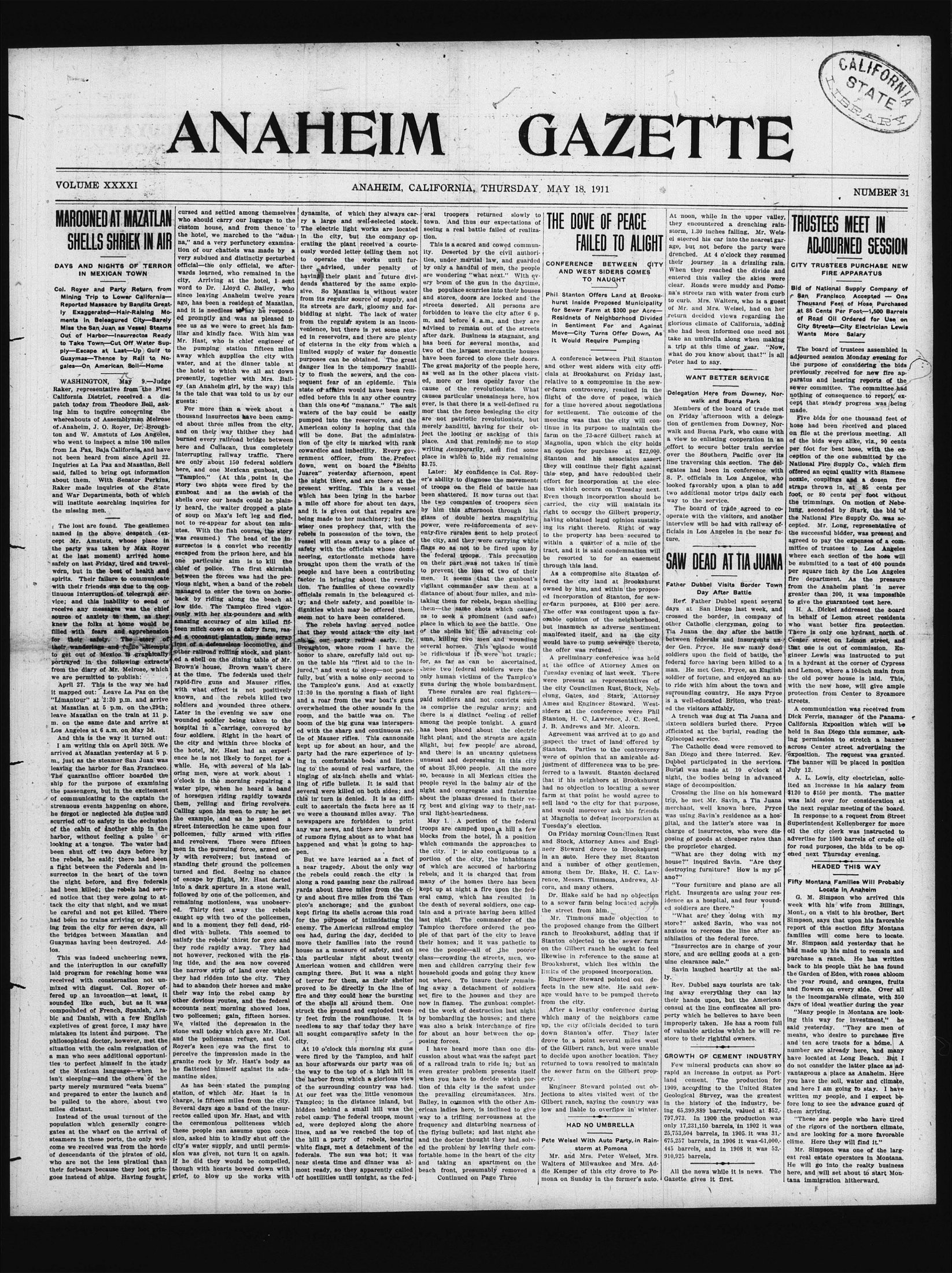
Searchable text
MAROONED AT MAZATLAN
SHELLS SHRIEK IN AIR
DAYS AND NIGHTS OF TERROR
IN MEXICAN TOWN
Col. Royer and Party Return, from Mining Trip to Lower California—Reported Massacre by Bandits Greatly Exaggerated—Hair-Raising Moments in Beleagured City—Barely Miss the San Juan as Vessel Steams Out of Harbor—Insurrectos Ready to Take Town—Cut Off Water Supply—Escape at Last—Up Gulf to Guaymas—Thence by Rail to Nogales—On American Soil—Home
WASHINGTON, May 9. — Judge Raker, representative from the First California District, received a dispatch today from Theodore Bell, asking him to inquire concerning the whereabouts of Assemblyman Melrose of Anaheim, J. O. Royer, Dr. Broughton and W. Amstutz of Los Angeles, who went to inspect a mine 100 miles from La Paz, Baja California, and have not been heard from since April 22. Inquiries at La Paz and Mazatlan, Bell said, failed to bring out information cursed and settled among themselves who should carry our luggage to the custom house, and from thence to the hotel, we marched to the "aduana," and a very perfunctory examination of our chattels was made by a very subdued and distinctly perturbed official—the only official, we afterwards learned, who remained in the city. Arriving at the hotel, I sent word to Dr. Lloyd C. Bailey, who since leaving Anaheim twelve years ago, has been a resident of Mazatlan, and it is needless to say he responded promptly and was as pleased to see us as we were to greet his familiar and kindly face. With him was Mr. Hast, who is chief engineer of the pumping station fifteen miles away which supplies the city with water, and at the dinner table at the hotel to which we all sat down presently, together with Mrs. Bailey (an Anaheim girl, by the way) this is the tale that was told to us by our guests:
For more than a week about a thousand insurrectos have been camped about three miles from the city, and on their way thither they had burned every railroad bridge between here and Culiacan, thus completely interrupting railway traffic. There are only about 150 federal soldiers here, and one Mexican gunboat, the dynamite, of which a large and electric light in the city, but operating the plant ousely worded letter to operate the other advised, having their plan dends shattered alive. So Mazatlan from its regular seals its streets are daily bidding at night. From the regular venience, but there ed in reservoirs, a of cisterns in the limited supply of purposes can be of danger lies in the ty to flush the sequent fear of a state of affairs wowed before this lie than this one of "waters of the bay" pumped into the American colony will be done. Bition of the city is cowardice and imbuement officer, down, went on Juarez" yesterday.
WASHINGTON, May 9.—Judge Raker, representative from the First California District, received a dispatch today from Theodore Bell, asking him to inquire concerning the whereabouts of Assemblyman Melrose of Anaheim, J. O. Royer, Dr. Broughton and W. Amstutz of Los Angeles, who went to inspect a mine 100 miles from La Paz, Baja California, and have not been heard from since April 22. Inquiries at La Paz and Mazatlan, Bell said, failed to bring out information about them. With Senator Perkins, Raker made inquiries of the State and War Departments, both of which will institute searching inquiries for the missing men.
The lost are found. The gentlemen named in the above despatch (except Mr. Amstutz, whose place in the party was taken by Max Royer at the last moment) arrived home safely on last Friday, tired and travel-worn, but in the best of health and spirits. Their failure to communicate with their friends was due to the continuous interruption of telegraph service; and this inability to send or receive any messages was the chief source of anxiety to them, as they knew the folks at home would be filled with fears and apprehension for their safety. The story of their wanderings and futile attempts to get out of Mexico is graphically portrayed in the following extracts from the diary of Mr. Melrose, which we are permitted to publish:
April 27. This is the way we had it mapped out: Leave La Paz on the "Limantour" at 2:20 p.m. and arrive at Mazatlan at 5 p.m. on the 29th; leave Mazatlan on the train at 11 p.m. on the same date and arrive at Los Angeles at 6 a.m. on May 3d.
And this is the way it turned out:
I am writing this on April 30th. We arrived at Mazatlan yesterday at 5 p.m., just as the steamer San Juan was leaving the harbor for San Francisco. The quarantine officer boarded the ship for the purpose of examining the passengers, but in the excitement of communicating to the captain the strenuous events happening on shore, he forgot or neglected his duties and scurried off to safety in the seclusion of the cabin of another ship in the harbor, without feeling a pulse or looking at a tongue. The water had been shut off two days before by the rebels, he said; there had been a fight between the Federals and insurrectos in the heart of the town the night before, and five federals had been killed; the rebels had served notice that they were going to at presently, together with Mrs. Bailey (an Anaheim girl, by the way) this is the tale that was told to us by our guests:
For more than a week about a thousand insurrectos have been camped about three miles from the city, and on their way thither they had burned every railroad bridge between here and Culiacan, thus completely interrupting railway traffic. There are only about 150 federal soldiers here, and one Mexican gunboat, the "Tampico." (At this point in the story two shots were fired by the gunboat and as the swish of the shells over our heads could be plainly heard, the waiter dropped a plate of soup on Max's left leg and fled, not to re-appear for about ten minutes. With the fish course, the story was resumed.) The head of the insurrectos is a convict who recently escaped from the prison here, and his one particular aim is to kill the chief of police. The first skirmish between the forces was had the previous night, when a band of the rebels managed to enter the town on horseback by riding along the beach at low tide. The Tampico fired vigorously with her six-pounders and with amazing accuracy of aim killed fifteen milch cows on a dairy farm, razed a cocoanut plantation, made scrap iron of a defenseless locomotive, and other railroad rolling stock, and planted a shell on the dining table of Mr. Brown's house. Brown wasn't there at the time. The federals used their rapid-fire guns and Mauser rifles, with what effect is not positively known, and the rebels killed two soldiers and wounded three others. Later in the evening we saw one wounded soldier being taken to the hospital in a carriage, conveyed by four soldiers. Right in the heart of the city and within three blocks of the hotel, Mr. Hast had an experience he is not likely to forget for a while. He, with several of his laboring men, were at work about 1 o'clock in the morning repairing a water pipe, when he heard a band of horsemen riding rapidly towards them, yelling and firing revolvers. Calling upon his men to run; he set the example, and as he passed a street intersection he came upon four policemen, fully armed with rifles and revolvers. There were fifteen men in the pursuing force, armed only with revolvers; but instead of standing their ground the policemen turned and fled. Seeing no chance of escape by flight, Mr. Hast darted into a dark aperture in a stone wall, followed by one of the policemen, and
The rebels have that they would aid our party in our honor to share care on the table his "jured," and went fully, but with a new Tampico's gun 12:30 in the morning and a roar from the overwhelmed room, and the bad boom of the big guned with the sharp knife of Mauser rifles kept up for about a party had the raiding in comfortable ing to the sound of singing of six-inch bullets of rifle bullet several were killed; this in turn is denied to ascertain that we were a thousand newspapers are for any war news, and of rumors flying about happened and what pen.
But we have learnt a near tragedy. All the rebels could move along a road passing yards about three miles and about five miles
or communicating to the captain the strenuous events happening on shore,
he forgot or neglected his duties and scurried off to safety in the seclusion of the cabin of another ship in the harbor, without feeling a pulse or looking at a tongue. The water had been shut off two days before by the rebels, he said; there had been a fight between the Federals and insurrectos in the heart of the town the night before, and five federals had been killed; the rebels had served notice that they were going to attack the city that night, and we must be careful and not get killed. There had been no trains arriving or departing from the city for seven days, all the bridges between Mazatlan and Guaymas having been destroyed. Adios.
This was indeed uncheering news, and the interruption in our carefully laid program for reaching home was received with consternation not unmixed with disgust. Col. Royer offered up an invocation—at least, it sounded like such, but as it was compounded of French, Spanish, Arabic and Danish, with a few English expletives of great force, I may have mistaken its intent and purpose. The philosophical doctor, however, met the situation with the calm resignation of a man who sees additional opportunities to perfect himself in the study of the Mexican language—when he isn't sleeping—and the others of the party merely murmured "esta buena" and prepared to enter the launch and be pulled to the shore, about two miles distant.
Instead of the usual turnout of the population which generally congregates at the wharf on the arrival of steamers in these ports, the only welcome we received was from the horde of descendants of the pirates of old, who are not the less piratical than their forbears because they loot grin-goes instead of ships. Having fought,
them, yelling and firing revolvers. Calling upon his men to run, he set the example, and as he passed a street intersection he came upon four policemen, fully armed with rifles and revolvers. There were fifteen men in the pursuing force, armed only with revolvers; but instead of standing their ground the policemen turned and fled. Seeing no chance of escape by flight, Mr. Hast darted into a dark aperture in a stone wall, followed by one of the policemen, and remaining motionless, was unobserved. Thirty feet away the rebels caught up with two of the policemen, and in a moment they fell dead, riddled with bullets. This seemed to satisfy the rebels' thirst for gore and they rode rapidly away. They had not however, reckoned with the rising tide, and the sea now covered the narrow strip of land over which they had ridden into the city. They had to abandon their horses and make their way into the rebel camp by other devious routes, and the federal accounts next morning showed loss, two policemen; gain, fifteen horses. We visited the depression in the stone wall today which gave Mr. Hast and the policeman refuge, and Col. Royer's keen eye was the first to perceive the impression made in the granite rock by Mr. Hast's body as he flattened himself against its adamantine sides.
As has been stated the pumping station, of which Mr. Hast is in charge, is fifteen miles from the city. Several days ago a band of the insurrectos called upon Mr. Hast, and with the ceremonious politeness which these people can assume upon occasion, asked him to kindly shut off the city's water supply, and until permission was given, not turn it on again. If he did they would be compelled, though with hearts bowed down with grief, to blow up the works with them, yelling and firing revolvers. Calling upon his men to run, he set the example, and as he passed a street intersection he came upon four policemen, fully armed with rifles and revolvers. There were fifteen men in the pursuing force, armed only with revolvers; but instead of standing their ground the policemen turned and fled. Seeing no chance of escape by flight, Mr. Hast darted into a dark aperture in a stone wall, followed by one of the policemen, and remaining motionless, was unobserved. Thirty feet away the rebels caught up with two of the policemen, and in a moment they fell dead, riddled with bullets. This seemed to satisfy the rebels' thirst for gore and they rode rapidly away. They had not however, reckoned with the rising tide, and the sea now covered the narrow strip of land over which they had ridden into the city. They had to abandon their horses and make their way into the rebel camp by other devious routes, and the federal accounts next morning showed loss, two policemen; gain, fifteen horses. We visited the depression in the stone wall today which gave Mr. Hast and the policeman refuge, and Col. Royer's keen eye was the first to perceive the impression made in the granite rock by Mr. Hast's body as he flattened himself against its adamantine sides.
At 10 o'clock this were fired by the an hour afterwards; the way to the top of the harbor from where of the surrounding At our feet was Tampico; in the hidden behind a srebel camp. The feared, were deployed lines, and as we ran the hill a party of white flags, met a federals. The sun near siesta time are most ready, so they off hostilities until
ANAHEIM, CALIFORNIA, THURSDAY, MAY 18, 1911
dynamite, of which they always carry a large and well-selected stock. The electric light works are located in the city, but the company operating the plant received a courteously worded letter telling them not to operate the works until further advised, under penalty of having their plant and future dividends shattered by the same explosive. So Mazatlan is without water from its regular source of supply, and its streets are dark, gloomy and forbidding at night. The lack of water from the regular system is an inconvenience, but there is yet some stored in reservoirs, and there are plenty of cisterns in the city from which a limited supply of water for domestic purposes can be obtained. The great danger lies in the temporary inability to flush the sewers, and the consequent fear of an epidemic. This state of affairs would have been remedied before this in any other country than this one of "manana." The salt waters of the bay could be easily pumped into the reservoirs, and the American colony is hoping that this will be done. But the administration of the city is marked with rank cowardice and imbecility. Every government officer, from the Prefect down, went on board the Benito Juarez" yesterday afternoon, spenteral troopers returned slowly to town. And thus our expectations of seeing a real battle failed of realization.
This is a scared and cowed community. Deserted by the civil authorities, under martial law, and guarded by only a handful of men, the people are wondering "what next." With every boom of the gun in the daytime, the populace scurries into their houses and stores, doors are locked and the streets deserted. All persons are forbidden to leave the city after 6 p.m. and before 6 a.m., and they are advised to remain out of the streets after dark. Business is stagnant, and has been for several months, and two of the largest mercantile houses have been forced to close their doors. The great majority of the people here, as well as in the other places visited, more or less openly favor the cause of the revolutionists. What causes particular uneasiness here, however, is that there is a well-defined moral that the force besieging the city are not patriotic revolutionists, but merely banditti, having for their object the looting or sacking of this place. And that reminds me to stop writing temporarily, and find some place in which to hide my remaining $3.75.
Later: My confidence in Col. Roy-
THE DOVE OF PEACE FAILED TO ALIGHT
CONFERENCE BETWEEN CITY AND WEST SIDERS COMES TO NAUGHT
Phil Stanton Offers Land at Brookshurst Inside Proposed Municipality for Sewer Farm at $300 per Acre—Residnets of Neighborhood Divided in Sentiment For and Against Move—City Turns Offer Down, As It Would Require Pumping
A conference between Phil Stanton and other west siders with city officials at Brookshurst on Friday last, relative to a compromise in the sewer-farm controversy, resulted in the flight of the dove of peace, which for a time hovered about negotiations for settlement. The outcome of the meeting was that the city will continue in its purpose to maintain the farm on the 73-acre Gilbert ranch at Magnolia, upon which the city holds an option for purchase at $22,000. Stanton and his associates assert they will continue their fight against this step, and have redoubled their
at a camp city, had between metely where soldiers the theplain plate affiled,ministry be instantly his the mish prerebels horse at algorwith the nish prerebels horse at algorwith the nish prerebels horse at algorwith the nish prerebels horse at algorwith the nish prerebels horse at algorwith the nish prerebels horse at algorwith the nish prerebels horse at algorwith the nish prerebels horse at algorwith the nish prerebels horse at algorwith the nish prerebels horse at algorwith the nish prerebels horse at algorwith the nish prerebels horse at algorwith the nish prerebels horse at algorwith the nish prerebels horse at algorwith the nish prerebels horse at algorwith the nish prerebels horse at algorwith the nish prerebels horse at algorwith the nish prerebels horse at algorwith the nish prerebels horse at algorwith the nish prerebels horse at algorwith the nish prerebels horse at algorwith the nish prerebels horse at algorwith the nish prerebels horse at algorwith the nish prerebels horse at algorwith the nish prerebels horse at algorwith the nish prerebels horse at algorwith the nish prerebels horse at algorwith the nish prerebels horse at algorwith the nish prerebels horse at algorwith the nish prerebels horse at algorwith the nish prerebels horse at algorwith the nish prerebels horse at algorwith the nish prerebels horse at algorwith the nish prerebels horse at algor with the nish prerebels horse at algor with the nish prerebels horse at algor with the nish prerbels horse at algor with the nish prerbels horse at algor with the nish prerbels horse at algor with the nish prerbels horse at algor with the nish prerbels horse at algor with the nish prerbels horse at algor with the nish prerbels horse at algor with the nish prerbells horse at algor with the nish prerbells horse at algor with the nish prerbells horse at algor with the nish prerbells horse at algor with the nish prerbells horse at algor with the nish prerbells horse at algor with the nish prerbells horse at algor with the nish prerbells horse at algor with the nish prerbells horse at algor with the nish prerbells horses
The rebels having served notice that they would attack the city last night our party retired early. Dr. Broughton, whose room I have the honor to share, carefully laid out upon the table his "first aid to the injured," and went to sleep—not peacefully, but with a noise only second to the Tampico's guns. And at exactly 12:30 in the morning a flash of light and a roar from the war boat's guns overwhelmed the other sounds in the room, and the battle was on. The boom of the big guns was interspersed with the sharp and continuous rattle of Mauser rifles. This cannonade kept up for about an hour, and the party had the rare experience of lying in comfortable beds and listening to the sound of real warfare, the singing of six-inch shells and whistling of rifle bullets. It is said that several were killed on both sides; and this in turn is denied. It is as difficult to ascertain the facts here as if we were a thousand miles away. The newspapers are forbidden to print any war news, and there are hundred of rumors flying about as to what has happened and what is going to happen.
But we have learned as a fact of a near tragedy. About the only way the rebels could reach the city is along a road passing near the railroad yards about three miles from the city and about five miles from the Tam
Later: My confidence in Col. Royer's ability to diagnose the movement of troops on the field of battle has been shattered. It now turns out that the two companies of troopers seen by him this afternoon through his glass of double hextra magnifying power, were re-inforcements of seventy-five rurales sent to help protect the city, and they were carrying white flags so as not to be fired upon by the federal troops. This precaution on their part was not taken in time to prevent the loss of two of their men. It seems that the gunboat's vigilant commander saw them at a distance of about four miles, and mistaking them for rebels, began shelling them—the same shots which caused us to seek a prominent (and safe) place in which to see the battle. One of the shells hit the advancing column, killing two men and wounding several horses. This episode would be ridiculous if it were not tragic; for, as far as can be ascertained, these two federal soldiers were the only human victims of the Tampico's guns during whole bombardment.
These rurales are real fighters—paid soldiers and not convicts such as comprise the regular army; and there is a distinct feeling of relief among people tonight. A guard has been placed about the electric light plant, and the streets are again alight, but few people are abroad, and there is an uncanny quietness unusual and depressing in this city of about 25,000 people. All the more so, because in all Mexican cities the people revel in the balmy air of the night and congregate and fraternize about the plazas dressed in their very best and giving way to their natural light-heartedness.
May 1. A portion of the federal troops are camped upon a hill a few blocks from the hotel, in a position which commands the approaches to the city. It is also contiguous to a portion of the city, the inhabitants of which are accused of harboring rebels, and it is charged that from many of the homes there has been kept up at night a fire upon the federal camp, which has resulted in claas at Brookshurst on Friday last, relative to a compromise in the sewer-farm controversy, resulted in the flight of the dove of peace, which for a time hovered about negotiations for settlement. The outcome of the meeting was that the city will continue in its purpose to maintain farm on the 73-acre Gilbert ranch at Magnolia, upon which the city holds an option for purchase at $22,000. Stanton and his associates assert they will continue their fight against this step, and have redoubled their effort for incorporation at the election which occurs on Tuesday next. Even though incorporation should be carried, the city will maintain its right to occupy the Gilbert property, having obtained legal opinion sustaining its right thereto. Right of way to the property has been secured to within a quarter of a mile of the tract, and it is said condemnation will be resorted to for an easement through this land.
As a compromise site Stanton offered the city land at Brookshurst owned by him, and within the proposed incorporation of Stanton, for sewer-farm purposes, at $300 per acre. The offer was contingent upon a favorable opinion of the neighborhood, but inasmuch as adverse sentiment manifested itself, and as the city would have to pump sewerage thereto, the offer was refused.
A preliminary conference was held at the office of Attorney Ames on Tuesday evening of last week. There were present as representatives of the city Councilmen Rust, Stock, Nebelung, Gates, and Stark, Attorney Ames and Engineer Steward. West-siders at the conference were Phil Stanton, H. C. Lawrence, J. C. Reed, J. B. Andrews and Mr. Alcorn.
Agreement was arrived at to go and inspect the tract of land offered by Stanton. Parties to the controversy were of opinion that an amicable adjustment of differences was to be preferred to a lawsuit. Stanton declared that if his neighbors at Brookshurst had no objection to locating a sewer farm at that point he would agree to sell land o'the city for that purpose, and would moreover ask his friends at Magnolia to defeat incorporation at Tuesday's election.
On Friday morning Councilmen Rust and Stock, Attorney Ames and Engineer Steward drove to Brookshurst in an auto. Here they met Stanton and a number of other gentlemen, among them Dr. Blake, H. C. Lawrence, Messrs. Timmons, Andrews, Alcorn, and many others.
Dr. Blake said he had no objection
this in turn is denied. It is as difficult to ascertain the facts here as if we were a thousand miles away. The newspapers are forbidden to print any war news, and there are hundred of rumors flying about as to what has happened and what is going to happen.
But we have learned as a fact of a near tragedy. About the only way the rebels could reach the city is along a road passing near the railroad yards about three miles from the city and about five miles from the Tampico's anchorage; and the gunboat kept firing its shells across this road for the purpose of intimidating the enemy. The American railroad employees had, during the day, decided to move their families into the round house as a measure of safety, and on this particular night about twenty American women and children were camping there. But it was a night of terror for them, as their shelter proved to be directly in the line of fire and they could hear the bursting of the shells all around them. One struck the ground and exploded twenty feet from the roundhouse. It is needless to say that today they have all sought comparative safety in the city.
At 10 o'clock this morning six guns were fired by the Tampico, and half an hour afterwards our party was on the way to the top of a high hill in the harbor from which a glorious view of the surrounding country was had. At our feet was the little venomous Tampico; in the distance inland, but hidden behind a small hill was the rebel camp. The federal troops, mounted, were deployed along the shore lines, and as we reached the top of the hill a party of rebels, bearing white flags, met a detachment of the federals. The sun was hot; it was near siesta time and dinner was almost ready, so they apparently called off hostilities until tonight, as the fed-
May 1. A portion of the federal troops are camped upon a hill a few blocks from the hotel, in a position which commands the approaches to the city. It is also contiguous to a portion of the city, the inhabitants of which are accused of harboring rebels, and it is charged that from many of the homes there has been kept up at night a fire upon the federal camp, which has resulted in the death of several soldiers, one captain and a private having been killed last night. The commander of the Tampico therefore ordered the people of that part of the city to leave their homes; and it was pathetic to see the people—all of the poorer class—crowding the streets, men, women and children carrying their few household goods and going they knew not where. To insure their remaining away a detachment of soldiers set fire to the houses and they are now in flames. The gunboat completed the work of destruction last night by bombarding the houses; and there was also a brisk interchange of fire for about an hour between the opposing forces.
I have heard more than one discussion about what was the safest part of a railroad train to ride in; but an even greater problem presents itself when you have to decide which portion of this city is the safest under the prevailing circumstances. Mrs. Bailey, in common with the other American ladies here, is inclined to give way to a trifling nervousness at the frequency and disturbing nearness of the flying bullets; and last night she and the doctor thought they had solved the problem by leaving their comfortable home in the heart of the city and taking an apartment on the beach front, presumably removed a Continued on Page Three
sell land *o* the city for that purpose, and would moreover ask his friends at Magnolia to defeat incorporation at Tuesday's election.
On Friday morning Councilmen Rust and Stock, Attorney Ames and Engineer Steward drove to Brookshurst in an auto. Here they met Stanton and a number of other gentlemen, among them Dr. Blake, H. C. Lawrence, Messrs. Timmons, Andrews, Alcorn, and many others.
Dr. Blake said he had no objection to a sewer farm being located across the street from him.
Mr. Timmons made objection to the proposed change from the Gilbert ranch to Brookshurst, adding that if Stanton objected to the sewer farm on the Gilbert ranch he ought to feel likewise in reference to the same at Brookshurst, which lies within the limits of the proposed incorporation.
Engineer Steward pointed out defects in the new site. He said sewage would have to be pumped thereto from the city.
After a lengthy conference during which many of the neighbors came up, the city officials decided to turn down Stanton's offer. They later drove to a point several miles west of the Gilbert ranch, but were unable to decide upon another location. They returned to town resolved to maintain the sewer farm on the Gilbert property.
Engineer Steward pointed out objections to sites visited west of the Gilbert ranch, saying the country was low and liable to overflow in winter.
HAD NO UMBRELLA
Pete Weisel With Auto Party, in Rain-storm at Pomona
Mr. and Mrs. Peter Weisel, Mrs. Walters of Milwaukee and Mrs. Addie Kemper of this city drove to Pomona on Sunday in the former's auto.
CALIFORNIA STATE LIBRARY
AZETTE
911 NUMBER 31
OF PEACE
ED TO ALIGHT
BETWEEN CITY
SIDERS COMES
NAUGHT
Fers Land at BrooksProposed Municipality
at $300 per Acre—
Neighborhood Divided
For and Against
turns Offer Down, As
quire Pumping
between Phil Stanton
insiders with city offisurst on Friday last,
empromise in the sewservy, resulted in the
love of peace, which
led about negotiations.
The outcome of the
at the city will conpose to maintain the
acre Gilbert ranch at
which the city holds
purchase at $22,000.
His associates assert
their fight against
have redoubled their
At noon, while in the upper valley,
they encountered a drenching rainstorm, 1.30 inches falling. Mr. Weisel steered his car into the nearest garage, but not before the party were drenched. At 4 o'clock they resumed their journey in a drizzling rain. When they reached the divide and entered this valley the skies were clear. Roads were muddy and Pomona's streets ran with water from curb to curb. Mrs. Walters, who is a guest of Mr. and Mrs. Weisel, had on her return decided views regarding the glorious climate of California, adding she had been informed one need not take an umbrella along when making a trip at this time of year. "Now, what do you know about that?" is all Peter had to say.
WANT BETTER SERVICE
Delegation Here from Downey, Norwalk and Buena Park
Members of the board of trade met on Friday afternoon with a delegation of gentlemen from Downey, Norwalk and Buena Park, who came with a view to enlisting cooperation in an effort to secure better train service over the Southern Pacific over its line traversing this section. The delegates had been in conference with
TRUSTEES MEET IN ADJOURNED SESSION
CITY TRUSTEES PURCHASE NEW FIRE APPARATUS
Bid of National Supply Company of San Francisco Accepted — One Thousand Feet of Hose Purchased at 85 Cents Per Foot—1,500 Barrels of Road Oil Ordered for Use on City Streets—City Electrician Lewis Wants More Salary
The board of trustees assembled in adjourned session Monday evening for the purpose of considering the bids previously received for new fire apparatus and hearing reports of the sewer committee. The committee had nothing of consequence to report, except that steady progress was being made.
Five bids for one thousand feet of hose had been received and placed on file at the previous meeting. All of the bids were alike, viz., 90 cents per foot for best hose, with the exception of the one submitted by the National Fire Supply Co., which firm offered an equal quality with Siamese
WANT BETTER SERVICE
Delegation Here from Downey, Norwalk and Buena Park
Members of the board of trade met on Friday afternoon with a delegation of gentlemen from Downey, Norwalk and Buena Park, who came with a view to enlisting cooperation in an effort to secure better train service over the Southern Pacific over its line traversing this section. The delegates had been in conference with S. P. officials in Los Angeles, who looked favorably upon a plan to add two additional motor trips daily each way to the service.
The board of trade agreed to cooperate with the visitors, and another interview will be had with railway officials in Los Angeles in the near future.
SAW DEAD AT TIA JUANA
Father Dubbel Visits Border Town Day After Battle
Rev. Father Dubbel spent several days at San Diego last week, and crossed the border, in company of other Catholic clergyman, going to Tia Juana the day after the battle between federals and insurgents under Gen. Pryce. He saw many dead soldiers upon the field of battle, the federal force having been killed to a man. He met Gen. Pryce, an English soldier of fortune, and enjoyed an auto ride with him about the town and surrounding country. He says Pryce is a well-educated Briton, who treated the visitors affably.
A trench was dug at Tia Juana and sixteen soldiers buried there. Pryce officiated at the burial, reading the Episcopal service.
The Catholic dead were removed to San Diego and there interred. Rev. Dubbel participated in the services. Burial was made at 10 o'clock at night, the bodies being in advanced stage of decomposition.
Crossing the line on his homeward trip, he met Mr. Savin, a Tia Juana merchant, well known here. Pryce was using Savin's residence as a hospital, and the latter's store was in charge of insurrectos, who were disposing of goods at cheaper rates than the proprietor charged.
“What are they doing with my house?” inquired Savin. “Are they destroying furniture? How is my piano?”
“Your furniture and piano are all right. Insurgents are using your residence and hearing reports of the sewer committee. The committee had nothing of consequence to report, except that steady progress was being made.
Five bids for one thousand feet of hose had been received and placed on file at the previous meeting. All of the bids were alike, viz., 90 cents per foot for best hose, with the exception of the one submitted by the National Fire Supply Co., which firm offered an equal quality with Siamese nozzle, couplings and a dozen fire straps thrown in, at 85 cents per foot, or 80 cents per foot without the trimmings. On motion of Nebelung, seconded by Stark, the bid of the National Fire Supply Co. was accepted. Mr. Long, representative of the successful bidder, was present and agreed to pay the expenses of a committee of trustees to Los Angeles where each section of the hose will be submitted to a test of 400 pounds per square inch by the Los Angeles fire department. As the pressure from the Anaheim plant is never greater than 200, it was impossible to give the guaranteed test here.
H. A. Dickel addressed the board in behalf of Lemon street residents who want better fire protection. There is only one hydrant north of Center street on Lemon street, and that one is out of commission. Engineer Lewis was instructed to put in a hydrant at the corner of Cypress and Lemon, where a 10-inch main from the old power house is laid. This, with the new hose, will give ample protection from Center to Sycamore streets.
A communication was received from Dick Ferris, manager of the Panama-California Exposition which will be held in San Diego this summer, asking permission to stretch a banner across Center street advertising the exposition. The request was granted. The banner will be placed in position July 12.
A. L. Lewis, city electrician, solicited an increase in his salary from $120 to $150 per month. The matter was laid over for consideration at the next regular meeting of the board.
In response to a request from Street Superintendent Kellenberger for more oil the city clerk was instructed to advertise for 1500 barrels of crude oil for road purposes, the bids to be opened next Thursday evening.
HEADED THIS WAY
Fifty Montana Families Will Probably Locate in Anaheim
G. M. Simpson who arrived this
Fifty Montana Families Will Probably Locate in Anaheim
G. M. Simpson who arrived this week with his wife from Billings, Mont., on a visit to his brother, Bert Simpson, says that upon his favorable report of this section fifty Montana families will come here to locate Mr. Simpson said yesterday that he had made up his mind to remain and purchase a ranch. He has written back to his people that he has found the Garden of Eden, with roses abloom the year round, and oranges, fruits and flowers on every side. Over all is the incomparable climate, with 350 days of ideal weather during the year.
"Many people in Montana are looking this way for investment," he said yesterday. "They are men of means, who desire to purchase five and ten acre tracts for a home. A number are already here, and many have located at Long Beach. But I do not consider the latter place as advantageous a place as Anaheim. Here you have the soil, water and climate, and here I am going to stay. I have written my people, and I expect before long to see the advance guard of them arriving."
"These are people who have tired of the rigors of the northern climate, and are looking for a more favorable clime. Here they will find it."
Mr. Simpson was one of the largest real estate operators in Montana. He will go into the realty business here, and will set about to start Montana immigration hitherward.