anaheim-gazette 1911-03-23
Scanned page
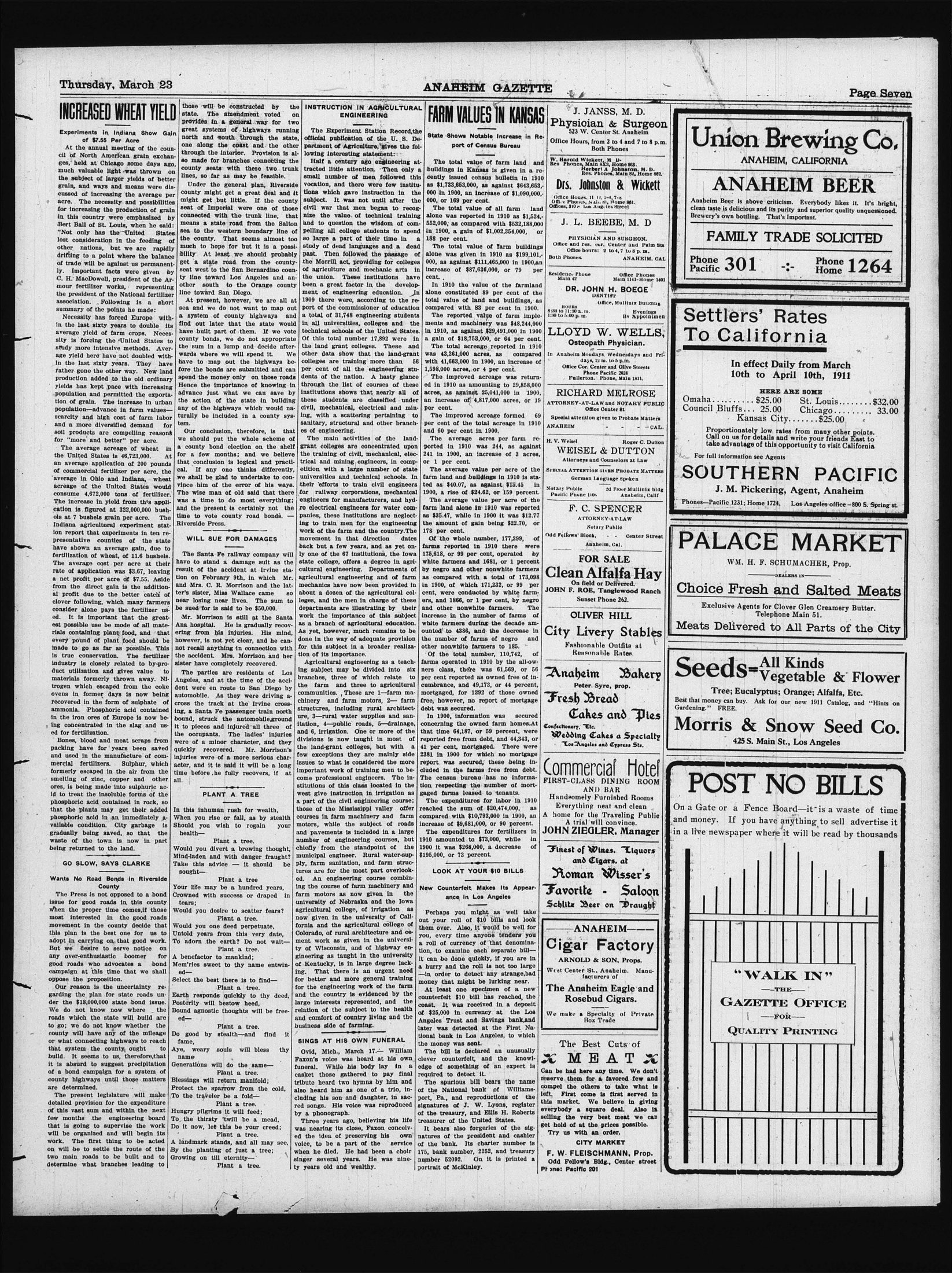
Searchable text
INCREASED WHEAT YIELD
Experiments in Indiana Show Gain of $7.55 Per Acre
At the annual meeting of the council of North American grain exchanges, held at Chicago some days ago, much valuable light was thrown on the subject of larger yields of better grain, and ways and means were discussed of increasing the average per acre. The necessity and possibilities for increasing the production of grain in this country were emphasized by Bert Ball of St. Louis, when he said: "Not only has the United States lost consideration in the feeding of other nations, but we are rapidly drifting to a point where the balance of trade will be against us permanently. Important facts were given by C. H. MacDowell, president of the Armour fertilizer works, representing the president of the National fertilizer association. Following is a short summary of the points he made:
Necessity has forced Europe within the last sixty years to double its average yield of farm crops. Necessity is forcing the United States to study more intensive methods. Average yield here have not doubled within the last sixty years. They have rather gone the other way. New land production added to the old ordinary yields has kept pace with increasing population and permitted the exportation of grain. The increase in urban population—advance in farm values—scarcity and high cost of farm labor and a more diversified demand for soil products are compelling reasons for "more and better" per acre.
The average acreage of wheat in the United States is 46,723,000. At an average application of 200 pounds of commercial fertilizer per acre, those will be constructed by the state. The amendment voted on provides in a general way for two great systems of highways running north and south through the state, one along the coast and the other through the interior. Provision is also made for branches connecting the county seats with these two trunk lines, so far as may be feasible.
Under the general plan, Riverside county might get a great deal and it might get but little. If the county seat of Imperial were one of those connected with the trunk line, that means a state road from the Salton sea to the western boundary line of the county. That seems almost too much to hope for but it is a possibility. At least we should probably get a state road from the county-seat west to the San Bernardino county line toward Los Angeles and another south to the Orange county line toward San Diego.
At present, however, we are all at sea and we do not want to map out a system of county highways and find out later that the state would have built part of them. If we vote county bonds, we do not appropriate the sum in a lump and decide afterwards where we will spend it. We have to map out the highways before the bonds are submitted and can spend the money only on those roads. Hence the importance of knowing in advance just what we can save by the action of the state in building any of the highways which would naturally be included in a county system.
Our conclusion, therefore, is that we should put the whole scheme of a county bond election on the shelf for a few months; and we believe that conclusion is logical and practical. If any one thinks differently,
INSTRUCTION ENGINEER
The Experiment official publication department of Agriculture lowing interesting.
Half a century traced little attentive small number of vocation, and the tions which gave subject. It was civil war that nize the value and to question pelling all colleges so large a part study of dead last past. Then follow the Morrill act, part of agriculture and the union. These been a great facetment of engineers 1909 there were, port of the commute a total of 31,748 in all universities technical schools Of this total number the land grant co other data show colleges are training per cent of all students of the nation through the list institutions shows these students are civil, mechanical, ing, with a scatters sanitary, structures of engineering.
The main active grant colleges are the training of civil trical and mining etition with a lar-
production added to the old ordinary yields has kept pace with increasing population and permitted the exportation of grain. The increase in urban population—advance in farm values—scarcity and high cost of farm labor and a more diversified demand for soil products are compelling reasons for "more and better" per acre.
The average acreage of wheat in the United States is 46,723,000. At an average application of 200 pounds of commercial fertilizer per acre, the average in Ohio and Indiana, wheat acreage of the United States would consume 4,672,000 tons of fertilizer. The increase in yield from this application is figured at 322,000,000 bushels at 7 bushels grain per acre. The Indiana agricultural experiment station report that experiments in ten representative counties of the state have shown an average gain, due to fertilization of wheat, of 11.6 bushels. The average cost per acre at their rate of application was $3.67, leaving a net profit per acre of $7.55. Aside from the direct gain is the additional profit due to the better catch of clover following, which many farmers consider alone pays the fertilizer used. It is important that the greatest possible use be mode of all materials containing plant food, and that every pound of plant food should be made to go as far as possible. This is true conservation. The fertilizer industry is closely related to by-product utilization and gives value to materials formerly thrown away. Nitrogen which escaped from the coke ovens in former days is now being recovered in the form of sulphate of ammonia. Phosphoric acid contained in the iron ores of Europe is now being concentrated in the slag and used for fertilization.
Bones, blood and meat scraps from packing have for years been saved and used in the manufacture of commercial fertilizers. Sulphur, which formerly escaped in the air from the smelting of zinc, copper and other ores, is being made into sulphuric acid to treat the insoluble forms of the phosphoric acid contained in rock, so that the plants may get their added phosphoric acid in an immediately available condition. City garbage is gradually being saved, so that the waste of the town is now in part being returned to the land.
GO SLOW, SAYS CLARKE
Wants No Road Bonds in Riverside County
The Press is not opposed to a bond spend the money only on those roads Hence the importance of knowing in advance just what we can save by the action of the state in building any of the highways which would naturally be included in a county system.
Our conclusion, therefore, is that we should put the whole scheme of a county bond election on the shelf for a few months; and we believe that conclusion is logical and practical. If any one thinks differently, we shall be glad to undertake to convince him of the error of his ways. The wise man of old said that there was a time to do most everything; and the present is certainly not the time to vote county road bonds. — Riverside Press.
WILL SUE FOR DAMAGES
The Santa Fe railway company will have to stand a damage suit as the result of the accident at Irvine station on February 9th, in which Mr. and Mrs. C. R. Morrison and the latter's sister, Miss Wallace came so near losing near lives. The sum to be sued for is said to be $50,000.
Mr. Morrison is still at the Santa Ana hospital. He is gradually recovering from his injuries. His mind, however, is not yet clear, and he cannot recall anything in connection with the accident. Mrs. Morrison and her sister have completely recovered.
The parties are residents of Los Angeles, and at the time of the accident were en route to San Diego by automobile. As they were driving across the track at the Irvine crossing, a Santa Fe passenger train north bound, struck the automobile ground it to pieces and injured all three of the occupants. The ladies' injuries were of a minor character, and they quickly recovered. Mr. Morrison's injuries were of a more serious character, and it is said it will be a long time before he fully recovers, if at all.
PLANT A TREE
In this inhuman rush for wealth,
When you rise or fall, as by stealth
Should you wish to regain your health—
Plant a tree.
Would you divert a brewing thought,
Mind-laden and with danger fraught?
Take this advice — it should be sought—
Plant a tree
Your life may be a hundred years,
Crowned with success or draped in
GO SLOW, SAYS CLARKE
Wants No Road Bonds in Riverside County
The Press is not opposed to a bond issue for good roads in this county when the proper time comes, if those most interested in the good roads movement in the county decide that this plan is the best one for us to adopt in carrying on that good work. But we desire to serve notice on any over-enthusiastic boomer for good roads who advocates a bond campaign at this time that we shall oppose the proposition.
Our reason is the uncertainty regarding the plan for state roads under the $18,000,000 state bond issue. We do not know now where the roads which the state will build are to go; we do not know whether the county will have any of the mileage or what connecting highways to reach that system the county ought to build. It seems to us, therefore, that it is absurd to suggest precipitation of a bond campaign for a system of county highways until those matters are determined.
The present legislature will make detailed provision for the expenditure of this vast sum and within the next few months the engineering board that is going to supervise the work will be organized and will begin its work. The first thing to be acted on will be to settle the route of the two main roads to be built and to determine what branches leading to
In this inhuman rush for wealth,
When you rise or fall, as by stealth
Should you wish to regain your health—
Plant a tree.
Would you divert a brewing thought,
Mind-laden and with danger fraught?
Take this advice — it should be sought—
Plant a tree
Your life may be a hundred years,
Crowned with success or draped in tears;
Would you desire to scatter fears?
Plant a tree.
Would you one deed perpetuate,
Untold years from this very date,
To adorn the earth? Do not wait—
Plant a tree.
A benefactor to mankind;
Mem'ries sweet to thy name entwined—
Select the best there is to find—
Plant a tree.
Earth responds quickly to thy deed,
Posterity will bestow heed,
Bound agnostic thoughts will be freed—
Plant a tree.
Do good by stealth—and find it fame,
Aye, weary souls will bless thy name
Generations will do the same—
Plant a tree.
Blessings will return manifold;
Protect the sparrow from the cold,
To the traveler be a fold—
Plant a tree.
Hungry pilgrims it will feed;
To the thirsty 'twill be a mead,
Do it now, let this be your creed;
Plant a tree.
A landmark stands, and all may see,
By the planting of just a tree;
Growing on till eternity—
Plant a tree.
ANAHEIM GAZETTE
INSTRUCTION IN AGRICULTURAL ENGINEERING
The Experiment Station Record, the official publication of the U.S. Department of Agriculture, gives the following interesting statement:
Half a century ago engineering attracted little attention. Then only a small number of men followed this vocation, and there were few institutions which gave instruction in the subject. It was not until after the civil war that men began to recognize the value of technical training and to question the wisdom of compelling all college students to spend so large a part of their time in a study of dead languages and a dead past. Then followed the passage of the Morrill act, providing for colleges of agriculture and mechanic arts in the union. These institutions have been a great factor in the development of engineering education. In 1909 there were, according to the report of the commissioner of education a total of 31,748 engineering students in all universities, colleges and the technical schools of the United States. Of this total number 17,892 were in the land grant colleges. These and other data show that the land-grant colleges are training more than 56 per cent of all the engineering students of the nation. A hasty glance through the list of courses of these institutions shows that nearly all of these students are classified under civil, mechanical, electrical and mining, with a scattering pertaining to sanitary, structural and other branches of engineering.
The main activities of the land-grant colleges are concentrated upon the training of civil, mechanical, electrical and mining engineers, in competition with a large number of state
FARM VALUES IN KANSAS
State Shows Notable Increase in Report of Census Bureau
The total value of farm land and buildings in Kansas is given in a recently issued census bulletin in 1910 as $1,733,653,000, as against $643,653,000 in 1900, an increase of $1,090,000,-000, or 169 per cent.
The total value of all farm land alone was reported in 1910 as $1,534,-552,000, as compared with $532,188,000 in 1900, a gain of $1,002,354,000, or 188 per cent.
The total value of farm buildings alone was given in 1910 as $199,101,-000, as against $111,465,000 in 1900, an increase of $87,636,000, or 79 per cent.
In 1910 the value of the farmland alone constituted 89 per cent of the total value of land and buildings, as compared with 83 per cent in 1900.
The reported value of farm implements and machinery was $48,244,000 in 1910, as against $29,491,000 in 1900 a gain of $18,753,000, or 64 per cent.
The total acreage reported in 1910 was 43,261,000 acres, as compared with 41,663,000 in 1900, an increase of 1,598,000 acres, or 4 per cent.
The improved acreage was returned in 1910 as amounting to 29,858,000 acres, as against 25,041,000 in 1900, an increase of 4,817,000 acres, or 19 per cent.
The improved acreage formed 69 per cent of the total acreage in 1910 and 60 per cent in 1900.
The average acres per farm reported in 1910 was 244, as against 241 in 1900, an increase of 3 acres, or 1 per cent.
The average value per acre of the
A hasty glance through the list of courses of these institutions shows that nearly all of these students are classified under civil, mechanical, electrical and mining, with a scattering pertaining to sanitary, structural and other branches of engineering.
The main activities of the land-grant colleges are concentrated upon the training of civil, mechanical, electrical and mining engineers, in competition with a large number of state universities and technical schools. In their efforts to train civil engineers for railway corporations, mechanical engineers for manufacturers, and hydro electrical engineers for water companies, these institutions are neglecting to train men for the engineering work of the farm and the country. The movement in that direction dates back but a few years, and as yet only one of the 67 institutions, the Iowa state college, offers a degree in agricultural engineering. Departments of agricultural engineering and of farm mechanics have now been provided in about a dozen of the agricultural colleges, and the men in charge of these departments are illustrating by their work the importance of this subject as a branch of agricultural education. As yet, however, much remains to be done in the way of adequate provision for this subject in a broader realization of its importance.
Agricultural engineering as a teaching subject may be divided into six branches, three of which relate to the farm and three to agricultural communities. These are 1—farm machinery and farm motors, 2—farm structures, including rural architecture, 3—rural water supplies and sanitation, 4—public roads, 5—drainage, and 6 irrigation. One or more of the divisions is now taught in most of the land-grant colleges, but with a few exceptions they are mainly side issues to what is considered the more important work of training men to become professional engineers. The institutions of this class located in the west give instruction in irrigation as a part of the civil engineering course; those of the Mississippi valley offer courses in farm machinery and farm motors, while the subject of roads and pavements is included in a large number of engineering courses, but chiefly from the standpoint of the municipal engineer. Rural water-supply, farm sanitation, and farm structures are for the most part overlooked. An engineering course combining the course of farm machinery and farm motors as now given in the documents of the nation. A hasty glance through the list of courses of these institutions shows that nearly all of these students are classified under civil, mechanical, electrical and mining, with a scattering pertaining to sanitary, structural and other branches of engineering.
The improved acreage was returned in 1910 as amounting to 29,858,000 acres, as against 25,041,000 in 1900, an increase of 4,817,000 acres, or 19 per cent.
The improved acreage formed 69 per cent of the total acreage in 1910 and 60 per cent in 1900.
The average acres per farm reported in 1910 was 244, as against 241 in 1900, an increase of 3 acres, or 1 per cent.
The average value per acre of the farm land and buildings in 1910 is stated as $40.07, as against $15.45 in 1900, a rise of $24.62, or 159 percent.
The average value per acre of the farm land alone in 1910 was reported as $35.47, while in 1900 it was $12.77 the amount of gain being $22.70, or 178 per cent.
Of the whole number, 177,299, of farms reported in 1910 there were 175,618, or 99 per cent, operated by white farmers and 1681, or 1 percent by negro and other nonwhite farmers as compared with a total of 173,098 in 1900, of which 171,232, or 99 per cent, were conducted by white farmers, and 1866, or 1 per cent, by negro and other nonwhite farmers. The increase in the number of farms of white farmers during the decade amounted to 4386, and the decrease in the number of farms of negro and other nonwhite farmers to 185.
Of the total number, 110,742, of farms operated in 1910 by the all-owners class, there was 61,569, or 56 per cent reported as owned free of incumbrance, and 49,173, or 44 percent, mortgaged, for 1292 of those owned free, however no report of mortgage debt was secured.
In 1900, information was secured concerning the owned farm homes. At that time 64,187, or 59 percent, were reported free from debt, and 44,343, or 41 per cent, mortgaged. There were 2381 in 1900 for which no mortgage report was secured; these being included in the farms free from debt. The census bureau has no information respecting the number of mortgaged farms leased to tenants.
The expenditures for labor in 1910 reached the sum of $20,474,000, as compared with $10,793,000 in 1900, an increase of $9,681,000, or 90 percent.
The expenditures for fertilizers in 1910 amounted to $73,000, while in 1900 it was $268,000, a decrease of $195,000, or 73 percent.
LOOK AT YOUR $10 BILLS
New Counterfeit Makes Its Appearance in Los Angeles
a part of the civil engineering course; those of the Mississippi valley offer courses in farm machinery and farm motors, while the subject of roads and pavements is included in a large number of engineering courses, but chiefly from the standpoint of the municipal engineer. Rural water-supply, farm sanitation, and farm structures are for the most part overlooked. An engineering course combining the course of farm machinery and farm motors as now given in the university of Nebraska and the Iowa agricultural college, of irrigation as now given in the university of California and the agricultural college of Colorado, of rural architecture and cement work as given in the university of Wisconsin, and of highway engineering as taught in the university of Kentucky, is in large degree lacking. That there is an urgent need for better and more general training for the engineering work of the farm and the country is evidenced by the large interests represented, and the relation of the subject to the health and comfort of country living and the business side of farming.
SINGS AT HIS OWN FUNERAL
Ovid, Mich., March 17.—William Faxon's voice was heard at his own funeral. While his body lay in a casket those gathered to pay final tribute heard two hymns by him and also heard him as one of a trio, including his son and daughter, in sacred songs. His voice was reproduced by a phonograph.
Three years ago, believing his life was nearing its close, Faxon conceived the idea of preserving his own voice, to be a part of the service when he died. He had been a choir singer several years. He was ninety years old and wealthy.
The expenditures for labor in 1910 reached the sum of $20,474,000, as compared with $10,793,000 in 1900, an increase of $9,681,000, or 90 percent.
The expenditures for fertilizers in 1910 amounted to $73,000, while in 1900 it was $268,000, a decrease of $195,000, or 73 percent.
LOOK AT YOUR $10 BILLS
New Counterfeit Makes Its Appearance in Los Angeles
Perhaps you might as well take out your roll of $10 bills and look them over. Also, it would be well for you, every time anyone tenders you a roll of currency of that denomination, to examine each separate bill—it can be done quickly, if you are in a hurry and the roll is not too large—in order to detect any strange, bad money that might be lurking near.
At least one specimen of a new counterfeit $10 bill has reached the coast. It was received in a deposit of $25,000 in currency at the Los Angeles Trust and Savings bank, and later was detected at the First National bank in Los Angeles, to which the money was sent.
The bill is declared an unusually clever counterfeit, and the knowledge of something of an expert is required to detect it.
The spurious bill bears the name of the National bank of Williamsport, Pa., and reproductions of the signatures of J. W. Lyons, register of the treasury, and Ellis H. Roberts treasurer of the United States.
It bears also forgeries of the signatures of the president and cashier of the bank. Its charter number is 175, bank number, 2252, and treasury number 52092. On it is printed a portrait of McKinley.
UNION BREWING CO.
ANAHEIM, CALIFORNIA
ANAHEIM BEER
Anaheim Beer is above criticism. Everybody likes it. It's bright,
clean taste is delicious and its purity and superior quality unquestioned.
Brewery's own bottling. That's Important.
FAMILY TRADE SOLICITED
Phone Pacific 301 - Phone Home 1264
Settlers' Rates To California
In effect Daily from March
10th to April 10th, 1911
HERE ARE SOME
Omaha... $25.00 St. Louis... $32.00
Council Bluffs... 25.00 Chicago... 33.00
Kansas City... $25.00
Proportionately low rates from many other points.
Call on us for details and write your friends East to
take advantage of this opportunity to visit California
For full information see Agents
SOUTHERN PACIFIC
10th to April 10th, 1911
HERE ARE SOME
Omaha... $25.00 St. Louis... $32.00
Council Bluffs... 25.00 Chicago... 33.00
Kansas City... $25.00
Proportionately low rates from many other points.
Call on us for details and write your friends East to take advantage of this opportunity to visit California
For full information see Agents
SOUTHERN PACIFIC
J. M. Pickering, Agent, Anaheim
Phones—Pacific 1231; Home 1724. Los Angeles office—800 S. Spring st.
PALACE MARKET
WM. H. F. SCHUMACHER, Prop.
DEALERS IN
Choice Fresh and Salted Meats
Exclusive Agents for Clover Glen Creamery Butter.
Telephone Main 51.
Meats Delivered to All Parts of the City
Seeds=All Kinds Vegetable & Flower
Tree; Eucalyptus; Orange; Alfalfa, Etc.
Best that money can buy. Ask for our new 1911 Catalog, and “Hints on Gardening.” FREE.
Morris & Snow Seed Co.
425 S. Main St., Los Angeles
POST NO BILLS
On a Gate or a Fence Board—it is a waste of time and money. If you have anything to sell advertise it in a live newspaper where it will be read by thousands
On a Gate or a Fence Board—it is a waste of time and money. If you have anything to sell advertise it in a live newspaper where it will be read by thousands
"WALK IN"
THE
GAZETTE OFFICE
FOR
QUALITY PRINTING