anaheim-gazette 1911-03-16
Scanned page
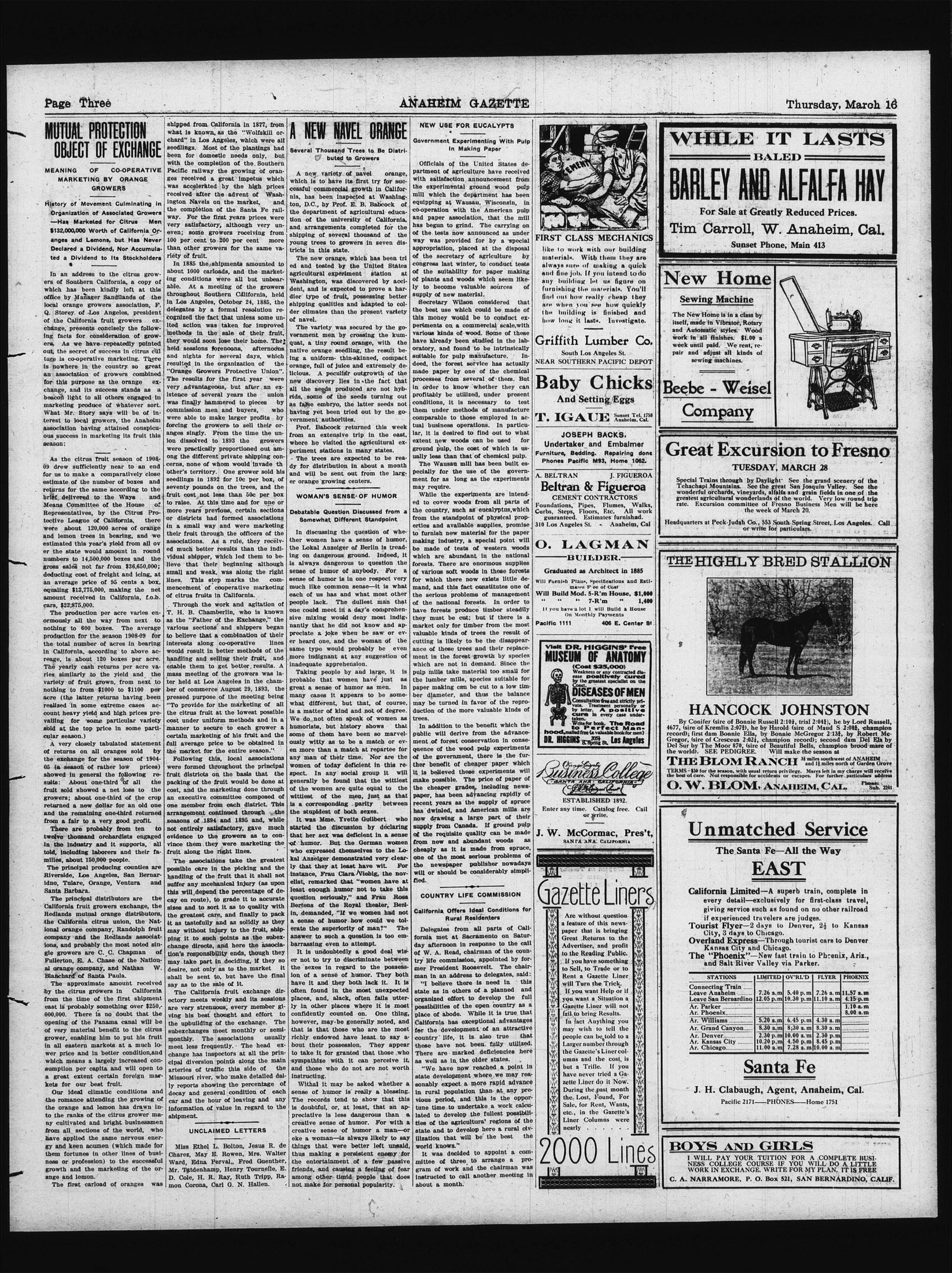
Searchable text
MUTUAL PROTECTION OBJECT OF EXCHANGE
MEANING OF CO-OPERATIVE MARKETING BY ORANGE GROWERS
History of Movement Culminating in Organization of Associated Growers — Has Marketed for Citrus Men $132,000,000 Worth of California Oranges and Lemons, but Has Never Declared a Dividend, Nor Accumulated a Dividend to Its Stockholders
In an address to the citrus growers of Southern California, a copy of which has been kindly left at this office by Manager Sandilands of the local orange growers association, F. Q. Storey of Los Angeles, president of the California fruit growers exchange, presents concisely the following facts for consideration of growers. As we have repeatedly pointed out, the secret of success in citrus culture is co-operative marketing. There is nowhere in the country so great an association of growers combined for this purpose as the orange exchange, and its success stands as a beacon light to all others engaged in marketing produce of whatever sort. What Mr. Story says will be of interest to local growers, the Anaheim association having attained conspicuous success in marketing its fruit this season:
As the citrus fruit season of 1908-09 drew sufficiently near to an end for us to make a comparatively close shipped from California in 1877, from what is known as the "Wolfskill orchard" in Los Angeles, which were all seedlings. Most of the plantings had been for domestic needs only, but with the completion of the Southern Pacific railway the growing of oranges received a great impetus which was accelerated by the high prices received after the advent of Washington Navels on the market, and the completion of the Santa Fe railway. For the first years prices were very satisfactory, although very uneven; some growers receiving from 100 per cent to 200 per cent more than other growers for the same variety of fruit.
In 1885 the shipments amounted to about 1000 carloads, and the marketing conditions were all but unbearable. At a meeting of the growers throughout Southern California, held in Los Angeles, October 24, 1885, the delegates by a formal resolution recognized the fact that unless some united action was taken for improved methods in the sale of their fruit, they would soon lose their home. They held sessions for nooons, afternoons and nights for several days, which resulted in the organization of the "Orange Growers Protective Union". The results for the first year were very advantageous, but after an existence of several years the union was finally hammered to pieces by commission men and buyers, who were able to make larger profits by forcing the growers to sell their oranges singly. From the time the union dissolved to 1893 the growers were practically proportioned out among the different private shipping concerns, none of whom would invade th other's territory. One grower sold his A NEW NAVEL Several Thousand Trees butted to it.
A new variety of which is to have its successful commercial genius, has been inspection, D.C., by Prof. E. the department of agriculture of the university and arrangements co-shipping of several young trees to grower tricts in this state.
The new orange, whited and tested by the agricultural experimenter Washington, was disbanded, and is expected drier type of fruit, p shipping qualities and der climates than those of navel.
The variety was seized government men by crayquat, a tiny round native orange seedling a uniform-thin-smooth orange, full of juice and licious. A peculiar new discovery lies in all the seeds produced rids, some of the seas as false embryo, the having yet been tried government authorities.
Prof. Babcock returned from an extensive trip where he visited three permanent stations in The trees are expdy for distribution in and will be sent our
As the citrus fruit season of 1908-09 drew sufficiently near to an end for us to make a comparatively close estimate of the number of boxes and returns for the same according to the brief delivered to the Ways and Means Committee of the House of Representatives, by the Citrus Protective League of California, there were about 120,000 acres of orange and lemon trees in bearing, and we estimated this year's yield from all over the state would amount in round numbers to 14,500,000 boxes and the gross sales not far from $36,650,000; deducting cost of freight and icing, at an average price of 95 cents a box, equaling $13,775,000, making the net amount received in California, f.o.b. cars, $22,875,000.
The production per acre varies enormously all the way from next to nothing to 600 boxes. The average production for the season 1908-09 for the total number of acres in bearing in California, according to above acreage, is about 120 boxes per acre. The yearly cash returns per acre varies similarly to the yield and the variety of fruit grown, from next to nothing to from $1000 to $1100 per acre (the latter returns having been realized in some extreme cases account heavy yield and high prices prevailing for some particular variety sold at the top price in some particular season.) A very closely tabulated statement of returns on all oranges sold by the exchange for the season of 1904-05 (a season of rather low prices) showed in general the following results: About one-third of all the fruit sold showed a net loss to the growers; about one-third of the crop returned a new dollar for an old one and the remaining one-third returned from a fair to a very good profit.
There are probably from ten to twelve thousand orchardists engaged in the industry and it supports, all told, including laborers and their families, about 150,000 people.
The principal producing counties are Riverside, Los Angeles, San Bernardino, Tulare, Orange, Ventura and Santa Barbara.
The principal distributors are the results for the first year were very advantageous, but after an existence of several years the union was finally hammered to pieces by commission men and buyers, who were able to make larger profits by forcing the growers to sell their oranges singly. From the time the union dissolved to 1893 the growers were practically proportioned out among the different private shipping concerns, none of whom would invade other's territory. One grower sold his seedlings in 1892 for 10c per box, of seventy pounds on the trees, and the fruit cost not less than 50c per box to raise. At this time and for one or more years previous, certain sections or districts had formed associations in a small way and were marketing their fruit through the officers of the associations. As a rule, they received much better results than the individual shipper, which led them to believe that their beginning although small and weak, was along the right lines. This step marks the commencement of cooperative marketing of citrus fruits in California.
Through the work and agitation of T. H. B. Chamberlin, who is known as the "Father of the Exchange," the various sections and shippers began to believe that a combination of their interests along co-operative lines would result in better methods of the handling and selling their fruit, and enable them to get better results. A mass meeting of the growers was later held at Los Angeles in the chamber of commerce August 29, 1893, the pressed purpose of the meeting being "To provide for the marketing of all the citrus fruit at the lowest possible cost under uniform methods and in a manner to secure to each grower a certain marketing of his fruit and the full average price to be obtained in the market for the entire season."
Following this, local associations were formed throughout the principal fruit districts on the basis that the packing of the fruit would be done at cost, and the marketing done through an executive committee composed of one member from each district. This arrangement continued through the seasons of 1894 and 1895 and, while not entirely satisfactory, gave much evidence to the growers as to convince them they were marketing the fruit along the right lines.
The associations take the greatest possible care in the picking and the handling of the fruit that it shall not suffer any mechanical injury (as upon this will depend on route) to grade it to accurate new discovery lies in all the seeds produced rids, some of the seals as false embryo, the having yet been tried government authorities.
Prof. Babcock return from an extensive tour where he visited these permanent stations in The trees are especially for distribution in and will be sent out er orange growing centers.
WOMAN'S SENSE
Debatable Question D
Somewhat Different
In discussing the other women have a Lokal Anzeiger owing on dangerous gree is always dangerous sense of humor of a sense of humor is in much like common sense of us has and people lack. The do one could meet in a safe mixing would dentantly that he did not preciate a joke when er heard one, and then same type would prove more indignant at an inadequate apprehension.
Taking people by probable that women great a sense of hum many cases it appears what different, but is a matter of kind and We do not often spee humorists, but history some of them have usually witty as to be en more than a match any man of their time women of today deficient. In any social generally be found that of the women are quite wittiest of the men is a corresponding to the stupidest of both It was Mme. Yvett started the discussion that her sex was deficient humor. But then who expressed them kal Anzeiger demonstry that they at least instance, Frau Clara elist, remarked that least enough humor question seriously."
There are probably from ten to twelve thousand orchardists engaged in the industry and it supports all told, including laborers and their families, about 150,000 people.
The principal producing counties are Riverside, Los Angeles, San Bernaridno, Tulare, Orange, Ventura and Santa Barbara.
The principal distributors are the California fruit growers exchange, the Redlands mutual orange distributors, the California citrus union, the National orange company, Randolph fruit company and the Redlands associations, and probably the most noted single growers are C. C. Chapman of Fullerton, E. A. Chase of the National orange company, and Nathan W. Blanchard of Santa Paula.
The approximate amount received by the citrus growers in California from the time of the first shipment east is probably something over $250,000,000. There is no doubt that the opening of the Panama canal will be of very material benefit to the citrus grower, enabling him to put his fruit in all eastern markets at a much lower price and in better condition, and which means a largely increased consumption per capita and will open to a great extent certain foreign markets for our best fruit.
Our ideal climatic conditions and the romance attending the growing of the orange and lemon has drawn into the ranks of the citrus grower many cultivated and bright businessmen from all sections of the world, who have applied the same nervous energy and keen acumen (which made for them fortunes in other lines of business or profession) to the successful growth and the marketing of the orange and lemon.
The first carload of oranges was an executive committee composed of one member from each district. This arrangement continued through the seasons of 1894 and 1895 and, while not entirely satisfactory, gave much evidence to the growers as to convince them they were marketing the fruit along the right lines.
The associations take the greatest possible care in the picking and the handling of the fruit that it shall not suffer any mechanical injury (as upon this will depend the percentage of decay en route), to grade it to accurate sizes and to sort it as to quality with the greatest care, and finally to pack it as tastefully and as solidly as they may without injury to the fruit, shipping it to such points as the subexchange directs, and here the association's responsibility ends, though they may take part in deciding, if they so desire, not only as to the market it shall be sent to, but have the final say as to the sale of it.
The California fruit exchange directory meets weekly and its sessions are very strenuous, every member giving his best thought and effort to the upbuilding of the exchange. The subexchanges meet monthly or semi-monthly. The associations usually meet less frequently. The head exchange has inspectors at all the principal diversion points along the main arteries of traffic this side of the Missouri river, who make detailed daily reports showing the percentage of decay and general condition of each car and the hour of leaving and any information of value in regard to the shipment.
UNCLAIMED LETTERS
Miss Ethel L. Bolton, Jesus R. de Charez, May E. Rowen, Mrs. Walter Ward, Edna Perval,, Fred Guenther, Mr. Tatdenhamp, Henry Tournelle, E. D. Cole, H. R. Ray, Ruth Tripp, Ramon Corona, Carl G. N. Hallen.
A NEW NAVEL ORANGE
Several Thousand Trees to Be Distributed to Growers
A new variety of navel orange, which is to have its first try for successful commercial growth in California, has been inspected at Washington, D.C., by Prof. E. B. Babcock of the department of agricultural education of the university of California, and arrangements completed for the shipping of several thousand of the young trees to growers in seven districts in this state.
The new orange, which has been tried and tested by the United States agricultural experiment station at Washington, was discovered by accident, and is expected to prove a harder type of fruit, possessing better shipping qualities and adapted to colder climates than the present variety of navel.
The variety was secured by the government men by crossing the kumquat, a tiny round orange, with the native orange seedling, the result being a uniform thin-skinned, compact orange, full of juice and extremely delicious. A peculiar outgrowth of the new discovery lies in the fact that all the seeds produced are not hybrids, some of the seeds turning out as false embryo, the latter seeds not having yet been tried out by the government authorities.
Prof. Babcock returned this week from an extensive trip in the east, where he visited the agricultural experiment stations in many states.
The trees are expected to be ready for distribution in about a month and will be sent out from the larg-
NEW USE FOR EUCALYPTS
Government Experimenting With Pulp In Making Paper
Officials of the United States department of agriculture have received with satisfaction announcement from the experimental ground wood pulp mill which the department has been equipping at Wausau, Wisconsin, in co-operation with the American pulp and paper association, that the mill has begun to grind. The carrying on of the tests now announced as under way was provided for by a special appropriation, placed at the disposal of the secretary of agriculture by congress last winter, to conduct tests of the suitability for paper making of plants and woods which seem likely to become valuable sources of supply of new material.
Secretary Wilson considered that the best use which could be made of this money would be to conduct experiments on a commercial scale, with various kinds of wood. Some of these have already been studied in the laboratory, and found to be intrinsically suitable for pulp manufacture. Indeed, the forest service has actually made paper by one of the chemical processes from several of them. But in order to know whether they can profitably be utilized, under present conditions, it is necessary to test them under methods of manufacture comparable to those employed in actual business operations. In particular, it is desired to find out to what extent new woods can be used for ground pulp, the cost of which is usually less than that of chemical pulp.
The Wausau mill has been built especially for the use of the govern-
new discovery lies in the fact that all the seeds produced are not hybrids, some of the seeds turning out as false embryo, the latter seeds not having yet been tried out by the government authorities.
Prof. Babcock returned this week from an extensive trip in the east, where he visited the agricultural experiment stations in many states.
The trees are expected to be ready for distribution in about a month and will be sent out from the larger orange growing centers.
WOMAN'S SENSE OF HUMOR
Debatable Question Discussed from a Somewhat Different Standpoint
In discussing the question of whether women have a sense of humor, the Lokal Anzeiger of Berlin is treading on dangerous ground. Indeed, it is always dangerous to question the sense of humor of anybody. For a sense of humor is in one respect very much like common sense—it is what each of us has and what most other people lack. The dullest man that one could meet in a day's comprehensive mixing would deny most indignantly that he did not know and appreciate a joke when he saw or ever heard one, and the woman of the same type would probably be even more indignant at any suggestion of inadequate apprehension.
Taking people by and large, it is probable that women have just as great a sense of humor as men. In many cases it appears to be somewhat different, but that, of course, is a matter of kind and not of degree. We do not often speak of women as humorists, but history shows that some of them have been so marvelously witty as to be a match or even more than a match at repartee for any man of their time. Nor are the women of today deficient in this respect. In any social group it will generally be found that the wittiest of the women are quite equal to the wittiest of the men, just as that is a corresponding parity between the stupidest of both sexes.
It was Mme. Yvette Guilbert who started the discussion by declaring that her sex was deficient in a sense of humor. But the German women who expressed themselves to the Lokal Anzeiger demonstrated very clearly that they at least have wit. For instance, Frau Clara Viebig, the novelist, remarked that "women have at least enough humor not to take this question seriously," and Frau Rosa processes from several of them. But in order to know whether they can profitably be utilized, under present conditions, it is necessary to test them under methods of manufacture comparable to those employed in actual business operations. In particular, it is desired to find out to what extent new woods can be used for ground pulp, the cost of which is usually less than that of chemical pulp.
The Wausau mill has been built especially for the use of the government for as long as the experiments may require.
While the experiments are intended to cover woods from all parts of the country, such as eucalyptus, which from the standpoint of physical properties and available supplies, promise to furnish new material for the paper making industry, a special point will be made of tests of western woods which are abundant in the national forests. There are enormous supplies of various soft woods in these forests for which there now exists little demand, and this fact constitutes one of the serious problems of management of the national forests. In order to have forests produce timber steadily they must be cut; but if there is a market only for timber from the most valuable kinds of trees the result of cutting is likely to be the disappearance of these trees and their replacement in the forest growth by species which are not in demand. Since the pulp mills take material too small for the lumber mills, species suitable for paper making can be cut to a low timber diameter, and thus the balance may be turned in favor of the reproduction of the more valuable kinds of trees.
In addition to the benefit which the public will derive from the advancement of forest conservation in consequence of the wood pulp experiments of the government, there is further benefit of cheaper paper which it is believed these experiments will make possible. The price of paper of the cheaper grades, including newspaper, has been advancing rapidly of recent years as the supply of spruce has dwined, and American mills are now drawing a large part of their supply from Canada. If ground pulp of the requisite quality can be made from new and abundant woods as cheaply as it is made from spruce, one of the most serious problems of the newspaper publisher nowadays will or should be considerably simplified.
COUNTRY LIFE COMMISSION
is a corresponding parity between the stupidest of both sexes.
It was Mme. Yvette Guilbert who started the discussion by declaring that her sex was deficient in a sense of humor. But the German women who expressed themselves to the Local Anzeiger demonstrated very clearly that they at least have wit. For instance, Frau Clara Viebig, the novelist, remarked that "women have at least enough humor not to take this question seriously," and Frau Rosa Bertens of the Royal theater, Berlin, demanded, "If we women had not a sense of humor how could we tolerate the superiority of man?" The answer to such a question is too embarrassing even to attempt.
It is undoubtedly a good deal wiser not to try to discriminate between the sexes in regard to the possession of a sense of humor. They both have it and they both lack it. It is often found in the most unexpected places, and, alack, often falls utterly in other places where it is most confidently counted on. One thing, however, may be generally noted, and that is that those who are the most richly endowed have least to say about their possession. They appear to take it for granted that those who sympathize with it can perceive it, and those who do not are not worth instructing.
Withal it may be asked whether a sense of humor is really a blessing. The records tend to show that this is doubtful, or, at least, that an appreciative is less dangerous than a creative sense of humor. For with a creative sense of humor a man—or eke a woman—is always likely to say things that were better left unsaid, thus making a persistent enemy for the entertainment of a few passive friends, and causing a feeling of fear among other timid people that does not make for personal popularity.
recent years as the supply of spruce has dwinled, and American mills are now drawing a large part of their supply from Canada. If ground pulp of the requisite quality can be made from new and abundant woods as cheaply as it is made from spruce, one of the most serious problems of the newspaper publisher nowadays will or should be considerably simplified.
COUNTRY LIFE COMMISSION
California Offers Ideal Conditions for Rural Residenters
Delegates from all parts of California met at Sacramento on Saturday afternoon in response to the call of W. A. Read, chairman of the country life commission, appointed by former President Roosevelt. The chairman in an address to delegates, said:
"I believe there is need in this state as in others of a planned and organized effort to develop the full possibilities of the open country as a place of abode. While it is true that California has exceptional advantages for the development of an attractive country life, it is also true that these have not been fully utilized. There are marked deficiencies here as well as in the older states.
"We have now reached a point in state development where we may reasonably expect a more rapid advance in rural population than at any previous period, and this is the opportunity to undertake a work calculated to develop the fullest possibilities of the agriculture' regions of the state and to develop here a rural civilization that will be the best the world knows."
It was decided to appoint a committee of three to arrange a program of work and the chairman was instructed to call another meeting in about a month.
THURSDAY, MARCH 16
WHILE IT LASTS
BALED
BARLEY AND ALFALFA HAY
For Sale at Greatly Reduced Prices.
Tim Carroll, W. Anaheim, Cal.
Sunset Phone, Main 413
New Home
Sewing Machine
The New Home is in a class by itself, made in Vibrator, Rotary and Automatic styles. Wood work in all finishes. $1.00 a week until paid. We rent, repair and adjust all kinds of sewing machines.
Beebe - Weisel Company
Great Excursion to Fresno
TUESDAY, MARCH 28
Beebe - Weisel Company
Great Excursion to Fresno
TUESDAY, MARCH 28
Special Trains through by Daylight: See the grand scenery of the Teachaapi Mountains. See the great San Joaquin Valley. See the wonderful orchards, vineyards, alfalfa and grain fields in one of the greatest agricultural wonderlands of the world. Very low round trip rate. Excursion committee of Fresno Business Men will be here the week of March 20.
Headquarters at Peck-Judah Co., 553 South Spring Street, Los Angeles. Call or write for particulars.
THE HIGHLY BRED STALLION
HANCOCK JOHNSTON
By Conifer (sire of Bonnie Russell 2:10¼, trial 2:04¾), he by Lord Russell, 4677, (sire of Kremlin 2:07¾), he by Harold (sire of Maud S. 2:08¾, champion record); first dam Bonnie Ella, by Bonnie McGregor 2:13¾, by Robert McGregor, (sire of Cresceus 2:02¾, champion record); second dam Del Ela by Del Sur by The Moor 870, (sire of Beautiful Bells, champion brood mare of the world). SEE PEDIGREE. Will make the season at THE BLOM RANCH 3½ miles southwest of ANAHEIM and 1½ miles north of Garden Grove TERMS - $30 for the season, with usual return privilege. Mares left in my charge will receive the best of care. Not responsible for accidents or escapes. For further particulars address O. W. BLOM, ANAHEIM, CAL.
Phone: Sub. 2241
Unmatched Service
The Santa Fe—All the Way
EAST
California Limited—a superb train, complete in
Unmatched Service
The Santa Fe—All the Way
EAST
California Limited—A superb train, complete in every detail—exclusively for first-class travel, giving service such as found on no other railroad if experienced travelers are judges.
Tourist Flyer—2 days to Denver, 2½ to Kansas City, 3 days to Chicago.
Overland Express—Through tourist cars to Denver Kansas City and Chicago.
The "Phoenix"—New fast train to Phoenix, Ariz., and Salt River Valley via Parker.
STATIONS
Connecting Train ...
Leave Anaheim ...
Leave San Bernardino ...
Ar. Parker ...
Ar. Phoenix ...
Ar. Williams ...
Ar. Grand Canyon ...
Ar. Denver ...
Ar. Kansas City ...
Ar. Chicago
LIMITED
7.26 a.m.
12.05 p.m.
OV'RL'D
5.40 p.m.
10.30 p.m.
FLYER
7.26 a.m.
11.10 a.m.
1.10 a.m.
8.00 a.m
PHOENIX
11.57 a.m
4.15 p.m
Santa Fe
J. H. Clabaugh, Agent, Anaheim, Cal.
Pacific 2171—PHONES—Home 1751
BOYS AND GIRLS
I WILL PAY YOUR TUITION FOR A COMPLETE BUSINESS COLLEGE COURSE IF YOU WILL DO A LITTLE WORK IN EXCHANGE. WRITE FOR MY PLAN. IT IS FREE
C. A. NARRAMORE, P. O. Box 521, SAN BERNARDINO, CALIF.