anaheim-gazette 1911-03-09
Scanned page
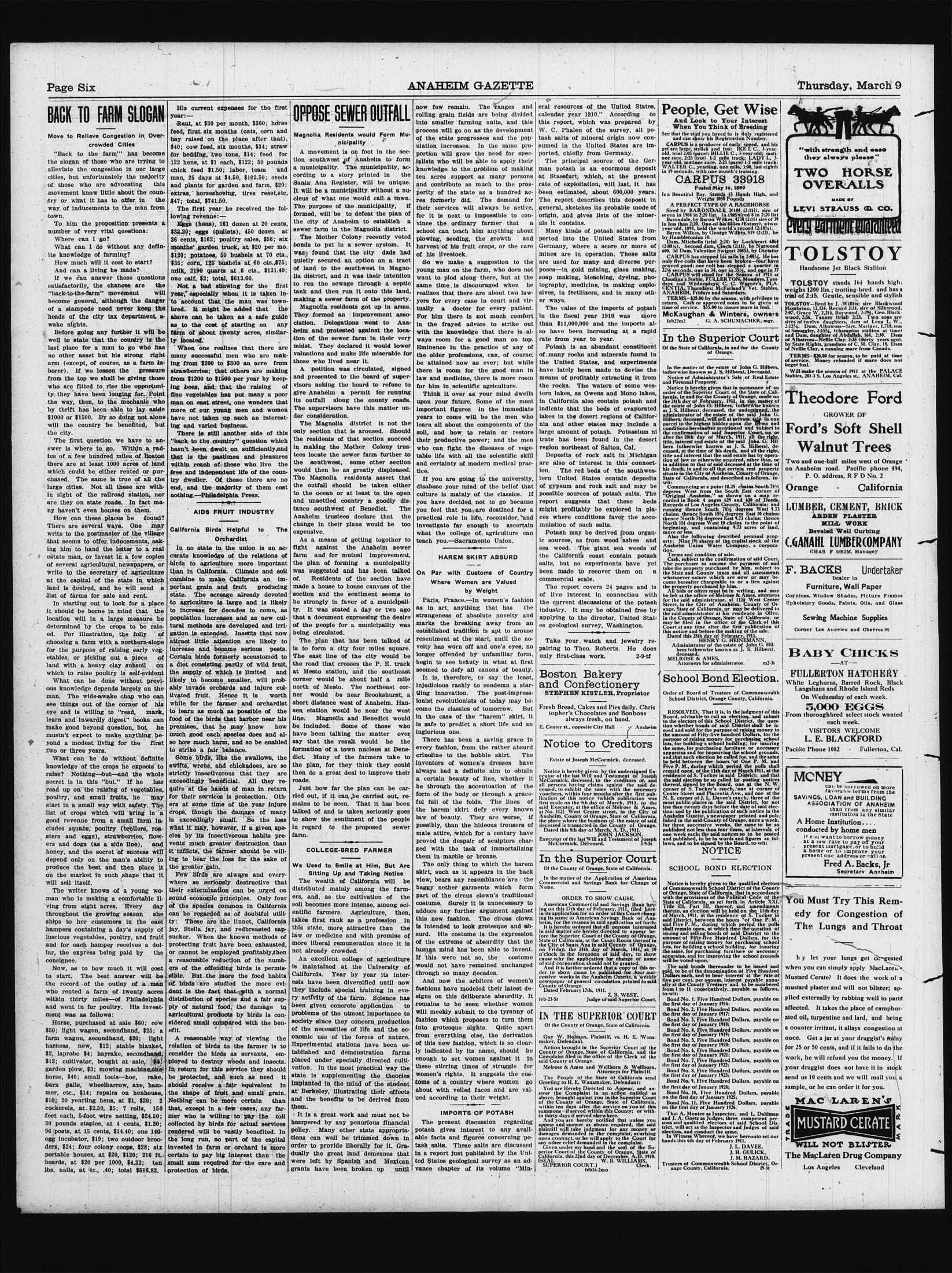
Searchable text
BACK TO FARM SLOGAN
Move to Relieve Congestion in Overcrowded Cities
"Back to the farm" has become the slogan of those who are trying to alleviate the congestion in our large cities, but unfortunately the majority of those who are advocating this movement know little about the country or what it has to offer in the way of inducements to the man from town.
To him the proposition presents a number of very vital questions:
Where can I go?
What can I do without any definite knowledge of farming?
How much will it cost to start?
And can a living be made?
If we can answer these questions satisfactorily, the chances are the "back-to-the-farm" movement will become general, although the danger of a stampede need never keep the heads of the city tax department awake nights.
Before going any further it will be well to state that the country is the last place for a man to go who has no other asset but his strong right arm (except, of course, as a farm laborer). If we lessen the pressure from the top we shall be giving those who are fitted to rise the opportunity they have been longing for. Point the way, then, to the mechanic who by thrift has been able to lay aside $1000 or $1500. By so doing not alone will the country be benefited, but the city.
The first question we have to answer is where to go. Within a radius of a few hundred miles of Boston there are at least 1000 acres of land which could be either rented or pur-
His current expenses for the first year:
Rent, at $30 per month, $360; horse feed, first six months (oats, corn and hay raised on the place after that), $40; cow feed, six months, $34; straw for bedding, two tons, $14; feed for 122 hens, at $1 each, $122; 50 pounds chick feed $1.50; labor, team and man, 25 days at $4.50, $102.50; seeds and plants for garden and farm, $20; extras, horseshoeing, tires reset, etc., $47; total, $741.50.
The first year he received the following revenue:
Eggs (hens), 161 dozen at 20 cents, $32.20; eggs (pullets), 450 dozen at 36 cents, $162; poultry sales, $56; six months' garden truck, at $20 per mo. $120; potatoes, 50 bushels at 70 cts., $35; corn, 125 bushels at 60 cts., $75; milk, 2190 quarts at 6 cts., $131.40; one calf, $2; total, $613.60.
Not a bad showing for the first year, especially when it is taken into account that the man was town-bred. It might be added that the above can be taken as a safe guide as to the cost of starting on any farm of about twenty acres, similarly located.
When one realizes that there are many successful men who are making from $200 to $300 an acre from strawberries; that others are making from $1200 to $1500 per year by keeping bees, and that the raising of fine vegetables has put many a poor man on east street, one wonders that more of our young men and women have not taken up such an interesting and varied business.
There is still another side of this "back to the country" question which hasn't been dwelt on sufficiently,and that is the pastimes and pleasures within reach of those who live the free and independent life of the coun-
from the top we shall be giving those who are fitted to rise the opportunity they have been longing for. Point the way, then, to the mechanic who by thrift has been able to lay aside $1000 or $1500. By so doing not alone will the country be benefited, but the city.
The first question we have to answer is where to go. Within a radius of a few hundred miles of Boston there are at least 1000 acres of land which could be either rented or purchased. The same is true of all the large cities. Not all these are within sight of the railroad station, nor are they on state roads. In fact many haven't even houses on them.
How can these places be found? There are several ways. One may write to the postmaster of the village that seems to offer inducements, asking him to hand the letter to a real estate man, or invest in a few copies of several agricultural newspapers, or write to the secretary of agriculture at the capital of the state in which land is desired, and he will send a list of farms for sale and rent.
In starting out to look for a place it should be borne in mind that the location will in a large measure be determined by the crops to be raised. For illustration, the folly of choosing a farm with a northern-slope for the purpose of raising early vegetables, or picking out a piece of land with a heavy clay subsoil on which to raise poultry is self-evident.
What can be done without previous knowledge depends largely on the man. The wide-awake chap who can see things out of the corner of his eye and is willing to "read, mark, learn and inwardly digest" books can make good beyond question, but he mustn't expect to make anything beyond a modest living for the first two or three years.
What can he do without definite knowledge of the crops he expects to raise? Nothing—but—and the whole secret is in this "but." If he has read up on the raising of vegetables, poultry, and small fruits, he may start in a small way with safety. The list of crops which will bring in a good revenue from a small farm includes squabs, poultry (brollers, roosters and eggs), strawberries, flowers and dogs (as a side line), and honey, and the secret of success will depend only on the man's ability to produce the best and then place it on the market in such shape that it will sell itself.
The writer knows of a young woman who is making a comfortable life from $1200 to $1500 per year by keeping bees, and that the raising of fine vegetables has put many a poor man on east street, one wonders that more of our young men and women have not taken up such an interesting and varied business.
There is still another side of this "back to the country" question which hasn't been dwelt on sufficiently, and that is the pastimes and pleasures within reach of those who live the free and independent life of the country dweller. Of these there are no end, and the majority of them cost nothing.—Philadelphia Press.
AIDS FRUIT INDUSTRY
California Birds Helpful to The Orchardist
In no state in the union is an accurate knowledge of the relations of birds to agriculture more important than in California. Climate and soil combine to make California an important grain and fruit producing state. The acreage already devoted to agriculture is large and is likely to increase for decades to come, as population increases and as new cultural methods are developed and irrigation is extended. Insects that now attract little attention are likely to increase and become serious pests. Certain birds formerly accustomed to a diet consisting partly of wild fruit, the supply of which is limited and likely to become smaller, will probably invade orchards and injure cultivated fruit. Hence it is worth while for the farmer and orchardist to learn as much as possible of the food of the birds that harbor near his premises, that he may know how much good each species does and also how much harm, and so be enabled to strike a fair balance.
Some birds, like the swallows, the swifts, wrens, and chickadees, are so strictly insectivorous that they are exceedingly beneficial. All they require at the hands of man in return for their services is protection. Others at some time of the year injure crops, though the damage of many is exceedingly small. Be the loss what it may, however, if a given species by its insectivorous habits prevents much greater destruction than it inflicts, the farmer should be willing to bear the loss for the sake of the greater gain.
Few birds are always and everywhere so seriously destructive that their extermination can be urged on sound economic principles. Only four
start in a small way with safety. The list of crops which will bring in a good revenue from a small farm includes squabs, poultry (brollers, roasters and eggs), strawberries, flowers and dogs (as a side line), and honey, and the secret of success will depend only on the man's ability to produce the best and then place it on the market in such shape that it will sell itself.
The writer knows of a young woman who is making a comfortable living from eight acres. Every day throughout the growing season she ships to her customers in the east hampers containing a day's supply of luscious vegetables, poultry, and fruit and for each hamper receives a dollar, the express being paid by the consignee.
Now, as to how much it will cost to start. The best answer will be the record of the outlay of a man who rented a farm of twenty acres within thirty miles—of Philadelphia and went in for poultry. His investment was as follows:
Horse, purchased at sale $60; cow $50; light wagon, secondhand, $25; a farm wagon, secondhand, $20; light harness, new, $12; stable blanket, $2, laprobe $4; hayrake, secondhand, $12; cultivator, bought at sale, $4; garden plow, $3; mowing machine, one horse, $40; small tools—hoe, rake, barn pails, wheelbarrow, axe, hammer, etc., $14; repairs on henhouse, $10; 20 yearling hens, at $1, $20; 2 cockerels, at $2.50, $5; 7 rolls, 150 feet each, 5-foot wire netting, $24.50; 30 pounds staples, at 4 cents, $1.20; 96 posts, at 15 cents, $14.40; one 140-egg incubator, $19; two outdoor brooders, $24; four colony coops, $28; six portable houses, at $20, $120; 216 ft. boards, at $20 per 1000, $4.32; ten lbs. nails, at 4c., .40; total $516.82.
Few birds are always and everywhere so seriously destructive that their extermination can be urged on sound economic principles. Only four of the species common in California can be regarded as of doubtful utility: These are the linnet, California jay, Stella jay, and redbreasted sappucker. When the known methods of protecting fruit have been exhausted, or cannot be employed profitably, then a reasonable reduction of the numbers of the offending birds is permissible. But the more the food habits of birds are studied the more evident is the fact that with a normal distribution of species and a fair supply of natural food, the damage to agricultural products by birds is considered small compared with the benefit.
A reasonable way of viewing the relation of birds to the farmer is to consider the birds as servants, employed to destroy weeds and insects. In return for this service they should be protected, and such as need it should receive a fair equivalent in the shape of fruit and small grain. Nothing can be more certain than that, except in a few cases, any farmer who is willing to pay the toll collected by birds for actual services rendered will be vastly benefited. In the long run, no part of the capital invested in farm or orchard is more certain to pay big interest than the small sum required for the care and protection of birds.
We Used to Smile
Sitting Up and
The wealth of California distributed mainly to farmers, and as the cuckoo soil becomes more intensive farmers. A takes first rank as this state, more attentive law or medicine and more liberal remuneration not already crowded.
An excellent colleague is maintained at the California. Year by yearests have been diversified they include special activity of the fauna given concrete problems of the utmost society since they coated of the necessities ofonomic use of the Experimental station established and demoplaced under special vation. In the most state is supplemented implanted in the milieu at Berkeley, illustrand and the benefits to them.
It is a great work hampered by any peculiar policy. Many other tions can well be the order to provide liberally the great land were left by Spanish grants have been b
OPPOSE SEWER OUTFALL
Magnolia Residents would Form Municipality
A movement is on foot in the section southwest of Anaheim to form a municipality. The municipality, according to a story printed in the Santa Ana Register, will be unique. It will be a municipality without a nucleus of what one would call a town. The purpose of the municipality, if formed, will be to defeat the plan of the city of Anaheim to establish a sewer farm in the Magnolia district.
The Mother Colony recently voted bonds to put in a sewer system. It was found that the city dads had quietly secured an option on a tract of land to the southwest in Magnolia district, and it was their intention to run the sewage through a septic tank and then run it onto this land, making a sewer farm of the property.
Magnolia residents got up in arms. They formed an improvement association. Delegations went to Anaheim and protested against the location of the sewer farm in their very midst. They declared it would lower valuations and make life miserable for those who lived near it.
A petition was circulated, signed and presented to the board of supervisors asking the board to refuse to give Anaheim a permit for running its outfall along the county roads. The supervisors have this matter under consideration.
The Magnolia district is not the only section that is aroused. Should the residents of that section succeed in making the Mother Colony trustees locate the sewer farm further to the southwest, some other section would then be as greatly displeased.
now few remain. The ranges and rolling grain fields are being divided into smaller farming units, and this process will go on as the development of the state progresses and the population increases. In the same proportion will grow the need for specialists who will be able to apply their knowledge to the problem of making ten acres support as many persons and contribute as much to the prosperity of the state as a hundred acres formerly did. The demand for their services will always be active, for it is next to impossible to convince the ordinary farmer that a school can teach him anything about plowing, seeding, the growth and harvest of his fruit crops, or the care of his livestock.
So we make a suggestion to the young man on the farm, who does not want to plod along there, but at the same time is discouraged when he realizes that there are about two lawyers for every case in court and virtually a doctor for every patient. For him there is not much comfort in the frayed advice to strike out with the knowledge that there is always room for a good man on top. Eminence in the practice of any of the older professions, can, of course, be attained now as ever; but while there is room for the good man in law and medicine, there is more room for him in scientific agriculture.
Think it over as your mind dwells upon your future. Some of the most important figures in the immediate years to come will be the men who learn all about the components of the soil, and how to retain or restore their productive power; and the men who can fight the diseases of vegetable life with all the scientific skill and certainty of modern medical practice.
eral resources of the United States, calendar year 1910." According to this report, which was prepared by W. C. Phalen of the survey, all potash salts of mineral origin now consumed in the United States are imported, chiefly from Germany.
The principal source of the German potash is an enormous deposit at Stassfurt, which, at the present rate of exploitation, will last, it has been estimated, about 600,000 years. The report describes this deposit in general, sketches its probable mode of origin, and gives lists of the minerals it contains.
Many kinds of potash salts are imported into the United States from Germany, where a score or more of mines are in operation. These salts are used for many and diverse purposes—in gold mining, glass making, soap making, bleaching, dyeing, photography, medicine, in making explosives, in fertilizers, and in many other ways.
The value of the imports of potash in the fiscal year 1910 was more than $11,000,000 and the imports also have been increasing at a rapid rate from year to year.
Potash is an abundant constituent of many rocks and minerals found in the United States, and experiments have lately been made to devise the means of profitably extracting it from the rocks. The waters of some western lakes, as Owens and Mono lakes, in California also contain potash and indicate that the beds of evaporated lakes in the desert regions of California and other states may include a large amount of potash. Potassium nirate has been found in the desert region northeast of Salton, Cal.
Deposits of rock salt in Michigan are also of interest in this connection. The red beds of the southwestern United States are also of interest in this connection.
and presented to the board of supervisors asking the board to refuse to give Anaheim a permit for running its outfall along the county roads. The supervisors have this matter under consideration.
The Magnolia district is not the only section that is aroused. Should the residents of that section succeed in making the Mother Colony trustees locate the sewer farm further to the southwest, some other section would then be as greatly displeased. The Magnolia residents assert that the outfall should be taken either to the ocean or at least to the open and unsettled country a goodly distance southwest of Benedict. The Anaheim trustees declare that the change in their plans would be too expensive.
As a means of getting together to fight against the Anaheim sewer farm and for mutual improvement, the plan of forming a municipality was suggested and has been talked of. Residents of the section have made a house to house canvass of the section and the sentiment seems to be strongly in favor of a municipality. It was stated a day or two ago that a document expressing the desire of the people for a municipality was being circulated.
The plan that has been talked of is to form a city four miles square. The east line of the city would be the road that crosses the P. E. track at Mesto station, and the southeast corner would be about half a mile north of Mesto. The northeast corner would be near Brookhurst, a short distance west of Anaheim. Hansen station would be near the west line. Magnolia and Benedict would be included. Some of those who have been talking the matter over say that the result would be the formation of a town nucleus at Benedict. Many of the farmers take to the plan, for they think they could then do a great deal to improve their roads.
Just how far the plan can be carried out, if it can be carried out, remains to be seen. That it has been talked of and is taken seriously goes to show the sentiment of the people in regard to the proposed sewer farm.
COLLEGE-BRED FARMER
We Used to Smile at Him, But Are Sitting Up and Taking Notice
The wealth of California will be distributed mainly among the farmers, and, as the cultivation of the law and medicine, there is more room for him in scientific agriculture.
Think it over as your mind dwells upon your future. Some of the most important figures in the immediate years to come will be the men who learn all about the components of the soil, and how to retain or restore their productive power; and the men who can fight the diseases of vegetable life with all the scientific skill and certainty of modern medical practice.
If you are going to the university, disabuse your mind of the belief that culture is mainly of the classics. If you have decided not to go because you feel that you are destined for a practical role in life, reconsider, and investigate far enough to ascertain what the college of agriculture can teach you.—Sacramento Union.
HAREM SKIRT ABSURD
On Par with Customs of Country Where Women are Valued by Weight
Paris, France.—In women's fashion as in art, anything that has the strangeness of absolute novelty and marks the breaking away from an established tradition is apt to arouse resentment at the start, until the novelty has worn off and one's eyes, no longer offended by unfamiliar form, begin to see beauty in what at first seemed to defy all canons of beauty.
It is, therefore, to say the least, injudicious rashly to condemn a starling innovation. The post-impressionist revolutionists of today may become the classics of tomorrow. But in the case of the "harem" skirt, it is safe to predict a short life and an inglorious one.
There has been a saving grace in every fashion, from the rather absurd crinoline to the hobble skirt. The inventors of women's dresses have always had a definite aim to obtain a certain beauty of line, whether it be through the accentuation of the form of the body or through a graceful fall of the folds. The lines of the harem skirt defy every known law of beauty. They are worse, if possibly, than the hideous trousers of male attire, which for a century have proved the despair of sculptors charged with the task of immortalizing them in marble or bronze.
The only thing to which the harem skirt, such as it appears in the back view, bears any resemblance are the baggy nether garments which form part of the circus clown's traditional means of profitably extracting it from the rocks. The waters of some western lakes, as Owens and Mono lakes, in California also contain potash and indicate that the beds of evaporated lakes in the desert regions of California and other states may include a large amount of potash. Potassium niate has been found in the desert region northeast of Salton, Cal.
Deposits of rock salt in Michigan are also of interest in this connection. The red beds of the southwestern United States contain deposits of gypsum and rock salt and may be possible sources of potash salts. The report suggests that these beds might profitably be explored in places where conditions favor the accumulation of such salts.
Potash may be derived from organic sources, as from wood ashes and sea weed. The giant seaweeds of the California coast contain potash salts, but no experiments have yet been made to recover them on a commercial scale.
The report covers 24 pages and is of live interest in connection with the current discussions of the potash industry. It may be obtained free by applying to the director, United States geological survey, Washington.
Take your watch and jewelry repairing to Theo. Roberts. He does only first-class work.
Boston Bakery and Confectionery STEPHEN KISTLER, Proprietor
Fresh Bread, Cakes and Pies daily. Christopher's Chocolates and Bonbons always fresh, on hand.
E. Center st., opposite City Hall Anaheim
Notice to Creditors
Estate of Joseph McCormick, deceased.
Notice is hereby given by the undersigned Executor of the last Will and Testament of Joseph McCormick, deceased, to the creditors of, and all persons having claims against the said deceased, to exhibit same with necessary vouchers, within four months after the first publication of this notice (which publication was first made on 9th day of March, 1911, to the said Executor, at the office of Macrose & Ames at No. 112) West Center street, in the City of Anaheim, County of Orange, State of California, place where the business of the estate of said deceased is transacted in the County of Orange. Dated this 8th day of March, A.D., 1911.
JOHN JACKSON,
Executor of the last Will and Testament of Joseph McCormick, Deceased.
In the Superior Court
Of the County of Orange, State of California.
In the matter of the Application of American Commercial and Savings Bank for Change of Name.
ORDER TO SHOW CAUSE
COLLEGE-BRED FARMER
We Used to Smile at Him, But Are Sitting Up and Taking Notice
The wealth of California will be distributed mainly among the farmers, and, as the cultivation of the soil becomes more intense, among scientific farmers. Agriculture, then, takes first rank as a profession in this state, more attractive than the law or medicine and with promise of more liberal remuneration since it is not already crowded.
An excellent college of agriculture is maintained at the University of California. Year by year its interests have been diversified until now they include special training in every activity of the farm. Science has been given concrete application to problems of the utmost importance to society since they concern production of the necessities of life and the economic use of the forces of nature. Experimental stations have been established and demonstration farms placed under specially directed cultivation. In the most practical way the state is supplementing the theories implanted in the mind of the student at Berkeley, illustrating their effects and the benefits to be derived from them.
It is a great work and must not be hampered by any penurious financial policy. Many other state appropriations can well be trimmed down in order to provide liberally for it. Gradually the great land demesnes that were left by Spanish and Mexican grants have been broken up until full fall of the folds. The lines of the harem skirt defy every known law of beauty. They are worse, if possibly, than the hideous trousers of male attire, which for a century have proved the despair of sculptors charged with the task of immortalizing them in marble or bronze.
The only thing to which the harem skirt, such as it appears in the back view, bears any resemblance are the baggy nether garments which form part of the circus clown's traditional costume. Surely it is unnecessary to adduce any further argument against this new fashion. The circus clown is intended to look grotesque and absurd. His costume is the expression of the extreme of absurdity that the human mind has been able to invent. If this were not so, the costume would not have remained unchanged through so many decades.
And now the arbiters of women's fashions have modeled their latest designs on this delibere absurdity. It remains to be seen whether women will meekly submit to the tyranny of fashion which proposes to turn them into grotesque sights. Quite apart from everything else, the derivation of this new fashion, which is so clearly indicated by its name, should be enough to set women against it in these stirring times of struggle for women's rights. It suggests the customs of a country where women go about with veiled faces and are valued according to their weight.
IMPORTS OF POTASH
The present discussion regarding potash gives interest to any available facts and figures concerning potash salts. These salts are discussed in a report just published by the United States geological survey as an advance chapter of its volume "Min-
IN THE SUPERIOR COURT
Of the County of Orange, State of California.
Guy W. Holman, Plaintiff, vs. H. E. Wana-maker, Defendant.
Action brought in the Superior Court of the County of Orange, State of California, and the Complaint filed in the office of the Clerk of the said County of Orange.
Melrose & Ames and Wellborn & Wellborn, Attorneys for Plaintiff.
The People of the State of California send Greeting to H. E. Wana-maker, Defendant:
Yod are Hereby Directed to Appear, and answer the Complaint in an action entitled as above, brought against you in the Superior Court of the County of Orange, State of California, within ten days after the service on you of this summons—if served within this County—or within thirty days if served elsewhere.
And you are hereby notified that unless you appear and answer as above required, the said plaintiff will take judgment for any money or damages demanded in the complaint, as arising upon contract, or he will apply to the Court for any other relief demanded in the complaint.
Given under my hand and the seal of the Superior Court of the County of Orange, State of California, this 22nd day of December, A.D. 1910.
[SEAL]
W. B. WILLIAMS,
febl6-2mo
People, Get Wise
And Look to Your Interest
When You Think of Breeding
See that the stud you breed to is duly registered and can show his Registration Number.
CARPUS is a producer of early speed, and his gef are large, stylish and fast: IKE L. C., 3-year-old, trial 2:05 (pace); BILLIE C., 3-year-old, matinee race, 2:23 (trot) 1-2 mile track; LADY L., 3-year-old, matinee race, 2:23 (pace) 1-2 mile track; WALTER C., yearling, one mile, 3:00, last eighth in 19 seconds, with one month's training.
CARPUS 33918
Foaled May 16, 1899
Is a Beautiful Bay. Stands 15 Hands High, and Weights 1050 Pounds
A PERFECT TYPE OF A RACEHORSE
Sired by BARONDALE, 20184 (2:111), sire of seven in 1904 in 2:20 list. In 1905 sired 8 in 2:20 list.
Barondale, by Baron Wilkes, 4758 (2:18) sire of 39 in less than 2:20. One-of-his-filies (Extasy), a two-year-old, 1898, held the world's record (2:10%).
Baron Wilkes, by George Wilkes, 519 (2:22), he by Hambletonian 10.
Dam, Mitchella (trial 2:24) by Lockheart 6864 (2:08%), Second dam, Cinch (2:11), by Nutwood 600, 3d Dam, Valentine Swigert 20853, by Dictator
CARPUS has stepped his mile in 2:08%. He has only five colts that have been broken—four have proved good; one colt has stepped a quarter in 32% seconds, one in 34, one in 35%, and one in 37.
CARPUS will stand for the Season of 1911 at Claudina's Stable, FULLERTON, Mondays, Tuesdays and Wednesdays; C. C. Wagner's, PLACENTIA, Thursdays; McFarland's Vet. Stables, ANAHEIM, Fridays and Saturdays.
TERMS—$25.00 by the season, with privilege to return. Cash or approved notes to be given at time of service. $35.00 to insure mare in foal.
McKaughan & Winters, owners
feb22m2
G. A. SCHUMACHER, mgr.
In the Superior Court
Of the State of California, in and for the County of Orange.
In the matter of the estate of John G. Hilbers,
(otherwise known as J. S. Hilbers), deceased.
Notice of Administrator's Sale of Real Estate and Personal Property.
Notice is hereby given that in pursuance of an order of the Superior Court of the State of California, in and for the County of Orange, made on the 24th day of February, 1911, in the matter of the estate of John G. Hilbers, (otherwise known as J. S. Hilbers), deceased, the undersigned, the administrator of the estate of the said John G. Hilberts, deceased, will sell at private sale in one parcel to the highest bidder upon the terms and conditions hereinafter mentioned and subject to the confirmation of said Superior Court, on or after the 20th day of March, 1911, all the right title, interest and estate of the said John G. Hilberts (otherwise known as J. S. Hilberts), deceased, at the time of his death, and all the right title and interest that the said estate has by operation of law or otherwise acquired, other than, or in addition to that of said deceased at the time of his death, in and to all that certain real property situate in the City of Anaheim, County of Orange,
"with strength and ease they always please"
TWO HORSE OVERALLS
MADE BY LEVI STRAUSS CO.
TOLSTOY
Handsome Jet Black Stallion
TOLSTOY stands 164 hands high; weighs 1200 lbs.; trotting-bred. and has a trial of 2:15. Gentle, sensible and stylish
TOLSTOY—Bred by J. Willits; sire Blackwood Mambrino, 12,324; Record 2:31; sire of Silkwood, 2:07; Grace W., 2:211; Baywood, 2:291; Geo.Blackwood, 2:36; Tanner (trial) 2:23. Two sons are sires of twelve daughters, dam of Lena L.W., 2:12%. Dam, Albatross—Sire, Mariner, 1,718 son of Smuggler, 2:15% (champion stallion at time) and Dam, daughter of Abdalfah, 164, 2:30. Dam of Albatross—Nellie Clay. 2:35 (thirty years ago). By State Rights, grandson of C.M. Clay, 18. Dam of Nellie Clay, a running mare from Canada.
TERMS—$20.00 for season, to be paid at time of service. Money refunded if mare does not beget foal.
Will make the season of 1911 at the PALACE Stables, 201-3 S. Los Angeles st., ANAHEIM, Cal.
Theodore Ford
GROWER OF
Ford's Soft Shell Walnut Trees
Two and one-half miles west of Orange on Anaheim road. Pacific phone 494.
Notice is hereby given that in pursuance of an order of the Superior Court of the State of California, in and for the County of Orange, made on the 24th day of February, 1911, in the matter of the estate of John G. Hilbers; otherwise known as J. S. Hilbers, deceased, the understated, the administrator of the estate of the John G. Hilbers, deceased, will sell at private sale in one parcel to the highest bidder upon the terms and conditions hereinafter mentioned and subject to the confirmation of said Superior Court, on or after the 20th day of March, 1911, all the right, title, interest and estate of the said John G. Hilbers (otherwise known as J. S. Hilbers), deceased, at the time of his death, and all the right, title and interest that the said estate has by operation of law or otherwise acquired, other than, or in addition to that of said deceased at the time of his death, in and to all that certain real property situate in the City of Anaheim, County of Orange, State of California, and described as follows: to-wit:
Commencing at a point 18.25 chains South 74% degrees West from the South East corner of "Original Anaheim," as shown on a map recorded in Book 4 pages 629 and 630 of Deeds, Records of Los Angeles County, California; and running thence South 74% degrees West 9.73 chains; thence South 15% degrees East 10 chains; thence North 74% degrees East 9.73 chains; thence North 15% degrees West 10 chains to the point of beginning, and containing 9.73 acres of land, more or less.
Also the following described personal property: Nine (9) shares of the capital stock of the Anaheim Union Water Company, a corporation.
Terms and condition of sale:
Cash, subject to the confirmation of said Court. The purchaser to assume the payment of and take the property purchased by him, subject to the State and County taxes and all assessments whatsoever nature which are now or may become hereafter chargeable to or a lien against the property purchased by him.
All bids or offers must be in writing, and may be left at the office of Melrose & Ames, attorneys for the said administrator, at 1121 West Center Street, in the City of Anaheim, County of Orange, State of California, or may be delivered to the said administrator at his residence in California, or may be filed in the office of the Clerk of this Court at any time after the first publication of this notice and before the making of the sale.
Dated this 28th day of February, 1911,
HENRY G. HEINEMANN,
Administrator of the estate of John G. Hilbers (otherwise known as J. S. Hilbers), deceased.
MELROSE & AMES,
Attorneys for administrator.
School Bond Election.
Order of Board of Trustees of Commonwealth School District, Orange County, California.
RESOLVED That it is, in the judgment of this Board, advisable to call an election, and submit to the electors of this School District, the question whether bonds of said District shall be issued and sold for the purpose of raising money to the amount of Fifty-five hundred Dollars, for the purpose of raising money for purchasing school lots, for building a school building; for insuring the same, for purchasing furniture or necessary apparatus and for improving the school grounds, and that such election be called for, and the same be held between the hours "of One P. M. and Five P. M., during which period the polls shall remain open, of the 11th day of March 1911, at the residence of S. Tucker in said District; and that the said election be so called by posting notices thereof, signed by the Board, one at the N.W. corner of S. Tucker's ranch, one at corner of Center Street and Placeia Ave., and at the N.E. corner of J.L. Daves ranch, three of the most public places in the said District, for not less than twenty days before the date of said election; and by the publication of such notice in the Anaheim Gazette, a newspaper printed and published in the said County of Orange, once a week, for three successive weeks, the same to be so published not less than four times, at intervals of one week each; the said notices so to be posted and published, to be in words and figures as follows, and to be signed by the Board, to-wit:
NOTICE
SCHOOL BOND ELECTION
Notice is hereby given to the qualified electors of Commonwealth School District of the County of Orange, State of California, that in accordance with the provisions of the Political Code of the Stables, 201-3 S. Los Angeles st., ANAHEIM, Cal.
Theodore Ford
GROWER OF
Ford’s Soft Shell Walnut Trees
Two and one-half miles west of Orange on Anaheim road. Pacific phone 494,
P.O. address, RFD No. 2
Orange - California
LUMBER, CEMENT, BRICK
ARDEN PLASTER
MILL WORK
Beveled Well Curbing
C.GANAHL LUMBERCOMPANY
CHAS F GRIM. Manager
F. BACKS Undertaker
Dealer in
Furniture, Wall Paper
Cornices, Window Shades, Picture Frames
Upholstery Goods, Paints, Oils, and Glass
Sewing Machine Supplies
Corner Los Angeles and Charles St.
BABY CHICKS
AT—
FULLERTON HATCHERY
White Leghorns, Barred Rock, Black Langshans and Rhode Island Reds
On Wednesday of each week.
5,000 EGGS
From thoroughbred select stock wanted each week.
VISITORS WELCOME
L. E. BLACKFORD
Pacific Phone 1082 Fullerton, Cal.
MCNEY
can be borrowed on more favorable terms from the SAVINGS, LOAN AND BUILDING ASSOCIATION OF ANAHEIM than from any similar institution in the State
A Home Institution... conducted by home men
If you want to borrow money at a low rate to pay off your present mortgage or to build a home or to improve your present one address or call on Fred A. Backs Jr.
Secretary Anaheim
NOTICE
SCHOOL BOND ELECTION
Notice is hereby given to the qualified electors of Commonwealth School District of the County of Orange, State of California, that in accordance with the provisions of the Political Code of the State of California, as set forth in Article XXI, Title III, Part III, thereof, and amendments thereto, an election will be held on the 11th day of March, 1911, at the residence of S. Tucker in said District, between the hours 'of One P. M., and Five P. M., during which period the polls shall remain open, at which time the question of issuing and selling bonds of said District to the amount of Fifty-five Hundred Dollars, for the purpose of raising money for purchasing school lots, for building a school building, for insuring the same, for purchasing furniture or necessary apparatus, and for improving the school grounds will be voted upon.
The said bonds thereunder to be issued and sold, to be of the denomination of Five Hundred Dollars each, and to bear interest at the rate of five per cent, per annum, interest payable annually at the County Treasury and to be numbered from 1 to 11 consecutively, payable as follows, to-wit:
Bond No. 1. Five Hundred Dollars, payable on the first day of January 1916;
Bond No. 2. Five Hundred Dollars, payable on the first day of January 1917;
Bond No. 3. Five Hundred Dollars, payable on the first day of January 1918;
Bond No. 4. Five Hundred Dollars, payable on the first day of January 1919;
Bond No. 5. Five Hundred Dollars, payable on the first day of January 1920;
Bond No. 6. Five Hundred Dollars, payable on the first day of January 1921;
Bond No. 7. Five Hundred Dollars, payable on the first day of January 1922;
Bond No. 8. Five Hundred Dollars, payable on the first day of January 1923;
Bond No. 9. Five Hundred Dollars, payable on the first day of January 1924;
Bond No. 10. Five Hundred Dollars, payable on the first day of January 1925;
Bond No. 11. Five Hundred Dollars, payable on the first day of January 1926.
That A. Montee as Inspector, and L. Dahlman and J.A. Goetz as Judges, three competent persons and qualified electors of said School District, will act as the Inspector and Judges of said election, and conduct the same.
In Witness Whereof, we have hereunto set our hands this 6th day of February 1911.
J. L. DAVEE,
J. H. GULICK,
J. M. HAZARD,
Trustees of Commonwealth School District, Orange County, California.
F9-5t